Explaining and Generalizing Skip-Gram through
Exponential Family Principal Component Analysis
Ryan Cotterell Adam Poliak
Center for Language and Speech Processing Johns Hopkins University
{ryan.cotterell,azpoliak,vandurme,jason}@cs.jhu.edu
Benjamin Van Durme Jason Eisner
Abstract
The popular skip-gram model induces word embeddings by exploiting the signal from word-context coocurrence. We offer a new interpretation of skip-gram based on ex-ponential family PCA—a form of matrix factorization. This makes it clear that we can extend the skip-gram method totensor factorization, in order to train embeddings through richer higher-order coocurrences, e.g., triples that include positional informa-tion (to incorporate syntax) or morphologi-cal information (to share parameters across related words). We experiment on 40 lan-guages and show that our model improves upon skip-gram.
1 Introduction
Over the past years NLP has witnessed a verita-ble frenzy on the topic of word embeddings: low-dimensional representations of distributional infor-mation. The embeddings, trained on extremely large text corpora such as Wikipedia and Common Crawl, are claimed to encode semantic knowledge extracted from large text corpora.
Numerous methods have been proposed—the most popular being skip-gram (Mikolov et al., 2013) and GloVe (Pennington et al., 2014)—for learning these low-dimensional embeddings from a bag of contexts associated with each word type. Natural language text, however, contains richer structure than simple context-word pairs. In this work, we embedn-tuples rather than pairs, allow-ing us to escape the bag-of-words assumption and encode richer linguistic structures.
As a first step, we offer a novel interpretation of the skip-gram model (Mikolov et al., 2013). We show how skip-gram can be viewed as an applica-tion of exponential-family principal components analysis (EPCA) (Collins et al., 2001) to an integer matrix of coocurrence counts. Previous work has
related the negative sampling estimatorfor skip-gram model parameters to the factorization of a matrix of (shifted) positive pointwise mutual infor-mation (Levy and Goldberg, 2014b). We show the skip-gramobjectiveis just EPCA factorization.
By extending EPCA factorization from matrices to tensors, we can consider higher-order cooccur-rence statistics. Here we explore incorporating positional and morphological content in the model by factorizing a positional tensor and morphology tensor. The positional tensor directly incorporates word order into the model, while the morphology tensor adds word-internal information. We validate our models experimentally on 40 languages and show large gains under standard metrics.1
2 Matrix Factorization
In this section, we briefly explain how skip-gram is an example of EPCA. We are given data in the form of a matrixX ∈ Rn1×n2, whereXij is the
number of times that wordjappears in contexti under some user-specified definition of “context.”
Principal components analysis (Pearson, 1901) approximatesXas the productC>W of two
matri-cesC ∈Rd×n1 andW ∈Rd×n2, whose columns
ared-dimensional vectors that embed the contexts
and the words, respectively, for some user-specified
d <min(n1, n2). Specifically, PCA minimizes2
X−C>W2 F=
X
ij
(Xij−ci·wj)2 (1)
=X
j
xj −C>wj2 (2)
whereci,wj,xj denote theithcolumn ofCand
thejthcolumns ofW andX, andci·wjdenotes an
inner product of vectors (sometimes called “cosine 1The code developed is available athttps://github.
com/azpoliak/skip-gram-tensor.
2Singh and Gordon (2008) offer a comprehensive
discus-sion of PCA and other matrix factorization techniques in ML.
xj
wj
C
1≤j≤n2
(a) Matrix factorization
X·jk
wj
C
rk
1≤j≤n2,1≤k≤n3
[image:2.595.79.289.61.163.2](b) Tensor factorization
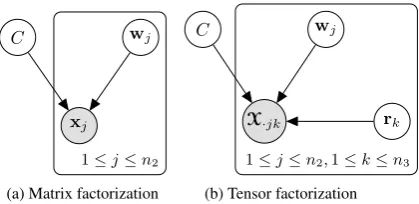
Figure 1: Comparison of the graphical model for matrix fac-torization (either PCA or EPCA) and 3-dimensional tensor factorization. Priors are omitted from the drawing.
similarity”). Note that rank(C>W)≤d, whereas
rank(X) ≤ min(n1, n2). Globally optimizing
equation (1) means finding thebestapproximation toXwith rank≤d(Eckart and Young, 1936), and can be done by SVD (Golub and Van Loan, 2012).
By rewriting equation (1) as (2), both Roweis (1997) and Tipping and Bishop (1999) observed that the optimal values ofCandW can be regarded as the maximum-likelihood parameter estimates for the Gaussian graphical model drawn in Figure 1a. This model supposes that the observed column vec-torxj equalsC>wj plus Gaussian noise,
specif-ically xj ∼ N(C>wj, I). Equation (2) is this
model’s negated log-likelihood (plus a constant).3
However, recall that in our application,xj is a
vector of observedcountsof the various contexts in which wordjappeared. Its elements are always non-negative integers—so as Hofmann (1999) saw, it is peculiar to model xj as having been drawn from a Gaussian. EPCA is a generalization of PCA, in which the observation xj can be drawn
according toany exponential-family distribution (log-linear distribution) over vectors.4The
canon-ical parameter vector for this distribution is given by thejthcolumn ofC>W, that is,C>wj.5
3The graphical model further suggests that thec
iandwj vectors are themselves drawn from some prior. Specifying this prior defines a MAP estimate ofCandW. If we take the prior to be a spherical Gaussian with mean0∈Rd, the MAP estimate corresponds to minimizing (2) plus anL2regularizer, that is, a multiple of||C||2
F+||W||2F. We do indeed regularize
in this way throughout all our experiments, tuning the multi-plier on a held-out development set. However, regularization has only minor effects with large training corpora, and is not in the originalword2vecimplementation of skip-gram.
4EPCA extends PCA in the same way that generalized
lin-ear models (GLMs) extend linlin-ear regression. The maximum-likelihood interpretation of linear regression supposes that the dependent variablexjis a linear functionCof the indepen-dent variablewjplus Gaussian noise. The GLM, like EPCA, is an extension that allows other exponential-family distribu-tions for the dependent variablexj. The difference is that in EPCA, the representationswjare learned jointly withC.
5In the general form of EPCA, that column is passed
through some “inverse link” function to obtain the expected feature values under the distribution, which in turn determines
EPCA allows us to suppose that each xj was
drawn from a multinomial—a more appropriate family for drawing a count vector. Our observa-tion is that skip-gram is precisely multinomial EPCA with the canonical link function (Mo-hamed, 2011), which generatesxj from a multino-mial with log-linear parameterization.That is, skip-gram chooses embeddingsC, W to maximize
X
j X
i
Xijlogp(contexti|wordj) (3)
=X
j X
i
XijlogPexp (ci·wj)
i0exp (ci0·wj) (4)
This is the log-likelihood (plus a constant) if we assume that for each word j, the context vec-tor xj was drawn from a multinomial with nat-ural parameter vectorC>w
j and count parameter
Nj = PiXij. This is the same model as in
Fig-ure 1a, but with a different conditional distribution forxj, and withxj taking an additional observed
parentNj (which is the token count of wordj).
2.1 Related work
Levy and Goldberg (2014b) also interpreted gram as matrix factorization. They argued that skip-gram estimationby negative sampling implicitly factorizes a shifted matrix of positive empirical pointwise mutual information values. We instead regard the skip-gram objective itself as demanding EPCA-style factorization of the count matrixX: i.e.,X arose stochastically from some unknown matrix of log-linear parameters (column j ofX generated from parameter columnj), and we seek a rank-destimateC>W ofthatmatrix.
pLSI (Hofmann, 1999) similarly factors an unknown matrix of multinomial probabilities, which is multinomial EPCA with the identity link function. In contrast, our unknown matrix holds linear parameters—arbitrarily shifted log-probabilities, not probabilities.
Our EPCA interpretation applies equally well to the component distributions that are used in hierar-chical softmax (Morin and Bengio, 2005), which is an alternative to negative sampling. Additionally, it yields avenues of future research using Bayesian (Mohamed et al., 2008) and maximum-margin (Sre-bro et al., 2004) extensions to EPCA.
3 Tensor Factorization
Having seen that skip-gram is a form of matrix factorization, we can generalize it to tensors. In contrast to the matrix case, there are several distinct definitions of tensor factorization (Kolda and Bader, 2009). We focus on the polyadic decomposition (Hitchcock, 1927), which yields a satisfying gen-eralization. The tensor analogue to PCA isrank-d
tensor approximation, which minimizes
||X−C 1⊗1W1⊗1R||2F
=X
ijk
(Xijk−1·(ciwjrk))2 (5)
=X
jk
X·jk−C>(wj rk) 2
(6)
Given a tensorX∈Rn1×n2×n3, this objective tries
to predict each entry as the three-way dot product of the columnsci,wj,rk ∈ Rd, thus finding an
approximation to Xthat factorizes into C, W, R. This polyadic decomposition of the approximating tensor can be viewed as a Tucker decomposition (Tucker, 1966) that enforces a diagonal core.
In our setting, the new matrixR ∈Rd×n3
em-beds types of context-wordrelations. The tensorX can be regarded as a collection ofn2n3count
vec-torsX·jk ∈Nn1: the fibers of the tensor, each of
which provides the context counts for some (word
j, relationk) pair. Typically, X·jk counts which
context wordsiare related to wordjby relationk. We now move from order PCA to third-order EPCA. Minimizing equation (6) corresponds to maximum-likelihood estimation of the graph-ical model in Figure 1b, in which each fiber of Xis viewed as being generated from a Gaussian all at once. Our higher-order skip-gram (HOSG) replaces this Gaussian with a multinomial. Thus, HOSG attempts to maximize the log-likelihood
X
ijk
Xijklogp(contexti|wordj,relationk) (7)
=X
ijk
XijklogPexp (1·(ciwjrk)) i0exp (1·(ci0wjrk)) (8)
Note that as before, we are taking the total count Njk =PiXijkto be observed. So while our
em-bedding matrices must predict which words are related to wordjby relationk, we are not proba-bilistically modeling how often wordjparticipates in relationkin the first place (nor how often word j occurs overall). A simple and natural move in
future would be to extend the generative model to predict these facts also fromwj andrk, although
this weakens the pedagogical connection to EPCA. We locally optimize the parameters of our prob-ability model—the word, context and relation embeddings—through stochastic gradient ascent on (7). Each stochastic gradient step computes the gradient of a single summandXijklogp(i| j, k).
Unfortunately, this requires summing overn1
con-texts in the denominator of (8), which is problem-atic asn1 is often very large, e.g.,107. Mikolov
et al. (2013) offer two speedup schemes: negative sampling and hierarchical softmax. Here we apply the negative sampling approximation to HOSG; hi-erarchical softmax is also applicable. See Goldberg and Levy (2014) for an in-depth discussion.
HOSG is a bit slower to train than skip-gram, sinceXyields up ton3times as many summands
asX(butn3 in practice, asXis often sparse).
4 Two Tensors for Word Embedding
As examples of useful tensors to factorize, we offer two third-order generalizations of Mikolov et al. (2013)’s context-word matrix. We are still predict-ing the distribution of contexts of a given word type. Our first versionincreases the number of param-eters (giving more expressivity) by conditioning on additional information. Our second version de-creases the number of parameters (giving better smoothing) by factoring the word type.
4.1 Positional Tensor
When predicting the context words in a window around a given word token, Mikolov et al. (2013) uses the same distribution to predict each of them. We propose to use different distributions at dif-ferent positions in the window, via a “positional tensor”: Xhdog,ran,-2i is the number of times the
context worddog was seen two positions to the left of ran. We will predict this count using p(dog|ran,-2), defined from the embeddings of the wordran, the position-2, and the context worddogand its competitors. For a 10-word win-dow, we haveX∈R|V|×|V|×10. Considering word
position should improve syntactic awareness.
4.2 Compositional Morphology Tensor
For Mikolov et al. (2013), related words such as
ranandrunningare monolithic objects that do
ar bg ca cs da de el en es et eu fa fi fo fr ga gl he hi SG .25 .22 .41 .20 .21 .49 .58 .44 .41 .09 .41 .39 .20 .32 .41 .22 .43 .31 .10
HOSG .40 .46 .45 .36 .50 .48 .61 .48 .42 .28 .46 .43 .39 .40 .40 .29 .46 .44 .40
∆ +.15 +.24 +.14 +.16 +.29 −.01 +.03 +.04 +.01 +.19 +.05 +.04 +.19 +.08 −.01 +.07 +.03 +.13 +.30
c= 2 hr hu id it kk la lv nl no pl pt ro ru sl sv ta tr ug vi SG .51 .36 .41 .45 .47 .42 .21 .42 .30 .43 .42 .28 .34 .13 .54 .60 .22 .53 .57
HOSG .53 .49 .43 .46 .43 .46 .38 .45 .47 .44 .42 .46 .33 .37 .51 .58 .41 .62 .60
∆ +.02 +.13 +.02 +.01 −.04 +.04 +.17 +.03 +.17 +.01 0.0 +.18 −.01 +.24 −.03 −.02 +.21 +.09 +.03
ar bg ca cs da de el en es et eu fa fi fo fr ga gl he hi SG .24 .41 .39 .29 .44 .45 .54 .52 .45 .40 .40 .38 .37 .33 .39 .53 .40 .38 .48
HOSG .29 .47 .42 .36 .49 .52 .60 .54 .48 .42 .45 .44 .43 .41 .42 .56 .45 .43 .51
∆ +.05 +.06 +.03 +.07 +.04 +.07 +.06 +.02 +.03 +.02 +.05 +.06 +.06 +.08 +.08 +.06 +.06 +.05 +.03
c= 5 hr hu id it kk la lv nl no pl pt ro ru sl sv ta tr ug vi SG .50 .46 .39 .42 .47 .43 .52 .43 .39 .41 .38 .38 .24 .40 .46 .59 .38 .57 .57
HOSG .53 .49 .44 .50 .40 .46 .54 .50 .44 .47 .44 .43 .34 .46 .52 .58 .43 .63 .61
[image:4.595.76.524.62.196.2]∆ +.03 +.03 +.05 +.08 −.07 +.03 +.02 +.07 +.06 +.06 +.06 +.05 +.10 +.06 +.05 −.01 +.06 +.06 +.04
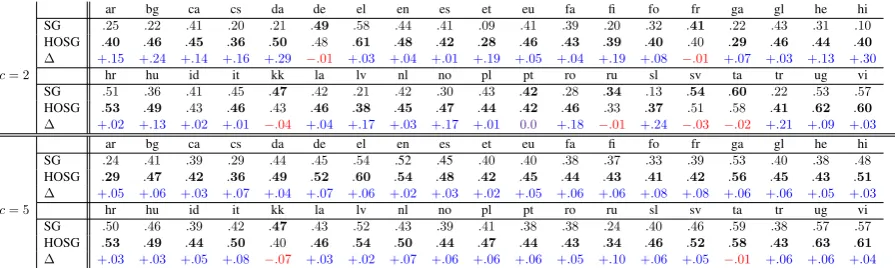
Table 1: The scores forQVEC-CCAfor 40 languages. All embeddings were trained on the complete Wikipedia dump of September 2016. We measure correlation with universal POS tags from the UD treebanks.
contextsiare still full words.6 Thus, we predict the
countXhdog,RUN,tiusingp(dog|RUN, t), wheret
is a morphological tag such as[pos=V,tense=PAST].
Our model is essentially a version of the skip-gram method (Mikolov et al., 2013) that parameter-izes the embedding of the wordranas a Hadamard productwjrk, wherewj embedsRUNandrk
em-beds tagt. This is similar to the work of Cotterell et al. (2016), who parameterized word embeddings as a sumwj+rkof embeddings of the component
morphemes.7 Our Hadamard product embedding
is in fact more general, since the additive embed-dingwj+rkcan be recovered as a special case—it
is equal to(wj;1)(1;rk), which uses twice as
many dimensions to embed each object.
5 Experiments
We build HOSG on top of theHYPERWORDS
pack-age. All models (both skip-gram and higher-order skip-gram) are trained for 10 epochs and use 5 negative samples. All models for§5.1 are trained on the Sept. 2016 dump of the full Wikipedia. All models for§5.2 were trained on the lemmatized and POS-tagged WaCky corpora (Baroni et al., 2009) for French, Italian, German and English (Joubarne and Inkpen, 2011; Leviant and Reichart, 2015). To ensure controlled and fair experiments, we follow Levy et al. (2015) for all preprocessing.
5.1 Experiment 1: Positional Tensor
We postulate that the positional tensor should en-code richer notions of syntax than standard bag-6If one wanted to extend the model to decompose the
context wordsias well, we see at least four approaches.
7Cotterell et al. (2016) made two further moves that could
be applied to extend the present paper. First, they allowed a word to consist of any number of (unordered) morphemes— not necessarily two—whose embeddings were combined (by summation) to get the word embedding. Second, this sum also included word-specific random noise, allowing them to learn word embeddings that deviated from compositionality.
of-words vectors. Why? Positional information allow us to differentiate between the geometry of the coocurrence, e.g.,theis found to the left of the noun it modifies and is—more often than—close to it. Our tensor factorization model explicitly en-codes this information during training.
To evaluate the vectors, we useQVEC(Tsvetkov
et al., 2016), which measures Pearson’s correla-tion between human-annotated judgements and the vectors using CCA. The QVEC metric will
be higher if the vectors better correlate with the human-annotated resource. To measure the syntac-tic content of the vectors, we compute the correla-tion between our learned vectorwifor each word
and its empirical distributiongiover universal POS
tags (Petrov et al., 2012) in the UD treebank (Nivre et al., 2016).gi can be regarded as a vector on the
(|T| −1)-dimensional simplex, whereTis the tag set. We report results on 40 languages from the UD treebanks in Table 1, using 4-word or 10-word sym-metric context windows (i.e.,c∈ {2,5}). We find that for 77.5% of the languages, our positional ten-sor embeddings outperform the standard skip-gram approach on theQVECmetric.
We highlight again that the positional tensor ex-ploitsnoadditional annotation, but better exploits the signal found in the raw text. Of course, our HOSG method could also be used to exploit anno-tations if available: e.g., one would get different embeddings by defining the relations of wordjto be the labeled syntactic dependency relations in which it participates (Lin and Pantel, 2001; Levy and Goldberg, 2014a).
5.2 Experiment 2: Morphology Tensor
con-fr it de en
353 353 SIML RG-65 353 SIML Z222 RG-65 353 MEN MTURK SIML SIMV RW
SG 48.31 43.63 21.33 44.90 28.39 50.39 29.75 70.60 64.50 64.33 58.77 41.62 30.48 40.78
HOSG 58.21 45.00 28.54 68.08 40.09 53.97 31.11 71.71 63.72 66.66 62.64 49.70 29.96 42.40
[image:5.595.75.526.62.119.2]∆ +9.90 +1.37 +7.21 +23.18 +11.7 +3.58 +1.36 +1.11 -0.78 +2.33 +3.87 +8.08 +0.52 +1.62
Table 2: Word similarity results comparing the compositional morphology tensor with the standard skip-gram model. Numbers indicate Spearman’s correlation coefficientρbetween human similarity judgements and the cosine distances of vectors. For each language, we compare on several sets of human judgments as listed by Faruqui et al. (2016, Table 2).
tribute signal to the embedding ofrun. We expect these lemma embeddings to be predictive of human judgments of lemma similarity.
We evaluate using standard datasets on four languages (French, Italian, German and English). Given a list of pairs of words (always lemmata), multiple native speakers judged (on a scale of 1– 10) how “similar” those words are conceptually. Our model produces a similarity judgment for each pair using the cosine similarity of their lemma em-beddingswj. Table 2 shows how well this learned judgment correlates with the average human judg-ment. Our model does achieve higher correlation than skip-gram word embeddings. Note we did not compare to a baseline that simply embeds lemmas rather than words (equivalent to fixingrk=1).
6 Related Work
Tensor factorization has already found uses in a few corners of NLP research. Van de Cruys et al. (2013) applied tensor factorization to model the composi-tionality of subject-verb-object triples. Similarly, Hashimoto and Tsuruoka (2015) use an implicit tensor factorization method to learn embeddings for transitive verb phrases. Tensor factorization also appears in semantic-based NLP tasks. Lei et al. (2015) explicitly factorize a tensor based on feature vectors for predicting semantic roles. Chang et al. (2014) use tensor factorization to create knowledge base embeddings optimized for relation extraction. See Bouchard et al. (2015) for a large bibliography. Other researchers have likewise attempted to es-cape the bag-of-words assumption in word embed-dings, e.g., Yatbaz et al. (2012) incorporates mor-phological and orthographic features into continu-ous vectors; Cotterell and Sch¨utze (2015) consider a multi-task set-up to force morphological informa-tion into embeddings; Cotterell and Sch¨utze (2017) jointly morphologically segment and embed words; Levy and Goldberg (2014a) derive contexts based on dependency relations; PPDB (Ganitkevitch et al., 2013) employs a mixed bag of words, parts of speech, and syntax; Rastogi et al. (2015) represent word contexts, morphology, semantic frame
rela-tions, syntactic dependency relarela-tions, and multi-lingual bitext counts each as separate matrices, combined via GCCA; and, finally, Schwartz et al. (2016) derived embeddings based on Hearst patterns (Hearst, 1992). Ling et al. (2015) learn position-specific word embeddings (§4.1), but do not factor them aswjrkto share parameters (we
did not compare empirically to this). As demon-strated in the experiments, our tensor factorization method enables us to include other syntactic proper-ties besides word order, e.g. morphology. Poliak et al. (2017) also create positional word embeddings. Our research direction is orthogonal to these efforts in that we provide a general purpose procedure for all sorts of higher-order coocurrence.
7 Conclusion
We have presented an interpretation of the skip-gram model as exponential family principal com-ponents analysis—a form of matrix factorization— and, thus, related it to an older strain of work. Building on this connection, we generalized the model to the tensor case. Such higher-order skip-gram methods can incorporate more linguistic structure without sacrificing scalability, as we il-lustrated by making our embeddings consider word order or morphology. These methods achieved better word embeddings as evaluated by standard metrics on 40 languages.
Acknowledgements
References
Marco Baroni, Silvia Bernardini, Adriano Ferraresi, and Eros Zanchetta. 2009. The WaCky wide web: a collection of very large linguistically processed web-crawled corpora. Language resources and evalua-tion, 43(3):209–226.
Guillaume Bouchard, Jason Naradowsky, Sebastian Riedel, Tim Rockt¨aschel, and Andreas Vlachos. 2015. Matrix and tensor factorization methods for natural language processing. InTutorials, pages 16– 18, Beijing, China, July. Association for Computa-tional Linguistics.
Kai-Wei Chang, Wen-tau Yih, Bishan Yang, and Christopher Meek. 2014. Typed tensor decompo-sition of knowledge bases for relation extraction. In Proceedings of the 2014 Conference on Empirical Methods in Natural Language Processing (EMNLP), pages 1568–1579, Doha, Qatar, October. Associa-tion for ComputaAssocia-tional Linguistics.
Michael Collins, Sanjoy Dasgupta, and Robert E. Schapire. 2001. A generalization of principal com-ponents analysis to the exponential family. In Ad-vances in Neural Information Processing Systems 14, pages 617–624.
Ryan Cotterell and Hinrich Sch¨utze. 2015. Morpho-logical word-embeddings. In Proceedings of the 2015 Conference of the North American Chapter of the Association for Computational Linguistics: Human Language Technologies, pages 1287–1292, Denver, Colorado, May–June. Association for Com-putational Linguistics.
Ryan Cotterell and Hinrich Sch¨utze. 2017. Joint se-mantic synthesis and morphological analysis of the derived word. CoRR, abs/1701.00946.
Ryan Cotterell, Hinrich Sch¨utze, and Jason Eisner. 2016. Morphological smoothing and extrapolation of word embeddings. In Proceedings of the 54th Annual Meeting of the Association for Computa-tional Linguistics (Volume 1: Long Papers), pages 1651–1660, Berlin, Germany, August. Association for Computational Linguistics.
Carl Eckart and Gale Young. 1936. The approximation of one matrix by another of lower rank. Psychome-trika, 1(3):211–218.
Manaal Faruqui, Yulia Tsvetkov, Pushpendre Rastogi, and Chris Dyer. 2016. Problems with evaluation of word embeddings using word similarity tasks.arXiv preprint arXiv:1605.02276.
Juri Ganitkevitch, Benjamin Van Durme, and Chris Callison-Burch. 2013. PPDB: The paraphrase database. InProceedings of the 2013 Conference of the North American Chapter of the Association for Computational Linguistics: Human Language Tech-nologies, pages 758–764, Atlanta, Georgia, June. Association for Computational Linguistics.
Yoav Goldberg and Omer Levy. 2014. word2vec explained: deriving Mikolov et al.’s negative-sampling word-embedding method. arXiv preprint arXiv:1402.3722.
Gene H. Golub and Charles F. Van Loan. 2012. Matrix Computations, volume 3. JHU Press.
Kazuma Hashimoto and Yoshimasa Tsuruoka. 2015. Learning embeddings for transitive verb disambigua-tion by implicit tensor factorizadisambigua-tion. InProceedings of the 3rd Workshop on Continuous Vector Space Models and their Compositionality.
Marti A. Hearst. 1992. Automatic acquisition of hy-ponyms from large text corpora. InProceedings of the 14th conference on Computational linguistics-Volume 2, pages 539–545. Association for Compu-tational Linguistics.
Frank L. Hitchcock. 1927. The expression of a ten-sor or a polyadic as a sum of products. Journal of Mathematics and Physics, 6(1):164–189.
Thomas Hofmann. 1999. Probabilistic latent seman-tic analysis. InUncertainty in Artificial Intelligence, pages 289–296.
Colette Joubarne and Diana Inkpen. 2011. Compar-ison of semantic similarity for different languages using the Google n-gram corpus and second-order co-occurrence measures. In Canadian Conference on Artificial Intelligence, pages 216–221. Springer. Tamara Kolda and Brett Bader. 2009. Tensor
decompo-sitions and applications. Society for Industrial and Applied Mathematics, 51(3):455–500.
Tao Lei, Yuan Zhang, Llu´ıs M`arquez, Alessandro Mos-chitti, and Regina Barzilay. 2015. High-order low-rank tensors for semantic role labeling. In Proceed-ings of the 2015 Conference of the North Ameri-can Chapter of the Association for Computational Linguistics: Human Language Technologies, pages 1150–1160, Denver, Colorado, May–June. Associa-tion for ComputaAssocia-tional Linguistics.
Ira Leviant and Roi Reichart. 2015. Separated by an un-common language: Towards judgment language informed vector space modeling. arXiv.
Omer Levy and Yoav Goldberg. 2014a. Dependency-based word embeddings. In Proceedings of the 52nd Annual Meeting of the Association for Compu-tational Linguistics (Volume 2: Short Papers), pages 302–308, Baltimore, Maryland, June. Association for Computational Linguistics.
Omer Levy and Yoav Goldberg. 2014b. Neural word embedding as implicit matrix factorization. In Ad-vances in Neural Information Processing Systems 27, pages 2177–2185.
Dekang Lin and Patrick Pantel. 2001. Dirt @sbt@discovery of inference rules from text. In Proceedings of the Seventh ACM SIGKDD Inter-national Conference on Knowledge Discovery and Data Mining, KDD ’01, pages 323–328, New York, NY, USA. ACM.
Wang Ling, Chris Dyer, Alan W. Black, and Isabel Trancoso. 2015. Two/too simple adaptations of word2vec for syntax problems. InProceedings of the 2015 Conference of the North American Chap-ter of the Association for Computational Linguistics: Human Language Technologies, pages 1299–1304, Denver, Colorado, May–June. Association for Com-putational Linguistics.
Tomas Mikolov, Kai Chen, Greg Corrado, and Jeffrey Dean. 2013. Efficient estimation of word represen-tations in vector space.CoRR, abs/1301.3781. Shakir Mohamed, Katherine A. Heller, and Zoubin
Ghahramani. 2008. Bayesian exponential family PCA. InAdvances in Neural Information Process-ing Systems 21, pages 1089–1096.
Shakir Mohamed. 2011. Generalised Bayesian Ma-trix Factorisation Models. Ph.D. thesis, University of Cambridge.
Frederic Morin and Yoshua Bengio. 2005. Hierarchi-cal probabilistic neural network language model. In Artificial Intelligence and Statistics Conference. Joakim Nivre, Marie-Catherine de Marneffe, Filip
Gin-ter, Yoav Goldberg, Jan Hajic, Christopher D. Man-ning, Ryan McDonald, Slav Petrov, Sampo Pyysalo, Natalia Silveira, et al. 2016. Universal depen-dencies v1: A multilingual treebank collection. In LREC.
Karl Pearson. 1901. On lines and planes of closest fit to systems of points in space. Philosophical Maga-zine, 6(2):559–572.
Jeffrey Pennington, Richard Socher, and Christo-pher D. Manning. 2014. Glove: Global vec-tors for word representation. In Proceedings of the 2014 Conference on Empirical Methods in Nat-ural Language Processing (EMNLP), pages 1532– 1543, Doha, Qatar, October. Association for Compu-tational Linguistics.
Slav Petrov, Dipanjan Das, and Ryan McDonald. 2012. A universal part-of-speech tagset. In Nico-letta Calzolari, Khalid Choukri, Thierry Declerck, Mehmet U˘gur Do˘gan, Bente Maegaard, Joseph Mar-iani, Jan Odijk, and Stelios Piperidis, editors, Pro-ceedings of the Eighth International Conference on Language Resources and Evaluation (LREC-2012), pages 2089–2096, Istanbul, Turkey, May. European Language Resources Association (ELRA). ACL An-thology Identifier: L12-1115.
Adam Poliak, Pushpendre Rastogi, Michael Patrick Martin, and Benjamin Van Durme. 2017. Efficient, compositional, order-sensitive n-gram embeddings.
InProceedings of the 15th Conference of the Euro-pean Chapter of the Association for Computational Linguistics.
Pushpendre Rastogi, Benjamin Van Durme, and Ra-man Arora. 2015. Multiview LSA: Representation learning via generalized CCA. InProceedings of the 2015 Conference of the North American Chapter of the Association for Computational Linguistics: Hu-man Language Technologies, pages 556–566, Den-ver, Colorado, May–June. Association for Computa-tional Linguistics.
Sam T. Roweis. 1997. EM algorithms for PCA and SPCA. InAdvances in Neural Information Process-ing Systems 10, pages 626–632.
Roy Schwartz, Roi Reichart, and Ari Rappoport. 2016. Symmetric patterns and coordinations: Fast and en-hanced representations of verbs and adjectives. In Proceedings of the 2016 Conference of the North American Chapter of the Association for Computa-tional Linguistics: Human Language Technologies, pages 499–505, San Diego, California, June. Asso-ciation for Computational Linguistics.
Ajit Paul Singh and Geoffrey J. Gordon. 2008. A unified view of matrix factorization models. In Joint European Conference on Machine Learning and Knowledge Discovery in Databases, pages 358– 373.
Nathan Srebro, Jason D. M. Rennie, and Tommi S. Jaakkola. 2004. Maximum-margin matrix factoriza-tion. InAdvances in Neural Information Processing Systems 17, pages 1329–1336.
Michael Tipping and Christopher Bishop. 1999. Prob-abilistic principal component analysis. Journal of the Royal Statistical Society: Series B (Statistical Methodology), 61(3):611–622.
Yulia Tsvetkov, Manaal Faruqui, and Chris Dyer. 2016. Correlation-based intrinsic evaluation of word vec-tor representations. InRepEval.
Ledyard R. Tucker. 1966. Some mathematical notes on three-mode factor analysis. Psychometrika, 31:279–311.
Tim Van de Cruys, Thierry Poibeau, and Anna Korho-nen. 2013. A tensor-based factorization model of semantic compositionality. In Proceedings of the 2013 Conference of the North American Chapter of the Association for Computational Linguistics: Hu-man Language Technologies, pages 1142–1151, At-lanta, Georgia, June. Association for Computational Linguistics.