Review Article
Evaluation of all-ceramic and metal-ceramic fixed
dental prostheses: a meta-analysis of
randomized controlled trials
Shanchuan Zhang, Penghua Ma, Guanchao Wang, Qiang Sun, Lili Tian, Lili Ma, Baohua Xu Center of Stomatology, China-Japan Friendship Hospital, Beijing, China
Received September 23, 2016; Accepted October 29, 2016; Epub January 15, 2017; Published January 30, 2017
Abstract: To systematically review the randomized controlled trials (RCTs) and compare the survival rates and com-plications of all-ceramic fixed dental prostheses (FDPs) with those of metal-ceramic FDPs. Eligible studies were retrieved in relevant electronic databases from their inception to June 8th, 2016. Then, quality of the included
stud-ies was assessed using Cochrane Collaboration’s tool. Heterogeneity across the studstud-ies was determined based on Cochrane Q and I2 statistic. Risk ratios (RR) and its 95% confidence intervals (CIs) were used as a measure of
effect size to pool outcomes. A total of 7 RCTs with 350 participants (178 applied all-ceramic FDPs and 172 applied metal-ceramic FDPs) were included in this study. The low risk bias of all included studies suggested high qualities. As a result, all-ceramic FDPs showed a comparable survival rate and copings fracture frequency with those of metal-ceramic FDPs. Although without significance (P > 0.05), all-ceramic FDPs had higher occurrences of crowns replacement (RR = 3.20, 95% CI, 0.54 to 18.97), veneering ceramic chipping (RR = 1.87, 95% CI, 0.94 to 3.72) and rough surface (RR = 3.33, 95% CI, 0.98 to 11.35) than metal-ceramic FDPs. It is suggested that all-ceramic FDPs have similar high survival rate and low copings fracture frequency as metal-ceramic FDPs. However, occurrences of other complications, ceramic veneer chipping fractures, crown replacement and rough surface, might be higher in all-ceramic FDPs than metal-ceramic. The alternative use of all-ceramic FDPs should be cautious. More RCTs with large samples are needed to confirm these findings.
Keywords: Fixed dental prostheses, all-ceramic, metal-ceramic, survival, complication, meta-analysis
Introduction
All-ceramic fixed dental prostheses (FDPs) have become popular in recent years because of the increasing demand of esthetics and metal-free materials. In addition, the good biocompatibili-ty makes all-ceramic crowns successfully used in the anterior and posterior segments [1-4]. Although all-ceramic systems have poor mechanical properties compared with metal-ceramic FDPs, several all-metal-ceramic FDPs such as zirconia-based FDP belong to the high-strength ceramic materials. Reportedly, all-ceramic FDPs have the same long-lasting resto -rations like metal-ceramics [5-7]. Moreover, zirconia-based FDPs have relatively high sur -vival rate (more than 90%, even 100%) after the follow-up time of more than three years [8-11]. Therefore, all-ceramic FDPs have been proposed as alternatives for metal-ceramic
FDPs. However, other studies hold the opposite opinion that all-ceramic FDPs have the limita -tions. For instance, when applying zirconia-based FDPs, frequency of veneering porcelain chipping might be high and zirconia might be degraded under moist oral environment, which might cause decreased effects [12, 13].
meta-analysis showed that all-ceramic FDPs had a significantly lower 5-year survival rate, but higher frequencies of material fractures than metal-ceramic FDPs. Meanwhile, other techni -cal complications such as loss of retention and biological complications were comparable between the two restorations [15]. Though this meta-analysis applied strict inclusions and assessed multiple outcomes, the included 9 studies were non-randomized controlled trials (RCTs). Additionally, the average follow-up time in the two different methods were quite differ-ent (all-ceramic FDP: 3.8 year; metal-ceramic FDP: 8 year), and the authors assumed that annual event rate was constant throughout the follow up time. This might cause bias of the results. Moreover, it was published newly ten years ago, and data needs to be updated. More recently, a meta-analysis includes 40 studies published from 2007 to 2013 to evalu-ate the 5-year survival revalu-ate and incidence of biological, technical and esthetic complica-tions of all-ceramic tooth-supported FDPs, compared with meta-ceramic FDPs [16]. However, like Sailer’s study, one major limita-tion is the assumplimita-tion of the constant annual event rate for all-ceramic FDPs. In addition, only four of the included studies were RCTs and the remaining were prospective and retro-spective cohort studies or case series. Moreover, outcomes of copings fracture, crowns replacement rate and rough surface were not assessed.
ledge Infrastructure (CNKI, http://www.cnki. net/) up to June 8th, 2016, without language
restriction. The search terms were “ceramics” or “ceramic” and “fixed partial dentures” or “fixed dental prostheses” and “test” or “com -parison” or “compare”. In order to obtain more relevant studies, manual search was carried out for articles in paper edition, and the bibliog-raphies of relevant studies were also scanned.
Inclusion and exclusion criteria
The following studies were included: (1) they were RCTs; (2) the study objects were patients who received FDPs; (3) the study compared outcomes between all-ceramic FDPs and met -al-ceramic FDPs; (4) the study involved out -comes as survival rate, rough surface, copings fractured, chipping of the veneering ceramic and crowns replacement rate.
The following studies were excluded: (1) non-RCTs; (2) the study provided incomplete data or unanalyzable outcomes; (3) the studies were reviews, letters and reports.
Data extraction and quality assessment
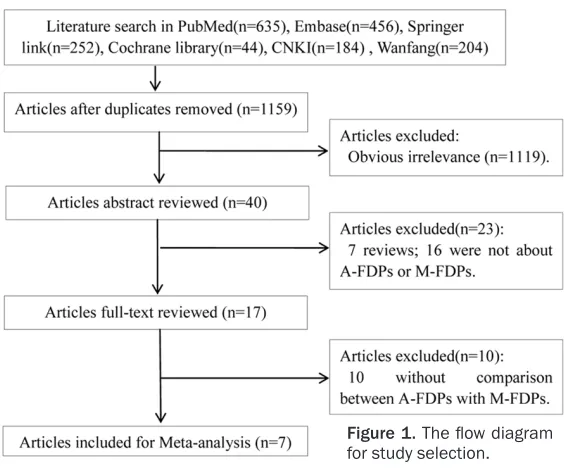
[image:2.612.91.373.70.304.2]After the eligible studies were selected, two investigators independently extracted the re- quired data using a predefined standard form. The following information was extracted: first author name, publication year, gender, sample sizes in each group (all-ceramic FDPs and Figure 1. The flow diagram
for study selection.
Therefore, we performed this meta-analysis, and more im- portantly, included only RCTs, to comprehensively evaluate the survival rate, copings frac-ture, chipping of the veneering ceramic, crowns replacement rate and rough surface of all-ceramic FDPs, by the compari -son with meta-ceramic FDPs. Methods
Search strategy
Table 1. Characteristics of 7 included studies
Study Year Area Type of FDPs Follow-up N (M/F), age No. of FDPs Outcomes*
metal-ceramic FDPs), follow-up time and out-comes. Discrepancies were resolved by dis -cussing with the third investigator.
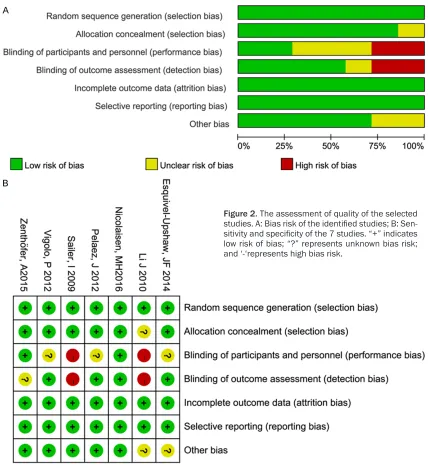
Quality of the included studies was assessed using Cochrane Collaboration’s tool [17], which contains 7 items to assess the quality: Random sequence generation, Allocation concealment, Blinding of participants and personnel, Blinding of outcome assessment, incomplete outcome data, Selective reporting and other bias.
Statistical analysis
Risk ratios (RR) and its 95% confidence interval (CI) were used as a measure of effect size.
Heterogeneity across the included studies was evaluated by Cochrane Q-statistic and I2
statis-tic (18). P < 0.05 and/or I2 > 50% indicated a
significant heterogeneity, and thus a random-effects model was used to pool the effect size. In contrast, a fixed-effects model was applied if there lacked significant heterogeneity (P ≥ 0.05 and/or I2 ≤ 50%). Publication bias was detected
[image:4.612.92.520.69.541.2]via funnel plots. Sensitive analysis was con-ducted by omitting one study at one time, to observe whether a reverse RR would be gener-ated. If a reverse result was observed, it indi-cated that the result was unstable. All statisti-cal analyses were performed using the RevMan 5.3 software.
Results Eligible studies
The flow diagram of study selection was shown in Figure 1. As a result, a total of 1,775 articles were obtained after preliminary screening (PubMed: 635, Embase: 456, Springer link: 252, Cochrane library: 44, CNKI: 184, Wanfang: 204). The duplications (616) were eliminated, and 1,119 irrelevant studies were excluded by browsing the title and abstract. In the remain-ing 40 studies, 23 were removed after abstract reading, and 10 were further eliminated after full-text reading. As no additional studies were screened out by manual search, finally, 7 RCTs [19-25] were included in this meta-analysis.
Characteristics of the included studies
As summarized in Table 1, the 7 RCTs were consisted of 350 participants (178 applied all-ceramic FDPs and 172 applied metal-all-ceramic FDPs). These studies were published from 2009 to 2016, and their follow-up times were all above two years, with the longest follow-up time of 50 months (4.2 years). Two studies [20, 25] focused the single-unit posterior FDPs, while the remaining five mainly involved 3-unit posterior FDPs.
The result of quality assessment was shown in
Figure 2. Risk of each bias item was relatively
low, except for performance bias and detection bias. This suggested that quality of the includ-ed studies were relatively high.
Outcomes
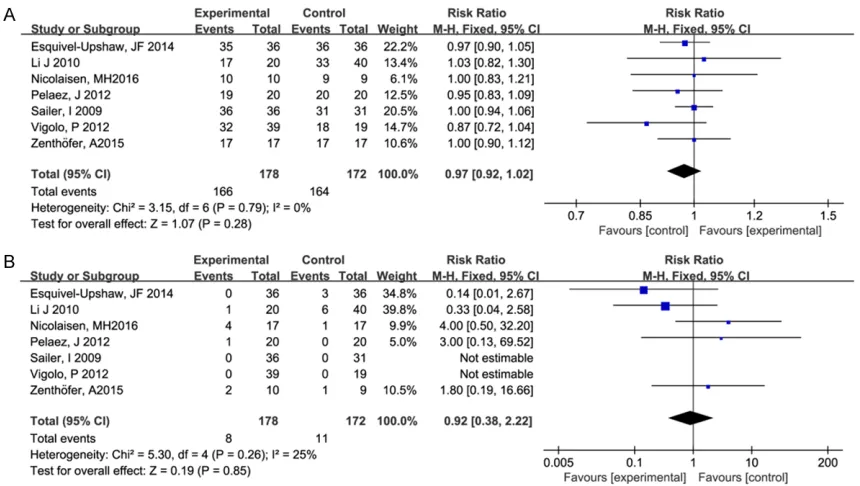
The seven studies all reported the outcomes of survival rate and copings fracture. The fixed-effects model was used because no significant heterogeneity was detected (survival rate: I2 =
0.0%, P = 0.79; copings fracture: I2 = 25%, P =
0.26). The results showed that no significant differences were observed between all-ceram-ic and metal-ceramall-ceram-ic FDPs on survival rate (RR = 0.97, 95% CI, 0.91 to 1.02, P = 0.28, Figure 3A) and copings fracture (RR = 0.92, 95% CI, 0.38 to 2.22, P = 0.85, Figure 3B).
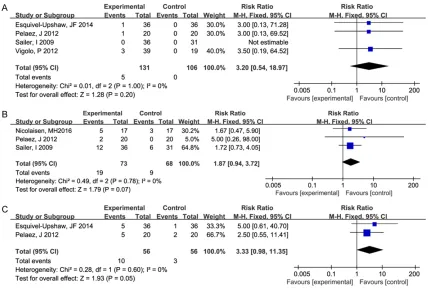
Four studies examined the outcome of crowns replacement rate, and a fixed-effects model was applied (heterogeneity: I2 = 0.0%, P =
1.00). All-ceramic FDPs showed a higher crow-ns replacement rate than metal-ceramic, how- ever without statistical significance (RR = 3.20, 95% CI, 0.54 to 18.97, P = 0.20, Figure 4A). Three studies covered chipping of the veneer-ing ceramic under a fixed-effects model (het -erogeneity: I2 = 0.0%, P = 0.78). Although
[image:5.612.92.522.62.305.2]all-ceramic FDPs showed a higher frequency of chipping of the veneering ceramic, the differ-ence was not significant (RR = 1.87, 95% CI, 0.94 to 3.72, P = 0.07, Figure 4B).
Two studies reported the rough surface using a fixed-effects model (heterogeneity: I2 = 0.0%, P
= 0.60). All-ceramic FDPs showed a higher rough surface than meta-ceramic, however without significant difference (RR = 3.33, 95% CI, 0.98 to 11.35, P = 0.05, Figure 4C).
Discussion
[image:6.612.91.519.72.360.2]In this study, we included 7 RCTs with 178 all-ceramic FDP cases and 172 metal-all-ceramic FDP cases. As a result, we found that all-ceram -ic FDPs showed a comparable effect with meta-Figure 4. Forest plot of frequencies of ceramic veneer chipping, rough surface and rate of crown replacement in the comparison of all-ceramic fixed dental prostheses (FDPs) and with metal-ceramic FDP. A: Ceramic veneer chipping; B: Rate of crown replacement; C: Rough surface.
Figure 5. Funnel plot of the included studies.
Publication bias
As reflected in the funnel plot (Figure 5), there was not sig-nificant publication bias amo-ng studies reportiamo-ng survival rate, suggesting a reliable result. With regard to other outcomes, as number of the included studies was small, publication bias was not examined.
Sensitive analysis
[image:6.612.91.384.425.614.2]ceramic FDPs on outcomes such as survival rate and copings fracture. On the other hand, the rate of crowns replacement, frequencies of veneering ceramic chipping and rough surface were higher when applied all-ceramic FDPs than meta-ceramic FDPs, however without sta -tistical significance.
The definition of survival of FDPs is that FDPs remains in situ with or without modifications during the entire observation period. Zirconia-based FDPs always have a relatively high sur -vival rate due to the property of high-strength ceramic material [26]. In our study, zirconia-ceramic FDPs were the only all-zirconia-ceramic FDPs material. Therefore, it is understandable that all-ceramic FDPs had a similar survival rate to metal-ceramic FDPs in our present study. In Pjetursson’s meta-analysis, different with our finding, they claim that all-ceramic FDPs achi-eve a lower survival rate than metal-ceramic, although without significance [16]. The reason might be that in their study, different all-ceram-ic materials were taken into consideration, such as glass ceramic FDPs, glass-infiltrated alumina FDPs and the densely sintered zirconia FDPs, and the former two belong to the low-strength materials. Especially, survival rate of glass-infiltrated alumina FDPs was 86.2%. Importantly, we should note that various stud-ies have shown that the 5-, 10-, 15- and 20-year survival of metal-ceramic FDPs were 95% [27], 90% [28], 85% [5], and 41%-73% [29], respec-tively. In contrast, all-ceramic FDPs have lower survival rates than metal-ceramic FDPs [15]. Therefore, in order to obtain more precise sur-vival rates, all-ceramic FDPs need to achieve longer follow-up time, similar to metal-ceramic FDPs.
The tough and strong material properties of zir-conia make it have superior fracture resistance, thus coping fractures are infrequent in zirconia-based ceramic FDPs [30]. It is reported that fracture toughness values of zirconia copings are much higher compared with other all-ceramic core materials [31]. In our study, as zirconia-based FDPs were the only all-ceramic FDP material, it is reasonable that all-ceramic FDP obtained a comparable copings fracture with metal-ceramic FDP in our meta-analysis.
As all-ceramic FDPs are latterly developed res -torations, more clinical studies focus on asse-
ssment of the failure for veneered zirconia FDPs [2, 32, 33]. Actually, incidence of the ceramic veneer chipping fractures of metal-ceramic FDPs was 6%, based on retrospective data [34]. Aging or low-temperature degrada-tion is the most focused ceramic veneer phe-nomena that might be associated with ceramic veneer chipping. The degradation of zirconia-based material’s mechanical properties is high-ly related to zirconium dioxide’s hydrothermal transformation from tetragonal to monoclinic phase. Zirconia has the property of low thermal conductivity; however the surface treatment of zirconium dioxide by abrasion could make a local temperature rise which will trigger the phase transformation [35]. Another study also indicates that the abrasions exhibited in the affected patients are the clinical reasons for the major chipping of the ceramic veneer, and its frequent occurrence could reduce the suc-cess rate of zirconia-based FDPs [11]. This might be the reasonable explanation for the slightly higher frequency of ceramic veneer chipping in all-ceramic FDP than in metal-ceramic one in our study. The lack of signifi -cance might be due to that only three RCTs with small sample size were included in the meta-analysis.
It is demonstrated that several technical prob-lems, such as the veneering ceramic fracture, are more frequent in zirconia-based FDPs res -toration [20]. Because of this reason, numbers of crowns that need to be replaced are higher than metal-ceramic FDPs. In addition, survival rate of all-ceramic implant-supported single crowns is relatively lower than meta-ceramic ones (92.2% vs. 95.4%) [36]. Consistent with this finding, although without significance, our pooled result suggested that all-ceramic FDP had a higher rate of crown replacement. Likewise, the small number of the included RCTs might be the causative factors for the lack of significance.
In our meta-analysis, all of the included studies were RCTs with high quality, and the original studies have quite precise design and reliable methodology. Additionally, all-ceramic and met-al-ceramic FDPs from each study were operat -ed by the same dentist, which avoid the bias caused by different operation methods. More- over, there lacked significant heterogeneity across all the included studies regarding to each outcome. Despite these obvious advan -tages, this meta-analysis also had several limi-tations. First, the sample size of the included studies was relatively small. Although the qual-ity of all included studies were high, more RCTs with larger samples are needed to verify our results. Second, follow-up time of the included studies was short, and we speculate that differ-ences between all-ceramic and metal-ceramic FDPs might be significant when a longer follow-up time was applied. Third, due to the limited number of the included RCTs, we did not per-form a subgroup analysis to evaluate the out-comes of different metal frameworks.
In conclusion, all-ceramic FDPs had a similar survival rate and frequency of coping fracture as metal-ceramic FDPs. However, occurrences of other complications, such as ceramic veneer chipping fractures, crown replacement and rough surface, might be higher in all-ceramic FDPs than metal-ceramic. The alternative use of all-ceramic FDPs should be cautious. Nevertheless, more RCTs with large samples and longer follow-up time period are required to confirm these findings.
Disclosure of conflict of interest
None.
Address correspondence to: Dr. Baohua Xu,Center of Stomatology, China-Japan Friendship Hospital, Beijing 100029, China. Tel: +86 10 84205121; Fax: +86 10 84205121; E-mail: baohuaxu3996@163. com
References
[1] Wolfart S, Eschbach S, Scherrer S and Kern M. Clinical outcome of three-unit lithium-disilicate glass-ceramic fixed dental prostheses: Up to 8 years results. Dent Mater 2009; 25: e63-e71. [2] Beuer F, Edelhoff D, Gernet W and Sorensen
JA. Three-year clinical prospective evaluation of zirconia-based posterior fixed dental pros
-theses (FDPs). Clin Oral Investig 2009; 13: 445-451.
[3] Harder S, Wolfart S, Eschbach S and Kern M. Eight-year outcome of posterior inlay-retained all-ceramic fixed dental prostheses. J Dent 2010; 38: 875-881.
[4] Kern M and Sasse M. Ten-year survival of ante-rior all-ceramic resin-bonded fixed dental pros -theses. J Adhes Dent 2011; 13: 407-410. [5] Walton TR. An up to 15-year longitudinal study
of 515 metal-ceramic FPDs: Part 1. Outcome. Int J Prosthodont 2001; 15: 439-445.
[6] Eliasson A, Arnelund CF and Johansson A. A clinical evaluation of cobalt-chromium metal-ceramic fixed partial dentures and crowns: a three-to seven-year retrospective study. J Prosthet Dent 2007; 98: 6-16.
[7] Napankangas R and Raustia A. An 18-year ret-rospective analysis of treatment outcomes with metal-ceramic fixed partial dentures. Int J Prosthodont 2010; 24: 314-319.
[8] Raigrodski AJ, Chiche GJ, Potiket N, Hochstedler JL, Mohamed SE, Billiot S, Mercante DE. The efficacy of posterior three-unit zirconium-oxide-based ceramic fixed partial dental prostheses: A prospective clinical pilot study. J Prosthet Dent 2006; 96: 237-244.
[9] Molin MK and Karlsson SL. Five-year clinical prospective evaluation of zirconia-based Denzir 3-unit FPDs. Int J Prosthodont 2007; 21: 223-227.
[10] Tinschert J, Schulze KA, Natt G, Latzke P, Heussen N and Spiekermann H. Clinical be-havior of zirconia-based fixed partial dentures made of DC-Zirkon: 3-year results. Int J Prosthodont 2007; 21: 217-222.
[11] Schmitt J, Holst S, Wichmann M, Reich S, Göllner M and Hamel J. Zirconia posterior fixed partial dentures: a prospective clinical 3-year follow-up. Int J Prosthodont 2009; 22: 597. [12] Örtorp A, Kihl ML and Carlsson GE. A 3-year
retrospective and clinical follow-up study of zir-conia single crowns performed in a private practice. J Dentist 2009; 37: 731-736.
[13] Swain M. Unstable cracking (chipping) of ve-neering porcelain on all-ceramic dental crowns and fixed partial dentures. Acta Biomaterialia 2009; 5: 1668-1677.
[14] Raigrodski AJ, Hillstead MB, Meng GK and Chung KH. Survival and complications of zirco-nia-based fixed dental prostheses: a system -atic review. J Prosthet Dent 2012; 107: 170-177.
[16] Pjetursson BE, Sailer I, Makarov NA, Zwahlen M and Thoma DS. All-ceramic or metal-cera-mic tooth-supported fixed dental prostheses (FDPs)? A systematic review of the survival and complication rates. Part II: Multiple-unit FDPs. Dent Mater 2015; 31: 624-639.
[17] Higgins JP, Green S; Collaboration C. Cochrane handbook for systematic reviews of interven-tions. Wiley Online Library 2008.
[18] Higgins JP, Thompson SG, Deeks JJ and Altman
DG. Measuring inconsistency in meta-analy -ses. BMJ 2003; 327: 557-560.
[19] Esquivel-Upshaw JF, Clark AE, Shuster JJ and
Anusavice KJ. Randomized clinical trial of im-plant-supported ceramic-ceramic and metal-ceramic fixed dental prostheses: preliminary results. J Prosthodont 2014; 23: 73-82. [20] Vigolo P and Mutinelli S. Evaluation of
zirconi-um-oxide-based ceramic single-unit posterior fixed dental prostheses (FDPs) generated with two CAD/CAM systems compared to porcelain-fused-to-metal single-unit posterior FDPs: a 5-year clinical prospective study. J Prosthodont 2012; 21: 265-269.
[21] Pelaez J, Cogolludo PG, Serrano B, Serrano JF and Suarez MJ. A four-year prospective clinical evaluation of zirconia and metal-ceramic pos-terior fixed dental prostheses. Int J Prosthodont 2012; 25: 451-458.
[22] Sailer I, Gottnerb J, Kanelb S and Hammerle CH. Randomized controlled clinical trial of zir-conia-ceramic and metal-ceramic posterior fixed dental prostheses: a 3-year follow-up. Int J Prosthodont 2009; 22: 553-560.
[23] Li J, Gong ZJ, Chen GP and Jiang SQ. 3.0-3.5 year comparison of all-ceramic bridges made by chari-side computer aided design and com-puter aided manufacture system with glod al-loy and Ni-Cr alal-loy ceramic bridges. Stomatology 2010; 9: 544-546.
[24] Nicolaisen M, Bahrami G, Schropp L and Isidor F. Comparison of metal-ceramic and all-ceram -ic three-unit posterior fixed dental prostheses: a 3-Year randomized clinical trial. Int J Prosthodont 2015; 29: 259-264.
[25] Zenthöfer A, Ohlmann B, Rammelsberg P and Bömicke W. Performance of zirconia ceramic cantilever fixed dental prostheses: 3-year re -sults from a prospective, randomized, con-trolled pilot study. J Prosthet Dent 2015; 114: 34-39.
[26] Beuer F, Naumann M, Gernet W and Sorensen
JA. Precision of fit: zirconia three-unit fixed den -tal prostheses. Clin Oral Investig 2009; 13: 343-349.
[27] Creugers NH, Käyser AF and Hof MA. A
meta-analysis of durability data on conventional fixed bridges. Community Dent Oral Epidemiol 1994; 22: 448-452.
[28] Scurria MS, Bader JD and Shugars DA.
Meta-analysis of fixed partial denture survival: pros -theses and abutments. J Prosthet Dent 1998; 79: 459-464.
[29] De Backer H, Van Maele G, De Moor N, Van den Berghe L and De Boever J. A 20-year retro -spective survival study of fixed partial den -tures. Int J Prosthodont 2005; 19: 143-153. [30] Guazzato M, Albakry M, Ringer SP and Swain
MV. Strength, fracture toughness and micro-structure of a selection of all-ceramic materi-als. Part II. Zirconia-based dental ceramics. Dent Mater 2004; 20: 449-456.
[31] Güncü MB, Cakan U, Aktas G, Güncü GN and Canay Ş. Comparison of implant versus tooth-supported zirconia-based single crowns in a split-mouth design: a 4-year clinical follow-up study. Clin Oral Investig 2016; 20: 2467-2473. [32] Von Steyern P, Carlson P and Nilner K. All-ceramic fixed partial dentures designed ac -cording to the DC-Zirkon® technique. A 2-year clinical study. J Oral Rehabil 2005; 32: 180-187.
[33] Roediger M, Gersdorff N, Huels A and Rinke S. Prospective evaluation of zirconia posterior fixed partial dentures: four-year clinical results. Int J Prosthodont 2010; 23: 141.
[34] Behr M, Winklhofer C, Schreier M, Zeman F, Kobeck C, Bräuer I, Rosentritt M. Risk of chip-ping or facings failure of metal ceramic fixed partial prostheses-a retrospective data record analysis. Clin Oral Investig 2012; 16: 401-405. [35] Solá-Ruíz MF, Agustin-Panadero R, Fons-Font A
and Labaig-Rueda C. A prospective evaluation of zirconia anterior partial fixed dental prosthe -ses: Clinical results after seven years. J Prosthet Dent 2015; 113: 578-584.
[36] Jung RE, Pjetursson BE, Glauser R, Zembic A, Zwahlen M and Lang NP. A systematic review of the 5-year survival and complication rates of implant-supported single crowns. Clin Oral Implants Res 2008; 19: 119-130.