Machine Reading Comprehension Using Structural Knowledge
Graph-aware Network
Delai Qiu1, Yuanzhe Zhang2, Xinwei Feng4, Xiangwen Liao1,
Wenbin Jiang4,Yajuan Lyu4,Kang Liu2,3,Jun Zhao2,3
1College of Mathematics and Computer Science, Fuzhou University, Fuzhou, China 2Institute of Automation, Chinese Academy of Sciences, Beijing, China
3University of Chinese Academy of Sciences, Beijing, China 4Baidu Inc., Beijing, China
[email protected],{yzzhang,kliu,jzhao}@nlpr.ia.ac.cn [email protected],{fengxinwei,jiangwenbin,lvyajuan}@baidu.com
Abstract
Leveraging external knowledge is an emerg-ing trend in machine comprehension task. Pre-vious work usually utilizes knowledge graph-s graph-such agraph-s ConceptNet agraph-s external knowledge, and extracts triples from them to enhance the initial representation of the machine compre-hension context. However, such method can-not capture the structural information in the knowledge graph. To this end, we propose a Structural Knowledge Graph-aware Network (SKG) model, constructing sub-graphs for en-tities in the machine comprehension context. Our method dynamically updates the represen-tation of the knowledge according to the struc-tural information of the constructed sub-graph. Experiments show that SKG achieves state-of-the-art performance on the ReCoRD dataset.
1 Introduction
Machine reading comprehension (MRC) is an im-portant subtask in natural language processing, which requires a system to read a given passage and answer questions about it. The ability of utilizing external knowledge is of great
signifi-cance in an MRC system (Rajpurkar et al.,2016;
Trischler et al.,2017). Latest large-scale datasets,
e.g. ReCoRD (Zhang et al.,2018) specify that
ex-ternal knowledge is required to answer questions. Many previous studies have introduced
exter-nal knowledge in machine comprehension (
Weis-senborn,2017;Mihaylov and Frank,2018;Bauer et al.,2018). They often acquire external knowl-edge from structural knowlknowl-edge graphs, such
as ConceptNet (Speer et al., 2017) and
Free-base (Tanon et al.,2016), in which knowledge is
organized by triples like “(shortage, related to,
lack)”and “(need, related to, lack)”. However, most of them fail to make full use of the struc-tural information in the knowledge graph, and use sequence modeling methods like recurrent neural
networks (RNNs) to generate the representation of knowledge, rather than based on graph structure.
In this paper, we present a Structural Knowl-edge Graph-aware Network (SKG) model to lever-age the structural information of external knowl-edge. The advantages of our proposed method are two folds: a) the constructed sub-graphs con-tain both MRC context and external knowledge nodes, reserving the knowledge structure; b) the graph neural network is capable of updating the nodes dynamically according to the structure of sub-graphs, instead of using external knowledge as pre-trained representations. Concretely, we first construct sub-graphs from external knowl-edge such as ConceptNet based on the context, and initialize the representation of nodes via
knowl-edge graph embedding method (Yang et al.,2015).
Then we employ graph attention networks to dy-namically update the representation of nodes on sub-graphs. Finally, we utilize the final represen-tation of nodes to augment the represenrepresen-tation of context via gate mechanisms.
Our contributions can be summarized as:
• We present a simple but effective method
to construct sub-graphs from a knowledge graph, which can reserve the structure of knowledge;
• Graph attention networks are employed to
dynamically update the representation of knowledge based on sub-graph structure, which can make full advantage of structural information of external knowledge;
• Experiments demonstrate that SKG model is
2 Related work
External Knowledge Enhanced MRC Models There are several models that use knowledge
for machine comprehension (Yang and
Mitchel-l,2017;Mihaylov and Frank,2018;Weissenborn,
2017; Bauer et al., 2018; Pan et al., 2019).
Mi-haylov and Frank (2018) relies on the ability of the
attention mechanism to retrieve relevant pieces of
knowledge, and Bauer et al. (2018) employs
multi-hop commonsense paths to help multi-multi-hop reason-ing. They treat retrieved knowledge triples as se-quences and use sequence modeling methods to compress the representation of knowledge, which are not based on graph structure. On the con-trary, we organize knowledge as sub-graphs, then update the representation of nodes on sub-graphs with graph neural network.
Graph Neural Netwoks
Graph neural netwoks (Kipf and Welling,2016;
Schlichtkrull et al.,2018;Veliˇckovi´c et al.,2017) have been shown successful on many Natural
Lan-guage Processing (NLP) tasks (Cao et al.,2018;
Zhou et al., 2018; Song et al., 2018; Cao et al.,
2019). They are good at dealing with
graph-structured data. In (Cao et al.,2018;Song et al.,
2018; Cao et al., 2019), Graph Convolutional Networks (GCNs) have been applied in multi-documnent machine comprehension for multi-hop reasoning question answering, but they consider only the internal structure information in the MRC context without incorporating external knowledge. To the best of our knowledge, our work is the first to study graph attention networks in machine com-prehension with external knowledge.
3 SKG Model
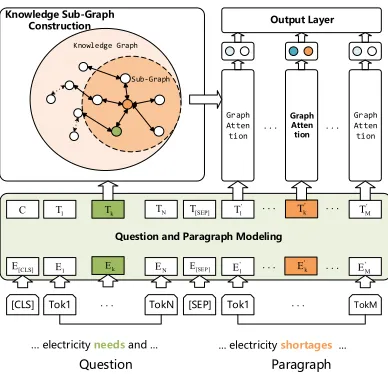
The architecture of SKG is shown in Figure 1.
It contains four modules: (1) Question and para-graph modeling module, which acquires the con-textual representation of question and paragraph with BERT; (2) Knowledge sub-graph construc-tion module, which retrieves sub-graphs from knowledge graph based on the context; (3) Graph attention module, which updates the representa-tion of nodes on graph; (4) Output layer module, which is employed to generate the final answer.
3.1 Question and Paragraph Modeling
We first encode the tokens with BERT (Devlin
et al.,2018). BERT has become one of the most successful natural language representation models
!"#$% &'() &'(* !$+,% &'()
&'(-!"#$%&'()*(+),*-*.-*/0)1'+#2&(.
! ! ! ! !
! ! ! ! ! !
[CLS]
E E1 EN E[SEP ] E'1
' M E ' M T ' 1 T [SEP] T N T 1 T C """ """ """ !' k T !' k E """ """ ! ! k E k T "#$%&'()'!*+,-. 3-*/0 4%%#( %&'( 5"%/"%)6*7#-*+,-. /00'# 01$# *+,-. /00'# 01$# ! """ """ ./0123'4 ,56576589 """ 2345*+,-. 8('92#+.#):";<3-*/0) ='($%-">%&'(
[image:2.595.305.499.78.265.2]:::;0<0=263=32>)$0'-%*.#$;;::: ;0<0=263=32>;(##+$;54?;:::
Figure 1: Framework of our SKG model.
on various NLP datasets, including SQuAD (
Ra-jpurkar et al.,2016). BERT’s model architecture is
a multi-layer bidirectional Transformer (Vaswani
et al.,2017) encoder, which is pre-trained on large-scale corpus. We represent the input question and paragraph as a single packed sequence as follows:
[CLS]Question[SEP]P aragraph[SEP]
where [CLS] is a specific classifier token and
[SEP]is a sentence separator which are defined
in BERT. And we use BERT to generate the con-textual representation of question and paragraph.
The final hidden output from BERT for theith
in-put token is denoted as tbi ∈ RH, and H is the
output hidden size of BERT model.
3.2 Knowledge Sub-Graph Construction We first use knowledge graph embedding ap-proach to generate the initial representation of n-odes and edges in terms of the whole knowledge graph.
We consider a knowledge triple in a knowledge
graph as(head, relation, tail). For theith token
tiin paragraph, we retrieve all triples whose head
or tail contains lemmas of the token. Take to-ken “shortage” as an example, we retrieve triples like“(shortage, related to, lack)”. Then, we re-trieve the neighbor triple of them, and reserve ones that contain lemmas of any token of the question.
Thus we can acquire triples like “(need,
we can construct a simple sub-graph like “(short-age, related to, lack, related to, need)”, where “lack” is the identical entity. The sub-graph can
be denoted asgiand the nodes and edges of it are
initiated by the embeddings above.
3.3 Graph Attention
Our graph attention network is designed to update the representation of the nodes in a constructed
sub-graph, which is inspired by (Veliˇckovi´c et al.,
2017; Zhou et al.,2018). For theith tokent i in
paragraph, its sub-graph isgi = {n1, n2, .., nk},
wherekis the number of nodes. AndNjis the set
of thejthnode neighbors.
The representation of nodes is updatedLtimes.
At thelthupdate, the updating rules are as follows,
which are designed to model the interaction
be-tween thejthnode and its neighbor nodes. In this
way, the nodes are dynamically updated according to the structure of sub-graphs.
hlj+1=
Nj !
n=1
αntln (1)
αn= "Nexp (βn)
j
j=1exp (βj)
(2)
βn=
#
Wlrrln
$⊤
tanh#Wlhhln+Wlttln
$ (3)
where hlj ∈ Rd is hidden state of the jth node,
and its neighbor’s hidden state istln, and the
hid-den state of relation isrln, anddis the hidden state
dimension.Wlh,WltandWlrare trainable weight
matrices for the node, its neighbors and relations
respectively. AfterLupdates, we can get the final
hidden state of the central node as the final
repre-sentation, which can be denoted astki.
3.4 Output Layer
In the output layer, we combine this knowledge
representation tki with the textual representation
tbivia a sigmoid gate, since external knowledge is
not always necessary for reasoning.
wi=σ((W[tbi;tki])) (4)
t′i=wi⊙tbi+ (1−wi)⊙tki (5)
We denote T = {t′1,t′2, ...,t′n}as the final
representation, where t′i ∈ RH. And we study
a start vector S ∈ RH and an end vectorE ∈
RH like (Devlin et al., 2018), which take T as
input. Then, the probability of theithtoken being
the start of the answer span is computed as a dot
product betweenTi andS followed by a softmax
over all of the words in the paragraph:
Pis= e
S·Ti "
jeS·Tj
(6)
LetPiebe the probability of theithtoken to be
the end of an answer span, which can be calculat-ed by the same above formula, and the maximum scoring span is used as the answer. The training objective is the loglikelihood of the correct start and end positions.
4 Experiments
4.1 Dataset
ReCoRD We report results on ReCoRD
dataset (Zhang et al., 2018), a large-scale
dataset for machine comprehension requiring external knowledge. There are 100,730, 10,000 and 10,000 examples in the training set, the development set and the test set respectively. The test set is not public, which needs to submit the
model to the organization1to get the results.
External Knowledge We consider two
knowl-edge sources as our external knowlknowl-edge:
Word-Net and ConceptWord-Net. For WordNet, we use
the preprocessed data provided by Bordes et
at. (2013), which contains 151,442 triples with
40,943 synsets and 18 relations. For ConceptNet, we use the preprocessed data provided by Bauer et
al. (2018), which contains 2,808,998 triples with
978,672 entities and 46 relations.
4.2 Implementation Details
Our model is implemented with pytorch2, and
us-es the framework3for BERT model. We employ
the open-source framework OpenKE (Han et al.,
2018) to obtain the embedding of entities and
re-lations with the BILINEAR model (Yang et al.,
2015). The size of embedding of entities and
rela-tions is 100. The update timesLof graph attention
network is set to 5. We use Adam optimizer. The learning rate uses the linear schedule to decrease from0.00003to0.
1https://sheng-z.github.io/ReCoRD-explorer/
2https://github.com/pytorch/pytorch
3
Model DevEMTest Dev F1Test
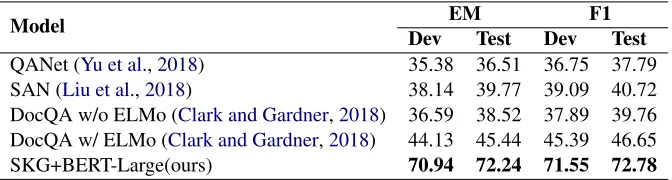
QANet (Yu et al.,2018) 35.38 36.51 36.75 37.79
SAN (Liu et al.,2018) 38.14 39.77 39.09 40.72
DocQA w/o ELMo (Clark and Gardner,2018) 36.59 38.52 37.89 39.76
DocQA w/ ELMo (Clark and Gardner,2018) 44.13 45.44 45.39 46.65
[image:4.595.125.461.81.171.2]SKG+BERT-Large(ours) 70.94 72.24 71.55 72.78
Table 1: The performance of different models on ReCoRD dataset.
Model EM F1
BERT-Base(2018) 54.03 55.99
SKG+BERT-Base(ours) 60.26 60.79
BERT-Large(2018) 64.28 66.60
[image:4.595.81.264.209.274.2]SKG+BERT-Large(ours) 70.94 71.55
Table 2: The effectiveness of introducing external
knowledge.
Model EM F1
MHPGM+NOIC(2018) 28.36 29.29
KG+LSTM+Bert-Base 58.01 58.49
SKG+BERT-Base(ours) 60.26 60.79
Table 3: The results of different ways of introducing external knowledge.
4.3 Results and Analysis Results on ReCoRD
We choose several baselines: (1) QANet (Yu et al.,
2018) is one of the top MRC models, which is
different from many other MRC models due to
the use of transformer (Vaswani et al.,2017). (2)
SAN (Liu et al.,2018) is a top-rank MRC
mod-el, which employs a stochastic answer module.
(3) DocQA (Clark and Gardner,2018) is a strong
baseline model, which consists of bidirectional at-tention flow and self-atat-tention.
The results of different models are shown in
Ta-ble 1. Our SKG+BERT-Large4 model achieves
better performance than all previous published models, which is 26.13% higher in value than the state-of-art model DocQA with ELMo.
The Effectiveness of External Knowledge Moreover, ablation experimental results on the
dev set5 are given in Table 2. Once we
re-4Our first module is based on different BERT model sizes.
BERT-Base contains 110M parameters and BERT-Large con-tains 340M parameters.
5Due to several weeks evaluation wait-time on the
non-public test set, we just report results of our supplementary experiments on the dev set. In previous submissions, the
re-move the module incorporating external knowl-edge, the model degenerates into the fine-tuing BERT model, and the results show significant per-formance drop with 4.80% and 4.95% on different pre-trained model sizes respectively. The results demonstrate that our model can effectively utilize external knowledge.
Different Ways to Use External Knowledge
In the original paper of ReCoRD (Zhang et al.,
2018), there is no research on existing models
that use external knowledge to improve MRC task. So we study the recent model MHPGM+NOIC (Bauer et al.,2018) , which utilizes multi-hop re-lational knowledge paths from ConceptNet. As
shown in Table3, our SKG model is more proper
for introducing external knowledgse. In addition, to investigate the impact of the structural infor-mation on performance, we replace our sub-graph construction module with KG+LSTM, which re-trieves knowledge triples without reconstructing the structure of them, and considers paths among them as sequences. We employ Long Short-Term Memory (LSTM) model to generate the
represen-tation of knowledge. As shown in Table 3, the
performance drops 2.3% in F1, which means that the incorporation of structural information in the knowledge graph is able to make better use of ex-ternal knowledge.
5 Conclusion
We propose SKG model for improving machine comprehension. Rather than treating triples from knowledge graph independently and separately, we construct sub-graphs from external knowledge. Then we generate the representation of knowledge with graph attention networks to improve the rep-resentation of context. Experimental results indi-cate that our model achieves the best performance in the challenging ReCoRD dataset.
Acknowledgements
This work was supported by National Key R&D Program of China under Grant 2018YFB1005100, the National Natural Science Foundation of China (No.61533018, No.U1605251). This work was al-so supported by the Open Project of National Lab-oratory of Pattern Recognition at the Institute of Automation of the Chinese Academy of Sciences (201900041) and the independent research project of National Laboratory of Pattern Recognition.
References
Lisa Bauer, Yicheng Wang, and Mohit Bansal. 2018.
Commonsense for generative multi-hop question an-swering tasks. In Proceedings of the 2018 Con-ference on Empirical Methods in Natural Language Processing, Brussels, Belgium, October 31 - Novem-ber 4, 2018, pages 4220–4230.
Antoine Bordes, Nicolas Usunier, Alberto Garcia-Duran, Jason Weston, and Oksana Yakhnenko. 2013. Translating embeddings for modeling
multi-relational data. InAdvances in neural information
processing systems, pages 2787–2795.
Nicola De Cao, Wilker Aziz, and Ivan Titov. 2018.
Question answering by reasoning across documents with graph convolutional networks. CoRR, ab-s/1808.09920.
Yu Cao, Meng Fang, and Dacheng Tao. 2019. Bag: Bi-directional attention entity graph convolutional net-work for multi-hop reasoning question answering.
arXiv preprint arXiv:1904.04969.
Christopher Clark and Matt Gardner. 2018. Simple
and effective multi-paragraph reading comprehen-sion. In Proceedings of the 56th Annual Meeting of the Association for Computational Linguistics, A-CL 2018, Melbourne, Australia, July 15-20, 2018, Volume 1: Long Papers, pages 845–855.
Jacob Devlin, Ming-Wei Chang, Kenton Lee, and
Kristina Toutanova. 2018. BERT: pre-training of
deep bidirectional transformers for language under-standing. CoRR, abs/1810.04805.
Xu Han, Shulin Cao, Xin Lv, Yankai Lin, Zhiyuan Li-u, Maosong Sun, and Juanzi Li. 2018. Openke: An
open toolkit for knowledge embedding. In
Proceed-ings of EMNLP, pages 139–144.
Thomas N Kipf and Max Welling. 2016.
Semi-supervised classification with graph convolutional
networks.arXiv preprint arXiv:1609.02907.
Xiaodong Liu, Yelong Shen, Kevin Duh, and Jianfeng Gao. 2018. Stochastic answer networks for
ma-chine reading comprehension. InProceedings of the
56th Annual Meeting of the Association for Compu-tational Linguistics (Volume 1: Long Papers), pages 1694–1704.
Todor Mihaylov and Anette Frank. 2018.
Knowledge-able reader: Enhancing cloze-style reading compre-hension with external commonsense knowledge. In
Proceedings of the 56th Annual Meeting of the As-sociation for Computational Linguistics, ACL 2018, Melbourne, Australia, July 15-20, 2018, Volume 1: Long Papers, pages 821–832.
Xiaoman Pan, Kai Sun, Dian Yu, Heng Ji, and Dong Yu. 2019. Improving question answering with ex-ternal knowledge.
Pranav Rajpurkar, Jian Zhang, Konstantin Lopyrev, and Percy Liang. 2016. Squad: 100,000+ questions for
machine comprehension of text. InProceedings of
the 2016 Conference on Empirical Methods in Nat-ural Language Processing, pages 2383–2392.
Michael Schlichtkrull, Thomas N Kipf, Peter Bloem, Rianne Van Den Berg, Ivan Titov, and Max Welling. 2018. Modeling relational data with graph
convolu-tional networks. InEuropean Semantic Web
Confer-ence, pages 593–607. Springer.
Linfeng Song, Zhiguo Wang, Mo Yu, Yue Zhang,
Radu Florian, and Daniel Gildea. 2018. Exploring
graph-structured passage representation for multi-hop reading comprehension with graph neural net-works. CoRR, abs/1809.02040.
Robert Speer, Joshua Chin, and Catherine Havasi.
2017. Conceptnet 5.5: An open multilingual graph
of general knowledge. InProceedings of the Thirty-First AAAI Conference on Artificial Intelligence, February 4-9, 2017, San Francisco, California,
US-A., pages 4444–4451.
Thomas Pellissier Tanon, Denny Vrandecic, Sebas-tian Schaffert, Thomas Steiner, and Lydia Pintscher.
2016. From freebase to wikidata: The great
migra-tion. InProceedings of the 25th International Con-ference on World Wide Web, WWW 2016, Montreal, Canada, April 11 - 15, 2016, pages 1419–1428.
Adam Trischler, Tong Wang, Xingdi Yuan, Justin Har-ris, Alessandro Sordoni, Philip Bachman, and Ka-heer Suleman. 2017. Newsqa: A machine
compre-hension dataset. InProceedings of the 2nd
Work-shop on Representation Learning for NLP, pages 191–200.
Ashish Vaswani, Noam Shazeer, Niki Parmar, Jakob
Uszkoreit, Llion Jones, Aidan N Gomez, Łukasz
Kaiser, and Illia Polosukhin. 2017. Attention is all
you need. InAdvances in neural information
pro-cessing systems, pages 5998–6008.
Petar Veliˇckovi´c, Guillem Cucurull, Arantxa Casano-va, Adriana Romero, Pietro Lio, and Yoshua
Ben-gio. 2017. Graph attention networks.arXiv preprint
arXiv:1710.10903.
Dirk Weissenborn. 2017. Reading twice for natural
Bishan Yang and Tom M. Mitchell. 2017. Leverag-ing knowledge bases in lstms for improvLeverag-ing machine reading. InProceedings of the 55th Annual Meeting of the Association for Computational Linguistics, A-CL 2017, Vancouver, Canada, July 30 - August 4, Volume 1: Long Papers, pages 1436–1446.
Bishan Yang, Wen-tau Yih, Xiaodong He, Jianfeng
Gao, and Li Deng. 2015. Embedding entities and
relations for learning and inference in knowledge bases. In3rd International Conference on Learning Representations, ICLR 2015, San Diego, CA, USA, May 7-9, 2015, Conference Track Proceedings. Adams Wei Yu, David Dohan, Minh-Thang Luong, Rui
Zhao, Kai Chen, Mohammad Norouzi, and Quoc V.
Le. 2018. Qanet: Combining local convolution
with global self-attention for reading
comprehen-sion. CoRR, abs/1804.09541.
Sheng Zhang, Xiaodong Liu, Jingjing Liu, Jianfeng Gao, Kevin Duh, and Benjamin Van Durme. 2018.
Record: Bridging the gap between human and ma-chine commonsense reading comprehension.CoRR, abs/1810.12885.
Hao Zhou, Tom Young, Minlie Huang, Haizhou Zhao,
Jingfang Xu, and Xiaoyan Zhu. 2018.