Multilingual Semantic Role Labeling
Anders Bj¨orkelund Love Hafdell Pierre Nugues
Department of Computer Science, Lund University S-221 00 Lund, Sweden
[email protected] love [email protected]
Abstract
This paper describes our contribution to the semantic role labeling task (SRL-only) of the CoNLL-2009 shared task in the closed chal-lenge (Hajiˇc et al., 2009). Our system con-sists of a pipeline of independent, local clas-sifiers that identify the predicate sense, the ar-guments of the predicates, and the argument labels. Using these local models, we carried out a beam search to generate a pool of candi-dates. We then reranked the candidates using a joint learning approach that combines the lo-cal models and proposition features.
To address the multilingual nature of the data, we implemented a feature selection procedure that systematically explored the feature space, yielding significant gains over a standard set of features. Our system achieved the second best semantic score overall with an average la-beled semantic F1 of 80.31. It obtained the best F1 score on the Chinese and German data and the second best one on English.
1 Introduction
In this paper, we describe a three-stage analysis ap-proach that uses the output of a dependency parser and identifies the arguments of the predicates in a sentence. The first stage consists of a pipeline of independent classifiers. We carried out the pred-icate disambiguation with a set of greedy classi-fiers, where we applied one classifier per predicate lemma. We then used a beam search to identify the arguments of each predicate and to label them, yielding a pool of candidate propositions. The sec-ond stage consists of a reranker that we applied to
the candidates using the local models and proposi-tion features. We combined the score of the greedy classifiers and the reranker in a third stage to select the best candidate proposition. Figure 1 shows the system architecture.
We evaluated our semantic parser on a set of seven languages provided by the organizers of the CoNLL-2009 shared task: Catalan and Spanish (Taul´e et al., 2008), Chinese (Palmer and Xue, 2009), Czech (Hajiˇc et al., 2006), English (Surdeanu et al., 2008), German (Burchardt et al., 2006), and Japanese (Kawahara et al., 2002). Our system achieved an average labeled semantic F1 of 80.31, which cor-responded to the second best semantic score over-all. After the official evaluation was completed, we discovered a fault in the training procedure of the reranker for Spanish. The revised average labeled semantic F1 after correction was 80.80.
2 SRL Pipeline
The pipeline of classifiers consists of a predicate disambiguation (PD) module, an argument identi-fication module (AI), and an argument classifica-tion (AC) module. Aside from the lack of a pred-icate identification module, which was not needed, as predicates were given, this architecture is identi-cal to the one adopted by recent systems (Surdeanu et al., 2008), as well as the general approach within the field (Gildea and Jurafsky, 2002; Toutanova et al., 2005).
We build all the classifiers using the L2-regularized linear logistic regression from the LIB-LINEAR package (Fan et al., 2008). The package implementation makes models very fast to train and
N candidates
N candidates Reranker Local features + proposition features
Global model
Linear combination of models Local classifier pipeline
Sense disambiguation greedy search
Argument identification
beam search Argument labelingbeam search
[image:2.612.71.539.66.140.2]Reranked candidates
Figure 1: System architecture.
use for classification. Since models are logistic, they produce an output in the form of probabilities that we use later in the reranker (see Sect. 3).
2.1 Predicate Disambiguation
We carried out a disambiguation for all the lem-mas that had multiple senses in the corpora and we trained one classifier per lemma. We did not use the predicate lexicons and we considered lemmas with a unique observed sense as unambiguous.
English required a special processing as the sense nomenclature overlapped between certain nominal and verbal predicates. For instance, the nominal predicate plan.01 and the verbal predicate plan.01 do not correspond to the same semantic frame. Hence, we trained two classifiers for each lemma
plan that could be both a nominal and verbal
predi-cate.
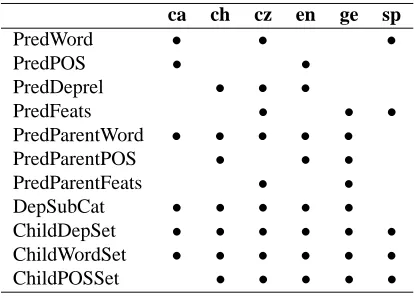
Table 1: Feature sets for predicate disambiguation.
ca ch cz en ge sp
PredWord • • •
PredPOS • •
PredDeprel • • •
PredFeats • • •
PredParentWord • • • • •
PredParentPOS • • •
PredParentFeats • •
DepSubCat • • • • •
ChildDepSet • • • • • •
ChildWordSet • • • • • •
ChildPOSSet • • • • •
2.2 Argument Identification and Classification
We implemented the argument identification and classification as two separate stages, because it en-abled us to apply and optimize different feature sets
in each step. Arguments were identified by means of a binary classifier. No pruning was done, each word in the sentence was considered as a potential argument to all predicates of the same sentence.
Arguments were then labeled using a multiclass classifier; each class corresponding to a certain la-bel. We did not apply any special processing with multiple dependencies in Czech and Japanese. In-stead, we concatenated the composite labels (i.e. double edge) to form unique labels (i.e. single edge) having their own class.
2.3 Identification and Classification Features
For the English corpus, we used two sets of features for the nominal and the verbal predicates both in the AI and AC steps. This allowed us to create different classifiers for different kinds of predicates. We ex-tended this approach with a default classifier catch-ing predicates that were wrongly tagged by the POS tagger. For both steps, we used the union of the two feature sets for this catch-all class.
We wanted to employ this procedure with the two other languages, Czech and Japanese, where predi-cates had more than one POS type. As feature selec-tion (See Sect. 2.4) took longer than expected, par-ticularly in Czech due to the size of the corpus and the annotation, we had to abandon this idea and we trained a single classifier for all POS tags in the AI and AC steps.
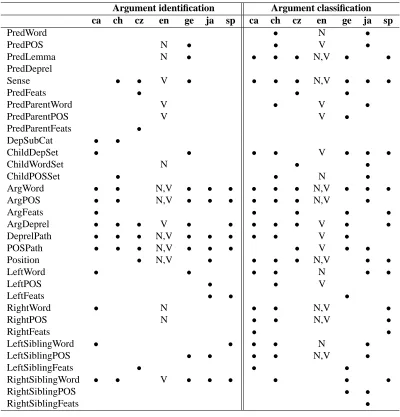
[image:2.612.79.286.484.633.2]Table 2: Feature sets for argument identification and classification.
Argument identification Argument classification
ca ch cz en ge ja sp ca ch cz en ge ja sp
PredWord • N •
PredPOS N • • V •
PredLemma N • • • • N,V • •
PredDeprel
Sense • • V • • • • N,V • • •
PredFeats • • •
PredParentWord V • V •
PredParentPOS V V •
PredParentFeats •
DepSubCat • •
ChildDepSet • • • • V • • •
ChildWordSet N • •
ChildPOSSet • • N •
ArgWord • • N,V • • • • • • N,V • • •
ArgPOS • • N,V • • • • • • N,V •
ArgFeats • • • • •
ArgDeprel • • • V • • • • • V • •
DeprelPath • • • N,V • • • • • V •
POSPath • • • N,V • • • • V • •
Position • N,V • • • • N,V • •
LeftWord • • • • N • •
LeftPOS • • V
LeftFeats • • •
RightWord • N • • N,V •
RightPOS N • • N,V •
RightFeats • •
LeftSiblingWord • • • • N •
LeftSiblingPOS • • • • N,V •
LeftSiblingFeats • • •
RightSiblingWord • • V • • • • • •
RightSiblingPOS • •
RightSiblingFeats •
sibling of the argument. The suffix of these names corresponds to the column name of the CoNLL for-mat, except Word which corresponds to the Form column. Additional features are:
• Sense: the value of the Pred column, e.g.
plan.01.
• Position: the position of the argument with re-spect to the predicate, i.e. before, on, or after.
• DepSubCat: the subcategorization frame of the predicate, e.g. OBJ+OPRD+SUB.
• DeprelPath: the path from predicate to argu-ment concatenating dependency labels with the
direction of the edge, e.g. OBJ↑OPRD↓SUB↓.
• POSPath: same as DeprelPath, but depen-dency labels are exchanged for POS tags, e.g. NN↑NNS↓NNP↓.
• ChildDepSet: the set of dependency labels of the children of the predicate, e.g.{OBJ, SUB}.
• ChildPOSSet: the set of POS tags of the chil-dren of the predicate, e.g.{NN, NNS}.
2.4 Feature Selection
We selected the feature sets using a greedy forward procedure. We first built a set of single features and, to improve the separability of our linear classifiers, we paired features to build bigrams. We searched the space of feature bigrams using the same proce-dure. See Johansson (2008, page 83), for a com-plete description. We intended to carry out a cross-validation search. Due to the lack of time, we re-sorted to using 80% of the training set for training and 20% for evaluating the features. Table 2 con-tains the complete list of single features we used. We omitted the feature bigrams.
Feature selection turned out to be a massive task. It took us three to four weeks searching the feature spaces, yet in most cases we were forced to interrupt the selection process after a few bigram features in order to have our system ready in time. This means that our feature sets can probably be further opti-mized.
When the training data was initially released, we used the exact feature set from Johansson and Nugues (2008) to compute baseline results on the development set for all the languages. After feature selection, we observed an increase in labeled seman-tic F1 close to 10% in most languages.
2.5 Applying Beam Search
The AI module proceeds left to right considering each word as an argument of the current predicate. The current partial propositions are scored by com-puting the product of the probabilities of all the words considered so far. After each word, the cur-rent pool of partial candidates is reduced to the beam size,k, and at the end of the sentence, the topk scor-ing propositions are passed on to the AC module.
Given kunlabeled propositions, the AC module applies a beam search on each of these propositions independently. This is done in a similar manner, proceeding from left to right among the identified arguments, keeping thelbest labelings in its beam, and returning the topl propositions, when all iden-tified arguments have been processed. This yields
n= k×lcomplete propositions, unless one of the unlabeled propositions has zero arguments, in which case we haven= (k−1)×l+ 1.
The probability of a labeled proposition according
to the local pipeline is given by PLocal = PAI ×
PAC, wherePAI andPAC is the output probability
from the AI and AC modules, respectively. In the case of empty propositions,PACwas set to1.
3 Global Reranker
We implemented a global reranker following Toutanova et al. (2005). To generate training ex-amples for the reranker, we trained m AI and AC classifiers by partitioning the training set inmparts and usingm−1of these parts for each AI and AC classifier, respectively.
We applied these AI and AC classifiers on the part of the corpus they were not trained on and we then generated the topnpropositions for each predicate. We ran the CoNLL evaluation script on the proposi-tions and we marked the top scoring one(s) as pos-itive. We marked the others negative. If the correct proposition was not in the pool of candidates, we added it as an extra positive example. We used these positive and negative examples as training data for the global reranker.
3.1 Reranker Features
We used all the features from the local pipeline for all the languages. We built a vector where the AI features were prefixed with AI- and the AC features prefixed withlab−, wherelabwas any of the argu-ment labels.
We added one proposition feature to the concate-nation of local features, namely the sequence of core argument labels, e.g. A0+plan.01+A1. In Catalan and Spanish, we considered all the labels prefixed by arg0, arg1, arg2, or arg3 as core labels. In Chinese and English, we considered only the labels A0, A1, A2, A3, and A4. In Czech, German, and Japanese, we considered all the labels as core labels.
Hence, the total size of the reranker vector space is|AI|+|L| × |AC|+|G|, where|AI|and|AC|
denotes the size of the AI and AC vector spaces, re-spectively,|L|corresponds to the number of labels, and|G|is the size of additional global features.
We ran experiments with the grammatical voice that we included in the string represent-ing the sequence of core argument labels, e.g.
A1+plan.01/Passive+A0. The voice was derived by
Spanish, and given in the Feat column in Czech. However, we did not notice any significant gain in performance. The hand-crafted rules use lexical forms and dependencies, which we believe classi-fiers are able to derive themselves using the local model features. This also applies to Czech, as Pred-Feats was a feature used in the local pipeline, both in the AI and AC steps.
3.2 Weighting the Models
In Sect. 2.5, we described how the pipeline was used to generate the topnpropositions, each with its own local probabilityPLocal. Similar to softmax, we
nor-malized these local probabilities by dividing each of them by their total sum. We denote this normalized probability by PLocal . The reranker gives a proba-bility on the complete proposition, PReranker. We
weighted these probabilities and chose the proposi-tion maximizing PF inal = (PLocal )α×PReranker.
This is equivalent to a linear combination of the log probabilities.
3.3 Parameters Used
For the submission to the CoNLL 2009 Shared Task, we set the beam widths tok=l = 4, yielding
can-didate pools of sizen = 13or n = 16 (See Sec-tion 2.5). We usedm = 5for training the reranker andα = 1for combining the local model with the reranker.
4 Results
Our system achieved the second best semantic score, all tasks, with an average labeled semantic F1 of 80.31. It obtained the best F1 score on the Chinese and German data and the second best on English. Our system also reached the third rank in the out-of-domain data, all tasks, with a labeled semantic F1 of 74.38. Post-evaluation, we discovered a bug in the Spanish reranker model causing the poor results in this language. After correcting this, we could reach a labeled semantic F1 of 79.91 in Spanish. Table 3 shows our official results in the shared task as well as the post-evaluation update.
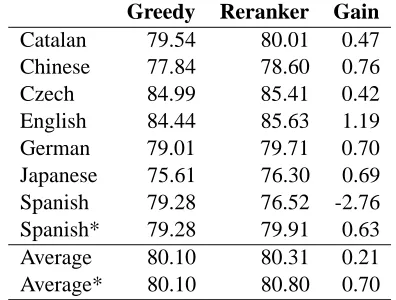
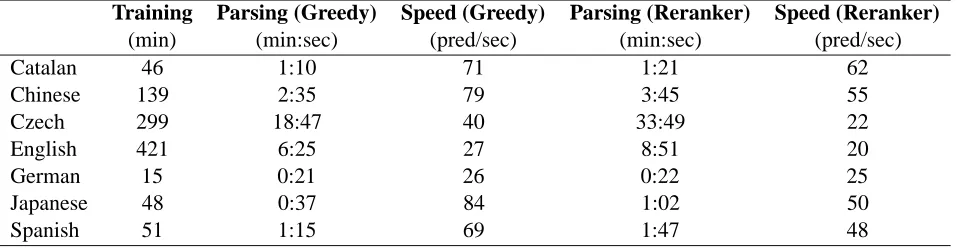
We also compared the performance of a greedy strategy with that of a global model. Table 4 shows these figures with post-evaluation figures in Spanish. Table 5 shows the training time, parsing time, and the parsing speed in predicates per second. These
[image:5.612.340.506.217.369.2]figures correspond to complete execution time of parsing, including loading models into memory, i.e. a constant overhead, that explains the low parsing speed in German. We implemented our system to be flexible for easy debugging and testing various ideas. Optimizing the implementation would reduce execution times significantly.
Table 3: Summary of submitted results: closed challenge, semantic F1. * denotes the post-evaluation results ob-tained for Spanish after a bug fix.
Unlabeled Labeled
Catalan 93.60 80.01
Chinese 84.76 78.60
Czech 92.63 85.41
English 91.17 85.63
German 92.13 79.71
Japanese 83.45 76.30
Spanish 92.69 76.52
Spanish* 93.76 79.91
Average 90.06 80.31
[image:5.612.324.522.435.585.2]Average* 90.21 80.80
Table 4: Improvement of reranker. * denotes the post-evaluation results obtained for Spanish after a bug fix.
Greedy Reranker Gain
Catalan 79.54 80.01 0.47
Chinese 77.84 78.60 0.76
Czech 84.99 85.41 0.42
English 84.44 85.63 1.19
German 79.01 79.71 0.70
Japanese 75.61 76.30 0.69
Spanish 79.28 76.52 -2.76
Spanish* 79.28 79.91 0.63
Average 80.10 80.31 0.21
Average* 80.10 80.80 0.70
5 Conclusion
Table 5: Summary of training and parsing times on an Apple Mac Pro, 3.2 GHz.
Training Parsing (Greedy) Speed (Greedy) Parsing (Reranker) Speed (Reranker)
(min) (min:sec) (pred/sec) (min:sec) (pred/sec)
Catalan 46 1:10 71 1:21 62
Chinese 139 2:35 79 3:45 55
Czech 299 18:47 40 33:49 22
English 421 6:25 27 8:51 20
German 15 0:21 26 0:22 25
Japanese 48 0:37 84 1:02 50
Spanish 51 1:15 69 1:47 48
robust and can handle incorrect syntactic parse trees with a good level of immunity. While input parse trees in Chinese and German had a labeled syntac-tic accuracy of 78.46 (Hajiˇc et al., 2009), we could reach a labeled semantic F1 of 78.60 and 79.71 in these languages. We also implemented an efficient global reranker in all languages yielding a 0.7 av-erage increase in labeled semantic F1. The reranker step, however, comes at the expense of parsing times increased by factors ranging from 1.04 to 1.82.
References
Aljoscha Burchardt, Katrin Erk, Anette Frank, Andrea Kowalski, Sebastian Pad´o, and Manfred Pinkal. 2006. The SALSA corpus: a German corpus resource for lexical semantics. In Proceedings of the 5th
Interna-tional Conference on Language Resources and Evalu-ation (LREC-2006), Genoa, Italy.
Rong-En Fan, Kai-Wei Chang, Cho-Jui Hsieh, Xiang-Rui Wang, and Chih-Jen Lin. 2008. LIBLINEAR: A li-brary for large linear classification. Journal of
Ma-chine Learning Research, 9:1871–1874.
Daniel Gildea and Daniel Jurafsky. 2002. Automatic la-beling of semantic roles. Computational Linguistics, 28(3):245–288.
Jan Hajiˇc, Jarmila Panevov´a, Eva Hajiˇcov´a, Petr Sgall, Petr Pajas, Jan ˇStˇep´anek, Jiˇr´ı Havelka, Marie Mikulov´a, and Zdenˇek ˇZabokrtsk´y. 2006. Prague De-pendency Treebank 2.0.
Jan Hajiˇc, Massimiliano Ciaramita, Richard Johans-son, Daisuke Kawahara, Maria Ant`onia Mart´ı, Llu´ıs M`arquez, Adam Meyers, Joakim Nivre, Sebastian Pad´o, Jan ˇStˇep´anek, Pavel Straˇn´ak, Mihai Surdeanu, Nianwen Xue, and Yi Zhang. 2009. The CoNLL-2009 shared task: Syntactic and semantic depen-dencies in multiple languages. In Proceedings of
the 13th Conference on Computational Natural Lan-guage Learning (CoNLL-2009), June 4-5, Boulder,
Colorado, USA.
Richard Johansson and Pierre Nugues. 2008. Dependency-based syntactic–semantic analysis with PropBank and NomBank. In Proceedings of the
Shared Task Session of CoNLL-2008.
Richard Johansson. 2008. Dependency-based Semantic
Analysis of Natural-language Text. Ph.D. thesis, Lund
University, December 5.
Daisuke Kawahara, Sadao Kurohashi, and Kˆoiti Hasida. 2002. Construction of a Japanese relevance-tagged corpus. In Proceedings of the 3rd International
Conference on Language Resources and Evaluation (LREC-2002), pages 2008–2013, Las Palmas, Canary
Islands.
Martha Palmer and Nianwen Xue. 2009. Adding seman-tic roles to the Chinese Treebank. Natural Language
Engineering, 15(1):143–172.
Mihai Surdeanu, Richard Johansson, Adam Meyers, Llu´ıs M`arquez, and Joakim Nivre. 2008. The CoNLL-2008 shared task on joint parsing of syntactic and se-mantic dependencies. In Proceedings of the 12th
Con-ference on Computational Natural Language Learning (CoNLL-2008).
Mariona Taul´e, Maria Ant`onia Mart´ı, and Marta Re-casens. 2008. AnCora: Multilevel Annotated Corpora for Catalan and Spanish. In Proceedings of the 6th
International Conference on Language Resources and Evaluation (LREC-2008), Marrakesh, Morroco.