© 2019, IRJET | Impact Factor value: 7.34 | ISO 9001:2008 Certified Journal
| Page 883
DEVELOPMENT OF A NEURAL NETWORK BASED MODEL FOR
CONSTRUCTION PROJECT MANAGEMENT EFFECTIVENESS
Pooja Dudhe
1, Prof. A.B. Ranit
2, Prof. R.R. Wankhade
31
Research Scholar, M.E. Construction Engineering and Management, Prof. Ram Meghe College of Engineering and
Management Badnera-Amravati.
2
Assistant Professor, Civil Engineering Department, Prof. Ram Meghe College of Engineering and Management
Badnera-Amravati.
3
Assistant Professor, Civil Engineering Department, Prof. Ram Meghe College of Engineering and Management
Badnera-Amravati.
---***---
Abstract - An artificial neural network based methodology is applied for predicting the level of organizational effectiveness in a construction firm. The methodology uses the competing value approach to identify 12 variables. The historical data of construction projects performance have been used to build the neural network model. Based on these factors, the construction projects management effectiveness model was established. The model can serve as the framework for further development of the construction management decision support system.Key words: Artificial neural network, construction management
INTRODUCTION
In the competitive nature of construction, industry and its heuristic problem-solving needs, among other reasons, have contributed to the development of some advanced decision-making tools. Research in artificial intelligence (AI), a branch of computer science, has provided more suitable tools to the construction industry. Since its initial development, the Artificial Intelligence has found large applicability in the field of engineering. In particular, the so-called soft computing methods have been shown to be very effective in the analysis and solution of construction engineering problems. However, the performance of these systems during the last decade is far from ideal. Neural networks research in AI has recently provided powerful systems that work as a supplement or a complement to such conventional expert systems. In this paper, neural networks are introduced as a promising management tool that can enhance current automation efforts in the construction industry, including its applications in construction engineering. The approach of artificial neural network is one of the empirical modelling technique that allows evaluation of the construction projects management effectiveness and to determine the factors that influence the project effectiveness in terms of budget performance.
ARTIFICIAL NEURAL NETWORKS
© 2019, IRJET | Impact Factor value: 7.34 | ISO 9001:2008 Certified Journal
| Page 884
LITERATURE REVIEWChua et al. (1997) proposed a neural network approach to identify the key management factors that affect budget performance in a project. This approach allowed the model to be built even if the functional interrelationships between input factors and output performance could not be clearly defined. Altogether eight key determining factors were identified covering areas related to the project manager, project team, and planning and control efforts, namely: number of organizational levels between project manager and craftsmen, project manager experience on similar technical scope, detailed design complete at start of construction, constructability program, project team turnover rate, frequency of control meetings during construction, frequency of budget updates, and control system budget. The model can be used to evaluate various management strategies and thus resources can be effectively deployed to strengthen these aspects of project management.
Parminder Kaur (2016) proposed an ANN model that was prepared in order to predict the duration of any ongoing project in addition to conventional techniques of project planning. A large number of trials were applied for model training. The absolute variance of model’s results varies from 1.7% to 2.6% which is less than variance calculated by use of PERT network technique (3.8 to 7.8%) in cases studied. Therefore the model testing is successfully passed and it can be concluded that Artificial Neural Networks are an effective project management tool that can be used to effectively predict the project duration and hence prevent scheduling and project duration overruns.
Megha Jain, KK Pathak (2014) concluded that ANNs have been successfully applied to many construction engineering areas like prediction, risk analysis, decision-making, resources optimization, classification, and selection etc. Based on the results of case studies, it is evident that ANNs perform better than, or at par to the conventional methods and also found that ANN have a number of significant benefits that make them a powerful and practical tool for solving many problems in the field of construction engineering and are expected to be applicable in future.
Baba Shehu Waziri, Kabir Bala and Shehu Ahmadu Bustani (2017) The study revealed successful applications of ANNs in cost prediction, optimization and scheduling, risk assessment, claims and dispute resolution outcomes and decision making. It was observed that ANN have been applied to problems that are difficult to solve with traditional mathematical and statistical methods. The study provides comprehensive repute of ANN in construction engineering and management for application in different areas for improved accuracy and reliable predictions.
QUESTIONNAIRE SURVEY AND DATA ANALYSIS
[image:2.595.38.552.619.787.2]A questionnaire was developed to collect data from past projects to be used in developing a predictive model. It was categorized into profile of the respondent and various factors which improve organizational performance. Questions in the respondent profile were created to collect information such as name of company, contact information, type of organization, projects per year and size of projects. The framework for the list of construction management effectiveness factors covering areas related to project manager, project team, project planning, organization and control, safety management , material management, financial Planning was selected from the research conducted by Jaselskis and Ashley (1991), Kanchana Priyadarshani (2003), adnan enshassi(2009), aparna shruthi E (2017). However, the actuality of each construction management factor was retested by interviewing construction management practitioners, engineers, and contractors and the approach was modified according to the interviewers opinion. Construction project management effectiveness factors described in Table 1 served as the independent input variables.
Table 1: Construction Project Management Effectiveness Factor
Category Project Management Factor Measure
Project manager (PM)
PM Meetings Number/month
PM time devoted hours/day
PM field visit Number/month
PM Subordinates Number
PM education level Years
PM experience as a Project Manager Number of projects
PM experience other than as PM Number of projects
© 2019, IRJET | Impact Factor value: 7.34 | ISO 9001:2008 Certified Journal
| Page 885
Construction cost variation criterion was used to measure construction project management effectiveness. The output variable of that model - construction project cost variation Q- was calculated by equation:Q = …….. (1)
where PI - estimated construction project cost; FI - actual construction project cost.
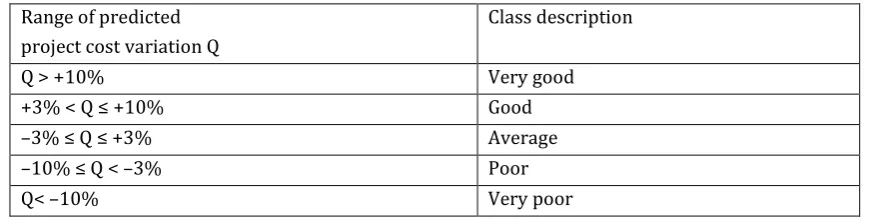
[image:3.595.80.518.632.742.2]The present study is based on a set of data obtained in a questionnaire survey on construction project management effectiveness factors from construction companies mostly in Amravati region and Yavatmal region. Personal contact was the major communication tool used to get organizations participated in the study. The interviewees were construction and project managers, engineers, consultant, and contractors. Information was collected on 99 completed projects. But only information on 66 completed projects were used for training and testing purpose. Then the whole data set of 66 projects was divided into two subsets: training and testing. The neural network model was trained with 54 project samples and retested with 12 project samples. The input data - project management factors - were classified into seven groups and the output data -the percentage of the construction cost variation in loss or profit - were classified into five groups (Table 2).
Table 2: Classification of project cost variation
Range of predicted project cost variation Q
Class description
Q > +10% Very good
+3% < Q ≤ +10% Good
–3% ≤ Q ≤ +3% Average
–10% ≤ Q < –3% Poor
Q< –10% Very poor
Monetary incentive to engineer % of design contract
Monetary incentive to contractor % of design contract
Monetary incentive to sub contractor % of design contract
Planning Design complete at construction start Percent
Budget contingency Percent
Modularisation % of total constriction cost
Organisation and
control Progress inspections Quality inspections Number/month Number/month
Control system budget Percent of total budget
Schedule updates Number/year
Budget updates Number/year
Safety management Safety meetings Number/month
Accidents rate Number/project
Site safety inspection and supervision Number/month
Material management Inspection & documentation of
materials Number/month
Material Requirement Planning Number/month
Financial Planning Meetings related to fund flow Number/month
Percentage of bank loans Percent
Cash flow statement Number/month
Percentage of advances from
© 2019, IRJET | Impact Factor value: 7.34 | ISO 9001:2008 Certified Journal
| Page 886
MODEL DEVELOPMENTThe construction projects management effectiveness neural network model had been developed using the NEURAL NETWORKS TOOLBOX by MATLAB. Preparation of the training data and statistical computations had been performed by applying Microsoft Excel.
In our case we have used a ratio of 70% data for training and 30 % data for testing, where 54 samples has been train and 12 samples has been tested and same for the validation.
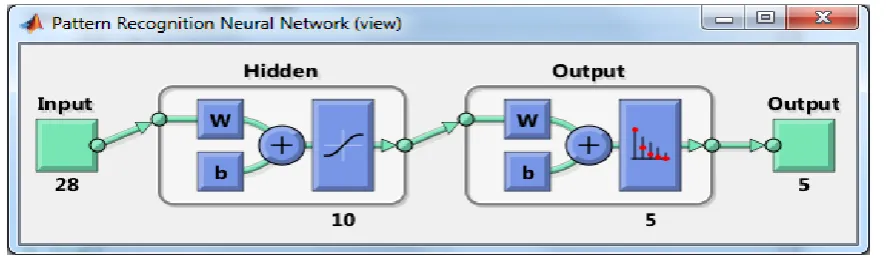
[image:4.595.78.523.278.407.2]The neural network chosen in the present study is multilayered with neurons in all layers fully connected in the feed forward manner. Sigmoid function is used as an activation function. The number of neurons in the input and output layer was decided by the number of input and output variables of the construction project management effectiveness neural network. Thus, the input layer had 28 neurons and the output layer had 5 neurons, representing five classes of the construction cost variation. One hidden layer is chosen in which the number of neurons is decided during the training process by trial and error (fig 2). The neural network was trained to solve the classification task by applying resilient back propagation learning algorithm.
Figure 2 Network building for 28 inputs
All construction management effectiveness factors were incorporated into the model at the first stage of model development. The initial network model comprised 28 neurons in the input layer with 1 neurons in the hidden layer and 5 neurons in the output layer. However, experimentation with an initial model that included all 28 variables resulted in a model with poor performance, thus indicating that including all variables makes the model less sensitive to each of them.
Many experiments with various network architectures were performed during training in order to arrive at the best-trained network. The insignificant factors were trimmed from the network at the stage of model development. This was done gradually by eliminating the least important factors. Based on the classification error, the final neural network model was built with 12 neurons in the input layer, 4 neurons in hidden layer and 5 neurons in the output layer.
CONCLUSIONS
A neural network for predicting construction project management effectiveness for the construction firm is developed. Twelve variables were identified to predict effectiveness. The network is a valuable practical tool that can give management of a construction firm operating in institutional and commercial construction a preproject view of their performance. To improve the performance of the network, significant variables through statistical analysis are identified, and then these variables are used in the input and hidden layers of the ANN. This has resulted in obtaining a simple and computationally efficient network that can predict organizational effectiveness of the construction firm.
The established neural network model can be used during competitive bidding process to evaluate management risk of construction project and predict construction budget performance. The model allows the construction project managers to focus on the key success factors and reduce the level of construction risk. The model can serve as the framework for further development of the construction management decision support system.
REFERENCES
© 2019, IRJET | Impact Factor value: 7.34 | ISO 9001:2008 Certified Journal
| Page 887
[2] Parminder Kaur, (2016) “Artificial Neural Networks as an Effective Project Management Tool”, International Journal of Advanced Technology in Engineering and Science, Vol No. 4, Issue No.07, July 2016.[3] Baba Shehu Waziri, Kabir Bala and Shehu Ahmadu Bustani, (2017) “Artificial Neural Networks in Construction Engineering and Management”, International Journal of Architecture, Engineering and Construction , Vol 6, No 1, March 2017, 50-60.
[4] Megha Jain, KK Pathak,(2014) “ Applications of Artificial Neural Network in Construction Engineering and Management-A Review”, International Journal of Engineering Technology, Management and Applied Sciences, August 2014, Volume 2 Issue 3, ISSN 2349-447.
[5] Rasa Apanavičienė & Arvydas Juodis, (2012) “Construction Projects Management Effectiveness Modelling with Neural Networks”, Journal of Civil Engineering and Management, 2003, Vol TX. No I, 59-67.
[6] Sang C. Lhee, Ian Flood, Raja R.A. Issa, (2014), “Development of A Two-Step Neural Network-Based Model to Predict Construction Cost Contingency”, Journal of Information Technology in Construction - ISSN 1874-4753, ITcon Vol. 19 (2014), Lhee et al, pg. 399.
[7] D. K. H. Chua,Y. C. Kog, P. K. Loh, and E. J. Jaselskis, Associate Member, ASCE, (1997) “Model for Construction Budget Performance-Neural Network Approach”, Journal of Construction Engineering and Management , September 1997.
[8] Rifat N. Rustom and Mohammad I. Amer “Identification of the Factors Affecting Quality in Building Construction Projects in Gaza Strip”.