Performance Improvement of Double Data Encryption
Standard Algorithm using Parallel Computation
Amaal Shorman
PhD Student
Department of Computer Science,
King Abdullah II School for Information Technology, University of Jordan, Amman, Jordan
Mohammad Qatawneh
Professor
Department of Computer Science,
King Abdullah II School for Information Technology, University of Jordan, Amman, Jordan
ABSTRACT
Most of the applications require information security on network. Cryptography is a method to provide information confidentiality, authenticity, and integrity. Double Data Encryption Standard al-gorithm (2DES) is used by several applications to protect their information security. However, current implementations of2DES algorithm suffer from large execution time. Parallel computation is a promising technique to improve the performance of an al-gorithm. Divide and conquer method is mainly used in parallel computation to solve the algorithm in parallel by partitioning a task into sub-task and allocating them to available processors. In this paper, sequential and parallel2DES are evaluated and com-pared in terms of the running time and the speedup. The paral-lel 2DES algorithm is implemented using Message Passing In-terface (MPI) library, and the results have been conducted using IMAN1supercomputer. Results showed that the run time of paral-lel2DES algorithm outperforms the sequential one. Moreover, on a large number of processors, parallel2DES achieves better paral-lel efficiency. Therefore, the paralparal-lel2DES provides much better performance in term of execution time than the serial ones and would be useful to apply it to encrypt and decrypt multimedia.
General Terms
Computer Science, Security
Keywords
Cryptography, Double Data Encryption Standard, MPI, Parallel Computation, Supercomputer
1. INTRODUCTION
Computer networks are required for exchanging information be-tween the sender and the receiver. A key requirements of such net-works is ensuring a secure flow of information. Cryptography is one such technique that offers the most secure manner of trans-mitting sensitive information from the sender to the recipient [11]. A critical objective of a cryptography algorithm is to turn sensi-tive information indecipherable to everyone except the intended re-cipient. An example of a cryptography algorithm that offers the much-needed confidentiality is the 2DES algorithm. However, this
algorithm suffers from several performance-related drawbacks-for example, execution time and memory requirement [10].
Parallel computation can be deployed for decreasing the execution time of this algorithm [17]. In this case, several computations are conducted at the same time, based on the principle that major prob-lems can usually be split into smaller ones that can be then executed in parallel [5].
The main topic of concern for this paper is scrutinizing the paral-lel execution of the 2DES algorithm at the data level, considering the nature of this algorithm is not sequential. The MPI Library is utilized for executing the parallel 2DES algorithm. An IMAN1 su-percomputer, which engages a distributed memory architecture, is used for carrying out the experiments. This supercomputer is uti-lized for decreasing the algorithm´s execution time. The assessment is carried out with regards to the speedup and execution time as per various file sizes and varying number of processors.
The structure of the remaining paper is as follows: Section 2 offers a synopsis of some related studies. Section 3 offers a synopsis of the DES algorithm. Section 4 comprises a report on the 2DES al-gorithm. Section 5 talks about the parallelization tools, while the parallelzation of the 2DES algorithm is depicted in the following section. The assessment outcomes of the parallel and sequential 2DES algorithm are outlined in Section 7, while Section 8 presents the conclusion and recommendations for future research.
2. RELATED WORKS
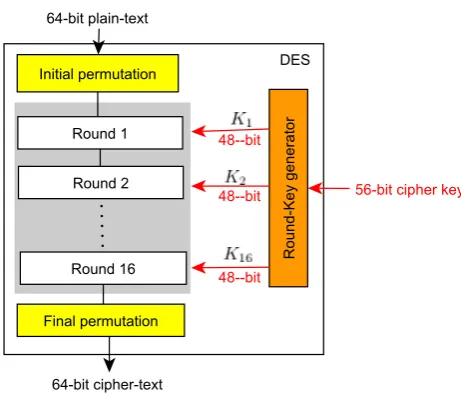
process-Fig. 1: General structure of DES algorithm.
ing unit. This is an execution running certain tests that are almost nine times quicker than libdes, the most rapid open source DES ex-ecution for theG4. In [1], Beletskyy et al. depict the outcomes of parallelising DES by deploying OpenMP, an application program interface. They segregated DES algorithm into parallelisable and un-parallelisable segments. The researchers indicate that block ci-phers parallelisation in the Electronic Code Book (ECB) mode is conceivable as well as effectual. Celikel et al. [3] perform the de-sign and execution of the DES encryption in the ECB mode with parallelisation schemes based on the following: pipeline, block and plain-text. Parallelisation based on plain-text rendered the best out-comes among the three. Furthermore, the authors indicate that the DES speed is not reliant on the source language. Khaddour et al. [8] investigates the execution of a block cipher Triple Data Encryption Standard (TDES) algorithm on a 16 processor single chip multi-processor utilizing two parallelisation methods-the first is by data parallelism in which every processor implements the whole TDES algorithm and the second is a pipelined TDES disseminated on the 16 processors. The data parallelism approach offered an improved performance compared to the pipelined technique.
Our design presents a new parallel execution of the 2DES algo-rithm in the manner that it disseminates the workload among the processors.
3. OVERVIEW OF THE DES ALGORITHM
The DES algorithm is extensively deployed in several applications. As per NIST [17], this algorithm is a symmetric-key block cipher. Fig.1 shows the overall organization of DES cryptography algo-rithm.
In the course of encryption, DES considers a 64−bit block of plain-text as input and generates a 64-bit block of cipher-plain-text as output by utilizing of permutation as well as substitution. Likewise, at the time of decryption, DES considers a 64−bit block of cipher-text as input and generates a 64−bit plain-text block. The same key is utilized in the course of encryption and decryption, albeit in reverse fashion, wherein the size of the key is 56−bit. There are multiple
approaches for the DES algorithm but the ECB approach was used. Here, each 64−bit block of data undergoes encryption individually.
1. Create sixteen sub-keys, each of them is 48 bits long. 1.1 Choose 64 bit from the key, then remove its parity bits and
then make permutation using(PC−1)table.
1.2 Divide the key into two equivalent parts: the first 28 bits is calledC0and the last 28 bits is calledD0.
1.3 Begin withi=1, compute the sixteen 48 bit sub-keysK1−
K16.
1.3.1 Do left shifts onCi−1andDi−1to obtainCiandDi
respectively.
1.3.2 Permute the concatenationCiDiwith(PC−2)table.
1.3.3 Returned back to 1.3.1 untilK16 has been computed.
2. Make encoding for each 64 bit block of data.
2.1 Take 64 bit block of plain-text and make permutation us-ing(IP)table.
2.2 Divide the block into two equal parts: the first 32 bits is calledL0and the last 32 bits is calledR0.
3. Start withi=l, then use sixteen different 48 bits sub-keys to the data blockK1−K16.
3.1 Make expansion of 32−bit sub-blockRi−1into 48 bits
us-ing expansion function(E). 3.2 Do⊕E(Ri−1)withKi.
3.3 DivideE(Ri−1)⊕Kiinto eight 6 bit blocksB1−B8.
3.4 Beginning with j=l, substitute the values that are in S−boxes for allB, (S−Boxes-Substitution Boxes). 3.4.1 The value of first and last bitsBj, (calledm) means
the row inS[j]in order to find the value.
3.4.2 The value of the second and fifth bitsBj, (calledn)
determines the values inS[j]to find the value. 3.4.3 SwapBj, withS[j][m][n].
3.4.4 Returned back to 3.4.1 until all eight blocks of data have been replaced.
3.5 Make Permutation of the concatenation ofB1−B8 with
Permutation(P)table.
3.6 Do ⊕ with the value with Li−1. Ri =
Li−1 ⊕ f(Ri−1,Ki), where f(Ri−1,Ki) =
P(S[l](Bl)S[l](B1)S[2](B2)S[3](B3)S[4](B4)S[5](B5)S[6](B6) S[7](B7)S[8](B8)) and where Bj is a six bit block of
E(Ri−1)⊕Ki
3.7 letLi=Ri−1.
3.8 Returned back to 3.1 untilK16 has been reached.
4. Make permutation of the blockR16L16 with the(IP−1).IP
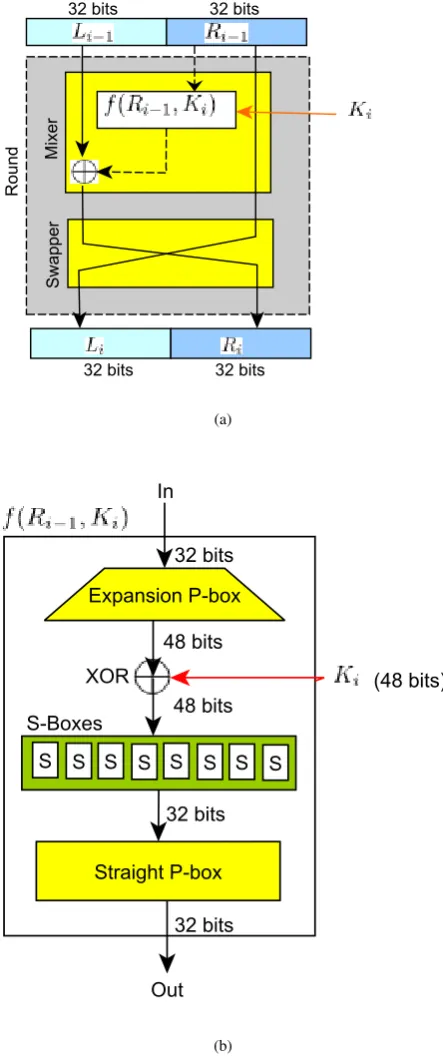
andIP−1 permutations are inverses with each another. DES cryptography algorithm uses 16 rounds.Fig.2(a) shows the structure of single round of DES algorithm. On the other hands, Fig.2(b) shows that the DES function is the core of DES algo-rithm. The DES function takes as input 48 bit of key and produce a 32 bit of output.
4. DOUBLE DES ALGORITHM
This cipher utilizes instances of DES cipher to encrypt and two instances of reverse ciphers to decrypt. Every instance utilizes a different key and the key size is increased twofold [6]. Considering a plain-text P and two encryption keysK1andK2, a cipher-text can
be produced as:
C=E(K2,E(K1,P))
Decryption entails the keys to be employed in reverse manner:
[image:2.595.61.292.74.272.2](a)
(b)
Fig. 2: (a) Single Round of DES, (b) DES function.
5. TOOLS OF PARALLELISATION
A. MPI
[image:3.595.327.541.75.177.2]MPI is a homogenous standard of trading messages between several computers that run a parallel program, by employing
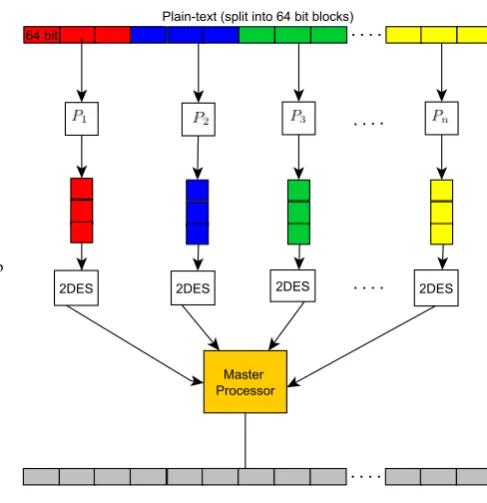
Fig. 3: ECB mode of encryption for 2DES algorithm.
FORTRAN, C or C++. It is a set of library routines, compiler directives, and environment variables which can be utilized for stipulating shared memory parallelism. MPI is devised for al-lowing users to formulate programs which can operate compe-tently on the majority of parallel architectures [13].
Furthermore, the MPI can support distributed program execu-tion on a heterogeneous hardware. In other words, one can run a program which begins processes on several computer sys-tems for operating on the same problem. Such processes are unable to communicate with each other by trading informa-tion by means of shared memory. Rather, they might employ few of the MPI communication routines. The two fundamen-tal routines are MPI-Send (for sending a message to another process) and MPI-Recv (for receiving a message from another process) [14].
B. IMAN1Supercomputer
[image:3.595.68.290.82.614.2]The MPI code used the IMAN1 supercomputer. This super-computer is Jordans first and quickest high-performance com-puting resource, with funding by SESAME and JAEC. It can be used by the academia and for industrial purposes within the expanse of Jordan. IMAN1 offers several resources and clus-ters for running and testing high-performance computing codes [12, 16].
6. PARALLELISATION OF THE2DES
ALGORITHM
The Electronic Code Book (ECB) approach is the easiest way of operation utilised with a block cipher for executing the entire en-cryption algorithm in cryptography [4]. The whole plain-text is split into chunks of fixed length that can be processed individually. The same key as with the unit encrypts each chunk of plain-text, which is converted into a cipher-text block.
The ECB encryption technique is espoused for executing the 2DES algorithm.Fig.3 depicts the ECB encryption technique for this algorithm. Blocks 64−bit in length are generated from the men-tioned plain-text. The ECB mode aids a parallel architecture since the individual plain-text blocks can be processed separately. The cipher-text´s decryption can be carried out in a similar manner. The sequential algorithm could be rendered certain modifications so as to capitalise on the multiprocessing units. As per the parallel computation paradigms [7], the individual parts of the algorithms should be determined and then equipped to work in an independent processor.
b
Fig. 4: Block diagram for Parallel Implementation of 2DES Algorithm.
but instead the blocks are encrypted separately. Doing this success-fully would offer us significant gains in efficacy as well as speedup. Fig.4 depicts the steps that are carried out to do the parallelisation according to the steps given below:
• Allot every processor a copy of the whole data;
• Every processor is allocated a part of the data, divided into 64−bit blocks;
• Every block then undergoes encryption by a processor for cre-ating cipher-text blocks; every processor encrypts its blocks separately; however, the blocks themselves are encrypted in sequence per processor;
• Data is reclaimed using a master processor; cipher-text is writ-ten to the output file.
The result of the parallelisation process is a parallelised 2DES al-gorithm that depicts enhanced performance over a sequential exe-cution.
7. PERFORMANCE ASSESSMENT AND RESULTS
The execution results mentioned in this section make a comparison between the parallel and sequential execution of the 2DES algo-rithm. The sequential 2DES was executed utilizing C programming language. It has been assessed with respect to the execution time of encryption as well as decryption. The sequential experiment was carried out on a laptop with an Intel(R) Core(TM)i7−4500U hav-ing a RAM of 8GB and a speed of 2.4 GHz. The file sizes were in the range of 8KB to 16MB.
[image:4.595.56.300.73.325.2]Conversely, the parallel 2DES was executed using MPI library and C language. It was assessed with respect to speedup, running time, and parallel efficacy performance metrics as per various file sizes and varying quantity of processors. On average, three runs are con-sidered for recording the outcomes. The parallel experiment was
Table 1. : The Hardware and Software Specifications.
Hardware specification Dual Quad Core Intel Xeon CPU with SMP, 16 GB RAM Software Specification Scientific Linux 6.4 with open MPI 1.5.4, C and C++ compiler.
File size 8KB, 16KB, 32KB,64KB,128KB, 265KB, 1MB Number of Processors 1, 2, 4, 8, 16, 32, 64
0 0.5 1 1.5 2 2.5 3 3.5 4 4.5 5 5.5 6 6.5 7
64CPU 32CPU 16CPU 8CPU 4CPU 2CPU Sequntial 2DES
Ex
ecuti
o
n
T
im
e in Seco
nds
Number of Proessors
8KB
16KB
32KB
64KB
128KB
256KB
512KB
[image:4.595.313.557.74.304.2]1MB
Fig. 5: Execution Time for Sequential and parallel 2DES.
carried out on a IMAN1 supercomputer real distributed system. The software and hardware details coupled with the used execution parameters are mentioned inTable1.
7.1 Run Time Assessment
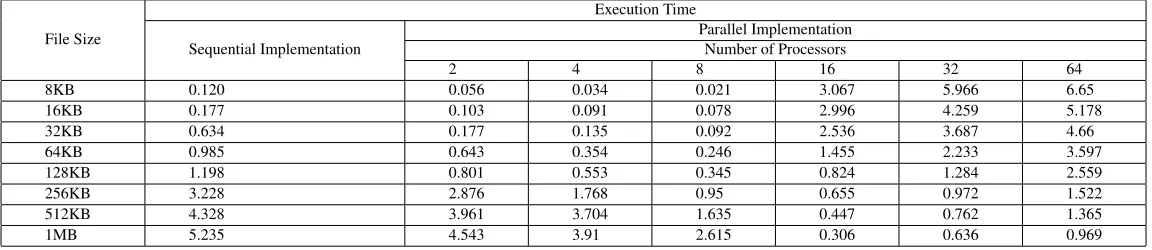
Table2 depicts the run time of parallel and sequential execution of the 2DES algorithm for various file sizes with varying quantity of processors. As shown in the table, as the size of data grows, the run time goes up because of the higher time needed for data split-ting and collection. The outcomes indicate that deploying up to 8 processors at the same time with the 2DES can deliver improved outcomes compared to the sequential one. It can be concluded that as the size of the file grew, the parallelised code with two processors decreased the time in comparison with the sequential time required for encrypting a file.Fig.5 indicates that the sequential codes ex-ecution time is more compared to the parallelised code. When the size of the file is under 16KB, the difference is negligible. Thus, when the size of the file grows, the differences between parallel and sequential running time would rise considerably.
7.2 Speedup Assessment
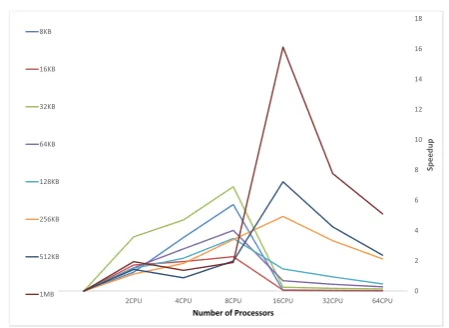
0 2 4 6 8 10 12 14 16 18
64CPU 32CPU 16CPU 8CPU 4CPU 2CPU
Speedu
p
Number of Processors 8KB
16KB
32KB
64KB
128KB
256KB
512KB
[image:5.595.65.290.79.243.2]1MB
Fig. 6: The Speedup of parallel 2DES.
8. CONCLUSION AND FUTURE WORKS
2DES is utilized in several real-time applications. Therefore, it is essential to encrypt and decrypt big files in real time. The objective of this paper is to decrease the time of encryption and decryption for the 2DES algorithm. A parallel 2DES encryption algorithm in ECB operation mode is devised and executed by utilizing the MPI library. Here, the plain-text is split into equal partitions which equal the quantity of processors available. The experiment outcomes are executed on an IMAN1 supercomputer. Following the assessment of the execution time and the speedup, the parallel execution of the 2DES algorithm utilizing more than one processor consumes less time and offers improved speedup for encrypting and decrypting large-sized files, like videos, compared to the sequential execution. In general, one can say that parallel computation offers an effectual and dependable mode of executing the 2DES algorithm.
Future research will encompass effectual parallel executions of other encryption algorithms, assessed using the IMAN1 supercom-puter for decreasing their execution time.
Acknowledgment
We would like to thank Eng. Zaid Abudayyeh for his support to accomplish this work.
9. REFERENCES
[1] V Beletskyy and D Burak. Parallelization of the data encryp-tion standard (des) algorithm. InEnhanced methods in com-puter security, biometric and artificial intelligence systems, pages 23–33. Springer, 2005.
[2] Eli Biham. A fast new des implementation in software. In International Workshop on Fast Software Encryption, pages 260–272. Springer, 1997.
[3] Ebru Celikel, Jean Davidson, and Colin Kern. Parallel per-formance of des in ecb mode. InComputer Networks, 2006 International Symposium on, pages 134–139. IEEE, 2006. [4] Morris J Dworkin. Recommendation for block cipher modes
of operation: Methods and techniques. 2001.
[5] Ananth Grama.Introduction to parallel computing. Pearson Education, 2003.
[6] Atul Kahate. Cryptography and network security. Tata McGraw-Hill Education, 2013.
[7] Hironori Kasahara and Seinosuke Narita. Practical multipro-cessor scheduling algorithms for efficient parallel processing. IEEE Trans. Comput.;(United States), 100, 1984.
[8] Mazen KHADDOUR, Zhoukun Wang, and Omar Hammami. Performance evaluation and analysis of parallel software im-plementations of tdes on a16-peembedded multiprocessor platform. InNetwork and Service Security, 2009. N2S’09. In-ternational Conference on, pages 1–5. IEEE, 2009.
[9] Ross Anderson1 Eli Biham2 Lars Knudsen. Serpent: A pro-posal for the advanced encryption standard. InFirst Advanced Encryption Standard (AES) Conference, Ventura, CA, 1998. [10] Wei Liu, Rong Luo, and Huazhong Yang. Cryptography
over-head evaluation and analysis for wireless sensor networks. InCommunications and Mobile Computing, 2009. CMC’09. WRI International Conference on, volume 3, pages 496–501. IEEE, 2009.
[11] Wei Liu, Beihua Ying, Huazhong Yang, and Hui Wang. Accu-rate modeling for predicting cryptography overheads on wire-less sensor nodes. InProceedings of the 11th international conference on Advanced Communication Technology-Volume 2, pages 997–1001. IEEE Press, 2009.
[12] IMAN1 Project. Jordan’s national supercompting center. http://www.iman1.jo/iman1/. Accessed: 2017-11-25. [13] J Quinn Michael. Parallel programming in c with mpi
and openmp mcgraw-hill inc. Technical report, ISBN 0-07-058201-7, 2004.
[14] Rolf Rabenseifner, Georg Hager, and Gabriele Jost. Hybrid mpi/openmp parallel programming on clusters of multi-core smp nodes. InParallel, Distributed and Network-based Pro-cessing, 2009 17th Euromicro International Conference on, pages 427–436. IEEE, 2009.
[15] Ronald L Rivest.Testing implementations of DES. MIT Lab-oratory for Computer Science, Cambridge, Mass, 1985. [16] Maha Saadeh, Huda Saadeh, and Mohammad Qatawneh.
Per-formance evaluation of parallel sorting algorithms on iman1 supercomputer. International Journal of Advanced Science and Technology, 95:57–72, 2016.
[17] Bruce Schneier.Applied cryptography: protocols, algorithms, and source code in C. john wiley & sons, 2007.
Table 2. : Execution Times of Sequential and Parallelized Code in Seconds.
File Size
Execution Time Sequential Implementation
Parallel Implementation Number of Processors
2 4 8 16 32 64