A Comparative Study on using Principle Component
Analysis with different Text Classifiers
D. A. Eisa
Mathematics Department Faculty of Science, Assiut University
New Valley, Egypt
Ahmed I. Taloba
Information System Department Faculty of Computers and Information,
Assiut University Assiut, Egypt
Safaa S. I. Ismail
Mathematics Department Faculty of Science, Assiut University
New Valley, Egypt
ABSTRACT
Text categorization (TC) is the task of automatically organizing a set of documents into a set of pre-defined categories. Over the last few years, increased attention has been paid to the use of documents in digital form and this makes text categorization becomes a chal-lenging issue. The most significant problem of text categorization is its huge number of features. Most of these features are redundant, noisy and irrelevant that cause over fitting with most of the classi-fiers. Hence, feature extraction is an important step to improve the overall accuracy and the performance of the text classifiers. In this paper, we will provide an overview of using principle component analysis (PCA) as a feature extraction with various classifiers. It was observed that the performance rate of the classifiers after us-ing PCA to reduce the dimension of data improved. Experiments are conducted on three UCI data sets, Classic03, CNAE-9 and DB-World e-mails. We compare the classification performance results of using PCA with popular and well-known text classifiers. Results show that using PCA encouragingly enhances classification perfor-mance on most of the classifiers.
Keywords
Text Categorization, Dimension Reduction, Feature Extraction, Principle Component Analysis, Classifiers
1. INTRODUCTION
Most text analysis, such as text categorization (TC), includes an essential step of feature extraction to find the best set of features that assimilate each text. Text categorization is one of the central problems in text mining and information retrieval, where it is the task of classifying documents by the words of which the documents include. Several machine learning algorithms have been developed for text classification, e.g.: decision tree (J-48) [1], k-nearest neighbor (KNN) [2], support vector machine(SVM) [3] and random forests (RF) [4]. Thus, these text classifiers give acceptable accuracy with high dimensional data such as text.
There are many applications of text categorization such as topic detection [5], phishing email detection[6], author identifica-tion [7]and etc.
In text categorization, a text or a document is always represented as a bag of words. The high dimensionality of the feature space emerged as a critical problem due to this representation. This huge number of features in the feature vector results in time complexity [8] and poor performance of the classifier, so the number of input variables have to be reduced before applying a text categorization algorithm. The reduction of the feature space makes the training faster, improves the accuracy of the classifier by removing the noisy features and avoid overfitting.
The dimensionality reduction in text categorization can be made in two different ways: feature selection and feature extrac-tion. In feature selection techniques, the most relevant variables are kept from the original data set, where as in feature extraction techniques, the original vector space is transformed into a new one with some special characteristics and the reduction is made in a new vector space. From the most popular feature extraction techniques are principle component analysis (PCA) [9][10], latent semantic indexing[11], clustering methods[12][13] and etc.
Among these many methods, PCA has attracted a lot of at-tention. PCA is a tool to reduce feature vector to lower dimension while retaining most of the information. It has been used since the early 90s in text processing tasks [12][14]. PCAs key advantages are its low noise sensitivity, reduce the need for capacity and mem-ory, does not need large computations and increased efficiency given the classifiers taking place in a smaller dimensions [15].
accuracy are mostly used. Experiments are conducted on three UCL data sets [16], which are Classic03, CNAE-9 and DBWorld e-mails collection for text classification.
2. PREVIOUS WORKS
In [17] they try to speed feature extraction by using a method that folds together Unicode conversion, forced lowercasing, word boundary detection, and string hash computation. The method they found require less computation and less memory to find the integer hash features result in classifiers with equivalent statistical performance to those built using string word features.
In [18] they modulate the classifier performance. They use two-stage feature selection and feature extraction methods. In the first stage, according to the importance for classification each term within the document is ranked using the information gain (IG) method. In the second stage, the dimension reduction step, they use genetic algorithm and principle component analysis for feature selection and feature extraction after ranking the terms in descending order of importance.They apply their model on two UCI data sets, Reuters-21,578 and Classic03 which are collected for text categorization. The experimental results show that their proposed model actualizes high classification effectiveness as measured by precision, recall and F-measure.
In [19] they try to solve the high dimension of the feature vector problem for text categorization. They use a multistage model to enhance the overall accuracy and the performance of classification. In the first stage, the documents are processed and each document is represented by a bag of words. In the second step each term within the documents are ranked according to their importance for classification using the information gain (IG). Then the third stage is the attribute reduction step based on rough set which is carried out on the terms which are ranked according to their importance. Finally the extracted features are then passed to naive bayes and KNN classifier. They apply their model on three UCI data sets, Reuters-21578, Classic04 and Newsgroup 20.
In [6] they try to solve a critical text classification applica-tion, phishing email detection. They use two feature selection techniques - chi-square, information gain ratio and two feature extraction techniques principal component analysis, latent seman-tic analysis are used for extracting the features that improve the classification accuracy. The data set used is prepared by collecting a group of e-mails from the well known publicly available corpus that most authors in this area have used. Phishing data set con-sisting 1,000 phishing emails received from November 2004 to August 2007 provided by Monkey web site and, 1,700 Ham email from Spam Assassin project.
In [20] a term frequency (TF) with stemmer-based feature extraction method is proposed for document classification. The classification accuracy was calculated using J-48 classification algorithm. The effectiveness of proposed method was investi-gated and compared against well known other feature extraction techniques.
3. THE PROPOSED METHOD
The stages in text categorization (TC) we will follow in our work is composed of the following steps:
3.1 Documents Collection
This is the initial step of any text categorization process in which documents of several format like .html, .pdf, .doc, web content and etc. are collected.
3.2 Preparing the Text for Classification
Pre-processing of documents is an essential task during text cate-gorization process before using the classifier in order to transform documents, which typically are strings of characters, into a set of words, which is a suitable representation for the learning algorithm, and at the same time enriching their semantic meaning. Documents filtering and stemming are applied in the extracted bag of words we have to reduce the dimensionally.
3.2.1 Stop Words Removal. Words such as pro-nouns, preposi-tions and articles, etc. in texts does not affect on the meaning of the documents. These words are called stop words. The removing of these words from the bag of words is an essential step such that these words are useless for purposes of retrieval. The stop words are not measured as a keywords in text mining applications [21]. Ex-ample for stop words: ”the”,”a”, ”an”, ”with”, etc. Removing stop words reduces the term space such that these words make the text look heavier and less important for analysts.
3.2.2 Stemming. This step is used to identify the words to its root. For example, extracted, extracting, extracts, extraction all can be stemmed to the word ”extract” [22]. The aim of this step is to eliminate various suffixes, to decrease the number of words, to have accurately matching stems, to save time and memory space.
3.3 Indexing
After the pre-processing step, each document is represented by a bag of words. We have to find the technique that create a vector representation of each document. So this step decrease the complexity of the documents and make them easier to handle. Each word is assigned a weight based on its number of times it appears in the document as shown in the following matrix. This process is known as term weighting.
T1 T2 .. Tat Ci
D1 W11 .. Wt1 C1
D2 W12 .. Wt2 C2
. . .. . . . . .. . . Dn W1n .. Wtn Cn
WhereWinis the weight of wordiin the documentn. We have
to know that there are several ways of calculating weight, such as boolean weighting, word frequency weighting, TF-IDF, entropy, etc. A commonly used term weighting method is the so-called TF-IDF (term frequency - inverse document frequency) weighting, which is a numerical statistic measure used to reflect how impor-tant a word is to a document in a certain class of collection or corpus.
the documentd, document frequency (DF(t)) is number of docu-ments in which the termtoccur at least once and inverse document frequency (IDF) that can be calculated from document frequency using the following formula
IDF= log ( num of documents
num of documents with word i) (1)
The inverse document frequency of a word is low if it occurs in many documents and is high if the word occurs in only few docu-ments. The measure of word important can be calculated by using the product of the term frequency and the inverse document fre-quency (TF * IDF).
3.4 Feature Extraction
After the preprocessing and indexing step we have a matrix of high dimension. Having too many features cause many problems such as overfitting, reduce the accuracy of the classifier and cause high time complexity. Feature extraction will reduce the matrix size and this will improve the scalability, efficiency and accuracy of the classifiers. The main idea of feature extraction is to reduce the features dimension by creating new combinations of attributes (words). Choosing right features and deciding how to encode them to be an input for the classifier can have an enormous impact on the classifier ability to extract a good model.
Principle component analysis (PCA) is one of the most popular sta-tistical technique for feature extraction.PCA help to improve the discriminative power of the classifiers. PCA is a useful statisti-cal technique that many applications can be used it, such as face recognition and image compression, and is a popular technique for finding patterns in data of high dimension without losing impor-tant information such as text categorization. It is used to project the original feature space onto a lower dimensional subspace. The key idea in PCA is to find a subset of variables from a larger set, based on which original variables have the highest correlations with what is called principal components [15]. The number of the principle components is less than or equal to the number of the original fea-tures. It is an acceptable choice for reducing the dimensionality of highly dimensional data.
3.5 Text Classifiers
There are many classifiers that have been developed for variety of tasks in text classification and they give acceptable accuracy. Among them we will use the following classifiers and show how the accuracy improved after using PCA as a feature extraction:
Random Forest (RF):RF is a very good, powerful, robust and ver-satile learning technique, however it is a promise choice for high-dimensional text data. It is introduced in 2000s [4], it is a pop-ular classification method which builds multiple decision trees (not only one), which are used to determine the final outcome. For classification problems, the ensemble of simple trees vote for the most popular class. One of the most known forest construc-tion procedures, proposed by Breiman, is a subspace of features which are chosen randomly at each node to grow branches of the decision trees, then bagging method is used to generate training data subsets for building individual trees, finally combination of all individual trees are formed to form random forests model [4]. Support Vector Machine (SVM): SVM has been recognized as one of the most effective text categorization method. It gives high classification accuracy especially in highly dimensional
data such that it controls complexity and overfitting issued. The time taken for each process is less than the other classifiers. So that it becomes an acceptable choice for large data set as textual data. SVMs are designed to handle high-dimensional data. SVM was developed in 1995 by Cortes and Vapnik [23]. Its core idea behind SVM is to find an optimal hyper plane between sets of hyper plane that maximize hyper plane margin, which is the dis-tance from hyper plane to the nearest point of the pattern [23] [24]. The document representatives which are closest to the de-cision surface are called the support vectors. SVM is primarily used to maximize the margin, which will ensure that the input pattern would be classified correctly [25].
The aim of SVM is to find out the best possible classifica-tion funcclassifica-tion in order to differentiate between members of two classes in the training data in a two-class learning task. Decision Tree Algorithm (J-48):The decision tree reconstructs the
manual categorization of training documents by making well de-fined true/false-queries in the form of a tree structure. In the decision tree structure, leaves represent the corresponding cat-egory of documents and branches represent conjunctions of fea-tures that lead to those categories. The tree expands until each and every text is categorized correctly or incorrectly. The well-organized decision tree can easily categorize a document by putting it in the root node of the tree and let it run through the query structure until it reaches a certain leaf which represents the goal for the classification of the document. The decision tree classification method have several advantages over other deci-sion support tools. The main advantage of decideci-sion tree is that it is easy in understanding and interpreting, even for non-well rounded users. Also, they are robustness to noisy data and they have the ability to learn disjunctive expressions seem suitable for text categorization. The major drawback of using a decision tree is over fits the training data with the occurrence of an alternative tree that categorizes the training data worse but would catego-rize the documents to be categocatego-rized better. One of the most well known decision tree algorithm is J-48 that we will use in our work.
K-Nearest Neighbor (KNN):The KNN is one of the simplest lazy classification algorithm [26] [27] and it is also well known as instance-based learning. The KNN classifier is based on the as-sumption that the classification of an instance is most similar to the classification of other instances that are nearby in the vector space. To categorize an unknown document d, the KNN classi-fier ranks the documents among training set and tries to find its k-nearest neighbors, which forms a neighborhood of d. Then ma-jority voting among the categories of documents in the neighbor-hood is used to decide the class label of d. KNN is an instance-based where the function is only approximated locally and all computation is adjourned until classification. KNN is used in many applications because of its effectiveness, non-parametric and it is easy to be implemented. However, when we use KNN, the classification time is very long and it is not easy to find opti-mal value of k. Generally, the best alternative of k to be chosen depends on the data. Also, the effect of noise on the classification is reduced by the larger values of k but make boundaries between the classes less distinct. By using various heuristic techniques, a good ’k’ can be selected.
3.6 Performance Measures for Text Classification
In our study we will use the following criteria; confusion matrix, classification accuracy, analysis of sensitivity, specificity and F-measure.
[image:4.595.377.494.66.143.2]3.6.1 Confusion Matrix. The confusion matrix consist of four classification performance indices: true positive, false positive, false negative, and true negative as given in Table 1. They are also usually used in the classification problem to evaluate the perfor-mance.
Table 1. The four classification performance indices of the confusion matrix.
Pretdicted Class
Actual class Classified aspos Classified asneg pos True Positive (TP) False Negative (FN)
neg False Positive (FP) True Negative (TN)
3.6.2 Classification Accuracy. In our study, the classification ac-curacy for the data sets are calculated with the following equation:
Accuracy(%) = TP + TN
TP +FN + FP + TN×100, (2) 3.6.3 Analysis of Sensitivity, Specificity and F-measure. sensitiv-ity, specificity and F-measure are widely used to evaluate text cat-egorization system. Specificity is the proportion of correctly pro-posed document to the propro-posed document. Sensitivity (Recall) is the proportion of the correctly proposed documents to the test data that have to be proposed. For calculating the sensitivity and the specificity of each class we use the following equations.
Sensetivity(%) = TP
(TP+FN)×100, (3)
Specif icity(%) = TN
(TN+FP)×100, (4)
F-measure is a measure of test’s accuracy. It is a harmonic mea-sure of both sensitivity and specificity. It is given by the following equation
F−measure(%) =2×Sensetivity×Specif icity
Sensetivity+Specif icity ×100,
(5)
4. EXPERIMENTAL RESULTS AND ANALYSIS
In this section, we present a series of experiments for text catego-rization on three different standards and popular text collection to examine the performance of using principle components analysis (PCA) with different text classifiers; standard RF, standard SVM, the J-48 decision tree and KNN methods are used in our study such that they are simple and give acceptable performance mea-surements in text categorization. The outline of the text data we used is in Table 2, where the data is downloaded from UCI machine learning databases [16]. For the classification stages we select a10 fold cross validation. All experiments are run on a personal com-puter with the configuration of Windows 7 Operation system, 1.8 GHz CPU, 2 GB of RAM and 500 GB HDD space. To evaluate the performance of the different classifiers we use WEKA 3.8.1 soft-ware which is developed by the University of Waikato [28].
[image:4.595.378.494.183.258.2]In our study, after pre-processing the data by eliminating the stop words which are worthless for classification and using porter
[image:4.595.378.493.299.376.2]Fig. 1. Random forest classification accuracy with and without using PCA.
Fig. 2. Support vector machine classification accuracy with and without using PCA.
Fig. 3. Decision tree (J-48) classification accuracy with and without using PCA.
algorithm for stemming step [21], we use TF-IDF weighting scheme to reflect the important of the word to the document. This is followed by using PCA, which gives an acceptable results when dealing with text data, to reduce the huge size of the matrix we have. Then finally the extracted features are then passed to various classifiers. We first separately examine the performance of various classifiers, we have mentioned above, without using PCA for feature extraction. Then we examine these various classifiers after using PCA. The aim of using various classifiers is to compare the performance of these methods before and after using PCA.
Tables 3, 5, 7 and 9 present the results obtained for the three data sets for standard RF, SVM, J-48 and KNN classifiers respectively. However, obtained results in Tables 4, 6, 8 and 10 show that using PCA to reduce the features vector before using the standard classi-fiers improve the accuracy with most of the data sets compared to the standard case.
Results in Tables 3 and 4 show that when using RF as a classifier it gives acceptable and higher accuracy when compared to the rest of classifiers we use. The results in Table 4 show the improvement occur in accuracy after using PCA in the three data sets.
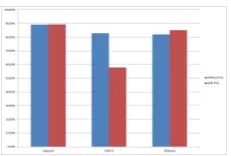
Fig. 4. K-nearest neighbor classification accuracy with and without using PCA.
Tables 7 and 8 show the performance of J-48 with our text data sets. Combining PCA and J-48 together improve the performance of J-48 with all data sets we use.
Results in Tables 9 and 10 show the performance of KNN classifier. When we compare the results in the two tables in DBworld data set we find that PCA fail to improve the performance of the KNN classifier.
With the respect to all experimental results shown above, it is seen that RF algorithm gives higher performance with text data when compared with other classifiers and its performance is improved after using PCA.
Figures 1, 2, 3, and 4 show the comparison of the classification accuracy of various classifiers we use before and after using PCA as a feature extraction technique on the different text data sets. The classification accuracy of most of the classifiers we use is improved after using PCA. Figures show that the improvement performance is much more marked with the classifier random forest (RF) when used on Classic03 data set as compared to other data sets.
5. CONCLUSION
In this study, we use principle component analysis (PCA) as a fea-ture extraction technique to reduce the high dimensionality of the feature vector. PCA removes the irrelevant, noisy and redundant features from the feature vector and thereby improve the perfor-mance of the classifier for text categorization. First, we pre-process the documents where the feature vector is obtained through differ-ent steps like stop words removal, stemming and indexing. On the core preprocessed documents the classifiers RF, SVM, KNN and J-48 are applied, without dimension reduction, and the performance of the classifiers are observed in terms of sensitivity, specificity and F-measures. Secondly, the feature extraction method principle component analysis (PCA) is applied in the core features and the feature dimension is reduced. Then the classifiers we mentioned above are applied on the extracted features. Most of the obtained re-sults show that the performance of most of the classifiers improved after using PCA and this seems very promising for text categoriza-tion applicacategoriza-tions.
Future scope of the work for text categorization is dimension re-duction, computational time and complexity by improving different feature extraction algorithm. Also the classification performance can be improved by using different hybrid model which seems very promising for text categorization.
Acknowledgment
The authors would like to thankDr. Rasha Mahmoud for many constructive technical discussions and for comments that greatly improved the manuscript. During my working on this paper, I learnt many things from her including building a system set up, provided
Table 2. Data Set Description
Data Set No.of Doc NO. of original Features Classes
Classic03 3830 100 3
DBworld 64 229 2
[image:5.595.116.232.64.142.2]CNAE-9 1080 856 9
Table 3. The Performance(average value of precision, sensitivity and F-measure)of RF Classifier on Three Data Sets
without PCA
Data set N. of FeaturesPrecision Sensitivity F-measure Accuracy
Classic03 100 95.9% 95.9% 95.9% 95.9%
DBworld 229 82.7% 79.7% 79.6% 79.6%
CNAE-9 856 90.4% 90.3% 90.3% 90.2%
Table 4. The Performance(average value of precision, sensitivity and F-measure)of RF Classifier with PCA
Data set N. of FeaturesPrecision Sensitivity F-measure Accuracy
Classic03 86 96.4% 96.4% 96.4% 96.3%
DBworld 52 87.7% 87.5% 87.5% 87.5%
CNAE-9 397 93.6% 93.6% 93.6% 93.6%
Table 5. The Performance(average value of precision, sensitivity and F-measure)of SVM Classifier on Three Data Sets
without Using PCA
Data set N. of FeaturesPrecision Sensitivity F-measure Accuracy
Classic03 100 95.8% 95.7% 95.7% 95.71%
DBworld 229 84.4% 84.4% 84.4% 84.37%
CNAE-9 856 91.1% 90.8% 90.9% 90.83%
Table 6. The Performance(average value of precision, sensitivity and F-measure)of SVM Classifier with PCA
Data set N. of FeaturesPrecision Sensitivity F-measure Accuracy
Classic03 86 95.9% 95.8% 95.8% 95.79%
DBworld 52 87.7% 87.5% 87.5% 87.5%
CNAE-9 397 94.4% 94.2% 94.2% 94.16%
Table 7. The Performance(average value of precision, sensitivity and F-measure)of J-48 Classifier on Three Data Sets
without Using PCA
Data set N. of FeaturesPrecision Sensitivity F-measure Accuracy
Classic03 100 94% 94% 94% 94.4%
DBworld 229 81.6% 75% 74.3% 75%
CNAE-9 856 78.6% 78.3% 78.4% 78.33%
Table 8. The Performance(average value of precision, sensitivity and F-measure)of J-48 Classifier with PCA
Data set N. of FeaturesPrecision Sensitivity F-measure Accuracy
Classic03 86 95.9% 95.8% 95.8% 95.79%
DBworld 52 79.4% 76.6% 76.4% 76.56%
CNAE-9 397 90.4% 88.8% 89.1% 88.79%
Table 9. The Performance(average value of precision, sensitivity and F-measure)of KNN Classifier on Three Data Sets
without Using PCA
Data set N. of FeaturesPrecision Sensitivity F-measure Accuracy
Classic03 100 89.7% 89.2% 89.2% 89.1%
DBworld 229 86% 82.8% 82.7% 82.81%
Table 10. The Performance(average value of precision, sensitivity and F-measure)of KNN Classifier with PCA
Data set N. of FeaturesPrecision Sensitivity F-measure Accuracy
Classic03 86 90% 89.3% 89.3% 89.32%
DBworld 52 72.7% 57.8% 52.4% 57.81%
CNAE-9 379 85.4% 85% 84.8% 85%
guidance for the statistical analysis of my results, etc. I thank her very much for all her help.
6. REFERENCES
[1] N. Ur-Rahman and J. A. Harding, “Textual data mining for industrial knowledge management and text classification: A business oriented approach,”Expert Systems with Applica-tions, vol. 39, no. 5, pp. 4729–4739, 2012.
[2] Y. Yang and J. O. Pedersen, “A comparative study on feature selection in text categorization,” inProceedings of the Four-teenth International Conference on Machine Learning, ICML ’97, (San Francisco, CA, USA), pp. 412–420, Morgan Kauf-mann Publishers Inc., 1997.
[3] T. Joachims, “Text categorization with support vector ma-chines: Learning with many relevant features,” Machine learning: ECML-98, pp. 137–142, 1998.
[4] L. Breiman, “Random forests,”Machine learning, vol. 45, no. 1, pp. 5–32, 2001.
[5] M. Ghiassi, M. Olschimke, B. Moon, and P. Arnaudo, “ Au-tomated text classification using a dynamic artificial neural network model,”Expert Systems with Applications, vol. 39, no. 12, pp. 10967–10976, 2012.
[6] M. Zareapoor and K. Seeja, “Feature Extraction or Feature Selection for Text Classification: A Case Study on Phishing Email Detection,”International Journal of Information Engi-neering and Electronic Business, vol. 7, no. 2, p. 60, 2015. [7] N. Cheng, R. Chandramouli, and K. Subbalakshmi, “Author
gender identification from text,”Digital Investigation, vol. 8, no. 1, pp. 78–88, 2011.
[8] J. Verbeek, “Supervised feature extraction for text categoriza-tion,” inTenth Belgian-Dutch Conference on Machine Learn-ing (Benelearn’00), 2000.
[9] S. L. Lam and D. L. Lee, “Feature reduction for neural net-work based text categorization,” inDatabase Systems for Ad-vanced Applications, 1999. Proceedings., 6th International Conference on, pp. 195–202, IEEE, 1999.
[10] A. Selamat and S. Omatu, “Web page feature selection and classification using neural networks,”Information Sciences, vol. 158, pp. 69–88, 2004.
[11] J.-T. Sun, Z. Chen, H.-J. Zeng, Y.-C. Lu, C.-Y. Shi, and W.-Y. Ma, “Supervised latent semantic indexing for document cat-egorization,” inData Mining, 2004. ICDM’04. Fourth IEEE International Conference on, pp. 535–538, IEEE, 2004. [12] N. Slonim and N. Tishby, “Document clustering using word
clusters via the information bottleneck method,” in Proceed-ings of the 23rd annual international ACM SIGIR confer-ence on Research and development in information retrieval, pp. 208–215, ACM, 2000.
[13] A. I. Taloba, M. R. Riad, and T. H. A. Soliman, “Developing an efficient spectral clustering algorithm on large scale graphs in spark,” inIntelligent Computing and Information Systems (ICICIS), 2017 Eighth International Conference on, pp. 292– 298, IEEE, 2017.
[14] J. C. Gomez, E. Boiy, and M.-F. Moens, “Highly discrimina-tive statistical features for email classification,”Knowledge and information systems, vol. 31, no. 1, pp. 23–53, 2012. [15] S. Karamizadeh, S. M. Abdullah, A. A. Manaf, M. Zamani,
and A. Hooman, “An overview of principal component anal-ysis,”Journal of Signal and Information Processing, vol. 4, no. 03, pp. 173–175, 2013.
[16] M. Lichman, “UCI machine learning repository,” 2013. [17] G. Forman and E. Kirshenbaum, “Extremely fast text feature
extraction for classification and indexing,” in Proceedings of the 17th ACM conference on Information and knowledge management, pp. 1221–1230, ACM, 2008.
[18] H. U˘guz, “A two-stage feature selection method for text cat-egorization by using information gain, principal component analysis and genetic algorithm,”Knowledge-Based Systems, vol. 24, no. 7, pp. 1024–1032, 2011.
[19] H. U˘guz, “A multistage feature selection model for document classification using information gain and rough set,” Inter-national Journal of Advanced Research in Artificial Intelli-gence(IJARAI), vol. 3, no. 11, 2014.
[20] S. Vidhya, D. A. A. G. Singh, and E. J. Leavline, “Feature Ex-traction for Document Classification,”International Journal of Innovative Research in Science,Engineering and Technol-ogy(IJIRSET), vol. 4, no. 6, pp. 50–56, 2015.
[21] M. F. Porter, “An algorithm for suffix stripping,” Program, vol. 14, no. 3, pp. 130–137, 1980.
[22] M. F. Porter, “Effective PreProcessing Activities in Text Min-ing usMin-ing Improved Porter’s StemmMin-ing Algorithm,” Interna-tional Journal of Advanced Research in Computer and Com-munication Engineering, vol. 2, no. 12, pp. 4536–4538, 2013. [23] C. Cortes and V. Vapnik, “Support-vector networks,”Machine
learning, vol. 20, no. 3, pp. 273–297, 1995.
[24] Z. Li, R. Yuan, and X. Guan, “Accurate classification of the internet traffic based on the svm method,” inCommunications, 2007. ICC’07. IEEE International Conference on, pp. 1373– 1378, IEEE, 2007.
[25] C.-C. Chang and C.-J. Lin, “LIBSVM: a library for support vector machines,”ACM Transactions on Intelligent Systems and Technology (TIST), vol. 2, no. 3, p. 27, 2011.
[26] J. Wang and X. Li, “An improved KNN algorithm for text clas-sification,” inInformation Networking and Automation (IC-INA), 2010 International Conference on, vol. 2, pp. V2–436, IEEE, 2010.
[27] G. Guo, H. Wang, D. Bell, Y. Bi, and K. Greer, “KNN model-based approach in classification,” inOTM Confederated In-ternational Conferences” On the Move to Meaningful Inter-net Systems”, pp. 986–996, Springer, 2003.