Decentralized Authorization for Web Services
Paraskevas Stefas
A dissertation submitted to the University of Dublin, in partial fulfilment of the requirements for the degree of Master of Science in Computer Science
Declaration
I declare that the work described in this dissertation is, except where otherwise stated, entirely my own work and has not been submitted as an exercise for a degree at this or any other university
Signed: ___________________ Paraskevas Stefas
Permission to lend and/or copy
I agree that Trinity College Library may lend or copy this dissertation upon request.
Signed: ___________________ Paraskevas Stefas
Acknowledgements
Abstract
Web Services is an area that encountered a very sudden and huge explosion on its
popularity during the latest years. The advantages Web Services provide compared to
traditional distributed computing methods such as Remote Procedure Calls and
Distributed Objects were found to be very appealing by researchers and users and
this lead to a huge development effort resulting in the creation of many standards and
specifications in a rather short period of time. This fact made a lot of security experts
to believe that the supporters of Web Services had not given the appropriate
consideration on the security aspects of their use. Many analysts showed that the
security risks were numerous from such a rapid development without the appropriate
attention on security. The response from the Web Services community was the
creation of many Workgroups that concentrated their efforts in providing common
security mechanisms to Web Services.
This dissertation investigates a different approach to Web Services security. We focus
on distributed authorization and access control for the development of a security
system for Web Services. The result is WebÆTHER which is a trust management
system for Web Services based on the ÆTHER system that was originally designed for
use in a ubiquitous environment. The system is relies on current technologies for the
implementation of the Web Service used and is composed by the Web Service and the
extra layer that provides the ÆTHER core functionality. This approach makes the
evaluation of this effort easy and comparable to current solutions in the field of Web
Services security.
The implemented Web Service is a file sharing application. The implementation
results are 2014.54 milliseconds average time for the transfer of a 10.4 megabytes file
that was used in the Web Service and the average overhead from the inference engine
Table of Contents
1 Introduction...1
1.1 Motivation...1
1.2 Proposed Goals ...2
1.3 Document Overview ...2
2 Background ...4
2.1 Access control...4
2.1.1 Authentication...4
2.1.2 Authorization ...4
2.2 Public Key Cryptography Access Control...5
2.2.1 PKI ...6
2.2.2 PMI ...8
2.3 PGP ...11
2.4 Role Based Access Control...13
2.5 Web Services ...15
2.5.1 Web Services standards ...16
2.5.1.1 SOAP ...17
2.5.1.2 REST...18
2.5.2 Security in Web Services ...19
2.5.2.1 XML Encryption & Signatures...19
2.5.2.2 SAML ...20
2.5.2.3 XACML ...20
2.5.2.4 XKMS ...21
2.5.2.5 WS-Security...22
2.5.2.6 WS-Policy ...22
2.5.2.7 WS-Trust...23
2.5.2.8 Discussion ...23
2.6 Summary ...24
3 Distributed Authorization & Access Control...26
3.1 Introduction...26
3.3 ÆTHER...30
3.4 Summary ...34
4 Design ...37
4.1 System Overview ...37
4.2 Architecture...37
4.2.1 Policy Statements...39
4.2.2 Policy Distribution ...40
4.2.3 Certificate Revocation ...44
4.2.4 Service Discovery ...46
4.2.5 Certificate Acquisition ...46
4.2.6 System Components...49
4.2.7 System Logic ...50
4.3 Summary ...53
5 Implementation ...54
5.1 Overview...54
5.2 Apache Web Server & gSOAP ...54
5.3 WebÆTHER Model Implementation and system components ...57
5.4 Implementation of the Service Query function...59
5.5 Implementation of the Service function...61
5.6 Implementation of Certificate Acquisition ...64
5.7 Summary ...65
6 Evaluation ...66
6.1 Overview...66
6.2 Performance of serviceA function ...67
6.3 System performance...70
6.4 Summary ...74
7 Conclusions & Future Work ...75
Table of Figures
Figure 2-1: Authorization Example ...5
Figure 2-2: Hierarchical Trust Model ...8
Figure 2-3: PKI model ...10
Figure 2-4: PMI model...10
Figure 2-5: Web of trust example ...13
Figure 2-6: RBAC model...14
Figure 2-7: Web Services Example ...16
Figure 2-8: Web Services Security overview ...24
Figure 3-1: Keynote input/output...28
Figure 3-2: Credential giving Bob access to a file...28
Figure 3-3: Credential from Bob giving Alice read-only access to a file...29
Figure 3-4: Permission modelling in ÆTHER...31
Figure 3-5: ÆTHER input/output ...34
Figure 3-6: Keynote implementation ...35
Figure 3-7: ÆTHER implementation...36
Figure 4-1: WebÆTHER model ...39
Figure 4-2: CompanyA example...41
Figure 4-3: merged companies example ...43
Figure 4-4: request handle approach...47
Figure 4-5: AC service...48
Figure 4-6: System components...49
Figure 4-7: Service Query...51
Figure 4-8: Service Request/Response ...52
Figure 5-1: Implemented system components ...58
Figure 5-2: model operations ...58
Figure 5-3: serviceAreq server side ...60
Figure 5-4: serviceAreq client side ...61
Figure 5-5: ServiceA implementation...63
Figure 6-1: attribute certificate number versus time...68
Figure 6-3: delegation depth versus time for threshold value 2...70
Figure 6-4: handshake compared to complete implementation ...71
Figure 6-5: Inference engine overhead ...72
Figure 6-6: components overhead...73
1
Introduction
1.1
Motivation
Web Services is an area that encountered a very sudden and huge explosion on its popularity during the latest years. The advantages Web Services provide compared to traditional distributed computing methods such as Remote Procedure Calls and Distributed Objects were found to be very appealing by researchers and users and this lead to a huge development effort resulting in the creation of many standards and specifications in a rather short period of time.
This fact made a lot of security experts to believe that the supporters of Web Services had not given the appropriate consideration on the security aspects of their use and many analysts showed that the security risks were numerous from such a rapid development without the appropriate attention on security.
The result was the creation of many work groups and a great effort in order to create standards concerning the security of web services along with the evolution of new protocols used especially for security purposes. Because of the fact that Web Services had advanced further than their security, most of the work groups concentrated their efforts to give Web Services the security assurances that traditional security mechanisms provide.
1.2
Proposed Goals
The main goal of this dissertation project is the design and implementation of a trust management system in the area of Web Services. The system is going to provide access control for a Web Service while being able to handle a large scale application effectively. In order to achieve the main goal of this project, the following parts have to be achieved:
• In depth understanding of the current efforts and technologies on Web Services security.
• Investigating how appropriate is the application of a trust management system on web services compared to traditional security mechanisms.
• The definition of a trust management model that is appropriate for use in Web Services.
• To measure the performance of the implemented system in a real world usage scenario and locate possible issues.
1.3
Document Overview
The rest of the document is organized as follows.
• Chapter 2 is consisted of two parts with background information. The first part of the chapter provides information on security concepts and mechanisms. The second part of the chapter presents web services and the most common technologies they use and finally the current efforts on web services security. • Chapter 3 presents the state of the art on distributed authorization and access
control and analyzes the features of two currently available systems. • Chapter 4 the design of WebÆTHER system is analysed.
• Chapter 6 presents the evaluation of the WebÆTHER system. The metrics that were used in measurements are presented along with diagrams to illustrate the performance of the system’s components.
2
Background
2.1
Access control
By the term Access Control we mean the set of policies and mechanisms that restrict or allow access on a set of resources. Access Control is composed by two separate processes which are Authentication (determining the identity of a user by using enough provided proof) and Authorization (allowing access to the appropriate resources for the specific user).
2.1.1 Authentication
Authentication is the process of a user proving to a system his identity. Authentication can be performed by using a knowledge that only the user and the system share (for example a username-password pair) or by using something only a specific user has and is either physical (fingerprints, voice pattern etc) or technical (for example a smartcard). The most commonly used traditional Authentication mechanism is password systems, while other common mechanisms are Kerberos [1], Certificates in SSL connections, Biometrics [2] and other. Authentication mechanisms have nothing to do with access rights of a user and only ensure that the user is the one he claims to be.
2.1.2 Authorization
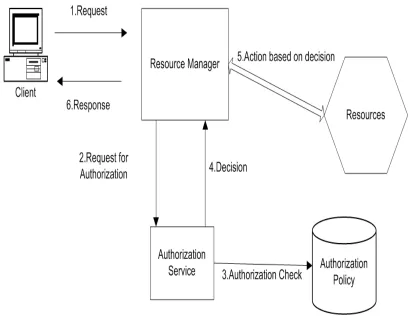
on a specific resource. Using ACLs and user groups, specific security policies are able to be implemented. Figure 2-1 illustrates an authorization mechanism example.
Figure 2-1: Authorization Example
2.2
Public Key Cryptography Access Control
Public key cryptography which was invented by Whitfield Diffie and Martin Hellman in the late 1970’s allowed among others the evolution of digital signatures. Public key cryptography is based on cryptographic keys coming in pairs, a public and a private key. The public key is distributed to many people and allows the decryption of messages that are encrypted with the private key which is kept secret. This way it is possible to make sure of the sender’s identity.
This way the recipient can make sure that the original message was not modified during transmission.
A digital certificate is the attachment of a digital signature to an electronic message for security purposes such as verifying the sender’s identity. A public key certificate is a specific kind of digital certificate that binds a public key with an identity and can be used to verify that a public key belongs to an individual.
2.2.1 PKI
PKI (Public Key Infrastructure) which is described in X.509 standard [3] provides a framework to verify the identities of each entity in a given domain. It uses public key certificates [4], which are data structures binding a name with a public key that are digitally signed by a trusted third party. The framework includes the requesting, issuing, signing and validating the public key certificates. The third party’s signature can be verified by every principal in the system and a trusted third party is called Certificate Authority (CA).
An X509 public key certificate contains the following information and is also digitally signed by the issuer in order to provide integrity:
• Version: the version number of the certificate.
• Serial number: a unique integer issued by the CA for every certificate.
• Signature: identifier for the algorithm and the hash function used by the CA in signing the certificate.
• Issuer: the entity that issued the certificate.
• Validity: a time interval in which the CA warrants for the validity of the certificate.
• Subject: the entity associated with the public key found in the certificate. • Subject public key info: the subject public key and the algorithm which this
key is instance of.
• Subject unique identifier: used to uniquely identify the subject in case of name reuse.
• Extensions: allows extra fields in the data structure
• Certificate Signature Algorithm: the algorithm that was used to sign the certificate.
• Certificate Signature: the digital signature.
The public-private key pair can be generated by the user, a third party or the CA. The creation and validation of public key certificates can only be done on a CA according to X.509.
The public key certificates can expire or be revoked by the CA prior to the expiration date. In order for the relying parties to be informed of revocations a mechanism called Certification Revocation List (CRL) is used. CRL is a data structure containing a list of revoked certificate serial numbers that is time-stamped and digitally signed by the Certification Authority.
According to PKI standards there are two types of certificates, user certificates and
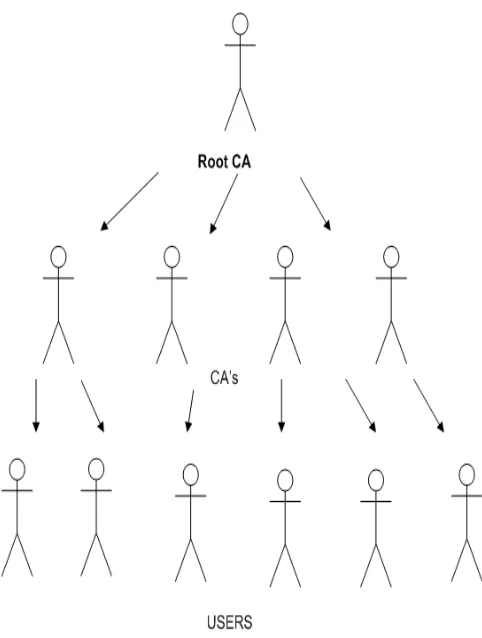
CA certificates. A user certificate is issued to a subject that is not an issuer itself and CA certificates are issued by CAs to subjects that are also CAs. The latter kind of certificate is called cross certificate and the lists of cross certificates are called certification paths. The decision if a CA is going to be trusted can be done by examining its certificate. The chain ends at the root certificate that is issued by the
Root CA that can be considered as the ultimate certification authority and root certificates are implicitly trusted and this trust model is called Hierarchical.
Figure 2-2: Hierarchical Trust Model
2.2.2 PMI
PMI (Privilege Management Infrastructure) [5] provides a framework to determine if an entity with a public key certificate is authorized to access a specific resource. PMI includes the issuing and validation of attribute certificates. Attribute certificates are digitally signed data structures which bind privileges to entities. Attribute Certificates are issued by Attribute Authorities (AA). Privilege Management Infrastructure can be established and managed independently from a PKI since it does not provide a mechanism to trust certificates’ holders. Instead, PKI is used to authenticate issuers and holders of attribute certificates.
• Version: the version number of certificate.
• Holder: the identity of the attribute certificate ’s holder • Issuer: the identity of the AA that issued the certificate
• Signature: the cryptographic algorithm used to digitally sign the attribute certificate.
• Serial number: the serial number that uniquely identifies the attribute certificate within the scope of its issuer.
• Validity: the time period during which the attribute certificate is considered valid.
• Attributes: the attributes for the holder that are being certified.
• Issuer unique ID: used to uniquely identify the issuer where the issuer component is not sufficient.
• Extensions: allows extra fields in the data structure.
• Attribute Certificate Signature Algorithm: the algorithm that was used to sign the attribute certificate.
• Attribute Certificate Signature: the digital signature.
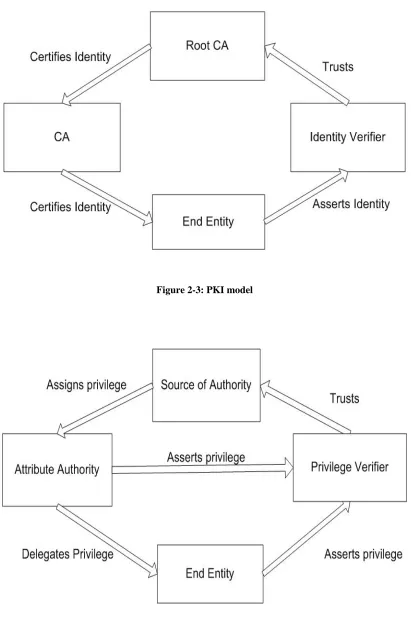
In PMI Attribute Authorities (AAs) and Certification Authorities (CAs) are independent. There is an entity called Source of Authority (SOA) which is itself an Attribute Authority and, in analogy to the root CA in PKI, is the entity that is trusted by a privilege verifier as the ultimate entity responsible for privilege assignment. A SOA can issue certificates to other entities that can also act as AAs and further delegate the privilege. This feature is called privilege delegation and may continue through several intermediate AAs.
Figure 2-3: PKI model
[image:19.595.98.498.68.327.2]2.3
PGP
PGP [6] is a cryptographic system used for authentication and encryption that was designed and developed by Phil Zimmermann in 1991. It uses public key cryptography and symmetric key cryptography. In PGP a sender uses a recipient’s public key to encrypt a shared secret key that is going to be used to encrypt the plaintext message with a symmetric cipher algorithm. In order to ensure that a message was not altered during transmission, PGP uses digital signatures. The users’ public keys are stored in special data structures called key rings. There are public and secret key rings, depending on the type of keys they include. Every PGP user will eventually add in his public key ring the public keys of his recipients. To prevent man-in-the-middle attacks PGP uses digital certificates and for the distribution of certificates storage repositories called certificate servers. Also PKI systems can be used. Both X.509 and PGP certificates are recognized by PGP.
PGP certificates have the following structure:
• PGP version number
• Certificate holder’s public key: the public key together with the algorithm that was used
• Certificate holder’s information: information about the user
• Digital signature of the certificate owner: also called a self-signature, this is the signature using the corresponding private key of the public key associated with the certificate.
• Certificate’s validity period: the time interval in which the certificate is valid. • Preferred symmetric encryption algorithm for the key: indicates the encryption
algorithm to which the certificate owner prefers to have information encrypted.
certificate. This allows a trust model (a way of establishing certificate validity) called
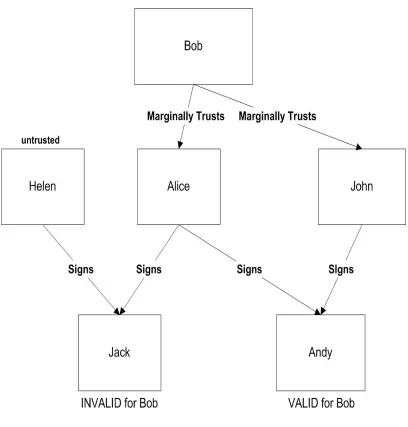
web of trust to be used. The idea is that at first everyone signs his friends’ and people he trusts PGP certificates. Next, a user checks if a PGP certificate of an unknown user is signed by people he trusts and if this is true he also signs the certificate and trusts the holder.
For implementing the trust model, PGP includes levels of trust. The highest trust level is implicit trust, which is the trust you have in your own key pair. All keys signed by your implicit trusted key are considered automatically valid. There are also the following levels of trust that you can assign to another person’s public key:
• Complete trust • Marginal trust • No trust
Along with trust levels there are three levels of validity which are:
• Valid
• Marginally valid • Invalid
Figure 2-5: Web of trust example
2.4
Role Based Access Control
In Discretionary Access Control, users may allow or deny other users (subjects) permissions to specific resources (objects) by using the identity of subjects and/or groups they belong. That means that in DAC, a subject that owns an object is able to decide to whom it gives access on the object.
In Mandatory Access Control, permissions are controlled by the system based on the sensitivity of the information contained in objects and the clearance of subjects to access information of that sensitivity. That means that a subject cannot give access on an object to a subject that is not qualified by the system.
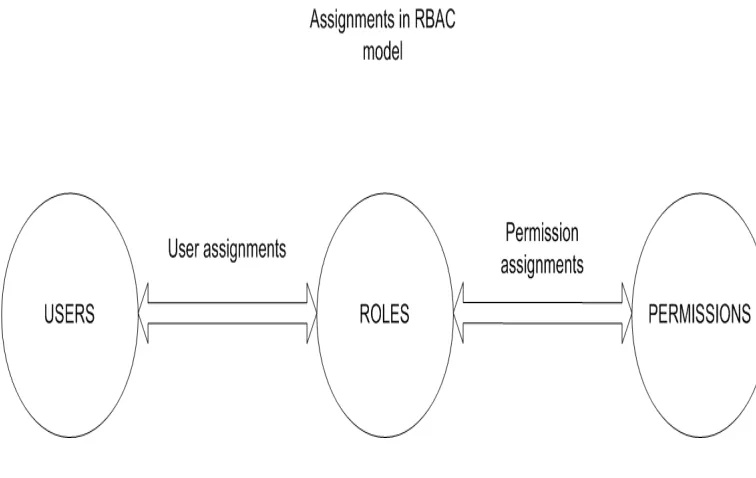
[image:23.595.105.483.424.663.2]In RBAC, the main idea is that in an organisation there are roles created for various job functions and permissions are assigned to specific roles instead of the users themselves. The users can acquire permissions by acquiring roles and management of individual user rights becomes management of specific roles (Figure 2-6). Only the administrator can assign roles on users and users cannot pass access permissions on to other users in their discretion. That means that RBAC is a form of MAC but is not based in multilevel security requirements.
In order for RBAC to be implemented correctly, a user must not be given any more privilege that is needed to perform the given job. This concept is called least privilege
and requires the identification of user’s job functions determining the minimum set of privileges required to perform those functions.
RBAC allows the separation of duty principle implementation. According to separation of duty the possibilities of fraud are minimized when collaboration between job-related capabilities in critical business functions do not exist. That means no single user can be allowed to perform all the operations associated with a business function. For example, a company might have the financial officer role and the payroll clerk role. These two roles cannot be assigned to the same user at the same time.
2.5
Web Services
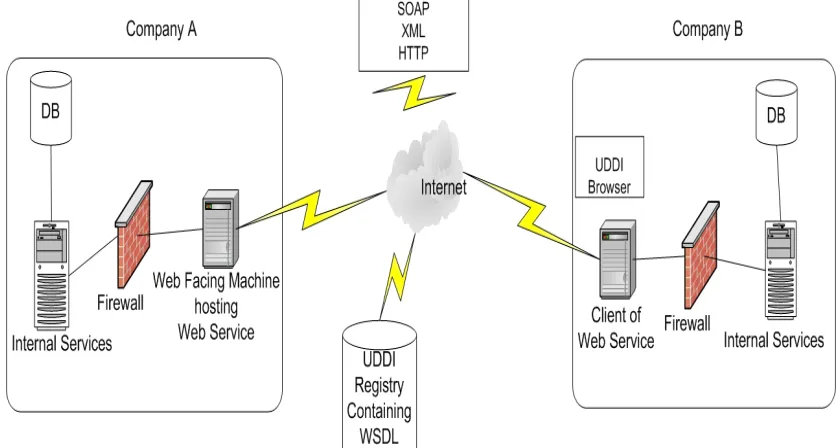
Web Services are the result of Distributed Computing evolution. Starting from Inter Process Communication, continuing to Remote Procedure Calls and evolving to Distributed Objects, along with the evolution of XML to ensure data portability, Web Services emerged. The evolution of the above technologies made possible to provide self-contained, self describing, modular applications that can be published, located and invoked across the Internet that are called Web Services.
Figure 2-7: Web Services Example
2.5.1 Web Services standards
1. Service Transport: this area is responsible for message transport between networks. Popular protocols such as HTTP, SMTP and FTP are being used in service transport. The reason is that these protocols can bypass firewalls without requiring changes to firewall rules.
2. Messaging: this area is responsible for encoding messages in a XML format which makes messages understandable at both ends of the network connection. Well known protocols in this area are XML-RPC, SOAP and REST.
3. Service Description: used for describing the interface to a specific web service. WSDL is the definition language typically used for this purpose. 4. Service Discovery: the role of this area is the creation of a centralized common
registry for the web services to publish their location and description. At present, the UDDI protocol is used for service discovery.
2.5.1.1 SOAP
SOAP is the most popular standard for exchanging XML based messages in web services usually using HTTP. The SOAP specification is maintained by the XML Protocol Working Group of the World Wide Web Consortium [11]. SOAP provides a messaging framework that more abstract layers can build on. A SOAP message is contained in an envelope and has two sections, the header (where relevant information about the message can be contained) and the body which contains the payload. An example of a client SOAP message requesting information about a fictional product is the following:
<soap:Envelope
xmlns:soap="http://schemas.xmlsoap.org/soap/envelope/">
<soap:Body>
<getDetails xmlns="http://company.example.com/ws">
<productNAME>productA</productNAME>
</getDetails>
</soap:Body>
An example response can be:
<soap:Envelope
xmlns:soap="http://schemas.xmlsoap.org/soap/envelope/">
<soap:Body>
<getDetailsResponse xmlns=" http://company.example.com/ws ">
<getDetailsResult>
<productNAME> productA </productNAME>
<description>An example product for a sample
message.</description> <price>96.50</price> </getDetailsResult> </getDetailsResponse> </soap:Body> </soap:Envelope> 2.5.1.2 REST
An alternative standard for messaging is Representational State Transfer (REST). REST is referred to a collection of architectural principles for distributed hypermedia systems and can be used to describe simple web based interfaces that use XML and HTTP without the message exchange patterns based approaches that are used in SOAP [12]. In REST clients work with the standard HTTP operations GET, POST, PUT and DELETE on resources that are represented with XML records on specific locations.
An example REST application could have the following record:
To update a user’s location, a REST client has to download the above record using HTTP GET, then modify it to change the location and upload it using PUT. SOAP and other applications using the RPC approach focus on operations that are represented as verbs (for example getDetails). REST in the other hand focuses on the diversity of resources which are represented as nouns (for example user). This means that because HTTP has not any LIST or FIND operations or any other method of resource discovery, REST data applications must create sets of search results as another type of resource, requiring users to know additional URLs for listing or searching each type of resource.
2.5.2 Security in Web Services
Web Services are based on XML which by itself provides no security mechanisms at the messaging layer and relies on transport layer security provided by SSL. However SSL has some serious drawbacks when used for securing web services which are due to the fact that SSL is all or nothing because it doesn’t allow the users to provide different levels of security in the various parts of the XML document. SSL also encounters problems in complex, high volume transactions because the systems must decrypt data every time they arrive in a new web server and then encrypt in order to transmit to the next web server. These facts have lead to the creation of various XML security standards, in order to be able to develop confidentiality, integrity and access control mechanisms in the messaging layer.
2.5.2.1 XML Encryption & Signatures
again to provide a wider context and issues arise when the different parts must be signed to ensure sender authentication.
XML encryption defines a vocabulary and processing rules in the form of XML tags that enclose the parts of data being encrypted, for protecting confidentiality of whole or parts of XML documents and non XML data. The idea is to place the element tag EncryptedData whenever and as often is needed.
In analogy, XML signature describes a specific XML syntax for the representation of associations between cryptographic signatures and XML documents. The Signature tag encloses the whole document, followed by SignedInfo and SignatureMethod nested tags to describe information and the algorithm used to sign the message. The XML Signature concept is a joint effort of W3C and IETF and has been standardized [13]. XML Encryption is in recommendation status [14].
2.5.2.2 SAML
Security Assertion Markup Language (SAML) is an XML based framework for the exchange of authorization and authentication information. This is useful in applications that do not share the same authentication and authorization infrastructure and gives the ability to create single sign on systems between different platforms. SAML statements include information referring to authentication, authorization and attributes such as credentials and group memberships and generally describe the results of previous authentication actions. The use of SAML requires the participants to be trusted by each other but it doesn’t include any mechanisms to establish trust. For this it relies to other mechanisms such as XML signature and XML encryption [15].
2.5.2.3 XACML
• Subject • Target object • Permitted Action • Provision
Subject can be user ID, group or role name. Target object allows granularity down to a single XML document element. Permitted Action can read, write, create or delete. Provisions are actions that must be executed upon a rule’s activation. Such action may be for example initiating login. XACML basically defines a language that can formulate such actions [16].
2.5.2.4 XKMS
XML Key Management Specification is a framework for supporting basic PKI functions for Web Services. XKMS basically defines an interface written in XML that is usually developed by PKI providers and allows the use of already present PKI infrastructure by users. The framework includes:
• Registration: XKMS services can be used to register key pairs. The generation of the keys can be performed by the client or the registration service. After registration the service manages the revocation and recovery of the registered keys. Some additional functions are reissue, revoke and recover.
• Locating: This service is used in order to retrieve a public key that is registered with an XKMS-compliant service. The public key can be then used for signature verification and encryption.
• Validation: Validate service is used to ensure that a registered public key is valid and has not expired or been revoked.
2.5.2.5 WS-Security
Web Services Security (WS-Security) is a standard that extends SOAP in order to provide message confidentiality, integrity and single message authentication [18]. This standard makes use of XML signatures and XML encryption specification and defines the use of digital signatures, encryption and message digests in a SOAP message. It doesn’t provide a complete security framework but is rather a set of basic mechanisms that may be incorporated into other security concepts or protocols like SSL and Kerberos. In order for users to be able to use a wide variety of security models, the following components have been implemented by the WS-Security group:
• tokens for authentication and authorization • trust domains
• encryption technologies
• end-to-end security in the messaging layer
WS-Security defines a vocabulary and processing rules at the form of additional XML tags included in a SOAP message header. This standard’s main purpose is to allow end to end security by using XML signatures and encryption in SOAP, rather than point to point security provided by SSL.
2.5.2.6 WS-Policy
2.5.2.7 WS-Trust
Web Services Trust Language (Trust) is a specification that is based on WS-Security and defines additional primitives and extensions for issuing, exchanging and validating security tokens [20]. In other words it defines extensions to WS-Security in order to be able to establish and access trust relationships between communicating parties.
In order for this to work, WS-Trust introduces two additional entities besides client and server which are a SOAP gateway and a security token service (STS). When the client sends a request to the service, it will be processed by the SOAP gateway which will extract the security token which is based on XML Signature and Encryption that the client included. Then it will issue a request to the STS to validate the original token and generate a new one valid for the service that will be sent back to SOAP gateway and will be incorporated in the original SOAP message before it is forwarded to the service itself.
2.5.2.8 Discussion
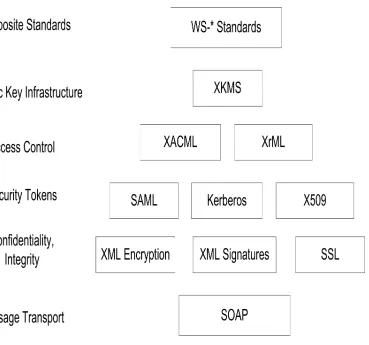
The above standards and specifications are not the only ones being in development. There are many other proposed specifications in order to address other issues associated with Web Services security such as WS-Privacy, WS-Secure Conversation, WS-Federation and WS- Authorization and also other XML based languages for the implementation like XrML for digital rights management. A common place in all the above is the use of SOAP for the messaging transport layer.
Figure 2-8: Web Services Security overview
2.6
Summary
In this chapter the traditional security mechanisms were presented along with general web services technologies and standards and finally the area of security in web services was presented, showing the directions that the researchers are following nowadays.
the proposed solutions haven’t been tested in real world scenarios and others haven’t been implemented at all. Thus, the selection of the protocols and/or the security scheme that is going to be used in a real world Web Service should be carefully and thoroughly considered.
3
Distributed Authorization & Access Control
3.1
Introduction
Traditional authorization mechanisms like the ones described in chapter 2 are identity-based, which means that they bind a user’s identity to a public key in order to build trust and authorize service requests. X.509 and XKMS which are proposed in order to implement X.509 in Web Services use these identity bindings to public keys and authentication is employed using a centralized architecture.
However, in a highly distributed environment the users are not known beforehand and an identity could have no meaning on authorization decisions because naming becomes very complex and locally scoped.
In RBAC, role assignment is managed in a centralized way which means that there is a single point of failure/attack and performance issues arise as the systems scale and more participants with different roles are added. X.509’s centralized architecture has the same drawbacks in large scale applications.
Trust management, first defined in PolicyMaker [21], is an approach that addresses the problem of decentralized authorization by using bindings of access rights to public keys instead of identities. These authorization certificates are used to delegate permissions directly from the key of the issuer to the key of the subject enabling access control decisions between strangers without the need for a universally trusted third party.
The five key components of a trust management system are:
• A language for describing `actions': actions are operations that are to be controlled by the system and have security consequences.
• A language for specifying application `policies': policies are rules containing the actions that principals are authorized to perform and this language defines them.
• A language for specifying `credentials': this language allows principals to delegate authorization to other principals.
• A `compliance checker': it provides a service to applications for determining how an action requested by principals should be handled, given a policy and a set of credentials.
Trust management approach has many advantages when security policy is distributed over a network and helps avoid the need for application-specific distributed policy configuration mechanisms, access control lists, and certificate parsers and interpreters.
3.2
KeyNote
KeyNote [22] is a trust-management system designed to work in a variety of large and small scale Internet-based applications. It provides a single, unified language for both local policies and credentials. KeyNote policies and credentials are called `assertions' and describe the trusted actions permitted by the holders of specific public keys like Trust management approach defines. There are two kinds of assertions, policy and
credential. Credential assertions can be sent over an untrusted network and also serve the role of certificates. They have the same syntax as policy assertions but are also signed by the principal delegating the trust.
The basic service provided by KeyNote is compliance checking which means checking whether a proposed action conforms to a policy. Actions are specified in
Figure 3-1: Keynote input/output
An example of two credentials forming part of a delegation chain is illustrated (figures 3-2 and 3-3). In the example illustrated, user Bob is granted access to a file through a credential shown in figure 3-2 which is issued by the administrator.
Figure 3-3 then shows how Alice is granted read-only access by Bob to access the same file during October 12 2005. KeyNote allows this delegation because the authority granted to Alice is a subset of the one granted to Bob.
Figure 3-3: Credential from Bob giving Alice read-only access to a file
The example shows that the users are identified only by their public keys. KeyNote allows using the system without previous knowledge of the user base. Users can propagate access by delegating rights to other users and this allows the system to associate access requests with keys by using the information in credentials making possible the reconstruction of the authorization path from the administrator to the user making the request.
3.3
ÆTHER
ÆTHER [23] [24] is a decentralized architecture for handling the complex requirements of trust establishment and authorization in pervasive computing. ÆTHER is designed specifically to address dynamic smart environments where a priori knowledge of the complete set of participating entities and global centralized trust registers cannot be assumed. The general ÆTHER model is instantiated into two distinct architectures, namely ÆTHER0 and ÆTHER1. ÆTHER0 has been designed to address the authorization needs of small pervasive computing domains whose management requirements are simple. ÆTHER1 has been designed to support the authorization requirements of large pervasive computing domains that have multiple owners with complicated security relationships. This means the existence of large numbers of devices whose ownership rights can be shared among many principals. ÆTHER0 is out of scope for this dissertation and from now on when ÆTHER is mentioned it refers to the ÆTHER1 instantiation.
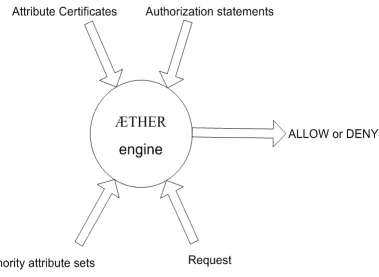
In ÆTHER the users embed policy entries into their devices that allow access to protected services only to entities that present the correct attribute certificates. Also definitions of attribute authority sets whose members are trusted to certify the corresponding attributes are created. The design of ÆTHER supports dynamic membership in the attribute authority sets in order to facilitate distributed administration and attribute mapping to allow roaming among authority domains. An authority domain (AD) in the terminology of ÆTHER is the initial set of relationships between attributes and principals specified in a security policy and is a logical representation of a smart environment. The owner of several pervasive devices creates an authority domain by specifying in a policy which principals are trusted to certify which attributes. Also the owner creates policy entries for controlling which attribute credentials a principal must present in order to get specific access rights to a resource provided by a device [24].
Figure 3-4: Permission modelling in ÆTHER
aether version: 1
type: authority attribute set
issuer: “304802...1532c” (public key Key0)
attribute name: group
attribute value: visitor
membership threshold value: 2
delegation depth: 2
sources of authority: “304802...1532c” (public key Key0),
“802...ab32c” (public key Key1)
signature: “5eac6d9...7cfd575e68” (Key0’s signature)
In this example, the issuer (Key0) defines the sources of authority for giving an attribute certificate with name group and value visitor which will be valid in his domain. Delegation depth and threshold value are 2 which means that a trusted visitor is able to introduce another visitor to the house, and in order for a visitor to be able to do so he must be trusted by two existing members of the AAS. That means that by using specific values for threshold and delegation the AASs can grow dynamically. ÆTHER also provides a mechanism to allow the linking of ADs by mapping corresponding attribute sets for supporting secure interactions between different smart environments by using attribute mapping certificates and a naming mechanism for allowing users to specify names instead of keys in interactions with their devices. For more information see [24].
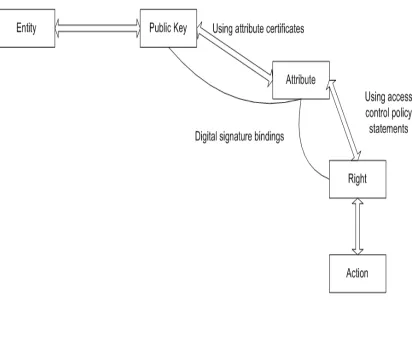
In ÆTHER bindings of public keys to attributes are being done by using attribute certificates (ACs) as shown in figure 3-4.
An attribute certificate example is the following:
aether version: 1
type: attribute certificate
issuer: “304802...1532c” (public key Key0)
subject: “1819c...2cf50bbb17c075e” (public key Key4)
attribute name: device
attribute value: family_object
not valid before: 2004/04/12-12:21
not valid after: 2004/04/12-12:31
In the above example the certificate binds the attribute (device, family_object) to the principal Key4 and is certified by principal Key0. Currently in ÆTHER instead of using CRLs a short expiration time period and refreshing mechanisms for the issued credentials are being used.
Bindings of attributes to rights are being done by using data structures called authorization statements. The authorization statements are further divided into positive and negative. The positive statements define the resources that are provided by the device and the attribute credentials that are required to access them.
The negative authorization statements explicitly deny access to a resource based on the attributes of the requesting principal and are used in ÆTHER to enforce separation of duty requirements for limiting the authority that can be acquired by a specific principal. A positive authorization statement is the following:
aether version: 1
type: positive authorization
issuer: “304802...1532c” (public key Key0)
resource: TV_set
operation: control_state
requires: (group == family_member) || (group == visitor)
signature: “5426d9...7cfd1b1575e68” (Key0’s signature)
This authorization example specifies that the action (TV_set, control_state) can be performed only by principals certified to have the attribute (group, family_member) or (group, visitor).
Figure 3-5: ÆTHER input/output
3.4
Summary
Trust management systems solve the difficulties met when using traditional authorization in highly distributed environments such as web services where participants are not known beforehand. The ÆTHER trust management system provides easier management of policies and provides decentralized administration by introducing the use of attribute based authorization in authority domains. Policies are kept in authority domains and only attribute certificates are being distributed. Capability-based systems like Keynote lack the ability to define complex policy expressions like for example “any principal that has an attribute is able to access a service”. Instead they must delegate the access right specifically for each user.
the same machine. An example would be a University that wants to provide access to an online library to all the students of a specific department. Using Keynote, a certificate that verifies that a student is able to access the specific online resource must be issued to every one of the students that belong to the department (figure 3-6).
Figure 3-6: Keynote implementation
This means that every time the department wants to provide access to a new online resource the operation of issuing certificates for the new resource to each student separately must be repeated. The same operation must be repeated in case the department wants to grant a different kind of access to the resource, for example if the post graduate students must have write access also, a new kind of certificates granting read-write access to the post graduates must be issued to them. And for every new resource the whole operation has to be done from the beginning, involving great management costs as the system scales.
Figure 3-7: ÆTHER implementation
Then it must create a corresponding access control statement that would give read access to the online resource on students and another one giving read-write access on post graduate students. When the department wants to provide access to a new online resource, it has only to create a new access control statement saying that all the students have access to it which in the case of using Keynote is impossible.
4
Design
4.1
System Overview
WebÆTHER is a security management system that focuses on access control for Web Services. The approach of WebÆTHER to web services security is different than the WS-* standards series. It focuses on trust management and the ability to distribute policies between previously unknown entities by using the ÆTHER decentralized architecture rather than XKMS where a traditional PKI is being used. Attribute based authorization is identical to ÆTHER and authority domains are considered the servers that provide the Web Services. Policies and attribute authority sets are specific for each Web Service and attribute certificates are being distributed to requesters of the service.
Encryption is being used in WebÆTHER at the transport layer in order to provide point to point confidentiality in terms of Web Services and integrity. This means that the architecture currently targets Web Services that will not use intermediate nodes that can access the same message thus requiring different encryption in parts of the message. This means that each message in WebÆTHER has only a single recipient. WebÆTHER does not address problems like denial of service attacks and is not able to handle stealing of private keys used in creating the public keys included in attribute certificates. Moreover definition of conflicting policies, issuing wrong attribute certificates and inappropriate administration are considered outside of this dissertation’s scope.
4.2
Architecture
kinds of ÆTHER statements and four mappings. In more detail WebÆTHER model is consisted of:
• A set of Subjects: this is the set of the requesters of web services • A set of Attributes (As)
• A set of Attribute Authority Sets (AASs): the list of principals that act as authorities for a given attribute name and value
• A set of operations • A set of Web Services • A set of permissions
• A mapping of As to permissions: this is done using the policy statements • A mapping of Subjects to attributes: this is done using AC statements • A mapping of Subjects to AASs: this is done using AAS statements • A mapping of AASs to As: this is also done using AAS statements
Policy statements are used in order to define permissions. In other words this means expressing the access control policies which are basically the rules on which a decision on giving access or not is made. The kind of access is described by the binding of an operation to the Web Service. The Attribute Authority set is a new concept of ÆTHER that defines the set of keys that are sources of authority for the specified attribute. In a similar way in Web ÆTHER Attribute authority sets are the means of defining the principals that are able to validate that a principal has an attribute. Attributes are similar to the concept of roles in traditional RBAC. A subject is a member of a role only if it has been assigned the authority attribute that represents the role. Attribute certificates are used by subjects that need to proof the possession of an attribute. The attributes are not static for a subject and they need to be obtained dynamically prior an access request. ACs are related to permissions in the context that in order to have a permission the subject must have the appropriate ACs that are defined in the Policy Statement.
Figure 4-1: WebÆTHER model
4.2.1 Policy Statements
employees or group co-workers specified by the administrator of the host. The policy statement is going to look like:
aether version: 1
type: positive access control policy
issuer: “304802...1532c”(hostA’s public key)
resource: special_serviceA
operation: get
requires: @group == employees || @group == co-workers
The public keys in all the statement files used in WebÆTHER are in hexadecimal format like in ÆTHER. In the given examples only a minor parts of the keys are displayed. The requesters of the service are going to be granted access as long as they provide an attribute certificate that can be validated and contains the attribute name group and either the value employees or co-workers. For each Web Service that hostA provides there must be a correspondent policy statement. WebÆTHER keeps the notion of positive and negative policy statements but in the context of rather simple Web Services that do not require separation of duty to be applied, only positive statements are useful. In more complex policies that for example would require public keys to belong in a specific group but have to make sure they don’t belong to another, both kinds of policy statements can be used. The task of including the correct attributes in the policy statements are the responsibility of the administrator.
One advantage of using policy statements is the ability to ask the requesters of a service to provide only the related attribute certificates instead of sending every attribute certificate they have when they want to access a Web Service. Notice that policy statements in WebÆTHER do not need to be signed because they are valid only locally to the host that provides the specific service.
4.2.2 Policy Distribution
service called special_serviceA and must be available to all the people working in the team. The model is illustrated in figure 4-1.
Figure 4-2: CompanyA example
In WebÆTHER this is being done by providing the attribute certificates to the employees that certify their status of being company employees. Such an example attribute certificate will have the following form:
aether version: 1
type: attribute certificate
issuer: “304802...1532c” (hostA public key)
subject: “1819c...2cf50bbb17c075e” (an employee’s public key)
attribute name: group
attribute value: employees
not valid after: 2004/04/15-12:31
signature: “5426d9...7cfd1b1575e68”(hostA’s signature)
The administrator of hostA will distribute this kind of certificates to every employee in the company in order for them to be able to prove to hostA that they are employees of the company. To be able to check the validity of these attribute certificates the system must be able to know which keys are able to certify the group. In WebÆTHER this is being done by using another kind of statements which are attribute authority sets. If in companyA exist two hosts (hostA and hostB) that can certify that a public key belongs to an employee the AAS is going to look like:
aether version: 1
type: authority attribute set
issuer: “304802...1532c”(hostA public key)
attribute name: group
attribute value: employee
membership threshold value: 0
delegation depth: -1
sources of authority: “304802...1532c”(hostA’s public key),
“5426d9...7cfd1b1575e68”(hostB’s public key)
In the above example hostA and hostB are defined as sources of authority which means that WebÆTHER is going to consider valid the ACs that are issued by any of these two hosts. Delegation depth -1 and threshold value 0 mean that a trusted employee is not able to introduce another employee to the company and only the employees with ACs signed by either of the two sources of authority are considered valid. If the number of employees is big and the two sources of authority are considered very few, the list of sources of authority can dynamically grow by increasing those two values. For example increasing to delegation depth 1 and threshold value 2, means that when a public key that has been issued an AC from each of the sources of authority in the AAS, can also act as a source of authority and the ACs it issues are considered valid from hostA. The value 0 for delegation depth means there is no restriction on the maximum delegation.
company that must collaborate in order to develop a new product. In order for this to happen, companyB’s employees must also have access to the service called special_serviceA.
[image:52.595.93.506.215.464.2]The new model of the two merged companies is illustrated in figure 4-2.
Figure 4-3: merged companies example
In WebÆTHER this can be done in three different ways:
• Create a new host or select a host in companyB to act as a source of authority in companyB and add his public key in the existing AAS.
• Sign companyB employees’ ACs using either hostA or hostB who are currently in the AAS.
It is easy to realize that the architecture is flexible enough to provide alternative ways of introducing new people as employees with different impact on administrative tasks and relying on different trust relationships. If the employees are fully trusted the increase of delegation depth and threshold value leads to minimum administrative effort. If such decision of who is an employee is not trusted to be made from current employees, then depending on the number of new employees one of the other two options can be selected.
There are other options to solve a real world scenario like this using WebÆTHER. For example instead of group employees, alternative groups can be used like companyA_employees and companyB_employees with the corresponding changes in AAS’s sources of authority and policy statements.
4.2.3 Certificate Revocation
There are occasions when an attribute certificate’s validity must be revoked. These occasions include the loss or compromise of the key that was used by a source of authority in order to sign an attribute certificate, the loss or compromise of a key to which a certificate was issued or when the attribute that was certified for a requester is not considered valid by the authority any longer. The main mechanisms to achieve this are:
• Using the validity period of a certificate • CRLs
• OCSP
system and could harm other applications using the same networks. It can also lead to time periods during which access to a particular service is impossible. On the other hand, if the validity period is set to a very high value then a required revocation may not take place until this period expires.
The next mechanism is Certificate Revocation Lists (CRLs), which are lists that include all credentials that have been revoked. The issuer must create a CRL and distribute it to all participants of the system. The main problems with using CRLs are two. First of all the list must be distributed to all the interested parties. This can be done by using flooding techniques. Another solution is placing the CRL on a public repository that the interested parties would retrieve the CRL from. Both of these approaches require the issuer to always be available for access. The second problem is related to scalability. As the number of revoked certificates increases CRLs require more effort in order to manage them.
The final revocation mechanism is OCSP (Online Certificate Status Protocol) [25]. OCSP requires the certificate verifier to check the revocation status of the presented certificate at every verification request. When a user attempts to access a server, the server’s OCSP implementation sends a request for information considering the certificate status to the issuer. The issuer sends back a response that classifies the certificate’s status as current, expired, or unknown. OCSP allows expired certificates a grace period, so that the users that have them can access servers for a limited time before renewing. This means that the verifier must always be able to contact the issuer of every credential that is presented to him. Also, since the verifier is also a service provider, the process of checking the status of every credential at every access request introduces a significant additional computation overhead.
ÆTHER uses the approach of using the certificates’ validity period. This is due to the fact that CRL implementation and management is difficult in a ubiquitous environment with a large number of participants. Also, the computation overhead introduced in the use of OCSP is also very expensive for small devices and there is the requirement that the issuer is always accessible by every verifier, a requirement that is not compatible with the disconnected nature of pervasive computing. The responsibility of setting a correct expiration period is assigned to the administrators of these environments and a suggested value for it is 1 hour.
performance. The administrative effort in the other hand of using CRLs or OCSP would be at the same level. In WebÆTHER services and participants can be numerous and the implementation of such mechanisms would be very difficult because of the distributed environment. Therefore, the certificate validity period is considered the best solution to certificate revocation, with the suggested expiration values being higher than the ones used in a ubiquitous environment, for example 24 hours or more.
4.2.4 Service Discovery
WebÆTHER being a trust management system for use in Web Services uses the typical service discovery mechanism for Web Services which consists of WSDL descriptions of the provided remote methods that compose the service and can be contained in a UDDI registry for easier publishing and acquisition. The WSDL descriptions can also reside on static URLs for the interested parties to acquire them. The advantage of this method for service discovery is that it is based in a currently used approach. The disadvantages are that WSDL provides description of the input and output of the remote methods but it doesn’t provide information on how they can be implemented. This means that familiarity with WebÆTHER is required in order to implement the methods described in the WSDL descriptions.
4.2.5 Certificate Acquisition
If the decision is yes, he will create a temporary URL that will be valid only for a short period of time and will contain the AC issuing service. Finally he will send a reply giving the URL requester_B (figure 4-4).
Figure 4-4: request handle approach
After this step the requester knows the URL that he is going to use to acquire the AC. The AC issuing service works in four steps (figure 4-5). In order to prevent man in the middle attacks, the whole operation is done by using SSL and the requester has to use his public key that will also be used in the AC for the SSL session establishment. The operation after the establishment of the SSL channel is:
• First the requester makes a call on the remote method to signal the start of the request.
• Then the Issuer sends back a data structure that contains the attribute name and value that is going to be in the AC when the procedure finishes.
• Now the issuer is able to verify that the public key used in the SSL session is the same to the provided one, create the AC using the attribute name-value pair, the requester’s public key and his own public key, sign it, verify it and send it back to the requester.
Figure 4-5: AC service
available to be kept to only a few minutes after the sending the email that contains it so the security risk will be minimized.
4.2.6 System Components
The WebÆTHER is consisted of 3 major components in the server side and 2 major components in the client side. The components found in the server side are the proxy component, the ÆTHER component and the Web Service resources component. The components found in the client side are the proxy component and the ÆTHER component.
Figure 4-6: System components
able to provide. For example this can be access to a file that is located at the server side.
4.2.7 System Logic
WebÆTHER system logic is divided in three main parts. The first part is Certificate Acquisition which was described in paragraph 4.2.5. The remaining two parts form the web service and include the establishment of an SSL session before the logic itself takes places. The two parts are:
• Service Query • Service
Service Query is the part of the system that is used in order to provide the list of needed attribute names for accessing the service to the requester. There is a service query method for every provided service in the system. The requester has to invoke this method in order to acquire the list of needed attribute names before he attempts to access the service itself. The service provider when he receives a service query message, he searches the list of policy statements for the correspondent to the service one. After parsing the field requires that is found, he is able to construct a reduced ACL (RACL) which is a set of all the attribute names found in the policy statement without the predicates that apply on them.
For example, if the policy statement is:
aether version: 1
type: positive access control policy
issuer: (hostA’s public key)
resource: special_serviceA
operation: get
requires: @group == employees && @speciality == engineers
Figure 4-7: Service Query
Figure 4-8: Service Request/Response
with attribute name group and value employees and a valid AC with attribute name speciality and value engineers.
4.3
Summary
5
Implementation
5.1
Overview
In order to implement and evaluate WebÆTHER the Web Service that was chosen is a file transfer service. The host of the service is going to provide a file that when the requester meets the requirements will be available for downloading. This scenario was chosen in order to demonstrate the ability of WebÆTHER to be implemented in the very popular area of file sharing while providing a secure framework for the service. For the Service Transport layer, HTTP was selected because it is the dominant protocol for this layer in the Web Services area. The creation of a new XML based messaging protocol for the messaging layer implementation was considered to be outside of scope to this dissertation, therefore the options were limited to the ones with the best support and documentation. These options were SOAP and REST. SOAP was finally selected between the two, because of the features of the existing tools, the overall support from the Web Services community and the ease of implementation using the existing development tools.
Apache web server, being the dominant web server was selected and the whole implementation would work over an established SSL session using Apache and OpenSSL. All the toolkits to be used are going to be open source projects.
One of the primary aims during implementation was to keep as much of the original ÆTHER infrastructure as possible in order to demonstrate the suitability of this trust management system to be used in the area of Web Services.
5.2
Apache Web Server & gSOAP
to invoke application code. When a SOAP message arrives to the proxy component by a listener, the proxy must do three things:
1. If necessary, De-serialize the message from XML into some native format suitable for passing off to the code.
2. Invoke the code.
3. Serialize the response to the message (back into XML and hand it back to the transport listener for delivery back to the requester.
The following were the main choices that were available for open source toolkits to be used in the implementation:
2. Apache – AXIS Java version. The Java version of Apache – AXIS has by far the greater support among the open source toolkits currently used for web services in the apache web server because of the fact that it is widely used. In this version of AXIS the web service is written in Java and deployed as a Tomcat webapp (servlet) on the server side. The framework implements the JAX-RPC API which is a way to provide Web Services written in Java and provides the WSDL2Java tool in order to create stubs and skeletons. In the java version of Apache – AXIS, an HTTPS listener and sender are not yet implemented at the time this dissertation was carried out.
3. SOAP::Lite [27] [28]. This is a collection of Perl modules that provides an interface to SOAP both on client and server side. There are no special requirements for the Apache web server in order to use this framework and Web Services are cgi scripts written in perl that automatically use SOAP for the messaging layer and are also able to use SSL.
4. gSOAP. gSOAP [29] is a toolkit that provides a transparent SOAP API for the creation of Web Services through the use of compiler technologies. These technologies are being used by the toolkit in order to map XML schemas to C/C++ definitions. The toolkit uses a compiler that generates efficient XML serializers for native and user-defined C and C++ data types. As a result, SOAP/XML interoperability is achieved with a simple API and hides WSDL and SOAP details from the user, thus enabling him or her to concentrate on the application-essential logic. Finally gSOAP supports SSL.
account when the decision on the toolkit had to be made. SOAP::Lite was an interesting solution but invoking C++ from inside perl scripts was considered less convenient than using C++ for the whole implementation.
gSOAP is consisted of a stub and skeleton compiler and a WSDL parser. The stub and skeleton compiler (named soapcpp2) is a pre-processor that generates the necessary C++ sources to build SOAP C++ clients. The input to soapcpp2 is a standard C/C++ header file that can be generated from a WSDL documentation of the service using the gSOAP WSDL parser (named wsdl2h). SOAP service methods are specified in the header file as function prototypes and the stub routines in C/C++ are automatically generated by soapcpp2 for these function prototypes.
The resulting stub routines allow C and C++ client applications to seamlessly interact with existing SOAP Web Services. In a same manner soapcpp2 generates skeleton routines in C++ source form for each of the remote methods specified as function prototypes in a header file that is processed by soapcpp2. The skeleton routines can be then used to implement the remote methods in a new Web Service. The gSOAP compiler automatically generates serializers and deserializers for the data types that are being used in order to enable the generated stub and skeleton routines to encode and decode the contents of the parameters of the remote methods in XML.
The gSOAP compiler also generates a remote method request dispatcher routine that will serve requests by calling the appropriate skeleton when the SOAP service application is installed as a cgi on a Web Server.
5.3
WebÆTHER Model Implementation and system components
provides the service in the form of the CGI in the server and ÆTHER component provides the trust management to the server and AC handling to the client.
Figure 5-1: Implemented system components
[image:67.595.129.469.164.287.2]The certificates that the clients use in client authentication must include the same public key to the one that is being used later in the WebÆTHER statement files. WebÆTHER only works with RSA 1024-bit keys. The file transfer service was named serviceA and the operations on the model can be viewed on figure 5-2.
After the establishment of the SSL channel, the client sends a serviceA request in order to retrieve the reduced ACL as WebÆTHER system logic commands. The server creates the reduced ACL and returns it to the client. After this step the client knows the required ACs and searches his repository to find all that satisfy the requirements. Then the client is ready to make a call to serviceA itself while sending at the same time the ACs he has gathered from his repository. The server checks the validity of the statements and compares the subject keys of the ACs to the one used in the establishment of the SSL channel and takes into account only those who are identical to it. Then it checks the policy statement for serviceA to make a decision on sending the file back to the client. If the decision is positive, the file is returned else the client gets an error. The implementation of the model is consisted of a header file that contains the function prototypes and the declarations of the complex data types that are being used along with a source file for the server and a source file for the client. In order to meet the goal of using as much of the core of ÆTHER, the implementation uses the sources of ÆTHER for parsing statements, making the date checks, the verification of the statements and the logic control of the collected information in order to make decisions.
5.4
Implementation of the Service Query function
The service query function in the file transfer implementation is called serviceAreq. This is a remote method and according to gS