BlendCAC: A Smart Contract Enabled Decentralized
Capability-based Access Control Mechanism for IoT
Ronghua Xu1, Yu Chen1*, Erik Blasch2, Genshe Chen3
1 Binghamton University, SUNY, Binghamotn, NY 13902, USA; [email protected]
2 The U.S. Air Force Research Lab, Rome, NY 13441, USA; [email protected]
3 Intelligent Fusion Technology, Inc. Germantown, MD 20876, USA; [email protected]
1
2
3
4
5
6
7
8
9
10
11
12
13
14
15
16
17
18
19
* Correspondence:[email protected];Tel.:+1-607-777-6133
Abstract: WhiletheInternetofThings(IoT)technologyhasbeenwidelyrecognizedastheessential partofSmartCities,italsobringsnewchallengesintermsofprivacyandsecurity.Accesscontrol (AC)isamongthetopsecurityconcerns,whichiscriticalinresourceandinformationprotection overIoTdevices.Traditionalaccesscontrolapproaches,likeAccessControlLists(ACL),Role-based AccessControl(RBAC)andAttribute-basedAccessControl(ABAC),arenotabletoprovideascalable, manageableandefficientmechanismtomeettherequirementsofIoTsystems.Anotherweakness in today’s ACisthecentralizedauthorization server, whichcan betheperformance bottleneck orthesinglepointoffailure. Inspiredbythesmartcontractontopofablockchainprotocol,this paperproposesBlendCAC,whichisadecentralized,federatedcapability-basedACmechanism toenableaneffectiveprotectionfordevices,servicesandinformationinlargescaleIoTsystems. Afederatedcapability-baseddelegationmodel(FCDM)isintroducedtosupporthierarchicaland multi-hopdelegation.Themechanismfordelegateauthorizationandrevocationisexplored.Arobust identity-basedcapabilitytokenmanagementstrategyisproposed,whichtakesadvantageofthesmart contractforregistering,propagatingandrevocatingoftheaccessauthorization.Aproof-of-concept prototypehasbeenimplementedonbothresources-constraineddevices(i.e.,RaspberryPInode)and morepowerfulcomputingdevices(i.e.,laptops),andtestedonalocalprivateblockchainnetwork. TheexperimentalresultsdemonstratethefeasibilityoftheBlendCACtoofferadecentralized,scalable, lightweightandfine-grainedACsolutionforIoTsystems.
Keywords: Decentralized AccessControl; Internet of Things (IoT); BlockchainProtocol; Smart Contract;FederatedDelegation;Capability-basedAccessControl.
20
1. Introduction 21
With the proliferation of the Internet of Things (IoT), a large number of physical devices are being 22
connected to the Internet at an unprecedented scale. The prevalence of the IoT devices changes human 23
activities by ubiquitously providing applications and services that are revolutionizing transportation, 24
healthcare, industrial automation, emergency response, and so on [1]. These capabilities offer both 25
measurement data and information context for situation awareness (SAW) [2,3]. While benefiting from 26
the large-scale applications like Smart Gird and Smart Cities, the quick growing IoT systems also incur 27
new concerns for security and privacy. With the increased popularity, the connected smart IoT devices 28
without sufficient security measures increase the risk of privacy breaches and various attacks. Security 29
issues, such as privacy, authentication, access control, system configuration, information storage and 30
management, are the main challenges that these IoTs based applications are facing [4]. 31
Among the top security challenges in IoT environments, access authorization is critical in resource 32
and information protection. Conventional access control approaches, like Access Control List (ACL), 33
Role-based Access Control (RBAC) and Attribute-based Access Control (ABAC) have been widely 34
used on information technology (IT) system. However, they are not able to provide a manageable and 35
efficient mechanism to meet the requirements raised by IoT networks: 36
Both RBAC and ABAC have been found inflexible to provide complex arrangements to 44
support delegation and transitivity, which are essential for efficient and effective intra-domain 45
authorization and access control. 46
• Causality: Traditional RBAC and ABAC systems envisage planned and long-lived patterns, 47
while the IoT world is mainly characterized by short-lived, often causal and/or spontaneous 48
interactions [5], in which an access control scheme is required to deal with dynamic challenges. 49
• Lightweight: IoT devices are usually resource-constrained, which cannot support heavy 50
computational and large storage required applications, and those smart devices connect to 51
each other by low power and lossy networks. Consequently the access control protocol should 52
be lightweight and not impose significant overhead on devices and communication networks. 53
The extraordinary large number of devices with heterogeneity and dynamicity necessitate more 54
scalable, flexible and lightweight access control mechanisms for IoT networks. In addition, a majority 55
of the AC solutions rely on centralized authorities. Although the delegation mechanism helps migrate 56
certain intelligence from the centralized cloud server to a near-site fog or edge network, the power 57
of policy decision making and identity management is exclusively located in the cloud center. IoT 58
networks need a new AC framework that provides decentralized authentication and authorization 59
scheme in trustless application network environments, such that intelligence could be diffused among 60
large number of distributed edge devices. 61
While being well-known as the fundamental protocol of Bitcoin [6], the first digital currency, 62
the blockchain protocol has been recognized as the potential to revolutionize the fundamentals 63
of IT technology because of its many attractive features and characteristics such as supporting 64
decentralization and anonymity maintenance [7]. In this paper, aBLockchain-ENabled, Decentralized, 65
Federated, Capability-based Access Control (BlendCAC) scheme is proposed to enhance the security 66
of IoT devices. It provides a decentralized, scalable, fine-grained, and lightweight AC solution to 67
protect smart devices, services and information in IoT networks. An identity-based capability token 68
management strategy is presented and the federated authorization delegation mechanism is illustrated. 69
In addition, a capability-based access validation process is implemented on service providers that 70
integrate SAW and customized contextualized conditions. The experimental results demonstrate the 71
feasibility and effectiveness of the proposed BlendCAC scheme. 72
The major contributions of this work are: 73
1. Leveraging the blockchain protocol, a decentralized, federate access control scheme is proposed, 74
which is a scalable, fine-grained, and lightweight solution for today’s IoT networks; 75
2. A complete architecture of a federated capability-based authorization system is designed, which 76
includes delegation authority, capability management, and access right validation; 77
3. A capability-based federated delegation model is introduced and the enforcement of polices is 78
discussed in detail; 79
4. A concept-proof prototype based on smart contracts is implemented on resource-constrained 80
edge devices and more powerful devices, and deployed on a local private blockchain network; 81
and 82
5. A comprehensive experimental study has been conducted that compares the proposed scheme 83
with the well-known RBAC and ABAC models. The experimental results validate the feasibility 84
The remainder of this paper is organized as follows: Section 2gives a brief review on the 86
state-of-the-art research in access control for IoT systems. Section3defines components of federated 87
delegation model including capability-based delegation and revocation. Then, Section4illustrates 88
the details of the proposed BlendCAC system and Section5explains the implementation of the 89
proof-of-concept prototype. The experimental results and evaluation are discussed in Section6. Finally, 90
the summary, current limitations and on-going efforts are discussed in Section7. 91
2. Background Knowledge and Related Work 92
2.1. Access Control in IoTs 93
Technologies for authentication and authorization of access to certain resources or services are 94
among the main elements to protect the security and privacy for IoT devices [8]. As a fundamental 95
mechanism to enable security in computer systems, AC is the process that decides who is authorized to 96
have what communication rights on which objects with respect to some security models and policies [9]. 97
An effective AC system is designed to satisfy the main security requirements, such as confidentiality, 98
integrity, and availability. However, recently raised security and privacy issues push the AC systems in 99
the era of IoT to meet a higher bar with more design considerations such as high scalability, flexibility, 100
lightweight and causality. 101
There are various AC methods and solutions with different objectives proposed to address IoT 102
security challenges. The Role-Based Access Control (RBAC) model [10] provides a framework that 103
species user access authorization to resources based on roles, and supports principles such as least 104
privilege, partition of administrative functions and separation of duties [11]. However, a pure RBAC 105
model presents a role explosion problem, which is inappropriate to implement security policies 106
that require interpreting complex and ambiguous IoT scenarios. The RBAC model implemented on 107
devices adopts a Web of Things (WoTs) approach to implement AC policies on the smart objects via 108
the web service [12,13], and the RBAC model was extended by introducing context constraints to 109
consider contextual awareness in AC decisions [14]. However, those proposals are not able to clearly 110
specify the fine-grained AC on variant resources or services, like the mapping of the role notion and 111
device-to-device communication. 112
To address the weaknesses of RBAC model in a highly distributed network environment, an 113
Attribute-based Access Control (ABAC) [15,16] is introduced in IoT networks to reduce the number of 114
rules resulting from role explosion. In ABAC the AC policies are defined through directly associating 115
attributes with subjects. An efficient authentication and ABAC based authorization scheme for the IoT 116
perception layer has been proposed [17]. Based on user attribute certificates, an access right is granted 117
by AC authority to ensure fine-grained access control. However, specifying a consistent definition 118
of the attributes within a domain or across different domains could significantly increase effort and 119
complexity on policy management as the number of devices grow, and hence, the attribute-based 120
proposal is not suitable for large scale distributed IoT networks. 121
Due to drawbacks that exist in traditional access control models such as RBAC and ABAC, the 122
requirements imposed by IoT scenarios cannot be satisfied. Given many great advantages from an 123
IoT perspective, such as scalability, flexibility, distributed, and user-driven, IoT systems can support 124
delegation and revocation[8]. Capability-based access control approaches have been considered a 125
promising solution to IoT systems. The Access Control Matrix (ACM) model represents a good 126
conceptualization of authorizations by providing a framework for describing Discretionary Access 127
Control (DAC) [11]. As two implementations of ACM, Access Control List (ACL) and Capability are 128
widely used in authorization systems. In the ACL model, each object is associated with an access 129
control list that saves the subjects and their access rights for the objects. 130
The ACL is a centralized approach to support administrative activities with better traceability 131
by implementing AC strategies on cloud servers [18]. However, as the number of subjects and 132
in IoT networks has raised several issues, like capability propagation and revocation [9]. To tackle 141
these challenges, a Secure Identity-Based Capability (SICAP) System is proposed, which enables the 142
monitoring, mediating, and recording of capability propagations to enforce security policies as well as 143
achieving rapid revocation capability by using an exception list [9]. However, the centralized access 144
control server (ACS) becomes the performance bottleneck of the system, and the author didn’t provide 145
a clear illustration on security policy used in capability generation and propagation, neither was the 146
context information in making authorization decision considered. 147
To enable contextual awareness in federated IoT devices, an authorization delegation method 148
is proposed based on a Capability-based Context-Aware Access Control (CCAAC) model [20]. By 149
introducing a delegation mechanism to capability generation and propagation process, the CCAAC 150
model shows great advantages to address scalability and heterogeneity issues in IoT networks. 151
Given the requirement that a prior knowledge of the trust relationship among domains in federated 152
IoTs must be established, however, the proposed approach is not suitable universally for all IoT 153
application scenarios. Inspired by the SUN DIGITAL ECOSYSTEM ENVIRONMENT project [21], a 154
Capability-based Access Control (CapAC) model was proposed that adopted a centralized approach for 155
managing access control policy [5]. However, the proposed CapAC scheme depends on a centralized 156
authority and did not consider the lightweight requirement at the smart device side. To address the 157
limitations in CapAC, a Distributed Capability-based Access Control (DCapAC) model was proposed, 158
which was directly deployed on resource-constrained devices [22,23]. The DCapAC allows smart 159
devices to autonomously make decisions on access rights based on an authorization policy, and it 160
shows advantages in scalability and interoperability. However, capability revocation management and 161
delegation were not discussed, neither were the granularity and context-awareness considered. 162
2.2. Blockchain and Smart Contract 163
The blockchain is the fundamental framework of Bitcoin [6], which was introduced by Nakamoto 164
in 2008. The blockchain is the public ledger that allows the data be recorded, stored and updated 165
distributively. By its nature, the blockchain is a decentralized architecture that does not rely on a 166
centralized authority. The transactions are approved and recorded in blocks created by miners, and the 167
blocks are appended to the blockchain in a chronological order. Blockchain uses consensus mechanism 168
to maintain the sanctity of the data recorded on the blocks. Thanks to the “trustless” proof mechanism 169
enforced through mining task on miners across networks, users can trust the system of the public 170
ledger stored worldwide on many different decentralized nodes maintained by ”miner-accountants,” 171
as opposed to having to establish and maintain trust with the transaction counter-party or a third-party 172
intermediary [24]. Blockchain is the ideal architecture to ensure distributed transactions between all 173
participants in a trustless environment. 174
Because of many attractive characteristics, blockchain technology has been investigated to offer a 175
decentralized AC scheme in trustless network environments. A blockchain based AC is proposed to 176
publish AC policy and to allow distributed transfer access right among users on bitcoin network [25]. 177
The proposal allows distributed auditability, preventing a third party from fraudulently denying the 178
rights granted by an enforceable policy. However, the solution still relies on an external centralized 179
policy database to fetch access right given the links stored in the blockchain, and the experimental 180
results are not provided. Based on blockchain technology, FairAccess is proposed to offer a fully 181
devices [26]. In FairAccess, the AC policies are enclosed in new types of transactions that are used 183
to grant, get, delegate, and revoke access. However, the scripting language used in Bitcoin allows to 184
transcode two types of AC policies, so that the proposed framework cannot support more complex 185
and granular access control model. 186
Blockchain has shown its success in decentralization of currency and payments, like Bitcoin. 187
Currently, designing a programmable money and contracts, which support variety of customized 188
transaction types, has become a trend to extend blockchain applications beyond the cryptocurrency 189
domain.Smart contract, which emerges from the smart property, is a method of using blockchain to 190
achieve agreement among parties, as opposed to relying on third parties for maintaining a trust 191
relationship. By using cryptographic and other security mechanisms, smart contract combines 192
protocols with user interfaces to formalize and secure relationships over computer networks [27]. Smart 193
contract is essentially a collection of pre-defined instructions and data that have been recorded at a 194
specific address of blockchain. Through encapsulating operational logic as a bytecode and performing 195
Turing complete computation on distributed miners, a smart contract allows user to transcode more 196
complex business models as new types of transactions on a blockchain network. Smart contract 197
provides a promising solution to implement more flexible and fine-grained AC models on blockchain 198
networks. 199
3. Federated Capability-based Delegation and Revocation Model 200
In today’s IoT based systems, data service and security enforcement are deployed on centralized 201
cloud centers where abundant computing and storage resources are allocated. Such a centralized 202
network architecture is not scalable for large-scale IoT networks, and management efforts for resource 203
and security policy become dramatically increased owning to heterogeneity property in a highly 204
decentralized IoT environment. Delegation enables an entity to give permission to let other entities 205
function on its behalf by providing all or some of its rights. It is considered a useful and effective 206
approach to improve the scalability of distributed systems and decentralize access control tasks [28]. 207
As an important factor for secure distributed system, delegation has been recognized as one 208
of the schemes to support access policy management in a distributed computing environment [29]. 209
Although a rule-based framework for role-based delegation and revocation was proposed [30], the 210
proposal cannot support capability-based access control system. In this section we propose aFederated 211
Capability-based Delegation Model(FCDM). This FCDM model supports capability-based hierarchy and 212
multi-step delegation by introducing the delegation relationship. 213
3.1. Capability Access Control Model 214
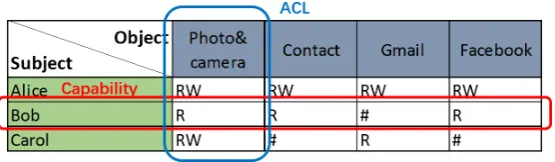
The elements and relations in Capability AC model are depicted in Figure1. Access Control 215
Matrix (ACM) includes sets of three basic elements: SubjectS, ObjectO, and PermissionP. Access 216
Control List (ACL) and Capability are two permission relationships in the ACM model. The ACL 217
permission assignment is a many-to-one relation between Subject and Objects, which means that 218
each object is associated with a set of access control lists that save the subjects and their authorized 219
permissions for the object. However, the capability model uses subject oriented permission assignment 220
in which relations between Subject and Objects becomes one-to-many. 221
A subject in the capability model is a human being or device, a object is an entity who offers 222
services or resources, and permission refers to an authorized activity to carry out a particular task or 223
an access resource on an object. In Fig.1, the permissions are: R-read, W-write and #-not allowed. For 224
each subject, the capability specifies a set of connected objects which are associated with authorized 225
permissions to access services or resources. The following is a list of definitions in capability model: 226
• S,OandPare sets of subjects, objects and permissions. 227
• inCapO⊆O×Pis internal capability which defines a one-to-many relation assignment between 228
Figure 1. Capability Access Control Model.
• extCap(S,O)⊆S×inCapOis external capability which specifies a one-to-many relation assignment 230
by associating a subject with a subset of internal capabilities. 231
TheinCapO are defined by object owner or policy authority to indicate all available service 232
permissions supported by an object. The policy decision authority could generateextCap(S,O)for a 233
subject to access an object by authorizing permissions ininCapO. 234
3.2. Federated Capability-based Delegation Model 235
Delegation is an efficient mechanism to simplify access policy management by building a 236
hierarchical relationship to reflect an organization’s lines of authority and responsibility. In essential, a 237
delegation hierarchy is a partial order relation. If x delegates the permissions to y, or y inherits the 238
permissions of x, the delegation relation between x and y could be represented as a partial order yx. 239
A partial order is a reflexive, transitive, and antisymmetric relation. 240
To control the delegation propagation and simplify the federated delegation model, we assume 241
that a subject cannot be delegated any new permissions if the subject has already been assigned 242
delegated permissions. Given the above assumption,Delegation Relation (DR)in FCDM is defined as 243
follows: 244
• DR⊆extCap×extCapis one-to-many delegation relation. A delegation relation can be represented 245
by((S1,(O×P1)),(S2,(O×P2)))∈DR, where P2P1. It indicates that subject S1 delegates subset 246
of P1 to subject S2 as P2. 247
To confine delegation relation propagation steps, it’s necessary to set delegation depth to 248
define maximum times whether or not delegation operation can be further performed. Two types 249
of delegation: single-step delegationand multi-step delegationare considered in FCDM. Single-step 250
delegation prevents the delegated subject from further performing delegation; whereas multi-step 251
delegation allows multiple delegate operations until it reaches the maximum delegation depth. Thus, 252
Single-step delegation is considered to be a special case of multi-step delegation with maximum 253
delegation depth equal to one. 254
Multi-step delegation generates an ordered list of delegation relation, calledDelegation Path (DP). 255
In general, a delegation path starts from an initial or rootextCap, and is represented as the following 256
notation: 257
DR0→DR1→· · ·→DRi→· · ·→DRn 258
All delegation paths starting with the rootextCapconstruct a hierarchical structure:Delegation 259
Tree (DT). In the delegation tree, each node represents aextCapand each edge refers to a DR. The layer 260
ofextCapin the tree is defined as the delegation depth. 261
Given above discussions, the definitions and functions in FCDM are: 262
• DP⊆DR×DRis an ordered list of delegation relation indicating a delegation path. 263
• DT⊆DR×DRis a delegation relation hierarchy representing a delegation tree. 264
• NmaxDepthis a natural number representing maximum delegation depth.
Figure 2. An Example for Delegation Paths and an Delegation Tree.
• Ancestor:extCap→extCapis a function that maps aextCapnode to another parentextCapnode in 266
the delegation tree. 267
• Path:extCap→DPis a function that maps aextCapnode to a delegation path. Path(extCapi) = { 268
DR0→DR1→· · ·→DRi|extCapi =Ancestor(extCapi−1)} 269
• DelegateDepth:extCap→Nis a function that returns a delegation depth in delegation tree given 270
extCapnode, whereNis a natural number set representing delegation depth. 271
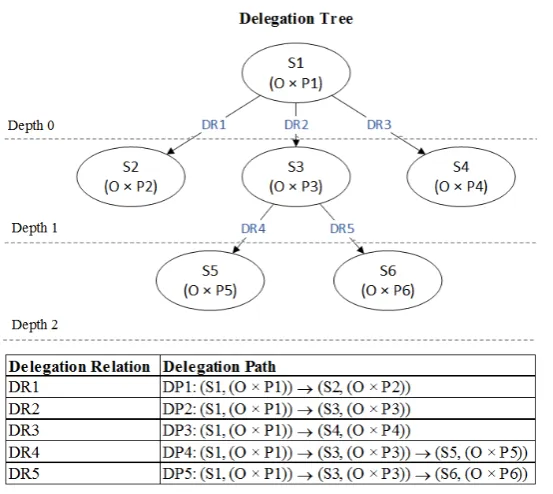
In order to illustrate the concepts of delegation path and delegation tree. a set of delegation 272
relations example is list as follows: 273
DR1 :((S1,(O×P1)),(S2,(O×P2)))∈DR 274
DR2 :((S1,(O×P1)),(S3,(O×P3)))∈DR 275
DR3 :((S1,(O×P1)),(S4,(O×P4)))∈DR 276
DR4 :((S3,(O×P3)),(S5,(O×P5)))∈DR 277
DR5 :((S3,(O×P3)),(S6,(O×P6)))∈DR 278
According to above delegation relations, all delegation paths can be calculated by applyingPath 279
function, and build up a delegation tree as shown in Fig2. In the delegation tree, the parent node only 280
delegated a subset of its permissions to a child, so that permission propagation over delegation path is 281
essentially a partial order sequence. Take DP5 for example, permission delegation is represented as 282
partial order relation: P6P3P1. 283
3.3. Capability-based Delegation Authorization 284
Delegation authorization is mainly to impost restrictions on which subject can be delegated 285
to whom based on delegation authorization rules. In our proposed FCDM, the subject-to-subject 286
delegation authorization relation is defined as follows: 287
• extCap,S,C,NmaxDepthare sets of capability, subject, conditions for authorization and maximum
288
delegation depth, respectively. 289
Figure 3. An Example for Grant-independent Cascading Revocation.
The relation(extCapS1,S2, C,NmaxDepth)∈can_Delegatemeans that a subjectS1, who is a node 291
in delegation tree with capabilityextCapS1, could delegate its subset of permissions to subjectS2 whose 292
properties satisfy the conditions without exceeding the maximum delegation depthNmaxDepth. Take 293
an example in Fig.2,(extCapS4∈extCap)∧((extCapS4,S7,C, 1)∈can_Delegate), whereNmaxDepth = 294
3 andC = {extCapS7∈/extCap}, then S4 can delegate subset of its permissionP4 to new subjectS7 295
as permissionP7. As a result, the new delegation relationDR6 :((S4,(O×P4)),(S7,(O×P7)))∈DR 296
and capabilityextCapS7= (S7,(O×P7))∈extCapare created and appended to DR3 as a leaf node of 297
delegation tree DT. 298
3.4. Capability-based Delegation Revocation 299
As an important process that accompanies the delegation mechanism, revocation refers to process 300
to nullify the delegated permissions, or attempts to rollback the state before permissions were delegated. 301
The revocation approaches can be categorized into three dimensions [30]:grant-dependency, propagation, 302
anddominance. Our FCDM only considers two dimensions:grant-dependencyandpropagation. 303
Grant-dependencyrefers to the legitimacy of a subject who can take away assigned permissions 304
from a delegated subject, and has two types:grant-dependentandgrant-independent.Grant-dependent 305
revocation means that only the delegating subject (parent) can revoke the permissions from directly 306
delegated subjects (children).Grant-independentrevocation means any ancestor subject in the delegation 307
path can revoke the delegated permissions from the offspring subjects. 308
Propagationspecifies the extent of the revocation to subsequent delegated subjects. it can be 309
categorized ascascadingandnon-cascading.Cascadingrevocation directly revokes delegated permissions 310
from subject as well as indirectly nullified a set of subsequent propagated delegation relation. While 311
Non-cascadingrevocation only takes away directly delegated permissions from children subjects. 312
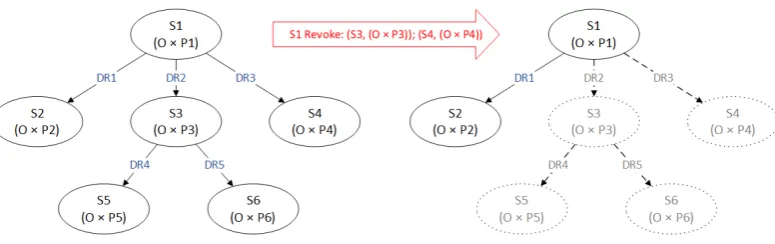
To reduce the complexity in the revocation process, our FCDM enforcesgrant-independentand 313
cascadingrules in delegation revocation. Figure3is an example for grant-independent cascading 314
revocation. Revocation authorization can be defined as follows: 315
• extCap,S,Ancestor()are sets of capability, subject and Ancestor function, respectively. 316
• can_Revoke⊆extCap×S×Ancestor(S). 317
The relation (extCapS1, Ancestor(S2))∈can_Revoke means that a subject S1, who is the 318
ancestor of subject S2, can revoke delegated permissions of S2 as well as all indirect assigned 319
permissions by S2 in subsequent delegation relation. As shown in Fig. 3, owing to fact 320
that bothS1∈Ancestor(S3) andS1∈Ancestor(S4), revocation authorization satisfies the relation 321
(extCapS1,Ancestor(S3))∨(extCapS1,Ancestor(S4))∈can_Revoke. As a result, the delegation relation 322
DR2 and DR3 are removed from delegate tree and delegated capabilityextCapS3andextCapS4are 323
revoked. In addition, subsequent relation DR4 and DR5 assigned by S3 are also removed, and 324
4. BlendCAC: a BLockchain-ENabled Decentralized Federated CapAC System 326
Most dominant IoT based systems, like ASW IoT, utilize a centralized cloud platform where 327
abundant computing and storage resources are allocated to securely manage connected devices. 328
As a result, all service access requests on devices need to be transmitted to remote servers for 329
authentication and authorization. Such a centralized network architecture is not scalable for today’s 330
large IoT networks, and latencies are not tolerable in many mission-critical applications. To meet 331
the requirements of real-time processing and instant decision making, online, uninterrupted smart 332
surveillance systems have been intensively studied recently leveraging the edge-fog-cloud computing 333
paradigm [31–33]. Based on an automatic surveillance system architecture, a federated capability-based 334
access control system (FedCAC) [34] has been proposed to addresses scalability, granularity, and 335
dynamicity challenges in access control strategy for IoT devices. Through delegating part of the 336
identify authentication and authorization task to domain delegator, workload of the centralized policy 337
decision making center (PDC) is reduced. Migrating some processing validation tasks to local devices 338
helps the FedCAC to be lighter and context-awareness enabled. Involving smart objects in access 339
right authorization process allows device-to-device communication, which implies better scalability 340
and interoperability in an IoT network environment. However, a comprehensive capability-based 341
delegation and revocation mechanism is not illustrated. In addition, FedCAC is essentially still a 342
centralized AC scheme, such that weaknesses include being the single-point of failure and performance 343
bottleneck, are still not solved. 344
Inspired by the smart contract and blockchain technology, a decentralized federated 345
capability-based access control framework for IoTs, called BlendCAC, is proposed in this paper, 346
and a prototype of proposal has been implemented in a physical IoT network environment to verify the 347
efficiency and effectiveness. The next subsection provides a comprehensive system design of BlendCAC 348
framework. Unlike the approaches discussed above, BlendCAC, effectively provides decentralization, 349
scalability, granularity, and dynamicity of AC strategies for IoTs. Through encapsulating FCDM model 350
and AC policies into a Smart Contract, which is deployed across the blockchain network, users are 351
the master of their own data or devices instead of being supervised or controlled by a third party 352
authority. Enforcing authorization and access right verification among a large number of distributed 353
edge devices allows more coordination on edge networks. 354
4.1. System Architecture of BlendCAC 355
Figure4illustrates the proposed BlendCAC system architecture, which intends to function in a 356
scenario including two isolated IoT-based service domains without pre-establishing a trust relationship. 357
In our proposed BlendCAC framework, the cloud works as service provider to provide global profile 358
data and security policy management , and the domain coordinator enforces delegated security policies 359
to manage domain related devices and services. Operation and communication modes are listed as 360
follows: 361
1. Registration: All entities must create at least one main account defined by a pair of keys to join 362
the blockchain network. Each account is indexed by its address that is derived from his/her 363
own public key. In our scenario, identity authentication and management is deployed on two 364
levels: cloud and coordinator. The cloud server maintains a global profile database, and the 365
domain coordinator maintains a local profile database, and regular synchronization between the 366
cloud server and domain coordinator ensures data consistence. New users could either sends 367
registration request to cloud or delegated coordinator. Once the identity information related to 368
users or IoT devices is verified, the profile of each registered entity is created by using his/her 369
address for authentication process when an access right request happens. As a result, the domain 370
coordinators are able to enforce delegated authorization policies and perform decision-making 371
Figure 4. System Architecture of BlendCAC.
2. Smart Contract Deployment: A smart contract, which manages federated delegation relation and 373
capability tokens, must be developed and deployed on the blockchain network by the policy 374
owner. In our framework, the cloud acts as data and policy owner who could deploy smart 375
contract encapsulating delegation and CapAC token. Thanks to cryptographic and security 376
mechanisms provided by blockchain network, smart contracts can secure any algorithmically 377
specifiable protocols and relationships from malicious interference by third parties under 378
trustless network environment. After synchronizing the blochchain data, all nodes could access 379
all transactions and recent state of each smart contract by referring local chain data. Each 380
node interacts with the smart contract through the provided contract address and the Remote 381
Procedure Call (RPC) interface. 382
3. Federated Delegation: The PDC at the cloud server is responsible for delegation policy definition 383
and access right authorization enforcement. To reduce the overhead of the centralized cloud 384
server and meet requirements of scalability and heterogeneity in each IoT domain, the domain 385
coordinator delegates part of the policy decision making tasks and carries out domain specified 386
authorization rules based on domain specified policies. After receiving a delegation request 387
from a coordinator candidate and executing policy decision making task to delegate permissions 388
to coordinator, cloud launches a transaction to issue a delegation certificate on smart contract. 389
Finally, the federated delegation relationship is established between the cloud server and the 390
coordinator, and profile and policy data synchronization between the cloud and coordinator is 391
periodically carried out to ensure data consistence on two side. 392
4. Capability Authorization: To successfully access services or resources at service providers, an entity 393
initially sends an access right request to the domain coordinator to get a capability token. Given 394
the registered entity information established in the profile database, a policy decision making 395
module evaluates the access request by enforcing the delegated authorization policies. If the 396
access request is granted, the domain coordinator issues the capability token encoding the access 397
transaction has been approved and recorded in a new block, the domain coordinator notifies the 399
entity with a smart contract address for the querying token data. Otherwise, the access right 400
request is rejected. 401
5. Access Right Validation: The authorization validation process is performed at the local service 402
providers on receiving a service request from the entity. Through regularly synchronizing the 403
local chain data with the blockchain network, a service provider just simply checks the current 404
state of the contract in the local chain to get a capability token associated with the entity’s address. 405
Considering the capability token validation and access authorization process result, if the access 406
right policies and conditional constraints are satisfied, the service provider grants the access 407
request and offers services to the requester. Otherwise, the service request is denied. 408
To enable a scalable, distributed and fine-grained access control solution to IoT networks, the 409
proposed BlendCAC is focused on three issues: identity-based capability management, access right 410
authorization and privilege mechanism delegation. 411
4.2. Capability Token Structure 412
In the BlendCAC system, the entities are categorized as subjects and objects.Subjectsare defined 413
as entities who request a service from the service providers, whileobjectsare referred to entities who 414
offer the resources or services. Entities could be either human beings or smart devices. In the profile 415
database, all registered entities are associated with a globally unique Virtual Identity (VID), which is 416
used as the prime key for identifying entities’ profile information. As each entity has at least one main 417
account indexed by its address in the blockchain network, the blockchain is used to represent the VID 418
for profiling register entities. 419
In general, the capability specifies which subject can access resources of a target object by associating subject, object, actions and condition constraints. The identity-based capability structure is defined as follows:
ICap= f(V IDS,V IDO,AR,C) (1)
where the parameters are: 420
• f: a one-way hash mapping function; 421
• V IDS: the virtual ID of a subject that requests an access to a service or resource; 422
• V IDO: the virtual ID of an object that provides a service or resource; 423
• AR: a set of access right for actions, e.g. read, write, execute; and 424
• C: a set of context awareness information, such as time, location. 425
In the BlendCAC system, anAR is defined as the access right set. For example, theAR can 426
be{Read},{Write},{Read;Write}, or{NULL}. IfAR= {NULL}, the operation conducted on the 427
resource is not allowed.Cis defined as a context constraints set, likeC={C1,C2}orC={NULL}. If 428
C={NULL}, no context constraint is considered in the access right validation process. 429
4.3. Delegation Certificate Structure 430
Identity-based Delegation Certificate(IDC) is in essential a special capability token which specifies the delegation relation. The structure of IDC is represented as follows:
IDC= f(V IDS,{V IDP},{V IDC},D,W,DAR) (2)
where the parameters are: 431
• f: a one-way hash mapping function; 432
• V IDS: the virtual ID of a subject who is the owner of the delegation token; 433
• V IDP: the virtual ID of a parent subject that delegates the token toV IDS; 434
IDT= f(S,MD,IDC) (3) where the parameters are:
440
• f: a one-way hash mapping function; 441
• S: the virtual ID of a subject who is the owner of delegation tree; 442
• MD: a natural number that defines maximum delegation depth; and 443
• IDC: a delegation certificate that indicates the root node of delegation tree. 444
4.4. Federated Delegation Mechanism 445
Through encapsulating a delegation certificate structure as smart contract and deployed on 446
blockchain network, the delegation mechanism could be enforced across different security domains in 447
a federated network environment. In the BlendCAC system, the delegator, delegation authority center 448
(DAC) and identity management are all implemented as service applications on the cloud server, while 449
the delegatee is deployed on the coordinator in each network domain. The DAC is responsible for 450
identification authentication and delegation authorization service. Prior to the delegation process, the 451
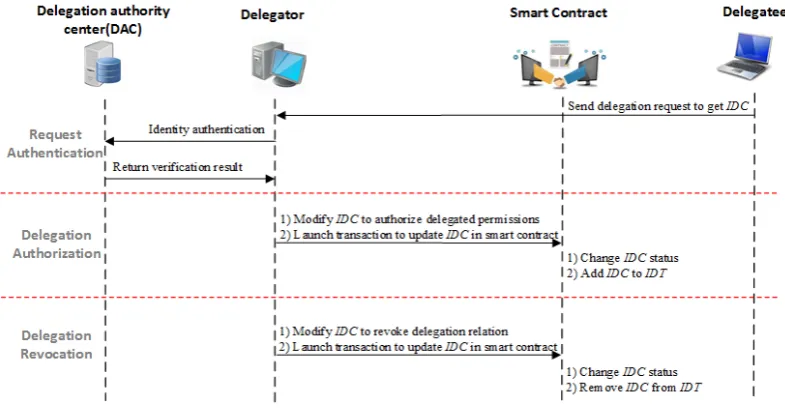
delegator and delegatee should have finished the identity registration process. Figure5illustrates the 452
delegation process in our proposed BlendCAC system. The involved work flow in delegation process 453
is: 454
Figure 5. Delegation Process in BlendCAC System.
• Request Authentication: The delegatee sends a delegation request to the delegator to ask for 455
IDC. On receiving the request from the delegator, the DAC verifies the identity of delegatee 456
by referring identity management service. If the delegatee’s identity is valid, the identity 457
management service returns a virtual ID (VID) of the delegatee to the DAC. Then the DAC sends 458
back the authentication result to the delegator. Otherwise, the DAC rejects the delegation request 459
• Delegation Authorization: After receiving the verification result from the DAC, the delegator is 461
capable of assigning delegable permissions to trusted delegatee given predefined delegation 462
policies. In our proposal, the federated delegation mechanism is implemented by modifying 463
delegation certificate IDCto assign the delegated permissions or change delegation relation. 464
As the smart contract has received an update DC transaction from the delegator, it checks 465
the delegator’s IDC to validate the delegation right. If the delegation status can match the 466
can_Delegate relation, the delegator could delegate subset of his/her delegated permissions 467
to delegatee entity by modifying delegatee’sIDC and appending the delegatee’s address to 468
delegator’s children nodes set{V IDC}to set up delegation relation. Otherwise, the capability 469
delegation request is rejected. 470
• Delegation Revocation: The delegation revocation considers two scenarios: delegated permissions 471
Prevocation and delegation certificate IDCrevocation. According to revocation mechanism 472
defined in FCDM, only entities who meet thecan_Revokerelation could carry out revocation 473
operation over smart contract. In delegated permissions revocation process, the delegator could 474
nullify part of assigned permissions by simply removing access right elements fromDARin 475
delegatee’sIDC. In case ofIDCrevocation, throughcascadingremoving all subsequent delegate 476
relations fromDPwhich starts from delegator and destructing delegatee’sIDC, the delegator 477
could tear down all delegation relations that is associated with delegatee, including thoseIDCs 478
assigned by delegatee. 479
4.5. Capability-based Access Right Authorization 480
The capability token structure and the related operations are transcoded to a smart contract 481
and deployed on the blockchain network, while the access right authorization is implemented as a 482
policy-based decision making service running on the cloud or delegated domain coordinator. As 483
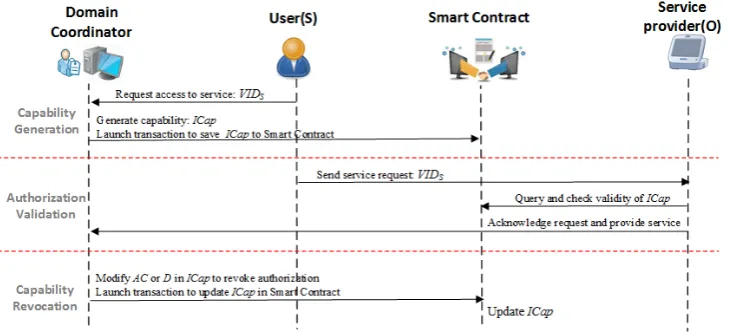
shown by Fig6, a comprehensive capability-based access right authorization procedure consists of 484
four steps: capability generation, access right validation, capability delegation and revocation. 485
1. Capability Generation: As one type of meta data to represent the access right, the capabilityICap 486
could be generated by associating a VID with an AR, thus theICaphas the identified property 487
to prevent forgery. After receiving access request from user, the domain coordinator generates 488
capability token based on delegated access right authorization policy, and launches transactions 489
to save a new token data to a smart contract. A large number ofICap’s are grouped into the 490
capability pools on smart contract, which could be proofed and synchronized among the nodes 491
across the blockchain network. 492
2. Access Right Validation: After receiving the service request from a subject, the service provider 493
first fetches the capability token from the smart contract by using the subject’s address, then 494
makes decisions on whether or not to grant an access to the service according to the local access 495
control policy. Implementing access right validation at the local service provider allows smart 496
objects to be involved in the AC decision making task, which is suitable to offer a flexible and 497
fine-grained AC service in IoT networks. 498
3. Capability Revocation: The capability revocation considers two scenarios: partial access right 499
revocation and ICaprevocation. In our proposal, only the entities with delegated capability 500
management permissions are allowed to perform revocation operation on capability tokenized 501
smart contract. In the partial access right revocation process, the delegated entities could remove 502
part of entries fromARto revoke the selected access right. In case ofICaprevocation, through 503
directly clearing theARinICap, the whole capability token becomes unavailable to all associated 504
entities. 505
5. Prototype Design 506
A concept-proof prototype system has been implemented on a real private Ethereum blockchain 507
Figure 6. Flowchart of the Capability-based Access Right Authorization.
Ethereum has a more matured ecosystem and is designed to be more adaptable and flexible for the 509
development of a smart contract and business logic [35]. 510
5.1. Delegation Certificate and Capability Token Structure 511
The proposed BlendCAC model has been transcoded to a smart contract using Solidity [36], 512
which is a contract-oriented, high-level language for implementing smart contracts. With Truffle [37], 513
which is a world class development environment, testing framework and asset pipeline for Ethereum, 514
contract source codes are compiled to Ethereum Virtual Machine (EVM) bytecode and migrated to the 515
Ethereum blockchain network. 516
To implement a BlendCAC system on IoT devices without introducing significant overhead over 517
network communication and computation, delegation certificate and capability token data structure is 518
represented in JSON [38] format. Compared to XML-based language for access control, like XACML 519
and SAML, JSON is lightweight and suitable for constrained platforms. 520
Figure7: a) demonstrates a delegation certificate example, and the data fields in the data structure 521
are described as follow: 522
• parent: a 20 bytes value to represent address of parent node in blockchain network; 523
• children: a queue to record all address of delegated entities; 524
• depth: a natural number to indicate depth of current delegation certificate in the delegation tree; 525
• delegateWidth: a natural number to constraint horizontal delegation times; 526
• privileges: a set of delegated access rights that delegator has assigned to the delegatee, including 527
– contract: a 20 bytes value to indicate address of delegated smart contract; and 528
– authorization: a set of delegated functions for which the operations are granted. 529
Figure7: b) presents a capability token data example used in the AC system. A brief description 530
of each field is provided as follows: 531
• id: the auto-incremented prime key to identify a capability token; 532
• initialized: a bool flag used for checking token initialized status; 533
• isValid: a bool flag signifying enabled status to show whether token is valid or not; 534
• issuedate: for identifying the date time when the token was issued; 535
• expireddate: the date time when token becomes expired; 536
• authorization: a set of access right rules that the issuer has granted to the subject, including 537
– action: to identify a specific granted operation over resource; 538
– resource: the resource in the service provider for which the operation; is granted. In this 539
Figure 7. Token Data Structure in BlendCAC.
– conditions: a set of conditions which must be fulfilled locally on the service provider to 541
grant the corresponding operation. 542
After a smart contract has been successfully deployed on the blockchain network, all nodes in the 543
network could interact with smart contract using address of contract and Application Binary Interface 544
(ABI) definition, which describes the available functions of a contract. 545
5.2. Access Authorization Service 546
The access authorization and validation policy is enforced as a web service application based 547
on the Flask framework [39] using Python. The Flask is a micro-framework for Python based on 548
Werkzeug, Jinja 2 and good intentions. The lightweight and extensible micro architectures make the 549
Flask a preferable web solution on resource constrained IoT devices. 550
Web service application in BlendCAC system consists of two parts: client and server. The client 551
performs operation on resource by sending data request to the server, while the server provides 552
REST-ful API for the client to obtain data or perform operation on resource in server side. A capability 553
based access control scheme is enforced on server side by performing access right validation on 554
the service provider. The access right validation process is launched after a request containing the 555
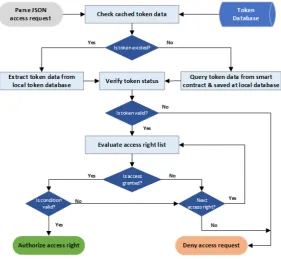
capability token is received on server. Figure8shows a block diagram with the steps to process an 556
authorization decision. 557
1. Check cached token data: After receiving a service request from a user, the service provider firstly 558
checks whether or not the token data associated with user’s address exists in the local database. 559
If it is failed in searching the token data, the service provider can fetch the token data from the 560
smart contract through calling an exposed contract method and save token data to the local 561
database. Otherwise, the token data is directly reloaded from the local token database for further 562
validation process. The service provider regularly synchronizes the local database with smart 563
contract to ensure the token data consistence. 564
2. Verify token status: As a capability token has been converted to JSON data, the first step of token 565
validation is checking the current capability token status, such as initialized, isValid, issuedate, 566
and expireddate. If any status of a token is not valid, the authorization process stops and sends 567
deny access request acknowledgement back to the subject. 568
3. Check whether access is granted or not: The service provider will go through all access rules in the 569
access right set to guarantee that the request operation is permitted. The process checks whether 570
or not the REST-ful method used by the requester matches the authorized action of current access 571
rules and the value of resource field is the same as the Request-URI option used by the requester. 572
Figure 8. BlendCAC Access Authorization Process.
none of the access rules could successfully pass the verification, the authorization validation 574
process stops and denies the access request. 575
4. Verify the conditions: Even through the action on a target resource is permitted after the access 576
validation, the context-awareness constrains are necessary to be evaluated on the local device 577
by verifying whether or not the specified conditions in the token is satisfied. The condition 578
verification process goes through all constraints in the condition set to find the matched ones. If 579
no condition is fulfilled in the given local environment, the access right validation process stops 580
and denies access request. 581
6. Experimental Results 582
In order to evaluate the performance and the overhead of our BlendCAC scheme, two benchmark 583
models, RBAC and ABAC, are also transcoded to separate smart contracts and enforced on the 584
experimental web service system. All transcoded access control models have the similar data structure 585
in smart contract except authorization representation. In RBAC based smart contract, authorization 586
is defined as the approach to bridge the relationship between user and permission, while RBAC 587
based smart contract uses user’s attributes as representative format for authorization. Both the 588
RBAC and ABAC need a local database, either to maintain the user-role-permission or to manage 589
the attribute-permission policy for authorization validation process, the profiles and policy rules 590
management are developed by using an embedded SQL database engine, called SQLite[40]. The lower 591
memory and computation cost make the SQLite an ideal database solution to resource constrained 592
system, like Raspberry Pi. 593
6.1. Environmental Setup 594
The mining task is performed on a system with stronger computing power, like a laptop or a 595
desktop. Two miners are deployed on a laptop, of which the configuration is as follows: the processor 596
is 2.3 GHz Intel Core i7 (8 cores), the RAM memory is 16 GB and the operating system is Ubuntu 597
Figure 9. Experimental Results of BlendCAC System.
16.04 OS, 3 GHz Intel Core TM (2 cores) processor and 4 GB memory. In our system, the laptop 599
acts as a cloud computing server, while all desktops work as fog computing nodes to take role of 600
domain coordinator. Each miner uses two CPU cores for mining. The edge computing nodes are two 601
Raspberry PI 3 Model B with the configuration as follows: 1.2GHz 64-bit quad-core ARMv8 CPU, the 602
memory is 1GB LPDDR2-900 SDRAM and the operation system is Raspbian based on the Linux kernel. 603
Unfortunately, the Raspberry PI is not powerful enough to function as a miner, so all Raspberry Pi 604
devices worked as nodes to join the private blockchain without mining. All devices use Go-Ethereum 605
[41] as the client application to work on the blockchain network. 606
6.2. Experimental Results 607
To verify effectiveness of our proposed BlendCAC approaches to defense unauthorized access 608
request, a service access experiment is carried out on the real network environment. In the test 609
scenario, one Raspberry Pi 3 device works as the client while another Raspberry Pi 3 device works 610
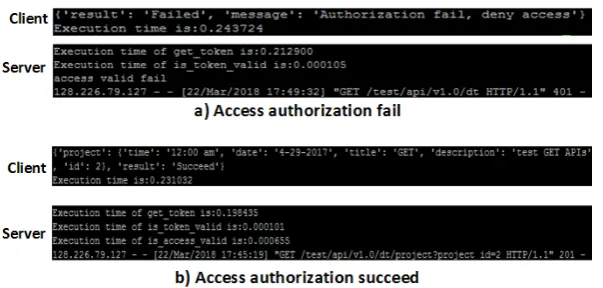
as the service provider. Given the authorization process shown in Fig9, when any of the steps in 611
the authorization is failed, the running process will immediately be aborted instead of continuing to 612
carry out all authorization stages. As shown by Fig9(a), the server aborted authorization process 613
due to failing to verify granted actions or conditional constraints that are specified in the access right 614
list. As a result, the client node received a deny access notification from the server and cannot read 615
the requested data. In a contrast, Fig9(b) presents a successful data request example, in which the 616
whole authorization process is accomplished at the server side without any error. Finally, the client 617
successfully retrieves the data from the service provider. 618
6.3. Performance Evaluation 619
In the test scenario, two Raspberry Pi 3 devices are adopted to play the roles of the client and 620
the service provider respectively. To measure the general cost incurred by the proposed BlendCAC 621
scheme both on the IoT devices’ processing time and the network communication delay, 50 test runs 622
have been conducted based on the proposed test scenario, where the client sends a data query request 623
to the server for an access permission. This test scenario is based on an assumption that the subject has 624
a valid capability token when it performs the action. Therefore, all steps of authorization validation 625
must be processed on the server side so that the maximum latency value is computed. 626
6.3.1. Computational Overhead 627
According to the results shown in Fig.10, the average total delay time required by the BlendCAC 628
operation of retrieving data from the client to server is 243 ms, which is almost the same as RBAC or 629
Figure 10. Computation Time for Each Stage in BlendCAC.
the smart contract, time for parsing JSON data from the request, and time for access right validation. 631
The token processing task is mainly responsible for fetching token data from the smart contract and 632
introduces the highest workload among the authorization operation stages. Owing to the fact that 633
encapsulating user-role relationship in the smart contract requires less data than the capability or 634
attributes does, the RBAC incurred less computational cost than what BlendCAC and ABAC did in 635
token processing stage. As the most computing intensive stage, the execution time of token processing 636
is about 210 ms, which is accounted for almost 86% of the entire process time. 637
The entire authorization process is divided into two steps, token validation and authorization 638
verification, where the average time of the authorization process is about 0.86 ms (0.12 ms + 0.74 639
ms). Compared with token validation process, which only simply checks the token valid status, the 640
authorization verification process requires more computational power to enforce the local access 641
control policies. Although the similarity in token data structure allows all the three access control 642
models have almost the same time in the token validation stage, the BlendCAC outperforms the RBAC 643
and ABAC in authorization verification. Since both the RBAC and ABAC needs a database to either 644
manage user-role-permission relationship or maintain attributes-permission rules, which inevitably 645
incurs time consuming on searching rules in database. In our experimental study, the RBAC (2.47 ms) 646
and ABAC (2.07 ms) have much higher processing time than BlendCAC (0.74 ms). 647
6.3.2. Communication Overhead 648
Owing to the high overhead introduced by querying token data from the smart contract in token 649
processing stage, a token data caching solution is introduced in the BlendCAC system to reduce 650
network latency. When the client sends a service request to the server, the service side extracts cached 651
token data from the local storage to valid authorization. The service providers regularly update cached 652
token data by checking smart contract status. The token synchronization time is in consistence with 653
block generation time, which is about 15 seconds in the Ethereum blockchain network. Simulating 654
a regular service request allows us to measure how long it takes for the client to send a request and 655
retrieve the data from the server. 656
Figure11shows the overall network latency incurred and compares the execution time of the 657
BlendCAC with RBAC, ABAC and a benchmark without any access control enforcement. At the 658
beginning, a long delay is observed in the first service request scenario, in which service provider 659
communicated with the smart contract and cached the token data. However, through processing 660
Figure 11. Network Latency of BlendCAC.
becomes stable at a low level during the subsequent service requests. The benchmark without access 662
control enforcement takes an average of 31 ms for fetching requested data versus that the BlendCAC 663
consumes on average of 36 ms. It means that the proposed BlendCAC scheme only introduces about 664
5 ms extra latency. The overhead in terms of delay is trivial. As shown by Fig. 11, the BlendCAC 665
also has lower latency than RBAC and ABAC in most period of time. In addition, unlike RBAC and 666
ABAC, which rely on the local policy database as intermediate to valid access right, encoding access 667
right directly in capability token makes the BlendCAC more scalable and flexible in the large scale IoT 668
networks. 669
As the experimental results show, the proposed BlendCAC scheme introduced a small amount of 670
overhead, both at the network layer and the local device layer. To measure general network latency of 671
inter-domain communication, HTTP is executed on the same testbed to simulate a regular transaction, 672
like connects, sends a request and retrieves the reply. Compared with calculated average network 673
latency that is about 300 ms, the trade-off in the proposed BlendCAC is acceptable for the network 674
environments by only incurring 5 ms latency (no more than 2%). In addition, the test scenarios are 675
based on Raspberry Pi devices, which belongs to a type of simple board computer (SBC) with limited 676
computation power and memory space. It is reasonable to expect a better performance when the 677
BlendCAC scheme is implemented on more powerful smart devices, like a smart phone. Although 678
synchronizing cached token data with the smart contract requires more computational resources, the 679
transactions of querying smart contract status are regularly launched by the service providers in a 680
separate service thread rather than being called in each service request, so that network overhead over 681
service request communication is greatly reduced to improve QoS requirement. 682
6.4. Discussions 683
The experimental results demonstrate that our proposed BlendCAC strategy is effective and 684
efficient to protecting the IoT devices from an unauthorized access request. Compared to centralized 685
AC model, our proposed scheme has the following advantages: 686
• Load balance: The BlendCAC framework takes advantage of delegation mechanism to distribute 687
the load of centralized PDC server to separate local domain coordinators, such that the bottleneck 688
effect of PDC is mitigated and the risk of malfunction resulting from centralized system is 689
reduced. Even in the worst case when the PDC crash for a short period of time, a large number 690
of domain coordinators still work normally on behalf of the PDC to provide services; 691
• Decentralized authorization: Leveraging the blockchain technique, the proposed BlendCAC scheme 692
bottleneck and the single point of failure are mitigated, and smart things are capable of protecting 701
their own resource and privacy by enforcing user-defined security mechanism; 702
• Fine granularity: Enforcing access right validation on local service providers empowers those 703
smart devices to decide whether or not to grant access to certain services according to local 704
environmental conditions. Fine-grained access control with lease privilege access principle 705
prevents privilege escalation, even if attacker steals capability token; 706
• Lightweight: Compared to XML-based language for access control, such as XACML, JSON 707
is a lightweight technology that is suitable for resource constrained platforms. Given the 708
experimental results, our JSON based capability token structure introduces small overhead 709
on the general performance. 710
7. Conclusions 711
In this paper, we proposed a decentralized federated capability-based access control framework 712
leveraging the smart contract and blockchain technology, called BlendCAC, to handle the challenges 713
in access control strategies for IoT devices. A concept-proof prototype has been built in a physical IoT 714
network environment to verify the feasibility of the proposed BlendCAC. The FCDM model and CapAC 715
policy are transcoded to smart contracts and works on the private Ethereum blockchain network. 716
The desktops and laptops serve as miners to maintain the sanctity of transactions recorded on the 717
blockchain, while Raspberry PI devices act as edge computing nodes to access and to provide IoT-based 718
services. Extensive experimental studies have been conducted and the results are encouraging. It 719
validated that the BlendCAC scheme is able to efficiently and effectively enforce access control 720
authorization and validation in a distributed and trustless IoT network. This work has demonstrated 721
that our proposed BlendCAC framework is a promising approach to provide a scalable, fine-grained 722
and lightweight access control for IoT networks. 723
While the reported work has shown significant potential, there is still a long way to go to build a 724
complete decentralized security solution for IoT edge computing. Deeper insights are expected. Part of 725
our on-going effort is focused on further exploration of the blockchain based access control scheme in 726
real-world applications. Taking the smart surveillance system as a case study, the proposed BlendCAC 727
will be extended to protect network cameras and motion sensors in the novel urban surveillance 728
platform we developed recently [32,42]. 729
Abbreviations 730
The following abbreviations are used in this manuscript: 731
732
ABAC: Attribute-based Access Control 733
AC: Access Control 734
ACL: Access Control List 735
ACM: Access Control Matrix 736
BlendCAC: BLockchain-ENabled Decentralized Federated Capability-based Access Control 737
CAC/CapAC: Capability-based Access Control 738
FCDM: Federated Capability-based Delegation Model 739
IoT: Internet of Thing 740
RTT: Round Trip Time 742
QoS: Quality of Service 743
744
1. Al-Fuqaha, A.; Guizani, M.; Mohammadi, M.; Aledhari, M.; Ayyash, M. Internet of things: A survey 745
on enabling technologies, protocols, and applications. IEEE Communications Surveys & Tutorials2015, 746
17, 2347–2376. 747
2. Snidaro, L.; Garcia-Herrera, J.; Llinas, J.; Blasch, E.Context-Enhanced Information Fusion; Springer, 2016. 748
3. Blasch, E.; Kadar, I.; Grewe, L.L.; Brooks, R.; Yu, W.; Kwasinski, A.; Thomopoulos, S.; Salerno, J.; Qi, H. Panel 749
summary of cyber-physical systems (CPS) and Internet of Things (IoT) opportunities with information 750
fusion. Signal Processing, Sensor/Information Fusion, and Target Recognition XXVI. International Society 751
for Optics and Photonics, 2017, Vol. 10200, p. 102000O. 752
4. Alaba, F.A.; Othman, M.; Hashem, I.A.T.; Alotaibi, F. Internet of Things security: A survey. Journal of 753
Network and Computer Applications2017,88, 10–28. 754
5. Gusmeroli, S.; Piccione, S.; Rotondi, D. A capability-based security approach to manage access control in 755
the internet of things.Mathematical and Computer Modelling2013,58, 1189–1205. 756
6. Nakamoto, S. Bitcoin: A peer-to-peer electronic cash system2008. 757
7. Crosby, M.; Pattanayak, P.; Verma, S.; Kalyanaraman, V. Blockchain technology: Beyond bitcoin.Applied 758
Innovation2016,2, 6–10. 759
8. Ouaddah, A.; Mousannif, H.; Elkalam, A.A.; Ouahman, A.A. Access control in the Internet of things: big 760
challenges and new opportunities.Computer Networks2017,112, 237–262. 761
9. Gong, L. A secure identity-based capability system. Security and Privacy, 1989. Proceedings., 1989 IEEE 762
Symposium on. IEEE, 1989, pp. 56–63. 763
10. Sandhu, R.S.; Coyne, E.J.; Feinstein, H.L.; Youman, C.E. Role-based access control models. Computer1996, 764
29, 38–47. 765
11. Samarati, P.; de Vimercati, S.C. Access control: Policies, models, and mechanisms. International School on 766
Foundations of Security Analysis and Design. Springer, 2000, pp. 137–196. 767
12. De Souza, L.M.S.; Spiess, P.; Guinard, D.; Köhler, M.; Karnouskos, S.; Savio, D. Socrades: A web service 768
based shop floor integration infrastructure. InThe internet of things; Springer, 2008; pp. 50–67. 769
13. Spiess, P.; Karnouskos, S.; Guinard, D.; Savio, D.; Baecker, O.; De Souza, L.M.S.; Trifa, V. SOA-based 770
integration of the internet of things in enterprise services. Web Services, 2009. ICWS 2009. IEEE 771
International Conference on. IEEE, 2009, pp. 968–975. 772
14. Zhang, G.; Tian, J. An extended role based access control model for the Internet of Things. Information 773
Networking and Automation (ICINA), 2010 International Conference on. IEEE, 2010, Vol. 1, pp. V1–319. 774
15. Yuan, E.; Tong, J. Attributed based access control (ABAC) for web services. Web Services, 2005. ICWS 2005. 775
Proceedings. 2005 IEEE International Conference on. IEEE, 2005. 776
16. Smari, W.W.; Clemente, P.; Lalande, J.F. An extended attribute based access control model with trust and 777
privacy: Application to a collaborative crisis management system. Future Generation Computer Systems 778
2014,31, 147–168. 779
17. Ye, N.; Zhu, Y.; Wang, R.c.; Malekian, R.; Qiao-min, L. An efficient authentication and access control 780
scheme for perception layer of internet of things. Applied Mathematics & Information Sciences2014,8, 1617. 781
18. Liu, B.; Chen, Y.; Hadiks, A.; Blasch, E.; Aved, A.; Shen, D.; Chen, G. Information fusion in a cloud 782
computing era: a systems-level perspective. IEEE Aerospace and Electronic Systems Magazine2014,29, 16–24. 783
19. Gusmeroli, S.; Piccione, S.; Rotondi, D. IoT@ Work automation middleware system design and architecture. 784
Emerging Technologies & Factory Automation (ETFA), 2012 IEEE 17th Conference on. IEEE, 2012, pp. 1–8. 785
20. Anggorojati, B.; Mahalle, P.N.; Prasad, N.R.; Prasad, R. Capability-based access control delegation model 786
on the federated IoT network. Wireless Personal Multimedia Communications (WPMC), 2012 15th 787
International Symposium on. IEEE, 2012, pp. 604–608. 788
21. Skinner, G.D.; others. Cyber security management of access controls in digital ecosystems and distributed 789
environments. 6th International Conference on Information Technology and Applications (ICITA 2009), 790
Distributed Applications and Interoperable Systems. Springer, 2017, pp. 206–220. 799
26. Ouaddah, A.; Abou Elkalam, A.; Ait Ouahman, A. FairAccess: a new Blockchain-based access control 800
framework for the Internet of Things. Security and Communication Networks2016,9, 5943–5964. 801
27. Szabo, N. Formalizing and securing relationships on public networks. First Monday1997,2. 802
28. Gomi, H.; Hatakeyama, M.; Hosono, S.; Fujita, S. A delegation framework for federated identity 803
management. Proceedings of the 2005 workshop on Digital identity management. ACM, 2005, pp. 804
94–103. 805
29. Aura, T. Distributed access-rights management with delegation certificates. InSecure Internet Programming; 806
Springer, 1999; pp. 211–235. 807
30. Zhang, L.; Ahn, G.J.; Chu, B.T. A rule-based framework for role-based delegation and revocation.ACM 808
Transactions on Information and System Security (TISSEC)2003,6, 404–441. 809
31. Chen, N.; Chen, Y.; You, Y.; Ling, H.; Liang, P.; Zimmermann, R. Dynamic urban surveillance video 810
stream processing using fog computing. Multimedia Big Data (BigMM), 2016 IEEE Second International 811
Conference on. IEEE, 2016, pp. 105–112. 812
32. Chen, N.; Chen, Y.; Blasch, E.; Ling, H.; You, Y.; Ye, X. Enabling Smart Urban Surveillance at The Edge. 813
Smart Cloud (SmartCloud), 2017 IEEE International Conference on. IEEE, 2017, pp. 109–119. 814
33. Chen, N.; Chen, Y.; Song, S.; Huang, C.T.; Ye, X. Smart Urban Surveillance Using Fog Computing. Edge 815
Computing (SEC), IEEE/ACM Symposium on. IEEE, 2016, pp. 95–96. 816
34. Xu, R.; Chen, Y.; Blasch, E.; Chen, G. A Federated Capability-based Access Control Mechanism for Internet 817
of Things (IoTs). the SPIE Defense & Commercial Sensing 2018 (DCS), Conference on Sensors and Systems 818
for Space Applications. SPIE, 2018. 819
35. Ethereum Homestead Documentation. http://www.ethdocs.org/en/latest/index.html. 820
36. Solidity.http://solidity.readthedocs.io/en/latest/. 821
37. Truffle.http://truffleframework.com/docs/. 822
38. Crockford, D. RFC 4627: The application/json media type for javascript object notation (json), July 2006. 823
Status: INFORMATIONAL. 824
39. Flask: A Pyhon Microframework. http://flask.pocoo.org/. 825
40. SQLite. https://www.sqlite.org/index.html. 826
41. Go-ethereum. https://ethereum.github.io/go-ethereum/. 827
42. Xu, R.; Nikouei, S.Y.; Chen, Y.; Song, S.; Polunchenko, A.; Deng, C.; Faughnan, T. Real-Time Human Object 828
Tracking for Smart Surveillance at The Edge. the IEEE International Conference on Communications, 829