A Model for Context-dependent Access Control for Web-based Services with
Role-based Approach
Ruben Wolf, Thomas Keinz, Markus Schneider
FhG Institute for Secure Telecooperation (SIT), 64293 Darmstadt, Germany
email:
ruben.wolf
thomas.keinz
markus.schneider
@sit.fhg.de
Abstract
Controlling access to resources is one of the most im-portant protection goals for web-based services in prac-tice. In general, access control requires identification of subjects that intend to use resources. Today, there are sev-eral identification mechanisms for subjects, providing
dif-ferent security levels. However, some of them are only
suitable to be used in specific environments. In this pa-per we consider access control to web-based services that also depends on the strength of identification mechanisms as a context-dependent parameter. Furthermore, we show how to model this context-dependent access control by us-ing role-based concepts.
1. Introduction
In the past years, an enormous diversity of technical ap-plications based on web technology has been developed. These applications can be identified in various fields such as electronic shopping, trading with information, applica-tions in the telematic area, or even accessing grid computing services via the web. Dealing with services provided over open networks, security questions like controlling access to offered services are of central interest.
Access control is strongly related to the question of user identification. There are several technical solutions which are used in practice, e.g., challenge & response protocols based on digital signatures and public key X.509 certificates (we consider X.509 certificates due to their wide deploy-ment), passwords, and even cookies. The decision, which of these identification mechanisms has to be applied, even-tually depends on the protection goals in the correspond-ing application and the desired security level. High-level protection usually requires stronger mechanisms. Further-more, there are possibly desired functionalities that can only be achieved with specific identification mechanisms. Thus,
This work was supported by the Federal Ministery of Education and Research in the ILAB project.
the usage of specific services may only be allowed to be used after identification with specific mechanisms. On the other hand, there are situations where different identifica-tion mechanisms can be reasonable for accessing services from different locations, e.g., identification via private key / certificate from the user’s own computer and identification via passwords from a public computer. In such a context, the user’s permissions should also depend on the strength of the identification mechanism. The idea of role-based access control (RBAC) has been extensively discussed. RBAC is considered to be attractive because of its advantages regard-ing the support for efficient administration of large numbers of users, and its property of being policy-neutral, i.e., being able to deal with a wide range of security policies [4].
In this paper, we propose the usage of RBAC concepts. In this context, we do not use roles by mapping structures inside an institution to a role hierarchy as this is usually done. Instead, we model user classes into roles combined with the identification mechanism they use. Furthermore, we show how well-known RBAC concepts can be applied to model cases in which identification mechanisms can be used as a parameter to be evaluated in access control.
2. Service Requirements
The WWW is a basis for many business models. To-day, there is a variety of services that can be accessed via the web. Examples are web-based email services, notifi-cation services, online auctions, virtual communities, col-laboration platforms, information portals, online libraries, grid computing, information brokerage, procurement sys-tems. These services can be considered to be bundles of various basic services which may comprise one or more op-erations on objects at the web server side. If specific oper-ations are not allowed for all —possibly unknown— users, the identity of the requesting user has to be verified through a well-chosen identification mechanism, adequate for the values to be protected. In practice, web-based services are usually offered with exactly one identification mechanism chosen by the web service provider.
We distinguish two classes of web-based services. There are free services, which means that users do not have to pay for them, or chargeable services where customers have to pay for use. Charging can be realized according to various payment models, e.g., pay per use or pay per subscription based. In general, before a customer uses a chargeable web service he has to register. Services can also be for free but may still require registration. In the registration phase, a customer usually has to give some personal data and may also select some service packages containing the desired features. Then, a user account can be created to which the user can be mapped after he has been identified. In previous works, the realization of identification and access control have been assumed to be static, i.e., no varying identifica-tion mechanisms have been considered. Here, the goal is to consider identification mechanism as a context parame-ter for the access control decision. This kind of context-dependent access control can be motivated by several exam-ples. Consider a user with the intent to access a web service from his own computer but also from a public computer somewhere in the world. Assume that from his computer at home this user uses his private key and his certificate for identification. Dependent on the concrete service, the high security level provided by private key / certificate identi-fication can be necessary, e.g., because of sensitive data. Assume now, that a user wants to use a web-based service while he is traveling and only having access from untrusted machines. Such a user would not want to expose his private key to a potentially hostile environment. Thus, less critical operations should be allowed when he uses password iden-tification, but more critical operations should be refused.
In another example, it is possible that specific service packages can have much more value for the customer than others. Also in such a case, it might be necessary that the protection level of the identification mechanism is high enough. This means, that according to a specific web ser-vice provider’s policy, high-valued serser-vice packages —e.g., usage allowed only to members of a premium customer
class instead of normal customer class— might require
ad-equate identification mechanisms. Furthermore, the choice of the payment model for chargeable services and the iden-tification mechanism should not be independent for security reasons. E.g., when offering services in a pay per
subscrip-tion model, a service provider could have the interest to
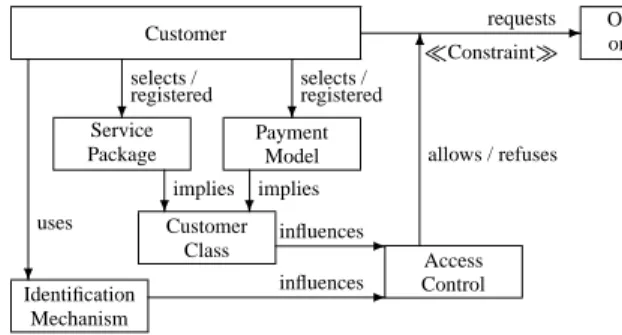
pre-vent two or more users from sharing one customer account to save costs. This functionality can be achieved with iden-tification based on digital signatures and certificates, since users usually avoid to share their private keys that can be used for the creation of binding signatures. However, mali-cious account sharing cannot be prevented with passwords. In a pay per use model, password identification is sufficient. Figure 1 summarizes the aspects mentioned above in a
do-main model as used in software engineering.
Operation on Object requests Customer Constraint allows / refuses uses selects / registered selects / registered Payment Model Service Package implies implies Access Control influences Customer Class influences Identification Mechanism
Figure 1. Context dependent access control
3. Role-based Access Control
In this section, the main ideas in RBAC are presented. Since the general concepts of RBAC are well understood and extensively described in the literature [4, 7], we will only briefly describe the key aspects.
Basic idea. The central terms in RBAC are user, role, and permission. Therefore, we have sets USERS, ROLES, and PERMS. For elements of these sets, we have two as-signment relations UA USERS ROLES and PA
PERMS ROLES. The user assignment UA defines a
re-lation between users and roles, whereas the permission
as-signment PA defines the relation between roles and
permis-sions. Both relations are many-to-many. The set of all per-missions is obtained by the combination of operations and
objects, i.e., PERMS OPS OBS, where OPS and OBS
are the corresponding sets. Types of operations depend on the type of system which is considered. In access control terminology, an object is an entity which contains or re-ceives information, e.g., an object may be a file or some exhaustible system resources. If a user USERS changes
to a new user category leaving his old role old then he is
simply assigned to a new role new by getting the
permis-sions of newand losing the permissions of old. RBAC
fa-cilitates security management, makes it more efficient, and
reduces costs.
Role hierarchy. Role hierarchies are thought to be one of the most desirable features in RBAC. They are very use-ful when overlapping capabilities of different roles result in common permissions because they allow to avoid re-peated permission-role assignments. This allows to gain efficiency, e.g., when a large number of users is autho-rized for some general permissions. Role hierarchies RH
ROLES ROLES are constructed via inheritance relations
between roles, i.e., by the introduction of senior and junior relations between roles in such a way that the senior
role
inherits permissions of the junior role
. To put it
more formally, if we have roles and with , then auth_perms auth_perms auth_usrs auth_usrs
. These mappings are defined as
! auth_perms " ROLES # $ PERMS, auth_perms %'& PERMS(*),+-/. 0& .1/) PA2 ,
! auth_usrs " ROLES #3$ USERS .auth_usrs % 4 USERS(*)5/. 6./) UA2 .
The opposite is not true, i.e., if
auth_perms 7 auth_perms 819 auth_usrs 8 auth_usrs 71 is
ful-filled, then it is still up to the role engineer to decide whether to introduce an inheritance relation between and or
not. Multiple inheritance means that a role inherits both permissions and role memberships from two or more roles. With the concept of multiple inheritance, these hierarchies provide a powerful means for role engineering, i.e., it is pos-sible to construct roles from many junior roles. Role hierar-chies are modeled as partial orders.
Role activation and sessions. In a role hierarchy, a senior role inherits the permissions from the junior role. But a user does not necessarily have to act in the most senior role(s) he is authorized for. Actual permissions for a user are not im-mediately given by evaluating the permission assignment of his most senior role(s); these roles can remain dormant. In-stead, actual permissions depend on the roles which are ac-tivated. A user may decide which roles to activate. Sessions are defined over phases in which users keep roles activated. A user’s session is associated with one or many roles.
Principle of least privilege. The principle of least privilege requires that a user should not obtain more permissions than actually necessary. This means that the user may have dif-ferent permissions at difdif-ferent times depending on the roles which are actually activated. As a consequence, permis-sions are revoked at the end of sespermis-sions.
Static separation of duty. In some security policies, there may arise a conflict of interest when users get some user-role assignments simultaneously. The idea of static sepa-ration of duties is to enforce some constraints in order to prevent mutually exclusive roles. In the presence of a role hierarchy, inheritance relations have to be respected in order to avoid infringing constraints.
Dynamic separation of duty. The goal of dynamic sep-aration of duty is —similar to static sepsep-aration of duty— to limit permissions for users by constraints in order to avoid potential conflicts. The difference here is that these constraints define which roles are not allowed to be acti-vated simultaneously, i.e., the constraints focus on activa-tion of roles. Roles obeying these constraints can be acti-vated when they are required independently, but
simultane-ous activation is refused.
Further relevant properties. RBAC is assumed to be policy-neutral. This means that RBAC provides a flexible means to deal with arbitrary security policies. It is highly desirable to have a common means to express a huge range
of security policies.
Since popular web-based services may attract large num-bers of users, such services pose demanding requirements to security administration systems. Furthermore, providers are interested in changing their business models either for
optimization reasons or just to test new ideas. Then, as a consequence, this may imply some changes in the secu-rity policy, e.g., introduction of new permissions, new cus-tomer categories. This requires adequate support for ad-ministration. RBAC simplifies access control management and supports flexibility. Consequently, there arises the ques-tion how RBAC can be used to provide efficient soluques-tions for controlling context-dependent access to web-based ser-vices exploiting the advantages of RBAC. Previous work on RBAC focuses on different application areas, where roles and their relations are usually given by organizational hier-archies. Here, the situation differs; we model capabilities of users respecting identification mechanisms. This means that roles are not used anymore in the classical way.
4. Roles for Identification Mechanisms
The reason for introducing roles was to efficiently assign users to specific sets of permissions. If a member of a role tries to initiate an operation on an object where this role is not authorized for the corresponding permission, then the requested operation is refused. We propose that access con-trol systems, which use identification results for their access control decisions, should take the security level of identi-fication mechanisms into consideration. Consequently, in context-dependent access control, where the relevant con-text parameter is defined by the identification mechanism, there should be different levels of permissions which de-pend on the identification mechanism. In classical RBAC, different levels of permissions are aggregated to roles. If the usage of different identification mechanisms implies differ-ent permissions, then these mechanisms should influence the generation of roles and hierarchies.
We illustrate this idea by means of an example. If user Alice is authorized to access a service by identifying with a certificate in a challenge and response protocol, then Alice will be assigned to a role cuser ROLES. The role:;=<7>
is authorized for a specific permission set PScuser $ PERMS.
Another user Bob which decided to identify himself with a password should be authorized to a role puser ROLES.
Analogously, he is authorized for permission set PSpuser
$
PERMS. If both users identify themselves successfully using
their chosen identification mechanisms, they are automati-cally authorized for the permissions which are assigned to their corresponding roles. With the introduction of roles, administration tasks become more efficient. A whole set of users can obtain new permissions by just assigning new permissions to their specific role. In case of changes in the access policy for roles like cuser or puser, this adaptation can be done easily.
In practice, roles for customers are more differentiated than shown in the previous example. In real-world exam-ples, there may be more roles necessary in order to ex-press the relevant access control categories for permission
assignment. In this context, there may be further roles for the categorization of subscribed service packages, e.g., such as a role premiumuser for users that are allowed to access highly-privileged services in contrast to the role normaluser for users that have registered for the normal privilege ser-vice package. In real-world examples, there may be many more aspects to be considered for the introduction of roles. However, the roles given in the example above might be sufficient in order to get the idea on how to deal with the problem of different security levels of identification mech-anisms in access control. The potential of roles becomes obvious when roles can be arranged in hierarchies as will be shown in Section 5.
5. Role Hierarchies for Protection Levels
After having shown how customers using specific iden-tification mechanisms can be modeled in a role-based ap-proach, we now go one step further by considering role hierarchies. This means that our goal is to construct role hierarchies for the introduced kind of roles. From the con-siderations in Section 3 it follows that
auth_perms ? auth_perms 81@ auth_usrs auth_usrs is a
necessary condition for an inheritance relation A of
the roles involved. This means that if the necessary condi-tion is fulfilled, it is on the role engineer to decide if there should be an inheritance relation among the relevant roles.
In practice, for some given roles the construction of a role hierarchy requires some role analysis in order to verify whether the necessary condition for inheritance is fulfilled, and in case of a fulfilled condition, it has to be decided whether the roles should really be arranged in an inheri-tance relation. We demonstrate this process by reviewing the roles introduced in the example of Section 4.
In the previous example we have introduced the roles cuser and puser constructed by respecting context-dependent parameters with the goal that access control de-cisions also depend on the security level of mechanisms for user identification. When we take a look at the set of per-missions obtained by auth_perms
B&
=<7> then there is no
obvious reason why its elements should not be contained in the set auth_perms
:;C<7>7 . Furthermore, we may
re-quire permissions obtained by auth_perms
:;=<7> which
are not contained in the result of auth_perms
0& C<7>7 . Thus, we have auth_perms B& =<7> ED auth_perms :;=<>7 which
means that the first part of the necessary condition is ful-filled. For the second part of the necessary condition, we have to look at user sets which are authorized for the roles
cuser and puser. Users which are assigned to the role cuser
can be authorized for the role puser as far as they do not obtain some undesired permissions via this role. But this we have already considered in the first part of the neces-sary condition. In the opposite direction, users assigned to the role puser should not immediately be authorized for
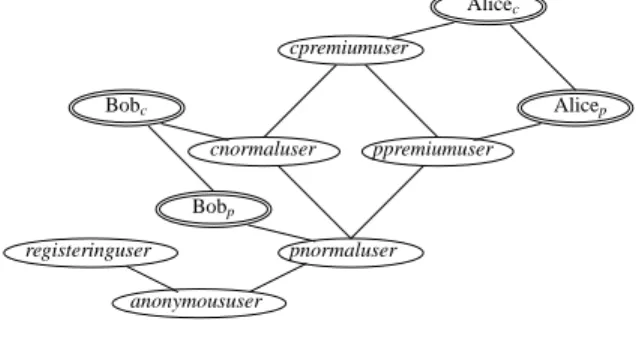
Alicec cpremiumuser Alicep ppremiumuser Bobc cnormaluser Bobp pnormaluser registeringuser anonymoususer
Figure 2. Role hierarchy for a web service
the role cuser. Therefore, we obtain auth_usrs
:;=<7> auth_usrs B& =<7>
. Thus, for the concept of modeling
iden-tification mechanisms as roles the second part of the neces-sary condition is also fulfilled. This means that we can build role hierarchies.
We introduce some additional and more differentiated roles in order to demonstrate how a sample role hierarchy for a small service example may look like.
Role cpremiumuser. This role is for a customer which sub-scribed the premium service package and identifies with his certificate in a challenge and response procedure.
Role cnormaluser. This role is for a customer which sub-scribed the normal service package and identifies with his certificate in a challenge and response procedure.
Role ppremiumuser. This role is for a customer which sub-scribed the premium service package and identifies by
send-ing his password.
Role pnormaluser. This role is for a customer which sub-scribed the normal service package and identifies by
send-ing his password.
Role registeringuser. This role is for a customer which has not yet subscribed for the provider’s services. In our example, for online registration it might be reasonable to require certificate identification.1 Since already registered
customers should be prevented to register multiple times they are not authorized for the role registeringuser.
Role anonymoususer. This role is for customers which do not identify themselves. Usually, in a web service there are some public areas which can be accessed by everyone with-out the need for identification, e.g., the start page or infor-mation to attract new customers.
The role hierarchy for these roles is depicted in Fig-ure 2. There, we show the inheritance relations among the roles introduced above. In Figure 2, we have as-sumed that customer Alice has subscribed the service pack-age premium and customer Bob has subscribed the ser-vice package normal. We assume that all permissions au-thorized via the normal service package are also
autho-1Certificate-based registration prevents customers from registering with pseudonyms or other person’s identities.
rized via the premium service package. Since both cus-tomers may have personal permissions for which they are authorized exclusively, we have additional personal roles in the hierarchy. E.g., such permissions may comprise ac-cess rights to some personal data like customer profiles, where each customer has the permission to access exclu-sively his own data and no data from other customers. Since such permissions may depend on the identification mechanism it is reasonable to differentiate between Alicec,
Bobc, and Alicep, Bobp. E.g., certificate identification may
authorize customers to read and modify data while pass-word identification may only authorize to read data. The role hierarchy shows that anonymoususer is the most ju-nior role in the hierarchy. The role registeringuser is for users with the intent to use the online subscription facil-ity. These users are not yet contained in the provider’s customer database. For security reasons, we recommend certificate identification for registration. Registered cus-tomers belong at least to one of the roles pnormaluser,
cnormaluser, ppremiumuser, or cpremiumuser dependent
on the service package they have subscribed at registra-tion and on the way they identify themselves when sending the request. The role pnormaluser inherits the permissions from anonymoususer, whereas both roles cnormaluser and
ppremiumuser inherit the permissions of pnormaluser. As
a senior role, cpremiumuser inherits the permissions from
cnormaluser and ppremiumuser.
6. Automated Role Activation
After having introduced roles and a role hierarchy, we explain how roles can be activated. In general, if a user is assigned to several roles, it is up to him to decide which role(s) he is authorized to activate. In our work, the user does not select the role to be activated directly. Instead, the activation depends on the way the user identifies himself. Thus, one can say that a user selects the role to be activated indirectly. This means that dependent on identification as-pects, the user role to be activated is selected by the access control system. In order to describe how and which roles are activated we introduce some mappings. For formalization reasons, we define IDMECHANISMS as the set containing the identifiers of identification mechanisms.
! assignedr " USERS #F$ ROLES .assignedr % G ROLES(
6. UA2 . The result of assignedr
is the
set of roles for which is assigned according to UA.
! juniorr "$ ROLES #H$ ROLES . juniorr /< % I ROLES
(+J)K.1)LM/<N2 . The result of juniorr
/< is the set
consisting of all roles which are in a junior inheritance relation to the roles contained in the set/< .
! allowedr " IDMECHANISMS A$ ROLES # $ ROLES . allowedr PORQ .1/< %
subset of*< authorized for ORQ
2 .
Given an identification mechanism
ORQ
and a set of roles
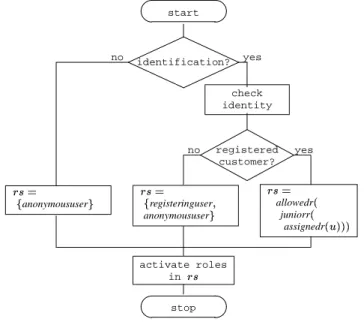
start yes no identification? check identity registered customer? no yes S'TCU V anonymoususerW S'TCU V registeringuserX anonymoususerW S'TCU allowedrY juniorrY assignedrY[Z\]\]\ activate roles in S^T stop
Figure 3. Role activation
*< , the relation allowedr ]ORQ
.*< filters all roles which
are allowed for activation according to some given pre-conditions to be presented next.
In the following, we will give some sample preconditions for the roles in the hierarchy shown in Figure 2.
!
anonymoususer: no identification
!
registeringuser: identification required
(certificate-based might be most reasonable), customer not yet reg-istered in customer database
!
pnormaluser: identification by password, customer
con-tained in customer database, customer has subscribed normal service package
!
cnormaluser: identification by certificate, customer
con-tained in customer database, customer has subscribed normal service package
!
ppremiumuser: identification by password, customer
contained in customer database, customer has subscribed premium service package
!
cpremiumuser: identification by certificate, customer
contained in customer database, customer has subscribed premium service package
When the provider system receives a request, roles will be activated dependent on whether the customer identifies himself, how he identifies, whether he has already regis-tered, and for which services he subscribed at registration. Dependent on the fulfillment of these requirements actual roles will be activated. The procedure according to which roles are selected for activation is depicted in Figure 3. With the activation of one role, all roles in junior inheritance re-lations are activated. In this way, the requesting customer also obtains the permissions of all junior roles.
Roles to be activated are selected automatically, i.e., be-side the fulfillment of the previous preconditions by using the corresponding identification mechanism a customer has no other possibility to select roles for activation. As it is shown in Figure 3, a non-identifying user can only ob-tain the permissions of the role anonymoususer. If an un-known customer, i.e., not yet registered, identifies himself, he obtains the permissions of the roles anonymoususer and
registeringuser. Registered users get their roles activated
according to (1) the UA stored in the customer database and (2) the identification mechanism they actually use. Here, this is modeled by the usage of assignedr, juniorr, and
allowedr. Note that a registered customer only obtains the
permissions of the role anonymoususer as long he does not identify.
7. Constrained RBAC for Web Services
Constraints in RBAC deal with static and dynamic sep-aration of duty. This means that the RBAC system either controls that no users are assigned to conflicting roles ac-cording to the underlying security policy (static separation of duties), or users cannot be activated for conflicting roles simultaneously (dynamic separation of duty).
If we consider the roles that we have introduced in Fig-ure 2, then it is clear that no registered user should be as-signed to the role registeringuser. This means that the role
registeringuser is mutually exclusive with all other roles
that we have introduced, except for the role anonymoususer. This property holds for both static and dynamic separation of duty aspects.
In more concrete business models, there may be other constraints which follow from potential conflicts resulting from the underlying security policy. E.g., consider a model in which a pay per subscription customer should be pre-vented to access a service with his password. Such a policy would require additional roles not contained in the exam-ple dealt with so far. Only to sketch it, a role hierarchy re-quired for this purpose should have password related roles and certificate related roles both being mutually exclusive. In these and many more cases, the application of RBAC mechanisms for avoiding assignment or activation of con-flicting roles can be useful.
8. Related Work
In the past years, there have been various contributions to the area of RBAC which emerged as an alternative of classi-cal discretionary and mandatory access control approaches. Ongoing research activities in RBAC resulted in the first proposed NIST standard for RBAC [4]. In the past, RBAC was mainly used for database management and network op-erating systems. Up to now, there are only a few contri-butions considering the usage of RBAC in the web context,
even though RBAC is assumed to be a promising alternative for this area [5]. But in practice, protection on the web is still dominated by traditional concepts [2], e.g., access con-trol lists. Proposals for the usage of RBAC for the WWW were given, e.g., in [1, 6, 8]. However, there the role con-cept focuses more on intra-organizational structures. The application of RBAC for controlling access to commercial services has not been considered. In the PERMIS project a role-based access control infrastructure was developed that uses X.509 attribute certificates containing user roles and the permissions granted to the roles [3]. However, certifi-cates have to be renewed after some period, and they can become invalid before expiry date that requires revocation mechanisms.
The second aspect of our work deals with the context-dependency respecting security level of identification for access control decisions. This idea has not been consid-ered so far in literature. In our opinion, this idea is of high relevance for WWW applications.
9. Conclusion
In this work we have shown how to model context-dependent access control regarding security level of iden-tification mechanisms for web-based services with RBAC. Furthermore, we have shown how permissions for request-ing users can be made dependent on the strength of identi-fication mechanisms. Using RBAC technology is a promis-ing approach for the realization of context-dependent access control in web-based services. This is especially interest-ing in cases of large user numbers, frequently changinterest-ing and flexible business models usually accompanied by adapta-tions concerning the enforcement of security policies.
References
[1] J. Barkley, A. Cincotta, D. Ferraiolo, S. Gavrilla, D. Kuhn. Role-based access control for the world wide web. In 20th
National Information Systems Security Conference, 1997.
[2] E. Bertino, E. Pagani, G. Rossi, P. Samarati. Protecting infor-mation on the web. Comm. of the ACM, 43(11es), 2000. [3] D. Chadwick, A. Otenko. The PERMIS X.509 role based
priv-ilege management infrastructure. In 7th ACM Symp. on Access
Control Models and Technologies (SACMAT 2002). 2002.
[4] D. Ferraiolo, R. Sandhu, S. Gavrila, D. Kuhn, R. Chan-dramouli. Proposed NIST standard for role-based access con-trol. ACM Trans. Inform. and System Security, 4(3), 2001. [5] J. Joshi, W. Aref, A. Ghafoor, E. Spafford. Security models
for web-based applications. Comm. of the ACM, 44(2), 2001. [6] J. Park, R. Sandhu, G. Ahn. Role-based access control on the
web. ACM Trans. Inform. and System Security, 4(1), 2001. [7] R. Sandhu. Role activation hierarchies. In 3rd ACM workshop
on Role-based access control. 1998.
[8] Z. Tari, S. Chan. A role-based access control model for in-tranet security. IEEE Internet Computing, 1(5), 1997.