Potential and Limits of Using Post-edits as
Reference Translations for
MT
Evaluation
Maja POPOVI ´C1, Mihael AR ˇCAN2, Arle LOMMEL3
1 Humboldt University of Berlin
2 Insight Centre for Data Analytics, NUI Galway, Ireland 3
Common Sense Advisory (CSA Research)
[email protected], [email protected], [email protected]
Abstract. This work investigates the potential use of post-edited machine translation (MT) out-puts as reference translations for automatic machine translation evaluation, focusing mainly on the following important question:Is it necessary to take into account the machine translation system and the source language from which the given post-edits are generated?
In order to explore this, we investigated the use of post-edits originating from different machine translation systems (two statistical systems and two rule-based systems), as well as the use of post-edits originating from two different source languages (English and German). The obtained results shown that for comparison of different systems using automatic evaluation metrics, a good option is to use a post-edit originating from a high-quality (possibly distinct) system. A better op-tion is to use it together with other references and post-edits, however post-edits originating from poor translation systems should be avoided. For tuning or development of a particular system, post-edited output of this same system seems to be the best reference translation.
Keywords: machine translation evaluation, reference translations, post-edited translations
1
Introduction
– nevertheless, creating each reference translation is a time consuming and expensive process. Therefore, automaticMTevaluation is usually carried out using only a single reference.
On the other hand,MThas considerably improved in the recent years so that the use ofMToutputs as a starting point for human translation has become a common practice. Therefore, ever-increasing amounts of post-edited machine translation outputs (PEs) are being collected. These represent very valuable data and are being used for a number of applications, such as automatic quality prediction, adaptation, etc. Among other things, post-edits are more similar to MToutputs than “independent” references, thus being potentially more useful for automatic evaluation and/or tuning. However, their use as reference translations has been scarcely investigated so far.
This work explores two scenarios: comparing four distinctMTsystems usingPEs originating from these systems, as well as comparing translations from two different source languages using PEs originating from these source languages. In addition, the effects of using multiple references are reported in terms of variations and standard deviations of automatic scores for different number of references.
1.1 Related work
Post-edited translations have been used for many applications, such as automatic pre-diction of translation quality [Specia, 2011], analysing various aspects of post-editing effort [Tatsumi and Roturier, 2010, Blain et al., 2011], human and automatic analy-sis of performed edit operations [Koponen, 2012, Wisniewski et al., 2013], as well as improving translation and language model of an SMT system by learning from post-edits [Bertoldi et al., 2013, Denkowski et al., 2014, Mathur et al., 2014]. The cache-based approach, introduced in [Bertoldi et al., 2013], makes it possible to periodically add knowledge fromPEs into anSMTsystem in real-time, without the need to stop it. The main idea behind the cache-based models is to mix a large global (static) model with a small local (dynamic) model estimated from recent items observed in the his-tory of the input stream. In [Wisniewski et al., 2013], thePEs are used as references for automatic estimation of performed edit operations, namely substitutions, deletions, insertions and shifts. [Denkowski et al., 2014] report the improvements of the BLEU scores calculated on independent references as well as onPEs in order to emphasise the suitability of their methods for the post-editing task.
To the best of our knowledge, no systematic investigation regarding the use of post-edited translation outputs as reference translations has been carried out yet.
2
Research questions
Although thePEs are intuitively better suitable forMTevaluation than standard human references because they are closer to theMToutput structure, there are several important questions which have to be taken into account:
1. Should thePEoriginate from the very sameMTsystem, or is it acceptable to use anyPE?
2. Is the source language of any importance?
3. Does the system type (statistical or rule-based) have any impact?
In order to systematically explore the potential and limits of post-edits and answer these questions, following scenarios are investigated:
– usingPEs produced by four distinctMTsystems;
– usingPEs generated from two different source languages;
ThePEs are used for system comparison in order to explore variations and possible bias of the obtained automatic scores. Apart from the use of each post-edit separately, the effects of combining them in the form of multiple references has been investigated. In addition, the effect of the source language has also been explored in terms of tuning anSMTsystem. The details about the experiments and the obtained results are described in the next two sections.
3
Experiments
3.1 Data sets
For investigation of effects described in the previous section, two suitable data sets containing different language pairs, target languages and domains were available:
1. TARAXÜ texts [Avramidis et al., 2014] containing to-English, German-to-Spanish and English-to-German raw translations andPEs of WMT news texts generated by twoSMT(phrase-based and hierarchical) and twoRBMTsystems; 2. OPENSUBTITLEStexts from thePE2rr corpus [Popovi´c and Arˇcan, 2016]
contain-ing Serbian and Slovenian subtitle raw translations andPEs generated by phrase-basedSMTsystems from English and from German.
Both data sets contain single standard reference translations, as well as sentence-level human rankings.
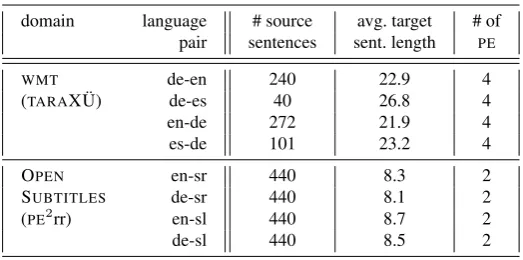
For theTARAXÜ WMTtexts, post-editing and ranking were performed by profes-sional translators, and for thePE2rr OPENSUBTITLEStexts by researchers familiar with machine and human translation highly fluent both in source and in target languages. De-tails about the texts can be seen in Table 1.4
4
Table 1: Data statistics
domain language # source avg. target # of pair sentences sent. length PE
WMT de-en 240 22.9 4
(TARAXÜ) de-es 40 26.8 4
en-de 272 21.9 4
es-de 101 23.2 4
OPEN en-sr 440 8.3 2
SUBTITLES de-sr 440 8.1 2
(PE2rr) en-sl 440 8.7 2
de-sl 440 8.5 2
It should be noted that, although there are more (larger) publicly available data sets containing post-edited MToutputs, none of these sets contains post-edits originating from different translation systems or from different source languages, which are re-quested to answer the questions posed in Section 2.
3.2 Evaluation methods
For all experiments,BLEUscores [Papineni et al., 2002] and character n-gram F scores, i.e.CHRF3 scores [Popovi´c, 2015], calculated using differentPEs are reported.BLEU is used as a well-known and widely used metric, andCHRF3 as a simple tokenisation-independent metric, which has shown very good correlations with human judgements on theWMT-2015 shared metric task [Stanojevi´c et al., 2015], both on the system level as well as on the segment level, especially for morphologically rich(er) languages.
For both scores, Pearson’s system-level correlation coefficientris reported for each PE. ForCHRF3, segment-level Kendall’sτcorrelation coefficient is presented as well. For both correlation coefficients, the ties in human rankings were excluded from calcu-lation. In all tables, post-editedMToutputs are marked withpe.
Initially, for each of the two data sets the scores were calculated separately for each target language. Nevertheless, since no differences related to the target language were observed, the results were merged.
4
Results
4.1 Post-edits from (four) different translation systems
multiplePEs. The scores, together with system-level and segment-level correlation co-efficients, are presented in Table 2.
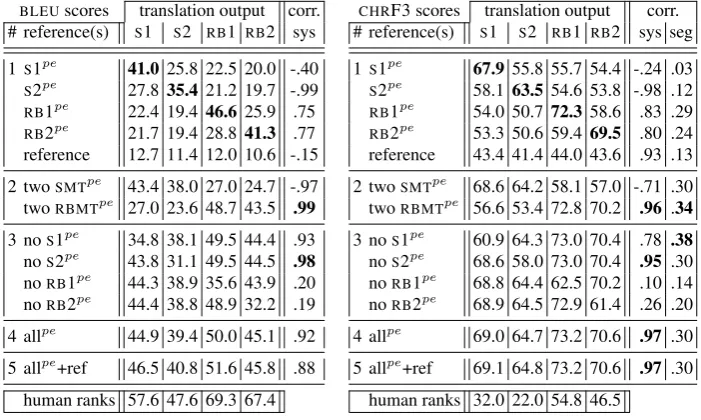
Table 2:BLEU(left) andCHRF3 (right) scores calculated onPEs originating from four distinctMTsystems (twoSMTand twoRBMT) and on an independent reference trans-lation; the scores are strongly biased towards the particular system and slightly biased towards the system type; the best option is to usePEof a high performance system or multiple references withoutPEs of poor quality systems.
BLEUscores translation output corr. # reference(s) S1 S2 RB1 RB2 sys 1S1pe 41.0 25.8 22.5 20.0 -.40
S2pe 27.8 35.421.2 19.7 -.99
RB1pe 22.4 19.4 46.625.9 .75
RB2pe 21.7 19.4 28.8 41.3 .77 reference 12.7 11.4 12.0 10.6 -.15 2 twoSMTpe 43.4 38.0 27.0 24.7 -.97 twoRBMTpe 27.0 23.6 48.7 43.5 .99 3 noS1pe 34.8 38.1 49.5 44.4 .93 noS2pe 43.8 31.1 49.5 44.5 .98 noRB1pe 44.3 38.9 35.6 43.9 .20 noRB2pe 44.4 38.8 48.9 32.2 .19 4 allpe 44.9 39.4 50.0 45.1 .92 5 allpe+ref 46.5 40.8 51.6 45.8 .88
human ranks 57.6 47.6 69.3 67.4
CHRF3 scores translation output corr. # reference(s) S1 S2 RB1 RB2 sys seg 1S1pe 67.955.8 55.7 54.4 -.24 .03
S2pe 58.163.554.6 53.8 -.98 .12
RB1pe 54.0 50.772.358.6 .83 .29
RB2pe 53.3 50.6 59.469.5 .80 .24 reference 43.4 41.4 44.0 43.6 .93 .13 2 twoSMTpe 68.6 64.2 58.1 57.0 -.71 .30 twoRBMTpe 56.6 53.4 72.8 70.2 .96 .34 3 noS1pe 60.9 64.3 73.0 70.4 .78 .38 noS2pe 68.6 58.0 73.0 70.4 .95 .30 noRB1pe 68.8 64.4 62.5 70.2 .10 .14 noRB2pe 68.9 64.5 72.9 61.4 .26 .20 4 allpe 69.0 64.7 73.2 70.6 .97 .30 5 allpe+ref 69.1 64.8 73.2 70.6 .97 .30
human ranks 32.0 22.0 54.8 46.5
The following can be observed:
– each system gets the highest score when its ownPEis used as a reference (bold); system level correlations are very low if the worse ranked system’sPEs are used – in such scenario, worst systems obtain the highest automatic scores;
– the scores for both ofSMTsystems are higher if the twoSMTPEs are used; analo-gously applies for theRBMTsystems;
– the best options in terms of correlations are
• usingPEof the best ranked system;
• not usingPEof the worst ranked system;
• using allPEs (and reference).
Table 3: Edit distances between PEs originating from four distinct systems and refer-ence; thePEs of the same system types are slightly closer than those of the two different system types; the reference is significantly different from allPEs.
edit distance S1pe S2pe RB1pe RB2pe ref
S1pe / 34.3 41.0 42.9 70.0
S2pe 34.2 / 41.9 42.4 70.1
RB1pe 40.5 41.5 / 35.4 70.9
RB2pe 41.7 41.3 34.7 / 69.6
ref 69.0 69.2 70.6 70.5 /
(∼42%), as well as that there is a large distance (∼70%) between the reference and each of thePEs.
An example of German-to-English translation outputs,PEs and the corresponding reference is presented in Table 4.
Table 4: Example of post-edited German-to-EnglishMToutputs originating from four distinct translation systems.
system translation output PE
S1 There are also a few cars off the road. There are also a few cars off the road.
S2 Few cars are off the road. A few cars are also off the road.
RB1 Also a few Pkws lie in the street ditch. Also, a few cars are lying on the side of the street.
RB2 Also a few car lies in the ditch. A few cars are also lying in the ditch. reference: Also several cars ended up in a ditch.
4.2 Post-edits from (two) different source languages
For exploring influence of the source language, the OPENSUBTITLEStexts were used, where each of the parallel German and English source sentences was translated by a corresponding phrase-based SMT system. The effects of the source language on the automatic scores are shown in Table 5. Since there are only two systems to compare, system-level Pearson’s correlation coefficient can be either 1 or -1.
It can be noted that:
Table 5:BLEU(left) andCHRF3 (right) scores calculated onSMTPEs originating from two different source languages and on an independent reference translation; the results are strongly biased towards the source language; the best option is to usePEof a high performance system or multiple references withoutPEs of poor systems.
BLEUscores translation output corr. reference(s) en→x de→x sys
1 en→xpe 47.7 23.9 1
de→xpe 24.4 45.5 -1
reference 24.8 17.2 1
2 en→xpe+ref 51.3 28.2 1 de→xpe+ref 35.9 47.9 -1
bothpe 50.4 48.0 1
3 bothpe+ref 53.0 49.2 1 human ranks 38.6 21.1
CHRF3 scores translation output corr. reference(s) en→x de→x sys seg 1 en→xpe 64.7 44.6 1 .42 de→xpe 45.8 62.6 -1 .13 reference 47.8 39.4 1 .44 2 en→xpe+ref 65.6 47.8 1 .42 de→xpe+ref 54.6 63.4 -1 .28
bothpe 66.5 63.8 1 .48
3 bothpe+ref 67.2 64.3 1 .50 human ranks 38.6 21.1
– usingPEof the better ranked system yields good correlation, whereas usingPEfrom the worse system claims that this system is better;
– the scores obtained by the independent reference are more similar to those obtained by thePEgenerated from English.
Furthermore, Table 6 shows that edit distances betweenPEs are rather large, about 45%. Similar edit distance can be seen between the independent reference and thePE originating from English, whereas for thePEoriginating from German it is much larger – over 55%. At this point, it is important to note that the original source language of all used texts is English – the German source text as well as the Serbian and Slovenian references are human translations of the English original. Therefore, the fact that the PEoriginating from German source is an “outlier” confirms the previous findings about the importance of the original source language, e.g. [Kurokawa et al., 2009, Lembersky et al., 2013], namely that (i) a translated text has different characteristics than the same text written directly in the given language, as well as that (ii) the direction of human translation has impact onMT, so that it is better to trainMTsystem in the corresponding direction, i.e. using original texts as the source language and human translations as the target language.
4.3 Multiple reference effects
Apart from the main questions posed in Section 2, an additional question has been raised during the realisation of the described experiments – what are the actual effects of the use of multiple references vs. the use of a single reference?
Table 6: Edit distances between post-edits originating from two different source lan-guages and an independent reference translation.
edit distance en-xpe de-xpe reference
en→xpe 0 44.6 44.7
de→xpe 45.7 0 56.4
reference 45.2 55.6 0
numbers of multiple references are used. For this experiment, apart from the two data sets described in previous sections, an additional small data set5was explored as well.
This data set consists of only 20 English source sentences from technical domain, how-ever each source sentence corresponds to 12 different human translations into German, i.e. 12 multiple references. Each source sentence has been automatically translated by four distinct translation systems, two statistical and two rule-based (albeit not the same as those used for experiments in Section 4.1), but no post-editing has been performed.
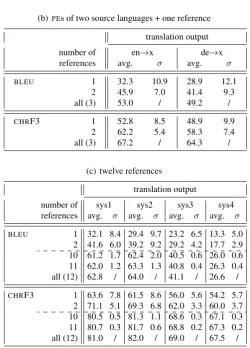
For each of the three data sets, averageBLEUandCHRF3 values and their standard deviations (σ) for different numbers of available reference translations are calculated and results are presented in Table 7. It can be seen that:
– average values are logarithmically increasing with increasing number of multiple references;
– standard deviations are
• dropping with increasing number of multiple references
• close to zero only for more than 10 references
• smaller for theMTsystems of lower performance
These tendencies can be equally observed for all data sets, no matter how manyPEs (more similar toMToutputs) and how many independent references (less similar toMT outputs) are used.
4.4 Tuning
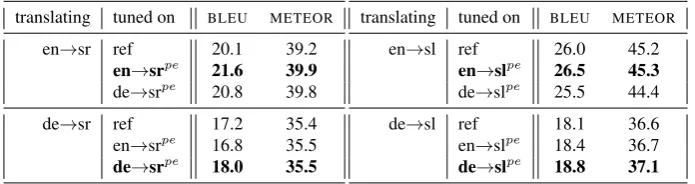
A preliminary experiment regarding tuning on PEs originating from different source languages has been carried out using the OPENSUBTITLESdata set: (i) the translation system was tuned withMERT[Och, 2003] onBLEUusing (i) the independent reference (standard method), (ii) using thePEoriginating from the corresponding language and (iii) using thePEoriginating from the other language.
The results for another test set (not the one used for tuning) containing 2000 sen-tences6 are presented in Table 8 showing that tuning on the post-edit from the corre-sponding source language produces bestBLEUandMETEORscores.
This confirms the effect of the source language bias and indicates a potential of usingPEs of aMTsystem for tuning and development of this system.
5
also available athttps://github.com/m-popovic/multiple-edits-refs
6
Table 7: Effects of the number of multiple references: averageBLEUandCHRF3 scores with standard deviations for different number of (independent) references ranging from 1 to 12. The results are obtained on the texts used in previous sections (a), (b) as well as on a small text with a large number (12) of independent reference translations (c).
(a)PEs of four different systems + one reference translation output
number of SMT1 SMT2 RBMT1 RBMT2 references avg. σ avg. σ avg. σ avg. σ
BLEU 1 25.1 9.3 22.3 8.0 26.2 11.5 23.5 10.2 2 35.0 7.0 30.8 5.9 37.3 9.5 33.3 8.3 3 40.3 5.3 35.4 4.4 43.6 7.6 38.8 6.7 4 43.9 3.4 38.5 2.8 48.2 5.2 42.8 4.6 all (5) 46.5 / 40.8 / 51.6 / 45.8 /
CHRF3 1 55.3 7.9 52.4 7.2 57.2 9.1 56.0 8.4 2 62.0 5.7 58.4 5.0 64.6 7.0 62.9 6.2 3 65.1 4.5 61.3 3.8 68.3 5.7 66.2 5.0 4 67.4 2.9 63.3 2.6 71.0 4.2 68.7 3.5 all (5) 69.1 / 64.8 / 73.2 / 70.6 /
(b)PEs of two source languages + one reference translation output
number of en→x de→x
references avg. σ avg. σ
BLEU 1 32.3 10.9 28.9 12.1
2 45.9 7.0 41.4 9.3
all (3) 53.0 / 49.2 /
CHRF3 1 52.8 8.5 48.9 9.9
2 62.2 5.4 58.3 7.4
all (3) 67.2 / 64.3 /
(c) twelve references
translation output
number of sys1 sys2 sys3 sys4
references avg. σ avg. σ avg. σ avg. σ
BLEU 1 32.1 8.4 29.4 9.7 23.2 6.5 13.3 5.0 2 41.6 6.0 39.2 9.2 29.2 4.2 17.7 2.9 10 61.2 1.7 62.4 2.0 40.5 0.6 26.0 0.6 11 62.0 1.2 63.3 1.3 40.8 0.4 26.3 0.4 all (12) 62.8 / 64.0 / 41.1 / 26.6 /
Table 8: Effects of source language on tuning of anSMTsystem:MERTtuning onBLEU using independent reference, post-edit from the corresponding source language and post-edit from another source language. The best BLEU andMETEOR scores are ob-tained when the corresponding source language post-edit is used.
translating tuned on BLEU METEOR
en→sr ref 20.1 39.2
en→srpe 21.6 39.9
de→srpe 20.8 39.8
de→sr ref 17.2 35.4
en→srpe 16.8 35.5 de→srpe 18.0 35.5
translating tuned on BLEU METEOR
en→sl ref 26.0 45.2
en→slpe 26.5 45.3
de→slpe 25.5 44.4
de→sl ref 18.1 36.6
en→slpe 18.4 36.7 de→slpe 18.8 37.1
5
Discussion
Knowing how difficult the generation of (even a single) references/PEs is, the following findings from the results described in Section 4 can be summarised:
– for comparison of different systems, using singlePEof a high quality translation output yields reliable automatic scores; the scores are even more reliable if thePE is generated by an external system – otherwise, the ranking would be still correct but the scores will be biased to this particular system;
– using multiplePEs (and references) is generally beneficial – however, it is better to have fewerPEs of high quality translation outputs than morePEs of low quality translation outputs;
– evaluation of low quality translation outputs is less prone to variability and is gen-erally more reliable, except if (one of) the used reference(s) is its ownPE; on the other hand, high quality translation outputs can easily be underestimated if using a single reference/PE;
– for tuning and development of a particular system, thePEfrom this very system should be used.
6
Summary and outlook
Multiple references are in principle beneficial, althoughPEs generated from low quality translation outputs should be avoided. Further investigation concerning both quality and quantity of multiple references should be carried out.
For tuning anSMT system, the best option is to use aPEgenerated by this same system. Nevertheless, it should be noted that this was a preliminary experiment, so that further confirmation of reported findings on more data and language pairs is necessary.
Acknowledgments
This publication has emanated from research supported by the TRAMOOC project (Translation for Massive Open Online Courses), partially funded by the European Com-mission under H2020-ICT-2014/H2020-ICT-2014-1 under Grant Agreement Number 644333, and by a research grant from Science Foundation Ireland (SFI) under Grant Number SFI/12/RC/2289 (Insight)
References
Joshua S. Albrecht, Rebecca Hwa (2007). Regression for Sentence-level MT Evaluation with Pseudo-references. InProceedings of the 45rd Annual Meeting of the Association for Com-putational Linguistics (ACL-07), pages 296–303, Prague, Czech Republic, July.
Joshua S. Albrecht and Rebecca Hwa. 2008. The Role of Pseudo-references in MT evaluation. InProceedings of the 3rd Workshop on Statistical Machine Translation (WMT-08), pages 187–190, Columbus, Ohio, June.
Eleftherios Avramidis, Aljoscha Burchardt, Sabine Hunsicker, Maja Popovi´c, Cindy Tscher-winka, David Vilar Torres, and Hans Uszkoreit. 2014. The taraXÜ Corpus of Human-Annotated Machine Translations. InProceedings of the 9th International Conference on Lan-guage Resources and Evaluation (LREC-14), pages 2679–2682, Reykjavik, Iceland, May. Satanjeev Banerjee and Alon Lavie. 2005. METEOR: An Automatic Metric for MT Evaluation
with Improved Correlation with Human Judgements. InProceedings of the ACL-05 Workshop on Intrinsic and Extrinsic Evaluation Measures for MT and/or Summarization, pages 65–72, Ann Arbor, MI, June.
Nicola Bertoldi, Mauro Cettolo, and Marcello Federico. 2013. Cache-based Online Adaptation for Machine Translation Enhanced Computer Assisted Translation. InProceedings of MT Summit XIV, Nice, France.
Frédéric Blain, Jean Senellart, Holger Schwenk, Mirko Plitt, and Johann Roturier. 2011. Qual-itative Analysis of Post-Editing for High Quality Machine Translation. InProceedings of Machine Translation Summit XIII, Xiamen, China, September.
Michael Denkowski, Chris Dyer, and Alon Lavie. 2014. Learning from Post-Editing: Online Model Adaptation for Statistical Machine Translation. InProceedings of the 14th Conference of the European Chapter of the Association for Computational Linguistics (EACL-14), pages 395–404, Gothenburg, Sweden, April.
George Doddington. 2002. Automatic Evaluation of Machine Tanslation Quality using n-gram Co-occurrence Statistics. InProceedings of the ARPA Workshop on Human Language Tech-nology, pages 128–132, San Diego, CA, March.
David Kurokawa, Cyril Goutte, and Pierre Isabelle. 2009. Automatic Detection of Translated Text and its Impact on Machine Translation. InProceedings of MT Summit XII, pages 81–88, Ottawa, Canada, August.
Gennadi Lembersky, Noam Ordan, and Shuly Wintner. 2013. Improving Statistical Machine Translation by Adapting Translation Models to Translationese. Computational Linguistics, 39(4):999–1024, December.
Nitin Madnani, Philip Resnik, Bonnie J. Dorr, and Richard Schwartz. 2008. Are multiple refer-ence translations necessary? Investigating the value of paraphrased referrefer-ence translations in parameter optimization. InProceedings of the 8th Conference of the Association for Machine Translation in the Americas (AMTA-08), Waikiki, Hawaii, October.
Prashant Mathur, Mauro Cettolo, Marcello Federico, and José Guillerme Carmago de Souza. 2014. Online Multi-User Adaptive Statistical Machine Translation. InProceedings of the 11th Conference of the Association for Machine Translation of the Americas (AMTA-14), pages 152–165, Vancouver, Canada, October.
Franz Josef Och. 2003. Minimum Error Rate Training in Statistical Machine Translation. In
Proceedings of the 41th Annual Meeting of the Association for Computational Linguistics (ACL 03), pages 160–167, Sapporo, Japan, July.
Kishore Papineni, Salim Roukos, Todd Ward, Wei-Jing Zhu (2002). BLEU: a Method for Auto-matic Evaluation of Machine Translation. InProceedings of the 40th Annual Meeting of the Association for Computational Linguistics (ACL-02), pages 311–318, Philadelphia, PA, July. Maja Popovi´c. 2015. chrF: Character n-gram F-score for Automatic MT Evaluation. In Proceed-ings of the 10th Workshop on Statistical Machine Translation (WMT-15), pages 392–395, Lisbon, Portugal, September.
Maja Popovi´c, Mihael Arˇcan. 2016. PE2rr corpus: Manual Error Annotation of Automatically Pre-annotated MT Post-edits. InProceedings of the 10th International Conference on Lan-guage Resources and Evaluation (LREC-16), Portorož, Slovenia, May.
Ying Qin and Lucia Specia. 2015. Truly Exploring Multiple References for Machine Translation Evaluation. InProceedings of the 18th Annual Conference of the European Association for Machine Translation (EAMT-15), pages 113–120, Antalya, Turkey, May.
Matthew Snover, Bonnie Dorr, Richard Schwartz, Linnea Micciulla, and John Makhoul. 2006. A Study of Translation Error Rate with Targeted Human Annotation. InProceedings of the 7th Conference of the Association for Machine Translation in the Americas (AMTA-06), pages 223–231, Boston, MA, August.
Lucia Specia. 2011. Exploiting Objective Annotations for Measuring Translation Post-editing Ef-fort. InProceedings of the 15th Annual Conference of the European Association for Machine Translation (EAMT-11), pages 73–80, Leuven, Belgium, May.
Miloš Stanojevi´c, Amir Kamran, Philipp Koehn, and Ondˇrej Bojar. 2015. Results of the WMT15 Metrics Shared Task. InProceedings of the 10th Workshop on Statistical Machine Translation (WMT-15), pages 256–273, Lisbon, Portugal, September.
Midori Tatsumi and Johann Roturier. 2010. Source Text Characteristics and Technical and Tem-poral Post-editing Effort: What is their Relationship? InProceedings of the Second Joint EM+/CGNL Worskhop Bringing MT to the user (JEC-10), pages 43–51, Denver, Colorado, November.
Guillaume Wisniewski, Anil Kumar Singh, Natalia Segal, and François Yvon. 2013. Design and Analysis of a Large Corpus of Post-edited Translations: Quality Estimation, Failure Analysis and the Variability of Post-edition. InProceedings of MT Summit XIV, pages 117–124, Nice, France, September.