POS Tagging for Historical Texts with Sparse Training Data
Marcel Bollmann
Department of Linguistics, Ruhr University Bochum [email protected]
Abstract
This paper presents a method for part-of-speech tagging of historical data and eval-uates it on texts from different corpora of historical German (15th–18th century). Spelling normalization is used to prepro-cess the texts before applying a POS tag-ger trained on modern German corpora. Using only 250 manually normalized to-kens as training data, the tagging accuracy of a manuscript from the 15th century can be raised from 28.65% to 74.89%.
1 Introduction1
Part-of-speech (POS) tagging of modern language data is a well-explored field, commonly achiev-ing accuracies around 97% (Brants, 2000; Schmid and Laws, 2008). For historical language varieties, the situation is worse, as specialized taggers are typically not available. As an example, a study by Scheible et al. (2011a) reports an average tag-ging accuracy of 69.6% for Early Modern German texts. However, with projects to create historical corpora being on the rise (S´anchez-Marco et al., 2010; Scheible et al., 2011b, are recent examples), the need for more accurate tagging methods on these types of data increases.
A common approach for historical texts is to use spelling normalization to map historical word-forms to modern ones (Baron and Rayson, 2008; Jurish, 2010). Manually normalized data was found to improve POS tagging accuracy for a variety of languages such as German, English, and Portuguese, with accuracies between 79% and 91% (Scheible et al., 2011a; Rayson et al., 2007; Hendrickx and Marquilhas, 2011).
1
I would like to thank the anonymous reviewers for their helpful comments. The research reported here was sup-ported by Deutsche Forschungsgemeinschaft (DFG), Grants DI 1558/4-1 and DI 1558/5-1.
This paper presents results for POS tagging of historical German from 1400 to 1770, classified here as Early New High German (ENHG), us-ing automatic spellus-ing normalization to prepro-cess the data for a POS tagger trained on mod-ern German corpora. To train the normalization tool, short fragments of a few hundred tokens are used for each text. This approach allows for a better adaptation to the individual spelling char-acteristics of each text while requiring only small amounts of training data. Additionally, different ways to deal with typical obstacles for processing historical texts (e.g., inconsistent use of punctua-tion) are compared.
The structure of this paper is as follows. Sec. 2 presents the historical texts used for the evalua-tion. Sec. 3 describes the approach to normal-ization, while Sec. 4 discusses problems and re-sults of POS tagging on normalized data. Sec. 5 presents related work, and Sec. 6 concludes.
2 Corpora
This study considers texts from two corpora of his-torical German: the Anselm corpus (Dipper and Schultz-Balluff, 2013) and the GerManC-GS cor-pus (Scheible et al., 2011b).
The Anselm corpus consists of more than 50 different versions of a medieval religious trea-tise written up in various German dialects. As the creation of gold-standard annotations for the cor-pus is still in progress, only two texts are used here: a manuscript in an Eastern Upper German dialect kept in Melk, Austria; and an Eastern Central German manuscript kept in Berlin. Both manuscripts are dated to the 15th century.
The GerManC-GS corpus aims to be a repre-sentative subcorpus of GerManC with additional gold-standard annotations. It contains texts from Early Modern German categorized by genre, re-gion, and time period. For this study, the three texts of the genre “sermon” are used. They are
Corpus Date Name Tokens
Anselm 15c Berlin 5,399
15c Melk 4,783
GerManC-GS
1677 LeichSermon 2,585
1730 JubelFeste 2,523
1770 Gottesdienst 2,292
Table 1: Texts used for the evaluation
dated from 1677 to 1770, which makes them con-siderably newer than the Anselm texts. Table 1 gives an overview of all texts used here.
All texts are manually annotated with normal-izations and POS tags. In the normalization layer, tokens are mapped to modern German equivalents. The normalization schemes are not identical, but roughly comparable for both GerManC-GS and Anselm (see Scheible et al. (2011b) and Bollmann et al. (2012) for details). In both corpora, POS tag-ging follows the STTS tagset (Schiller et al., 1999) without morphological information, though some additional tags were introduced in GerManC-GS. For our evaluation, they are mapped back to stan-dard STTS tags; this mapping only affects 80 to-kens from all three texts.
Additionally, both corpora are annotated with modern punctuation and sentence boundaries; however, while modern punctuation is a sep-arate annotation layer in Anselm, there is al-ways a 1:1 correspondence between historical and modern (i.e., normalized) punctuation marks in GerManC-GS.
Finally, both corpora preserve many spelling characteristics of the original manuscripts, e.g., superposition of characters such as ˚u, or abbrevi-ation marks such as the nasal bar (as in ¯v). Be-fore any further processing, all wordforms are sim-plified to plain alphabetic characters; e.g., ˚u is mapped to uo. For some abbreviation marks in the Anselm corpus, there is no clear “best” sim-plification: the nasal bar is a prime example here, which should be simplified most appropriately to
e,(e)n,(e)m, or nothing, either before or after the letter on which it is placed, depending on context. In these cases, manually defined heuristics were used to guess the most appropriate mapping. As capitalization is not used consistently in the texts, all letters were additionally lowercased.
3 Normalization
Spelling normalization is performed using the Norma tool (Bollmann, 2012). It implements a chain of normalization methods—to the effect that methods further down the chain are only called if previous ones failed to produce a result—in the following order: (1) wordlist mapping; (2) rule-based normalization; and (3) weighted Leven-shtein distance.
Wordlist mapping considers simple 1:1 map-pings of historical wordforms to modern ones (e.g.,vnd→und“and”), while rule-based
normal-ization applies context-sensitive character rewrite rules (e.g., transform v to u between a word boundary and n) to an input string from left to right. Weighted Levenshtein distance assigns in-dividual weights to character replacements (e.g.,
v→u), and performs normalization by retrieving
the wordform from a modern lexicon which can be derived from the historical input wordform with the lowest cost, i.e., using a sequence of edit oper-ations with the lowest sum of weights.
3.1 Normalization procedure
All normalization algorithms described above re-quire some kind of parametrization to work (i.e., a wordlist; rewrite rules; Levenshtein weights). These parametrizations are neither hard-coded nor manually defined, but are derived automatically by the Norma tool from a set of manually normal-ized training data. For this purpose, short samples from the text to be normalized are used; i.e., train-ing set and evaluation set are always disjoint parts of the same text. The reasons for choosing this approach lie in the individual spelling character-istics of the texts—the following examples show excerpts from Berlin, Melk, and LeichSermon, re-spectively, along with their (gold-standard) nor-malizations:
(1) dyn
dein
lybes
liebes
kynt
kind “your dear child”
(2) mein
mein
liebs
liebes
chind
kind “my dear child”
(3) eins
eins
ihrer
ihrer
andern
anderen
kinder
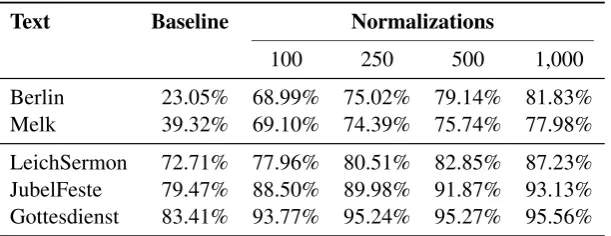
Text Baseline Normalizations
100 250 500 1,000
Berlin 23.05% 68.99% 75.02% 79.14% 81.83%
Melk 39.32% 69.10% 74.39% 75.74% 77.98%
LeichSermon 72.71% 77.96% 80.51% 82.85% 87.23%
JubelFeste 79.47% 88.50% 89.98% 91.87% 93.13%
[image:3.595.148.454.62.180.2]Gottesdienst 83.41% 93.77% 95.24% 95.27% 95.56%
Table 2: Normalization accuracy after training on ntokens and evaluating on 1,000 tokens (average of 10 random training and evaluation sets), compared to the “baseline” score of the full text without any normalization
The first two examples, while both dated to the 15th century, show quite different spellings of the modern Kind“child”: Ex. (1) shows the frequent use ofyfor moderneiori(e), while Ex. (2) demon-strates the frequent spelling ch for k. These dif-ferences are likely a cause of the different dialec-tal regions from which the manuscripts originate, but could also be attributed, at least in parts, to in-dividual preferences by the manuscripts’ writers. The LeichSermon text from 1677 in Ex. (3), on the other hand, already has the modern German spellingKind.
Given this range of spelling variations, it seems implausible to achieve good normalization results using the same parametrization for each of the texts. Furthermore, for the older manuscripts showing more variation such as in Ex. (1), it is unclear what other training data could be used. The full GerManC-GS consists of texts from 1650 to 1800, while Jurish (2010) uses a corpus of German texts from 1780 to 1880; these texts are all considerably newer, consequently having less spelling variation than the Anselm texts. This lack of appropriate training data applies similarly to all kinds of less-resourced language varieties.
Therefore, while this approach requires slightly more effort for manually normalizing parts of the texts beforehand, it does not depend on the avail-ability of a large training corpus or a specialized tool for the language variety to be processed.
3.2 Evaluation
Normalization is evaluated separately for each text, using a part of that text for training and eval-uating on a different part of the same text. To address the question of how much training data is needed, evaluation is performed with different sizes of the training set in a range between 100 and
1,000 tokens. The evaluation set is kept at a fixed size of 1,000 tokens. Normalization accuracy is calculated by taking the average of 10 trials with randomly drawn training and evaluation sets. The results of this evaluation are shown in Table 2.
The baseline score for a text is defined as the percentage of matching tokens between the un-modified, historical text and its gold-standard nor-malization. There is a clear difference between the Anselm texts, with scores of 23% and 39%, and the GerManC-GS texts, which range from 72% to 83%. This shows that spelling variation affects significantly more wordforms in the Anselm texts. The age of a text is likely to be the main factor for this, as even within the group of GerManC-GS texts, a clear tendency for newer texts to have higher baseline scores can be observed.
Spelling normalization with the Norma tool shows rather positive results even for small ing samples: with only 100 tokens used for train-ing, it achieves a normalization accuracy of 69% for the Anselm texts, and raises the score for the GerManC-GS texts by 5–10 percentage points. Using 250 tokens results in another noticeable in-crease in accuracy, although the relative gain from increasing the training size even further attenuates after this point.
4 Part-of-speech tagging
Text OrigP ModP NoP
Berlin 85.78% 87.29% 87.07%
Melk 85.21% 87.76% 87.74%
LeichSermon 81.22% 80.59% 81.04%
JubelFeste 90.41% 90.41% 90.03%
Gottesdienst 93.24% 93.24% 92.27%
Table 3: Tagging accuracy on the gold-standard normalizations (OrigP = original punctuation, ModP = modern punctuation, NoP = no punctu-ation)
4.1 Impact of punctuation
Normalization tries to handle the problem of spelling inconsistencies found in historical lan-guage data. However, this is not the only challenge for processing the data with modern POS taggers. There is often no consistent capitalization, which can normally be used as a clue to detect nouns in modern German. This has already led to all word-forms being lowercased for the normalization pro-cess. Additionally, punctuation marks are also of-ten used inconsisof-tently or are missing completely: e.g., the Melk manuscript mostly uses virgules (vi-sually resembling a modern slash ‘/’) where mod-ern German would use a full stop, but this is far from a definite rule, and large parts of the Anselm texts feature no punctuation marks at all. This raises the question whether punctuation should be used for POS tagging at all for these texts.
In order to test the impact of punctuation on tagging performance, three scenarios are consid-ered: tagging with original, modern, and no punc-tuation marks. In order to provide a fairer com-parison, instead of using the supplied parameter file for German, we retrain RFTagger on a pre-pared set of data. For this purpose, the TIGER corpus (Brants et al., 2002) and version 6 of T¨uba-D/Z (Telljohann et al., 2004) are used. First, the two corpora are combined—with minor modifica-tions to the POS tags to make them uniform—and lowercased. The combined corpus has a size of more than 1.6 million tokens. Additionally, for the evaluation without punctuation, a separate tagger model is trained on a version of the TIGER/T¨uba corpus where all punctuation marks and sentence boundaries have been removed.
Using these tagger models, tagging
perfor-Original 96.85%
Lowercased 96.50%
No punctuation and SB 96.22%
Lowercased + no punctuation and SB 95.74%
Table 4: Tagging accuracy on the combined TIGER/T¨uba corpus, using 10-fold CV, evaluated with and without capitalization, punctuation, and sentence boundaries (SB)
mance is evaluated on the gold-standard normal-izations with different levels of punctuation. The results are shown in Table 3. For better compara-bility, accuracy was evaluated excluding punctua-tion marks in all scenarios.
Tagging with modern punctuation or no punc-tuation is shown to be best in all cases, with the difference between these two scenarios never be-ing statistically significant (p > 0.05). For the Anselm texts, using the original punctuation is worse than using none at all. This is not true for GerManC-GS, though the differences are mi-nor; also, original and modern punctuation are identical for the JubelFeste and Gottesdienst texts, showing that they already follow modern German conventions in this regard.
The results show that removing all punctua-tion marks does not lead to significant losses in POS tagging accuracy. Indeed, for texts with in-frequent and/or inconsistent use of punctuation marks, discarding punctuation is shown to be preferable. For these reasons, the tagging ap-proach without punctuation is used for all follow-ing experiments.
4.2 Tagging “with handicaps”
So far, the preprocessing of the historical data in-cludes removing all capitalization and punctua-tion. Consequently, information about sentence boundaries should also be removed, as it cannot easily be derived from texts without (consistent) punctuation. However, POS tagging with these “handicaps” potentially increases the difficulty of the task in general.
Text Tokens Original Automatically normalized Gold
100 250 500 1,000
Berlin 4,719 28.65% 58.68% 74.89% 75.95% 78.03% 87.07%
Melk 4,550 44.70% 69.63% 74.02% 76.24% 78.66% 87.74%
LeichSermon 2,215 67.95% 72.87% 74.63% 75.85% 78.01% 81.04%
JubelFeste 2,137 82.26% 82.64% 83.62% 86.52% 87.74% 90.03%
Gottesdienst 1,953 88.07% 88.84% 90.27% 91.30% 91.65% 92.27%
Table 5: POS tagging accuracy on texts without punctuation and capitalization, for tagging on the original data, the gold-standard normalization, and automatic normalizations using the firstntokens as training data
this experiment; tagging accuracy drops from 96.85% to 95.74% when removing capitalization and punctuation. While this change is significant (p < 0.01) considering the corpus size, with re-gard to the effort involved in manually annotating whole texts with modern capitalization and punc-tuation marks, it seems small enough to make tag-ging without this information a viable approach for historical data.
4.3 Tagging historical data
POS tagging on the historical texts is evaluated in three different scenarios: first, tagging on the sim-plified, but otherwise unmodified, original texts; second, tagging on the gold-standard normaliza-tions; and third, tagging on texts which have been normalized automatically as described in Sec. 3.
For automatic normalization, the firstn tokens of a text were used for training the Norma tool, with different values forn(cf. Sec. 3.2). Only the remainder of the text has then been automatically processed by Norma. This means that, e.g., for a text with 500 tokens used for training, POS tag-ging is performed on a version of the text con-sisting of 500 gold-standard normalizations plus automatically generated normalizations for the re-mainder of the text. This evaluation method mod-els a typical application scenario, where a tradeoff is made between no manual effort (= tagging on the original) and full manual preprocessing (= tag-ging on the gold-standard).
Full evaluation results are shown in Table 5. Tagging accuracy roughly correlates with nor-malization accuracy (cf. Table 2); it tends to be slightly above the normalization score for Anselm and a few points below that score for GerManC-GS. Tagging on the original, historical data is particularly inaccurate for the Anselm texts, with
the Berlin text only achieving an accuracy of 28.7%. This again highlights the need for special-ized tagging methods on such types of data. The GerManC-GS texts from the 18th century perform much better without normalization, with accura-cies up to 88% for the Gottesdienst text. These results mainly confirm the observations that the Anselm texts show much more variety in spelling than the newer texts from GerManC-GS.
Similar to the results for normalization, us-ing only 100 tokens for trainus-ing is enough to in-crease tagging accuracy for the Melk text from 45% to 70%. For Berlin, this method results in an even higher relative increase, more than dou-bling the number of correct POS tags. Results for these texts can be improved further to about 74% when using 250 tokens for training; after this figure, POS tagging seems to profit less from in-creasing the size of the training set, with accura-cies around 78% for a training set of 1,000 tokens. The GerManC-GS texts, particularly JubelFeste and Gottesdienst, do not benefit as much from a small number of training tokens. With 100 tokens, POS tagging accuracy only increases by 0.38–0.77 percentage points. However, these texts already have a comparatively high baseline to start with (82–88%). As they are already much closer to modern German spelling, fewer wordforms have spelling variations at all; consequently, more train-ing data is required to capture a similar amount of variant wordforms as in the Anselm texts. Indeed, when increasing the training portion to 1,000 to-kens, the benefit of spelling normalization be-comes more pronounced.
un-expected, considering that the text is much more recent than Berlin and Melk. The reason for this discrepancy is the frequent use of bible verse num-bers in LeichSermon, which are written as numer-als followed by a dot and annotated as CARD (car-dinal number) in the gold-standard data. In the TIGER corpus and T¨uba-D/Z, such numerals are treated as ordinal numbers and tagged as ADJA, leading to a high number of mismatching tags.
4.4 Error analysis
POS tagging results for the historical texts are still considerably worse than those for modern data, even when tagging on gold-standard normaliza-tions (81–92% vs. 95.74%). There are several fac-tors responsible for this.
It is important to observe that even perfectly normalized historical data has different character-istics than modern data, as normalization only af-fects the spelling of wordforms. One potential source of errors are semantic changes, as shown in Ex. (4) from the LeichSermon text: the word-form so is an adverb in modern German, but is frequently used as a relative pronoun (PRELS2) in ENHG, which nevers occurs in the training data of the TIGER/T¨uba corpus.
(4) die
die ART
faelle
f¨alle NN
so
so PRELS
aus
aus APPR
schwacheit
schwachheit NN
geschehen
geschehen VVPP
“the cases which occur out of weakness”
Extinct wordforms are a major problem for the normalization approach. They cannot usually be normalized to a modern wordform by applying spelling changes, but would have to be mapped on a word-by-word basis. However, both GerManC-GS and the normalization layer of Anselm3 map extinct wordforms to artificial lemmas, which are still useful to identify spelling variants, but im-practical for this POS tagging approach. A com-mon example in Melk isczuhant “immediately”,
2Actually, GerManC-GS annotates so in this example
with the new tag PTKREL, which is mapped back to PRELS for reasons of compatibility. As PTKREL is not found in TIGER or T¨uba-D/Z, keeping this tag would not solve the problem here, though.
3The Anselm corpus provides an additional
“moderniza-tion” layer which maps extinct forms to actual modern words, but a first evaluation showed that using this layer has a nega-tive impact on overall normalization accuracy.
which is mapped to the artificial lemma zehant, but would rather be expressed assofortin modern German:
(5) czuhant
zehant ADV
chust
k¨usst VVFIN
iudas
judas NE
mein
mein PPOSAT
chint
kind NN “Immediately, Judas kisses my child”
Finally, a significant number of errors ap-pears to result from limitations of the modern TIGER/T¨uba corpus used to train the POS tag-ger. This corpus is created from newspaper texts, which are typically written in a rather formal style. The Anselm texts, on the other hand, consist of question/answer sets which contain a lot of direct speech. Similarly, the Gottesdienst text is a reli-gious speech which addresses its audience right from the beginning. Ex. (6) shows a phrase that occurs frequently in the Berlin text:
(6) sieh
VVIMP
anselm
NE “Look, Anselm”
The imperative form sieh “look” is used 24 times in the Berlin text, but typically mistagged as a proper noun (NE) despite being correctly nor-malized. A look at the TIGER/T¨uba training data reveals the cause for this: the wordformsiehdoes not occur there at all; only the standard formsiehe
was learned. Imperative verb forms in general are very uncommon in TIGER/T¨uba, only mak-ing up 397 tokens (0.02%). In comparison, the gold-standard POS annotation of Berlin already contains 43 imperative verb forms (0.91%).
Similarly, the religious texts in Anselm and GerManC-GS often use vocabulary that is rarely used in newspaper text. Ex. (7) shows the fi-nite verb formverschm¨ahten“despised/spurned”, which has only one occurrence in the TIGER/T¨uba corpus where it was used as an adjective instead, inevitably leading to a tagging error.
(7) vnd
und KON
vorsmeten
verschm¨ahten VVFIN
yn
ihn PPER “and [they] despised him”
5 Related work
For automatic spelling normalization, VARD 2 (Baron and Rayson, 2008) is another tool that has been developed for Early Modern English. It has been successfully adapted to other languages, e.g. Portuguese (Hendrickx and Marquilhas, 2011), though previous experiments found it to perform worse than Norma on the Anselm data (Bollmann, 2012). Jurish (2010) presents a normalization method that includes token context, which seems to be the logical next step to further improve nor-malization results.
POS tagging on normalized data has been tried for the GerManC-GS corpus before with an aver-age accuracy of 79.7% (Scheible et al., 2011a), however, only manual normalization was consid-ered. For English, Rayson et al. (2007) report an accuracy of 89–91% on gold standard izations and 85–89% on automatically normal-ized texts. Hendrickx and Marquilhas (2011) per-form a similar evaluation for Portuguese, achiev-ing 86.6% and 83.4% on gold standard and auto-matic normalizations, respectively.
There are some notable differences, however, between the aforementioned studies and the ap-proach outlined here. Firstly, those studies using automatic normalization methods typically utilize either a much higher amount of training data or some kind of manually crafted resource. VARD, for instance, uses a manually compiled list of spelling variants totalling more than 45,000 en-tries (Rayson et al., 2005), while Hendrickx and Marquilhas (2011) use a training set of more than 37,000 tokens. While I certainly expect to improve the results in the future by using full texts from the Anselm and/or GerManC-GS corpora as basis for training, this approach might not always be feasi-ble. The approach presented here, requiring only a few hundred tokens for training, seems especially suited for languages where projects to create his-torical corpora have only been started, and there-fore do not have large amounts of previously an-notated training material to fall back to.
Secondly, the Anselm texts evaluated here show a much lower baseline than the texts evaluated in other studies. Without normalization, POS tag-ging accuracy is 82–88% in Rayson et al. (2007), 76.9% in Hendrickx and Marquilhas (2011), and 69.6% for the German data in Scheible et al. (2011a). The texts from Berlin and Melk, on the other hand, perform much worse without the
nor-malization step (28.7% and 44.7%, respectively). This suggests a higher amount of variance in the Anselm data compared to the types of text used in previous studies, making their automatic process-ing a potentially more challengprocess-ing problem. Also, annotated data from these studies is less likely to be useful as training data for these texts.
6 Conclusion
I presented an approach to part-of-speech tagging for historical texts that uses spelling normalization as a preprocessing step. Evaluation on texts from Early New High German showed that by manually normalizing 250 tokens of a text and using them as training data, automatic normalization of the re-maining text performs well enough to result in a notable increase in POS tagging accuracy. Texts with more spelling variation were shown to ben-efit more from this approach than texts which are already closer to the modern target language.
For one German manuscript from the 15th cen-tury, this method increased tagging accuracy from 28.65% to 74.89%. While this is still far from the accuracy scores reported for modern language data, and also quite a bit worse than tagging on the gold-standard normalization (87.07% for this text), it offers a way to facilitate the (semi-automatic) POS annotation of historical texts with relatively minor effort. Furthermore, as it does not require a sizeable amount of training data, this ap-proach is potentially interesting for less-resourced language varieties in general, assuming some level of graphematic similarity to a well-resourced tar-get language.
References
Alistair Baron and Paul Rayson. 2008. VARD 2: A tool for dealing with spelling variation in historical corpora. InProceedings of the Postgraduate Con-ference in Corpus Linguistics.
Marcel Bollmann, Stefanie Dipper, Julia Krasselt, and Florian Petran. 2012. Manual and semi-automatic normalization of historical spelling – Case studies from Early New High German. In Proceedings of KONVENS 2012 (LThist 2012 workshop), pages 342–350, Vienna, Austria.
Marcel Bollmann. 2012. (Semi-)automatic normaliza-tion of historical texts using distance measures and the Norma tool. InProceedings of the Second Work-shop on Annotation of Corpora for Research in the Humanities (ACRH-2), Lisbon, Portugal.
Sabine Brants, Stefanie Dipper, Silvia Hansen, Wolf-gang Lezius, and George Smith. 2002. The TIGER treebank. In Erhard Hinrichs and Kiril Simov, ed-itors, Proceedings of the First Workshop on Tree-banks and Linguistic Theories (TLT 2002), Sozopol, Bulgaria.
Thorsten Brants. 2000. TnT — a statistical part-of-speech tagger. InProceedings of ANLP 2000, pages 224–231, Seattle, USA.
Stefanie Dipper and Simone Schultz-Balluff. 2013. The Anselm corpus: Methods and perspectives of a parallel aligned corpus. In Proceedings of the NODALIDA Workshop on Computational Historical Linguistics.
Stefanie Dipper. 2010. POS-tagging of historical lan-guage data: First experiments. InProceedings of KONVENS 2010, pages 117–121, Saarbr¨ucken, Ger-many.
Iris Hendrickx and Rita Marquilhas. 2011. From old texts to modern spellings: an experiment in auto-matic normalisation.JLCL, 26(2):65–76.
Bryan Jurish. 2010. More than words: using to-ken context to improve canonicalization of histori-cal German. Journal for Language Technology and Computational Linguistics, 25(1):23–39.
Paul Rayson, Dawn Archer, and Nicholas Smith. 2005. VARD versus Word. A comparison of the UCREL variant detector and modern spell checkers on en-glish historical corpora. InProceedings of Corpus Linguistics 2005, Birmingham, UK.
Paul Rayson, Dawn Archer, Alistair Baron, Jonathan Culpeper, and Nicholas Smith. 2007. Tagging the bard: Evaluating the accuracy of a modern POS tag-ger on Early Modern English corpora. In Proceed-ings of Corpus Linguistics 2007, University of Birm-ingham, UK.
Cristina S´anchez-Marco, Gemma Boleda, Josep Maria Fontana, and Judith Domingo. 2010. Annotation
and representation of a diachronic corpus of Span-ish. In Proceedings of the Seventh Conference on International Language Resources and Evaluation, pages 2713–2718.
Silke Scheible, Richard J. Whitt, Martin Durrell, and Paul Bennett. 2011a. Evaluating an ‘off-the-shelf’ POS-tagger on Early Modern German text. In Pro-ceedings of the ACL-HLT 2011 Workshop on Lan-guage Technology for Cultural Heritage, Social Sci-ences, and Humanities (LaTeCH 2011), pages 19– 23, Portland, Oregon, USA.
Silke Scheible, Richard J. Whitt, Martin Durrell, and Paul Bennett. 2011b. A gold standard corpus of Early Modern German. InProceedings of the ACL-HLT 2011 Linguistic Annotation Workshop (LAW V), pages 124–128, Portland, Oregon, USA.
Anne Schiller, Simone Teufel, Christine St¨ockert, and Christine Thielen. 1999. Guidelines f¨ur das Tagging deutscher Textcorpora mit STTS. Technical report.
Helmut Schmid and Florian Laws. 2008. Estima-tion of condiEstima-tional probabilities with decision trees and an application to fine-grained POS tagging. In
Proceedings of COLING ’08, Manchester, Great Britain.