Workshop on Monolingual Text-To-Text Generation, pages 1–9,
Learning to Simplify Sentences Using Wikipedia
William Coster
Computer Science Department Pomona College
David Kauchak
Computer Science Department Pomona College
Abstract
In this paper we examine the sentence sim-plification problem as an English-to-English translation problem, utilizing a corpus of 137K aligned sentence pairs extracted by aligning English Wikipedia and Simple En-glish Wikipedia. This data set contains the full range of transformation operations includ-ing rewordinclud-ing, reorderinclud-ing, insertion and dele-tion. We introduce a new translation model for text simplification that extends a phrase-based machine translation approach to include phrasal deletion. Evaluated based on three metrics that compare against a human refer-ence (BLEU, word-F1 and SSA) our new ap-proach performs significantly better than two text compression techniques (including T3) and the phrase-based translation system with-out deletion.
1 Introduction
In this paper we examine the sentence simplifica-tion problem: given an English sentence we aim to produce a simplified version of that sentence with simpler vocabulary and sentence structure while preserving the main ideas in the original sentence (Feng, 2008). The definition what a “simple” sen-tence is can vary and represents a spectrum of com-plexity and readability. For concreteness, we use Simple English Wikipedia1as our archetype of sim-plified English. Simple English Wikipedia arti-cles represent a simplified version of traditional En-glish Wikipedia articles. The main Simple EnEn-glish
1
http://simple.wikipedia.org
Wikipedia page outlines general guidelines for cre-ating simple articles:
• Use Basic English vocabulary and shorter sen-tences. This allows people to understand nor-mally complex terms or phrases.
• Simple does not mean short. Writing in Simple English means that simple words are used. It does not mean readers want basic information. Articles do not have to be short to be simple; expand articles, add details, but use basic vo-cabulary.
The data set we examine contains aligned sen-tence pairs of English Wikipedia2 with Simple
En-glish Wikipedia (Coster and Kauchak, 2011; Zhu et al., 2010). We view the simplification problem as an English-to-English translation problem: given aligned sentence pairs consisting of a normal, un-simplified sentence and a un-simplified version of that sentence, the goal is to learn a sentence simplifica-tion system to “translate” from normal English to simplified English. This setup has been successfully employed in a number of text-to-text applications in-cluding machine translation (Och and Ney, 2003), paraphrasing (Wubben et al., 2010) and text com-pression (Knight and Marcu, 2002; Cohn and Lap-ata, 2009).
Table 1 shows example sentence pairs from the aligned data set. One of the challenges of text sim-plification is that, unlike text compression where the emphasis is often on word deletion, text
simplifica-2
http://en.wikipedia.org/
a. Normal: Greene agreed that she could earn more bybreaking away from20th Century Fox. Simple: Greene agreed that she could earn more byleaving20th Century Fox.
b. Normal: The crust andunderlying relatively rigidmantle make up the lithosphere. Simple: The crust and mantle make up the lithosphere.
c. Normal: Theyestablished themselves here andcalled that port Menestheus’s port. Simple: They called the port Menestheus’s port.
d. Normal: Heat engines are often confused with the cycles they attempt to mimic.
Simple: Realheat engines are often confused with theideal engines orcycles they attempt to mimic.
[image:2.612.87.525.60.214.2]e. Normal: In 1962 ,Steinbeckreceivedthe Nobel PrizeforLiterature. Simple: Steinbeckwonthe Nobel PrizeinLiteraturein 1962.
Table 1: Example aligned sentences from English Wikipedia and Simple English Wikipedia.Normalrefers an English Wikipedia sentence andSimpleto a corresponding Simple English Wikipedia sentence.
tion involves the full range of transformation opera-tions:
deletion: “underlying relatively rigid” in b., “ es-tablished themselves here and” inc. and the comma ind.
rewording: “breaking away from”→“leaving” in a.and “received”→“won” ine.
reordering: in e. “in 1962” moves from the be-ginning of the sentence to the end.
insertion: “ideal engines or” ind.
Motivated by the need to model all of these dif-ferent transformations, we chose to extend a statis-tical phrase-based translation system (Koehn et al., 2007). In particular, we added phrasal deletion to the probabilistic translation model. This addition broad-ens the deletion capabilities of the system since the base model only allows for deletionwithina phrase. As Kauchak and Coster (2011) point out, deletion is a frequently occurring phenomena in the simplifica-tion data.
There are a number of benefits of text simplifica-tion research. Much of the current text data avail-able including Wikipedia, news articles and most web pages are written with an average adult reader as the target audience. Text simplification can make this data available to a broader range of audiences in-cluding children, language learners, the elderly, the hearing impaired and people with aphasia or cogni-tive disabilities (Feng, 2008; Carroll et al., 1998). Text simplification has also been shown to improve
the performance of other natural language process-ing applications includprocess-ing semantic role labelprocess-ing (Vickrey and Koller, 2008) and relation extraction (Miwa et al., 2010).
2 Previous Work
Most previous work in the area of sentence simpli-fication has not been from a data-driven perspec-tive. Feng (2008) gives a good historical overview of prior text simplification systems including early rule-based approaches (Chandrasekar and Srinivas, 1997; Carroll et al., 1998; Canning et al., 2000) and a number of commercial approaches. Vickrey and Koller (2008) and Miwa et al. (2010) employ text simplification as a preprocessing step, though both use manually generated rules.
Our work extends recent work by Zhu et al. (2010) that also examines Wikipedia/Simple En-glish Wikipedia as a data-driven, sentence simpli-fication task. They propose a probabilistic, syntax-based approach to the problem and compare against a baseline of no simplification and a phrase-based translation approach. They show improvements with their approach on target-side only metrics in-cluding Flesch readability and n-gram language model perplexity, but fail to show improvements for their approach on evaluation metrics that compare against a human reference simplification. In con-trast, our approach achieves statistically significant improvements for three different metrics that com-pare against human references.
problem of sentence compression, another English-to-English translation task. Knight and Marcu (2002) were one of the first to formalize text compression as a data-driven problem and pro-posed a probabilistic, noisy-channel model and de-cision tree-based model for compression. Galley and McKeown (2007) show improvements to the noisy-channel approach based on rule lexicaliza-tion and rule Markovizalexicaliza-tion. Recently, a number of approaches to text compression have been pro-posed that score transformation rules discrimina-tively based on support vector machines (McDonald, 2006; Cohn and Lapata, 2009) and conditional ran-dom fields (Nomoto, 2007; Nomoto, 2008) instead of using maximum likelihood estimation. With the exception of Cohn and Lapata (2009), all of these text compression approaches make the simplifying assumption that the compression process happens only via word deletion. We provide comparisons with some of these systems, however, for text sim-plification where lexical changes and reordering are frequent, most of these techniques are not appropri-ate.
Our proposed approach builds upon approaches employed in machine translation (MT). We intro-duce a variant of a phrase-based machine translation system (Och and Ney, 2003; Koehn et al., 2007) for text simplification. Although MT systems that em-ploy syntactic or hierarchical information have re-cently shown improvements over phrase-based ap-proaches (Chiang, 2010), our initial investigation with syntactically driven approaches showed poorer performance on the text simplification task and were less robust to noise in the training data.
Both English Wikipedia and Simple English Wikipedia have received recent analysis as a pos-sible corpus by for both sentence compression and simplification. Yamangil and Nelken (2008) exam-ine the history logs of English Wikipedia to learn sentence compression rules. Yatskar et al. (2010) learn a set of candidate phrase simplification rules based on edit changes identified in both Wikipedias revision histories, though they only provide a list of the top phrasal rules and do not utilize them in an end-to-end simplification system. Napoles and Dredze (2010) provide an analysis of the differences between documents in English Wikipedia and Sim-ple English Wikipedia, though they do not view the
data set as a parallel corpus.
3 Text Simplification Corpus
Few data sets exist for text simplification and data sets for the related task of sentence compression are small, containing no more than a few thousand aligned sentence pairs (Knight and Marcu, 2002; Cohn and Lapata, 2009; Nomoto, 2009). For this pa-per, we utilized a sentence-aligned corpus generated by aligning English Wikipedia with Simple English Wikipedia resulting in 137K aligned sentence pairs. This data set is larger than any previously examined for sentence simplification and orders of magnitude larger than those previously examined for sentence compression.
We give a brief overview of the corpus generation process here. For more details and an analysis of the data set, see (Coster and Kauchak, 2011). Through-out this article we will refer to English Wikipedia articles/sentences as normal and Simple English Wikipedia articles assimple.
We aligned the normal and simple articles at the document level based on exact match of the title and then removed all article pairs that were stubs, dis-ambiguation pages, meta-pages or only contained a single line. Following a similar approach to pre-vious monolingual alignment techniques (Barzilay and Elhadad, 2003; Nelken and Shieber, 2006), we then aligned each simple paragraph to any normal paragraph that had a normalized TF-IDF cosine sim-ilarity above a set threshold. These aligned para-graphs were then aligned at the sentence level using a dynamic programming approach, picking the best sentence-level alignment from a combination of the following sentence-level alignments:
– normal sentence inserted
– normal sentence deleted
– one normal sentence to one simple sentence
– two normal sentences to one simple sentence
– one normal sentence to two simple sentence
found this thresholding approach to be more intu-itive than trying to adjust a skip (insertion or dele-tion) penalty, which has also been proposed (Barzi-lay and Elhadad, 2003).
4 Simplification Model
Given training data consisting of aligned normal-simple sentence pairs, we aim to produce a trans-lation system that takes as input a normal English sentence and produces a simplified version of that sentence. Motivated by the large number and im-portance of lexical changes in the data set, we chose to use a statistical phrase-based translation system. We utilized a modified version of Moses, which was originally developed for machine translation (Koehn et al., 2007).
Moses employs a log-linear model, which can be viewed as an extension of the noisy channel model and combines a phrase-based translation model, an n-gram language model, as well as a number of other models/feature functions to identify the best transla-tion/simplification. The key component of Moses is the phrase-based translation model which decom-poses the probability calculation of a normal sen-tence simplifying to a simple sensen-tence as the product of individual phrase translations:
p(simple|normal) = m Y
i=1
p( ¯si|n¯i)
where each s¯i is a phrase (one or more contigu-ous words) in the simple sentence ands¯1,s¯2, ...,s¯m
exactly cover the simple sentence. n¯i are
simi-larly defined over the normal sentence. p( ¯si|n¯i)
denotes the probability of a normal phrase being translated/simplified to the corresponding simpli-fied phrase. These phrasal probabilities are ex-tracted from the sentence pairs based on an EM-learned word alignment using GIZA++ (Och and Ney, 2000).
Phrase-based models in machine translation of-ten require that both phrases in the phrasal prob-abilities contain one or more words, since phrasal deletion/insertion is rare and can complicate the de-coding process. For text simplification, however, phrasal deletion commonly occurs: 47% of the sen-tence pairs contain deletions (Coster and Kauchak,
2011). To model this deletion, we relax the restric-tion that the simple phrase must be non-empty and include in the translation model probabilistic phrasal deletion rules of the formp(N U LL|n¯i)allowing for
phrases to be deleted during simplification.
To learn these phrasal deletions within Moses, we modify the original word alignment output from GIZA++ before learning the phrase table entries in two ways:
1. If one or more contiguous normal words are unaligned in the original alignment, we align them to NULL appropriately inserted on the simple side
2. If a set of normal wordsN all align to a single simple wordsand there exists ann∈Nwhere
n = s then for all n0∈N :n06=n we align them to NULL.
This second modification has two main benefits. Frequently, if a word occurs in both the normal and simple sentence and it is aligned to itself, no other words should be aligned to that word. As others have noted, this type of spurious alignment is partic-ularly prevalent with function words, which tend to occur in many different contexts (Chen et al., 2009). Second, even in situations where it may be appro-priate for multiple words to align to a single word (for example, in compound nouns, such asPresident Obama→ Obama), removing the alignment of the extra words, allows us to delete those words in other contexts. We lose some specificity with this adap-tation because some deletions can now occur inde-pendent of context, however, empirically this modi-fication provides more benefit than hindrance for the model. We conjecture that the language model helps avoid these problematic cases.
Table 2 shows excerpts from an example sentence pair before the alignment alteration and after. In the original alignment “, aka Rodi” is unaligned. Af-ter the alignment processing, the unaligned phrase is mapped to NULL allowing for the possibility of learning a phrasal deletion entry in the phrase table. We also modified the decoder to appropriately han-dle NULL mappings during the translation process.
Normal: Sergio Rodriguez Garcia, aka Rodri ,is a spanish footballer ... Simple: Sergio Rodriguez Garcia is a spanish football player ... Modified Simple: Sergio Rodriguez Garcia NULL is a spanish football player ...
Table 2: Example output from the alignment modification step to capture phrasal deletion. Words that are vertically aligned are aligned in the word alignment.
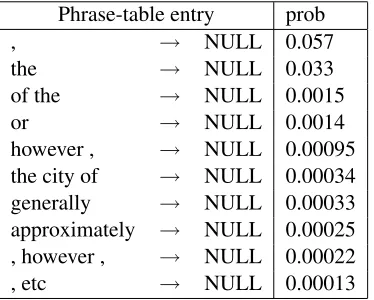
Phrase-table entry prob
, → NULL 0.057
the → NULL 0.033
of the → NULL 0.0015
or → NULL 0.0014
however , → NULL 0.00095 the city of → NULL 0.00034 generally → NULL 0.00033 approximately → NULL 0.00025 , however , → NULL 0.00022
, etc → NULL 0.00013
Table 3: Example phrase-table entries learned from the data and their associated probability.
of Moses after the word alignment was modified. The highest probability rules tend to delete punctua-tion and funcpunctua-tion words, however, other phrases also appeared. 0.5% of the rules learned during training are deletion rules.
5 Experiments
We compared five different approaches on the text simplification task:
none: Does no simplification. Outputs the normal, unsimplified sentence.
K & M: Noisy-channel sentence compression sys-tem described in Knight and Marcu (2002).
T3: Synchronous tree substitution grammar, trained discriminatively (Cohn and Lapata, 2009).
Moses: Phrase-based, machine translation ap-proach (Koehn et al., 2007).
Moses+Del: Our approach described in Section 4 which is a phrase-based approach with the addition of phrasal deletion.
From the aligned data set of 137K sentence pairs, we used 124K for training and 1,300 for testing
with the remaining 12K sentences used during de-velopment. We trained the n-gram language model used by the last four systems on the simple side of the training data.3 T3 requires parsed data which we generated using the Stanford parser (Klein and Manning, 2003). Both Moses and Moses+Del were trained using the default Moses parameters and we used the last 500 sentence pairs from the training set to optimize the hyper-parameters of the log-linear model for both Moses variants. T3 was run with the default parameters.
Due to runtime and memory issues, we were un-able to run T3 on the full data set.4 We therefore present results for T3 trained on the largest train-ing set that completed successfully, the first 30K sentence pairs. This still represents a significantly larger training set than T3 has been run on previ-ously. For comparison, we also provide results be-low for Moses+Del trained on the same 30K sen-tences.
5.1 Evaluation
Since there is no standard way of evaluating text simplification, we provide results for three different automatic methods, all of which compare the sys-tem’s output to a reference simplification. We used BLEU (Papineni et al., 2002), which is the weighted mean of n-gram precisions with a penalty for brevity. It has been used extensively in machine translation and has been shown to correlate well with human performance judgements.
We also adopt two automatic measures that have been used to evaluate text compression that com-pare the system’s output to a reference translation
3
See (Turner and Charniak, 2005) for a discussion of prob-lems that can occur for text compression when using a language model trained on data from the uncompressed side.
4
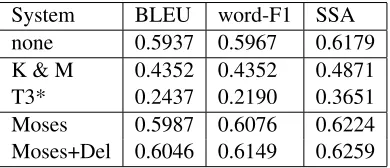
System BLEU word-F1 SSA none 0.5937 0.5967 0.6179 K & M 0.4352 0.4352 0.4871 T3* 0.2437 0.2190 0.3651 Moses 0.5987 0.6076 0.6224 Moses+Del 0.6046 0.6149 0.6259
Table 4: Performance of the five approaches on the test data. All differences in performance are statistically sig-nificant. * - T3 was only trained on 30K sentence pairs for performance reasons.
(Clarke and Lapata, 2006): simple string accuracy measure (a normalized version of edit distance, ab-breviated SSA) and F1 score calculated over words. We calculated F1 over words instead of grammatical relations (subject, direct/indirect object, etc.) since finding the relation correspondence between the sys-tem output and the reference is a non-trivial task for simplification data where reordering, insertions and lexical changes can occur. Clarke and Lapata (2006) showed a moderate correlation with human judge-ment for SSA and a strong correlation for the F1 measure.
To measure whether the difference between sys-tem performance is statistically significant, we use bootstrap resampling with 100 samples with the t-test (Koehn, 2004).
5.2 Results
Table 4 shows the results on the test set for the dif-ferent evaluation measures. All three of the evalu-ation metrics rank the five systems in the same or-der with Moses+Del performing best. All differ-ences between the systems are statistically signifi-cant for all metrics at thep= 0.01level. One of the challenges for the sentence simplification problem is that, like sentence compression, not making any changes to the system produces reasonable results (contrast this with machine translation). In the test set, 30% of the simple sentences were the same as the corresponding normal sentence. Because of this, we see that not making any changes (none) performs fairly well. It is, however, important to leave these sentences in the test set, since not all sentences need simplification and systems should be able to handle these sentences appropriately.
Both of the text compression systems perform
poorly on the text simplification task with results that are significantly worse than doing nothing. Both of these systems tended to bias towards modifying the sentences (T3 modified 77% of the sentences and K & M 96%). For K & M, the poor results are not surprising since the model only allows for deletion operations and is more tailored to the compression task. Although T3 does allow for the full range of simplification operations, it was often overly aggres-sive about deletion, for example T3 simplified:
There was also a proposal for an extension from Victoria to Fulham Broadway station on the district line , but this was not in-cluded in the bill .
to “it included .” Overall, the output of T3 aver-aged 13 words per sentence, which is significantly lower than the gold standard’s 21 words per sen-tence. T3 also suffered to a lesser extent from inap-propriately inserting words/phrases, which other re-searchers have also noted (Nomoto, 2009). Some of these issues were a results of T3’s inability to cope with noise in the test data, both in the text or the parses.
Both Moses and Moses+Del perform better than the text compression systems as well as the baseline system,none. If we remove those sentences in the test set where the simple sentence is the same as the normal sentence and only examine those sentences where a simplification should occur, the difference between the phrase-based approaches and none is even more significant with BLEU scores of 0.4560, 0.4723 and 0.4752, fornone, Moses and Moses+Del respectively.
BLEU
System Case none output
Moses
correct change 0.4431 0.4901 incorrect change 1 0.8625
Moses+Del
[image:7.612.349.502.59.116.2]correct change 0.4087 0.4788 incorrect change 1 0.8706
Table 5: BLEU scores for Moses and Moses+Del on sen-tences where the system made a change. “correct change” shows the score where a change was made by the system as well as in the reference and “incorrect change” where a change was made by the system, but not the reference.
we see an even larger gain by Moses+Del with a dif-ference of 0.07 BLEU.
For completeness, we also trained Moses+Del on the same 30K sentences used to train the T3 sys-tem.5 Using this training data, Moses+Del achieved
a BLEU score of 0.5952. This is less than the score achieved when using the full training data, but is sig-nificantly better than T3 and still represents a small improvement overnone.
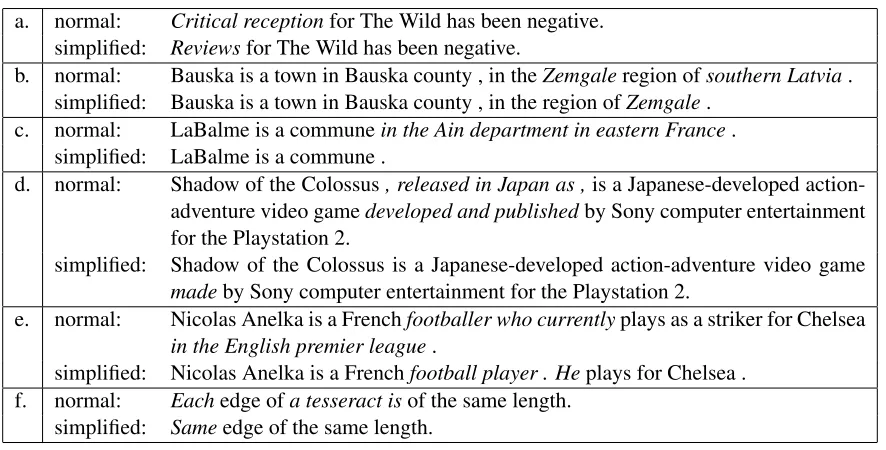
Table 6 shows example simplifications made by Moses+Del. In many of the examples we see phrasal deletion during the simplification process. The out-put also contains a number of reasonable lexical changes, for example in a, d and e. Example b contains reordering and e shows an example of a split being performed where the normal sentence is turned into two simplified sentences. This is not un-common in the data, but can be challenging to model for current syntactic approaches. The examples also highlight some of the common issues with the ap-proach. Examplesaandfare not grammatically cor-rect and the simplification inf does not preserve the original meaning of the text. As an aside, the normal sentence of exampledalso contains an omission er-ror following “as” due to preprocessing of the data, resulting from ill-formed xml in the articles.
5.3 Oracle
In the previous section, we looked at the perfor-mance of the systems based on the best translations suggested by the systems. For many approaches, we can also generate an n-best list of possible transla-tions. We examined the simplifications in this
n-5
To be completely consistent with T3, we used the first 29,700 pairs for training and the last 300 for parameter tuning.
[image:7.612.75.304.59.149.2]BLEU System original oracle Moses 0.5987 0.6317 Moses+Del 0.6046 0.6421
Table 7: BLEU score for the original system versus the best possible “oracle” translations generated by greedily selecting the best translation from an n-best list based on the reference simplification.
best list to measure the potential benefit of reranking techniques, which have proved successful in many NLP applications (Och et al., 2004; Ge and Mooney, 2006), and to understand how well the underlying model captures the phenomena exhibited in the data. For both of the phrase-based approaches, we gener-ated an n-best list of size 1000 for each sentence in the test set. Using these n-best lists, we generated an “oracle” simplification of the test set by greed-ily selecting for each test sentence the simplification in the n-best list with the best sentence-level BLEU score.
Table 7 shows the BLEU scores for the original system output and the system’s oracle output. In all cases, there is a large difference between the sys-tem’s current output and the oracle output, suggest-ing that utilizsuggest-ing some reranksuggest-ing technique could be useful. Also, we again see the benefit of the phrasal deletion rules. The addition of the phrasal dele-tion rule gives the system an addidele-tional dimension of flexibility, resulting in a more varied n-best list and an overall higher oracle BLEU score.
6 Conclusions and Future Work
In this paper, we have explored a variety of ap-proaches for learning to simplify sentences from Wikipedia. In contrast to prior work in the related field of sentence compression where deletion plays the dominant role, the simplification task we exam-ined has the full range of text-to-text operations in-cluding lexical changes, reordering, insertions and deletions.
a. normal: Critical receptionfor The Wild has been negative. simplified: Reviewsfor The Wild has been negative.
b. normal: Bauska is a town in Bauska county , in theZemgaleregion ofsouthern Latvia. simplified: Bauska is a town in Bauska county , in the region ofZemgale.
c. normal: LaBalme is a communein the Ain department in eastern France. simplified: LaBalme is a commune .
d. normal: Shadow of the Colossus, released in Japan as ,is a Japanese-developed action-adventure video gamedeveloped and publishedby Sony computer entertainment for the Playstation 2.
simplified: Shadow of the Colossus is a Japanese-developed action-adventure video game madeby Sony computer entertainment for the Playstation 2.
e. normal: Nicolas Anelka is a Frenchfootballer who currentlyplays as a striker for Chelsea in the English premier league.
simplified: Nicolas Anelka is a Frenchfootball player . Heplays for Chelsea . f. normal: Eachedge ofa tesseract isof the same length.
[image:8.612.86.529.57.282.2]simplified: Sameedge of the same length.
Table 6: Example simplifications. “normal” is the the unsimplified input sentence and “simplified” the simplification made by Moses+Del.
that the incorporation of phrasal deletion into the simplification process results in statistically signif-icant improvements over a traditional phrase-based approach.
While we obtained positive results using a phrase-based approach, we still believe that incorporating some additional hierarchical structure will help the simplification process, particularly since one of the goals of simplification is to reduce the grammatical complexity of the sentence. Also, as seen in some of the examples above, the phrase-based model can produce output that is not grammatically correct. Though T3 did not perform well, many other syntax-based models exists that have been successful in ma-chine translation.
There are a number of research questions moti-vated by this work in related areas including the scal-ability of discriminative trained rule sets, the impact of the language model training source (simple vs. normal English), document-level simplification and applications of text simplification. Our hope is that this new simplification task will spur a variety of re-lated research inquiries.
Acknowledgments
We’d like to thank Dan Feblowitz for his insights and discussions, and for generating the results for
the K & M implementation.
References
Regina Barzilay and Noemie Elhadad. 2003. Sentence alignment for monolingual comparable corpora. In Proceedings of EMNLP.
Yvonne Canning, John Tait, Jackie Archibald, and Ros Crawley. 2000. Cohesive generation of syntactically simplified newspaper text. InProceedings of TSD. John Carroll, Gido Minnen, Yvonne Canning, Siobhan
Devlin, and John Tait. 1998. Practical simplification of English newspaper text to assist aphasic readers. In Proceedings of AAAI Workshop on Integrating AI and Assistive Technology.
Raman Chandrasekar and Bangalore Srinivas. 1997. Au-tomatic induction of rules for text simplification. In Knowledge Based Systems.
Yu Chen, Martin Kay, and Andreas Eisele. 2009. Inter-secting multilingual data for faster and better statistical translations. InProceedings of HLT/NAACL.
David Chiang. 2010. Learning to translate with source and target syntax. InProceedings of ACL.
James Clarke and Mirella Lapata. 2006. Models for sentence compression: A comparison across domains, training requirements and evaluation measures. In Proceedings of ACL.
Will Coster and David Kauchak. 2011. Simple English Wikipedia: A new simplification task. InProceedings of ACL (Short Paper).
Lijun Feng. 2008. Text simplification: A survey. CUNY Technical Report.
Michel Galley and Kathleen McKeown. 2007. Lexical-ized Markov grammars for sentence compression. In Proceedings of HLT/NAACL.
Ruifang Ge and Raymond Mooney. 2006. Discrimina-tive reranking for semantic parsing. InProceedings of COLING.
Dan Klein and Christopher Manning. 2003. Accurate unlexicalized parsing. InProceedings of ACL. Kevin Knight and Daniel Marcu. 2002. Summarization
beyond sentence extraction: A probabilistic approach to sentence compression.Artificial Intelligence. Philipp Koehn, Hieu Hoang, Alexandra Birch, Chris
Callison-Burch, Marcello Federico, Nicola Bertoldi, Brooke Cowan, Wade Shen, Christine Moran, Richard Zens, Chris Dyer, Ondrej Bojar, Alexandra Con-stantin, and Evan Herbst. 2007. Moses: Open source toolkit for statistical machine translation. In Proceed-ings of ACL.
Philipp Koehn. 2004. Statistical significance tests for machine translation evaluation. In Proceedings of EMNLP.
Ryan McDonald. 2006. Discriminative sentence com-pression with soft syntactic evidence. InProceedings of EACL.
Makoto Miwa, Rune Saetre, Yusuke Miyao, and Jun’ichi Tsujii. 2010. Entity-focused sentence simplication for relation extraction. InProceedings of COLING. Courtney Napoles and Mark Dredze. 2010.
Learn-ing simple Wikipedia: A cogitation in ascertainLearn-ing abecedarian language. InProceedings of HLT/NAACL Workshop on Computation Linguistics and Writing. Rani Nelken and Stuart Shieber. 2006. Towards robust
context-sensitive sentence alignment for monolingual corpora. InProceedings of AMTA.
Tadashi Nomoto. 2007. Discriminative sentence com-pression with conditional random fields. In Informa-tion Processing and Management.
Tadashi Nomoto. 2008. A generic sentence trimmer with CRFs. InProceedings of HLT/NAACL.
Tadashi Nomoto. 2009. A comparison of model free ver-sus model intensive approaches to sentence compres-sion. InProceedings of EMNLP.
F.J. Och and H. Ney. 2000. Improved statistical align-ment models. InProceedings of ACL.
Franz Josef Och and Hermann Ney. 2003. A system-atic comparison of various statistical alignment mod-els.Computational Linguistics, 29(1):19–51.
Franz Josef Och, Kenji Yamada, Stanford U, Alex Fraser, Daniel Gildea, and Viren Jain. 2004. A smorgasbord of features for statistical machine translation. In Pro-ceedings of HLT/NAACL.
Kishore Papineni, Salim Roukos, Todd Ward, and Wei-Jing Zhu. 2002. BLEU: a method for automatic eval-uation of machine translation. InProceedings of ACL. Jenine Turner and Eugene Charniak. 2005. Supervised and unsupervised learning for sentence compression. InProceedings of ACL.
David Vickrey and Daphne Koller. 2008. Sentence sim-plification for semantic role labeling. InProceedings of ACL.
S. Wubben, A. van den Bosch, and E. Krahmer. 2010. Paraphrase generation as monolingual translation: Data and evaluation. InProceedings of the Interna-tional Workshop on Natural Language Generation. Elif Yamangil and Rani Nelken. 2008. Mining
Wikipedia revision histories for improving sentence compression. InACL.
Mark Yatskar, Bo Pang, Critian Danescu-Niculescu-Mizil, and Lillian Lee. 2010. For the sake of sim-plicity: Unsupervised extraction of lexical simplifica-tions from Wikipedia. InProceedings of HLT/NAACL (Short Paper).