http://www.scirp.org/journal/ijcns ISSN Online: 1913-3723
ISSN Print: 1913-3715
Radar Signal Intra-Pulse Feature Extraction
Based on Improved Wavelet Transform
Algorithm
Wenxu Zhang, Fuli Sun, Bing Wang
College of Information and Communication Engineering, Harbin Engineering University, Harbin, China
Abstract
With the new system radar put into practical use, the characteristics of com-plex radar signals are changing and developing. The traditional analysis me-thod of one-dimensional transformation domain is no longer applicable to the modern radar signal processing, and it is necessary to seek new methods in the two-dimensional transformation domain. The time-frequency analysis method is the most widely used method in the two-dimensional transforma-tion domain. In this paper, two typical time-frequency analysis methods of short-time Fourier transform and Wigner-Ville distribution are studied by analyzing the time-frequency transform of typical radar reconnaissance linear frequency modulation signal, aiming at the problem of low accuracy and sen-sitivity to the signal noise of common methods, the improved wavelet trans-form algorithm was proposed.
Keywords
Intra-Pulse Feature Extraction, Time-Frequency Analysis, Short-Time Fourier Transform, Wigner-Ville Distribution, Wavelet Transform
1. Introduction
The characteristics of modern complex radar signals penetrate into the time domain, frequency domain, airspace, two-dimensional transformation domain, which contains rich content; it is reflected in the subtle differences of the signal itself as well as in the characteristics and changes of the overall signal [1]. The traditional feature analysis and extraction methods are mostly reflected in the characteristics of a signal in a certain one-dimensional transformation domain (time domain, frequency domain, airspace), while the characteristics of other two-dimensional transformation domain are not obvious. Since the complex
How to cite this paper: Zhang, W.X., Sun, F.L. and Wang, B. (2017) Radar Signal Intra- Pulse Feature Extraction Based on Improved Wavelet Transform Algorithm. Int. J. Com-munications, Network and System Sciences, 10, 118-127.
https://doi.org/10.4236/ijcns.2017.108B013
signal feature analysis and extraction method should be carried out in the two-dimensional transformation domain, that is, the traditional method fails to extract the complex characteristic parameters of modern radar signals, thus af-fecting the reconnaissance effect of complex radar signals [2].
The time-frequency analysis method is the most widely used method in the two-dimensional transform domain. The time-frequency analysis method can reflect the time-varying nature of the non-stationary signal more accurately [3], so that the analysis of the non-stationary signal is accurate to the specific fre-quency of the specific time. There are many kinds of time-frefre-quency analysis methods, among them, Short-time Fourier transform, Wigner-Ville distribution and wavelet transform are widely used in the analysis and feature extraction of complex signals [4].
The literature [5] proposed an adaptive short-time Fourier analysis method, however it didn’t study the problem that the time resolution and the frequency resolution cannot be taken into account simultaneously. In the literature [6], the authors proposed a method of multi resolution signal analysis using improved Wigner-Ville distribution. But there is still cross-term interference when using it to analyze multi-component LFM signals, which seriously affects the extraction of the time-frequency characteristics of signal. The literature [7] proposed an improved Morlet wavelet and its complete transform. However, the authors didn’t study that how to apply the method in the radar signal intra-pulse feature extraction. Aiming at the problem of low accuracy and sensitivity to the signal noise of common methods in the radar signal intra-pulse feature extraction, this paper proposed the improved wavelet transform algorithm.
The linear frequency modulation (LFM) signal is one of the modern radar signals that are frequently used with a simple structure. It obtains a large time-bandwidth product by the linear frequency modulation. It is a typical signal type that is widely used in pulse compression signals. The LFM signal has the advantage of Doppler shift insensitivity, which means that even if the Doppler shift of the echo signal is large, the matched filter still has the effect of pulse pressure [8]. Typical time-frequency analysis methods of short-time Fourier transform, Wigner-Ville distribution and improved wavelet transform algorithm are studied by analyzing the time-frequency transform of typical radar recon-naissance LFM signal.
2. Typical Time-Frequency Analysis Methods
2.1. Short-Time Fourier Transform
In order to introduce time-dependency in the Fourier transform, a simple and intuitive solution consists in pre-windowing the signal x u( ) around a
particu-lar time t, calculating its Fourier transform, and doing that for each time
in-stant t. The resulting transform, called the short-time Fourier transform
(STFT) [10], is
2 ( , ; ) ( ) * ( ) j vu
x
F t v h =
∫
−+∞∞ x u h u−t e− π du. (1)where h t( ) is a short time analysis window localized around t=0 and ν =0.
Because multiplication by the relatively short window h∗ −(u t) effectively
suppresses the signal outside a neighborhood around the analysis time point
u=t, the STFT is a “local” spectrum of the signal x u( ) around t.
The STFT may also be expressed in terms of signal and window spectra:
*
( , ; ) ( ) ( ) [ 2 ( ) ]
x
F tν h =
∫
−∞+∞X ξ H ξ ν− exp j π ξ ν− t dξ . (2)where X and H are respectively the Fourier transforms of x and h. Thus,
the STFT F tx( , ; )ν h can be considered as the result of passing the signal x u( )
through a band-pass filter whose frequency response is *
( )
H ξ ν− , and is
there-fore deduced from a mother filter H( )ξ by a translation of v. So the STFT is
similar to a bank of band-pass filters with constant bandwidth [7].
2.2. Wigner-Ville Distribution
In contrast with the linear time-frequency representations which decompose the signal on elementary components, the purpose of the energy distributions is to distribute the energy of the signal over the two description variables: time and frequency. The starting point is that since the energy of a signal x can be
de-duced from the squared modulus of either the signal or its Fourier transform [6],
2 2
| ( ) | | ( ) |
x
E =
∫
−∞+∞ x t dt=∫
−∞+∞ X v dν. (3)we can interpret | ( ) |x t 2 and |X v( ) |2 as energy densities, respectively in time
and in frequency. It is then natural to look for a joint time and frequency energy density ρx( , )tν , such that
( , )
x x
E =
∫ ∫
−∞ −∞+∞ +∞ρ tν dtdν . (4)which is an intermediary situation between those described by (4). As the energy is a quadratic function of the signal, the time-frequency energy distributions will be in general quadratic representations. Two other properties that an energy density should satisfy are the following marginal properties:
2 ( , ) | ( )|
x t dt X v
ρ ν
+∞
−∞ =
∫
. (5)2 ( , ) | ( )|
x t d x t
ρ ν ν
+∞
−∞ =
∫
. (6) which mean that if we integrate the time-frequency energy density along one va-riable, we obtain the energy density corresponding to the other variable.Wigner-Ville distribution (WVD) defined as:
2 ( , ) ( / 2) ( / 2) j x
W tν =
∫
−∞+∞x t+τ x∗ t−τ e− πντdτ. (7)or equivalently as:
2 ( , ) ( / 2) ( / 2) j t x
W tν =
∫
−∞+∞X v+ξ X∗ v−ξ e πξdξ. (8)This distribution satisfies a large number of desirable mathematical properties, as summarized in the next sub-section. In particular, the WVD is always real-va- lued, it preserves time and frequency shifts and satisfies the marginal properties.
3. Improved Wavelet Analysis
Wavelet analysis is a kind of time-frequency analysis aiming to describe the sig-nal with time-scale plane based on the idea of replacing the representation of frequency domain with scale field, which has the characteristics of multiresolu-tion analysis together with the ability to indicate the local characteristics of the signal. Wavelet analysis is a localized analysis method of time and frequency in which the size of time–frequency window is fixed but the shape can be adjusted [11].
3.1. Continuous Wavelet Transform Principle
The idea of the continuous wavelet transform (CWT) is to project a signal x
on a family of zero-mean functions (the wavelets) deduced from an elementary function (the mother wavelet) by translations and dilations:
* , ( , ; ) ( ) ( )
x t a
T t a Ψ =
∫
−∞+∞x s Ψ s ds. (9)where 1/2 , ( ) | | ( ) t a s t s a a − −
Ψ = Ψ . (10) The variable a corresponds now to a scale factor, in the sense that taking
| | 1a > dilates the wavelet Ψ and taking | | 1a < compresses Ψ.
The basic difference between the wavelet transform and the short-time Fouri-er transform is as follows: when the scale factor a is changed, the duration and
the bandwidth of the wavelet are both changed but its shape remains the same. And in contrast to the STFT, which uses a single analysis window, the CWT uses short windows at high frequencies and long windows at low frequencies. This partially overcomes the resolution limitation of the STFT [11]. The CWT can also be seen as a filter bank analysis composed of band-pass filters with constant relative bandwidth.
3.2. Morlet Wavelet and Its Improved Algorithm
Morlet wavelet is chosen as the wavelet basis function to extract the characteris-tic parameters of radar signals because of its good time-frequency characterischaracteris-tics; its expression is [12]:
2
0 2
( ) j t t
and its Fourier transforms is:
2 2
0 2 ( 0) 2
( ) j t t j t 2
M ω =
∫
−∞+∞eω e− e−ωdt= πe− −ω ω . (12)So:
2 0 2
(0) 2 0
M = πe−ω ≠ . (13)
The improved wavelet transform has two purposes: 1) transform the time signal into time-frequency domain instead of time scale domain by means of wavelet transform with kernel function of Morlet wavelet; 2) each parameter of the wavelet has definite physical meaning.
The improved Morlet basic wavelet is as follow:
2
0 1
( ) exp 2 2
2 2
t
t j t
ψ π ω π
π
= − + =
, . (14)
In the formula, 1
2
π
is the wavelet amplitude parameter, which makes:( ) 1
Rψ t dt=
∫
. (15) The family of Morlet wavelet deduced from the mother wavelet by transla-tions and dilatransla-tions:2 2
,
( )
( ) exp 2 ( )
2 2
f
f f t
t j f t
τ τ
ψ π τ
π
−
= − + −
. (16)
In the formula, the parameters t and τ are the time, and f is the wavelet
dominant frequency.
The wavelet transform using Morlet wavelet as kernel function can be used for time-frequency analysis of signals. Morlet wavelet is a double window function. The time window center t0 of ψf,τ( )t , frequency window center f0, time
window radius ∆t and frequency radius ∆f are:
0 0
1
, , ,
2 2 2
f
t f f t f
f
τ
π
= = ∆ = ∆ = . (17)
The time-frequency window is:
1 1 1 1
, ,
2f 2f f 2 2 f 2 2
τ τ
π π
− + × − +
. (18)
and
1 1
4 2 2 2
f t f
f π π
∆ ∆ = ⋅ = . (19)
The modified Morlet wavelet approximation satisfies the admissible condi-tions, and
, ( ) 0, 0
fτ t f
4. Simulation Experiment and Analysis
4.1. Short-Time Fourier Transform Time-Frequency Graphs of
LFM Signals with Different SNR
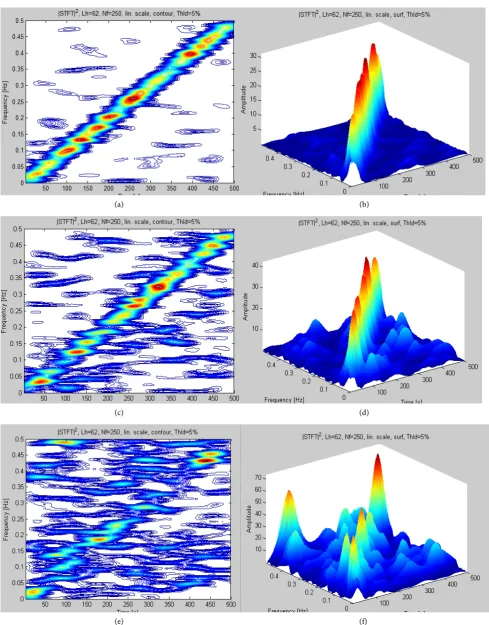
Figure 1 shows the short-time Fourier transform, and there is no cross-term in-terference for multi-component LFM signal since STFT belongs to linear trans-formation, which makes it suitable for detecting linear frequency modulation signal, and it can detect the basic characteristics of the signal even when SNR drops to −5 dB. However, due to the fixed length of the sliding window, the time resolution and the frequency resolution cannot be taken into account simulta-neously, so the accuracy of analysis is relatively low.
4.2. Wigner-Ville Distribution Time-Frequency Graphs of LFM
Signals with Different SNR
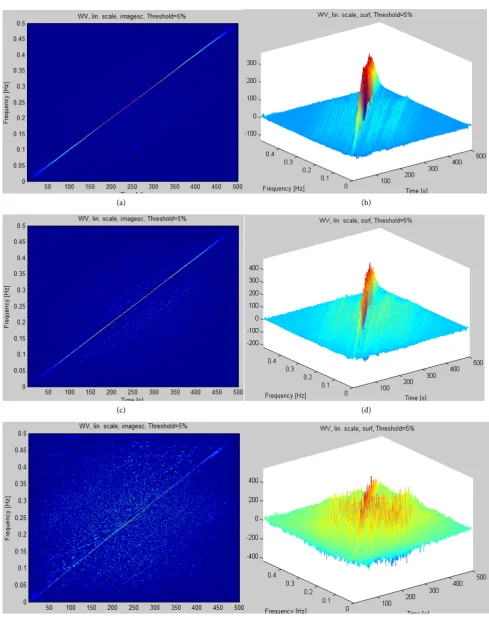
Without going into details about this representation we can see that the linear progression of the frequency with time is clearly shown in Figure 2. WVD has the feature of strong energy aggregation in LFM signals. There is obvious cross-term interference when using it to analyze multi-component LFM signals, which seriously affects the extraction of the time-frequency characteristics of signal, and WVD is very sensitive to noise.
4.3. Improved Wavelet Transform Time-Frequency Graphs of LFM
Signals with Different SNR
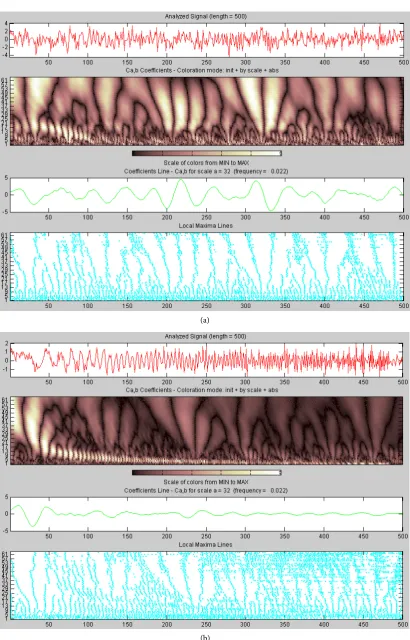
The improved wavelet transform has introduced the scalable parameters in the win-dow function to obtain the automatic resolution, that is, in the part of low frequency obtain the higher frequency resolution and the lower time resolution, and in the part of high frequency obtain the higher time resolution and the lower frequency reso-lution. Thus it is suitable for detecting the transient anomalies in the normal signal entrainment and shows its details, which is very useful for detecting the trip points of frequency coded and phase coded signal. And the effect of conti-nuous wavelet analysis has not changed considerably with the existence of noise, which indicates that wavelet analysis is not sensitive to noise, as is shown in Figure 3.
5. Conclusion
(a) (b)
(c) (d)
[image:7.595.58.548.64.690.2](e) (f)
(a) (b)
(c) (d)
[image:8.595.56.546.62.681.2](e) (f)
(a)
[image:9.595.128.539.60.701.2](b)
signals will be studied in a systematic, comprehensive and in-depth way, and the optimal corresponding intra-pulse feature extraction method are expected in the multidimensional transformation domain.
Acknowledgements
This work is supported partly by National Natural Science Foundation of China under Grant No. 61301205 and No. 61571146, National Defense Based Science Research Program under Grant No. JCKY2013604B001. This paper is funded by the International Exchange Program of Harbin Engineering University for In-novation-oriented Talents Cultivation.
References
[1] Stove, A.G., Hume, A.L. and Baker, C.J. (2004) Low Probability of Intercept Radar Strategies. IEEE Proceedings-Radar, Sonar and Navigation, 151, 249-260.
https://doi.org/10.1049/ip-rsn:20041056
[2] Liu, F., Xu, H. and Tao, R. (2012) Research on Resolution between Multi-Compo- nent LFM Signal in the Fractional Domain. Science China Information Sciences, 55, 1301-1312. https://doi.org/10.1007/s11432-011-4324-6
[3] Wang, K., Jiang, Q.-X., Liu, F.-Z. and Pan, J.-F. (2017) A Design of Broad Band Multidimensional Radar Signal. Journal of Naval University of Engineering, 29, 35- 40.
[4] Moraitakis, I. and Fargues, M.P. (2000) Feature Extraction of Intra-Pulse Modulated Signals Using Time-Frequency Analysis. Proceedings of 21st Century Military Com- munications Conference, Los Angeles, 22-25 October 2000, 737-741.
https://doi.org/10.1109/MILCOM.2000.904028
[5] Czerwinski, P.N. (2007) Adaptive Short-Time Fourier Analysis. IEEE Signal Pro- cessing Letters, 4, 42-45. https://doi.org/10.1109/97.554468
[6] Poyil, A.T. and Nasimudeen, K.M. (2012) Multi Resolution Signal Analysis Using Improved Wigner Ville Distribution. 2012 International Conference on Communi-cation, Information & Computing Technology (ICCICT), Mumbai, 19-20 October 2012, 1-4. https://doi.org/10.1109/ICCICT.2012.6398197
[7] Ji, Z.H. and Yan, S.G. (2016) Improved Morlet Wavelet and Its Complete Trans-form. Computer Engineering and Applications, 52, 12-18.
[8] Yang, H.F. and He, Z.R. (2016) Time-Frequency Analysis in Radar Signal Recogni-tion. Electronic Sci. & Tech, 29, 58-61.
[9] Zhang, X.R. and Xie, H. (2013) A Novel Method Based on Time-Frequency Atom for Complex Modulated Radar Signal Sorting in Low SNR Condition. Applied Science and Technology, 40, 51-57.
[10]Kwok, H.K. and Jones, D.L. (2000) Improved Instantaneous Frequency Estimation Using an Adaptive Short-Time Fourier Transform. IEEE Transactions on Signal Processing, 48, 2964-2972. https://doi.org/10.1109/78.869059
[11]Khalil, N.H. (2007) Wavelet Analysis of Instantaneous Correlations with Applica-tion to Frequency Hopped Signals. Naval Postgraduate School, Monterey.
Submit or recommend next manuscript to SCIRP and we will provide best service for you:
Accepting pre-submission inquiries through Email, Facebook, LinkedIn, Twitter, etc. A wide selection of journals (inclusive of 9 subjects, more than 200 journals)
Providing 24-hour high-quality service User-friendly online submission system Fair and swift peer-review system
Efficient typesetting and proofreading procedure
Display of the result of downloads and visits, as well as the number of cited articles Maximum dissemination of your research work
Submit your manuscript at: http://papersubmission.scirp.org/