Equilibria, Kinetics, and Mechanism in the Bicarbonate Activation of
Hydrogen Peroxide: Oxidation of Sulfides by Peroxymonocarbonate
David E. Richardson,* Huirong Yao, Karen M. Frank,‡and Deon A. Bennett
Contribution from the Center for Catalysis, Department of Chemistry, UniVersity of Florida, GainesVille, Florida 32611-7200
ReceiVed August 2, 1999
Abstract: Bicarbonate ion is an effective activator for hydrogen peroxide in the oxidation of sulfides. Kinetic
and spectroscopic results support the formation of peroxymonocarbonate ion (HCO4-) as the oxidant in the
catalytic reactions. The reaction of hydrogen peroxide and bicarbonate to form HCO4-occurs rapidly at 25°C
(t1/2≈300 s) near neutral pH in aqueous solution and alcohol/water mixtures, and an equilibrium analysis of
the reaction by13C NMR leads to an estimate of the electrode potential for the HCO
4-/HCO3-couple (1.8 V
vs NHE). Solubility of the bicarbonate catalyst is enhanced by the use of NH4HCO3rather than by the use of
group 1 salts, which tend to have lower solubility in the mixed solvents and can lead to phase separation. Rate laws and mechanistic analyses are presented for the oxidation of ethylphenylsulfide and related sulfides. The second-order rate constants for sulfide oxidations by HCO4-are∼300-fold greater than those for H2O2, and
this increase is consistent with expectations based on a Brønsted analysis of the kinetics for other heterolytic peroxide oxidations. At high concentrations of H2O2, a pathway that is second order in H2O2is significant,
and this path is interpreted as a general acid catalysis by H2O2of carbonate displacement accompanying substrate
attack at the electrophilic oxygen of HCO4-. Increasing water content up to 80% in the solvent increases the
rate of oxidation. The BAP (bicarbonate-activated peroxide) oxidation system is a simple, inexpensive, and relatively nontoxic alternative to other oxidants and peroxyacids, and it can be used in a variety of oxidations where a mild, neutral pH oxidant is required. Variation of bicarbonate source and the cosolvent can allow optimization of substrate solubility and oxidation rates for applications such as organic synthesis and chemical warfare agent decontamination.
Introduction
Hydrogen peroxide is a widely used oxidant with high active oxygen content,1but it is a rather slow oxidizing agent in the
absence of activators. In large-scale bleaching applications2and
many synthetic oxidations, activation via formation of peroxy-carboxylic acids is a favored method (i.e., RC(O)X+H2O2h RC(O)OOH+ HX).1,3,4 The activation is often accomplished
in situ by using a reactive carboxylic acid derivative with a good leaving group that leads to rapid conversion to the peroxyacid. Alternatively, a peroxyacid can be formed from the parent acid (X ) OH) by strong acid catalysis and high concentrations of H2O2.
A novel method for activating H2O2by using bicarbonate
ion was described by Drago and co-workers in their study of the oxidation of chemical warfare agents and simulant sulfides in mixed tert-butyl alcohol/water solvent.5They concluded on
the basis of NMR evidence that the active oxidant in the catalytic
pathway is peroxymonocarbonate ion (HCO4-)6formed by a
labile preequilibrium reaction between bicarbonate ion and H2O2
(eq 1).
The use of an alcohol cosolvent provides for organic substrate solubility and shifted the equilibrium of eq 1 to the right, favoring increased formation of peroxymonocarbonate ion. Recent experiments reported by Richardson et al,7 and Xu8
‡Present address: Daytona Beach Community College, Daytona Beach,
FL 32120.
(1) (a) Kislenko, V. N.; Berlin, A. A. Russ. Chem. ReV. 1991, 60, 470. (b) Schumb, W. C.; Satterfield, C. N.; Wentworth, R. L. Hydrogen Peroxide; Reinhold: New York, 1955.
(2) Farr, J. P.; Smith, W. L.; Steichen, D. S. In Kirk-Othmer Encyclopedia
of Chemical Technology; Kroschwitz, J. I., Ed.; Wiley-Interscience: New
York, 1997; Vol. 4, pp 271-300.
(3) Swern, D. In Organic Peroxides; Swern, D., Ed.; Wiley: New York, 1970; pp 313-516.
(4) Sanchez, J.; Myers, T. N. In Kirk-Othmer Encyclopedia of Chemical
Technology; Kroschwitz, J. I., Ed.; Wiley-Interscience: New York, 1997;
Vol. 18, pp 231-310.
(5) Drago, R. S.; Frank, K. M.; Yang, Y.-C.; Wagner, G. W. In the
Proceedings of the 1997 ERDEC Scientific Conference on Chemical and Biological Defense Research; U.S. Army Edgewood Research,
Develop-ment, and Engineering Center, 1998.
(6) The nomenclature for HCO4-and associated species is not universally accepted. The parent acid H2CO4(RN 593-69-9) is indexed by CAS as
carbonoperoxoic acid and is named by IUPAC as hydrogen dioxoperoxo-carbonate(2-). Common names for the acid include monoperoxycarbonic acid and percarbonic acid. By analogy to H2SO5(CAS name
peroxymono-sulfuric acid), peroxymonocarbonic acid could also be used as a common
name. Salts of HCO4- are indexed by CAS as carbonoperoxoic acid derivatives (e.g., carbonoperoxoic acid, monopotassium salt), while IUPAC would name the same salt potassium hydrogendioxoperoxocarbonate(1-). Common names for the same salt are potassium percarbonate, potassium
peroxycarbonate, and monopotassium peroxymonocarbonate. In this paper,
we have chosen to use the common name peroxymonocarbonate for the ion HCO4-. The commonly employed prefix “mono” readily distinguishes various monomeric oxyanions from their dimeric and polymeric counter-parts, and the choice parallels the common use of peroxymonosulfate for the analogous HSO5-ion. A difficulty with this choice is that the name could also apply to CO42-, but it assumed in this work that at pH values less than ∼9 the predominant ionization state is HCO4-. The more cumbersome hydrogenperoxymonocarbonate can be used when confusion is likely.
HCO3-+H2O2hHCO4
-+
H2O (1)
1729 J. Am. Chem. Soc. 2000, 122, 1729 1739
showed that increases in catalytic efficiency of the BAP system (bicarbonate activated peroxide) could be achieved by using a more soluble source of bicarbonate (NH4HCO3) and primary
alcohols in place of NaHCO3and tert-butyl alcohol, respectively.
The goal of the present study was to investigate the mechanism of bicarbonate-catalyzed oxidation of sulfides by H2O2in alcohol/water media via a detailed investigation of rate
laws. Bicarbonate catalysis of hydrogen peroxide oxidations has many potential advantages over other peroxyacids and oxidants for applications such as organic synthesis, bleaching, and chemical warfare agent decontamination.9-11Hydrogen peroxide
has a high active oxygen content compared to other stoichio-metric oxidants, e.g., peroxycarboxylic acids, periodate, and peroxymonosulfate.12 The conditions of the BAP system are
mild with pH around neutral or weakly alkaline rather than the strongly alkaline conditions often employed for peroxide bleaching.13The components of the system are inexpensive and
environmentally friendly. Experiments with chemical warfare agents such as HD (mustard), GB, and VX show that the system can be used as a broad-spectrum decontamination solution (“Decon Green”).14In other work to be published separately,15
we have shown that the BAP system is active in the epoxidation of alkenes near neutral pH, so that a wide range of functional groups that are normally oxidized using reactive peroxyacids are likely to be substrates for the BAP system.
The peroxymonocarbonate ion has been isolated in various salts and characterized by vibrational spectroscopy16,17and X-ray
crystallography (KHCO4‚H2O2).18Peroxymonocarbonate is a
true peroxide with structure HOOCO2-. Metal complexes of
CO42-have been prepared and are heterolytic oxidants.19,20The
solution properties of the ion have also been studied by NMR,16,21and salts have been shown to rapidly hydrolyze to
form HCO3-and H2O2in water (reverse reaction of eq 1). Given
the relative difficulty of isolating and storing the unstable peroxycarbonate salts, formation of HCO4-in situ is likely to
be the preferable method in most applications.
The equilibrium reaction in eq 1 and subsequent oxidations by HCO4-are also of interest in view of the possible but rarely
mentioned22 role of HCO
4- as a nonradical reactive oxygen
species (ROS)23,24in biological systems. The ubiquity of CO 2/
HCO3-buffers in biology and the well-known production of
H2O2in both normal metabolism25and the immune response26
argue for careful analysis of the formation and reactivity of HCO4-in water. The present report confirms the catalysis of
sulfide oxidation by bicarbonate ion, and we have also demonstrated the bicarbonate ion catalysis of methionine oxidation to methionine sulfoxide by H2O2in water.27Oxidation
of methionine is a marker for oxidative stress in biological systems.28,29Methionine residues may serve as intrinsic protein
antioxidants,30and methionine is the only amino acid that is
known to have a specific reductase enzyme system to reverse its oxidation in vivo.31Some types of protein oxidation are not
readily explained by radical chemistry,32suggesting that
het-erolytic oxidative pathways should be considered.
Rate laws for HCO4- oxidations have not appeared in the
literature. On the basis of the pKaof the leaving group conjugate
acid (i.e., CO32- leaving group, pKa(HCO3-) ) 10.3), it is
expected that HCO4-will be intermediate in reactivity compared
to H2O2 itself (OH- leaving group, pKa(H2O) ) 15.7) and
typical organic peroxyacids (RC(O)O- leaving group, pKa
-(RC(O)OH)≈4-5). The mechanism of equilibration via eq 1 is also of interest because formation of HCO4-occurs rapidly
in the absence of strong acid catalysts or highly reactive carboxylation agents; however, detailed mechanistic information on the reaction of eq 1 is not available in the literature.
In the present work, rate constants for the primary oxidation reactions of HCO4- have been obtained for various alcohol
cosolvents. In addition, the equilibration of eq 1 in alcohol/ water mixtures has been studied quantitatively with respect to equilibrium constants and the rate of equilibration. The results support the previously assumed mechanism and the role of HCO4- or its kinetic equivalent as the direct oxidant in the
catalysis. In addition, we have investigated the details of the peroxide concentration dependence in the reactions and provide evidence for a catalytic role for H2O2 in reactions with high
hydrogen peroxide concentration. Implications of the results for applications such as chemical warfare agent decontamination and organic synthesis are described.
Results
Equilibrium Formation of Peroxymonocarbonate. We used
99% 13C-enriched NaHCO
3 to examine bicarbonate-peroxide
equilibria in water and mixed alcohol/water solvents by 13C
NMR at 25 °C. Concentrations of hydrogen peroxide in the range 0.2-4.0 M were employed, and [H13CO
3-]) 0.10 M
for all studies.
(7) Richardson, D. E.; Yao, H.; Xu, C.; Drago, R. S.; Frank, K. M.; Wagner, G. W.; Yang, Y.-C. In the Proceedings of the 1998 ERDEC
Scientific Conference on Chemical and Biological Defense Research;
U. S. Army Edgewood Chemical Biological Center, 1999. (8) Xu, Cheng. Ph.D. Dissertation, University of Florida, 1999. (9) Yang, Y.-C. Chem, Ind, 1995, 334-337.
(10) Yang, Y.-C.; Baker, J. A.; Ward, J. R. Chem. ReV. 1992, 92, 1729
-1743.
(11) Yang, Y.-C.; Szafraniec, L. L.; Beaudry, W. T.; Rohrbaugh, D. K.
J. Am. Chem. Soc. 1990, 112, 6621-6627.
(12) Sheldon, R. A. Top. Curr. Chem. 1993, 164, 21-34.
(13) Thompson, K. M.; Griffith, W. P.; Spiro, M. J. Chem. Soc., Chem.
Commun. 1992, 1600-1601.
(14) Wagner, G. W.; Yang, Y.-C. In the Proceedings of the 1998 ERDEC
Scientific Conference on Chemical and Biological Defense Research;
U. S. Army Edgewood Chemical Biological Center, 1999. (15) Yao, Huirong; Richardson, D. E., submitted.
(16) Flanagan, J.; Jones, D. P.; Griffith, W. P.; Skapski, A. C.; West, A. P. J. Chem. Soc., Chem. Commun. 1986, 20-21.
(17) Jones, D. P.; Griffith, W. P. J. Chem. Soc., Dalton Trans. 1980, 2526-2532.
(18) Adam, A.; Mehta, M. Angew. Chem., Int. Ed. 1998, 37, 1387 -1388.
(19) (a) Aresta, M.; Tommasi, I.; Quarantano, E.; Fragale, C.; Mascetti, J.; Tranquille, M.; Galan, F.; Fouassier, M. Inorg. Chem. 1996, 35, 4254 -4260. (b) Sanyal, I.; Karlin, K. D.; Strange, R. W.; Blackburn, N. J. J. Am.
Chem. Soc. 1993, 115, 11259-11270.
(20) Hayward, P. J.; Blake, D. M.; Wilkinson, G.; Nyman, C. J. J. Am.
Chem. Soc. 1970, 92, 5873-5878.
(21) Brovkina, O. V.; Chernyshov, B. N. Russ. J. Inorg. Chem. 1989,
34, 166-168.
(22) Esnouf, M. P.; Green, M. R.; Hill, H. A. O.; Irvine, G. B.; Walter, S. J. Biochem. J. 1978, 174, 345-348.
(23) Davies, K. J. A. Free Radicals Oxid. Stress: EnViron., Drugs, Food Addit. 1995, 61, 1-31.
(24) Stadtman, E. R.; Berlett, B. S. Drug Metab. ReV. 1998, 30, 225
-243.
(25) Chance, B.; Sies, H.; Boveris, A. Physiol. ReV. 1979, 59, 527
-605.
(26) Babior, B. M.; Woodman, R. C. Semin. Hematol. 1990, 27, 247 -259.
(27) Richardson, D. E.; Yao, H.; Regino, C.; Mendez, T. J., manuscript in preparation.
(28) Brot, N.; Weissbach, H. Arch. Biochem. Biophys. 1983, 223, 271 -281.
(29) Vogt, W. Free Radical Biol. Med. 1995, 18, 93-105.
(30) Levine, R. L.; Berlett, B. S.; Moskovitz, J.; Mosoni, L.; Stadtman, E. R. Mech. Ageing DeVel. 1999, 107, 323-332.
(31) Moskovitz, J.; Berlett, B. S.; Poston, J. M.; Stadtman, E. R. Methods
Enzymol. 1999, 239-244.
In water, besides the peak for bicarbonate at 163.6 ppm, a single additional peak at 161.7 ppm assigned16as HCO
4-was
observed (chemical shifts relative to d4-TMSP). From relative
peak intensities and the concentration of H2O2, K2 )0.32(
0.02 M-1was obtained for eq 2.
The observed rate constant at pH)7.4 for equilibration of eq 2 at [H2O2])2.0 M and 25°C is (1.96(0.04)×10-3s-1.
From the value of K2, the forward rate constant for the reaction
of eq 2, kf, is 3.8×10⁻⁴M-1s-1, and for the reverse reaction
kr)1.2×10⁻³s-1. Noting that E°(H2O2/H2O))1.77 V (vs
NHE), E°(HCO4-/HCO3-))1.8(0.1 V.
In alcohol/water mixtures (1.76:1 alcohol:water, v/v), eq 3 applies.
By decreasing [H2O] in the solution, the equilibrium amount
of HCO4-is increased. In tert-butyl alcohol/water, the effective
equilibrium constant K3 ) 23 ( 1 and was found to be
independent of temperature in the range of 15-35°C. Thus, in 1 M H2O2, 54% of the bicarbonate is converted to HCO4-in
tert-butyl alcohol with [H2O])19.6 M. In ethanol, K3)27(
1 at 25°C, and the observed equilibration rate constant is (2.4 ( 0.1)×10-3 s-1. After correcting K
2 for the experimental
concentration of water to obtain K3≈17(1 for water as the
only solvent, we note that the magnitude of the effective equilibrium constant for eq 2 is increased slightly as alcohol is added.
Primary alcohols react with bicarbonate to form alkyl carbonate esters, RCO3-, and a third peak is observed in the
NMR spectrum (the spectrum for R)Et is shown in Figure 1). For eq 4,
K4)1.8(0.2, and the rate constant for equilibration at 25°C
is (1.4(0.2)×10-3s-1. Ester formation is not observed for
tert-butyl alcohol/water solutions.
At room temperature, it is typically observed that the HCO4
-peak is somewhat broadened, and we carried out a variable temperature 13C NMR study to investigate the temperature
dependence of the peak width in ethanol/water (Figure 2). Below 0°C, the line widths of all resonances are comparable, but the HCO4-peak broadens substantially at higher temperatures. The
broadening is pH dependent, and with K213CO3(pH of peroxide/
water solution)9.4) as the bicarbonate source the HCO4-peak
sharpens significantly, while the HCO3-/CO32-peak shifts (to
163 ppm referenced to ethanol at 57.0 ppm) as expected due to increased CO32-at equilibrium. This observation is consistent
with a proton-dependent chemical exchange reaction as the origin of the line-broadening, but a second13C species
partici-pating in the exchange was not observed and is evidently at low concentration.
Oxidation of Ethylphenylsulfide by Hydrogen Peroxide.
The oxidation of ethylphenylsulfide (EPS) was followed by monitoring the loss of absorbance in the 290-300 nm range. The sulfoxide and sulfone products do not absorb significantly in this region, presumably due to the shift or elimination of the n(S)-π* band. To ensure equilibration of eq 3, the peroxide -bicarbonate solutions were prepared and were allowed to stand for at least 20 min as required before addition of the substrate. The oxidation was usually followed for at least one half-life, and linear first-order plots were obtained. The contribution of the noncatalytic background oxidation was subtracted to obtain the phenomenological rate law for the catalytic path (discussed for different solvents below).
In accord with studies33 on sulfide oxidation by periodate
ion, ionic strength effects are small. We extensively investigated possible buffer effects by comparing the rates of EPS oxidation in H2O2 solutions with no added salts and with added
(NH4)2HPO4, which yields a pH close to that of NH4HCO3
solutions (7.9 in water). No significant differences were detected in the oxidation rates, but we controlled ionic strength in some studies described below using (NH4)2HPO4.
Although the contribution of background oxidation by H2O2
is normally small compared to the catalytic pathway at low [H2O2] values, a kinetic analysis shows that apparent higher
[image:3.612.349.527.49.200.2](33) Ruff, F.; Kucsman, A. J. Chem. Soc., Perkin Trans. 2 1985, 683 -687.
[image:3.612.86.266.49.199.2]Figure 1. 13C NMR spectra for a solution at 25°C of NaH13CO 3in 1.76:1 (v/v) ethanol/water with [H2O2] ) 2.0 M. The half-life for formation of HCO4-is∼300 s and that for ester formation is∼500 s. Times shown are for the completion of acquisition from the time of mixing.
Figure 2. Variable temperature13C NMR spectra for a solution of NaH13CO
3 in 1.76:1 (v/v) ethanol/water with [H2O2] ) 2.0 M. Significant lifetime broadening of the HCO4-peak occurs above∼0
°C. At lower temperatures the line widths for all major species are comparable.
HCO3-(aq)+H2O2(aq)h
HCO4-(aq)+H2O K2) [HCO4
-]
[H2O2][HCO3-] (2)
HCO3-(solv)+H2O2(solv)h
HCO4-(solv)+H2O (solv) K3) [HCO4
-][H2O]
[H2O2][HCO3-] (3)
HCO3-(solv)+C2H5OH (solv)h
C2H5CO3-(solv)+H2O (solv) K4) [RCO3
-][H2O]
[ROH][HCO3-] (4)
order pathways become important when [H2O2]> 1 M. The
data were fit by eq 5.
[image:4.612.55.560.58.125.2]Resulting rate constants are given in Table 1, and a fit for data in tert-butyl alcohol/water is shown in Figure 3. An attempted fit up to second order only is also shown for comparison in Figure 3.
Bicarbonate-Activated Oxidation of Ethylphenylsulfide in
tert-Butyl Alcohol/Water. In tert-butyl alcohol/water (1.76:1, v/v), bicarbonate ion accelerates the H2O2 oxidation
signifi-cantly. Variation of [HCO3-] shows the catalytic reactions are
first order in bicarbonate ion. The concentration of NH4HCO3
was sufficiently low in the kinetic experiments (e0.1 M) such that solubility saturation effects were not observed (at high concentrations of bicarbonate salts, especially group 1 salts, phase separation or insolubility of the salt makes kinetic studies impossible). The use of NH4HCO3 as the source of HCO3
-allows higher catalyst concentration than the use of alkali metal salts before solubility saturation effects become apparent.
Dependence of the reaction rates on [H2O2] shows the reaction
to be first order in peroxide at [H2O2]<0.3 M, and saturation
kinetics are observed at higher concentrations. However, the curve is not fit well by a simple saturation rate law, and a more complex empirical rate law is required that includes a second-order pathway in [H2O2] (eq 6).
Equation 6 yields excellent fits to the observed pseudo-first-order rate constants, kobs. Values of the constants a and b are
obtained when c and d are equated to known quantities (see Discussion).
1H NMR studies of the oxidation reaction were done to assess
product distributions. Subsequent oxidation of the initially formed sulfoxide to the sulfone was not observed under conditions (∼5 M H2O2, tert-butyl alcohol/water, 0.03 M
bicarbonate, 25°C) and reaction times similar to those used here. Slow conversion to the sulfone was observed for longer reaction times since excess oxidant was present. Oxidation of sulfide with equimolar hydrogen peroxide and sulfide at∼0.3 M or less gave sulfoxide as the only major product (by GC analysis).
Bicarbonate-Activated Oxidation of Ethylphenylsulfide in Ethanol/Water. Bicarbonate-catalyzed EPS oxidations in
etha-nol/water (1.76:1, v/v) are generally faster than those in tert-butyl alcohol/water by a factor of∼2. The kinetics in ethanol/
water were done by controlling the ionic strength via addition of (NH4)2HPO4, which has an insignificant effect on the
observed background reaction rates compared to reactions done with no added salts or buffers. The kinetic behavior of the catalytic reaction conforms to the rate law of eq 6.
Studies on the pH dependence of rate constants by using phosphate buffers showed that changes in the kinetic constants are negligible within the experimental error in the pH range of 7-8.4 (pH of peroxide/water before alcohol addition). Above pH 9, the catalytic rate does decline significantly.
The polydentate ligand diethylenetriaminepentaacetic acid (DTPA) was used in several experiments (up to 5 mM) and was found to have no effect on the observed rate constants. Thus, the oxidation of EPS does not appear to have any radical component due to Fenton chemistry involving adventitious iron, which would be deactivated by DTPA.
Catalysis by sodium bicarbonate, potassium bicarbonate, and ammonium bicarbonate were carefully studied in ethanol/water to establish that any counterion effect is negligible, and the source of bicarbonate has no significant effect on the rates of oxidation.
Bicarbonate-Activated Oxidation of Ethylphenylsulfide in Other Solvents. Other alcohol cosolvents and water contents
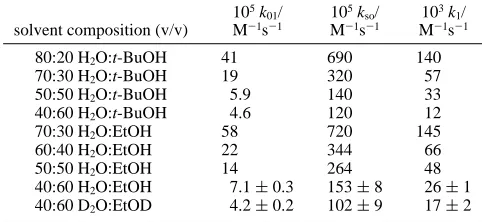
were surveyed to determine kinetic trends as a function of solvent polarity (Figure 4 and Table 2). The data in Figure 4 show that lighter alcohol cosolvents lead to higher overall rates, and the leveling off in the plots shows that the point of saturation of bicarbonate salt solubility is much higher in ethanol/water than in tert-butyl alcohol/water. In addition, a solvent deuterium
Table 1. Rate Constants and Equilibrium Constants for the Bicarbonate-Catalyzed Oxidation of Sulfides by Hydrogen Peroxidea
substrate solvent
105k 01/ M-1s-1
105k 02/ M-2s-1
105k 03/ M-3s-1
103k 1/ M-1s-1
103k 2/ M-2s-1 K
14b K15b k1/k01 ethylphenylsulfide EtOH/H2O 8.0(0.5 0.7(0.3 1.8(0.1 19(1 8.9(0.3 27(1 1.8(0.2 240
t-BuOH/H2O 2.5(0.7 0.7(0.4 0.72(0.06 11(1 2.8(0.1 23(1 n/a 440 2-chloroethylphenylsulfide EtOH/H2O 1.3(0.7 0.7(0.4 0.09(0.06 3.0(0.5c 1.6(0.2 27(1 1.8(0.2 230 2-hydroxyethylphenylsulfided EtOH/H
2O 4.3(0.7 12(1 27(1 1.8(0.2 280
aRate constants obtained from nonlinear regression analyses of kinetic data (25°C). Solvent is 1.76:1 v:v alcohol/water. Rate constants for the
background oxidation in the absence of bicarbonate (k01, k02, k03) were obtained from eq 5. Constants for the catalytic pathways (k1and k2) were derived from nonlinear fits to eq 20. Error limits are(standard errors from the fits.bEquilibrium constants for eqs 14 and 15 as determined from
replicate NMR measurements described in the text. These values used in fits via eq 20.cDetermined from fits to data at low [H
2O2].dKinetic data only obtained at low [H2O2] (<1 M); only k01and k1could be determined.
Figure 3. Plot of observed rate constants for H2O2oxidation of EPS in 1.76:1 (v/v) tert-butyl alcohol/water as a function of [H2O2] at 25 °C. The solid line is a fit to eq 5 (i.e., a cubic polynomial) with the rate constants given in Table 1. The contributions of the first-, second-, and third-order terms are illustrated. An attempt at fitting the data with a version of eq 5 truncated at second order (i.e., a quadratic polynomial) is shown as the dotted line.
-d[RSR′]
dt ){k01[H2O2]+k02[H2O2] 2+
k03[H2O2]3}[RSR′] (5)
-d[RSR′]
dt )
{a[H2O2]+b[H2O2]2}d[HCO3-][RSR′] c+d[H2O2] )
[image:4.612.320.557.181.347.2]isotope effect for the catalytic pathway (1.50(0.15 at the 95% confidence level) was measured for C2H5OD/D2O solvent.
Kinetic data are listed in Table 2 for various alcohol/water ratios and the isotope effects. The solvent isotope effect was deter-mined in C2H5OD/D2O to be 1.69(0.14 for the background
reaction, that is, direct oxidation of EPS by H2O2(Table 2). Activation Parameters for Ethylphenylsulfide Oxidation.
The temperature dependence of the catalytic EPS oxidation from 15 to 35°C was studied in tert-butyl alcohol/water (1.76:1, v/v) with 0.1 M H2O2and up to 0.05 M bicarbonate. The
second-order rate constant (after correction for background oxidation) was used to construct an Eyring plot of ln(k1/T) vs 1/T, and
activation parameters were derived (thermodynamics of pre-equilibria are not included in the parameters; k1is defined in
the Discussion). From a regression analysis,∆Hq)38(1 kJ mol-1and∆Sq) -154(4 J mol-1K-1(errors are standard
errors, N)6). An Eyring analysis of the background data for direct H2O2oxidation led to∆Hq)55(5 kJ mol-1and∆Sq
) -145(17 J mol-1K-1.
Oxidation of Other Sulfides. Kinetic parameters for two
other sulfides, 2-chloroethylphenylsulfide (CEPS) and 2-hy-droxyethylphenylsulfide, are given in Table 1. The latter compound forms slowly from CEPS in aqueous solution (t1/2
≈ 96 h under our conditions). The oxidation of CEPS was studied under conditions in which the hydrolysis was negligible during data collection.
Discussion
Kinetics and Thermodynamics of Peroxymonocarbonate Formation. The equilibrium constant for eq 2 is near unity and
shows that HCO4-is a potent oxidant in aqueous solution with
an electrode potential (1.8 (0.1 V vs NHE) close to that of H2O2. The acceleration of oxidation reactions upon formation
of HCO4- from H2O2 and HCO3- arises from a kinetic
advantage for the oxidation by HCO4-that is not derived from
an increase in thermodynamic driving force.
The activation of H2O2for synthetic transformations
proceed-ing via heterolytic oxidation is typically achieved through the formation of peroxyacids, which are generally several orders of magnitude more reactive toward nucleophilic substrates than H2O2itself.3Generation of peroxyacids from acids and H2O2
in situ is usually catalyzed by added strong acids for practical reasons. For example, the equilibration of acetic acid and H2O2
to form peracetic acid has a forward rate constant of∼10-7
M-1s-1in the absence of catalyst,34and the peroxyacid is often
prepared by addition of sulfuric acid as catalyst. In view of such slow peroxyacid equilibration in the absence of catalyst, it is perhaps unexpected that the bicarbonate ion accelerates oxida-tions of sulfides via the equilibrium of eq 1, where peroxy-monocarbonate is formed in a few minutes at pH≈7-9 with no acid catalyst added.
The reaction of eq 1 was studied by Griffith and co-workers by NMR,16and they also noted that the equilibration of HCO
4
-is complete within several minutes in water. Drago and co-workers5,35report comparable studies in mixed alcohol/water
solvents in which the equilibration is completed in minutes. Our kinetic results confirm the previous observations and provide rate constants for the forward and reverse reactions of the equilibria at pH)7.4.
The kinetic study was done to provide more details that might lead to a mechanism for the relatively rapid equilibration of eq 1. On the basis of the known chemistry of bicarbonate ion and hydrogen peroxide, it is likely that CO2 and/or HO2- are
involved. A role for CO2 seems probable in view of the
dehydration/hydration chemistry36 of HCO
3- solutions. The
mechanism of Scheme 1 can be constructed to account for the observations. The kinetic and equilibrium parameters for eqs 7 and 8 are well-known.36Equation 7 and presumably eq 10 can
be treated as rapid proton-transfer equilibria. The reaction of eq 9 is the perhydration analogue of the hydration reaction (reverse of eq 8). At sufficiently low pH (e8), the rate of formation of CO2via eqs 7 and 8 (k8≈20 s-1) is sufficiently
rapid to explain the observed equilibration rate of eq 1 (i.e, the sum of eqs 7-10). The assumptions of this analysis are that peroxycarbonic acid decomposition (reverse of eq 9) has kinetic parameters comparable to the analogous reaction for carbonic acid and the pKafor percarbonic acid (eq 10) is estimated by
that for carbonic acid (pKa)3.8).
It is notable that the rate constant for equilibration of the carbonate ethyl ester EtCO3-(1.4×10⁻³s-1) is similar to that (34) Schneider, H.-J.; Becker, N.; Philippi, K. Chem. Ber. 1981, 114, 1562-1566.
(35) Frank, K. M.; Drago, R. S., unpublished work.
[image:5.612.72.280.49.222.2](36) Palmer, D. A.; Van Eldik, R. Chem. ReV. 1983, 83, 651-731. Figure 4. Variation of observed first-order rate constants for EPS
oxidation for different alcohol cosolvents (1.76:1 alcohol:water, v/v). Reaction conditions: 25 °C, 2.0 M H2O2. For the glycol-ethanol cosolvent, the alcohol was 1:1 ethanol:propylene glycol (v/v).
Table 2. Dependence of EPS BAP Oxidation Rates on Solvent Compositiona
solvent composition (v/v)
105k 01/ M-1s-1
105k so/ M-1s-1
103k 1/ M-1s-1
80:20 H2O:t-BuOH 41 690 140 70:30 H2O:t-BuOH 19 320 57 50:50 H2O:t-BuOH 5.9 140 33 40:60 H2O:t-BuOH 4.6 120 12 70:30 H2O:EtOH 58 720 145 60:40 H2O:EtOH 22 344 66 50:50 H2O:EtOH 14 264 48 40:60 H2O:EtOH 7.1(0.3 153(8 26(1 40:60 D2O:EtOD 4.2(0.2 102(9 17(2
aEstimated standard errors on rate constants(20% except where
noted. Errors shown in last two entries are 95% confidence levels. The
k1values are derived from ksovalues from eq 23 assuming that k2[H2O2] is negligible. Conditions: 25°C, [H2O2])0.1 M, [HCO3-])0-0.05 M.
Scheme 1
[image:5.612.53.294.294.405.2]for the formation of HCO4- (3.0 × 10⁻³ s-1) under the
conditions of the NMR study. This result is consistent with a common reactive intermediate, and ester formation probably proceeds via eqs 7 and 8 followed by the reaction CO2+EtOH
fHEtCO3by analogy to the dehydration/hydration mechanism
for carbonic acid. Thus, it is likely that eq 9 accounts for the initial formation of peroxycarbonic acid.
The effect of added CO2 on the reaction of eq 1 was
investigated. The pH of the solution is reduced to∼6 by addition of CO2because of the formation of a carbonic acid/bicarbonate
buffer. We observed that the equilibration rate for H13CO 3-/
H13CO
4- is increased in solutions that are partially saturated
by CO2, and this result supports the role of the acid-dependent
reaction of eq 7 in the overall equilibration mechanism. The explanation for the rapid, pH-dependent exchange detected in the variable temperature NMR studies is not obvious. It may be associated with the exchange of eq 11 (i.e., sum of the reverse reactions of eqs 9 and 10).
However, if the exchange reaction of eq 11 is responsible for the line-broadening, the forward and reverse reactions for de-perhydration/perhydration (eq 9) must be substantially faster than dehydration/hydration (eq 8), and such a large rate difference seems unlikely. In more basic media (pH≈9), the line width for the H13CO
4-resonance is comparable to that of
H13CO
3-, consistent with a proton-dependent exchange.
At higher pH values (>8), the rate of carbonic acid formed via eqs 7 and 8 is probably too low to explain the equilibration rate for eq 1. However, the highly nucleophilic hydroperoxide ion becomes more available at higher pH values via eq 12 of Scheme 2 and may account for the formation of HCO4- by
either net displacement at bicarbonate (eq 13a) or carbonic acid (eq 13b).
General Mechanism for Heterolytic Oxidations by Per-oxides. The generally accepted mechanism of heterolytic
peroxide oxidation reactions is considered here to guide our mechanistic analysis of HCO4-oxidations (Scheme 3).37
The mechanism involves nucleophilic attack of substrate at the electrophilic oxygen of YOOH with displacement of the leaving group OY-. In the case of protic solvents (“AH”) such as water and alcohols, proton transfers can lead to displacement of YOH and immediate formation of NuO. As a consequence, peroxide oxidations tend to accelerate as the acidity of the solvent increases (as measured by the pKaor autodissociation
constant).38In aprotic solvents, the catalytic role can be played
by hydrogen peroxide itself, and the oxidations become second order in H2O2under such conditions.38
Many oxidants can be used to convert sulfides into sulfoxides and sulfones.12The oxidations of sulfides by two other anionic,
main group peroxides, peroxymonosulfate (HSO5-)39 and
periodate (IO4-),33 are particularly useful for comparison to
HCO4-reactions. Both are believed to react via a nucleophilic
attack of the substrate at oxygen, but the role of proton transfer from solvent in the transition state is apparently small in view of modest solvent deuterium isotope effects. Reactions of both oxidants with sulfides are accelerated by increasing solvent
polarity, and this has been interpreted to be a consequence of significant charge separation in the SN2 transition states
(“normal” anion-neutral SN2 displacements are slower in more
polar solvents as a result of charge delocalization in the transition state compared to the reactants).
Mechanism for Oxidation of Sulfides by Hydrogen Per-oxide. At low H2O2concentrations, the background reactions
(where H2O2is the only oxidant) are first order in H2O2, but at
the higher concentrations used in this study, the data are better fit by the empirical rate law of eq 5. We interpret the second-order term as the result of an autocatalyzed oxidation, wherein a second peroxide assists the displacement reaction by general acid catalysis. This explanation parallels that given by Edwards and co-workers for the appearance of a second-order term in H2O2for sulfide oxidations in the aprotic solvent dioxane.38In
our case, the high [H2O2] coupled with the higher acidity of
H2O2 (pKa ) 11.7) vs H2O (pKa ) 15.7) and alcohols (pKa
>15) makes hydrogen peroxide the most potent acid catalyst in the system, and the second-order term appears even in mixed water/alcohol at high peroxide concentrations.
The appearance of a third-order term for H2O2 in eq 5 is
required to achieve an acceptable empirical fit for the direct reaction with sulfides (Figure 3), but the origin of the term is not easily rationalized and the deviation from a fit to first and second order only is small. It could represent a transition state that involves two hydrogen peroxides acting in general acid -base catalysis proton transfer, but the apparent increase in order at high concentrations could also result from medium effects as the H2O2 concentration displaces solvent alcohol and
increases the polarity of the solvent. Experiments maintaining a constant concentration of alcohol while holding the sum of water and peroxide concentrations constant show small decreases in rate (<10%) at the highest peroxide concentrations. The similarity of water and hydrogen peroxide/water mixtures in their macroscopic physical properties40should be noted in this
regard.
We also determined the activation parameters for H2O2
oxidation (k01) of EPS in tert-butyl alcohol/water in the range
15-35°C (∆Hq)55(5 kJ mol-1and∆Sq) -145(17 J mol-1K-1), and these values can be compared with those in
the literature for thioxane as a substrate in dioxane (∆Hq)78 kJ mol-1and∆Sq) -92 J mol-1K-1).38
Mechanism for Bicarbonate-Catalyzed Oxidation of Sul-fides. The empirical rate law of eq 6 is consistent with the
(37) Edwards, J. O. In Peroxide Reaction Mechanisms; Edwards, J. O., Ed.; Interscience: New York, 1962; pp 67-106.
(38) Dankleff, M. A. P.; Curci, R.; Edwards, J. O.; Pyun, H. Y. J. Am.
Chem. Soc. 1968, 90, 3209-3218.
(39) Bunton, C. A.; Foroudian H, J.; Kumar, A. J. Chem. Soc., Perkin
Trans. 2 1995, 33-39.
(40) Kolczynski, J. R.; Roth, E. M.; Shanley, E. S. J. Am. Chem. Soc.
1957, 79, 531-533.
HCO4-+H+hCO2+H2O2 (11)
Scheme 2
mechanism of eqs 14-18. Equations 14 and 15
are preequilibria that are assumed here to be rapid on the time scale of the subsequent reactions, and the values of K14 and
K15 are obtained from the 13C NMR data. The rate of
disappearance of substrate is given by eq 19, where [HCO4-]
is the concentration of peroxymonocarbonate at equilibrium.
The initial concentration of bicarbonate is related to its equilibrium forms by [HCO3-]0 ) [HCO3-] + [HCO4-] +
[R′′CO3-]. Assuming that the initial concentrations [R′′OH]0,
[H2O]0, [H2O2]0.[HCO3-]0and [H2O2]0.[RSR′], the rate
law in eq 20 is obtained from eqs 14-17 and eq 19.
The observed pseudo-first-order rate constants correspond to kobs. At low peroxide concentration such that K14[H2O2]0,
[H2O]0+K15[R′′OH]0and k2[H2O2]0,k1, eq 21 applies and
the reaction is first order in hydrogen peroxide.
It is apparent that the kinetic complexity can be reduced by going to low peroxide concentrations, but we also chose to study high concentrations of H2O2in view of the potential applications
of the BAP system in rapid oxidation of organic substrates for synthetic and decontamination applications. At high peroxide concentration such that K14[H2O2].[H2O]0+ K15[R′′OH],
eq 22 applies, and the reaction depends on hydrogen peroxide
only via the k2pathway. This latter limit is not generally attained
even with [H2O2])5 M, however, and the full rate law of eq
20 was used to fit the data.
Comparison of the empirical rate law, eq 6, to eq 20 requires that k1)a, k2)b, [H2O]0+K15[ROH]0)c, and K14)d.
Values for k1and k2were obtained from nonlinear regression
analysis of the parameters in eq 20 (with K14and K15fixed by
the NMR results above) and are given in Table 1 for various solvents and substrates. The term K15[R′′OH] in eq 20 arises
from ester formation (eq 15) and therefore is not included in
the fits for tert-butyl alcohol/water solvent where ester formation is not observed by NMR. Data for low [H2O2] were used to
establish the value of k1in all cases (via eq 21), and the resulting
values compare favorably with the tabulated k1values from the
full fits. (CEPS is an exception, and the tabulated k1is derived
from low [H2O2] data.) A graphical display of the complete fit
is not possible since [H2O] varies along with [HCO3-], [R′′OH]
and [H2O2] in our experimental design. However, the variations
of [H2O] and [R′′OH] are relatively small ((10%), and good
fits can be obtained by using the average value for the concentration of water and ethanol (Figure 5 shows such a fit for tert-butyl alcohol/water).
From plots of kobsvs [HCO3-] at fixed [H2O2], second-order
rate constants, kso, can be determined, and from eq 20 they are
interpreted by eq 23.
A plot of experimental ksovalues vs [H2O2] can be produced
(Figure 6). Assuming that water is constant at an average value, a fit to eq 23 can be done, and, as expected, the resulting rate constants are essentially unchanged from those in Table 1. The contributions of the k1and k2steps can be obtained by separating
eq 23 into two terms and are illustrated in Figure 6. The two paths make roughly equal contributions at [H2O2])3.5 M for
the example shown. At low H2O2concentrations the k1 path
dominates.
In tert-butyl alcohol/water at low [H2O2] a reciprocal plot
equation can be obtained from eq 24, which is derived from eq 23 assuming k2[H2O2],k1and noting that the K15term is not
applicable.
From the slope and intercept of a plot of 1/ksovs [H2O]/[H2O2],
the value of k1(0.010(0.003 M-1s-1) and a kinetic value for
[image:7.612.326.550.53.246.2]the equilibrium constant K14 (25 ( 7) are obtained. The Figure 5. A 3D plot of the fit of eq 20 (mesh plot) to the observed
catalytic first-order rate constants kobs(b) as a function of [H2O2] and [HCO3-] ([H2O])19 M, [t-BuOH])10.3 M for this fit). The data are for the oxidation of EPS in tert-butyl alcohol/water (1.76:1, v/v) at 25°C.
HCO3-+H2O2hHCO4 -+
H2O K14 (14)
HCO3-+R′′OHhR′′CO3-+H2O K15 (15)
HCO4-+RSR′fRS(O)R′+HCO3-k1 (16)
HCO4-+RSR′+H2O2f
RS(O)R′+HCO3-+H2O2k2 (17)
RS(O)R′+[O]fRS(O)2R′ (18)
-d[RSR′]
dt )(k1+k2[H2O2])[HCO4
-][RSR′] (19)
-d[RSR′]
dt )
(k1+k2[H2O2]0)K14[H2O2]0[HCO3-]0[RSR′]
[H2O]0+K14[H2O2]0+K15[R′′OH]0
)
kobs[RSR′] (20)
-d[RSR′]
dt )
k1K14[H2O2]0[HCO3-]0[RSR′]
[H2O]0+K15[R′′OH]0 (21)
-d[RSR′]
dt )(k1+k2[H2O2]0)[HCO3
-]0[RSR′] (22)
kso) (k1
+k
2[H2O2]0)K14[H2O2]0
[H2O]0+K14[H2O2]0+K15[R′′OH]0 (23)
1 kso)
[H2O]0
k1K14[H2O2]0+ 1
k1 (24)
agreement between the NMR (27(1) and kinetic values of K14provides further support for the proposed mechanism.
Activation parameters for the k1pathway were obtained in
the temperature range 15-35 °C in tert-butyl alcohol/water (∆Hq)38(1 kJ mol-1and∆Sq) -154(4 J mol-1K-1)
and can be compared to those for other anionic oxidants such as IO4-and HSO5-. In all cases including HCO4-the entropy
values are strongly negative as expected for a bimolecular reaction (e.g., IO4-oxidation of methylphenylsulfide in 1:1 (v/
v) ethanol/water: ∆Hq)47(1 kJ mol-1and∆Sq) -113( 4 J mol-1 K-1 by reanalysis of published data;33 HSO
5
-oxidation of methylphenylsulfide in water:∆Hq)17 (1 kJ mol-1 and∆Sq ) -132 ( 1 J mol-1 K-1 by reanalysis of
published data39). For the oxidants IO
4-and HSO5-, variation
in rate constants for different sulfides primarily arises from changes in ∆Hq.33,39 The kinetic advantage of HSO
5- over
HCO4-can be traced primarily to the much lower∆Hqvalues
for oxidations by HSO5-.
A molecular interpretation of the catalytic mechanism (eqs 14, 16, and 17) is shown in Figure 7. The k1path (eq 16) is
interpreted as a solvent-assisted oxidation in which alcohol and water (R) alkyl, H) serve as proton donors to facilitate the displacement of carbonate from HCO4-. Note that the proton
transfer from ROH is assumed to be to the carboxylate oxygen of HCO4-, which is clearly the most basic site on the oxidant
(pKa(H2CO4)≈ 4 by analogy to H2CO3). In contrast, proton
transfer to the leaving group is assumed in Scheme 3 to be at the oxygen R to the electrophilic oxygen attacked by the substrate nucleophile, but in a typical peroxide YOOH another basic site is not available on the leaving group. In addition, k1
contains any contributions from the direct, unassisted displace-ment of carbonate ion from HCO4-. The k2path (eq 17) has an
additional H2O2 in the transition state and predominates at
[H2O2]>4 M. It is proposed to be essentially the k1path in
Figure 7 with R) OH. The k2pathway presumably appears
even though [H2O2]<[R′′OH], [H2O] since the acidity of H2O2
is significantly higher than that of alcohol or water.41
An intimate role for solvent proton transfer as shown in Figure 7 is consistent with the solvent kinetic isotope effect of 1.5 found for ethanol/water solutions (Table 2). The rather low value for kH/kD is consistent with an early transition state for proton
transfer from a solvent-OH group and is expected given the significant pKadifference between the leaving group (HCO3-,
pKa)10.3) and the solvent (ROH (R)H, Et), pKa≈15-16).
The value of kH/kDis the same for both the observed
second-order rate constants (kso) and the derived values of k1(from eq
23) since the values of K14and K15in the deuterated solvent
mixture were determined to be within experimental error of those in undeuterated ethanol/water. Therefore, the observed isotope effect is associated primarily with the proposed rate determining step (eq 16) rather than the prequilibria. A similar solvent isotope effect has been reported for the oxidation of thioxane by H2O2in water (kH/kD)1.68), for which solvent
assistance via the mechanism of Scheme 3 was proposed.38In
our study, a comparable kH/kDvalue of 1.7(0.1 was determined
for the background reaction, that is, direct oxidation of EPS by H2O2(Table 2).
A comparison of the second-order rate constants k01and k1
can also be used to support the proposed mechanism, and the ratios of these rate constants are given in Table 1. For a given substrate oxidation, the second-order rate constant for HCO4
-is an average of ∼300 times larger than that for H2O2. The
typical observation for peroxide and peroxyacid oxidations is that the Brønsted slope is∼0.4 for a plot of log koxvs pKa(YOH)
for halide oxidations, where YOH is the conjugate acid of the leaving group in the oxidant YOOH (Scheme 1).37A similar
analysis for sulfide oxidations by peroxyacids and peroxides produces a slope of∼0.6.42Assuming an average slope of 0.5
(0.1, comparison of the pKaof H2O (15.7) to the pKaof HCO3
-(10.3) would predict that k1for HCO4-should be a factor of
102.2-103.2 (∼160-1600) times greater than k
01, the
corre-sponding rate constant for H2O2. The experimental factor of (41) It should be noted that the inclusion of a higher order catalytic pathway is not likely a trivial result of changing polarity of the solvent at high peroxide concentrations. The kinetic experiments we have done were designed to have a constant alcohol/water ratio even at high peroxide concentrations. This means that the concentration of both water and alcohol decline in high [H2O2] experiments. We wondered if the rate increases arose from the increased polarity of the solvent assuming that H2O and H2O2are comparably polar. Experiments making [ROH] constant even at high [H2O2] showed only small catalytic rate reductions (<10%) compared to rates using the standard method.
(42) Bruice, T. C.; Noar, J. B.; Ball, S. S.; Venkataram, U. V. J. Am.
[image:8.612.328.549.47.281.2]Chem. Soc. 1983, 105, 2452-2463. Figure 6. Plot of second-order rate constants ksoat 25°C fit by eq 23
[image:8.612.57.294.49.214.2]for catalytic EPS oxidation in t-butanol/water (1.76:1, v/v) as a function of [H2O2] ([H2O])19 M, [t-BuOH])10.3 M for this fit). The separate contributions of the k1and k2paths are shown on the plot (see legend).
∼300 is within the predicted range, lending further support to the mechanism proposed in eqs 14-17.
Solvent Effects. Lower-molecular weight alcohols ROH tend
to lead to more rapid BAP reactions for two reasons. First, as a practical matter, the lower-molecular weight alcohols result in greater solubility of bicarbonate salts, so that higher catalyst concentrations can be achieved before saturation is attained (Figure 4). Second, for a given bicarbonate concentration, the smaller R groups lead to greater second-order rate constants for HCO4- oxidations. Presumably, the latter effect can be
associated with the increased acidity of ROH and the higher polarity of the lighter alcohols.
Increasing water content from 40 to 80% in tert-butyl alcohol accelerates the catalytic reaction for EPS oxidation substantially, by a factor of∼5, and a similar effect is observed for ethanol/ water reactions (Table 2). The data for ethanol/water media were fit to the Grunwald-Winstein equation43 for comparison to
solvent polarity studies done previously for IO4-oxidation of
sulfides in the same solvent.33 A plot of log k
1vs Y for the
appropriate data in Table 2 leads to m ) 0.46, which is substantially lower that the value for IO4-oxidation of
meth-ylphenylsulfide (m)0.722).33Note that the effect of varying
water content on the equilibrium reaction of eq 1 has been factored out of our analysis since k1 values are used in the
Grunwald-Winstein Y parameter fit. In addition, an overall observed rate increase with increasing water content occurs despite the shift of eq 1 to the left, which reduces the available HCO4-.
The results of the solvent polarity study imply that the transition state in the HCO4-reaction is less polarized than the
corresponding state for IO4-since Y is a measure of the solvent
stabilization of charge separation in the transition state.43The
difference may be a consequence of the participation of solvent proton transfer in the former case but not the latter. Consistent with this hypothesis, the IO4-reaction is not subject to solvent
isotope effects,33 in contrast to the results here for HCO 4-.
However, the reduced kinetic dependence on solvent polarity for HCO4-compared to IO4-could result from other
unidenti-fied mechanistic differences.
At pH values above 9, the rate of the bicarbonate catalytic pathway decreases. We tentatively ascribe this decrease to the deprotonation of HCO4-by analogy to the known pKaof HSO5
-(9.4).
Numerical Simulations. Oxidation reactions were done in
this study by preequilibrating the peroxide-bicarbonate solu-tions to allow complete equilibrium formation of HCO4-.
Generally, the sulfide oxidation reactions were assumed to be sufficiently slow that the HCO4-concentration was not
sig-nificantly depleted during the data collection. If the equilibration reaction of eq 1 is not sufficiently rapid to replenish HCO4-,
then nonlinearity would be expected in the pseudo-first-order plots. In such a case the mechanism of eqs 14-17 is inadequate, and the reaction in eq 14 would be replaced by eq 25.
The second-order rate constants kfand krhave been determined
for various solvents and are indeed not too different from the oxidation rate constants. Therefore, we have assessed the possible inadequacy of assuming the preequilibrium of eq 14 in the mechanism by doing a numerical simulation44 of a
mechanism for EPS oxidation consisting of eqs 16, 17, and 25,
substituting the estimated rate constants from the NMR study and Table 1.
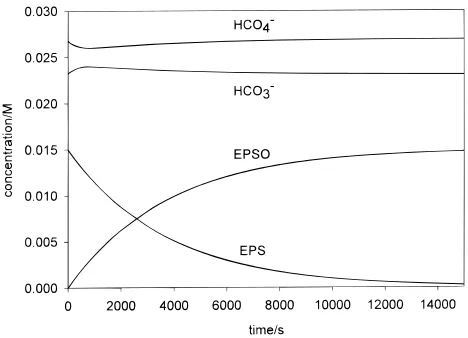
An example of a simulated concentration vs time profile is shown in Figure 8. At the reaction outset, when the substrate concentration is highest, an initial decrease does occur in the amount of HCO4-. As the substrate oxidation proceeds and the
rate of HCO4-consumption thereby decreases, the equilibrium
of eq 1 recovers. The maximum variation in [HCO4-] predicted
for the conditions and substrates used in our kinetic studies is <15% (usually much less), and the maximum error of the derived rate constants from first-order plots is<5% (this is the typical error limit for the numerical simulation of this mecha-nism and thus more precise comparisons could not be made). Insignificant nonlinearity (R2>0.999) is predicted in the
first-order ln[R2S] vs t plots due to the variations in the HCO4
-concentration during the reactions, and the experimental plots were indeed linear. It should be noted that for more nucleophilic substrates, such as dialkylsulfides, the rapid preequilibrium assumption is invalid.
Implications for Chemical Warfare Agent Decontamina-tion. Oxidation is a useful strategy for decontamination of
certain chemical warfare agents, especially mustard (HD, (ClCH2CH2)2S).10 Bicarbonate catalysis has been shown to
significantly lower the t1/2 for HD oxidation by H2O2,14 and
aqueous alcohol provides good agent and oxidant solubility characteristics. We have shown for EPS oxidation that partial replacement of ethanol by propylene glycol accelerates the reaction above that observed for aqueous ethanol as solvent (Figure 4). This observation is of interest since propylene glycol has a wide liquid temperature range and is readily applied on a large scale.
The general BAP formulation is mild and noncorrosive, making it compatible with equipment and relatively safe for human exposure. Aqueous sodium bicarbonate has a pH of 8.3, while solutions of the more soluble ammonium bicarbonate have a pH of 7.9. Upon standing, solid ammonium bicarbonate evaporates, forming CO2, NH3, and H2O. Thus, these solutions
could be used without requiring rinsing to remove residual salts
(43) Grunwald, E.; Winstein, S. J. Am. Chem. Soc. 1948, 70, 846.
(44) Numerical kinetic simulations were done with Kinetica99, a program based on the Gear integration method (D. E. Richardson, University of Florida, 1999).
HCO3-+H2O2y\z kf
kr
[image:9.612.321.555.46.215.2]HCO4-+H2O (25)
Figure 8. Numerical simulation of the oxidation of EPS by H2O2 catalyzed by HCO3-as described in eqs 16, 17, and 24. The simulation is done for tert-butyl alcohol/water so the equilibrium of eq 15 is not used. The following parameters were used: kf)1.6×10⁻³M-1s-1, kr)7.1×10⁻⁵M-1s-1, k1)0.010 M-1s-1, k2)0.00295 M-1s-1, [HCO3-]0)0.0232 M, [HCO4-]0)0.0268 M, [H2O2]0)1.0 M, and [EPS]0)0.015 M.
(however, the ammonium salt has low storage stability). Stable sources of peroxide equivalents are available in solid inorganic peroxides.45
The reactivity of mustard (HD) is typically between that of EPS and 2-chloroethylphenylsulfide (CEPS);46thus, we
exam-ined the oxidation of the latter compound for comparison. The rate constants for background oxidation and the catalytic oxidation of CEPS in ethanol/water are generally a factor of ∼5 lower than those for EPS (Table 1). Some difficulty in obtaining data for CEPS at very low [H2O2] values arose from
the observed hydrolysis of the substrate to form 2-hydroxyeth-ylphenylsulfide (t1/2 )4 days at 25 °C). We determined the
oxidation kinetics for the latter compound (Table 1) and found it was oxidized∼4-fold more rapidly than CEPS. Therefore, kinetic data for CEPS were obtained only under conditions where its hydrolysis was minimal during the data collection. It has also been reported that the BAP system is effective for rapid decontamination of other agents that can be decom-posed by perhydrolysis, such as VX.14Apparently the weakly
alkaline BAP system has sufficient concentration of the strong nucleophile HO2-at equilibrium to decompose these substrates
efficiently.
Synthetic Implications. The BAP system provides a
con-venient, high-oxygen efficiency method for the conversion of sulfides to sulfoxides and sulfones. The inexpensive reagents are nominally nontoxic, and organic products can be readily separated. Typical accelerations of 2 orders of magnitude and more for the oxidations can be obtained at moderate bicarbonate and H2O2concentrations. For example, with 1 M H2O2and 1
M HCO3-, the catalytic pathway for EPS oxidation is predicted
from the data in Table 1 and eqs 6 and 20 to be 190 times faster (t1/2)94 s) than the direct H2O2oxidation (t1/2)4.9 h)
under the conditions of our t-BuOH/water reactions.
In general, we have observed that rates of oxidation by HCO4- increase with increasing water content and lighter
alcohols as cosolvent (Table 2), and bicarbonate salts have greater solubility in the more polar solvents. Thus, maximizing water in the reaction medium is helpful, at least to the point where solubility limits of the substrate are reached. In addition, alkylated ammonium cations (RNH3+) can also be used to
increase solubility of the catalyst in less polar media.7
We have also demonstrated that the BAP system is useful for the epoxidation of alkenes.15Thus, the strong acceleration
seen in our sulfide kinetics is likely to be found for other substrates, and we have begun a systematic investigation of the synthetic utility of the BAP system in biphasic and monophasic reactions.
Comparison of Bicarbonate to CH3ReO3 in Peroxide Activation. CH3ReO3(MTO) is a well-studied example of a
transition-metal peroxide activation catalyst, and the kinetics of the catalytic oxidation of sulfides by H2O2 have been
investigated by Espenson and co-workers.47Useful comparisons
to the present bicarbonate system can be made that illustrate the advantages and disadvantages of the latter. In many respects, the MTO and bicarbonate systems are similar mechanistically. Both feature formation of a peroxy species by initial reaction with H2O2(in the case of MTO, both CH3Re(H2O)(O)2(O2) and
CH3Re(H2O)(O)(O2)2are formed), and these species then act
as electrophiles in direct reactions with substrate. The equilib-rium constants are somewhat larger for MTO in the
peroxide-forming reactions analogous to eq 1.48In addition, the
second-order rate constants for the reaction of the intermediate peroxy species with substrate are much higher for the MTO case (e.g., k ) 2700 M-1 s-1 for methylphenylsulfide oxidation by
CH3Re(H2O)(O)2(O2) in 1:1 acetonitrile/water at 25°C; compare
to k1≈0.05 M-1s-1for EPS oxidation (eq 16) in 1:1 ethanol/
water here). However, the bicarbonate system has the advantage of being stable and functional at neutral pH, while the MTO peroxides decompose with a half-life of<100 s at pH 7.48 Conclusions
We have shown that bicarbonate ion is an effective activator for hydrogen peroxide in the oxidation of sulfides. The kinetic and spectroscopic results strongly support the formation of peroxymonocarbonate as the oxidant in the catalytic reactions. The reaction of hydrogen peroxide and bicarbonate to form peroxymonocarbonate proceeds rapidly near neutral pH in aqueous solution and alcohol/water mixtures. An equilibrium analysis allows estimation of the electrode potential for the HCO4-/HCO3-couple.
Solubility of the bicarbonate catalyst is enhanced by use of NH4HCO3 rather than group 1 salts, which tend to have low
solubility in the mixed solvents and can lead to phase separation. The second-order rate constants for sulfide oxidations by peroxymonocarbonate are ∼300-fold greater than those for hydrogen peroxide, and this increase is consistent with expecta-tions based on a Brønsted analysis of the kinetics for other heterolytic peroxide oxidations. At high concentrations of H2O2
(>1 M), a significant pathway that is second order in H2O2is
observed, and this path is interpreted as a general acid catalysis of carbonate displacement by the substrate attack at the electrophilic oxygen of HCO4-.
The BAP oxidation system is a simple, inexpensive, and relatively nontoxic alternative to other oxidants, and our experiments indicate that it may have use in a variety of oxidations where a mild, neutral pH oxidant is required. Variation of bicarbonate source and the alcohol cosolvent can allow optimization of substrate solubility and oxidation rates for applications such as organic synthesis and chemical warfare agent decontamination. The lower intrinsic reactivity of HCO4
-compared to other peroxyacids and metal catalyst systems, such as MTO/H2O2, can be compensated by significantly increasing
the concentration of the inexpensive bicarbonate activator. Finally, the potential role of peroxymonocarbonate ion as a reactive oxygen species in biology is worthy of further investigation in view of the kinetic and mechanistic results of this study. Given the complexity of biochemical media, the results here argue for a more detailed examination of HCO4
-formation under typical biochemical conditions and its oxidation of substrates such as amino acids and proteins. Clearly, the heterolytic oxidation of methionine to methionine sulfoxide is a likely process for study, and we have observed bicarbonate-catalyzed oxidation of methionine by peroxide.27Further studies
of this type are underway in our laboratory.
Experimental Section
Materials. Sulfides (Aldrich), hydrogen peroxide (35%, Aldrich), propylene glycol (Fisher), tert-butyl alcohol (Fisher), 2-propanol (Fisher), and ethanol (AAPER), all reagent grade, were used without further purification. High purity sodium bicarbonate (99.99+%, Aldrich) was used to minimize metal contamination. Ammonium bicarbonate (Mallinckrodt), potassium bicarbonate (Mallinckrodt), potassium
car-(45) Comyns, A. E. In Kirk-Othmer Encyclopedia of Chemical
Technol-ogy; Kroschwitz, J. I., Ed.; Wiley-Interscience: New York, 1997; Vol. 18,
pp 202-229.
(46) Wagner, G. W., personal communication.
(47) Vassell, K. A.; Espenson, J. H. Inorg. Chem. 1994, 33, 5491-5498.
bonate (Baker), analytical reagent, were used as received. The buffer components ammonium dibasic phosphate (Sigma), potassium monoba-sic phosphate (Fisher), potassium dibamonoba-sic phosphate (Mallinckrodt), and potassium chloride (Fisher), also analytical quality, were used without further purification. High purity diethylene-triaminepentaacetic acid (DTPA) was obtained from Sigma. For13C NMR studies, 99%13 C-enriched sodium bicarbonate and 99.9% D2O (Cambridge Isotope Laboratories, Inc.) and 99%13C-enriched K
2CO3(Aldrich) were used. Water was purified using a Barnstead Nanopure system.
Kinetics. Alcohol/water solutions of hydrogen peroxide with bicarbonate catalyst were prepared 20-30 min prior to mixing with sulfide substrate to ensure the preequilibration of peroxymonocarbonate formation for each kinetic run. Oxidations of sulfides with hydrogen peroxide in large excess over the sulfide were followed spectrophoto-metrically with Hewlett-Packer 8453 single-cell or multicell spectrom-eters with a temperature control of(0.1°C. Typically, the concentration of hydrogen peroxide was at least 60-fold over that of the sulfide. Oxidation of sulfides was generally followed by the decreasing absorbance of atλ)296 nm. Variation of the sulfide concentration by a factor of up to 5 did not affect the rate constants. Due to the absorbance of hydrogen peroxide atλ≈290-300 nm, cells with shorter optical paths, for example, 0.2 or 0.1 cm, were used for kinetic measurements in 1-5 M hydrogen peroxide solutions.
The concentration of hydrogen peroxide ranged from 0.04 to 5 M in alcohol/water (1.76:1, v:v) binary solvents, and the stock solution of hydrogen peroxide (35%) was regularly standardized iodometrically. Although the ionic strength of the reaction media did not have a significant effect on rate constants at low concentration of bicarbonate salts, kinetic measurements in ethanol/water with ammonium bicarbon-ate (0-0.05 M) were obtained employing ammonium dibasic phosphate buffer with the total ionic strength maintained at 0.05 in all experiments. The pH range of the corresponding aqueous media with 0.04-5 M hydrogen peroxide was from 7.9 to 7.3 ((0.1), determined by using either an Orion Research Digital pH/Millivolt Meter 611 or a Fisher AB15 pH Meter.
A pH dependence study on rate constants was performed in ethanol/ water solutions of 2 M hydrogen peroxide with a total concentration of 0.05 M potassium bicarbonate/carbonate catalyst, and ionic strength was maintained at 0.12(0.03 (0.05 M potassium carbonate) by the addition of potassium chloride. The pH of the corresponding aqueous media (no alcohol added) of the above solutions ranged from 7.3 (0.05 M potassium bicarbonate) to 9.4 (0.05 M potassium carbonate). Similarly, rate constants of the uncatalyzed oxidation reactions in 2 M hydrogen peroxide solution with the corresponding pH range were measured in potassium phosphate monobasic/dibasic buffer solutions at a total ionic strength 0.1.
In most cases, the oxidations were followed up to 3 half-lives with 30-40 data points, and the absorbance changes were>0.3. In a few cases, the reactions were extremely slow due to a low concentration of hydrogen peroxide and little or no catalyst, data were taken for 0.5-2
half-lives. For kinetic measurements in propylene glycol/ethanol/water solution, minimal ethylphenylsulfide was added due to its poor solubility in the alkaline solution containing glycol, and the change of the absorbance was about 0.1-0.2. Overall, plots of ln A vs time were consistently linear for 3 half-lives with R2>0.999 in most cases.
Equilibria.13C NMR spectral measurements were carried out on a Gemini 300 MHz or a VXR 300 MHz NMR instrument to obtain the kinetic parameters and equilibrium constants for eq 1 in water, ethanol/ water and tert-butyl alcohol/water media at 25 ( 0.1 °C. Sample solutions were prepared as described for the kinetic studies, except that 10% of H2O was replaced by D2O. The three components, hydrogen peroxide stock solution, aqueous solution of 99%13C-enriched sodium bicarbonate, and alcohol were mixed and injected in an NMR tube immediately before each measurement. Variation of delay parameter d1 from 5 to 15 s gave similar integral ratios for peaks assigned to HCO3-, HCO4-, and EtOCO2-in ethanol/water solution, indicating that relaxation times of these species are not appreciably different. Acceptable13C NMR spectra were generally obtained with d1)10 s and 16 acquisitions. The spectra were recorded periodically for 30 -40 min automatically. The concentration of hydrogen peroxide varied from 0.2 to 4 M. In most cases, 0.1 M13C-enriched sodium bicarbonate was used. Concentrations of sodium bicarbonate<0.05 M decreases the signal/noise level of spectra for obtaining kinetic parameters unacceptably. Higher concentration of the bicarbonate salt usually resulted in difficulty shimming on the instrument due to high ionic strength of the solution.
The rates of the formation of HCO4-and EtOCO2-were analyzed by the increasing of intensities of these signals using the kini program in the Varian VNMR Software. The equilibrium constants were calculated from the integrated intensity ratios of HCO3-and HCO4 -or HCO3-and EtOCO2-. For solutions of 2 M hydrogen peroxide, three duplicate runs were carried out to obtain calculated values for equilibration rate constants and equilibrium constants. Variable-temperature13C NMR studies from-20 to 50°C in ethanol/water with 2 M hydrogen peroxide were performed.
Products. The reaction products of sulfide oxidation in the presence of large excess of hydrogen peroxide were examined on a Hewlett-Packard 5890 series II gas chromatography instrument with chloroben-zene as internal standard.
Acknowledgment. This paper is dedicated to the late Russell
S. Drago, our friend and colleague who first recognized the potential applications of the chemistry described here. The research was supported by a grant from the Army Research Office and the ECBC (ARO 37580-CH-2). Helpful discussions with Y.-C. Yang, G. Wagner, and J. Espenson are gratefully acknowledged.
JA9927467
![Figure 1.13C NMR spectra for a solution at 25 °C of NaH13CO3 in1.76:1 (v/v) ethanol/water with [H2O2] ) 2.0 M](https://thumb-us.123doks.com/thumbv2/123dok_us/1486827.688678/3.612.349.527.49.200/figure-nmr-spectra-solution-nah-co-ethanol-water.webp)

![Figure 5. A 3D plot of the fit of eq 20 (mesh plot) to the observedcatalytic first-order rate constants kobs (b) as a function of [H2O2] and[HCO3-] ([H2O] )19 M, [t-BuOH] ) 10.3 M for this fit)](https://thumb-us.123doks.com/thumbv2/123dok_us/1486827.688678/7.612.326.550.53.246/figure-mesh-plot-observedcatalytic-order-constants-function-buoh.webp)
![Figure 6. Plot of second-order rate constants kso at 25 °C fit by eq 23for catalytic EPS oxidation in t-butanol/water (1.76:1, v/v) as a functionof [H2O2] ([H2O] ) 19 M, [t-BuOH] ) 10.3 M for this fit)](https://thumb-us.123doks.com/thumbv2/123dok_us/1486827.688678/8.612.328.549.47.281/figure-plot-second-constants-catalytic-oxidation-butanol-functionof.webp)