A Hybrid Evaluation Framework of CMM and COBIT for
Improving the Software Development Quality
Amin Amid1,2, Somaye Moradi1,3
1
Industrial Engineering Department, Tehran North Branch Islamic Azad University, Tehran, Iran; 2Ryerson University, Toronto, Canada; 3Informatics Services Corporation (ISC), Tehran, Iran.
Email: [email protected]
Received December 17th, 2012; revised January 16th, 2013; accepted January 24th, 2013
Copyright © 2013 Amin Amid, Somaye Moradi. This is an open access article distributed under the Creative Commons Attribution License, which permits unrestricted use, distribution, and reproduction in any medium, provided the original work is properly cited.
ABSTRACT
It is essential to study quality of software production like others. Software productions have special properties. They are intangible. So, qualitative evaluation encountered with complexity. Hence, proposing a model in order to evaluate the quality of Software productions is considerable to most software managers and experts. In this paper, regarding to im- prove software productions quality, the process of software production has been determined, using CMM standard framework of maturity level. In CMM it does not present a method for measurement and evaluation maturity level, the presented process in CMM standard mapped by COBIT control objectives has been combined in the process of software productions development in developed hybrid framework. In this research, the processes have been mapped utilizing fo- cus and established group, in parallel of software production in different maturity level of CMM mapped by COBIT framework. In order to show the capabilities of proposed framework, the hybrid evaluation model was employed in a software developing organization as a case study. According to the results of evaluation, improvements proceedings and action plans have been proposed and discussed to enhance the software production processes.
Keywords: CMM; COBIT; Software Quality; Maturity Level; Control Objectives
1. Introduction
Software developers try to analyze business environment using diverse analysis and design methods.
Even in some cases, analysts improve processes before designing and implementing software, and then propose a logic model and required documents for software pro- ducers.
They try hard to produce software according to the customer’s needs and in this aspect, improve the quality of their software. Software producers, also try to deliver their projects to the customers on time using estimated time, cost and HR models, in regard to improve the qual- ity of their software.
Many researchers and experts believe that delay in de- livering projects results from incorrect estimation in re- quired resources, such as time and cost. Another factor leads to delay, is the lack of coordination in related sec- tors of a project. Corporation and interaction in different sectors is one of the requirements of planning and im- plementation phase.
The other influential reason on software projects’ de-
lay is changing customer requirements and lack of proper management in changing requirements. Some problems will have been happening in the environment that differ- ent groups of project don’t have any coordination to one another and customers’ requirements aren’t managed. These Issues can influence the quality of project.
The keys are often available in experts’ hands of suc- cessful company. It means that loyal and cooperative experts can solve the observed problems resulted from improper planning and project groups disorganization, but in condition that experts don’t have these qualified personals or the system is complex, there isn’t any guar- antee for software quality.
Observed complexity in evaluation software produc- tion quality level leads to company’s evaluation inability to measure customers’ consent and the quality of soft- ware production process. This research utilizes standard, successful and updated methods to propose a docu- mented plan excluded from characteristic and qualifica- tion of individuals in order to improve required process for software quality enhancement.
framework is proposed to evaluate software production quality.
CMM and COBIT are introduced shortly, soon after literature review, and then the method of process map- ping of these two standards is described.
In case study section of this essay, failure reasons of a software project are examined.
Finally, function of the model in evaluation and im- provement of software production process has been de- scribed and concluded.
2. Literature Reviews
The quality and effectiveness of any software can be measured by customer satisfaction. In present era, all software companies up to make quality software within and cost [1,2]. The most important quality attributes of a software product is usefulness; i.e. the software must satisfy user needs [3]. The quality of software product is defined in terms of its basic components, via which it’s constructed, and each component of product is uniquely characterized. Also the conformance to applicable speci- fication and standard that is agreement between user and software product developer [3].
Software quality is difficult to define is no single comprehensive and complete definition of its lexicon. The quality is very difficult task to accomplish in the result of there is not explicit necessities of each customer [1,2].
Software engineering and quality assurance has to be an integral part of system engineering right from the be- ginning of projects and be organized according to Indus- trial standards to be prepared for challenges of many in- dustries [4].
Common problems to attain the quality are: poor defi- nition of requirements, poor performance of system ana- lyst, poor testing, poor documentation, wrong estimation of time and cost [1,5]. The quality of software can be provided through various ways like: by testing, by in- spection, by standard.
Testing is overwhelming process for maintain the quality of the software, instead of using it inspection of code is time economy process has been decide on. The software quality through inspection cannot be increased as this is not an effective to eradicate all bugs [1,6].
In order to enhance the quality, productivity and re- duced cost of the software organizations are promoting to produce the reuse-oriented products [7].
Today various organizations are adopting a variety of international standards for providing high quality soft- ware to their customers. These standards define process framework for a number of processes used in software development like designing coding testing etc. [1,8].
Software architecture design is a critical step of soft-
ware development. Currently, there are various design methods available. However, the use of quality-based design methods is limited in software product line (SPL) because of the complexity and variability existing in SPL architecture [9]. The Software Engineering Institute (SEI) developed an initial version of a capability maturity model (CMM) at the request of the government and with the assistance of the MITRE Corporation [10].
Software Process Improvement (SPI) “best practice” models such as ISO 9000 and the Capability Maturity Model Integrated (CMMI) have been developed to assist software development organizations by harnessing their experience and providing them with support so that they can produce software products on time, within budget and to a high level of quality [11].
Advantages of SPI and CMM model are: Increase quality [12], risk management [13], gain to business goals [14].
In order to evaluate the maturity of the software de- velopment process in a software company, software measurements are needed and used to measure specific attributes of a software product or software process [6, 15].
CMM evaluation depends on external agency and its limitation is CMM lacking improvement through meas- urement [1,6].
In CMMI, the lead appraisers can know the effects and the performance of institutionalized process in one com- pany according to specific and generic goals, and generic and specific practices defined in process area. Lead ap- praisers can also evaluate in qualitative description based on questionnaire, interview and document by appraisal requirements for CMMI, and standard CMMI appraisal method for software development process. The CMMI evaluation results are usually dependent on the lead ap- praiser’s subjective judgment [16-18].
CMMI works only on achieving maturity levels in- stead of quality improvement so organizations even reaching the maturity level are not fully satisfied because People using the new processes in most cases feel the improvement, while management expects measurable contribution to a company’s business objectives [1].
In this paper, COBIT framework has been employed in order to prevent weakness of CMM. This framework directed IT processes in the organization to gain business objectives. COBIT can evaluate IT processes with con- trol objectives. COBIT processes cover all CMM proc- esses. Therefore this paper has been employed COBIT framework to evaluate CMM processes maturity and directed processes to business goals.
advance international standards in guiding and control- ling an enterprise’s information technology efforts. An effective IT governance standard can make sure that IT supports business objectives, manages and optimizes IT-related works.
finding. Hence, Section 6 of this paper describes some main differences between these two maps.
3. A Summary Definition of CMM
The Software Engineering Institute (SEI) developed an initial version of a maturity model and maturity ques- tionnaire at the request of the government and with the assistance of the MITRE Corporation.
ITGI has designed and created COBIT® 4.1, primarily as an educational resource for chief information officers (CIOs), IT management and professionals. IT govern- ance is the responsibility that ensures that the enterprise’s IT supports and aligns with the organization’s strategies and objectives.
Throughout the development of the model and the questionnaire, the SEI has paid attention to advice from practitioners who are involved in developing and im- proving software processes. The Capability maturity model (CMM) has been to provide a framework which is based on actual practices; reflects the best of the state of the practice.
Furthermore, IT governance integrates best demon- strated practices to support that the Organization’s IT enhances the business goals. IT governance can help the enterprise to have the advantage of its information and increasing competitive advantage [19].
The CMM is composed of five maturity levels. With the exception of Level 1, each maturity level is com- posed of several key process areas. Each key process area is organized into five sections called common fea-tures. The common features specify the key practices that, when collectively addressed, accomplish the goals of the key process area.
Control Objectives for Information and related Tech- nology (COBIT®) provides good practices across a do- main and process framework and presents activities in a manageable and logical structure. COBIT’s good prac- tices represent the consensus of experts.
[image:3.595.132.466.437.721.2]COBIT strongly concentrated on control more than execution. These practices will help optimize IT-enabled investments, support service delivery and provide a measurement against the personal judgment.
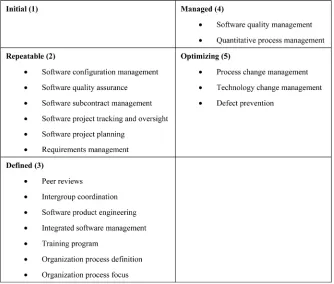
Figure 1 represents the key process areas for each maturity level in the CMM.
For a successful IT to support business requirements, management should set an internal control system or framework. The COBIT control framework provides
4. A Summary Definition of COBIT
The IT Governance Institute (ITGI) was established to
these needs by:
Making a link to the business requirements;
Organizing IT activities into a generally accepted process model;
Identifying the major IT resources to be leveraged;
Defining the management control objectives to be considered.
After the text edit has been completed, the paper is ready for the template. Duplicate the template file by using the Save As command, and use the naming con- vention prescribed by your journal for the name of your paper. In this newly created file, highlight all of the con- tents and import your prepared text file. You are now ready to style your paper.
5. Research Methodology
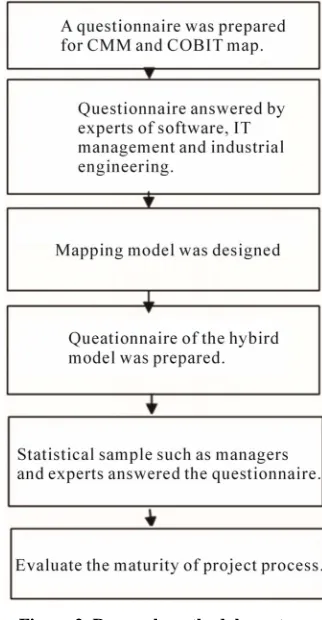
This paper is the result of a practical research. The type of data gathering is questionnaire. In considering the es- sence of this research, the researcher look for people who are as expert in CMM and COBIT concepts and mapping between them. Therefore, a focus group of all available experts of CMM and COBIT is used. At first a question- naire was designed mapping CMM and COBIT processes. The questionnaire was modified by experts’ opinion and then the final mapping model was designed. In case study, the questionnaire designed utilizing COBIT con- trol objectives answered by statistical sample such as managers and experts of department in order to evaluate the maturity of project process.
In this way, next after gathering data, maturity level of the project processes was determined by employing pro- posed method.
The research methodology is represented in Figure 2.
6. The Hybrid Model of CMM and COBIT
in Evaluation and Improvement of
Processes
In this research, the equivalent of CMM processes in COBIT framework has been searched conceptually, in the condition that it has been begun from the first CMM process of project. Details to this process and its objec- tives have been considered, and then the related domain of this process in COBIT framework has been found. In the next phase, conceptual equivalent of CMM process in COBIT framework has been found in accurate considera- tion of observed domain process.
4 domains have been defined in COBIT processes and they cover all of the CMM processes. Therefore, the CMM equivalent processes were found In COBIT frame- work, and then control objectives of COBIT were mapp- ed to evaluate CMM processes.
[image:4.595.340.501.87.397.2]During performing this research model, another group
Figure 2. Research methodology steps.
also introduced a model for mapping CMM and COBIT [20]. These research results and their finding does not match completely. Hence, in the following are described some of the main difference between these two models.
The difference between the two maps of CMM and COBIT.
The specific mapping of this article
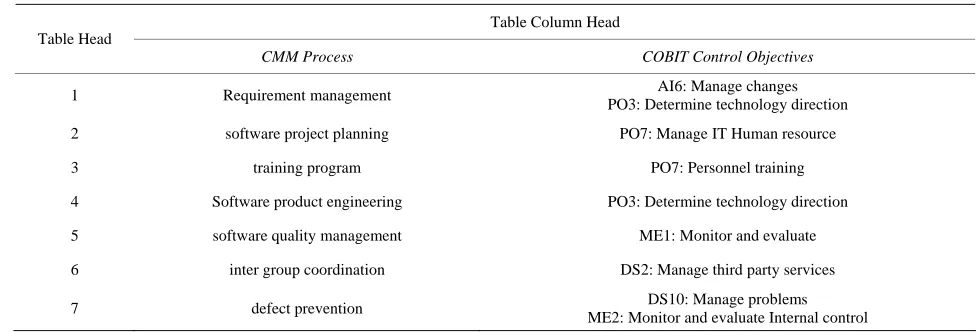
The “requirement management “process in CMM was mapped to the “Manage Changes” and “Determine tech- nology direction” process in COBIT framework.
The “Software project planning” process in CMM was mapped to the “Manage IT Human Resource” process in COBIT framework.
The “training program” process in CMM was mapped to the “Personnel training” process in COBIT frame- work.
The “software product engineering” process in CMM was mapped to the “Determine technology direction” process in COBIT framework.
The “software quality management” process in CMM was mapped to the “Monitor and evaluate” process in COBIT framework.
The “inter group coordination” process in CMM was mapped to the “Manage third party services” process in COBIT framework.
to the “Manage Problems” and “Monitor and evaluate Internal control” process in COBIT framework.
Table 1 represents the difference between presented model and ISACA mapping.
The parts of the mapping omitted from ISACA map The “quantitative process management” process in CMM has been mapped to the “Define a strategic IT plan” process in COBIT Framework but was omitted in this paper model.
The “organization process definition” process in CMM has been mapped to the “Manage the configuration” process in COBIT Framework but was omitted in this paper model.
The “training program” process in CMM has been mapped to the “Educate and train user” process COBIT framework but was omitted in this paper model.
The “software product engineering” process in CMM has been mapped to the “Manage Problems” process in COBIT Framework but was omitted in this paper model.
The “quantitative process management” process in CMM has been mapped to the “Manage Problems” process in COBIT Framework but was omitted in this paper model.
Table 2 represents the parts of the mapping omitted from ISACA mapping in represented model.
7. Case Study
The developed framework is applied to a software com- pany.
Case study is about one of the projects which have been started since 5 years ago but it hasn’t leaded to any production. Customers prefer their traditional method and don’t accept the system. Company also can not finish the project. It has been decided to use the proposed model of this research.
In order to find the reason of the problem, a question- naire has been planned to evaluate the project processes of each section in this project.
This questionnaire is derived from COBIT control ob- jectives. Andrea Pederiva proposed an evaluation method for this questionnaire [20].
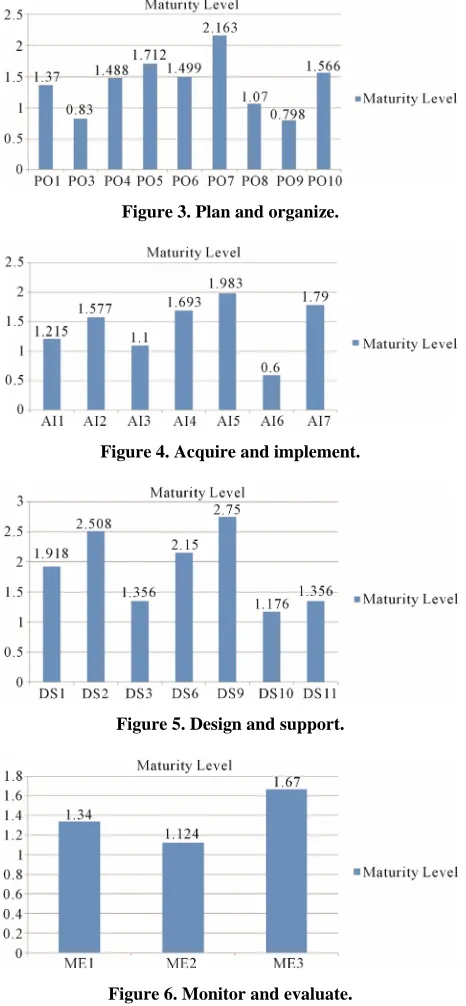
Figures 3-6 show the evaluation results of every CO- BIT domains.
7.1. Analyzing the Results of Case Study
According to the definition of software quality described in literature review, process related to quality shown in the table of CMM process in Figure 1 has been come to consideration then COBIT evaluation result from each process in Figures 3-6 has been searched and shown in column diagram.
[image:5.595.50.539.420.586.2] [image:5.595.56.538.613.738.2]Table 1. The difference between presented model and ISACA mapping.
Table Column Head Table Head
CMM Process COBIT Control Objectives
1 Requirement management AI6: Manage changes
PO3: Determine technology direction
2 software project planning PO7: Manage IT Human resource
3 training program PO7: Personnel training
4 Software product engineering PO3: Determine technology direction
5 software quality management ME1: Monitor and evaluate
6 inter group coordination DS2: Manage third party services
7 defect prevention DS10: Manage problems
ME2: Monitor and evaluate Internal control
Table 2. The parts of mapping omitted from ISACA in represented model.
Table Column Head Table Head
CMM Process COBIT Control Objectives
1 Quantitative process management PO1: Define a strategic IT plan
2 organization process definition DS9: Manage the configuration
3 training program DS7: Educate and train user
4 software product engineering DS10: Manage problems
Figure 3. Plan and organize.
Figure 4. Acquire and implement.
Figure 5. Design and support.
Figure 6. Monitor and evaluate.
Then to drill down the problem, circumstances of the process maturity level have been analyzed and the effec- tiveness rate of processes on each other and the Project quality are examined.
The processes related to the software quality have two categories as described. The processes related to cus- tomer consent and the process related to the project management. Although these two categories are consid- ered separately, in one of the COBIT processes they co- incide and influence on software quality.
At first, the maturity level of each group of above
processes is defined. Next, we achieve to the process related to every two categories and can see the relation between maturity of this process and those two catego- ries of maturity process.
This relation shows that software quality is influenced by two factors: customer discontent and lack of coordi- nation between technical groups.
7.2. Some Reasons of Customer Discontent Are The needs informally discuss in individual groups
meeting and requirements are sometimes documented.
Individuals define the solutions in response to vendor offering.
Applications are typically obtained based on IT with no consideration of actual requirements.
Every new application has infrastructure changes without any overall plan.
The test environment production is the environment.
Documentation is distributed to groups inconsistently.
There is no consideration of update the documenta- tion and procedures.
Different systems and business units have not integra- tion of procedures.
Individual teams produce the training materials and quality depends on them.
Documents and procedures are corrected reactively.
Changes made with no control because change man- agement process is not defined.
There is no awareness the change management bene- fits.
The approaches taken for testing is vary and the indi- vidual teams do that.
Company has problem in defining the strategic goals. It must be performed more certainly and the organization does not maintain an awareness of availabletechnology solutions potentially relevant to its business.
There is minimal structured research or analysis of available technology.
The maturity level of IT investigation is 1.7. It shows that company didn’t use its resources. Indeed, the corpo- ration resources are wasted.
7.3. Some Reasons of Scheduling Disruption The project and business objectives are not defined
align.
The project management process is reactive.
The staff roles and responsibilities are not assigned and informal.
The customer requirement is response inconsistently.
Individual knowledge and skills make decisions.
The responsibilities, accountability and Process own-ership are not defined.
There is no IT control environment.
Addressing the requirements of the environment is poor.
An Overall development framework does not exist.
The quality program is not defined by the senior man- agement and IT staff members.
There is no system development life cycle (SDLC) methodology and QMS planning process.
Lack of risk assessment for processes and business decisions.
Individual managers decide regarding the use of pro- ject management techniques.
User involvement in defining projects is poor.
7.4. Drill down the Process Influence on Quality
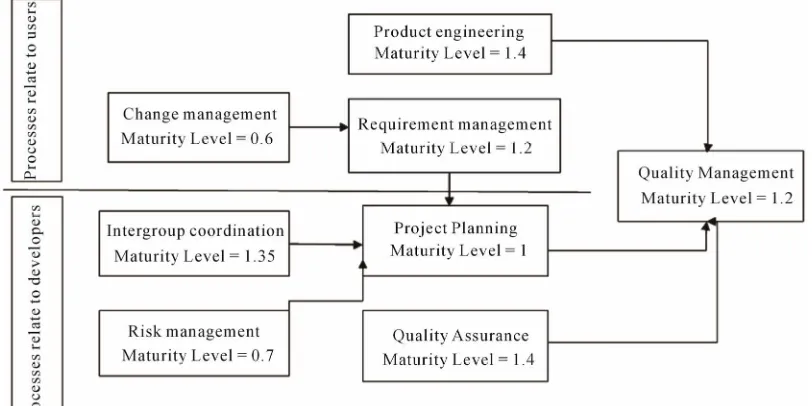
Analyzing the evaluation can determine the effective factors on quality. Figure 7 shows, the effective process respect to their effectiveness on each other. The sequence of these process finish in quality management.
[image:7.595.96.502.501.704.2]Studying this book shows the base of problems.
Figure 7 represents the process influence on quality has been studied in customers’ and developers’ view.
The processes sequences have been continued to “quality management”.
Drill down have been begun from last process, called “quality management”.
The factors influences on quality management are product engineering process, project planning and quality assurance
Every factor has been described in follow:
1) Product engineering influences on quality manage-
ment and has 1.4 maturity levels. Ignorance of the mod- ern technology during project definition and system de- sign are some factors of undesirable process maturity level.
2) Project planning: This process is depending on these three processes, requirement management, inter- group coordination and risk management.
a) Requirement management: “change management” is one of the key processes of requirement management and have 0.6 maturity level and leads to reduction of “re- quirement management” process maturity level to 1.2.
b) Intergroup coordination: maturity level = 1.35. c) Risk management: maturity level = 0.7. 3) Quality assurance: maturity level = 1.4.
Among the mentioned effective process, “intergroup coordination” has special complications and also influ- ence on other processes which will have been described. The maturity level of “intergroup coordination” is 1.35.
This process depends on following processes:
Third party services management: The goal is satisfac- tion of third party services and cost and benefits trans- parency as well.
Definition of the IT processes, organization and rela- tionships (PO4): The goal is implicating quickness in order to meet business strategy.
Communication with aims and direction of manage- ment (PO6): The goal is to provide detailed and on time information about current and future services and risks and responsibilities as well.
The processes defined in PO4 and PO6 domains in COBIT framework emphasize that IT processes and its organizations and relationships must be defined and or- ganized and risk and responsibilities must be defined and
aligned with management. The processes of DS2 domain emphasizes on determination third party services trans- parency. In CMM all definitions are in planning phase.
These definitions are: estimate project domain, lifecy- cle definition, Resource project planning, planning for essential knowledge and skills, project plan. The study of processes defined in CMM planning phase show that the IT processes haven’t been defined correctly in this case and experts don’t assign properly to the project. This means that PO4, PO6, DS2 haven’t been considered. In large scale project, consultation by an expert team is vital. It shows the top down view.
The expert group defining the fellow groups and their tasks and organizing the relationship between groups let them assign properly. It also decreases deviation between planning and implementation.
In importance of the mentioned processes in this pro- ject “HR management” is considered significantly. How- ever HR management has two maturity level the project is not successful.
The holistic approach in project management and fo- cusing on each technical team in their era are the reasons that the project can’t be finished despite experts working and spending time and cost since 5 years and the com- pany also paid fine.
The influence of “intergroup coordination” on risk management
The “intergroup coordination” belongs to CMM third level processes.
This section tries to mention the process in 4th and 5th level which are depend on this process. These processes are:
4th level—“quantitative process management”; 4th level—“software quality management”;
5th level—“process change management”: relate to the PO3, PO8, AI3 processes;
5th level—“defect prevention” = maturity level = 1.15. The evaluation shows that the maturity level of these processes is lower than 2th and 3th level processes.
Analyzing maturity processes done by proposed model and the factors related to “software quality management” as a chain expresses that, the project case study isn’t base on proper method.
That’s why the project had been failed in spite of hav- ing Human Resources and project management stan- dards.
Factors influenced on quality can be identified as fol- low: neglecting the users’ needs, neglecting the new technology in developing an acceptable product on cus- tomer’s view, lack of coordination in different groups and organizations, the holistic approach, neglecting risk management and defect prevention, that last two factors are related to each other.
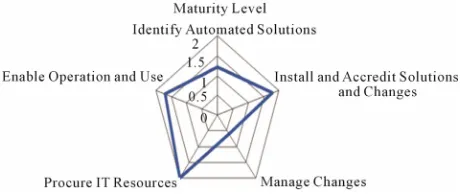
Figures 8 and 9 show the two factors influenced on
[image:8.595.308.538.490.587.2]quality: The factors influenced on customers’ consent and the factors influenced on project management.
Figure 8 shows the factors influenced on customers’ consent which are:
Identify Automated Solutions;
Install and Accredit Solutions and Changes;
Change management;
Procure IT Resources;
Enable Operation and Use;
Acquire and Maintain Technology Infrastructure;
Acquire and Maintain Application Software.
[image:8.595.309.538.613.710.2]Between the above processes, “Change Management” process has the lowest maturity level and “Procure IT Resources” have the highest maturity level.
Figure 9 shows the factors influenced on project man- agement which are:
Define a Strategic IT Plan;
Manage Project;
Assess and Manage IT Risks;
Manage Quality;
Communicate Management Aims and Direction;
Define the IT Processes, Organisation and Relation- ships;
Determine Technological Direction;
Between the above processes, “Assess and Manage IT Risks” process have the lowest maturity level and “Manage Project” process have the highest maturity level.
8. Conclusions
In this paper the factors affect on software quality con- sidered and hybrid model of CMM and COBIT proposed.
Figure 8. The factors influence on quality—customer view.
CMM defines the processes for software production and COBIT presents a framework to evaluate IT gov- ernance on organization and in this research, it has been employed to evaluate CMM processes.
The results of mapping hybrid model of CMM and COBIT in case study show that the company encountered with problem in meeting customers’ needs and in orga- nizing Human resource as well. These two factors are the reasons of project failure.
Lack of proper management in transformations, and passive attitude regarding to documentation and test are the reasons of low quality in customers’ view, in addition they influenced on project management activities such as: time and cost planning. There is a hidden factor in “pro- ject management” delay.
This hidden factor is the lack of coordination in dif- ferent departments related in one project. It is necessary to consider the coordination of different technical groups of the project in planning phase.
In this way, senior managers of the groups have to consider their commitments in scheduling. The existing expert team included of experts in all technical groups is completely aware of all subsystems and their scheduling is essential. In this research, the results show that: soft- ware developing and meeting customer needed in multi groups’ projects encountered with a problem and in case that companies neglect this issue, software quality has been influenced completely.
REFERENCES
[1] E. Agrawal, P. Jain and V. K. Jain, “Comparative Study of ISO 9001,CMMI and Six Sigma with Reference to Software Process Quality,” Global Journal of Enterprise Information System, Vol. 1, No. 1, 2009.
[2] J. S. Osmundson, J. B. Michael, M. J. Machniak and M. A. Grossman, “Quality Management Metrics for Software Development,” Information & Management, Vol. 40, No. 8, 2003, pp. 799-812.
doi10.1016/S0378-7206(02)00114-3
[3] B. Singh and S. P. Kannojia, “A Model for Software Pro- duct Quality Prediction,” Journal of Software Engineer- ing and Applications, Vol. 5, No. 6, 2012, pp. 395-401. doi10.4236/jsea.2012.56046
[4] G. Kühner, T. Bluhm, P. Heimann, C. Hennig, H. Kroiss, A. Krüger, H. Laqua, M. Lewerentz, J. Maier, H. Rie- mann, J. Schacht, A. Spring, A. Werner and M. Zilker, “Employing Industrial Standards in Software Engineering for W7X,” Fusion Engineering and Design, Vol. 84, No. 7-11, 2009, pp. 1130-1135.
doi10.1016/j.fusengdes.2008.12.019
[5] R. B. Grady and D. L. Caswell, “Software Metrics: Es- tablishing a Company-Wide Program,” Prentice Hall, Englewood Cliffs, 1987.
[6] N. Ashrafi, “The Impact of Software Process Improve- ment on Quality: In Theory and Practice,” Information &
Management, Vol. 40, No. 7, 2003, pp. 677-690. doi10.1016/S0378-7206(02)00096-4
[7] N. Goel and M. Gupta, “Testability Estimation of Frame- work Based Applications,” Journal of Software Engi- neering and Applications, Vol. 5, No. 1, 2012, pp. 841- 849. doi10.4236/jsea.2012.511097
[8] Y. Li Eldon, H.-G. Chen and T.-S. Lee, “Software Proc- ess Management of Top Companies in Taiwan: A Com-parative Study,” Total Quality Management, Vol. 13, No. 5, 2002, pp. 701-713. doi10.1080/0954412022000002081 [9] L. Tan, Y. Q. Lin and H. L. Ye, “Quality-Oriented Soft-
ware Product Line Architecture Design,” Journal of Soft- ware Engineering and Applications, Vol. 5, No. 7, 2012, pp. 472-476. doi10.4236/jsea.2012.57054
[10] M. C. Paulk, C. V. Weber, S. M. Garcia, M. B. Chrissis and M. Bush, “Key Practices of the Capability Maturity Model, Version 1.1,” 1993.
http://www.sei.cmu.edu/cmmi
[11] R. V. O’Connor and G. Coleman, “Ignoring Best Practice: Why Irish Software SMES Are Rejecting CMMI and ISO 9000,” Australasian Journal of Information Systems, Vol. 16, No. 1, 2009.
[12] H.-W. Jung and D. R. Goldenson, “Evaluating the Rela- tionship between Process Improvement and Schedule De- viation in Software Maintenance Grounded Theory Per- spective,” Information and Software Technology, Vol. 51, No. 2, 2009, pp. 351-361.
doi10.1016/j.infsof.2008.04.005
[13] J. P. Li, M. L. Li, D. S. Wu and H. Song, “An Integrated Risk Measurement and Optimization Modelfor Trust- worthy Software Process Management,” Information Sci- ences, Vol. 191, 2012, pp. 47-60.
doi10.1016/j.ins.2011.09.040
[14] S.-J. Huang and W.-M. Han, “Selection Priority of Proc- ess Areas Based on CMMI Continuous Representation,”
Information & Management, Vol. 43, No. 3, 2006, pp. 297-307. doi10.1016/j.im.2005.08.003
[15] R. B. Grady, “Measuring and Managing Software Main- tenance,” IEEE Software, Vol. 4, No. 5, 2006, pp. 35-45. doi10.1109/MS.1987.231417
[16] C.-H. Cheng, J.-R. Chang and C.-Y. Kuo, “A CMMI Appraisal Support System Based on a Fuzzy Quantitative Benchmarks Model,” Software Industry Service Newslet- ter, Vol. 54, 2003, pp. 46-57.
[17] Carnegie Mellon Software Engineering Institute, “Ap- praisal Requirements for CMMI, Version 1.1,” Continu- ous Representation, 2002.
[18] C.-Y. Chen and S. J. Huang, “Using Quantitative Soft- ware Metrics to Support CMMI Deployment and Ap- praisal,” Software Industry Service Newsletter, Vol. 54, 2009, pp. 46-57.
[19] ISACA, “Cobit Mapping: Mapping of CMMI for Devel- opmnet V1.2 with Cobit4.0,” Published in United State of America, ISSN 1-933284-80-3.