The Sound of Silence? : a comparative study of the
barriers to communication skills development in
accounting and engineering students
HASSALL, Trevor, JOYCE, John, BRAMHALL, Mike, ROBINSON, Ian and
ARQUERO, J.L.
Available from Sheffield Hallam University Research Archive (SHURA) at:
http://shura.shu.ac.uk/11695/
This document is the author deposited version. You are advised to consult the
publisher's version if you wish to cite from it.
Published version
HASSALL, Trevor, JOYCE, John, BRAMHALL, Mike, ROBINSON, Ian and
ARQUERO, J.L. (2005). The Sound of Silence? : a comparative study of the barriers
to communication skills development in accounting and engineering students.
Industry and Higher Education, 19 (5), 392-398.
Copyright and re-use policy
to be unprepared for employment and lacking in vocational skills. The UK government has overseen the identification of a set of key skills and has embedded them into the national qualifications system as part of its education and training policy (CBI, 1989). Three of these key skills – application of number, communications and information technology – are seen as compulsory for most programmes of study. These In recent years there has been a growing emphasis
on the role of higher education in preparing students for the workplace. Employers are increasingly urging higher education institutions to align their processes and ‘products’ more closely with the needs of industry. Surveys of UK employers such as those by Roizen and Jepson (1985) and Brennan and McGeever (1987) indicated that employers considered graduates
The sound of silence?
A comparative study of the barriers to
communication skills development in
accounting and engineering students
T. Hassall, J. Joyce, M.D. Bramhall, I.M. Robinson and
J.L. Arquero
Abstract: Employers often consider graduates to be unprepared for employment and lacking in vocational skills. A common demand from them is that the curriculum should include ‘communication skills’, as specific skills in their own right and also because of the central role that such skills can play in developing other desirable attributes. Current thinking in communication has indicated a split between communication apprehension and communication development. There are indications that techniques designed to develop communication skills will not resolve communication apprehension and that, if an individual has a high level of communication apprehension, these techniques will not result in improved communication performance. This paper compares and contrasts the levels and profiles of communication apprehension exhibited by accounting and engineering students. The implications of the findings are then discussed and the need for further research in the area of vocational choice is identified.
Keywords: communication skills; communication apprehension; communication development; key skills; accounting students; engineering students
skills emanate from the demands of employers and are referred to as ‘transferable’, ‘generic’, ‘personal’ or ‘core’. They relate to an individual’s ability to operate in the workplace either alone or with others.
While major efforts are being taken to facilitate skills development, Stanga and Ladd (1990) state that relatively little is known about the obstacles students face when they attempt to develop their abilities. Current thinking in communication has indicated a split between ‘communication apprehension’ and ‘communication development’ (the former is the fear of actually communicating and the latter is the ability to maintain and improve one’s performance). There are indications that techniques designed to develop communication skills will not resolve communication apprehension, and that if an individual has a high level of communication apprehension the techniques will not result in improved communication performance.
This study compares and contrasts the levels and profiles of the communication apprehension of accounting and engineering students, and attempts to identify factors that will be influential in reducing communication apprehension. The engineering and accounting sectors were chosen because both have made public statements about the need for their members to develop communication skills in order to be effective in their chosen vocational areas. Both professions are similarly structured in terms of vocational development and professional recognition.
In the first part of the paper the importance of communication skills for accountants and engineers is considered. The second part concentrates on the concept and relevance of communication apprehension. In the third part, the research method and context are presented. Finally, the levels and profiles of
communication apprehension are explored and analysed using descriptive and comparative approaches.
Importance of communication skills
A common demand from employers in many sectors is for the curriculum to include ‘communication skills’, as specific skills in their own right and also because of the central role that such skills can play in developing other desirable attributes.
This is the case in the vocational area of accounting, as illustrated by empirical research into the views of practising accountants on the skills required by graduates. Bhamornsiri and Guinn (1991), Deppeet al
(1991) and Novin and Tucker (1993) surveyed partners in accounting and consulting firms to determine the importance of various capabilities and their results suggest that communication is the most important. Morgan (1997) provides a UK perspective: his survey
of UK employers confirms the relative importance of communication skills and the deficiencies exhibited by accounting graduates. Specifically in the area of management accounting education, Arquero et al
(2001), taking account of the views of employers, suggest that priority should be given to the development of oral and written communication skills. There are also indications in Hassall et al (2000) that accounting students themselves recognize a skills expectation gap in relation to oral and written communication.
These views created pressure for change in accounting education. In fact, from the first calls of the American Institute of Certified Public Accountants (1996) to the issue of the International Education Guideline 9 (IFAC, 1996), almost every professional accounting body and academic organization has pointed out the importance of communication skills for accountants. The International Federation of Accountants (IFAC) believes that the role of the finance manager is shifting dramatically from one of transaction manager to that of communicator and strategist (IFAC, 2002). IFAC states that, in order to assume this new role, finance managers of the future will need strong communication skills.
Concerns about skills development have also arisen in the vocational area of engineering. Sir Monty Finniston (1980) undertook a major review of the need for engineers, the type of engineering expertise required and the framework for the formation of engineers. He found that engineers needed to develop appropriate skills in the following areas:
• the ability to express themselves and communicate both verbally and in writing;
• managing and participating in meetings; and • mastery of cost and budget information. The UK’s Engineering Council is committed to the regular reviewing and updating of its regulations for the accreditation of undergraduate courses. In the early 1990s the Council embarked on a fundamental review of the role and formation of professional engineers. The outcomes were published in a new edition of SARTOR (Standards and Routes to Registration) (Engineering Council, 1997) and included an explicit requirement for accredited programmes to include the development and assessment of transferable skills within their curricula.
According to the document, programmes must now be designed to achieve:
• a commitment to personal and professional development;
• generic engineering skills (examples are given); • personal organization;
• communication skills;
• the ability to work with others;
• industrial and professional practice; • equality of opportunity; and
• the development of a 'lifelong learning ethos'. Despite twenty years of attention to the problem, it seems that employers’ expectations in relation to communication-confident graduates are still not being met by engineering and accounting programmes. Both students and employers (Parnaby, 1998) have indicated that concerns persist. The lack of progress over the past two decades lends weight to the argument that it is not so much that communication skills development is not being attempted, but rather that the real barriers to the acquisition of such skills are not being
addressed.
Barriers to communication skills
development
There have been many attempts to improve the personal skills of students in higher education. Stanga and Ladd (1990) note that, despite the importance of communication skills, relatively little is known about the obstacles students face when they attempt to develop their communication abilities. One major obstacle is communication apprehension (CA), which has been the subject of much research – Payne and Richmond (1984) identified nearly a thousand studies in the area. McCroskey (1984) defines CA as ‘an individual’s level of fear and anxiety associated with either real or anticipated communication with another person’. Individuals who are apprehensive about participating in communicative situations are less able to communicate effectively. Richmond and McCroskey (1989) describe people with high levels of communication apprehension as ‘quiet’; because it is natural to avoid things we fear, such people are afraid to communicate. Allen and Bourhis (1996) find a consistently negative relationship between the level of CA and communication skills. Individuals who register higher levels of communication apprehension tend to avoid encounters, display poor cognitive processing during interaction, are perceived to be less confident and are characterized as inattentive and unable to recall important information. Spitzberg and Cupach (1984) also note the effect of communication apprehension on overall communication competence, indicating that the extent to which an individual is free of CA will determine the effectiveness of his or her communication competence.
Richmond and McCroskey (1989) have categorized CA as a ‘trait’ or a ‘state’. An individual’s general unease in communication situations is seen as a personal ‘trait’, whereas the fear of communicating in specific situations is referred to as a ‘state’. Individuals
will exhibit both types: they will have a general trait level of CA plus a ‘state’ reaction to the specific context in which they are attempting to communicate. Therefore, for the effective development of
communication skills to take place it is first necessary to diminish the level of communication apprehension that an individual may feel.
Research method
To assess levels of communication apprehension for this study, an instrument was devised that used as its basis the Personal Report of Communication Apprehension (PRCA-24) developed by McCroskey to measure oral communication apprehension (OCA), and the written communication apprehension (WCA) instrument developed by Daly and Miller. Both can be found in Simons et al (1995).
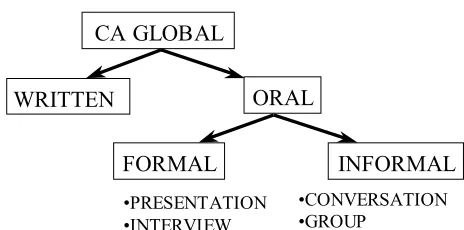
The resulting instrument included two major sections. The first was designed to gather personal data: age, gender, year/course, previous educational background and self-rating in terms of overall academic ability. The second section was devoted to the communication survey and consisted of a 48-item questionnaire to be answered according to a five-point Likert scale. The questions were split equally between written and oral communication items. The latter were grouped into four equal subsections which assigned six questions each to ‘presentations’, ‘interviews’, ‘group discussions’ and ‘conversations’. To prevent any confusion or misunderstanding of these contexts, a definition of each relevant term was given. Presentations and interviews were classed as ‘formal’ contexts and the other two were classed as ‘informal’ (see Figure 1).
[image:4.615.312.544.600.715.2]The questionnaire was distributed to students on the engineering and accounting degree programmes at a selected university. To facilitate wider comparison, it was also completed by 380 students on the business studies degree programme.
Results
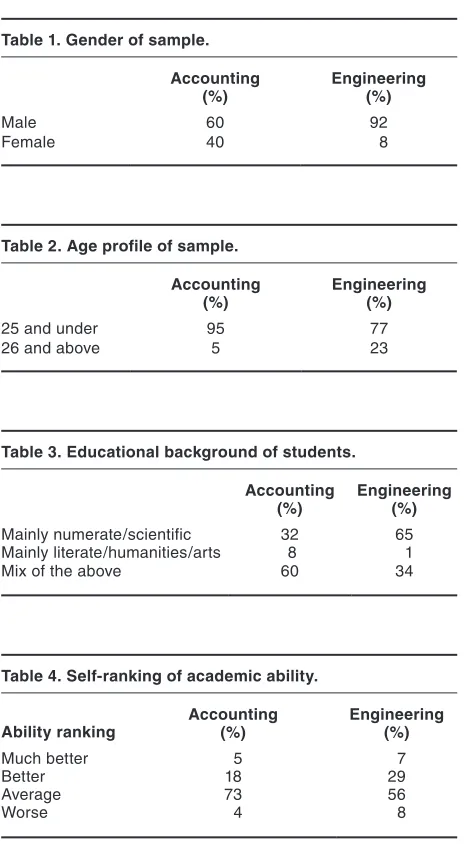
Responses were received from 312 engineering and 236 accounting students. The analysis of this population in terms of age, gender and previous educational background is shown in Tables 1–3. The students were also asked to rate their own academic ability against that of their colleagues on the same course. The results are shown in Table 4.
There are basic differences between the two groups of students. The engineering group has a much higher percentage of male students than the accounting group. It also has a much higher percentage of mature students – that is, those aged 26 and above. Fewer than 5% of the accounting group were mature students. It can also be seen that the engineering students have a predominantly numerate/scientific educational background while the accounting students
come predominantly from a mixed numerate/literate educational background. With regard to academic self-confidence, there is a noticeable difference, with a greater spread of responses from the engineering students who were more willing to differentiate their personal academic ability from that of their colleagues than were the accounting students.
The mean CA scores for the accounting and engineering students, the difference between the mean scores, and the significance of the differences as analysed by the t-test (parametrical), are shown in Table 5. As can be seen, there are no significant differences in the scores for total communication apprehension or in the constituent categories of written and oral communication apprehension, between the accounting and engineering groups. The only significant differences are in formal OCA, for which the accounting students exhibit higher levels in total and also in the sub-divisions ‘interviews’ and ‘presentations’.
The scores of the engineers were then compared to those of the business students, as shown in Table 6. The table shows that the engineering students have a significantly higher level of total CA than the business students. The predominant factor is that the engineering students have significantly higher WCA. Although there is no significant difference in the overall scores for OCA, there are differences in the subdivisions. This suggests that, as vocational groups, accountants and engineers are similar in that they both exhibit significantly higher levels of communication apprehension than business studies students.
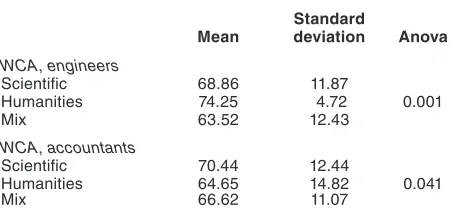
A noticeable factor is the high level of written communication apprehension exhibited by both accounting and engineering students – the relationship between written communication apprehension and the educational background of the engineering and accounting students is shown in Table 7. The WCA scores for the engineering group are distorted by the small number of students from a humanities background. However, it should be noted that the results for the engineering students show a different ordering to those of the accounting students. For the accounting students, the highest WCA scores were recorded by those students from a numerate/scientific background and the lowest scores by those from a literate/humanities educational background.
[image:5.615.71.304.315.742.2]In Table 8 the CA scores for the two groups of students are analysed in light of the students’ self-rating of their overall academic ability compared to their peers. The results for the accounting students exhibit the same trend – that is, an inverse relationship between communication apprehension and academic self-confidence. The engineering students
Table 1. Gender of sample. Accounting
(%) Engineering(%)
Male 60 92
Female 40 8
Table 2. Age profile of sample. Accounting
(%) Engineering(%)
25 and under 95 77
26 and above 5 23
Table 3. Educational background of students. Accounting
(%) Engineering(%)
Mainly numerate/scientific 32 65 Mainly literate/humanities/arts 8 1
Mix of the above 60 34
Table 4. Self-ranking of academic ability.
Ability ranking Accounting(%) Engineering(%)
Much better 5 7
Better 18 29
Average 73 56
Worse 4 8
do not register this trend in OCA and consequently in total communication apprehension. However, the trend for the engineers is the same as for the accountants in WCA. It is noticeable that although, as mentioned earlier, the range of academic self-rating by the engineers was much greater than that of the accountants, their range of mean scores is much smaller than for the other two groups. In the case of OCA, the range for the engineers is 5.17 (62.97 to 68.14) as against 16.22 for the accountants.
There are difficulties with issues such as sample size when considering the effects of demographic
[image:6.615.127.487.111.218.2]factors such as age and gender, but some observations are possible. The small number of mature students in the accounting group made a comparison with the engineering students inappropriate. The results for the engineering students analysed by age are shown in Table 9. The older engineering students exhibited statistically significantly lower scores than their
Table 5. Mean scores and tests of significance (accounting versus engineering).
Accounting Engineering Mean difference t-test p
Total CA 135.13 132.89 2.24 ns
WCA 67.70 67.21 0.49 ns
OCA 67.43 65.68 1.75 ns
Formal OCA 37.84 35.39 2.45 0.000
Interviews 18.83 17.54 1.29 0.001
Presentation 19.01 17.85 1.16 0.004
Informal OCA 29.59 30.29 –0.69 ns
Groups 14.70 15.02 –0.32 ns
Conversation 14.89 15.27 –0.38 ns
ns = not significant
Table 6. Mean scores and tests of significance (business studies versus engineering). Business Engineering Mean difference t-test p
Total CA 126.90 132.89 –5.99 0.000
WCA 62.68 67.21 –4.53 0.000
OCA 64.22 65.68 –1.46 ns
Formal OCA 37.00 35.39 1.61 ns
Interviews 17.67 17.54 0.13 ns
Presentation 19.33 17.85 1.48 0.000
Informal OCA 27.22 30.29 –3.07 0.000
Groups 13.86 15.02 –1.16 0.000
Conversation 13.36 15.27 –1.91 0.000
[image:6.615.123.487.280.384.2]ns = not significant
Table 7. WCA by previous educational background for engineers and accounting students.
Mean Standard deviation Anova
WCA, engineers
Scientific 68.86 11.87
0.001 Humanities 74.25 4.72
Mix 63.52 12.43
WCA, accountants
Scientific 70.44 12.44
Humanities 64.65 14.82 0.041
Mix 66.62 11.07
Table 8. CA by academic self-rating.
Engineering Accounting Self-rating Mean Anova Mean Anova
Total
Much better 131.64
0.024
119.66
0.000
Better 128.55 124.45
Average 134.01 137.68
Worse 141.88 152.40
WCA
Much better 63.50
0.031
60.08
0.002
Better 65.58 64.43
Average 67.77 68.53
Worse 72.64 76.60
OCA
Much better 68.14 59.58 Better 62.97
0.048 60.02 0.000 Average 66.24 69.15
[image:6.615.69.298.455.566.2]younger colleagues with regard to WCA and also for the ‘formal’ subdivision of OCA. When analysed by gender, the results highlight just one specific area, as shown in Table 10: there were no statistically significant relationships except with regard to informal OCA, for which female students in accounting and engineering recorded significantly higher scores than their male counterparts.
Conclusion and ways forward
The need for accounting and engineering students to possess communication skills and their current lack of these skills has been identified by employers, academics and students.A common demand from employers is that the curriculum should include ‘communication skills’ as specific skills in their own right and also because of the central role that such skills can play in developing other desirable attributes. Recent research indicates that the extent to which an individual is free of communication apprehension will determine the effectiveness of his or her
communication and also the effectiveness of any effort devoted to the development of such skills.
Evidence put forward by Stanga and Ladd (1990), Simons et al (1995), and Fordham and Gabbin (1996) suggests that accounting students appear to have above-average levels of oral communication apprehension. Hassall et al (2000) found significant differences in OCA in the UK and Spain between accounting and business studies students. The present study confirms
the noted high levels of communication apprehension in accounting students and also shows that engineering students have high levels. This similarity is perhaps not surprising, given the similarities between the two professions in terms of educational system and the numeracy requirements. The study shows no statistically significant difference between accounting and engineering students in terms of communication apprehension, but does find statistically significant differences when comparing them with students from the more general area of business studies.
The most significant difference between accounting and engineering students and their business studies counterparts is in written communication apprehension. Given that one of the most important communication channels for qualified accountants and engineers is written reports, this finding must be a matter of concern. Over the past few years many higher education courses have focused on improving oral communication skills. In the case of accountants and engineers this may be a misplaced priority and it may be advisable to concentrate efforts on the development of writing skills.
Accountants have higher levels of apprehension with regard to formal oral communication. This confirms the priorities indicated by Hassall et al (2000). The relatively lower apprehension scores of engineering students may be explained in terms of the discipline; if they think of a presentation as the communication of relatively uncontentious technical data, they may feel less threatened and therefore will be less apprehensive.
[image:7.615.71.294.109.227.2]When McCroskey (1984) advanced the construct of communication apprehension, he did not characterize it either as an individual trait or a response to the situational elements of a specific communication transaction (a ‘state’). It was Richmond and McCroskey (1989) who typified CA as being either ‘trait’ or ‘state’. This distinction is important because of its implications for possible intervention strategies to modify personal levels of CA. There are indications that techniques designed to develop communication skills will not resolve communication apprehension, and thus if an individual has a high level of communication apprehension the techniques will not result in improved communication performance. In order for
Table 9. CA by age for engineering students. Age Mean t-test p
Total
25 and under 134.25
0.027 26 and above 128.03
WCA
25 and under 68.00
0.025 26 and above 64.26
Formal OCA
25 and under 35.92
0.028 26 and above 33.61
Table 10. Formal oral communication apprehension by gender.
Accounting Engineering
% Mean t-test p % Mean t-test p
Male 42 36.92
0.038 92 35.06 0.009
Female 58 39.20 8 39.33
[image:7.615.128.489.680.734.2]the effective development of communication skills to take place, therefore, it is necessary first to diminish communication apprehension.
The current study contains evidence that supports both approaches. The analysis of previous educational background, which could be argued to indicate ‘state’ levels, shows that individuals from a more numeric background appear to have higher levels of communication apprehension. In terms of ‘trait’ factors, there appears to be an inverse relationship between academic self-confidence and communication apprehension. Other factors, such as age and gender, are also shown to be statistically significant. Perhaps the trait and state distinctions are too simplistic and need to be reconceptualized.
There are two areas that can be identified as worthy of further investigation for the vocational areas of accounting and engineering. The current study was based on students from all years of the relevant degree programmes. A longitudinal study that followed and recorded individual students might enable the identification of critical incidents during their studies that had an impact on their personal levels of apprehension. These critical incidents could then be considered in terms of their general applicability for the broader student body.
Given the similarities between the two professions in educational requirements and educational process, there must be concern that they are jointly attracting students who do not fulfil employers’ requirements for communication competence. Both professions have gone to considerable lengths to stress the importance of communication skills in professional development. Another goal for further research would be to measure the levels of communication apprehension of students before they begin their engineering and accountancy educational programmes. This would help to identify the extent to which communication problems are present before the students enter higher education and, in relation to this, whether students are attracted to such disciplines as engineering and accountancy because of a misperception of the skill requirements of their prospective profession.
References
AICPA, Comité Beamer (1969),Report of the Committee on Education and Experience Requirements for CPAs, American Institute of Certified Public Accountants, New York.
Allen, M., and Bourhis, J. (1996), ‘The relationship of communication apprehension to communication
behaviour: a meta-analysis’, Communication Quarterly, Vol 44, No 2, pp 214–226.
Arquero Montaño, J.L., Donoso Anes, J.A., Hassall T., and Joyce J. (2001), ‘Vocational skills in the accounting professional profile: the Chartered Institute of Management Accountants (CIMA) employers’ opinion’, Accounting Education, Vol 10, No 3, pp 299–313.
Bhamornsiri, D., and Guinn, R.E. (1991), ‘The road to partnership in the “Big Six” firms: implications for accounting education’, Issues in Accounting Education, Vol 6, No 1, pp 9–24.
Brennan, J., and McGeever, P. (1987), CNAA Graduates: Their Employment and Their Experience after College, Development Services, No 13, CNAA London.
CBI (1989), Towards a Skills Revolution – a Youth Charter, Confederation of British Industry London.
Deppe, L.A., Sonderegger, E.O., Stice, J.D., Clark, D.C., and Streuling, G.F. (1991), ‘Emerging competencies for the practice of accountancy’, Journal of Accounting Education, Vol 9, No 1, pp 257–290.
Engineering Council (1997), Standards and Routes to Registration, Engineering Council, London.
Finniston, M. (1980), Engineering Our Future: Report of the Committee of Inquiry into the Engineering Profession, Cmnd 7794, HMSO, London.
Fordham, D.R., and Gabbin, A.L. (1996), ‘Skills versus apprehension: empirical evidence on oral communication’,
Business Communication Quarterly, Vol 59, No 3, pp 88–98.
Hassall T., Arquero Montaño, J.L., Donoso Anes, J.A., Joyce J., and Ottewill, R. (2000), ‘Communication apprehension in UK and Spanish business students’, Education and Training, Vol 42, No 2, pp 93–100.
IFAC (1996), IEG 9 Prequalification Education: Assessment of Professional Competence and Experience Requirements of Professional Accountants, International Federation of Accountants, Education Committee, New York.
IFAC (2002), The Role of the Chief Financial Officer in 2010, International Federation of Accountants, Financial and Management Accounting Committee, New York. McCroskey, J.C. (1984), ‘The communication apprehension
perspective’, in Daly, J.A., and McCroskey, J.C., eds,
Avoiding Communication, Sage, Beverly Hills, CA. Morgan, G.J. (1997), ‘Communication skills required by
accounting graduates: practitioner and academic
perceptions’, Accounting Education, Vol 6, No 2, pp 93–107. Novin, A.M., and Tucker, J. M. (1993), ‘The composition of
150-hour accounting programs: an empirical investigation’,
Issues in Accounting Education, Vol 8, No 2, pp 273–291. Parnaby, J. (1998), ‘The requirements for engineering degree
courses and graduate engineers: an industrial viewpoint’, Engineering Science and Education Journal, Vol 7, No 4. Payne, S.K., and Richmond, V.P. (1984), ‘A bibliography of
related research and theory’, in Day, J.A., and McCroskey, J.C., eds, Avoiding Communication, Sage, Beverly Hills, CA.
Richmond, V.P., and McCroskey, J.C. (1989), Communication Apprehension, Avoidance and Effectiveness, Gorusch, Scottsdale, AZ.
Roizen, J., and Jepson, M. (1985), Degrees for Jobs: Employer Expectations of HE, SRHE/NFER, Nelson, Guildford.
Simons, K., Higgins, M., and Lowe, D. (1995), ‘A profile of communication apprehension in accounting majors: implications for teaching and curriculum revision’, Journal of Accounting Education, Vol 13, No 3, pp 299–318. Spitzberg, B.H., and Cupach, W.R. (1984), Interpersonal
Communication Competence, Sage, Beverly Hills, CA. Stanga, K.G., and Ladd, R.T. (1990), ‘Oral communication