An Audit of export services in England: developing
business focused support
SEAR, L., DODD, M. and DOOLE, I.
Available from Sheffield Hallam University Research Archive (SHURA) at:
http://shura.shu.ac.uk/729/
This document is the author deposited version. You are advised to consult the
publisher's version if you wish to cite from it.
Published version
SEAR, L., DODD, M. and DOOLE, I. (2001). An Audit of export services in England:
developing business focused support. In: Small business and enterprise
development conference 2001, Leicester, March 29-30 2001.
Copyright and re-use policy
See
http://shura.shu.ac.uk/information.html
Small Business and Enterprise Development Conference 2001
AN AUDIT OF EXPORT SERVICES IN ENGLAND:
DEVELOPING BUSINESS FOCUSED SUPPORT
Leigh Sear
1, Meryl Dodd
1and Isobel Doole
21
Foundation for SME Development, University of Durham, Mill Hill Lane, Durham
DH1 3LB
Tel: 0191 374 3390
Email:
[email protected]
2
The Enterprise Centre, Sheffield Business School, Sheffield Hallam University
Abstract
One of the key thresholds in the development of small and medium sized enterprises is exporting and trading internationally. A brief review of the academic and practitioner literature highlights a number of benefits associated with exporting that include exposure to differing ways of ‘how to do’ business and opportunities for the development of joint ventures and strategic alliances. However, several regions within the United Kingdom perceive that they have too few SMEs who trade internationally. Recent estimates suggest that approximately three per cent of the SMEs in the United Kingdom are actively exporting (Bank of England, 1999). Government policy makers have responded to such concerns by providing a range of support programmes to increase the number of SMEs who trade internationally and enhance the skills and capabilities of those SMEs who export, so that they can efficiently and effectively manage the exporting and market development process.
Therefore, in the majority of the English regions, there are a range of publicly funded organisations providing advice, consultancy, information and training to SMEs wishing to trade internationally and those businesses already exporting. In addition, SMEs can access a number of export services from private sector organisations such as banks, accountants, freight forwarders and export agents.
There has been no overall national ‘stocktake’ or audit of such provision. However, the need for such a stocktake is becoming increasingly important due to the introduction of a number of new support organisations into the institutional landscape and the re-organisation and re-branding of British Trade International as Trade Partners UK and the appointment of a series of Regional International Trade Directors. The introduction of the Small Business Service will have a major impact on the coverage and nature of provision for exporting SMEs within each of the English regions. The introduction of the Small Business Service, however, provides an opportunity to explore and examine alternative configurations of small business support and the types of organisation that are best placed to satisfy the needs of exporting SMEs.
This paper presents the key findings to emerge from an audit of export services within each of the English regions. Based on a research and development project undertaken in conjunction with Trade Partners UK, the paper offers insights into:
The coverage of export services available to SMEs within England;
The effectiveness and appropriateness of current configuration of export services;
The ways in which the effectiveness of the current configuration of export services could be enhanced.
AN AUDIT OF EXPORT SERVICES IN ENGLAND:
DEVELOPING BUSINESS FOCUSED SUPPORT
Leigh Sear
1, Meryl Dodd
1and Isobel Doole
21
Foundation for SME Development at the University of Durham
2
The Enterprise Centre, Sheffield Business School, Sheffield Hallam University
1. INTRODUCTION
Since the mid 1990s, there has been a great deal of debate around the exporting and new market development activities of small and medium sized enterprises (SMEs), in both a regional and a national context. The ability to export and develop new markets has been recognised by policy makers as critical in enhancing the competitiveness of SMEs and hence local and regional economies. A brief review of the academic and practitioner literature highlights a number of perceived benefits associated with exporting that include exposure to differing ways of doing business (Barclay Bank, 1996), additional demand for the product or service of the business (Julien et al., 1997) and opportunities for modifications of existing products and new product development. Although there are numerous models of the key stages in exporting and new market development (see, for example, Gankema et al., 2000), there is confusion over how SMEs within the United Kingdom develop new markets and how many SMEs are actually engaged with exporting.
Recent estimates suggest that as few as three per cent (c. 110,000) of SMEs in the United Kingdom are actively exporting (Bank of England, 1999). However, in comparison, other estimates suggest that between 10 per cent (Atherton and Sear, 1997a) and 42 or 44 per cent of SMEs actively export (Grant Thornton, 1999; Small Business Research Centre, 2000). Overall, however, there are concerns that too few SMEs are actively involved in exporting and market entry.
In response to such concerns and recognition of the links between international activity and
competitiveness, central government and local agencies have provided a range of support programmes to:
Increase the number of SMEs who export, and;
Enhance the skills and capabilities of those SMEs who are exporting.
As a result, in the majority of the English regions, there are a range of publicly-funded organisations providing advice, consultancy, information and training to SMEs wishing to export and those businesses already exporting. In addition, SMEs can access a number of export services from private sector organisations such as banks, accountants, freight forwarders and export agents.
Various aspects of the nature and effectiveness of this provision for businesses wishing to develop new markets and the type of support which is used by businesses in the process of exporting and new market development has been explored. For example, there are a large number of descriptive guides and accounts of the different types of support which are available to assist the process of new market development and exporting (see, for example, Scottish Enterprise, 1995; Barclays Bank, 1996). Such documents highlight that the main providers of exporting services, in the United Kingdom, are:
Other businesses including overseas customers and suppliers;
Private institutions including banks, consultants, lawyers and freight forwarders;
Chambers of Commerce, trade associations and other professional institutions such as the Institute of Export;
Public and semi-public agencies such as Trade Partners UK, Business Links, local authorities and Training and Enterprise Councils (TECs).
In addition to practitioner guides, there is an academic literature exploring the availability, and
1996; Carrier, 1997). These studies suggest that although there are a number of national schemes and services and business support organisations providing support that appears to be similar, there are variations in supply between and within regions. Although the coverage of such provision has been mapped within regions such as the North East and Yorkshire and the Humber (Atherton and Sear, 1997a; The Enterprise Centre, 1998), there has been no overall audit of export services within England. Indeed, the Wilson Review of Export Promotion (1999) highlights the need for such a mapping of current export provision, as the first step in developing business-driven forms of export provision and addressing the mis-match between policy and support expectations of small business export activity and actual activity within the sector (Julien et al., 1997).
This paper reports on the key findings to emerge from an audit of export of services in the nine English regions.1 The aim of the audit was to identify the coverage of export services available to SMEs and assess the effectiveness and appropriateness of such provision. The audit was particularly focused on identifying opportunities by which to enhance the effectiveness of the current configuration of export services and how such insights could be used to develop business-driven forms of support. Before reviewing the key issues to emerge from the audit of export provision in England, the paper outlines the audit methodology.
2. MAPPING EXPORT PROVISION: PROJECT METHODOLOGY
In order to ensure that the audit of export services identified both the extent and depth of provision within each English region, an audit methodology using a combination of quantitative and qualitative methods of investigation was used. Initially, a desk based review of the output from existing business support mapping exercises was undertaken to identify those ‘key’ organisations actively involved in the delivery of exporting services to SMEs within each region and at a national level. Face-to-face interviews were then undertaken with these key organisational providers to identify the type of export services provided by the organisation, the degree to which services are targeted and segmented to the needs of different types of exporting SME and the measures by which they evaluate the effectiveness of the current configuration of service offerings. In addition, the face-to-face interviews provided an opportunity to develop an overview of the strengths and weaknesses of export provision within the appropriate region and identify other providers of export services.
Therefore, a snowballing technique was used to develop a list of ‘other’ providers within each region and at a national level (Silvermann, 1985). This list was further developed by a review of local directories of support, both paper and electronic-based. The list included a range of public and private export providers within each sub-region and undertaking different types of exporting activity. Telephone interviews were undertaken with these ‘other’ providers to identify the type of services provided, the degree of
segmentation to service provision and the extent of partnership activity and the type of activities undertaken with other agencies. In order to check the accuracy of the information obtained from the telephone interviews, the interview data was supplemented with information from available promotional literature, service guides and strategy documents.
In all, the mapping exercises involved consultations and interviews with 198 publicly-funded and not for profit organisations operating in each of the nine regions and nationally and 160 private sector
organisations that covered different types of private sector activity such as accountancy, export management, finance and logistics management. An overview of the organisational status of the interviewed organisations is provided in Table 1.
The information from the face-to-face and telephone interviews was used to construct a series of organisational and service provision matrices that illustrated the current extent and depth of supply of export services within each region and at a national level. A comparison and synthesis of these service
1
provision and organisational matrices was then undertaken to identify areas of opportunity and key issues to be addressed by the stakeholders and partners within the project.
Table 1: Organisational status of the interviewed organisations
Region Public Not for profit Private Total
East 9 - 17 26 (7.3%)
London 9 2 16 27 (7.5%)
South East 14 2 24 40 (11.1%) South West 24 - 13 37 (10.3%) East Midlands 19 1 11 31 (8.7%) West Midlands 22 - 9 31 (8.7%) North East 22 4 22 57 (15.9%) North West 31 1 18 41 (11.4%) Yorkshire and the Humber 19 - 18 37 (10.3%) National 10 9 12 31 (8.7%)
All organisations 179 (50%) 19 (5.3%) 160 (44.7%) 358 (100%)
3. THE CONFIGURATION OF EXPORT PROVISION IN ENGLAND: AN ANALYSIS AND SYNTHESIS
The configuration of support for exporting in England can be considered from both regional and sub-regional perspectives. At a general level, the maps of support provision within each of the English regions were complex and involved a large number of organisations, in many cases in multiple networks and relationship. However, the synthesis of the regional and national matrices identified eight general types of organisation operating as export support providers:
i. Government bodies and agencies incorporating regional and national government bodies and supporting the funding of trade services, such as Trade Partners UK. This structure is not fixed. For example, during 1996, responsibility for the delivery of export services was transferred from the Overseas Trade Services to Business Link (National Audit Office, 1996; Atherton and Sear, 1997a). Recently, the re-branding of British Trade International as Trade Partners UK has created a number of ambiguities, especially in terms of the focus of Government.
ii. Regional agencies such as Regional Development Agencies (RDAs) that have trade development as one of their strategic activities;
iii. The Business Link network which bridges, to some extent, the regional-local divide in support configuration, in that it is a sub-regional provider but operates as an interface between local and regional support programmes;
iv. Local authority economic development units (EDUs) who focus on trade development and exporting as a means of job and wealth creation;
v. Chambers of Commerce who operate largely at a sub-regional or local level;
vi. Business federations, associations and institutes which are generally business-led but with some support and input from the public or quasi-public sector;
vii. Private sector providers supporting different types of export activity;
viii. A broad range of other providers of support, such as enterprise agencies and Universities, who are involved at a local, regional and national level and offer varied services. Such agencies tend to have somewhat different, and unclear, relationships with the above groupings of providers within and between regions.
development of the Small Business Service franchises has altered the configuration of export services, at a local level, within several of the regions. Johnson et al. (2000) note that such changes will create new issues to be resolved and present challenges to developing coherence within the configuration of provision which makes sense to the business community.
There were a number of similarities and differences in export provision between the nine regions, not only in terms of the type of organisations and provision, but also in the degree of segmentation to offerings and the delivery mechanisms underpinning service provision.
Coverage and type of export provision
At a local and regional level, three general observations can be made about the coverage and type of support. First, there are a plethora of advisory, information and ‘other’ related types of service in each English region. For example, over 40 per cent of organisations in each region provide some form of advisory or information service (see Table 2). The majority of such provision is provided by publicly-funded agencies such as Business Link, government agencies and other types of providers such as enterprise agencies. In some Northern regions export advice is provided by Trade Partners UK, the Chambers of Commerce, local enterprise agencies, local government EDUs, and universities. In
comparison, other services tend to be provided by the private sector. This includes export management, freight forwarding, logistics management and market and product representation services.
Second, Table 2 highlights that there is a relative lack of financial provision, training and networking services. In five English regions, less than one organisation in five provides some form of direct or indirect financial provision. If financial assistance is available at a local, regional or a national level it tends to be provided by two types of provider: private finance providers or local government economic development units. In terms of available training offerings, on closer inspection, it emerges that the majority of such provision is designed to provide an awareness, and develop an understanding of how to complete export documentation, income terms, letters of credit and export procedures. However, there are relatively few offerings that assist businesses to develop the capabilities and competencies required to manage the different activity flows involved in developing a new market and exporting (Atherton and Sear, 1997b).
Third, there are a number of differences in the configuration of export provision within Northern and Southern regions.2 There is a greater propensity for organisations in the Northern regions to provide advice, consultancy and information services, whilst providers in the Southern regions had a greater propensity to offer other types of service. To an extent, this difference reflects the different configurations of support and inter-organisational relationships between the regions. Different regions have different business bases and support infrastructures which tend to influence the point of delivery of assistance (Robson et al., 2000). In the majority of Northern regions, for instance, publicly funded agencies can use European monies to underpin a range of export support services that may overlap with existing provision. In Southern regions, the audit identified that there was a more active private sector providing specific services to SMEs who were willing to pay for niche-focused services.
This variation in institutional support services can, however, generate a sense of confusion or
inconsistency among potential, or actual, business users, particularly if the businesses are located near to an administrative border or have facilities in different areas. This was particularly an issue in regions such as the East Midlands and the South West:
Within my patch, the differences in the availability of European funding make it very hard to provide an ‘even’ service, and this makes it difficult in managing the expectations of businesses (Export Development Counsellor).
2
Table 2: Type of service provision offered by the interviewed organisations
Service East London South East South West
East Midlands
West Midlands
North East North West
Yorkshire and the Humber
National
Advice 42.3% 51.8% 47.5% 51.4% 58.1% 83.9% 54.4% 75.6% 56.8% 74.2% Consultancy 38.4% 18.5% 30.0% 48.6% 48.4% 58.1% 54.4% 73.1% 62.2% 35.5% Finance 19.2% 11.1% 17.5% 35.1% 29.0% 48.3% 29.8% 14.6% 8.1% 51.6% Information 50.0% 44.4% 50.0% 67.6% 74.2% 71.0% 42.1% 63.4% 40.5% 74.2% Networking 30.7% 14.8% 55.0% 45.9% 51.6% 51.6% 21.1% 46.3% 64.7% 29.0% Training 34.6% 25.9% 47.5% 37.8% 45.2% 45.1% 22.8% 43.9% 48.6% 12.9% Other 76.9% 59.2% 62.5% 62.2% 54.8% 61.3% 33.3% 63.4% 45.9% 61.3%
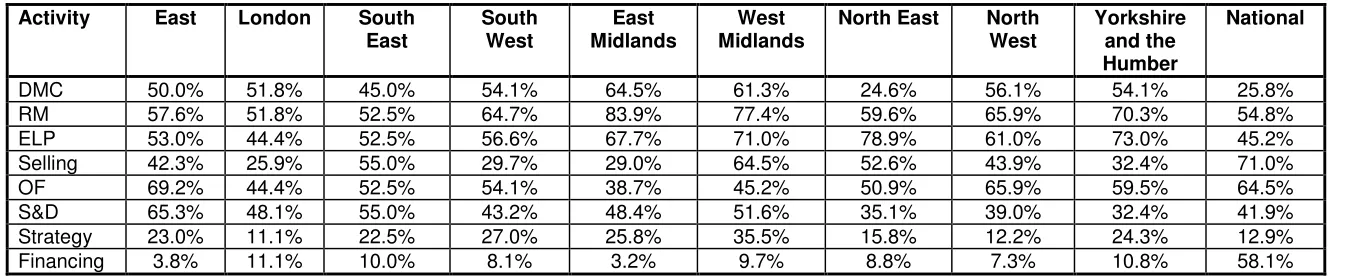
Table 3: The provision of export services by stage of the exporting process
Activity East London South East
South West
East Midlands
West Midlands
North East North West
Yorkshire and the Humber
National
DMC 50.0% 51.8% 45.0% 54.1% 64.5% 61.3% 24.6% 56.1% 54.1% 25.8% RM 57.6% 51.8% 52.5% 64.7% 83.9% 77.4% 59.6% 65.9% 70.3% 54.8% ELP 53.0% 44.4% 52.5% 56.6% 67.7% 71.0% 78.9% 61.0% 73.0% 45.2% Selling 42.3% 25.9% 55.0% 29.7% 29.0% 64.5% 52.6% 43.9% 32.4% 71.0% OF 69.2% 44.4% 52.5% 54.1% 38.7% 45.2% 50.9% 65.9% 59.5% 64.5% S&D 65.3% 48.1% 55.0% 43.2% 48.4% 51.6% 35.1% 39.0% 32.4% 41.9% Strategy 23.0% 11.1% 22.5% 27.0% 25.8% 35.5% 15.8% 12.2% 24.3% 12.9% Financing 3.8% 11.1% 10.0% 8.1% 3.2% 9.7% 8.8% 7.3% 10.8% 58.1%
[image:7.792.63.738.298.437.2]The depth and appropriateness of export provision
Commentators such as Julien et al. (1997) have noted that availability of significant levels of advice and guidance to support the development of exporting SMEs does not necessarily translate into
commensurate levels of usage by small businesses. Atherton and Sear (1997a) and Carrier (1997) suggest that this difference between availability and usage reflects weaknesses in the accessibility and appropriateness of export offerings. Indeed, the Wilson Review (1999, p.5) comments that ‘the strategy and objectives of the new operation should be clearly based on business needs’.
Accordingly, one of the key aims of the audit was to assess the depth and appropriateness of the current configuration of export provision. Gibb (1997) suggest that appropriateness can be measured by the degree to which support reflects the business development process, as experienced by the business itself. This implies that the role of support interventions is to assist the business in satisfying key ‘how to’ requirements and needs. Therefore, during the face-to-face and telephone interviews, the activities and services of the interviewed organisations were audited against a business-focused model of exporting (see, Atherton and Sear, 1997b).
The audit highlighted that the majority of provision within England focuses on the ‘front-end’ activities of the exporting process such as researching the market and establishing a local presence (see Table 3). This reflects a supply-side perception that the relatively low level of exporting activity within the SME community reflects a lack of business awareness of exporting opportunities and how to develop new markets (CBI, 1996). As a result, interviewed organisations noted developing a range of advisory and information services designed to assist SMEs to find new customers and research conditions in certain markets and sectors.
There is, however, a major concern with this support focus on the early stages of the new market development process model, which highlights the particular nature of exporting activity in small
businesses. Atherton and Sear (1997b) and Chetty and Hamilton (1996) highlight that during the initial stages of exporting, businesses tend to focus on selling rather than on researching the market and establishing a local presence. This is because ‘the development of a new market tended to be
transaction-led, i.e. in response to a selling opportunity, rather than planned’ (Atherton and Sear, 1997b, p. 1060). As the selling activity is consolidated, however, businesses tend to increase their formal, and purposive, researching of the market and start to develop more considered forms of local presence. Therefore, the focus of the majority of publicly-funded agencies on helping new and inexperienced exporters to research the market and establish a local presence does not reflect the initial entry point into exporting, via selling.
In addition, Westhead (1993) suggest that the appropriateness of export offerings can be ascertained by exploring the degree to which services were targeted towards different groupings or types of exporting SMEs. During the face-to-face and telephone interviews, organisations were asked whether they
segment the exporting market, and if they did, what type of segments were targeted. There is a tendency for support organisations throughout England to provide services that can be accessed by any type of exporting business. Table 4 highlights that in seven of the nine regions over 75 per cent of the organisations did not segment the exporting market. The lack of segmentation reflects that:
The aims and objectives of the organisations required services to be provided to as many SMEs as possible and hence achieve ‘visibility’ within the market place. For example, numerous Business Links commented that ‘numbers and outputs, as opposed to outcomes determine our approach’ (Export Development Counsellor);
The role of the agency did not necessitate the segmentation of the market, because the agency is largely approached by SMEs to provide a general advisory or information service that negates the need to act in a diagnostic manner;
The majority of organisations who commented that they do segment the exporting SME tended to do so by targeting SMEs in certain sectors or promoting exporting activity in certain markets. The focus on supporting export activity in certain sectors reflects the emphasis placed on sectoral and market
development by Trade Partners UK, the Government Office and the Regional Development Agencies as a strategy for regional development (Robson et al., 2000). On closer inspection, however, there was a degree of tension and overlap between local, regional and national priorities in terms of which sectors were important to local and regional competitiveness. This raises an issue of how these different
priorities can be managed into an effective and deliverable programme of support for sector development.
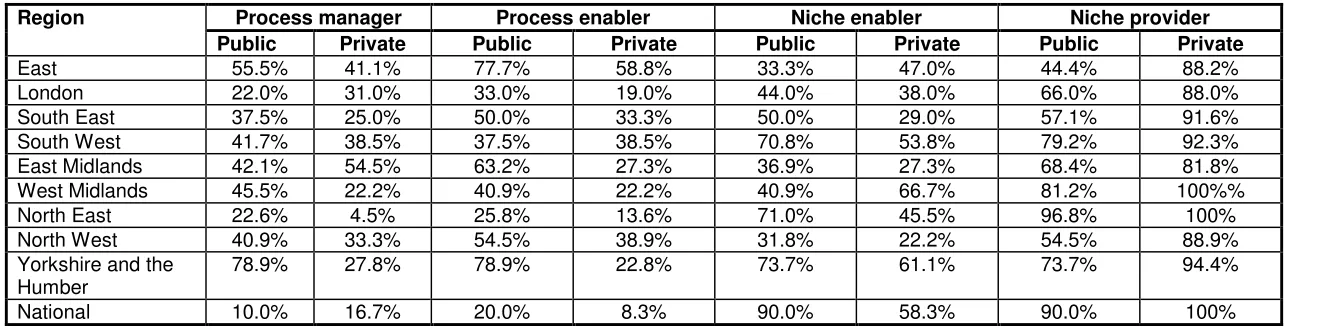
Finally, there is evidence that the interviewed organisations adopted different ‘delivery’ roles in their day-to-day interactions with exporting SMEs. One common distinction, prevalent within the discourse surrounding Business Link and the Small Business Service, is the difference between the provision of services, enabling or brokering access to other sources of support and assisting the business to manage the business development process (Johnson et al., 2000). This difference can be used as the basis for a four-fold categorisation of ‘delivery’ roles:
Process manager – i.e. assisting the business to manage the exporting process; Process enabler– i.e. enabling access to other agencies who can manage the process; Niche enabler – i.e. providing access to other agencies who provide specific services; Niche provider – i.e. providing specific, one-off services.
In each region, and at a national level, there is a clear focus on the provision of specific, one-off services (i.e. niche provision), particularly within the private sector. This reflects that the delivery of services, unlike more process-focused or brokerage roles, is easier to present as an income generation opportunity and a chargeable service. This tension between more process-focused roles and niche provision is encapsulated within the Export Development Counsellor role. Until recently, there was pressure on EDCs to provide specific services as one way of generating income to cover costs incurred in providing a more process-focused role which was perceived as a service which businesses were unwilling to pay for (Sear and Agar, 1996). As a result, the provision of specific services tends to be combined with other roles such as signposting and/or process management.
Table 4: Segmentation strategies used by the interviewed organisations
Segment East London South East
South West
East Midlands
West Midlands
North East
North West
Yorkshire and the Humber
National
None 92.3% 85.1% 90.0% 78.4% 77.4% 77.4% 94.7% 65.9% 59.5% 67.7% Size 7.6% 3.7% 2.5% 16.2% 3.2% 9.7% 17.5% 4.9% - 16.1% Match 7.6% - 7.5% 10.8% 9.7% 16.1% 5.3% 4.9% 21.6% 12.9% Sector 19.2% 22.2% 27.5% 24.3% 22.6% 32.3% 19.3% 17.1% 37.8% 41.9% Experience
level
11.5% 3.7% 5.0% 5.4% 19.4% 9.7% 5.3% 4.9% 21.6% -
Geographical area
3.8% 3.7% - 2.7% 3.2% - 7.0% 7.3% - -
Table 5: Types of role adopted by publicly-funded and private sector organisations
Region Process manager Process enabler Niche enabler Niche provider
Public Private Public Private Public Private Public Private
East 55.5% 41.1% 77.7% 58.8% 33.3% 47.0% 44.4% 88.2% London 22.0% 31.0% 33.0% 19.0% 44.0% 38.0% 66.0% 88.0% South East 37.5% 25.0% 50.0% 33.3% 50.0% 29.0% 57.1% 91.6% South West 41.7% 38.5% 37.5% 38.5% 70.8% 53.8% 79.2% 92.3% East Midlands 42.1% 54.5% 63.2% 27.3% 36.9% 27.3% 68.4% 81.8% West Midlands 45.5% 22.2% 40.9% 22.2% 40.9% 66.7% 81.2% 100%% North East 22.6% 4.5% 25.8% 13.6% 71.0% 45.5% 96.8% 100% North West 40.9% 33.3% 54.5% 38.9% 31.8% 22.2% 54.5% 88.9% Yorkshire and the
Humber
78.9% 27.8% 78.9% 22.8% 73.7% 61.1% 73.7% 94.4%
[image:10.792.74.738.311.476.2]4. DISCUSSION AND IMPLICATIONS
Overall, the audit of export services highlights that there are a number of key similarities in provision between each region in England, especially in terms of the coverage and depth of provision. Although individual organisations in each of the regions are operating under unique circumstances, because of variations in their internal structure and their external environment, a number of key challenges and opportunities emerge that have implications for local, regional and national support agencies, such as Trade Partners UK, in terms of developing business driven forms of support.
The first challenge relates to resolving the key gaps and concentrations in provision. Across England, the extensive provision of advice and information and other services suggests that this is considered the most appropriate form of support for providers to offer. However, this raises a question concerning whether this configuration of provision reflects a set of particular customer needs and local/regional priorities or represents a lack of differentiation and overlap. Similarly, the observed gaps in financial and training provision can be seen as both positive, where services are not being delivered because there is no or minimal demand, and negative where gaps in provision are problematical in that they indicate a lack of response to market needs or demands. Such concerns can only be resolved by comparing and contrasting audits of supply-side provision against ‘audits’ of the needs of exporting SMEs. Such a comparison would provide information that could be used by local, regional and national agencies to identify the requirements of exporting SMEs and the responses required to satisfy the ‘how to’ needs of exporting SMEs. The lack of such insights was highlighted in each region as one of the key barriers to being able to effectively segment the SME market and developing business driven forms. Indeed, even in the 1980s, it was noted that ‘... little is known [about] how well demand (firms’ need) for support and supply (assistance offered) actually match’ (Seringhaus, 1987, p. 27).
Another key challenge for support agencies, especially publicly-funded agencies, is clarifying what is the most appropriate alignment of support, both geographically and between different types of support provider. In terms of the latter, the audit highlights that the private sector is better able to tailor their offerings to different types of exporting SME, by addressing the immediate problems and opportunities encountered by the business. Therefore, a problem-focused role or opportunity driven service is provided to meet the ‘how to’ needs of the business. The lack of targeting and segmentation to the majority of publicly-funded offerings, especially advice and information services, would imply that there is a lack of differentiation and hence overlap and competition between publicly-funded and private sector provision. To ensure that publicly funded services do not continue to displace and duplicate private sector offerings, there is an issue concerning how publicly-funded provision can add value to private sector offerings.
Previous research on Business Links, and PBAs, has highlighted that there is a role for publicly funded agencies in providing a process management role (Sear and Agar, 1996; Priest, 1998). The audit highlighted that very few publicly-funded agencies adopt a process management role in assisting SMEs to manage the entire exporting process. The key aim of a process management role is to develop the skills of the business owner-manager and export managers to manage the export process themselves. In so doing, publicly-funded agencies would assist the business to manage the risk, uncertainty and
complexity associated with exporting and developing new markets (Chetty and Hamilton, 1996).
There are certain key skills or attributes required by a process manager (e.g. counselling and
communications skills and process facilitation skills) could be translated into a set of competencies which would underpin the development of a continuing professional programme for export advisers and
counsellors. This programme would ensure that export advisers would possess the skills required to perform a process management role, but also develop local and specialist knowledge required to keep up to date with businesses who are engaging with, and managing the exporting process. The current lack of such a programme was highlighted by the interviewed organisations as a major barrier to offering
business driven forms of support:
Finally, the audit highlighted a mismatch between the focus of support within the regions and the process as experienced by SMEs. The focus of public provision is on the front-end (promotional) activities of the process. However, when a business starts to develop new markets, the focus is predominately on more transactional (developmental) activities. Therefore, there is a difference between how the support network conceptualises the process by which a small business starts to sell in a new market and the actual development of this activity within the business. Ultimately, this difference is one of an emphasis on trade promotion as opposed to trade development focused export provision.
The majority of publicly-funded provision is concerned with trade promotion, in particular finding
customers and identifying export opportunities for businesses via market research services. As a result, the general focus for much of the new market development support is formal in nature. However, the entry point into using support for the small business tends to be informal and personalised, but support responses are often formal (Atherton and Sear, 1997b). How can the interaction between these two approaches be balanced? The starting point is a recognition that businesses have different levels of expertise of developing new markets, and hence learning requirements, which will determine the approach to exporting and market development adopted by the business. For example, the entry point into developing new markets will be different for starter or inexperienced exporters, in comparison to global, or expert, exporters. These different types of business will have different characteristics, encounter different barriers and challenges and hence have different requirements and developmental needs. The implication for support organisations is that support is most effective when it is targeted to assist businesses with different levels of experience and ‘know-how’ of the exporting process. This will be the starting point for developing-business driven forms of support.
REFERENCES
Atherton, A. and Sear, L. (1997a) ‘Support for the Exporting SME: Current Configurations of Provision in the North-east of England’. Paper to be presented at the 20th National ISBA Small Firms Policy and Research Conference, Belfast, 19-21 November.
Atherton, A. and Sear, L. (1997b) ‘Working within the Global Economy: Insights into the
Internationalisation Process in the North-east England’. Paper to be presented to the 27th efmd European Small Business Seminar, Rhodes, 17-19 September.
Bank of England (1999) Smaller Exporters: A Special Report, Bank of England, London. Barclays Bank (1996) Realising Your Export Potential, Barclays Bank, Coventry.
Carrier, C. (1997) ‘The Training and Development Needs of Owner-managers of Small Businesses with Export Potential’. Paper presented to the 42nd World ICSB Conference, San Francisco, 20-22 June. CBI (1996) Trade Secrets: Maximising Export Potential in SMEs, Confederation of British Industry,
London.
Chetty, S.K. and Hamilton, R.T. (1996) ‘The Process of Exporting in Owner-controlled Firms’,
International Small Business Journal, Vol. 14, No. 2, pp. 12-22.
Gibb, A.A. (1997) ‘Small Firms Training and Competitiveness: Building Upon The Small Business as a Learning Organisation’, International Small Business Journal, Vol. 15, No. 3, pp. 13-29.
Gankema, H., Snuif, H. and Zwart, P. (2000) The Internationalisation Process of Small and Medium-sized Enterprises: An Evaluation of the Stage Theory, Journal of Small Business Management, Vol. 38, No. 4, pp. 15-27.
Grant Thornton (1999) European Business Survey, Grant Thornton, London.
Johnson, S., Sear, L. and Jenkins, A (2000) Small Business Policy, Support and Governance, in Jones-Evans, D. and Carter, S. (eds.) Enterprise and Small Business: Principles, Practice and Policy, London: Addison Wesley-Longman.
Julien, P.A., Joyal, A., Deshaies, L. and Ramangalahy, C. (1997) ‘A Typology of Strategic Behaviour Among Small and Medium-sized Exporting Businesses: A Case Study’, International Small Business Journal, Vol. 15, No. 2, pp. 33-50.
National Audit Office (1996) Overseas Trade Services: Assistance to Exporters, HMSO, London. Priest, S. (1998) ‘Business Link SME Services: Targeting, Innovation and Charging’, Environment and
Planning C: Government and Policy, Vol. 6.
Scottish Enterprise (1995) The International Challenge: An Export Development Strategy for Scotland, Scottish Enterprise, Glasgow.
Sear, L. and Agar, J. (1996) ‘Business Links and Personal Business Advisers: Selling Services
Irrespective of Client’s Needs?’. Paper presented to the 19th National ISBA Small Firms Policy and Research Conference, Birmingham, 20-22 November.
Seringhaus, R. (1987) ‘The Role of Information Assistance in Small Firms’ Export Involvement’,
International Small Business Journal, Vol. 5, No. 2, pp. 26-36.
Silverman, D. (1985) Qualitative Methodology and Sociology, Gower Press, Aldershot.
Small Business Research Centre (2000) British Enterprise in Transition, University of Cambridge, Cambridge.
The Enterprise Centre (1998) Analysis of Supply Side Research: Humberside, North Yorkshire, South Yorkshire, West Yorkshire, The Enterprise Centre, Sheffield Hallam University, Sheffield.
Westhead, P. (1993) A Matched Pairs Comparison of ‘Exporting’ and ‘Non-Exporting’ Small Firms in Great Britain, Warwick Business School Small and Medium Enterprise Centre Working Paper No. 19, Warwick Business School, Warwick.