BIOANALYTICAL METHOD DEVELOPMENT AND VALIDATION
OF TENELIGLIPTIN USING RP-HPLC IN RABBIT PLASMA
Nallakumar P.*1 and Siva Kumar R.2
1
Department of Pharmaceutical Analysis, Sri Venkateshwara College of Pharmacy and Research Centre, Madhapur, Hyderabad - 500081, India.
2
Department of Pharmaceutical Analysis, Geethanjali College of Pharmacy, Cheeryal Vill, Keesara Mdl, RR Dist. India.
ABSTRACT
A simple, highly sensitive, precise and accurate high-performance liquid chromatographic (HPLC) method was developed and validated for the determination of teneligliptin in rabbit plasma samples. The chromatographic separation was achieved with a reverse phase column thermo C18 (4.6×100 mm, 5µ) and the mobile phase consisted of methanol and 5mm potassium phosphate buffer (60:40 v/v) at a flow rate of 1mL/min. Sitagliptin was used as an internal standard. The retention time of Teneligliptin and sitagliptin were found to be 3.9 and 2.2min respectively. The calibration curve was linear (r2 > or = 0.99) ranging from 7.20 to 470ng/ml and the lower limit of quantification was 7.20 ng/mL. Interday precision were lower than 5% (CV) and accuracy ranged from 90 to 110% in terms of percent accuracy. Mean extraction recovery was found to be above 82%. The method was successfully developed and validated in rabbit plasma for excellent selectivity, accuracy, precision, recovery and stability.
KEYWORDS: HPLC; Teneligliptin; internal standard, Rabbit plasma; Validation.
Abbreviations
CV: Coefficient Variation; HPLC: High Performance Liquid Chromatography; IS: Internal Standard; LC: Liquid Chromatography; LC-MS/MS: Liquid Chromatography –Mass Spectrometry / Mass Spectrometry; LLOQ: Lower Limit of Quantitation; LQC: Low Quality Control; MQC: Medium Quality Control; HQC: High Quality Control; PK:
Volume 6, Issue 10, 589-602. Research Article ISSN 2277– 7105
*Corresponding Author
Nallakumar P.
Department of
Pharmaceutical Analysis, Sri
Venkateshwara College of
Pharmacy and Research
Centre, Madhapur,
Hyderabad - 500081, India.
Article Received on 01 July 2017,
Revised on 22 July 2017, Accepted on 12 August 2017
Pharmacokinetics; QC: Quality Control; RP: Reverse Phase; TK: Toxicokinetic studies; BCS: Biopharmaceutics Classiication System; UV: Ultraviolet spectrophotometry; Cmax: the
maximum plasma concentration of the drug; psi: Pounds per square inch.
INTRODUCTION
Teneligliptin has the molecular formula C22H30N6OS and chemical
name{(2S,4S)-4-[4-(3-Methyl-1-phenyl-1H-pyrazol-5-yl)-1-piperazinyl]-2- pyrrolidinyl}(1,3-thiazolidin-3-yl)methanone with a molecular mass of 426.583 g/mol. and absorption maxima around 244 nm. Teneligliptin belong to class of Antidiabetic drugs known as dipeptidyl peptidase inhibitors or gliptins. Teneliglitpin got FDA approval in 19 mainly for the treatment of diabetic. The mode of action of the teneligliptin is the glucagon-like peptide-1 (GLP-1) is secreted from alimentary canal in response to meal that promotes insulin secretion from pancreas and regulates blood sugar post meal by controlling glucagon secretion. Teneligliptin exhibits a hypoglycemic effect by controlling the degradation of GLP-1 by inhibiting dipeptidyl peptidase-4 (DPP-4) activity and thereby increasing blood concentration of active GLP-1.
Pharmacokinetics
radioactivity was excreted in urine and 46.5% in faeces till 216 hours after dose. The cumulative urinary excretion rates for upto 120 hours for un-metabolized, M1, M2 and M3 were 14.8%, 17.7%, 1.4% and 1.9% respectively while the cumulative faecal excretion rates for un-metabolized, M1, M3, M4 and M5 were 26.1%, 4.0%, 1.6%, 0.3% and 1.3% respectively. The single administration of teneligliptin at 20 mg in patients with renal impairment revealed no remarkable changes in Cmax and t1/2 corresponding to the level of renal impairment. Compared with healthy adult subjects, the AUC0–∞ of subjects with mild renal impairment (50 ≤ creatinine clearance [Ccr] ≤ 80 mL/minute), moderate renal impairment (30 ≤ Ccr < 50 mL/minute) and severe renal impairment (Ccr < 30 mL/minute) was approximately 1.25 times, 1.68 times and 1.49 times higher than that of healthy adult subjects, respectively. A single administration of teneligliptin 20 mg in patients with hepatic impairment revealed that the Cmax of subjects with mild hepatic impairment (Child–Pugh classification: total score 5–6) and moderate hepatic impairment (Child–Pugh classification: total score 7–9) was approximately 1.25 times and 1.38 times that of healthy adult subjects, respectively. Compared to healthy adult subjects, the AUC0–∞ of subjects with mild and moderate hepatic impairments was approximately 1.46 times and 1.59 times higher than that of healthy adult subjects, respectively. There have been no previous clinical studies using teneligliptin in patients with severe hepatic impairment (Child–Pugh classification: total score was greater than 9).
Adverse effects
The most common adverse reactions reported with teneligliptin are hypoglycemia and constipation. Other adverse reactions reported with teneligliptin are: Gastrointestinal Disorders: Intestinal obstruction, abdominal bloating, abdominal discomfort, nausea, abdominal pain, flatulence, stomatitis, gastric polyps, colon polyps, duodenal ulcer, reflux esophagitis, diarrhea, loss of appetite, increased amylase, lipase increased, acute pancreatitis. Kidney and Urinary system: Proteinuria, urine ketone-positive. Skin and Subcutaneous Tissue Disorders: Eczema, rash, itching, allergic dermatitis. Investigations: Increase in AST, ALT, γ-GTP and ALP. Others: Increased CPK, increased serum potassium, fatigue, allergic rhinitis, elevation of serum uric acid.
Over Dosage
(including obtaining an electrocardiogram) and institute supportive therapy as dictated by the patient's clinical status.
Warnings and Precautions
Teneligliptin should be administered carefully in the following: Patients with advanced liver failure (safety has not been established), Patients with congestive heart failure (NYHA category III-IV) (safety has not been established), Patients with pituitary insufficiency or adrenal insufficiency, poor nutritional state, starvation, an irregular dietary intake, or debilitating condition, intense muscle movement or excessive alcohol intake (may cause low blood sugar), Patients with history of abdominal surgery or with a history of bowel obstruction (may cause bowel obstruction), Patients with arrhythmia, severe bradycardia or its history, patients with heart disease such as congestive heart failure or patients with low serum potassium, congenital prolonged QT syndrome, history of Torsades de pointes or patients using antiarrhythmic drugs (may cause QT prolongation), Patients using an insulin secretagogue (e.g., sulfonylurea) (risk of severe hypoglycaemia).
Drug name: Teneligliptin.
Chemical Formula: C22H30N6OS.
Chemical Structure:{(2S,4S)-4-[4-(3-Methyl-1-phenyl-1H-pyrazol-5-yl)-1-piperazinyl]-2-
pyrrolidinyl}(1,3-thiazolidin-3-yl)methanone.
Molecular Weight: 426.22 g/mol.
Solubility: in water, DMSO, methanol.
PKa: 8.7.
Fig 1: chemical structure of Teneliglitpin.
Drug name: Sitagliptin.
Chemical Formula: C16H15F6N5O.
Chemical Structure:
(3R)-3-amino-1-3(trifluoromethyl)-5H,6H,7H,8H-[1,2,4]triazolo[4,3-a]pyrazin-7-yl]-4-(2,4,5-trifluorophenyl)butan-1-one.
Solubility: in water, 179.2mg/L at 250C.
LogP: 1.5.
[image:5.595.191.404.141.250.2]PKa: 8.78.
Fig 2: chemical structure of sitagliptin.
Literature survey
MATERIALS AND METHODS
Chemicals and reagents
Teneligliptin (Figure 1) of the highest quality has been purchased from Microlabs and sitagliptin (Internal Standard) (Figure 2) was donated by MSD. HPLC grade Methanol 99.8% was obtained from Merck chemicals, Hplc grade water and ethylacetate were of analytical reagent grade supplied by Merck Chemicals.
Instrumentation
WATERS HPLC, Model: Aglient 2695, Photo diode array detector (PDA), with an automated sample injector. The output signal was monitored and integrated using Empower 2 software.
Chromatographic conditions
Chromatographic separations were achieved by using Thermo C18 column (250×4.6 mm, 5 µm). The mobile phase consisted of methanol and 5 mm potassium hydrogen phosphate buffer in the ratio of 60:40 v/v. runtime – 7miuntes and flow rate of 1 mL/min and the injection volume was 20 µl. the column oven was kept at 25°C throughout the analysis. The eluent was detected by PDA detector.
Preparation of stock and standard solutions
Teneligliptin was weighed and dissolved in methanol and concentrations made to 1000µg/ml and futher samples are prepared of eight different standard concentrations of 7.20, 20.24, 47.060, 117.660, 213.940, 305.620 and 470.00ng/ml. The QC samples are prepared at four different levels are HQC, MQC, LQC and LLOQ. All the standard concentration and QC samples are prepared by using methanol and water (80:20) as diluents.
Extraction method
Bioanalytical method validation
Preparation of calibration curve: the linearity of the method was evaluated by a calibration curve in the range of 7.20 – 490ng/ mL of teneligliptin. The calibration curve was achieved by plotting the peak area ratios of teneligliptin versus the concentration of teneligliptin by least-squares linear regression analysis. The calibration curve requires a correlation coefficient (R2) of >0.999. The acceptance criteria for each back-calculated standard concentration should be within 15% of the nominal concentration, except it should not exceed 20% for the LLOQ.(table-1).
Accuracy and precision
Intra-day accuracy and precision were determined by duplicate analysis of six sets of samples spiked with four different concentrations of teneligliptin at low, medium, high quality control samples (18.000,211.680,376.000ng/mL) including LLOQ (7.200 ng/mL) within a day or on 6 consecutive days. For acceptance criteria for intra and inter-day precision, accuracy should be within 85–115% of the nominal concentration and coefficient of variation (%CV) values should be <15% over the calibration range, except at the LLOQ, where accuracy should be between 80 – 120% and %CV should not be more than 20%.(table-2).
Selectivity
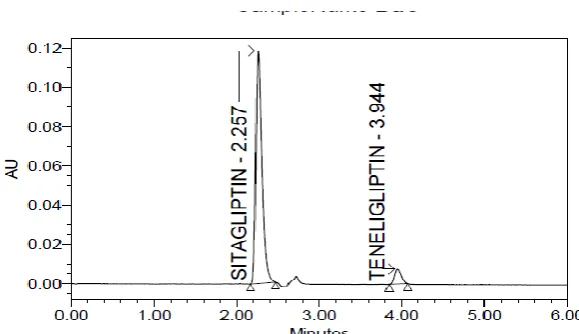
The selectivity of the assay methodology was established using a minimum of six independent sources of the same matrix. There were no interferences from the endogenous material at the retention time for both teneligliptin and internal standard (sitagliptin). The representative chromatogram is shown in Figure 3.
Recovery
Stability
In order to find out the stability of teneligliptin in rabbit plasma, bench top stability, freeze thaw stability and long term stability studies were carried out by using six replicates of the low and high plasma quality control samples. For the bench top stability, frozen plasma samples were kept at room temperature for 24 hr before sample preparation. Freeze–thaw stability of the samples was obtained over three freeze-thaw cycles, by thawing at room temperature for 2–3 hr and refrozen for 12–24 hr for each cycle. Freshly prepared solutions are taken and analysed after 24hours and Long term stability of teneligliptin in rabbit plasma was tested after 3 days. For the acceptance criteria of stability, the deviation compared to the freshly prepared standard should be within ± 15% of the nominal concentration.
Matrix effect
The matrix effect was performed in 6 different lots of rabbit plasma by taking aqueous samples and spiked plasma samples at HQC and LQC level (6replicates of each). Matrix suppression or enhancement was calculated as follows: 100×mean peak area of post extracted sample/mean peak area of neat standard solution. The acceptance criteria for matrix effect implied that the %CV should be less than 15% of matrices tested and at least 80% of matrices should meet the above criteria. the results obtained were displayed in Table 4.
Table 1: Calibration table.
Concentration(ng/ml) Area
Ratio back.cal.con
% concentration
7.080 0.018 7.377 104.2
20.240 0.050 20.497 101.3
47.060 0.117 47.277 100.5
117.660 0.293 117.883 100.2
213.940 0.529 212.514 99.3
305.620 0.760 305.080 99.8
399.500 0.997 399.930 100.1
470.000 1.173 470.541 100.1
Table 2: precision and accuracy (n=6).
QC Sample Teneligliptin
LLOQ LQC MQC HQC
Theoretical concentration
(ng/mL) 7.200 18.000 211.680 376.000
precision and accuracy Mean estimated concentration
(ng/mL)± SD 7.107±0.04 17.210±0.05 199.478±0.07 354.871±0.40
Precision (CV, %) 0.17 0.2 0.150 0.644
Table 3: Extraction Recovery (n=6).
teneligliptin LQC % MQC% HQC%
Extraction recovery of six different aliquots of rabbit plasma 101.4745 101.521 100.00 97.12576 102.8593 107.7903 103.0403 102.7362 101.3169 103.0584 101.952 107.0072 101.3758 103.6097 103.8113 89.14724 103.3616 114.2069 Mean of
extraction recovery
99.20366 102.6733 105.6888
[image:9.595.95.437.78.248.2]Sitagliptin (IS) 99.05
Table 4: Matrix effect (n=6).
Teneligliptin Extracted
area
Unextracted area
HQC
1007715 935722 1007623 934799 1006654 993570 1005683 939827 1004378 967504 1073892 940304 Average area 1017657.5 951954.3
M.E at HQC (%) 106.9019242
Teneligliptin Extracted area Unextracted
area
LQC
48241 47540 47241 48639 48567 47134 49872 48392 47895 47245 42098 47223 Average area 47319.0 47695.5 M.E at LQC (%) 99.21061735
Table 5: Stability details of teneligliptin in rabbit plasma sample (n=6).
Sample name Mean concentration
±SD %cv
Freeze thaw stability
LQC 17.16±0.05 O.29
HQC 354±0.46 0.12
Short term stability
LQC 17.14±0.11 0.64
HQC 356±0.12 0.31
Long term stability
LQC 17.14±0.12 0.70
[image:9.595.171.426.286.584.2]Fig 3: Representative chromatogram of sitagliptin and Teneligliptin in rabbit plasma.
Fig 4: Representative chromatogram of Teneligliptin and sitagliptin at lower limit of
quantification in rabbit plasma.
RESULTS
Selectivity and optimization of chromatographic conditions
[image:10.595.161.451.267.434.2]Calibration curve
Linear detector response for the peak-area ratios of the teneligliptin was observed in the concentration range between 7.20-470 ng/mL with a mean correlation coefficient of 0.999. the reason for choosing a wide calibration range for teneligliptin is to analyze samples of higher and lower dose concentration for route of administration like oral route where the Cmax concentration, best it for the calibration curve could be achieved with the linear equation Y = mx + c. where Y was the peak area ratio of the analyte and x was the concentration of the analyte. the results were given in the Table 1.
Accuracy and precision
The intra-day accuracy and precision ranged between 94.36-98-7% and 0.17-0.64%, respectively. The accuracy and precision at the LLOQ and at LQC, MQC, HQC control samples of teneligliptin in plasma were within acceptable limits (N = 6). The results of the method validation studies presented in Table2.
Matrix effect
The sample solutions are prepared at two QC levels that is HQC and LQC one is of aqueous format and other is of spiked plasma. matrix effect is calculated that is average area observed at QC level in matrix sample by average area observed at QC level in aqueous sample * 100. the matrix effect studies presented in table 4.
Recovery
The recovery of teneligliptin in plasma was calculated at three QC levels. the response (extracted) compared to that of unextracted samples of the reference solution. The percentage recovery of teneligliptin and sitagliptin (internal standard) were found to be above 85%. Results are displayed in the Table 3.
Stability
Application of the method
The method had been successfully employed for the quantitative estimation of teneligliptin in rabbit plasma samples. This Bioanalytical method has selectivity, sensitivity and reproducible.
DISCUSSION
RP-HPLC optimization
The RP-HPLC method for the detection of Teneligliptin in rabbit plasma was investigated. Teneligliptin was dissolved in methanol to obtain the primary stock solution followed by subsequent dilution in methanol: water (80:20) and was directly introduced into the HPLC and various conditions are maintained and checked out for the response.
based on separation, reproducibility and response. Taking into account the non polarity nature of the teneligliptin, liquid liquid extraction had been proven to be an effective technique in the published methods. However, liquid liquid extraction was found to be LLE provides efficient removal of analyte with desired specificity/selectivity required for intended bioanalysis. Employing a methanol and ethylacetate for the extraction and constituted with mobile phase. Since, the reported bioanalytical methods for the estimation of teneligliptin by LC-MS/MS in human plasma. But, the present method is determination of Teneligliptin in rabbit biological samples by RP-HPLC. In this proposed method, no interfering peaks were observed at the elution times of Teneligliptin and sitagliptin (IS). The method also had sufficient selectivity, specificity, precision and accuracy over the concentration range of 7.20–490 ng/mL. This method had a quantification limit of 7.20 ng/mL, which was adequate enough to quantify the drug in rabbit plasma.
CONCLUSION
Since merits of HPLC compare to other techniques are well recognized, a highly sensitive, specific, less cost compared to LCMS/MS and reproducible HPLC method is more valuable. In addition, along with method development, the method is also validated to quantify the concentration range of 7.20 – 470 ng/mL of Teneligliptin in rabbit plasma samples. The HPLC method presented here fulfils the criteria generally required for the Bioanalytical assays. This Bioanalytical method has sensitivity, selectivity and recovery above 85%.
ACKNOWLEDGEMENT
Authors are thankful to principal Dr. Bhagavan Raju Sri Venkateshwara College Of Pharmacy, for support, encouragement and providing facilities to carry out the work. Also, thankful to Osmania University, Hyderabad, who extended their support for project.
REFERENCES
1. Guidance for industry, Bioanalytical method validation, U.S. Department of Health and Human Services Food and Drug Administration Centre for Drug Evaluation and Research, Centre for Veterinary Medicine, 2013; P 1-23.
2. Guideline on Bioanalytical method validation, European medicines agency, 2011; P 1-23. 3. Chunduri et al. World Journal of Pharmacy and Pharmaceutical Sciences, Development
4. Vishnu C. Shinde et al Der Pharmacia Lettre, 2016; 8(8): 291-301 Development and validation of UV spectrophotometric method and high performance thin layer chromatographic (HPTLC) method for estimation of Teneligliptin hydrobromide in pharmaceutical preparation, Scholars Research Library.
5. Sohan S. Chitlange et al. ISSN NO: 2231-6876 Vol 6, Issue 07, 2016. Estimation Of Anti-diabetic Teneligliptin Hydrobromide Hydrate By Rp-hplc And Derivative Spectroscopic Method Indo American Journal of Pharmaceutical Research.
6. Charde Et Al /2013 Bioanalytical Method Development And Validation International Journal Of Advances In Pharmaceutical Analysis IJAPA 2013; 3(4): 90-94.
7. https://pubchem.ncbi.nlm.nih.gov/compound/Teneligliptin
8. http://www.Drugbank.ca/drugs/DB01261 description about sitagliptin.
9. http://www.centaurpharma.com/newwebsite/downloads/TEN20.pdf about pharmaceutical information about TEN20mg.
10.Extraction of Drug from the Biological Matrix: A Review, Applied Biological Engineering – Principles and Practice, www.intechopen.com