FORMULATION DEVELOPMENT AND EVALUATION OF FAST
DISSOLVING BIOADHESIVE SUBLINGUAL FILM OF
SUMATRIPTAN
Pawandeep Kaur1* and Vijay Kumar2
1
Department of Pharmaceutics, School of Pharmaceutical Sciences, Lovely Professional
University, Phagwara-144 001.
2
Drug Regulatory Affairs, School of Pharmaceutical Sciences, Lovely Professional
University, Phagwara-144 001.
ABSTRACT
The fast dissolving sublingual films are more beneficial in comparison
to the tablets and capsules because sublingual films tend to dissolve
within a minute/ second after placing below the tongue. Sumatriptan
succinate is a drug of choice used in the treatment of migraine, which
is very common problem for the travellers. The aim of the study was
formulation development and evaluation of Fast dissolving
Bio-adhesive sublingual film of Sumatriptan. Films were prepared by using
solvent casting method. Administering the drug by sublingual route
enhances the bioavailability and fast dissolving films bypasses the first
pass metabolism of the drug. Fast dissolving films are the advancement
in the solid dosage forms and having more patient compliance. Fast
dissolving sublingual films were prepared using HPMC E5/PVP K30
in the combination, mannitol and glycerine in different concentrations of polymers i.e.
50/10mg, 200/10mg, 400/10mg and 450/10mg. The formulation containing 400/10mg i.e.
formulation code F3 which show high dissolution and permeation were selected as best
formulation.
KEYWORDS: Sumatriptan succinate, Fast dissolving sublingual films, Migraine.
Volume 6, Issue 14, 385-410. Research Article ISSN 2277–7105
Article Received on 11 Sept. 2017,
Revised on 01 October 2017, Accepted on 21 October 2017
DOI: 10.20959/wjpr201714-9873
*Corresponding Author
Pawandeep Kaur
Department of
Pharmaceutics, School of
Pharmaceutical Sciences,
Lovely Professional
University, Phagwara-144
INTRODUCTION
Delivery System
In the last two decades, there has been enormous effort towards the development of novel
drug delivery systems (NDDS). The reason for this development in technology is the
relatively low development cost and time required for introducing a NDDS as compared to a
new chemical entity. Moreover, in the form of NDDS, an existing drug molecule can get a
„new life‟ there by increasing its market value, competitiveness and patent life. The
conventional or classical therapy also have certain limitations such as in case of oral dosage
form it has a problem of swallowing tablets, problem associated with patient compliance
among pediatric and geriatric, it is difficult to take these dosage forms without water while
travelling and these systems also shows less absorption which leads to slow onset of action.
To overcome these problems, a novel drug delivery system is one of a better solution such as
designing a sublingual drug delivery system. Sublingual mucosa due to their thin membrane
and large veins is relatively permeable. Due to high blood flow, the sublingual mucosa
provides rapid absorption and instant bioavailability of drugs.[1] Quick onset of action may
therefore be observed as the rapid absorption is possible.[2]
Fast dissolving films are the advanced form of solid dosage form due to their flexibility. Fast
dissolving sublingual films are dissolved by itself when placed below the tongue, these are
dissolved due to the presence of saliva. Films are used in case of migraine attack, asthma,
nausea etc.[3]
Advantages of fast dissolving sublingual drug delivery
Provides better patient compliance
Taste masking of the drug
Improved stability
No need of water
Rapid onset of action
Improve bioavailability
Accurate dosing
Disadvantages of fast dissolving sublingual drug delivery
Fast dissolving films are hygroscopic in nature so kept in dry places
Composition of fast dissolving sublingual films
Table. 1: Components of fast dissolving films.[4]
Substances Composition
Drug 1-30%
Film forming polymer 40-50%
Plasticizer 0-20%
Flavouring agent q.s.
Migraine
Definition
Acute migraine is a disabling disorder characterized by moderate to severe pain often
associated with photophobia, phonophobia, nausea and vomiting. It worsens with day to day
activity of patient.[5] An untreated migraine attack can last for 4 hours to 72.[6] Sexual
dimorphism is reported in migraine i.e. prevalence ratio among men and women is 3:7.[7]
Causes
Changes in brainstem and their interaction with trigeminal nerve
Variation in brain chemicals which includes serotonin
Hormonal changes in women
Food products, Stress, Changes in wake sleep pattern, Physical factors, Medications
Symptoms: Throbbing, Nausea, Vomiting, Moderate to severe pain, Photophobia (afraid of
light), Phonophobia (afraid of sound).
Treatment
1) First line therapies
Combination analgesics
Triptans
NSAIDS
2) Other therapies
Anti- emetics
Ergotamin
Pathophysiology of migraine and mechanism of action of triptans
Main goal of acute migraine therapy is to treat the disorder in less time with low cost of
anti-migraine therapy involves the use of potent serotonin 5-HT1B/1D receptor agonists,
collectively termed as triptans. There are seven triptans available in market viz. Sumatriptan,
Zolmitriptan, Naratriptan, Rizatriptan, Eletriptan, Almotriptan and latest triptan come into the
scene is “Frovatriptan”.[8] Although all triptan share same pharmacological mechanism of
action but they have distinct pharmacokinetic profiles which makes each of the triptan a
unique one. Main basis of determining efficacy of a triptan is “pain free response at 2nd hour” of drug administration. Based on this, triptans are broadly classified into two categories viz. “high efficacy” triptans having faster onset of action, high potency and high reoccurrence
rate. It includes Sumatriptan, Zolmitriptan, Rizatriptan, Almotriptan and Eletriptan. Another
group involves “low efficacy” triptans having slower onset of action, low potency and lower
reoccurrence rate. It includes Naratriptan and frovatriptan.
Sumatriptan
Sumatriptan is a synthetic drug belonging to the triptan class which is used in the treatment of
migraine. Sumatriptan is structurally similar to the 5-hydroxy tryptamine and it is 5-HT1D
receptor agonists.
Sumatriptan present at receptor 1D. It located at CNS and Blood vessels and showing effects
such as cerebral vasoconstriction.
Methods for the development of fast dissolving sublingual films
Rolling method: - Solution or suspension of the drug is prepared with film forming polymers
and this is subjected to the roller. The rheological properties for solution or suspension of the
drug should be considered before processing them. The solvent which is mainly used is water
or mixture of water with alcohol. The film which is placed on the roller is dried and then after
drying film is cut into specific pieces of desired shapes and sizes.[9]
Hot melt extrusion: - In this method heating is used to convert the polymeric solution into
film. In this method API and other ingredients are mixed in a dry state and then subjected to
heating process. The mixture is then extruded out in the molten state without using any
solvent. The molten mass is thus used to cast the film and then film is cut into desired size
and shape. This process is not suitable for the thermolabile ingredients. Optimization of speed
of casting and drying time are important from the commercial scale output. E.g. of
formulation of FDFs using hot melt extrusion is piroxicam film with maltodextrin
Solid dispersion extrusion: - In this technique immiscible components are extruded with
drug and then solid dispersion is prepared. Finally solid dispersion is shaped into the films.
Spray drying: - A solvent system containing film former and other excipients are sprayed or
coated on suitable carrier material, dried and peeled off to get the film. The carrier materials
used for the film are glass, non siliconized kraft paper or polyethylene film etc.
Solvent casting technique: - In this method the film forming agents are soaked into the
solvent overnight. Other ingredients and drug are added to the solution and thoroughly
mixed. Then liquid is poured over a suitable casting mold (petri dish) to get a film of desired
thickness. The selection of the solvent depends specefically upon active pharmaceutical
ingredients.
Ingredients used in the fast dissolving films
Film forming polymers: - These are the agents which are used as film formers. It is used as
the base of the FDF‟s. It helps in the rapid disintegration and provides mechanical properties to the FDF‟s. It provides good mouth feel also. The disintegration rate of the polymer is
decreased by increasing the molecular weight of the polymer film base. Polymers which are
mainly used in the FDF‟s are HPMC (Hydroxyl Propyl Methyl Cellulose), PVA ( Polyvinyl
Alcohol), pullulan, eudragit, sodium alginate, gelatin, Pectin etc.[11]
Plasticizer:-These plasticizers are important for providing the mechanical properties to the
FDF‟s. Mechanical properties which are mainly improved by using these plasticizers are
percentage elongation and tensile strength. Optimized amount of plasticizers are used to get a
better FDF‟s. The commonly used plasticizers are Polyethylene Glycol (PEG 400, 4000 etc.), and glycerol‟s.
Flavors: - Flavors are added to provide taste to the film. There are various flavors which are
added to the film formation. Any flavor can be added i.e. intense mint, sour fruits flavor, or
other sweet confectionary flavors are also added to the fast dissolving film formulation.
Optimized amount of flavor was added to the FDF‟s. These flavoring agents should be
compatible with the drug and other ingredients. The choice of flavors changes with the
conditions like age i.e. geriatric patients like mint or orange flavor, while youngsters like fruit
Coloring agents: - The coloring agents are added to the film formation to impart color to the
FDF‟s. Coloring agents should be compatible with the drug and other ingredients.[12]
Sweetening agents: - It is the most important part of the oral pharmaceutical product.
Sweetening agents helps in the taste masking of the bitter drugs. There are varieties of
sweetening agents which are used in the formulation of FDF‟s i.e. sucrose, dextrose, fructose,
glucose, etc. There are also polyhydric alcohols such as sorbitol, mannitol and isomalt. These
are preferably used in the combination for having less carcinogenic activity and also used as
cooling agents.[13]
List of marketed products of fast dissolving film Table. 2: Marketed products.
S.No. Name Manufacturer API Uses
1 ZomigFastmelt Novartis Zolmitriptan Anti-migraine
2 Listerine Pfizer Cool mint Mouth fresheners
3 Benadryl Pfizer Diphenhydramine HCL Anti-allergic
4 Theraflu Novartis Dextromethorphan HBR Anti-allergic
MATERIAL AND METHODS
List of Chemicals used
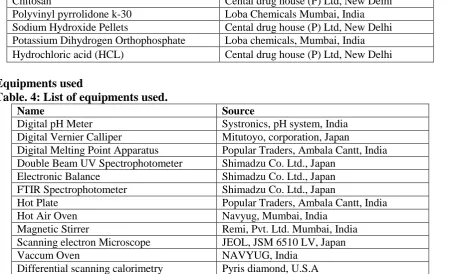
Table. 3: List of chemicals used.
Chemicals Manufacturers
Sumatriptan Succinate Azakem Labs Pvt. Ltd., Hyderabad
Hydroxy propyl methyl cellulose E 5 LV Loba chemicals, Mumbai, India
Glycerin Cental drug house (P) Ltd, New Delhi
Mannitol Qualikems Fine Chem Pvt. Ltd
Chitosan Cental drug house (P) Ltd, New Delhi
Polyvinyl pyrrolidone k-30 Loba Chemicals Mumbai, India
Sodium Hydroxide Pellets Cental drug house (P) Ltd, New Delhi
Potassium Dihydrogen Orthophosphate Loba chemicals, Mumbai, India
Hydrochloric acid (HCL) Cental drug house (P) Ltd, New Delhi
[image:6.595.77.529.493.767.2]Equipments used
Table. 4: List of equipments used.
Name Source
Digital pH Meter Systronics, pH system, India
Digital Vernier Calliper Mitutoyo, corporation, Japan
Digital Melting Point Apparatus Popular Traders, Ambala Cantt, India Double Beam UV Spectrophotometer Shimadzu Co. Ltd., Japan
Electronic Balance Shimadzu Co. Ltd., Japan
FTIR Spectrophotometer Shimadzu Co. Ltd., Japan
Hot Plate Popular Traders, Ambala Cantt, India
Hot Air Oven Navyug, Mumbai, India
Magnetic Stirrer Remi, Pvt. Ltd. Mumbai, India
Scanning electron Microscope JEOL, JSM 6510 LV, Japan
Vaccum Oven NAVYUG, India
METHODOLOGY
Characterization of SS (Sumatriptan Succinate)
Physical appearance test
SS was observed for colour, odour and physical state.
Melting point
Melting point of SS was determined using capillary method. Drug was filled into the
capillary tube sealed at one end Upto the height of 3 mm from the sealed end. Capillary was
introduced into the digital melting point apparatus. Melting point was noted from the
temperature at which drug starts melting to the temperature at which entire sample melts.
FTIR spectra analysis
A FT-IR spectrum of SS was recorded by Potassium bromide (KBr) palletization method.
Drug was mixed with KBr and was compressed into small thin disk, which was subsequently
analyzed by FT-IR spectrophotometer. Obtained spectra were analyzed for characteristic
peaks corresponding to specific functional groups present in the drug molecule. These peaks
were considered as a reference for further drug-excipient compatibility studies.
Analytical method development
Determination of absorption maxima (λmax).
Sumatriptan Succinate (10mg) was accurately weighed and transferred to a 100 ml
volumetric flask. To this pH 6.8 phosphate buffer was added to dissolve the drug and make
up the volume Upto 100 ml. The resultant solution was having concentration of 100 µg/ml.
Then take the scan to get the absorption maxima by using double beam UV-visible
spectrophotometer.
Calibration plots of Sumatriptan succinate (SS) in pH 6.8 phosphate buffer
The calibration plot of Sumatriptan Succinate was prepared in pH6.8 phosphate buffer. From
the 100µg/ml solution 0.5, 1.5, 2.5, 3.5, 4.5, 5.5 and 6.5 ml were withdrawn separately into
pre calibrated 10 ml volumetric flask and volume was made up to the mark by using
phosphate buffer USP (pH 6.8). Absorbance was recorded at 227nm by using double beam
UV spectrophotometer. All the measurements were done in triplicate and were statistically
analyzed. A calibration plot was constructed between concentration (μg/ml) on X- axis and
absorbance on Y- axis. The linear regression equation and linear regression coefficient were
Calibration plots of Sumatriptan succinate (SS) in pH 7.4 phosphate buffer
The calibration plot of Sumatriptan Succinate was prepared in pH 7.4 phosphate buffer. From
the 100µg/ml solution 1.5, 2.5, 3.5, 4.5 and 5.5ml were withdrawn separately into pre
calibrated 10 ml volumetric flask and volume was made up to the mark by using phosphate
buffer USP (pH 7.4). Absorbance was recorded at 227nm by using double beam UV
spectrophotometer. All the measurements were done in triplicate and were statistically
analyzed. A calibration plot was constructed between concentration (μg/ml) on X- axis and
absorbance on Y- axis. The linear regression equation and linear regression coefficient were
then calculated from the calibration plot.
Drug Excipients compatibility studies
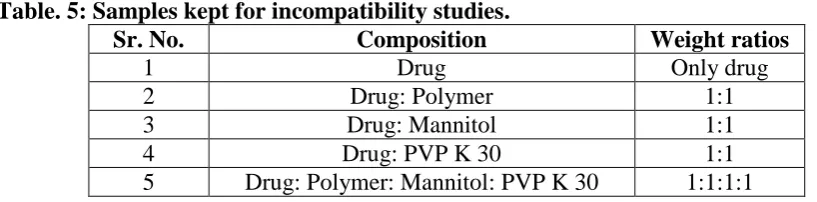
To test the compatibility of the excipients with SS, they were individually mixed with SS in
1:1 w/w proportion (Table 5). Resultant mixtures (along with suitable control samples) were
transferred to open glass vials sealed and were exposed directly to the variety of temperature
and humidity conditions (5˚C i.e. refrigerator conditions and 40˚C/ 75% RH i.e. accelerated
conditions) for 15 days. After that the samples were analyzed for change in their physical
appearance i.e. colour change, flow characteristics and lump formation and odour change.
Chemical incompatibility was tested by analysing the presence and/or alteration of peak
[image:8.595.74.483.474.575.2]values corresponding to specific functional groups present in drug molecule.
Table. 5: Samples kept for incompatibility studies.
Sr. No. Composition Weight ratios
1 Drug Only drug
2 Drug: Polymer 1:1
3 Drug: Mannitol 1:1
4 Drug: PVP K 30 1:1
5 Drug: Polymer: Mannitol: PVP K 30 1:1:1:1
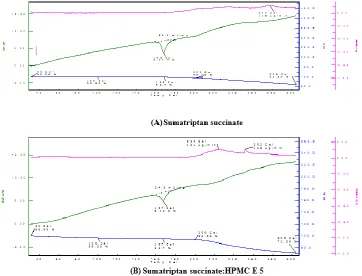
Differential scanning calorimetry (DSC)
The DSC profile of pure and physical mixtures of Sumatriptan was recorded on Perkin Elmer
DSC-4 (Pyris Diamond, U.S.A). Thermal behaviour was studied under normal conditions
with perforated and sealed quartz pans and with a nitrogen gas flow of 200ml/min. The
samples ( 100mg for pure drug, 1:1 for Sumatriptan + HPMC E5, 1:1 for Sumatriptan +
mannitol, 1:1 for Sumatriptan + PVP K30, 1:1:1:1 for Sumatriptan + HPMC E5 + Mannitol +
PVP K30) were heated at 5oC/min over a temperature range of 34-300oC. The reference
sample used in all the determinations was alumina with a height of 5mg. Peak temperatures
Preparation of Fast Dissolving Sublingual Films (FDSF’S)
FDSF‟S were prepared by solvent casting method. Firstly HPMC E 5/PVP K 30 was
dissolved in 10ml distilled water and stirred until the solution becomes clear. The solution
was allowed to stand for 1 hr so that the air bubbles were cleared completely. Another
solution was prepared by dissolving drug, plasticizer and mannitol in required distilled water.
Both the prepared solutions were mixed together and were stirred for 1.5 hrs. After stirring,
solution was poured into a 9cm petri plate and was dried in hot air oven at 45oC for
overnight. A film of 2×2 cm2 dimensions was cut down from the petri plate. Prepared film
were valuated for thickness, tensile strength, percent elongation, disintegration time,
dissolution study and mucoadhesion study.[14]
Table. 6: Composition of films.
Formulation code
HPMC E5/PVP K 30
(mg) Plasticizer(mg)
Sweetener (mg)
Drug
(mg) Remarks
F1 50/10 80 20 35 Film was not formed
F2 200/10 80 20 35 Film was formed but
breakage was their
F3 400/10 80 20 35 Uniform film was
formed
F4 450/10 80 20 35 Film formed but do not
sustain its integrity
Evaluation of Sublingual films
Physical evaluation
Film forming capacity
It is the ability of film formers to form desired films. It is categorized according to film
forming capacity such as very poor, poor, average, good, very good and excellent.[15]
Appearance of films
It is evaluated by visual observation such as transparent or opaque.[16]
Weight variation
The film of dimension 2×2 cm2 was cut at three different places from the casted film. The
Thickness
The thickness of the patch was measured using digital Vernier Calliper with a least count of
0.01 mm at different position of the film. The thickness was measured at five different
positions of the film and average was taken and standard deviation was calculated.
Mechanical evaluation
Folding endurance
To determine folding endurance, a film was cut and repeatedly folded at the same place till it
broke. The number of times the film could be folded at the same place without breaking gives
the value of folding endurance.[17]
Tensile strength
The Tensile strength (psi) is the property of the film that requires a load to cause load
deformation failure of film. Film strips in special dimension and free from air bubbles or
physical imperfections were held between two clamps positioned at a distance of 3 cm.
During measurement, the strips were pulled by the top clamp at a rate of 100 mm/min; the
force and elongation were measured when the film broke. Tensile strength was obtained by
following equation:
Tensile strength Force at break Initial cross-sectional area of the sample
Percent elongation
The percent elongation is measured when the film snaps as sufficient force applied so as to
exceed the elastic limit. Percentage elongation was obtained by following equation.[18]
% Elongation = Increase in length at breaking point (mm) / original length (mm) × 100
Surface pH
The surface pH of fast dissolving film was determined in order to investigate the possibility
of any in vivo side effect. As an acidic or alkaline pH may cause irritation of the mucosa, so
the surface pH of the films was determined to check whether its neutralising or not. A pH
electrode was used for this purpose. The film was allowed to swell in closed petri dish for 30
min. The pH was measured by bringing the electrode in contact with the surface of the
sublingual film. The procedure was performed in triplicate and average with standard
In-vitro Disintegration
The disintegration time is the time when the film starts to break or disintegrates. In vitro
disintegration time was determined in a petri dish containing 25ml of pH 6.8 phosphate
buffer at 37±0.50C with swirling every 10 sec.[19]
Drug Content
Drug content determination of the film was carried out by dissolving the film of 4 cm2 in 100
ml of pH 6.8 phosphate buffer using magnetic stirrer for 1 hour. The drug concentration was
then evaluated spectrophotometrically at λmax of 227 nm. The determination was carried out
in triplicate and average with standard deviation was recorded.
Dissolution test
In vitro dissolution test was carried out according to the USP type II dissolution apparatus.
900ml of pH 6.8 phosphate buffer was taken as dissolution media, the temperature was
maintained at 37±0.5°C with a rotation speed of 50rpm. Five ml of sample was taken at
regular intervals which were replaced with same volume of fresh pH 6.8 phosphate buffer
and take the absorbance at 227 nm with the help of double beam UV-Visible
spectrophotometer.
Scanning electron microscopy (SEM)
The morphological characteristics of the Sublingual films were studied by scanning electron
microscopy (JEOL, JSM-6510 LV SEM). The film sample was placed in the sample holder
and the SEM micrographs were taken at 10,000x and 3000 magnification using tungsten
filament as an electron source. Films were fixed onto a metallic stub with double sided
conductive tape (diameter 12 mm, Oxon, Oxford Instruments, UK).
RESULT AND DISCUSSION
Characterization of SS
Physical appearance test
Result of physical characterization of SS is listed in Table.7. No variations were found in its
specification in Certificate of Analysis (COA) and observations recorded at the time of
Table. 7: Physical characterization of SS.
Sr.No. Parameter Observation
1. Odour Odourless
2. Colour White
3. Appearance Powder
Melting point
Experimentally observed melting point (Table.8) complies with reported melting point in
[image:12.595.97.504.399.550.2]literature.[20]
Table. 8: Melting point of SS.
Sr.No. Parameter Specification in literature Melting point
1. Melting point 168.220C 168oC
FTIR spectra analysis
The FT-IR spectra of procured sample show comparable principle absorption bands with that
of FT-IR spectra of working standard of SS obtained from industry (Fig.1 and Table.9).
Compliance between the values of characteristic peaks indicates the purity of drug.
Fig. 1 IR spectra of Sumatriptan succinate.
Table. 9: FTIR spectra analysis of SS.
The IR spectra of the given sample show comparable principle absorption band. This
matching for characteristic peak of drug with that of standard confirms the purity of drug.
Sr.No. Standard value range (cm-1) Observed value Interpretation
1. 3395-3180 3363.97 N-H stretch
2. 1081-1030 1080.17 S=O stretch
3. 700-600 638.46 C-S stretch
[image:12.595.83.514.610.685.2]Analytical method development
Determination of absorption maxima
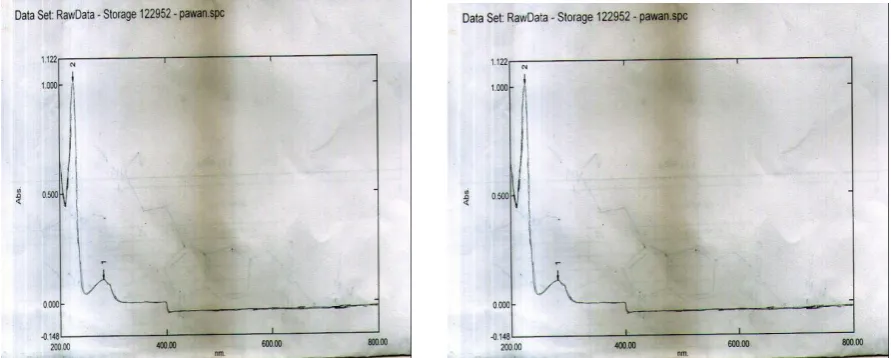
Irrespective to the nature of media the λmax of SS was found to be 227nm (Fig.2).
Fig.2 Determination of λmax of SS in different media (A) phosphate buffer USP (pH
6.8) and (B) phosphate buffer USP (pH 7.4).
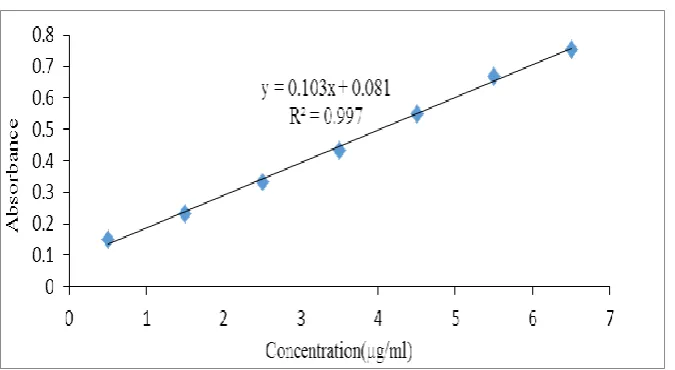
Construction of calibration plots for SS
Calibration plots of SS were developed in phosphate buffer USP (pH 6.8) and phosphate
buffer USP (pH 7.4). Reason behind selecting above mentioned buffers comprises the
resemblance of their pH with characteristic sites within the body that are required to be
considered for the development of sublingual dosage form.
Table. 10 Calibration curve of Sumatriptan succinate in pH 6.8 phosphate buffer.
Sr.No. Conc. Abs.
1 0.5 0.148±0.000577
2 1.5 0.231±0.000577
3 2.5 0.334±0.001
4 3.5 0.434±0.002
5 4.5 0.549±0.001528
6 5.5 0.667±0.002
7 6.5 0.775±0.0157
[image:13.595.75.521.148.327.2]Fig. 3 Calibration curve of Sumatriptan succinate in 6.8 pH phosphate buffer.
Table. 11 Calibration curve of Sumatriptan succinate in pH 7.4 phosphate buffer.
Sr.No. Conc. Abs.
1 1.5 0.212±0.000577
2 2.5 0.311±0.001
3 3.5 0.421±0.000577
4 4.5 0.534±0.001528
5 5.5 0.623±0.001
Data are represented as mean ± S.D (n=3).
Fig. 4 Calibration curve of Sumatriptan succinate in 7.4 pH phosphate buffer.
Drug excipients compatibility studies
Physical drug excipient compatibility studies concluded that there was no lump formation,
flow change, colour change or odour change during the time of storage at specified storage
conditions. The DSC results and the IR spectra revealed that no interaction between the drug
[image:14.595.127.467.425.615.2]no shift in the IR peaks of the drug.There was no shifting in IR peaks of the samples kept at
different environmental conditions with respect to initial sample and control samples as
shown in Fig. 5 & 6 and Table. 12 which confirm the compatibility of drug with different
excipients.
Table. 12 Physical compatibility study of the Sumatriptan Succinate with different
excipients.
Composition Control
(RT)
50C 450C/75% RH
Initial 15thday Initial 15th day
Drug
Drug: Polymer
Drug: Mannitol
Drug: PVP K30
Drug: Polymer: Mannitol: PVP K30
Refers to the same as original.
(A) Sumatriptan succinate.
(B) Sumatriptan succinate:HPMC E 5.
(D) Sumatriptan succinate:PVP K 30.
(E) Sumatriptan succinate: HPMC E 5: PVP K 30: Mannitol.
Fig. 8.5 FTIR spectra of (A) Sumatriptan Succinate (B) Physical mixture of
Sumatriptan Succinate and HPMC E5 (C) Physical mixture of Sumatriptan Succinate
and Mannitol (D) Physical mixture of Sumatriptan Succinate and PVP K 30 (F)
[image:16.595.108.471.448.724.2](C) Sumatriptan succinate: Mannitol.
(D) Sumatriptan succinate:PVP K 30.
Preparation of fast dissolving sublingual films
Initially the film forming polymer i.e. HPMC E5 and permeation enhancer i.e. PVP K30 were
used for the preparation of films in different conc. i.e. 50/10mg, 200/10mg, 400/10mg and
450/10mg. Best concentration was further used for the preparation of film (400/10mg) due to
[image:18.595.141.455.187.397.2]their uniformity.
Fig.7 Sumatriptan sublingual film.
Evaluation of sublingual film
[image:18.595.143.449.502.577.2] Film forming capacity
Table. 13 Results of film forming capacity.
Sr.No. Formulation code Film forming capacity
1 F1 Very poor
2 F2 Poor
3 F3 Very good
4 F4 Average
Appearance of films
Table. 14: The results of appearance of films.
Sr.No. Formulation code Appearance
1 F1 Transparent
2 F2 Transparent
3 F3 Transparent
[image:18.595.164.428.631.706.2] Weight Variation
Three films each of 4cm2 were cut at three different places from the casted film and weight
[image:19.595.85.447.168.202.2]variation was determined. The result of weight variation is shown in Table 15.
Table. 15: Results of weight variation.
Sr.No. Formulation code Mean ± S.D.
1 F3 54.66±2.516611
Data are represented as mean ± S.D (n=3).
Thickness
Thickness of film was done in triplicate and then average and standard deviation was taken.
The results of thickness are given in Table.16.
Table. 16 Results of thickness.
Sr.No. Formulation code Mean±S.D.
1 F3 0.05±0.005774
Data are represented as mean ± S.D (n=3).
Folding endurance
Mechanical strength is an important aspect for any type of dosage forms. It has got very
significant prospects as far as industrial requirement is concerned. A good mechanical
property is always an indication that the product is going to withstand any cut, wear and tear
or damage during handling or transportation. Therefore, this is very critically evaluated. As
friability is the official evaluation of tablets to ensure mechanical strength, folding
resilience/endurance is the evaluation parameter of films/patches. Folding endurance of film
was done in triplicate and then average and standard deviation was taken. The results of
folding endurance are given in Table. 17.
Table. 17: The results of folding endurance.
Sr.No. Formulation code Mean±S.D.
1 F3 286±1
Data are represented as mean ± S.D (n=3).
Tensile strength and Percent elongation
Tensile testing is an indication of the strength or the toughness and elastic behaviour of the
film, measured by the parameters tensile strength (TS), percent elongation, sometime denoted
hard and brittle film is defined by a moderate TS and low E/B. Hence it is suggested that a
suitable buccoadhesive film should have a relatively moderate TS and E/B. The results of
tensile strength and Percent elongation are given in Table.18.
Table. 18 Results of Tensile strength and Percent elongation.
Sr.No. Formulation code Tensile strength Percent elongation
1 F3 3.85 20
Surface pH
Surface pH of film was done in triplicate and then average and standard deviation was taken.
The results of surface pH are given in Table.19 The results showed that the prepared films
were suitable for buccal administration as the pH of buccal region is nearly 6.5.
Table. 19: The results of surface pH.
Sr.No. Formulation code Mean ± S.D.
1 F3 6.88 ± 0.051962
Data are represented as mean ± S.D (n=3).
In-Vitro Disintegration
In-Vitro Disintegration of film was done in triplicate and then average and standard deviation
[image:20.595.77.498.165.201.2]was taken. The results of in-Vitro Disintegration are given in Table. 20.
Table. 20: The results of in vitro disintegration.
Sr.No. Formulation code Mean ± S.D.
1 F3 55 ± 1
Data are represented as mean ± S.D (n=3).
Drug content
The prepared film formulation was assayed for drug content. Actual drug content in the
prepared films was in the range of 95-105% of the claimed content. This indicates the even
distribution of the drug in the prepared matrix of the films as well as the stability of drug in
the procedure used for preparation. It was observed that the formulation was satisfactory in
uniformity of drug as given in Table. 21.
Table. 21: The results of drug content.
Sr.No. Formulation code Mean ± S.D.
1 F3 2.26 ± 0.015275
[image:20.595.76.453.310.359.2] In-vitro Dissolution
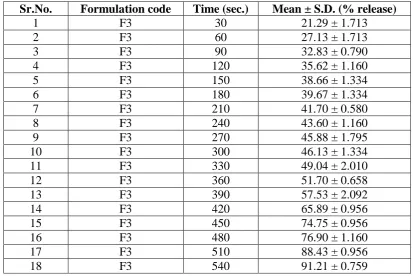
In-Vitro Dissolution of film was done in triplicate and then average and standard deviation
was taken. 91.21% of drug was released from the film within 540 sec. The results of in-Vitro
[image:21.595.90.504.189.465.2]Dissolution are given in Table. 22 and Fig. 8.
Table. 22: The results of in vitro dissolution.
Sr.No. Formulation code Time (sec.) Mean ± S.D. (% release)
1 F3 30 21.29 ± 1.713
2 F3 60 27.13 ± 1.713
3 F3 90 32.83 ± 0.790
4 F3 120 35.62 ± 1.160
5 F3 150 38.66 ± 1.334
6 F3 180 39.67 ± 1.334
7 F3 210 41.70 ± 0.580
8 F3 240 43.60 ± 1.160
9 F3 270 45.88 ± 1.795
10 F3 300 46.13 ± 1.334
11 F3 330 49.04 ± 2.010
12 F3 360 51.70 ± 0.658
13 F3 390 57.53 ± 2.092
14 F3 420 65.89 ± 0.956
15 F3 450 74.75 ± 0.956
16 F3 480 76.90 ± 1.160
17 F3 510 88.43 ± 0.956
18 F3 540 91.21 ± 0.759
[image:21.595.128.458.494.697.2]Data are represented as mean ± S.D (n=3).
Scanning electron microscopy
Morphological characteristic of sublingual film (F3) was studied by scanning electron
microscopy. Study was done at 10,000 and 3000 magnification. Integrity of the structure was
analysed and found to be intact with some cuboidal crystals of PVP K30 dispersed on the
films. Smooth surface of film also confirms the uniform distribution of drug and polymers.
Smooth surface may help in the proper adhesion of film to the site of action i.e., buccal
mucosa). The results are given in Fig.9.
(A)
(B)
Fig.9 Scanning electron microscopic images of Film (F3) at the magnification of (A)
Ex vivo Permeation studies
The oral mucosa represents a barrier to drug permeation and it is intermediate between skin
epidermis and the gut in its permeability characteristics. The permeability study defines the
effectiveness of SS to move across this barrier and providing enough evidence that the buccal
absorption could provide means for SS administration. Therefore, in vitro permeability
experiments of SS were conducted. 72.55% of drug release was found to be permeated after
[image:23.595.98.507.269.639.2]18 min. confirming appreciable permeation of drug through film. The results are given in
Table. 23 and Fig. 10.
Table. 23: The results of ex vivo permeation studies.
Sr.No. Formulation code Time (min.) Mean ± S.D. % Release
1 F3 2 0.102 ± 0.004 8.74
2 F3 4 0.121 ± 0.002 10.19
3 F3 6 0.236 ± 0.010 18.96
4 F3 8 0.356 ± 0.011 28.129
5 F3 10 0.432 ± 0.014 33.93
6 F3 12 0.576 ± 0.008 45.02
7 F3 14 0.751 ± 0.018 58.28
8 F3 16 0.879 ± 0.009 67.05
9 F3 18 0.938 ± 0.010 72.55
[image:23.595.120.480.433.637.2]Data are represented as mean ± S.D (n=3).
Fig.10 Plot of ex vivo permeation of sublingual film.
CONCLUSION
Fast dissolving films have been introduced in the market recently as they provide
convenience and ease of use over other dosage forms such as disintegrating tablets. The use
films has been the focus of attention in recent years. Drug chosen for study is Sumatriptan
succinate which is serotonin 5-HT1 receptor agonist that potently and selectively binds to
5-HT1B/1D subtype present mainly in brain. It is used mainly in acute attack of migraine. The
identification of Sumatriptan succinate was confirmed by melting point and IR spectra. In the
present study fast dissolving sublingual films of Sumatriptan succinate were prepared by
solvent casting method using polymer HPMC E5/PVP k30 and their combinations along with
different concentration of plasticizer. Hydroxy propyl methylcellulose (HPMC E5) and
mannitol were used as excipients due to their excellent film forming property and palatable
taste. Glycerine was used as a plasticizer. Studies were carried out using different conc of the
polymer/pvp k30 i.e. 50/10mg, 200/10mg, 400/10mg and 450/10mg but only in
400/10mg(F3) uniform film was formed and in others film was formed but don‟t sustain its
integrity and in some breakage was there. The high percentage drug release of formulation F3
was observed with approximately 91.25% of Sumatriptan succinate release within 540 sec.
The formulation F3 also showed high percentage of drug permeated during ex vivo
permeation study. Thus it may conclude that these combination systems of HPMC E5 along
with PVP K30 have potential for consideration for drug delivery through FDFs.
Therefore, on the basis of the data obtained from the in vitro and ex vivo studies, the
formulation F3 is the promising formulation for the immediate release of Sumatriptan
succinate through sublingual route since they exhibited maximum drug release and
permeation. The present fast dissolving sublingual film containing Sumatriptan succinate is
considered to be potentially useful for treatment of acute migraine patients especially for
pediatrics and elderly patients due to its convenience.
REFERENCES
1. David, H., & Joseph, R. R. (1992). Drug delivery via mucous membrane of the oral
cavity. Journal of Pharmaceutical Sciences, 81(1): 1– 10.
2. Hoogstraate, A. J., Verhoef, J. C., Tuk, B., & Pijpers, A. (1996). In-vivo buccal delivery
of flourescein isothiocyanate-dextran 4400 with glycodeoxycholate as an absorption
enhancer in pig. Journal of Pharmaceutical Sciences, 85(5): 457–460.
3. Tayel, S.A., Mohamed A. El Nabarawi., Maha Amin, M. and Mohamed H, Abou Ghaly.,
2015. Sumatriptan succinate sublingual fast dissolving thin films: formulation and
4. Dhere, P.M. and Patwekar, S L., 2011. Review on preparation and evaluation of oral
disintegrating films IJPT, 3(4): 1572-1585.
5. Tepper, S.J., Spears, R. C., 2009. Acute treatment of migraine. Neurol. Clin. 27: 417-427.
6. Goadsby, P.J., 2003. Migraine: diagnosis and management. Int. Med. J. 33: 436- 442.
7. Dhillon, K. S., Singh, J., Lyall, J. S., 2011. A new horizon into the pathobiology, etiology
and treatment of migraine. Med. Hypotheses. 77: 147- 151.
8. Jhee, S., Shiovitz, T., Crawford, Cutler, N. R., 2001. Pharmacokinetics and
pharmacodynamics of the triptan Antimigraine agents. Clin. Pharmacokinet. 40: 189-205.
9. Panda, B.P., Dey, N.S, 2012. Rao M.E.B, Development of innovative orally fast
disintegrating film dosage form. A review, International Journal of pharmaceutical
science and nanotechnology, 5: 1666-1667.
10.Arunachalam, A., Karthikeyan, M., Ashutoshkumar, S., and Kishore, K., 2010. Fast
Dissolving drug delivery system: a review, Journal of Global Trends in Pharmaceutical
Sciences, 1(1): 92-110.
11.Arya, A., Chandra, A., Sharma, V., Pathak, K., 2010. Fast dissolving oral film: Innovative
drug delivery system and dosage form. International Journal Of Chemtech Research 2:
576-583.
12.Siddiqui, nehal, M.D., Garg, G., Sharma, P.K., 2011, A Short Review on “A Novel
Approach in Oral Fast Dissolving Drug Delivery System and Their Patents”, Advances in
Biological Research, 5: 291-303.
13.Pandya, K., Patel K.R., Patel, M.R., Patel, N.M., 2013. Fast dissolving film: A novel
approach to oral drug delivery, International Journal of Pharmacy Teaching and Practice,
4: 655-661.
14.Kalia, V., Garg, T., Rath, G., & Kumar Goyal, A., 2014. Development and evaluation of a
sublingual film of an antiemetic granisetron hydrochloride. Informa healthcare, 1-5.
15.Dixit, R.P., Puthli, S.P., 2009. Oral strip technology: Overview and future potential. J.
Controlled Release. 139: 94-97.
16.Mashru, R.C., Sutariya, V.B., Sankalia, M.G., and Parikh, P.P. 2005. Development and
evaluation of fast dissolving film of Salbutamol sulphate. Drug Dev Ind Pharm. 31(1):
25-34.
17.Sushma, M., Prasanna, Y.R., Sundaresan, C., Vandana, K., Kumar, N.V. and Chowdary,
V.H., 2014. Transmucosal delivery of metformin- a comprehensive study. Curr Drug
18.Shaik, R. F., 2013. Formulation and Characterization of Domperidone Oral Thin Films,
International Journal of Pharma Sciences, 3: 126-128.
19.Gohel, M.C., Sharma, R., 2009. Development of taste masked film of valdecoxib for oral
use. Ind. J. Pharm. Sci., 69: 320-323.
20.Tayel, S.A., Mohamed A. El Nabarawi., Maha Amin, M., and Mohamed H, Abou Ghaly.,
2015. Sumatriptan succinate sublingual fast dissolving thin films: formulation and