Effect of SiC and Zinc Sterate on the Mechanical
and Metallurgical Characterization of
Functionally Graded Material using Powder
Metallurgy
Y Manideepvarma1, PNS Srinivas2, Dr. P. Ravindra Babu3, Dr. B. BalaKrishna4 1
M.Tech (Machine Design) Gudlavalleru Engineering College, Gudlavalleru. 2
Assistant Professor, Gudlavalleru Engineering College, Department of Mechanical Engineering, Gudlavalleru. 3
Professor, Gudlavalleru Engineering College, Department of Mechanical Engineering, Gudlavalleru. 4
Professor, Department of Mechanical Engineering JNTUK, Kakinada.
Abstract: Today Functionally Graded Material (FGM) has become the emerging trend in the field of advanced composite material to replace the conventional composite materials. It not only provides tensile, impact strength to the material but offers functional requirements to a material at different operating conditions. The overall properties of FMG are unique and different from any of the individual material that constitutes it. There are a enormous applications of FGM starting from a automobile industry to space related applications due to its volume effecting properties. In our work of FGM by PM process we have selected pure aluminium of 98% purity as the matrix material and SiC as the reinforcing agent.To increase bondage between mixed ratios from one another Zinc stearate also included in this FGM preparation. In this paper the blended elemental technology by a simple pressing and sintering method has been initiated using Aluminium, silicon and zinc stearate. Main part of work was done on Al - Sic (wt. %) composition. Chemical characteristics of initial powders, temperature and time of sintering were main variables of the study. In addition to this it is found that with increase in sintering time, the hardness is increasing. Micro structural analysis showed a phase and structural homogeneity of the synthesized material.
Keywords: Functionally graded material, powders, Sintering, Powder metallurgy and Micro structure.
I. INTRODUCTION
Functionally graded materials (FGM) can be obtained by layered mixing of two or more materials of different thermo- mechanical properties with different volume ratio by gradually changing from layer to layer such that the first layer has only a few particles of second phase and the last has the maximum volume ratio of the first phase. This project aims at the processing of functionally graded metal matrix composites (MMCs), green compacts of silicon carbide (SiC) reinforced with Aluminium as matrix material to produce composite material by adopting powder metallurgy technique. Functionally graded composites are widely used in various components of automobile and aeronautical industries because of their superior material properties in functional and operational requirements than that of conventional composite materials. It not only possess high stiffness to weight ratio and high impact strength but the backdrop of the material is the sharp interfaces between the molecules in structural level. The green compacts have been prepared by incorporating SiC particles to pure Aluminium matrix material in different weight fractions (5%, 10%, 15%, & 20%). The mechanical and tribological properties of these compacts are determined to assess various functional requirements and also assessing the effectiveness of the adopted fabrication technique. This method is an effective way to change the properties of the materials as required in different directions.
II. EXPERIMENTAL WORK
The main work consists of selecting the materials in an effective way to obtain the required properties.
A. Powder Materials
density and high specific stiffness. Pure Aluminium is a silvery- white coloured metal with a bluish tinge and with high reflectivity for both heat and light. It forms a tightly adherent transparent oxide film when exposed to air. This film is resistant to corrosion in ordinary media. Although this property is useful in resisting corrosion, it is troublesome when soldering, welding and electroplating. Particle size of received Aluminium is of 50microns used for the experiment. Melting point: 660.4 °C, Density: 2.7 g/cm³.
TABLE I
Chemical Composition Of Pure Aluminium (98%) Element Weight (%)
Si 0.41
Fe 0.15
Mn 0.023
Mg 0.38
Ti 0.016
Al Balance
[image:2.612.206.404.373.497.2]Micro-sized SiC particles are commonly used as reinforcement materials for ceramics, metals and alloys for various structural and Tribological applications. It has high mechanical strength, high hardness, low density, high thermal conductivity, low thermal expansion coefficient, large band gap and excellent oxidation and corrosion resistances. Silicon carbide is also known as “carborundum”. Particle size of received silicon carbide is in the range of 50microns is used for the experiment. Melting point: 2,730 °C, Density: 3.21 g/cm³.
TABLE III
Chemical Composition Of Silicon Carbide (99%) Element Weight (%)
C 29.0
O 1.5
Fe 0.05
Al 0.03
Ca 0.01
B. Sample Preparation
The FGM material composition obviously considering ball milling and die preparation and the preoccupation of each layer was performed at a lower pressure before stacking the adjacent layer under high pressure to ensure on exact compositional distribution with in the layers.
Each specimen consists of 4 individual layers and each layer has specific composition of Al and SiC weight fractions.
TABLE IIIII
Chemical Composition Of Specimen Layers Chemical Composition (%)
I 90% Al + 10% SiC
II 90% Al + 5% SiC + 5% Zinc Stearate
III 85% Al + 10% SiC + 5% Zinc Stearate
IV 80% Al + 10% SiC + 10% Zinc
C. Specimen Size and Specifications
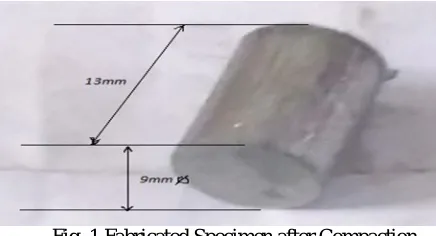
Fig. 1 Fabricated Specimen after Compaction
For this purpose of study four specimens were considered and each of size ø9mm and thickness of 13mm as shown in Fig. 1. For each specimen is fabricated at 17kN compaction pressure. Therefore all together four specimens are fabricated and tribution within the layers.
Each specimen is fabricated Al with different weight percentages of SiC. Specimens are prepared according to the following composition in the Table III.
Mass of Al = density× volume
Volume of specimen=area of specimen × thickness. Mass of Al = ρ × v (grams)
III. EXPERIMENTAL PROCEDURE
For this, Powder Metallurgy method is chosen due to its advantages. The following are the considered steps.
A. Powder Metallurgy
Powder Metallurgy may be defined as the art of producing metal powders and using them to make serviceable objects. This method has gained popularity because of the high strength, ductility and toughness that can be obtained by this route. One of the outstanding uses of powder metallurgy is the combination of hard materials in a metallic matrix. Moreover, powder metallurgy is more economical than most other manufacturing processes.
Powder Metallurgy processing involves the following stages:
1) Preparation of the powder materials in powder form,
2) Forming operations which has an open interconnected pore structure to remove volatile contaminants water vapor, and gases,
3) Processing of the powder i.e., compacting (cold pressing) the homogeneous blend to roughly 80% density,
4) The sintering or pressure-assisted hot Isostatic pressing.
Powder metallurgy methods involve cold pressing and sintering, or hot pressing, to produce MMCs. The matrix and the reinforcement powders are blended to produce a homogeneous distribution. The blending stage is followed by cold pressing to produce what is called a green part, which is about 80% dense and can be easily handled. The cold pressed green part is canned in a sealed container and degassed to remove any absorbed moisture from the particle surfaces. The final step is hot pressing, uniaxial or Isostatic, to produce a fully dense composite. The hot pressing temperature can be either below or above that of the matrix alloy solidus
B. Sintering
Sintering is the process of heating the green part in a furnace to cause some of the constituent materials of the FGM to be melted or surface melted. The sintering process is usually carried out at a temperature below the highest melting constituent. Sintering occurs by diffusion of atoms through the microstructure. This diffusion is caused by a gradient of chemical potential – atoms move from an area of higher chemical potential to an area of lower chemical potential. The different paths the atoms take to get from one spot to another are the sintering mechanisms
BHN
Fig. 2 Tubular Furnace
The compacted pellets were taken and heated in a tubular furnace as shown in Fig. 2. in a closed atmosphere at temperatures of 500 and 550 to densify the compacted powder samples. A heating rate of 5 /min was maintained and the holding time for the
samples was 30 min. The densities of the sintered samples were calculated and the theoretical density of the samples was calculated. The sintered density for each of the specimen was measured using Archimedes’ Principle. The densification parameter was also calculated to get an idea of amount of densification.
IV. RESULTS AND DISCUSSIONS
C. Hardness Measurement
The hardness of the composite specimens were measured by Brinell hardness tester. The samples was measured under a load of 187.5kgf and ball diameter of 3 mm is used for a dwell time of 15 seconds. The impressions are taken down and measured through optical microscope. For each sample at least five measurements were taken at equivalent positions of the sample and resulted graph Fig.3.
200
150
100
50
0
Fig. 3 Hardness Test Results
100% Al 90% AL
+ 10%
90%Al+ 5%SiC+
85%Al+ 10%SiC
80%Al+
10%SiC FGM
[image:4.612.176.431.480.672.2]D. Wear Testing
To study wear behaviour of composite specimens ball-on-plate type wear testing instrument. The wear specimen with a diameter of 9mm and a height of 15mm was prepared. The ends of the specimens were polished using abrasive paper with a grade of 600 first, and then with a grade of 1000. The sliding end of the pin-and disc surface was cleaned with acetone before testing.
Condition Data
Pin Material 80% Al + 10% SiC + 10% Zinc Stearate Disc Material EN 31 disc steel with a hardness of
75HRC
Pin Dimensions 15*9*9mm3
Time(minutes) 30
Load(N) 50
[image:5.612.153.461.324.621.2]Track diameter (mm) 70 Disc speed(rpm) 400
Table IV: Wear Rate Conditions
The composites are mounted on pin on disc wear test apparatus of model TR-201 and To study wear behavior of composite specimens pin on disc methodology is adopted.
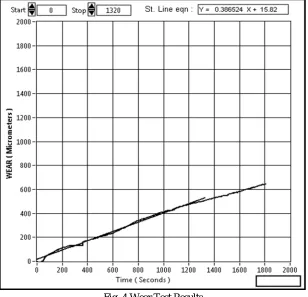
Tests were carried out with an 9mm diameter, 400 rpm rotational speed for a period of 30 minutes and resulted graph as shown in Fig.4.
Fig. 4 Wear Test Results
E. SEM Testing
SEM (Scanning Electron Microscope)
A SEM is a type of electron microscope that produces images of a sample by scanning the surface with a focused beam of electrons. The electrons interact with atoms in the sample, producing various signals that contain information about the surface topography and composition of the sample.
Edge 1
Center
V. CONCLUSION
Aluminium Metal matrix composites with different weight proportions of Silicon carbide (SiC) are fabricated successfully. Hardness test on the composites have done successfully and it was found that specimen of two different compositions 85% AL + 10% SiC + 5% Zinc stearate attained hardness of 152.588 BHN highest among other reinforcement. Hardness of material with goes on increasing with percentage of SiC
Wear test of composites have done successfully by using pin on disc wear test apparatus (TR 201) and found out that highest coefficient of friction is 0.59 at frictional force 30N having the wear rate of 400 microns
In the SEM and EDS Tests, we observed that proper mixing of elements and specified arrangement of layers are successfully accomplished.
VI.ACKNOWLEDGMENT
A very special thanks to Dr. SEELAM PICHI REDDY, HOD of Mechanical Department, LBRCE and thanks to VIGNAN UNIVRSITY.
REFERENCES
[1] A.C. Vieira, P.D. Sequeira, J.R. Gomes, and L.A. Rocha, Dry sliding wear of Al alloy/SiCp functionally graded composites: Influence of processing conditions, Wear 267, 2009, pp. 585–592.
[2] El-Galy, Islam & Ahmed, M.H. & Saleh, Bassiouny, Characterization of functionally graded Al-SiC p metal matrix composites manufactured by centrifugal casting, Alexandria Engineering Journal. 56. 10.1016/j.aej.2017.03.009.
[3] T.P.D. Rajan and B.C. Pai, Processing of Functionally Graded Aluminium Matrix Composites by Centrifugal Casting Technique, Materials Science Forum, Vol. 690, pp. 157-161, 2011.
[4] Gasik, Michael & Kawasaki, Akira & Ueda, Sei, Design and Powder Metallurgy Processing of Functionally Graded Materials, 10.1002/3527607277.ch41. [5] Mahmoud M. Nemat-Alla, Moataz H. Ata, Mohamed R. Bayoumi, Wael Khair-Eldeen, Powder Metallurgical Fabrication and Microstructural Investigations of
Aluminum/Steel Functionally Graded Material, Materials Sciences and Applications, 2011, 2, 1708-1718 doi:10.4236/msa.2011.212228 .
[6] C. Vieira, A & D. Sequeira, P & Gomes, J & Rocha, Luis., Dry sliding wear of Al alloy/SiC p functionally graded composites: Influence of processing conditions Wear, 267. 585-592. 10.1016/j.wear.2009.01.041.
[7] Zhang, KP & Shen, Q & Fang, Q & Wang, Z., Design and optimization of Al2TiO5/Al2O3 system functionally graded materials. 141-144.
[8] B. Kieback, A. Neubrand, and H. Riedel, Processing techniques for functionally graded materials, Materials Science and Engineering,(2003), pp. 81– 105. [9] F. Watari, A. Yokoyama, H. Matsuno, R. Miyao, M. Uo, T. Kawasaki, M. Omori, and T. Hirai, Fabrication of functionally graded implant and its
biocompatibility, functionally graded materials in the 21stcentury: a workshop on trends and forecasts. Boston, Kluwer Academic, (2001), pp. 187–190.
[10] A. Velhinho et al., Evaluation of Al/SiC Wetting Characteristics in Functionally Graded Metal-Matrix Composites by Synchrotron Radiation Microtomography, Materials Science Forum, Vols. 423-425, pp.263-268, 2003. h ttps://doi.org/10.4028/www.scientific.net/MSF.423-425.263
[11] Yasuyoshi, Fukui & Watanabe, Yoshimi. (1996)., Analysis of thermal residual stress in a thick-walled ring of Duralcan-base Al-SiC functionally graded material, Metallurgical and Materials Transactions A. 27. 4145-4151. DOI: 10.1007/BF02595662.
[12] M. M. Nemat-Alla1, M. H. Ata, M. R. Bayoumi, and W. Khair Eldeen, Powder metallurgical fabrication and microstructural investigations of Aluminium/Steel functionally graded material, Materials Sciencesand Applications, vol. 2, (2011), pp. 1708-1718.
[13] Mahamood, R.M., Akinlabi, E.T., Shukla M., Pityana, Functionally graded material: An overview, In: Proceedings of the world congress on engineering WCE 2012, vol. 3, pp. 1593– 1597 (2012)
[14] Mahamood, R.M., Akinlabi, Laser-metal deposition of functionally graded Ti6Al4V/TiC, Mater. Des. 84, 402–410 (2015)
[15] Nemat-Alla, M.M., Ata, M.H., Bayoumi, M.R., Khair-Eldeen, Powder metallurgical fabrication and microstructural investigations of aluminum/steel functionally graded material, Mater. Sci. Appl. 2, 1708–1718 (2011)
[16] Niino, M., Hirai, T., Watanabe, R.: The functionally gradient materials, J. Jpn. Soc. Compos. Mater. 13, 257–264 (1987)
[17] R. Knoppers, J. W. Gunnink, J. Van den Hout, and W. Van Vliet, The reality of functionally graded material products, TNO Science and Industry, The Netherlands, pp 38-43.
[18] Report on, Fundamental study on relaxation of thermal stress for high-temperature material by tailoring the graded structure, Department of Science and Technology Agency (1992)
[19] Saiyathibrahim, A., Mohamed, N.S.S., Dhanapal, P.: Processing techniques of functionally graded materials—a review, In: International Conference on Systems, Science, Control, Communication, Engineering and Technology, pp. 98–105 (2015)
[20] Shanmugavel, P., Bhaskar, G.B., Chandrasekaran, M., Mani, P.S., Srinivasan, S.P.: An overview of fracture analysis in functionally graded materials, Eur. J. Sci. Res. 68(3), 412–439 (2012)