Enhancing reflective learning experiences in museums through
interactive installations
1Hai Huang, 1Wei Hong Lo, 1Kher Hui Ng, 2Tim Brailsford and 3Claire O’Malley
1School of Computer Science, University of Nottingham
Malaysia Campus, Jalan Broga 43500 Semenyih,
Selangor, Malaysia
2School of Computer Science University of Nottingham
Jubilee Campus, Wollaton Road Nottingham NG8 1BB, UK
3Department of Psychology, Durham University,
Science Site, South Road, Durham DH1 3LE, UK
Abstract: In this study we examine the effect that several technological affordances have upon the experiences of children while visiting a museum, focusing upon engagement, discussion and reflection. The museum is the Baba Nyonya Heritage Museum in Malacca, Malaysia. We created a number of public interactive installations designed to facilitate inter-cultural and inter-generational dialogues about inter-cultural identity. The technology employed mixed and augmented reality techniques and gesture recognition to enable visitors to have a multisensory experience with the artefacts on display. Analysis of pre- to post-test knowledge based surveys showed significant learning gains as a result of interacting with the exhibits. Surveys of visitors’ attitudes showed that they felt they had benefitted from the physical interactivity. Qualitative analysis of observational and video data showed that the different interaction techniques provided both benefits and challenges for interaction, which we reflect upon in the paper.
Keywords: cultural learning, reflection, interactive installations, kinaesthetic learning, museum studies
Introduction
Museums have existed for millennia, and throughout their long history their role in society has slowly evolved. They started out as private collections of curiosities, and for a long time their primary role was the cataloguing of artefacts. In more recent times public museums have developed with dual roles as a form of entertainment and vehicles of education (Van Leeuwen et al., 2013). Now they are often viewed as tourist destinations and as such are important contributors to local economies (Van Aalst & Boogaarts, 2002). Modern museums are sophisticated organisations that play a variety of roles in society. Increasingly, they are custodians of community memory and repositories of heritage (Andermann & Arnold-de Simine, 2012). Increasingly also, museums are designed to encourage visitors to create their own meaning by reflecting upon experiences that they have during their visit and relating these to their life outside of the museum. This is why museums have been described as “socially-mediated meaning making environments” (Falk & Dierking, 2000).
The technological revolution has had a major impact upon museums, and many of them make very effective use of a wide variety of interactive technologies. These augment physical artefacts with various types of digital information to increase engagement and facilitate education. There is a widespread belief that many visitors no longer engage with static text, and need to be motivated by interaction (Koleva et al., 2009). However, there is a paradoxical concern that technologies that focus too much on learning goals can distract from the meaning making processes, which are the very things that the technology is trying to promote (Cosley et al., 2008). The key issue is to consider how the technology promotes discussion and reflection in order to facilitate meaning making. Several studies have focused on using technology to encourage visitors to reflect upon their experiences in museum visits. For example, Bampatzia et al. (2016) have used social media to promote discussions between visitors that are designed to stimulate reflection by thinking about the past. A completely different approach is described by Muntean et al. (2017), who have focused upon designing an interactive tangible table-top in a cultural heritage museum in such a way that the tangible interactions support visitors’ experience and understanding of specific cultural values that the museum desires to impart. This type of thinking in museum design is quite new, and there is as yet no received wisdom on how designers should create museum experiences that evoke deep, cultural reflections to help shape community identity.
Baba Nyonya (also known as Peranakan) is a unique cultural group. The Peranakan people are the descendants of Chinese traders who originally came to the Malay archipelago (an area that now encompasses parts of Malaysia, Singapore, Indonesia and Thailand) between the 15th and 17th centuries (West, 2010). These, invariably male, traders married local women of Malay, Indian, Thai or Portuguese descent. Some of these families became hugely wealthy and they developed their own distinct fusion culture, complete with traditions, food, clothing and many artefacts. The descendants of Peranakans who live in modern Malaysia usually identify themselves as the Baba Nyonya. During the late 19th and early 20th Century (e.g. the British colonial era) the Baba Nyonya families were at the height of their wealth and influence, and so there also came to be a very strong British influence upon this fusion culture. Modern Malaysia is a young country that contains one of the most culturally diverse societies in the world. The population consists of three major ethnic/cultural/religious groups (identified as the Islamic Malays, the Buddhist or Christian Chinese and the Hindu Indians) as well as many smaller groups. Because of the youth of the country and this cultural diversity, many young Malaysians struggle with a sense of national identity. The fusion culture of the Baba Nyonya cuts to the heart of this. Upon visiting the museum, all Malaysians (and indeed many other nationals) do see a lot that is familiar in Baba Nyonya culture.
What we are trying to achieve with this research is to encourage young Malaysians to reflect upon this familiarity, and also the uniqueness of Baba Nyonya culture. We have created several public interactive installations in the museum that are designed to facilitate inter-cultural and inter-generational dialogues about cultural identity. The hope is that these dialogues will help children to consider some important and fundamental questions about what it means to be a Malaysian. In times of increasing ethnic tensions throughout the world, the role of museums as repositories of heritage is ever more important to help people understand cultural similarities and appreciate cultural differences. We are attempting to build upon modern thinking in museum about the use of tangible interfaces to help promote this sort of reflection.
Related work
The use of digital technologies is becoming widespread in museum and other cultural heritage settings. Examples include the use of augmented reality (AR) (Pedersen et al., 2017) and games (Anderson et al., 2010) to support cultural heritage learning and to enhance museum visits. The digitalization of works of art and historical artefacts using modern technologies such as tangible user interfaces (TUI) and Internet of Things (IoT) further allow visitors to interact with either original or copies of cultural heritage artefacts physically, cognitively and emotionally using their senses (Wakkary et al., 2009). For example, in the MeSch project, visitors can use smart replicas – copies of physical artefacts augmented with RFID tags to trigger and play associated multimedia stories about the artefacts (Marshall et al., 2016). The aim of this research is to explore new technological approaches that go beyond supporting cultural heritage learning to evoke deep, cultural reflections as well.
Designing for reflection
Reflection is a key component of successful inquiry based learning (Quintana et al., 2004).There have been several examples of how technology can be used to support reflection in learning and teaching (e.g., Lin et al., 1999; Fleck & Fitzpatrick, 2009). Fleck and Fitzpatrick have synthesized the literature on reflection into a framework consisting of five different levels: ranging from (mere) revisiting of experiences through description, revisiting with explanation, exploring relationships, transformation of earlier perspectives, and critical consideration of wider perspectives (Fleck & Fitzpatrick, 2010). There are many definitions and theories of reflective learning, and we do not set out to synthesise this literature, nor espouse a particular approach. We do, however, take as our starting point the important role of social interaction in supporting reflection on experience (Lin et al., 1999), particularly in young children, and the significant role of the (family) group as the social context for learning in visits to museums and science centres (Falk & Dierking, 2013). Our design approach, therefore, has been to provide visitor experiences that support social interaction within groups of visitors and with exhibits that provoke discussion and reflection.
land through locative and tangible media. Similar to the present research, CrossCult (http://www.crosscult.eu) is a project that aims to change the way people view history, but using a different platform – that of social networks. Visitors are able to share cultural experiences with social network friends and discuss with each other on museum themes and reflection topics. So far, many of the papers reviewed here have focused on exploring possible approaches to reflective design in cultural settings, but little evidence has been provided so far to suggest their effectiveness in engaging visitors in reflective thoughts (Baumer et al., 2014). In this project, we attempt this by developing three distinctive interactive installations and compare them to understand how best to design for cultural heritage learning as well as reflection.
Context and design of the interactive exhibits
This project is carried out as part of a research collaboration with Baba Nyonya Heritage Museum. It is located in the old district of the World UNESCO area of Malacca town. The project is in line with the museum’s vision of bridging communities to Malaysia’s history through the Baba Nyonya culture. Initial ethnographic studies, information gathering and brainstorming sessions were conducted involving museum curators in a participatory design process over a 6 month period. We found that current personal guided museum tours lack interaction between visitors and museum contents, and fail to cultivate or sustain the cultural learning interest of children. As a huge number of visitors to the museum are school and family groups with children, we decided to design interactive exhibits that could become part of a self-guided tour for families and children.
We were interested in exploring how multisensory and physical interactions facilitate cultural learning and reflection among visitors. Three interactive exhibits were developed, supporting varying levels of multisensory and physical user interactions (from least to most):
1) An interactive mural that allows visitors to listen to and interact with crowdsourced life stories. 2) A goldsmith simulator that allows visitors to simulate the process of making Peranakan jewelry. Early
craftsmen would use coins, mainly English sterling and US dollars, incorporated into pendants whose designs were further influenced by local ethnicities (e.g., Indian or Chinese-influenced).
3) An interactive stone grinder (known as ‘Batu Boh’) that allows visitors to engage in the process of ‘kuih’ making. Kuih are bite-sized snacks or cakes and are usually made from rice or glutinous rice. The Batu Boh interactive exhibit highlights the many kuih native to Malay, Indian and Chinese culture that have been improvised by the Baba Nyonyas. Four different kuih recipes could be chosen.
The historical and cultural topics and learning content were chosen to highlight the rich diversity in the Peranakan culture (eastern and western influences, and different Peranakan ethnicities).
Technological approach
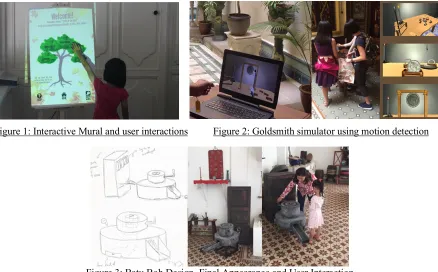
Interactive mural - The interactive mural allows visitors to listen and connect to life stories crowdsourced among the Baba Nyonyas. They can submit their audio stories online which are automatically downloaded to the interactive mural. Touch sensitive points, created using conductive paint, were connected to a Raspberry Pi 3 and PiCap adapter. The physical board is complemented with digital projections, allowing background images to be changed based on the selected Peranakan ethnicity (see Figure 1).
Goldsmith simulator – The goldsmith simulator uses Leap Motion, a hand tracking technology to help users understand the jewelry making process by allowing them to take on the role of an early goldsmith. To start, visitors use gestures to select a pendant frame and a coin in the virtual world, made with Unity. In order to solder them together, users need to pump on a physical bellows to start the solder ‘fire’. At the end, visitors have an opportunity to photograph themselves wearing the soldered pendant as a digital souvenir (see Figure 2). Interactive Batu Boh grinder – The interactive Batu Boh is designed as a replica of an old stone grinder, historically used by Nyonyas to grind and mix spices and other ingredients. By embedding it with sensor technologies, users can insert a tagged ingredient card and turn the handle to simulate the process of kuih
Figure 3: Batu Boh Design, Final Appearance and User Interaction
Method
The user trial was carried out in the Baba Nyonya Heritage Museum on March 19th and 20th, 2017, and involved groups comprising families with children. We employed surveys, user observations and video analyses as the evaluation methods. All participants filled in consent forms agreeing to participate in the study and to be video-recorded. They also completed a pre-test survey to provide their demographic details (e.g., age, gender, education level). The pre- and post-test domain knowledge surveys consisted of 11 items designed to test participants’ knowledge of the Baba Nyonya culture that formed the basis of the culture-related exhibits. Question items were different for the pre- and post-test instruments, but tapped the same knowledge content. Learning outcomes were measured using changes in performance from pre- to post-experience. Participants’ attitudes towards the experience were surveyed after the visit, employing a 7-point scale to indicate agreement with the six statements (see results section). Video data were collected by filming every tour and were supplemented by observational notes taken by researchers. A self-guided map was provided to each group. Our prediction was that the visitors would be more engaged in learning and reflection when the interactive exhibit supports more physical and multi-sensory interaction.
Participants
The user trial involved 10 groups, with 32 participants in total. The group size ranged between 3-8 people. All participants were visitors to the museum and from Malaysia. Three groups were residents of Malacca. In the resident group, two groups had visited the museum before. The individual participant age ranged from 9 to 47 years (mean (M) = 19.97 yrs; standard deviation (SD) = 13.33 yrs). There were 23 children under age 18 (M = 11.82 yrs; SD = 2.42 yrs) and 9 adults above the age of 18 (M = 36.8 yrs; SD = 10.46 yrs). A single letter identifier naming approach was adopted for each group (e.g., H), followed by a number for each participant in the group (e.g., H2).
Results
Learning outcomes
[image:4.595.78.516.89.361.2]The post-test data from the knowledge based survey were positively skewed (z = 2.202) and both the pre- and post-test scores deviated significantly from normal (pre: D (30) = 0.241, p < .001; post: D (30) = 0.203, p < .01). Therefore, a Wilcoxon test was used to compare pre- to post-test scores. Post-test scores were significantly higher at post-test (M = 8.00) than at pre-test (M = 7.00, T = 355, p < .001, r = 0.52).
User attitudes
Table 1. Percentage agreement with the statements about the experience (% participants giving a rating of 4-7 on a 7-point scale, from strongly disagree to strongly agree, with a neutral midpoint).
Statements Goldsmith
simulator Batu Boh Interactive mural 1. The exhibit provides a good learning experience of the Baba
Nyonya culture 73 83 70
2. The exhibit encourages discussions with others 63 66 50
3. The exhibit helps me reflect/think more about my own culture 66 75 66 4. The exhibit made me want to learn more about the Baba Nyonya
culture 68 68 58
5. The physical interaction with the exhibit enhanced my learning
experience 72 78 66
6. I feel that I have gained more knowledge after using the exhibit 77 84 74
Qualitative analysis of sociocultural reflections
Interactive Batu Boh grinder
The design of the interactive Batu Boh exhibit showed some success in encouraging discussion and reflection among family members. Through the video analysis, we observed a boy T1, having finished using the interactive Batu Boh, proceed to examine an original Batu Boh artefact within the exhibit area and engage in conversation with his parents in the background (see Figure 4). There were also instances of historical reflections between participants and other museum visitors who were observing the user interactions. For example, upon seeing a girl (H1) interacting with the interactive Batu Boh, a visitor (A) asked “What’s this?”. The girl’s mother (H2) explained. Then visitor A said “Oh, put [inaudible] to the hole, then...[inaudible]. Let children experience the kind of life in the olden days”. Her father (H3) then remarked, “Howlong does it need to grind? Maybe grind four more times? Let them experience life”. H2 agreed with H3 by saying, “Yes, experience life”. The use of the interactive Batu Boh also encouraged inter-generational dialogue where a father (Y2) was seen to explain to his child “If you grind this way, the kuih’s flour will come out. You can cook it...I saw this one before…In my grandma’s house”. Another example showed a girl (O1), who was grinding the Batu Boh, ask, “Can it make dim sum?” (see Figure 5). Other group members started to discuss this possibility with her mother (O2) asking, “Is the thing coming out dry stuff or wet like soya bean?” Her father (O3) also began to ask “Can rice flour also be ground?”. In the end, another woman friend (O4) replied, “Yes, you can put the rice flour in there” while pointing at an old Batu Boh. This discussion helped O1 learn that rice flour is an ingredient for making dim sum and can be ground using the Batu Boh.
Goldsmith simulator
With respect to user interactions at the goldsmith exhibit, we observed many occasions where group members worked collaboratively to carry out jewelry making tasks. We found that participants often missed hearing the audio instructions as they concentrated on carrying out the task as it required controlled gestures. Typically, other group members would help repeat the audio instruction to guide the participant through the tasks. In this exhibit, the use of the bellows by participants often triggered discussion about the soldering task. For example, when other members in group C saw how the bellows were used to start the solder fire, C2 (father) said “Emm…This is soldering…You can see it is used to solder things….Did you see him solder the money?”. Then C3 (mother) asked “Are you sure that is money?”, to which C2 replied “That’s a coin…You didn’t see?”.
Interactive mural
In the user observation involving the interactive mural exhibit, most participants did not notice it right away until it was pointed out. Almost instantly, all participants would become curious about the technology, and look behind the board to find out how it works. It was observed that children usually tended to lose interest in the audio stories before they end, suggesting that the current content needs to be modified to suit younger children.
Role of physical and digital souvenirs
to exchange them. For example, when girl A1 finished her turn, she asked girl A2 “Can you give me yours? I want to exchange”. In group F, when the girl F1 received a capsule, she looked at its sticker content and remarked, “I know, this in Chinese is called [kuih’s name in Chinese]”. In comparison, the digital souvenir (digital photo of user wearing virtual pendant) did not solicit much discussion. Some children did not want their photos to be taken, while others kept re-taking photos without focusing much on the pendant they made.
Role of smell
As to the use of fragrance of kuih being emitted when the kuih making was completed at the Batu Boh exhibit, many participants would notice the smell and asked “What’s that smell?”, “Do you smell something?”, “Why do we need perfume?” or commented “The smell is nice”.
Discussion
The results of the pre- to post-test comparison of tests of knowledge about Baba Nyonya culture showed that there was a significant learning gain as a result of engagement with the exhibits. However, a drawback to this preliminary study is that there was no control group with which to compare any learning gains from visiting without the technology augmentation. Nonetheless, the results are encouraging. Participants also seemed to feel that they gained some knowledge of Baba Nyonya culture as a result of the experience (Q1 and Q6 in Table 1). Whilst they felt that the goldsmith and Batu Boh exhibits encouraged discussion (Q2), there was less agreement about this for the Interactive Mural (the least interactive of the exhibits). This is also reflected in the views about the effects of physical interaction on learning (Q5). Here there was less agreement about the Interactive Mural compared with the other two exhibits.
These experimental installations were designed to provide a range of different levels of physical interaction to evaluate how this kinaesthetic experience influenced engagement, discussion and reflection and ultimately learning. We also included a multisensory experience which included smell, to evaluate whether or not that would trigger discussions. In terms of the kinaesthetics, the interactive mural is the least physical (it has a touch board, but other than that it is a conventional computer interface). The goldsmith simulator is more physical, requiring fine gestures to control the interface and a real bellows to activate the soldering. The Batu Boh is the most physical. There is no screen – the computer-generated output consists entirely of voice and smell, and the user interaction involves inserting a card, turning a handle and collecting a physical souvenir.
[image:6.595.108.520.217.336.2]With the interactive mural, there was some engagement but not much more than would be expected from a conventional museum exhibit. Some children were curious about the technology (as were some of their parents), but we observed very little reflection about the contents. The goldsmith station was much more physical. The simulation allowed children to select a coin and a frame – using gesture recognition to pick them up, and a real bellows to operate the soldering. The fine motor control required to operate the simulator did cause problems for some younger children, but it also sparked a good deal of interaction and cooperation between children. Sometimes children offered advice to their peers, sometimes they split the physical tasks (for example with one child operating the bellow and another the gestures). There was some discussion about the coins, but little evidence of reflection and certainly no evidence of higher levels of reflection. Any reflection that was observed would fall in the categories of description and explanation (cf. Fleck & Fitzpatrick, 2010). The interactive Batu Boh was by far the most engaging installation. This was a large object that required a lot of physical manipulation. When children first walked in to the room they were often immediately attracted to it. This inspired a good deal of discussion between children, their friends and the parents about the nature of both the artefact and the task. There were also some examples of higher level reflection exploring relationships. A
good example of this was a girl who, unprompted, made a connection with the virtual recipe she was making and modern dim sum.
After the successful completion of the goldsmith and Batu Boh simulations, the children were given souvenirs – digital in the case of the goldsmith and physical in the case of the Batu Boh. In the goldsmith simulator, the children made a virtual pendant and at the end they could photograph themselves “wearing” this. In the Batu Boh simulator, they were given a coloured capsule containing a sticker representing the food they had created. These souvenirs were certainly popular with the children and very engaging, however there was little evidence of them supporting reflection. What discussion there was tended to be more about the souvenir itself than its cultural significance. With the digital souvenir from the goldsmith simulator, the children were far more interested in the photographs of themselves than the pendant they had made. (It should be noted, though, that some children were shy and unwilling to be photographed.) With the stickers produced by the Batu Boh simulator, some children were quite competitive and played the game multiple times to try to get the complete set of stickers. Some traded them with each other – again trying to get a complete set.
The smell produced by the Batu Boh simulator did not in any way seem to facilitate either engagement or reflection. The children certainly noticed it, and sometimes commented upon it but these comments had nothing to do with the simulation or its context – they were along the lines of “what’s the smell?”
This study has provided some evidence to suggest that increasing the kinaesthesic aspects of mixed reality installations can promote reflection. It can certainly promote engagement and is popular with children. It is possible that there is a relationship between the level of kinaesthesic engagement and the level of reflection. However, we don’t have enough data at present to be able to be certain whether this is the case. This is an area in need of further research with larger numbers of children.
Conclusions
The aim of this research was to design and evaluate the effectiveness of mixed reality technologies in augmenting the visitor experience in a museum and cultural heritage context. Our design was based on the potential of interactive installations to enhance the kinaesthetic and multisensory experience of hands-on engagement with artefacts that are normally ‘hands-off’, in order to promote deeper engagement, discussion and reflection in small groups of visitors, especially children. We have presented some evidence that this was achieved. We have shown that the experience resulted in significant learning gains in terms of knowledge of the content of the exhibits. Visitors liked the experience, and felt that they had learned from it – in particular those aspects involving physical interaction. We also set out in this research to provide a context in which Malaysian visitors (as well as others from an Asian / South East Asian context) might be supported in learning about and reflecting on their (multi)cultural identity. Our qualitative analyses showed instances of how the experiences with the exhibits enhanced discussion and sharing of Peranakan culture within the groups of visitors, especially intergenerational exchanges. Finally, the research was an exploration of the affordances of different interaction techniques in supporting reflective learning through intra-group discussions. In comparing between the different interaction techniques, it seems that the goldsmith and Batu Boh exhibits, each of which involved a greater amount of physical engagement, were the more successful in terms of generating moments of reflective learning. These exhibits also afforded more collaborative interactions, where several members of the group could participate at once. These insights have been observed in other studies. However, where we feel we have made an original contribution is in showing how relatively simple interaction techniques can create a rich inter-generational cultural learning experience, embedded in the original museum setting (rather than being separated from it) and that brings to life exhibits that are usually hands-off and experienced at a distance.
References
Andermann, J. & Arnold-de Simine, S. (2012). Introduction: memory, community and the new museum. Theory, Culture & Society, 29(1), 3-13.
Anderson, E., McLoughlin, L., Liarokapis, F., Feters, Petridis, P. & de Freitas, S. (2010). Developing serious games for cultural heritage: a state-of-the-art review. Virtual Reality, 14, 255-275.
Bampatzia, S., Antoniou, A., Lepouras, G., Vasilakis, C. & Wallace, M. (2016). Using social media to stimulate history reflection in cultural heritage. In 11th International Workshop on Semantic and Social Media
Adaptation and Personalization (SMAP) (pp. 89-92). IEEE.
Baumer, E. P., Khovanskaya, V., Matthews, M., Reynolds, L., Schwanda Sosik, V. & Gay, G. (2014).
Reviewing reflection: on the use of reflection in interactive system design. In Proceedings of the 2014
Baumer, E. P. (2015). Reflective informatics: conceptual dimensions for designing technologies of reflection.
In Proceedings of the SIGCHI Conference on Human Factors in Computing Systems (pp. 585-594).
ACM.
Benford, S., Giannachi, G., Koleva, B. & Rodden, T. (2009). From interaction to trajectories: designing coherent journeys through user experiences. In Proceedings of the SIGCHI Conference on Human
Factors in Computing Systems (pp. 709-718). ACM.
Boehner, K., Sengers, P., & Gay, G. (2005). Affective presence in museums: ambient systems for creative expression. Digital Creativity, 16(2), 79-89.
Cosley, D., Lewenstein, J., Herman, A., Holloway, J., Baxter, J., Nomura, S., Boehner, K. & Gay, G. (2008). ArtLinks: fostering social awareness and reflection in museums. In Proceedings of the SIGCHI
Conference on Human Factors in Computing Systems (pp. 403-412). ACM.
Falk, J. H. & Dierking, L. D. (2000). Learning from Museums: Visitor Experiences and the Making of Meaning. Altamira Press.
Falk, J.H. & Dierking, L.D. (2013). The Museum Experience Revisited. Left Coast Press. Fleck, R. & Fitzpatrick, G. (2009). Teachers’ and tutors’ social reflection around SenseCam
images. International Journal of Human-Computer Studies, 67(12), 1024-1036.
Fleck, R. & Fitzpatrick, G. (2010). Reflecting on reflection: framing a design landscape. In Proceedings of the 22nd Conference of the Computer-Human Interaction Special Interest Group of Australia on
Computer-Human Interaction (pp. 216-223). ACM.
Giaccardi, E. & Palen, L. (2008). The social production of heritage through cross-media interaction: making place for place-making. International Journal of Heritage Studies, 14(3), 281-297.
Koleva, B., Egglestone, S. R., Schnädelbach, H., Glover, K., Greenhalgh, C., Rodden, T. & Dade-Robertson, M. (2009). Supporting the creation of hybrid museum experiences. In Proceedings of the SIGCHI
Conference on Human Factors in Computing Systems (pp. 1973-1982). ACM.
Lamberty, K. K. & Kolodner, J. L. (2005). Camera talk: Making the camera a partial participant. In Proceedings
of the SIGCHI Conference on Human Factors in Computing Systems (pp. 839-848). ACM.
Lin, X., Hmelo, C., Kinzer, C. K. & Secules, T. J. (1999). Designing technology to support reflection. Educational Technology Research and Development, 47(3), 43-62.
Marsh, T. (2016). Slow serious games, interactions and play: Designing for positive and serious experience and reflection. Entertainment Computing, 14, 45-53.
Marshall, M. T., Dulake, N., Ciolfi, L., Duranti, D., Kockelkorn, H. & Petrelli, D. (2016). Using tangible smart replicas as controls for an interactive museum exhibition. In Proceedings of the Tenth International
Conference on Tangible, Embedded, and Embodied Interaction (pp. 159-167). ACM.
Muntean, R., Antle, A. N., Matkin, B., Hennessy, K., Rowley, S. & Wilson, J. (2017). Designing cultural values into interaction. In Proceedings of the SIGCHI Conference on Human Factors in Computing
Systems (pp. 6062-6074). ACM.
Pedersen, S., Gale, N., Mirza-Babaei, P. & Reid, S. (2017). More than meets the eye: the benefits of augmented reality and holographic displays for digital heritage. Journal on Computing and Cultural Heritage, 10(2), Article 11. ACM.
Quintana, C., Reiser, B.J., Davis, E.A., Krajcik, J., Fretz, E., Duncan, R.G., Kyza, E., Edelson, D. & Soloway, E. (2004). A scaffolding design framework for software to support science inquiry. Journal of the Learning Sciences, 13(3), 337-386.
Sengers, P., Boehner, K., David, S. & Kaye, J. J. (2005). Reflective design. In Proceedings of the 4th Decennial
Conference on Critical Computing: Between Sense and Sensibility (pp. 49-58). ACM.
Skydsgaard, M. A., Møller Andersen, H. & King, H. (2016). Designing museum exhibits that facilitate visitor reflection and discussion. Museum Management and Curatorship, 31(1), 48-68.
Van Aalst, I. & Boogaarts, I. (2002). From museum to mass entertainment: The evolution of the role of museums in cities. European Urban and Regional Studies, 9(3), 195-209.
Van Leeuwen, T., Kriegsman, L., van Tol, J. & Schokkenbroek, J. (2013). The changing role of museums in the global scientific landscape. Journal of Scientometric Research, 2(2), 137.
Wakkary, R., Hatala, M., Muise, K., Tanenbaum, K., Corness, G., Mohabbati, B. & Budd, J. (2009). Kurio: a museum guide for families. In Proceedings of the 3rd International Conference on Tangible and
Embedded Interaction (pp. 215-222). ACM.
West, B. A. (2010). Encyclopedia of the Peoples of Asia and Oceania. Infobase Publishing.