doi:10.4236/jmp.2010.11003 Published Online April 2010 (http://www.scirp.org/journal/jmp)
On the Nature of Dark Matter and Dark Energy
Baurov Yury Alexeevich1, Malov Igor Fedorovich2
1Central Research Institute of Machine Building, Korolyov, Russia 2P. N. Lebedev Physical Institute, Russian Academy of Sciences, Moscow, Russia
E-mail: [email protected], [email protected]
Received February 19, 2010; revised March 17, 2010; accepted March 20, 2010
Abstract
It is known that all candidates in dark matter (DM) particles (neutrinos, axions, supersymmetric particles etc.) can not explain the basic properties of DM. The same can be said on the proposed candidates in dark energy (DE) (for example, quintessence). In the paper it is shown that some problems connected with DM and DE can be solved in the framework of the byuon theory. Basic axioms and some conclusions of this theory are discussed. The existence of fundamental unobserved elements in nature, byuons is declared. Physical space in our Universe is the quantum medium of special objects 4b, formed in four-contact interactions of byuons (m4b c2 ≈ 33eV). These objects determine the average density of substance (DM) in the Universe ~10-29 g
cm-3. The byuon theory predicts a new interaction of natural objects with physical vacuum. This new force
can cause the observed acceleration of our Universe. The estimations show that it is higher than the gravita-tional force at distances of order to 1026-1028 cm. Some other consequences of the byuon theory are
consid-ered.
Keywords: Dark Matter, Dark Energy, Byuon, New Force
1. Introduction
Some hard problems have appeared in astrophysics dur-ing the last dozens of years. Observations show that ap-proximately 4% of the cosmological energy density is accounted for by baryons, 23% by “the dark matter” and the reminder by “the dark energy” (see, for example, [1,2]).
There are some evidences for the existence of dark matter (DM) and dark energy (DE). Here we enumerate basic ones only.
1) In 1937 F.Zwicky measured velocities of galaxies in the Coma cluster and concluded that the total mass of this cluster must be much more than observable one to prevent the escaping of investigated galaxies from the cluster.
2) The summarized mass of the observed gas and gal-axies in the number of clusters is not enough to keep them inside of the cluster.
3) The gravitational lensing by clusters of galaxies gives the mass of such lens much more than calculated masses of clusters.
4) The rotation curves of galaxies [3] show that the total mass of the individual galaxy is approximately one order higher than the mass of gas and all stars observed in this galaxy.
5) The observations of supernovae in distant galaxies (see, for example, [4]) show that our Universe expanses with an acceleration, and there is a source causing such type of expansion.
The nature of dark matter and dark energy is unknown up to now.
2.
Dark Matter
DM is not observed as a shining matter and must be characterized by extremely weak electromagnetic inter-actions. It must be approximately collisionless and non- relativistic.
DM is not primarily baryonic. The calculated amount of deuterium should be much smaller than observed one if the average baryon density was an order of magnitude higher than the modern value (~0.3 baryons per cubic meter).
The mass interval for the possible candidates in DM is huge (from 10 -22 eV to 106 M
⊙≈ 1072 eV).
Let us discuss the most probable candidates in DM. 1) Axions, light pseudo-scalar bosons [5,6] with mass
μeV ≲ m ≲ meV. They could be detected by resonant axion-photon conversion in a magnetic field [7,8].
cos-mological restrictions give the mass interval for all kinds of neutrinos:
50 meV ≲Σ mν≲ 0.7 eV, or 0.0005 < Ων h2 < 0.0076,
where Ων = ρν/ρc , h = H0/100 km/sec/Mpc, ρc = 3 H02/ (8 π G) is the critical density of the Universe, H0 is the Hubble constant.
Super-symmetric theories put bosons and fermions in common multipletes. They give some possible candi-dates in DM.
1) The super-partner of the graviton, gravitino with the spin 3/2 [9].
2) Neutralinos. These are the four spin ½ Majorana fermion super-partners of the neutral gauge and Higgs bosons (χ0
1-4) [10]. There are also two charged Dirac fermion super-partners of charge gauge and Higgs bos-ons, charginos (χ±
1-2).
3) Axinos, a spin ½ partner of the axion [11]. 4) Non-topological solitons, Q-balls [12].
5) If our four-dimensional space-time is embedded in a higher dimensional space, the Kaluza – Klein excita-tions of Standard Model states along the orthogonal di-mensions may be as DM candidates [13].
6) Objects of many dimensions (branes) are described in string theories. Their fluctuations have been consid-ered as particles (branons) which could be DM candi-dates [14].
7) DM could be an ordinary matter in the mirror world where the only communication is gravitational. In this case our Universe and a mirror universe are two branes in a higher dimensional space [15].
8) At the last stages of inflation gravitational interac-tions can produce a lot of weakly interacting massive particles which for mass scales of 1013 GeV could ac-count for DM [16].
9) Primordial black holes have been considered as candidates in DM as well [17].
So, as observations give, baryons provide approxi-mately 4% of DM, neutrinos ~0.3-3% of it. The rest (20-25%) is a non-baryonic DM. The nature of this part of DM is unclear. There are many problems with theo-retical foundations and experimental evidences of the existence of particles mentioned above and described in cited papers.
3. Dark Energy
The nature of DE is much more unclear than that of DM. It is necessary for it to have the equation of state of the following form (see, for example, [18]):
p = w ρ (1) where p is pressure and ρ is the energy density. The most probable value of the parameter w is approximately –1, as follows from the known observations. This implies that the energy density of such substance is constant and corresponds to the flat universe, i.e. the curvature K of
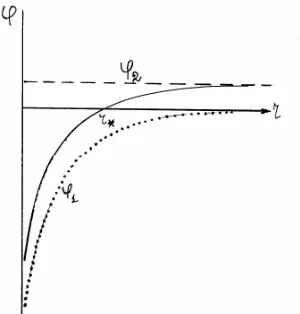
the spatial sections (slices at constant cosmic time) is equal to zero. DE causes the acceleration of the expan-sion of our Universe. Figure 1 shows the sum (solid line) of two potentials: The usual (negative) gravitational po-tential φ1 (broken line) causing the attraction of two bodies and a positive constant potential φ2 giving the repulsion at large distances (r > r*).
One of the possible sources of DE is “quintessence” [19], a scalar field Φ rolling slowly in a potential. Most quintessence models give for such scalar fields
mΦ c2 ~ 10-33 eV (2)
In quantum field theory light scalar fields are hard to understand. In any case these fields should give rise to long-range forces which must be observable. It is sur-prisingly why such quintessence field has not been de-tected up to now.
There are many problems with other models of DE (see, for example, [18]).
In this paper we shall try to explain DM and DE in the framework of the byuon theory. First of all we will de-scribe briefly the foundations of this theory.
4. Basic Axioms and Hypotheses: Space,
Time, and Physical Vacuum in the Light
of the Byuon Theory
Any theory begins with axioms, that is, with basic pos-tulates accepted without proofs.
Thus, let us assume that there are no space, no time, no world of elementary particles of which all physical bodies consist, but there is an unobservable object, a byuon (i) [20-25], being unobservable in itself and characterized by discrete states (i.e. numbered by the series of natural numbers) having inherent “vectorial” property. The expression for (i) is
[image:2.595.353.503.547.704.2]Ф(i) = [Ag X(i)] (– 1 [Ag X(i)]) (3) where X(i) is “length” of the byuon, a real (positive or negative) value depending on the index i = 0,1,2,…k,…
Index i is a quantum number for (i)1. The explanation of square brackets has been given further. The dimension of byuons is equal to the dimension of electric charge (in the CGSE-system) or of magnetic flux or of the Dirac’s monopole. The quantity Ag is some internal potential being equal in magnitude to the cosmological vectorial potential Ag, a new fundamental vectorial constant in-troduced in [26,27] (Ag 1.951011Gscm).
Thus, Ф( )i can take both real and pure imaginary values.
The whole set (i) forms a one-dimensional space R1 in index i.
According to this conception, by the discrete time is meant, for the byuon, a discrete change in the index i (its increase or decrease) is possible. In connection with the discrete time, a quantum of time 0 and quantum of space
0
~x are introduced in the one-dimensional discrete space
R1 formed by byuons (00.9 10–43s, ~x02.8 10–33 сm). The distance between byuons is defined therewith as a difference in their lengths x(i). The space R1is dis-crete by definition.
Since the space R1 is discrete, one of methods of pa-rametrization of X(i) is X(i) =
o
x
~ i, or X(i) = -x~oi. Statics. In the set {(i)}, there are meant no static states with time t > 0.
Kinematics. Depending on whether the length X(i) positive or negative, decreases or increases in magnitude, free byuons (i.e. not interacting one with another) can be only in one of the four so called vacuum states (VS) II+,
I+, I–, II–. Further we will omit sometimes VS in the ex-pressions like VS II+.
Introduce the following definitions.
1) A free byuon is in the state II+ if its positive length discretely, in a quantum of time 0, increases by a quan-tum of distance ~x0 with the speed of propagation (in-crease in length) 0
0 0 0
~
c x
c
(c0 is the light speed).
Hence the speed of byuons is the ratio of their lengths to the postulated quantum of time.
2) A free byuon is in the state I+ if its positive length discretely, in a quantum of time 0, decreases by ~x0. In
this case 0
0 0
~ 0
c x
c
.
3) A free byuon is in II– if the modulus of its negative length increases by ~x0 in time 0 with 0
0
0
x c
0
c
.
4) A free byuon is in I– if the modulus of its negative
length discretely, in time 0, decreases by ~x0. In this
case 0
0 0) ~ ( 0
c x
c
.
From the definition of byuons it is seen that they are in perpetual dynamics of generation and annihilation, ex-tension and contraction. The collection of free (not in-teracting) byuons in VSs II+, I+, I–, II– forms physical vacuum of the one-dimensional space R1 of index i (about properties of R1 will be said below). Recall how-ever that in this model of physical vacuum, time is a se-quence of events of byuon generation (extension) and “collapse” (contraction). These correspond to each byuon its own count of time measured by the natural number series. One of the two directions of the one-dimensional space R1, coincident with that of a byuon with the maxi-mum x(i)in VS II+, is taken for the positive direction of the vector АG and Ф(i)
.
The average magnitudes for byuons being in the above described VSs at maximum i=k, are determined from the following expressions (see 1, and [20-22]):
1 1
1
1
1 1
2 1
[ ] 0,
2
2 1
[ ] 1 0,
2
2( ) 1
[ ] 1 0,
2
2( ) 1
[ ] 0,
2
i G II
G i
G I
G k i
G II
G k i
G I
G
const i
A X A X
k A const i
A X A X
k A const k i
A X A X
k A const k i
A X A X
k A
(4)
where .
3
4 20
0 0
1 e
hc hc
const is some constant. As we will
see later h is equal to the Plank constant and e0 is the electron charge. (See Appendix 1). The square brackets mean the average value for byuons between previous and subsequent magnitudes because any observations are possible during time intervals much more than a time quantum only.
Assume that for the byuons with the length greater than ~x0, only contact interactions are realized, by which we will mean existence of at least two byuon VSs at a quantum of space R1.
Hypothesis 1. Assume the observable three-Dimen- sional space R3 to appear as a result of minimization of the potential energy (PE) of VSs byuon interactions in the one-dimensional space R1 formed by them. We con-struct PE from the taking into consideration of dimen-sions. More precisely, the space R3 is fixed by us as the result of this byuon dynamics. In the space R3 therewith the dynamical processes for objects with the residual positive potential energy of byuon interactions originate, and in consequence, the wave properties of elementary 1It should be explained that the vector (i) is not an ordinary vector in
some space but an object with “inner” vectorial properties that are
manifesting themselves when the value x(i) changes in the process of
particles arise.
PE means the extreme value of the expression with the dimension of energy. This expression is formed using all possible vacuum states of byuons and the distance in the
R1 space. This distance is taken positive values only. The proposed hypothesis requires to develop a mathematical model based on a new algebra of probabil-istic events since the elementary events (a discrete de-crease (Ä) or increase (D) in the length of byuon) are assumed to be probabilistic in character. Hence for the byuons of the minimum length we may say about the existence, with certain probability, of the events ÄD
0. Note that in [9] an algebra of events is given, being a development of the Boolean algebra with the proviso that ÄD = 1. For the deterministic approach used in [28], the event ÄD 0 is illogical by von Neumann, but in the probabilistic space of events the existence of ÄD 0is possible.
In this paper only the physical statement of the prob-lem will be considered, and results of evaluations made in support of the hypothesis advanced, will be given.
The space R1 is formed from the set of byuons in such a manner that at its i-th point there exist all the byuons with the lengths smaller than X(i) or equal to X(i) for X(i) > 0, and those with the absolute values smaller than X(k-i) for X(k-i)<0, where k is some period in i.
The assumption that two neighboring byuons (the i-th
and (i + 1)-th; (i + 1)-th and (i + 2)-thetc.) being in vac-uum states II+ will interact, is unreasonable since in this case the definition of byuons for this VS would be violated at the point of interaction. Such interaction is possible only between the i-th and (i-k)-th byuons in the state II+if they form a “loop” in the space R1 (by the “loop”, the periodic-ity of the process in i is implied), i.e. the two byuons IIi
[image:4.595.341.502.301.685.2]and IIik will be observed simultaneously at one point of the space R1. The least possible value of k is k = 3. In Figure 2 shown is the interaction of byuons in the vacuum states II1 and
4
II (the smallest loop). The byuons in the state II– interact likely.
0
1 2
II+ 4
II+
1 II
+ 3
[image:4.595.130.214.565.691.2]II+ 2
Figure 2. Interaction of byuons in vacuum states II1+and
II4+ (the smallest loop).
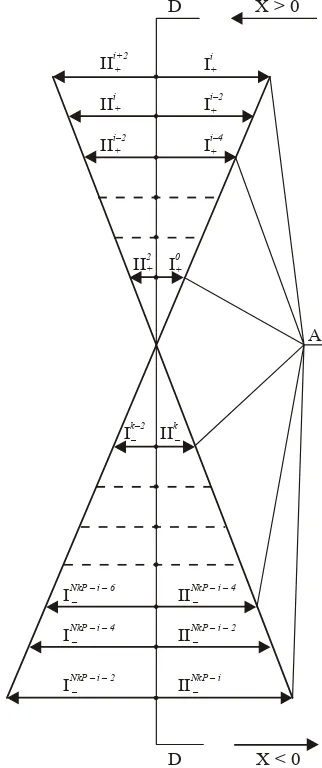
The byuon states I+ and I– can occur only if the byuons have already been in VS II+ and II–, respectively. At maximum positive potential energy of byuon interaction there exists a single variant of “occupancy” (Figure 3).
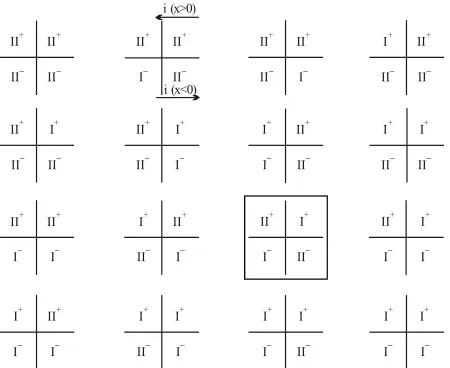
The probability of the minimum four-contact interac-tion of the neighboring in i byuons I+II+ I–II– (“” symbolizes interaction) with randomly appearing states
I+ and I–, is equal to 1/16 [20-22]. That is quite under-standable when analyzing possible four-contact interac-tions (see Figure 4)). All other possible variants of the four-contact interaction are unobservable either because one cannot introduce them without violating the defini-tion of byuons or in view of imaginary energy of such interaction.
Note once more that there exist only two directions in the one-dimensional world, the first of which corre-sponds to increasing index i for byuons with X > 0 (vac-uum II+), and the second corresponds to decrease in i for
I0
IINkP – i – 4
IINkP – i – 2
II2 +
IIk
–
IINkP – i
–
–
–
Ii
Ii–2
Ii–4 +
+
+
IIi+2
IIi–2
IIi +
+ +
+
Ik 2–
–
INkP – i – 6
INkP – i – 4
INkP – i – 2
–
–
–
A D X > 0
D X < 0
Figure 3. Completion of vacuum states II+ and II– by
vac-uum states I+ and I–, respectively, at the maximum potential
II+
II+
II+ II+
II+ II+ II+ II+ I+
I+
I+
I+ I+ I+
I+
I+ I+ II– II–
II–
II– II–
II–
II– II–
II– I–
I–
I– I–
I–
I–
I–
I– I–
I– I– I–
II–
II– II–
II–
II–
II–
I– I–
I– I– II–
II+
II+
I+ I+
I+ I+ II+ II+ II+
II+
II+
I+ I+ I+
II+
[image:5.595.61.286.78.262.2]i (x<0) i (x>0)
Figure 4. The possible variants of four-contact interaction of byuons. Square means that this interaction can realize in nature.
such byuons (vacuum I+). These directions are coinci-dent with those for byuons with X < 0: II– with I+, and
I– with II+. It is clear from above definitions that the byuon with the maximum length X(i) in VS II+ deter-mines the positive direction, and directions of other byuons are correspondent with it.
The four-contact interaction of byuons is realized within a time =~0 only at points D of the R1-space (Figure 3), i.е. at the points where introducing an inter-action with PE > 0 is possible. In Figure 3 the arrows corresponding to byuons show directions of a decrease or an increase in their lengths relative to the origin of the coordinates introduced, for example, where i 0 (in its direction the absolute value of the byuon length de-creases (states I+ and I–), and it increases in the opposite directions (states II+ and II–)). At the points A in Figure 3, the coordinate denoting place (time) of byuon interac-tion cannot be fixed because of violating, in such a case, the definitions of the byuon states (in one quantum of the
R1-space within a time 0, the byuons with II+I+ I–II– should not be present).It is assumed that before the ori-gin of VS II+ with the minimum length (i = 1), the byuon vacuum states II– and I– with any possible lengths are already in existence.
The propagation of byuons in VSs II+I+ and I–II–, the interaction between which occurs with imaginary energy (see below ), presents two wave-like processes (see be-low) directed towards each other at X(i) > 0 and X(i) < 0, respectively. These processes are unobservable. A really observable signal can be transmitted by means of such processes only in the four-contact byuon interaction II+I+
I–II–.
Let us obtain an equation characterizing the propaga-tion of the four-contact interacpropaga-tion of byuons in R1. In-troduce functions of index i,characterizing the origin of
such or another VS by byuons: i 2, k i II II
, determining the processes of byuon length magnitude origin and in-crease at positive and negative X(i), respectively;
2
,
i k i I I
, determining the processes of byuon length magnitude cancellation and decrease at positive and negative X(i), respectively.
The physical sense of the introduced functions consists in that their product determines the probability of two-contact interaction of byuons (for example, iII2
2
i k
II
determines the probability of interaction of
byuons IIi k
i
II A X
X
A
] 2 [ ] 2
[ и ), the product of four
functions determines the probability of four-contact in-teraction, the product of eight functions gives the prob-ability of eight-contact interaction. These products should be positive, and in this case only they can de-scribe an observed event.
The probability of a single event is no greater than 1. Depending on which range is i in (0 i < k, k < i < Nk, Nk < i < NkP where k, N, P are the assumed periods in i) various types of contact interactions between byuons may be introduced. Hence the normalization of the introduced functions should be dependent on i.
Let us normalize the introduced functions for the case
0 i < k in the following manner ( )/ 2
2 2 2 2 2
0 0 2
NkP k j i
j j NkP j NkP j
II I II I
j
NP
(5) 1
2
1 0
j i NP
NkP j NkP j k
II II
j
P
, (6)( )/2
2 2 2
0 0 2
NkP k j i
j NkP j
II I
j
NP
, (7)( )/ 2
2 2
0 0 2
NkP k j i
j NkP j
I II
j
NP
. (8)When normalizing, it is taken into account that within a period in i =k, one four-contact interaction occurs with probability 1.
Let us obtain an equation in terms of -functions, de-scribing the propagation of a four-contact interaction of byuons. For that we may write the following relation-ships as to the origin of VSs II+(
II
f ), I+(
I
f ), II-(
II
f ),
I - (
I
f ) depending on certain VSs of the byuons neighbouring in the index i:
2 1 2 2
1 2
1 1 2
2 1 2 2
[ , , , ],
[ , , , ],
[ , , , ],
[ , , , ].
i i i NkP i NkP i
II II II I II I
i i i NkP i NkP i
I I I II II I
NkP i NkP i NkP i i i
II II II I II I
NkP i NkP i NkP i i i
I I I II II I
f f
f f
Assuming only linear dependences in Expressions (9) as well as equiprobability of VSs of byuons neighbour-ing in i, we obtain the following equations for -func- tions of four-contact interactions of byuons:
2 1 2 2
1 2
1 1 2
2 1 2 2
,
,
,
.
i i i NkP i NkP i
II II I II I
i i i NkP i NkP i
I I II II I
NkP i NkP i NkP i i i
II II I II I
NkP i NkP i NkP i i i
I I II II I
(10)
From the first and second pairs of Equations (10) we obtain, respectively, the following equations:
1 1 1 1
[ i i ] i i 0
II I II I
, (11)
0 ]
[ 1 1 1 1
i INkPi IINkPi INkPi NkP
II (12)
where denote the second finite differences in index i. It is seen from Equations (11) and (12) that the process in i is of oscillatory character for the functions (IIi1
) 1
i
I and ( )
1
1
NkP i
I i NkP
II . These functions de-termine the A-type points in the space of index i shown in Figure 3, i.e. the points at which we cannot introduce interaction of byuons. The A-type points in the space R1 determine as if “ruptures” in i, between which there exist objects with energy E > 0.
For the case i k, write an equation for an increment in potential energy of a byuon interaction E(i), correspond-ing to the occurrence of VSs 2
i
II and Ii. Minimiza-tion of E(i) is assumed to be going at each step in i.
, 2 2 ,
3 3 , 2 2 2, 2
( ) cos cos
cos ... c
NkP i k NkP i NkP i k NkP i NkP i k NkP i NkP i k NkP i
II II II II II II II II II II II II
NkP i k NkP i NkP i k NkP i i NkP i i NkP i
II II II II II II II I II I
E i E E
E E
2 2 2 2, 2 2 2 2 2 2 2, 2 2 2
2 2 2 3 2, 2 2 3 ,
os
cos cos
cos ... cos
II I
i NkP i i NkP i i NkP i i NkP i
II I II I II I II I II I II I
i NkP i i NkP i NkP i i NkP i i
II I II I II I II I II I II I I
E E
E E
2 2,
2 2 2 2, 2 3 2 3,
cos
cos cos ...
NkP i i NkP i i
I I II I II I
NkP i i NkP i i NkP i i NkP i i
II I II I II I II I II I II I
E
E E
2 2 , 2 2,
2 2 2 2 , 2 2 2, 2
2 2 2 2
cos cos
cos cos
i i NkP i NkP i i i NkP i NkP i
I II I II I II I II I II I II
i i NkP i NkP i i i NkP i NkP i
I II I II I II I II I II I II
i i NkP i NkP i
I II I II
E E
E E
2 2 , 2 2 2 2, 2 2
2 2 2 3 2 3 , 2 2 2 3, 2 3
cos cos
cos cos ...
i i NkP i NkP i
I II I II
I II I II
i i NkP i NkP i i i NkP i NkP i
I II I II I II I II I II I II
E E
E E
(13)
where , ,..., ,2
i kNkP i iIiII NkP
II
II E
E , etc. are maximum values of potential energy of interactions of byuons with the lengths X(NkP-i-k) < 0 and X(NkP-i) < 0 in VS II–, as well as byuons with the lengths X(i) and X(i+2) in VSs I+ and II+, respectively; сos
I+II+, сosI–II– etc. are functions minimizing the potential energy of interactions of byuons entering into the expressions for , 2 ,..., NkP i 2,NkP i,
II I i i
II I E
E
etc.; these functions are “responsible” for the appearance of a minimum plane object and the introduction of the concept of spin (see below). Functions сosI+II+are not the usual Cos-functions, because we work up to now in one-dimensional space of i –indices. These Cos\s can have values from 0 to 1. Upper and lower indices in (13) correspond to interactions of byuon VSs,
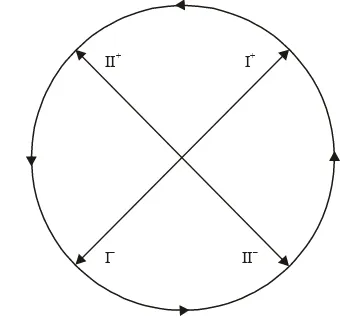
The difference in the average values of byuon lengths calculated basing upon the definition of byuons with the use of the rule of circular arrow (see Figure 5), is taken as a distance between the interacting byuons to find E(i)
> 0. The meaning of this rule is that the said distance is
calculated as the difference in the length values of the subsequent and preceding byuons in the direction pointed by an arrow.
II+
I–
I+
[image:6.595.332.506.531.690.2]II–
The lengths of byuons are:
1 1 1
1
1 1
2 1 2( ) 1
; ;
2 2
2 1 2( ) 1
;
2 2
cp cp
cp cp
i k i
II II
G G
i k i
I I
G G
const const
i k i
X X
k A k A
const const
i k i
X X
k A k A
etc.
The distance between byuons does not depend on i and may take by magnitude only two values:
; A k const X ; A k const X ; A const X ; A const X 1 i k , 2 i k II I 1 2 i, i II I 1 1 i k , 1 i I II 1 i, i k I II G G G G
or multiples of them, for example, . A
N const
XNk ii, 1
I II G
The expressions determining the maximum energy of byuon interactions are written as
.] 1 ) ( 2 [] 1 ) ( 2 [ 4 ;] 3 ) ( 2 ][ 1 ) ( 2 [ 4 1 ); 1 2 )( 3 2 ( 4 1 ); 1 2 ( ] 1 ) ( 2 [ 4 ); 1 2 ( ] 1 ) ( 2 [ 4 ] [ ] [ 2 1 , 2 1 , 2 2 1 2 , 21 2 , 2 21 , , i NkP k i NkP A k const E i k i k A k const E i i A k const E i i k A k const E i i k A k const X Ax Ax E i NkP k i NkP II II i k i k II I i i II I i k i I II i i k I II i I i k II i i k I II G G G G G (14) The minimization of E(i) is achieved in the func-tional space of the following variables:
NP , k , cos , cos , , , ,
Ψ NkP k i,NkP i
II II 2 i, i II I 2 NkP I NkP II 2 II 0 I (15) It is assumed therewith that the conditions of symme-try during the “closure of the loop” in i are fulfilled as well as symmetry of the world and antiworld, which conditions can be represented as:
...; cos cos ; ... cos cos cos cos , 2 , 2 2 , 2 2 2 2 , 2 2 , 2 2 , i NkP k i NkP II II i NkP k i NkP II II i NkP i NkP II I i NkP i NkP II I i NkP i NkP II I i i II I (16)
The functions сos II+I– , сos II–I+are considered as equal to 1.
Initial conditions for - function are preset to be
0 , , , 0 , 1 , 1 , 0 1 2 2 1 2 1 0 0 i I i I II NkP II NkP I I NkP I NkP II I
II (17)
Using the solutions of the Equations (11) and (12):
1 1 cos 2 sin 2 ,
i i II I i i A B k k
we contract
the space of variables down to four: cosi i, 2,
I II
2,
cosNkP i NkP i, ,
II II k NP
.
Now, taking into account the normalizing Expressions (5-8), seek for min E(i) by the steepest descent method. When retaining only 14 terms of the series in (16) and (5), min E(i) will correspond to the following values:
0 2 4
2 4 , 2 5
, 5
15 60
0.999(6), 1.00136 10 , 0.999(8), 1.100043 10 , cos 1.01887 10 ,
cos 1.20013 10 ,
6.2 10 , 3 10
NkP
I II II
NkP i i
I I II
NkP i k Nkp i
II II k
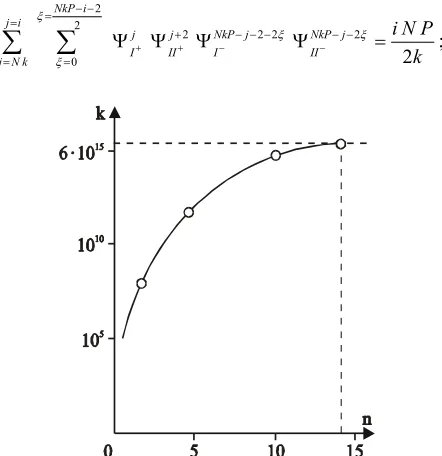
NkP (15) With increasing n, as is seen from the solutions given and Figure 6, k (the first period in i) approaches its value obtained in [25,26] on the base of physical considera-tions as an integer part of the ratio x x0 0 . 3.2 10 15
Thus, we can now obtain, with the aid of the calculated k, one of the fundamental dimensions in physics of ele-mentary particles, х010–17 cm, with the only quantum of space ~x0 given. This mathematical result raises prospects that the advanced hypothesis is true. It reflects the nature of physical space and vacuum.
The minimum 1E(i) was sought for a case when Nk <
i NkP. In this case the normalizing expressions for the arising interactions of byuons have the form:
2 2
2 2 2 2
0 2
NkP i j i
j j NkP j NkP j I II I II j N k
[image:7.595.315.536.461.689.2]i N P k
;Figure 6. k as a function of the number n of the terms of the
2 2 1
NkP i
NkP i NkP i k II II NkP i N k
/ 2 2 1 i ki i k
II II i N k
; 2 22 2 2
0 2
NkP i j i
j NkP j II I j N k
i N P k
; 2 2 2 0 2 NkP i j iNkP j j II I j N k
i N P k
. (19)The expression for 1E(i) becomes more complicated:
2 2 2, 2 2 2 2 2, 2 2
1
2 2 2, 2 2 2 2 2, 2 2
( ) cos cos ...
cos cos
i i k i i k i i k i i k
II II II II II II II II II II II II
i NkP i i NkP i i Nk i i NkP i
II I II I II I II I II I II I
E i E E
E E
2 2 2 2 2, 2 2 2 2 2 2 , 2
2 2 2 2 , 2 2
2 2 2 2
cos ... cos
cos
i NkP i i NkP i i k NkP i k i k NkP i k
II I II I II I II I II I II I
i k NkP i k i k NkP i k
II I II I II I
i k NkP i k
II I II
E E E E
2 , 2 2 2
2 2 2 2 2 2 , 2 2
cos ...
cos ... ( )
i k NkP i k
II I I
i k NkP i k i k NkP i k
II I EII I II I E i
(E(i) is taken from Equation (10), taking into account for multiplication over index i as was shown above (i + 2, I +
2-k, i + 2-2ketc.).
The search for minE(i) with the use of the chain of Equations (7) in the space of similar variables with simi-lar initial conditions (where i = 0 corresponds now to i = Nk), leads to practically the same results:
2 4
2 4 , 2 2, 2 5
, 5 15
60
0.9998, 1.006 10 ,
0.9999,
1.101 10 , cos cos
1.1019 10 ,
cos 1.203 10 , 4.475 10 ,
3.169 10
Nk Nk NkP
I II II
NkP i i i i k I I II II II
NkP i k Nkp i
II II k NkP
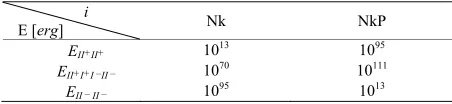
It is interesting that at i < k and even at i Nk (Table 1), a significant part in the magnitude of E(i)is poten-tial energy of the byuon interaction in VS IIII, and at i NkP the four-contact interaction of byuons in VS
II+I+III becomes determining.
Let us consider a simplified case when only the period in i, equal to k, is present in the antiworld. Then we have from the necessary condition of minimum E(i) with respect to the function ΨiII2
(i.e. from the equa-tion () 0
[image:8.595.58.284.671.723.2]2 i II i E ):
Table 1. The values of potential energy E in vacuum states
(II+ II+), (II+I+ I II), (II II) depending on the i index.
i
E [erg] Nk NkP
EII+II+ 1013 1095
EII+I+I –II – 1070 10111
EII – II – 1095 1013
. ] 3 ) 2 ( [ ) 3 2 ( ) 1 2 ( ] 1 ) ( [ 1 1 cos i k i i i k k i k II i I I
II (20)
If i << k,N = P = 1, and hence, according to Equation (5)
0
1 j i
j k j
I II j
, we obtain from Equation (20)сosII+I+ 1/k.
Thus, as show our numerical calculations and analyti-cal estimations, the minimization of E(i) leads to values of functions сos II+I+ etc. if not zero but extremely small.
Note that the functions сos II+I+ for the case of NP “loops” in VS II (see (18)) and for the case when N = P = 1, differ by ten orders of magnitude. The physical meaning of these functions will be shown further.
Put a question, where disappears and into what kind of energy the potential energy of byuon interaction trans-forms? An answer seems to be simple, of course, - into the kinetic energy of rotation (since сosII+I+<< 1, see (18, 20)). But the rotation of what and around what? And why do we assume the law of conservation of energy to be fulfilled here? After all, it makes no sense to say about uniformity in time for this statement in which the time is discrete! Let us answer these questions.
As it was shown above, the optimum values of the functions cos2, ,cos , 2,
i NkPII IiNkP i i
I
II etc., are much less than 1 but non-zero. The smallest values of сosII+I+ 1/k correspond to residual (finite) potential energies Ek, from which, as we will further assume, the smallest part (asso-ciated with the formation of the own space of elementary particles) of the potential self-energy of elementary par-ticles corresponding to the known Einstein’s relationship
simplest objects with N and P approximately equal to 1, the minimum Ek is equal to the potential energy of the four-contact interaction of byuons with the minimum values of сosII+I+, сos II–I–.
In view of the normalization (5) we have for this case
II I k k
II I II I II I
k E E
E(0) 0,2 cos 2, cos
min . (21)
From that, with the condition (16), and using Equation (14) and the equality сosII+I+ 1/k, we obtain Ek(min0) 33 eV.
Consider the process of energy transformation for the four-contact byuon interaction occurring within a time quantum 0 (Hence, the transformation must be discrete).
Any value of i can be redenoted with an another index, for example, with j, , ,etc., which may be set equal to zero. At each point then, where j = = =...= 0, there will be always present an own system of account of the indices j, , , etc., as well as the minimum energy of four-contact byuon interaction (0)
min k
E 33eV. Note that this minimum energy is limited in index i by values i = 0
and i = 2 (point AFigure 3).
Thus, we have in R1 two sets of points A({A}) and
D({D}), between which the dynamic process of renumera-tion goes in connecrenumera-tion with the properties of vacuum states of the discrete objects, the byuons II+, I+, I–, II–:
the time i+1
... , , 2 } {
... , 1 , 1 } {
i i A
i i D
the time i+1+0
... , 1 , 3 } {
... , , 2 } {
i i A
i i D
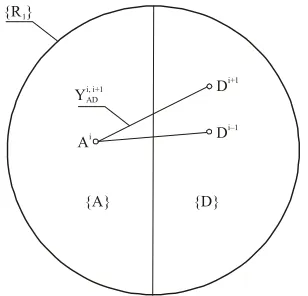
The set R1 may be represented, at some i-th point of time as the join of {A} and {D}, i.e.R1 = {A} U {D}(Figure 7).
Hence the space R1segregates into the subspaces RD of D-points and RA of A-points. Thus, we may say about the motion of D-points relative to A-points. A new, sec-ond coordinate appears, symbolize it by YAD (Figure 7).
Di+1
Yi, i+1
{R }1
Di–1
Ai AD
[image:9.595.101.255.542.690.2]{A} {D}
Figure 7. Representation of the set {R1} as a union of sets of
the points {A} and {D}.
The minimum value of YAD:YADmin C00|(i1)A .
~ | X0
iD
The minimum object appears. Assume that its appearance (new coordinate) corresponds to the minimum action h ( see [1-3], h = (([Агxo]II+[Aгxo]I-)/co) xo/ct* and elementary electric charge eo2 = (1/(4√3)) Аg2xo2(xo/ct*)3/2 ).We may then introduce the concept of momentum for objects with the residual PE of a byuon interaction by writing the relationship P Yii h
AD i
D1 ,1 where PDi1 is the momentum of the point D numbered
i+1 relative to the point A with the number i. Similar relationship can be written in any point from {A}. The direction of the momentum vector i 1
D
P corresponds to
that towards the point Di+3 of the subspace RD. The direc-tion of the coordinate i,i1
AD
Y corresponds to the vector directed from the point Ai to the point Di+1.
The appearance of the minimum plane object and re-alization of the minimum action are connected with the origin of the quantum spin number [ 1 i,i1,]
AD i D Y
P S
expressed numerically in minimum actions h.
The function сosII+I+ etc. minimizing E(i), will be further considered by us as cosines of the angles between the vector i1
D
P and i,i1
AD
Y i.e. before the byuon inter-action, the space R1 represents, at some time point , a certain discrete straight line of points {D}and{A}, and at the time point + 0 forms a line, broken at points {D}. That is the minimum interaction of byuons has occurred. If an “observer” was able to perceive objects with E>0
only every = k0, he would simultaneously (within a time quantum 0) fix all the planes arrived to the point of “observation”, and “see” already the three-dimensional world formed from the plane world in the result of its dynamics within the time = 0. Why the three-dimen-sional and not N-dimensional one? Because the set of two-contact interactions of byuons is divided, depending on reference point (Figure 2, i = 0, 1, 2), into three sub-sets M0, M1, M2 (the lower index denotes reference point), corresponded by three one-dimensional subspaces R1,0,
R1,1, R1,2 while introducing metric properties. Explain the above said.
As was indicated above, any value of index i can be always redenoted by j and then j = 0, 1, 2 corresponds to reference points. Redenoting i + 1 by , i + 2 by etc.
leads, depending on reference points, to formation of three families of subspaces embedded in each other:
reference point “0”R1i,0R1j,0R1,0R1,0 etc.; reference point “1”R1i,1R1j,1R1,1R1,1 etc.; reference point “2”R1i,2R1j,2R1,2R1,2 etc., if
i > j > > etc.
the three independent coordinates should be given to fix a pair interaction with respect of the three reference points, i.e. R3 can be represented as R3 = R1,0R1,1 R1,2. Note that R1,0, R1,1, R1,2 consist of the sets of points {A} and {D}, i.e. at each subsequent point in time, renumera-tion of points A and D and “spinning” of objects with E > 0in the subspaces R1,0, R1,1, R1,2, occur. In this manner the concept of spin is introduced for objects with E > 0 in R3. For objects of a big size (as a result of described minimization of PE), the rotation will be always take place since the byuons are not closed in a volume of R3 due to cosII+II+ 0. That is why, planets, stars and so on rotate, with the main part of potential energy of byuons being transformed into energy of rotation.
Advance (without proving) the following theorem: If a system is closed, the amount of information in it is constant.
That is, transformation of one information image into another is possible in the system, but the total amount of information does remain invariable.
Note that by information we mean here not informa-tivity as in theory of information developed by Hartly and Shannon [29] on the basis of entropic approach, but the numbers of information bits (the values “0” and “1”) in one or another information subsystems of the system of considered objects (the combinatoric approach [30]). By “1” we imply here accomplishing the minimal act (minimum action h/2) in the system with formation of an object with E > 0 from byuons, and by “0” disappearing of the object with E > 0is meant.
On the base of the theorem, write the following equal-ity for informational units (bits) in the subspaces R1 and
R3:
N S h
k S E
3 1 1 0
2 2
2
(22) where N is the number of information images in R3 (N=сt*/х
0 - the second period in i); S3 the complex of the information image in R3(number of “loops” of length N;
S3= 1, 2, ...); E1 potential energy of minimum four-con-tact interaction of byuons in R1if сosII+I+ = сos II–I– = 1;
h S E1 1 2
0
is a transformation factor of recounting the number of information images (k) in R1 into that in R3for
i kN; S1 is complex of the information image in R1 (number of “loops” of length k, S1 = 1, 2, ...).
By an information image in R3, one means one or an-other quantum number of an elementary particle.
With Equation (22), the expressions for lepton masses obtained in [20-22] (see Appendix 1) become more un-derstandable (for example, 2 0min *
0
33 e k
m c E N eV ct x
2 * 0
2
e
m c ct x
).
Taking k from the solution of the problem of searching the minimum E and substituting S3 = 1, S1 = 1 into
Equation (22), we find N = 1.544 104= сt*/х 0 , and knowing N and NP from this solution, determine P
1042. The value of 0
~
x kN 10-13сm.
Thus, we find all the periods of byuon motion in i, corresponding to the following scales of our World: 10-17 cm is a characteristic scale of weak interactions ( for larger lengths our World is three-dimensional and almost orthogonal, for an empty space with the 10-15 precision); 10-13 cm is a characteristic size of proton and atomic nu-clei, 1028 cm is the radius of our Metagalaxy or the ob-servable part of our Universe.
(See: Appendix 1 – The expressions for masses of ul-timate particles; Appendix 2 – A qualitative distinction between the theory of byuons and previous physical theories. See in [21] “Force-free physics. A qualitative pattern of a common approach to unifying all interac-tions. A novel principle of relativity.”)
It should be also noted that to calculate the fundamen-tal constants h, e0, c; constants of known interactions, masses of main baryons, leptons, and mesons , only three numbers x~o 0, |Ag| should be given since the charac-teristic dimensions x~o 10-17 cm, ct* 10-13 cm and 1028 cm are found from the minimum PE of byuons and from the information theorem.
5. Dark Matter and Dark Energy in the
Byuon Theory
Determine the average density of substance in the Uni-verse while taking i = NkP and, hence, its characteristic dimension x NkP 28cm
0 10
~ (it coincides with the
as-sumed radius of the Universe). The total energy in the Universe can be represented as hNkP
0
. Its value is 5.4
1077erg, and the corresponding equivalent mass 6 1056g. The uniformity of distribution of substance over the sphere with the radius ~x0NkP gives the density of substance in the Universe 10-29 g cm-3, which is meas-ured in the known observations.
Through the set {A}, information exchange occurs between points of the set {D}, which is the main mecha-nism determining physical essence of the Heisenberg uncertainty interval in the conception of physical space and physical vacuum. Without introducing the points {A}, the connection between D-points is realized in one direc-tion only, in that of increasing index i with the speed no greater than c0.
according to (22). Here YADi,i+1 is any distance in one-dimensional space between the points A and D (cf. Figure 7). That is, writing the uncertainty relation in R3 for some elementary object as PX h/2, we mean
P and X to be caused by the process of R3 formation from byuons, i.e. determined by quantities of PD and YAD type.
Its momentum corresponding to the minimum mo-mentum for elementary particles, can be given in general form as [20-22]
c E Ф
P k
0 min
,
where is probability of observing the object 4b formed in the process of the four-contact interaction in some region of space R3.
If the objects 4b are free (that is, they create not an elementary particle but space free of them), then
0 2 0 3 0 ~ 4
~ 16
1
x x x Ф
, where ~x0 10-33 cm, and x
0 10-17 cm. In this case, if the scatter in values of the momentum is P for an elementary object Δp, then the uncertainty in the coordinate in R3 for the object 4b will be equal to 1028 cm. This value X has given us earlier the possibility to ob-tain the density of matter in the Universe, observed in experiment, by way of averaging it over the sphere 1028 cm in radius. From the modern point of view [cf. Arxiv: 0710.3018v1 [physics.gen-ph] 16 Oct.2007 ] the 4b-objects with m4bc2 = 33 eV and X= 1028 cm, form the so-called the cold dark matter – the quantum medium corresponding to the observed physical R3 – space.
If the object 4b is not free (that is, it forms the internal geometry of an electron, for instance), then
3 0
2
0 0
1
Ф
16 4 ( )
x
Nx x
, (23)
and we can write the following expression for an assem-blage of objects 4b forming an electron (for which mec2 = NEkmin):
Nc E c
NE x Nx
x
p k k
0 0
0 2 0 3
0 min min
64 1 )
( 4 16
1
(24)
Using Equation (24) we obtain the uncertainty in co-ordinate Δx in R3 of the order to 10 cm for the assem-blage of N objects 4b, that is, the electron, due to wave properties of N objects 4b, carries information on its properties not over distances of 10-8 cm (characteristical dimension of the de Broglie wave for electron at the temperature of 300 K) as would be in the case of a point-wise particle but over distances of the order to 10 cm.
When considering not N objects but one object 4b in the electron (that is, when Formula (23) is valid) then Δx 105 cm. Hence the less is an information on conditions of internal spatial characteristics of electron, the more is the scatter in coordinate.
In the modern terminology [cf. Arxiv: 0710.3018v1 [physics.gen-ph] 16 Oct.2007 ] 4b-objects forming ele-mentary particles (their charges, masses and so on) and having X from 10 to 105 cm create the hot or warm dark matter.
In [21] a qualitative pattern of a common approach to unifying all interactions is shown
The byuon theory predicts a new anisotropic interac-tion of natural objects with physical vacuum.
Peculiar “taps” to gain new energy are elementary par-ticles because their masses are proportional to the modulus of some summary potential A that contains
potentials of all known fields (Appendix 1). The value of A cannot be larger than the modulus of Ag [20-22]. In
accordance with the experimental results shown in [22,31], this force ejects any substance from the area of the weakened A potential along conal surfaces at angles
of 100о± 10о around the vector A
direction. This vector
has the following coordinates in the second equatorial system of coordinates: right ascension 293 10
(19h 20m ), declination 36 10 [22,31]. The vector A is parallel to the vector Ag practically.
The new force is of nonlinear and non-local character as to variation of some summary potential Aand may be
represented by some series in A [20-22,32].
The expression for the new force takes the form :
1 2
0| | ( ) ( )
2 | |
X A A
A A
c A Nm F
G
(25)
Here N is the number of stable elementary particles in the body (electrons, protons and neutrons).
Note that expression for the new force (25) is local (we cannot deal with the nonlocal ones as yet), therefore, to account for the nonlocality of the phenomenon, we will take А equal to the difference in changes of the summary potential |А| at the location points of a test
body and a sensor element [20-22].
These changes being equal, the force will be absent. Depending on the relative position of the sensor and the test body, A can take as a positive, so a negative value. To estimate a role of gravitational field in a change of |А| we put forward the maximal gravitational potential
φmax, determined for proton by the following relation-ship:
mpφmax= e| Ag |, (26) where mp is the proton mass. Then the contribution of
φmax in the change of |А
| is described by the following
equality: