https://www.scirp.org/journal/opj ISSN Online: 2160-889X ISSN Print: 2160-8881
DOI: 10.4236/opj.2019.911016 Nov. 18, 2019 178 Optics and Photonics Journal
Calculation of the Nonlinear Susceptibility in
van der Waals Crystals
Mingxi Chen, Chao Tang, Tadao Tanabe
*, Yutaka Oyama
Department of Materials Science, Graduate School of Engineering, Tohoku University, Sendai, Japan
Abstract
The development of theoretical models for crystals has led to the evolution of computational methods with which much more thorough investigations than previously possible can be done, including studies of the nonlinear optical properties. There has recently been a rise in interest in 2-dimensional mate-rials; unfortunately, measurements of the nonlinear susceptibility of these materials in the wavelength range of the order of hundreds of nanometers by traditional methods are difficult. Studies of second-harmonic generation
(SHG) from the transition-metal dichalcogenides (TMDCs), MoS2 and MoSe2,
have been reported; however, SHG from other typical van der Waals crystals such as GaSe and other transition metal monochalcogenides (TMMCs) has rarely been studied under the same conditions. In this study, the 211 (i = 2, j
= 1, k = 1) elements in the susceptibility matrices of GaSe, InSe, MoS2 and
WS2 were calculated and compared. A tendency for the SHG intensity to
weaken as the wavelength increases from 500 nm to 1000 nm was observed for GaSe and InSe, and, apart from some periodic fluctuations, no clear in-crease could be seen for these two materials in the SHG response curve in the
near infrared. By comparison, MoS2 and WS2 have obvious peaks in both the
visible and infrared bands. Calculations of the SHG response show peaks at
around 500 nm (for GaSe), 570 (for InSe), 660 nm, 980 nm (for MoS2) and
580 nm, 920 nm (for WS2). Moreover, similarities between the SHG curves
for GaSe and InSe and for MoS2 and WS2 were revealed, which may be due to
the similarities found for these two groups of crystals.
Keywords
Two-Dimensional Material, Second-Harmonic Generation, Density Functional Theory, Density Functional Perturbation Theory
1. Introduction
Because of their high mobility and thermal conductivity, and their good me-How to cite this paper: Chen, M.X., Tang,
C., Tanabe, T. and Oyama, Y. (2019) Cal-culation of the Nonlinear Susceptibility in van der Waals Crystals. Optics and Photonics Journal, 9, 178-188.
https://doi.org/10.4236/opj.2019.911016
Received: August 28, 2019 Accepted: November 15, 2019 Published: November 18, 2019
Copyright © 2019 by author(s) and Scientific Research Publishing Inc. This work is licensed under the Creative Commons Attribution International License (CC BY 4.0).
DOI: 10.4236/opj.2019.911016 179 Optics and Photonics Journal
chanical properties, the interest in van der Waals crystals has increased in recent decades. In addition to graphene, chalcogenide compound semiconductors with two-dimensional sublayer structures have been prepared and studied [1] [2] [3] [4] [5], and the band characteristics of these compound materials make it possi-ble for them to be applied for light-emission and detection, communication, imaging and other related functions [6] [7] [8]. Moreover, due to the special symmetry of van der Waals crystals, which arises from the sublayers, they are considered to be ideal nonlinear-optical materials, and this has attracted interest among researchers. The nonlinear optical response of materials with different thicknesses has been studied using several methods. Taking a monolayer of
MoS2 as an example, a strong resonant SHG coefficient was obtained which was
attributed to electronic structural changes at the layer edges [9] [10], and it has been reported that as the number of layers increases, the position and intensity of the SHG response curve shifts. Some attempts at applying van der Waals crystals as frequency modulation devices have been made and the prospect of using them, especially in communication, has been predicted [8] [11] [12] [13] [14] [15].
Other nonlinear optical effects are the intensity of the SHG response with respect to the polarization of the light incident on the crystal in a particular electric field; thus, the SHG response is considered to be a function of the inci-dent light frequency. It is important to find the optimal nonlinear optical crys-tal for a particular frequency band. Although efforts have been made on inves-tigating nonlinear optical properties, these have been limited by the high ex-penditure required for crystal growth and the construction of the optical sys-tem; thus, experimental investigations of a huge number of crystals in order to compare the nonlinear coefficients of each material is costly and inefficient. In the last decade, due to the development of theoretical models and computa-tional methods, some results, such as the susceptibilities of TMDCs, have been obtained from first principles calculations. More specifically, calculations for
MoSxSe2−x were reported by Hu et al. and an interpretation of the SHG disparity
at 810 nm was put forward [16] [17]. Though efforts have been made, the SHG properties at wavelengths above a hundred nanometers of other typical van der Waals crystals including the transition metal monochalcogenides (TMMDs), GaSe, InSe, have rarely been studied and still need to be investigated [18] [19] and in this study we calculated and directly compared the susceptibilities of 4 kinds of
typical transition metal chalcogenides (GaSe, InSe, MoS2, WS2). Considering
the practical applications, we chose the bulk form of typical van der Waals crystals to do the calculation, which is also different from previous research [16].
This study theoretically predict the SHG response of crystals in the 500 to 1100 nm wavelength range by using the calculations, which are mainly based on density functional theory (DFT) and density functional perturbation theory
DOI: 10.4236/opj.2019.911016 180 Optics and Photonics Journal
InSe, MoS2 and WS2 were chosen as representatives not only because they are
typical van der Waals crystals but also because their structural similarities allow
them to be divided into two groups—MX and MX2, where M represents the
metal (Ga, In, Mo) and X is the chalcogen (S, Se). With our calculations, it is possible to filter out inappropriate candidates, and find the best optical crystal needed for a given frequency band.
2. Theoretical
According to the Hohenberg and Kohn theorem, all the physical properties of an electronic system can be uniquely determined by its ground-state charge density distribution [23]. Thus, getting information about the ground-state is the very first step in calculating the susceptibility. Density functional theory states that the system energy can be written as a functional of charge density and that the ground-state energy functional has the minimum value [24] [25]. The explicit form of the energy functional can be expressed in terms of Kohn Sham eigenva-lues as below [23].
[ ]
2 2( ) ( )
[ ]
( ) ( )
1
2 d d d
2
N
n xc xc
N
n n
e
E n = = − ′ ′+E n − n v
′ −
∑
∫
r r r r∫
r r rr r
(1)
Here N is the number of electrons, −e is the electron charge, n(r) is the charge density at position r, Exc is the exchange-correlation energy, νxc is defined as
( )
E nν δ δ≡ r and ϵn is the Kohn Sham eigenvalue corresponding to the nth state. In the formula we have divided the system energy into three parts, and the
exchange-correlation term, Exc is known to be the smallest, but cannot be
ig-nored. Since an exact expression for the exchange-correlation energy is un-knowable, Kohn and Sham proposed a reasonable approximation for it. It is considered that the exchange-correlation energy for a real electron is equal to
the Exc in a homogeneous electron gas with the same charge-density distribution,
and the assumption is known as the local density approximation (LDA) [26]. Although the LDA is a really successful approach in most cases, it also well known that this method underestimates the bandgaps of materials [23] [27]. For this reason, scissors-type bandgap corrections are needed in our calculations and the specific values used will be discussed later.
The second-harmonic generation corresponds to the third-order derivative of
the system energy, but due to the 2n + 1 theorem, the first-order derivative of
the wave function is sufficient to calculate the SHG response, and the suscepti-bility is as follows:
( )2
(
( )1)
( )12 , 1
0
3 d
2
N k k k k
m n c n c m
m n BZ
e
i k u u P u P u
k
χ = Ω = × ∂
∂
πE
∑
∫
(2)where Ω is the dimensions of the unit cell and u is the periodic part of the Bloch
DOI: 10.4236/opj.2019.911016 181 Optics and Photonics Journal
3. Calculational Details
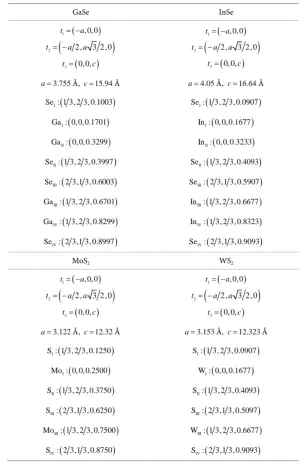
Details of the structural parameters of GaSe, InSe, MoS2 and WS2 used in the
calculations are shown in Table 1 and Figure 1 [28] [29] [30] [31] [32].
[image:4.595.219.522.259.726.2]Norm-conserving Fritz-Haber pseudopotentials with a cutoff energy of 100Ry were used in our calculations, which was deemed to cover the states needed to calculate the SHG response. The sampling point densities of the GaSe, InSe, MoS2 and WS2 Brillouin zones were set to 10 × 10 × 10, 7 × 7 × 7, 8 × 8 × 8, 8 × 8 × 8 respectively.
Table 1. Primitive vectors and coordinates of the basis atoms of GaSe, InSe,
MoS2 and WS2, in which t1, t2, t3 represent the base vectors in Cartesian
coor-dinate system used to decribe the unit cells. a and c are lattice consistants. Xy
represents the coordinate in (t1, t2, t3) of X-atom in y-sublayer.
GaSe InSe
( )
1 , 0, 0
t = −a
(
)
2 2, 3 2, 0
t = −a a
( )
3 0, 0,
t = c
(
)
1 , 0, 0
t = −a
(
)
2 2 , 3 2 , 0
t = −a a
(
)
3 0, 0,
t = c
3.755 , 15.94
a= Å c= Å a=4.05Å, c=16.64Å
(
)
I
Se : 1 3, 2 3, 0.1003 Se : 1 3, 2 3, 0.0907I
(
)
( )
I
Ga : 0, 0, 0.1701 In : 0, 0, 0.1677I ( )
(
)
II
Ga : 0, 0, 0.3299 In : 0, 0, 0.3233II
(
)
( )
II
Se : 1 3, 2 3, 0.3997 Se : 1 3, 2 3, 0.4093II ( )
(
)
III
Se : 2 3,1 3, 0.6003 Se : 2 3,1 3, 0.5907III
(
)
( )
III
Ga : 1 3, 2 3, 0.6701 In : 1 3, 2 3, 0.6677III ( )
(
)
IV
Ga : 1 3, 2 3, 0.8299 In : 1 3, 2 3, 0.8323IV
(
)
(
)
IV
Se : 2 3,1 3, 0.8997 Se : 2 3,1 3, 0.9093IV
(
)
MoS2 WS2
( )
1 , 0, 0
t = −a
(
)
2 2, 3 2, 0
t = −a a
( )
3 0, 0,
t = c
( )
1 , 0, 0
t = −a
(
)
2 2, 3 2, 0
t = −a a
( )
3 0, 0,
t = c
3.122 , 12.32
a= Å c= Å a=3.153Å, c=12.323Å
(
)
I
S : 1 3, 2 3, 0.1250 S : 1 3, 2 3, 0.0907I
(
)
( )
I
Mo : 0, 0, 0.2500 W : 0, 0, 0.1677I ( )
(
)
II
S : 1 3, 2 3, 0.3750 S : 1 3, 2 3, 0.4093II
(
)
(
)
III
S : 2 3,1 3, 0.6250 S : 2 3,1 3, 0.5097III
(
)
(
)
III
Mo : 1 3, 2 3, 0.7500 W : 1 3, 2 3, 0.6677III
(
)
( )
IV
DOI: 10.4236/opj.2019.911016 182 Optics and Photonics Journal
Figure 1. Calculation steps with the methods we applied in each steps.
4. Results
4.1. Band Structure Verification
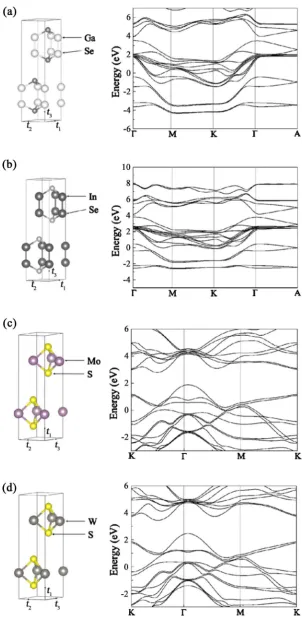
To verify the accuracy of the calculated electronic structures, we compared the band diagrams obtained with ones published in previous papers. Underestimates of the bandgaps were revealed by the comparison. Here, the band structures of
GaSe InSe MoS2 and WS2 are given in Figure 2(a)-(d) respectively. By
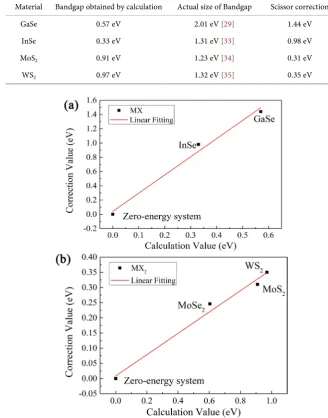
compar-ison with results published previously by other researchers, the accuracy of the calculations was determined and the scissors corrections obtained. These are given in Table 2 and Figure 3.
4.2. Nonlinear Optical Tensor
As we know, the second-order susceptibility matrix has 33 = 27 elements. For
GaSe, InSe, MoS2, and WS2, the 211 element is the one that concerns us most:
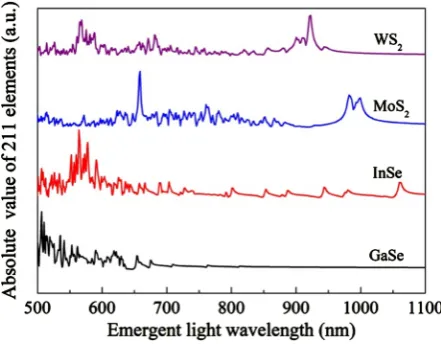
most of the other elements are canceled to zero due to the symmetry of these crystals, and coaxial phase matching is non-negligible in nonlinear optical processes. The susceptibility is a complex number, in which the real part represents the light arising, and information about the energy loss is obtained from the imaginary part combined with the real part. The absolute values of the 211 element of the susceptibility matrix, which is proportional to the SHG emergent light intensity is given in Figure 4.
In Figure 4, it is can be seen that all four materials have significant SHG ef-fects in the visible and infrared bands, and at particular wavelengths the nonli-near optical response is several orders of magnitude larger than the band. These results are consistent with previous results. Moreover, crystals with similar structures have similar nonlinear response curves, with a short-wave-directed shift as the actual bandgap increases. The phenomenon is understandable and the result is implied by the scissors corrections obtained.
In particular, the nonlinear responses of all four crystals in the green to red light region of the visible light band reach significant levels, with InSe, GaSe and
MoS2 having their highest response efficiency in this region. The results predict
DOI: 10.4236/opj.2019.911016 183 Optics and Photonics Journal
Figure 2. Unit cell and band structures of van der Waals crystals for (a) GaSe, (b) InSe (c)
DOI: 10.4236/opj.2019.911016 184 Optics and Photonics Journal
Table 2. Bandgaps obtained by our calculation, actual size of the gaps and the scissors
corrections obtained by comparing the values.
Material Bandgap obtained by calculation Actual size of Bandgap Scissor correction
GaSe 0.57 eV 2.01 eV [29] 1.44 eV
InSe 0.33 eV 1.31 eV [33] 0.98 eV
MoS2 0.91 eV 1.23 eV [34] 0.31 eV
WS2 0.97 eV 1.32 eV [35] 0.35 eV
Figure 3. Scissors correction values for the bandgaps obtained by comparing actual
bandgaps with the values obtained by calculation using DFT with LDA for (a) AB-structured materials like GaSe and (b) AB2-structured materials like MoS2, respectively. Besides the
parameters we need for later discussion, the points for MoSe2 and the zero energy system
are shown in the plots.
intensity of the SHG response decreases and is weaker for GaSe and InSe, but we can still see some small periodic peaks in the spectral distribution as shown in Figure 3. In contrast, WS2 and MoS2 are deemed to be better choices if an IR-band SHG device is needed. Specifically, we can expect to see clear SHG
peaks at around 980 nm for MoS2 and 920 nm for WS2. However, in the DFT
DOI: 10.4236/opj.2019.911016 185 Optics and Photonics Journal
Figure 4. The absolute value of the spectral distribution of the 211 element in the (2nd
order) susceptibility matrices calculated by DFT method of (a) GaSe, (b) InSe, (c) MoS2
and (d) WS2 in the wavelength range from 500 nm to 1100 nm, respectively.
5. Conclusion
We used first principles calculations to obtain the SHG transition efficiencies of
four typical van der Waals crystals, including the TMMCs, MoS2 and WS2, and
the TMDCs, GaSe and InSe. From our calculations we obtained a linear regres-sion for the scissors correction, and similar SHG response curves were observed for the two groups of materials, which may be due to the similarities between the crystal structures and their electronic states. Our calculations can be used to predict the SHG response of several crystals in the 500 to 1100 nm wavelength range, and so enable unsuitable nonlinear optical materials to be filtered out. SHG from GaSe and InSe in the visible light region is predicted. The calculations predict that high peaks for light emerging at 500 nm (for GaSe) and 570 nm (for InSe) would be observed. Moreover, two high SHG response regions in the
visi-ble light and infrared regions for MoS2 and WS2 are predicted by the
calcula-tions. Peaks in the SHG transformation efficiency at 660 nm and 980 nm for
MoS2 and at 580 nm and 920 nm for WS2 were obtained. In the future, the
present calculation will be extended to other 2D materials such as graphene, to find their potentials of nonlinear optical application.
Acknowledgements
This work was partly supported by Grant-in-Aid for JSPS Research Fellow JP19J20564, Japan.
Conflicts of Interest
The authors declare no conflicts of interest regarding the publication of this pa-per.
References
DOI: 10.4236/opj.2019.911016 186 Optics and Photonics Journal III-VI Layered Crystals like GaSe, GaTe, InSe, GaSe1−xTex and GaxIn1−xSe. Progress
in Crystal Growth and Characterization of Materials, 5, 323. https://doi.org/10.1016/0146-3535(82)90004-1
[2] Shaw, J. C., Zhou, H., Chen, Y., Weiss, N. O., Liu, Y., Huang, Y. and Duan, X. (2014) Chemical Vapor Deposition Growth of Monolayer MoSe2 Nanosheets. Nano
Research, 7, 511.https://doi.org/10.1007/s12274-014-0417-z
[3] Tanabe, T., Zhao, S., Sato, Y. and Oyama, Y. (2017) Effect of Adding Te to Layered GaSe Crystals to Increase the van der Waals Bonding Force. Journal of Applied Physics, 122, Article ID: 165105.https://doi.org/10.1063/1.4986768
[4] Oyama, Y., Tanabe, T., Sato, F., Kenmochi, A., Nishizawa, J., Sasaki, T. and Suto, K. (2008) Liquid-Phase Epitaxy of GaSe and Potential Application for Wide Frequen-cy-Tunable Coherent Terahertz-Wave Generation. Journal of Crystal Growth, 310, 1923.https://doi.org/10.1016/j.jcrysgro.2007.11.205
[5] Tanabe, T., Tang, C., Sato, Y. and Oyama, Y. (2018) Direct Determination of the Interlayer van der Waals Bonding Force in 2D Indium Selenide Semiconductor Crystal. Journal of Applied Physics, 123, Article ID: 245107.
https://doi.org/10.1063/1.5024313
[6] Takasuna, S., Shiogai, J., Matsuzaka, S., Kohda, M., Oyama, Y. and Nitta, J. (2017) Effect of Optical Waveguide on Photoluminescence Polarization in Layered Materi-al GaSe with Millimeter ScMateri-ale. Physical Review B, 96, Article ID: 161303.
https://doi.org/10.7567/JJAP.57.020308
[7] Auerbach, S.M., Carrado, K.A. and Dutta, P.K. (2004) Handbook of Layered Mate-rials. CRC Press, New York.https://doi.org/10.1201/9780203021354
[8] Kenmochi, A., Tanabe, T., Oyama, Y., Suto, K. and Nishizawa, J. (2008) Terahertz Wave Generation from GaSe Crystals and Effects of Crystallinity. Journal of Physics and Chemistry of Solids, 69, 605.https://doi.org/10.1016/j.jpcs.2007.07.047
[9] Neshev, D. and Kivshar, Y. (2014) Nonlinear Optics Pushed to the Edge. Science, 344, 483.https://doi.org/10.1126/science.1253531
[10] Yin, X., Ye, Z., Chenet, D.A., Ye, Y., O’Brien, K., Hone, J.C. and Zhang, X. (2014) Edge Nonlinear Optics on a MoS2 Atomic Monolayer. Science, 344, 488.
https://doi.org/10.1126/science.1250564
[11] Geim, A.K. and Grigorieva, I.V. (2013) Van der Waals Heterostructures. Nature, 499, 419.https://doi.org/10.1038/nature12385
[12] Coleman, J.N., Lotya, M., O’Neill, A., Bergin, S.D., King, P.J., et al. (2011) Two- Dimensional Nanosheets Produced by Liquid Exfoliation of Layered Materials.
Science, 331, 568.https://doi.org/10.1126/science.1194975
[13] Tang, C., Sato, Y., Tanabe, T. and Oyama, Y. (2018) Low Temperature Liquid Phase Growth of Crystalline InSe Grown by the Temperature Difference Method under Controlled Vapor Pressure. Journal of Crystal Growth, 495, 54.
https://doi.org/10.1016/j.jcrysgro.2018.05.016
[14] Eaton, D.F., Meredith, G.R. and Miller, J.S. (1992) Molecular Nonlinear Optical Materials-Potential Applications. Advanced Materials, 4, 45.
https://doi.org/10.1002/adma.19920040110
DOI: 10.4236/opj.2019.911016 187 Optics and Photonics Journal Monolayer TMDCs and Its Potential Application in Producing Terahertz Radiation.
The Journal of Chemical Physics, 147, Article ID: 244701. https://doi.org/10.1063/1.5000561
[17] Wang, C.-Y. and Guo, G.-Y. (2015) Nonlinear Optical Properties of Transi-tion-Metal Dichalcogenide MX2 (M = Mo, W; X = S, Se) Monolayers and Trilayer-sfrom First-Principles Calculations. The Journal of Physical Chemistry C, 119, 13268-13276.https://doi.org/10.1021/acs.jpcc.5b01866
[18] Cabuk, S. (2012) The Nonlinear Optical Susceptibility and Electro-Optic Tensor of Ferroelectrics: First-Principle Study. Central European Journal of Physics, 10, 239. https://doi.org/10.2478/s11534-011-0079-3
[19] Sharma, S. and Ambrosch-Draxl, C. (2004) Second-Harmonic Optical Response from First Principles. Physica Scripta, 109, 128.
https://doi.org/10.1238/Physica.Topical.109a00128
[20] Gonze, X., Amadon, B., Anglade, P.-M., Beuken, J.-M., Bottin, F., et al. (2009) ABINIT: First-Principles Approach to Material and Nanosystem Properties. Com-puter Physics Communications, 180, 2582.
https://doi.org/10.1016/j.cpc.2009.07.007
[21] Gonze, X., Rignanese, G.-M., Verstraete, M., Beuken, J.-M., Pouillon, Y., Caracas, R., Jollet, F., Torrent, M., Zerah, G., Mikami, M., Ghosez, Ph., Veithen, M., Raty, J.-Y., Olevano, V., Bruneval, F., Reining, L., Godby, R., Onida, G., Hamann, D.R. and Allan, D.C. (2005) A Brief Introduction to the ABINIT Software Package. Zeit-schrift für Kristallographie, 220, 558.
[22] Gonze, X. (2002) First-Principles Computation of Material Properties: The ABINIT Software Project. Computational Materials Science, 25, 478.
https://doi.org/10.1016/S0927-0256(02)00325-7
[23] Baroni, S., De Gironcoli, S., Dal Corso, A. and Giannozzi, P. (2001) Phonons and Related Crystal Properties from Density-Functional Perturbation Theory. Reviews of Modern Physics, 73, 515.https://doi.org/10.1103/RevModPhys.73.515
[24] Gross, E.K. and Dreizler, R.M. (1990) Density Functional Theory. Springer, Berlin. https://doi.org/10.1016/S0065-3276(08)60600-0
[25] Parr, R.G. and Yang, W. (1989) Density-Functional Theory of Atoms and Mole-cules. Oxford University Press, Oxford.
[26] Kohn, W. (1965) Self-Consistent Equations Including Exchange and Correlation Effects. Physical Review, 140, A1133.https://doi.org/10.1103/PhysRev.140.A1133 [27] Assadi, M.H.N. and Hanaor, D.A. (2013) Theoretical Study on Copper’s Energetics
and Magnetism in TiO2 Polymorphs. Journal of Applied Physics, 113, Article ID:
233913.https://doi.org/10.1063/1.4811539
[28] Nagel, S., Baldereschi, A. and Maschke, K. (1979) Tight-Binding Study of the Elec-tronic States in GaSe Polytypes. Journal of Physics C: Solid State Physics, 12, 1625. https://doi.org/10.1088/0022-3719/12/9/006
[29] Plucinski, L., Johnson, R., Kowalski, B., Kopalko, K., Orlowski, B., Kovalyuk, Z. and Lashkarev, G. (2003) Electronic Band Structure of GaSe (0001): Angle-Resolved Photoemission and ab Initio Theory. Physical Review B, 68, Article ID: 125304. https://doi.org/10.1103/PhysRevB.68.125304
[30] McCanny, J. and Murray, R. (1977) The Band Structures of Gallium and Indium Selenide. Journal of Physics C: Solid State Physics, 10, 1211.
https://doi.org/10.1088/0022-3719/10/8/022
Mo-DOI: 10.4236/opj.2019.911016 188 Optics and Photonics Journal nolayer. Solid State Communications, 152, 909.
https://doi.org/10.1016/j.ssc.2012.02.005
[32] Schutte, W., De Boer, J. and Jellinek, F. (1987) Crystal Structures of Tungsten Disul-fide and Diselenide. Journal of Solid State Chemistry, 70, 207.
https://doi.org/10.1016/0022-4596(87)90057-0
[33] Debbichi, L., Eriksson, O. and Lebègue, S. (2015) Two-Dimensional Indium Sele-nides Compounds: An ab Initio Study. The Journal of Physical Chemistry Letters, 6, 3098.https://doi.org/10.1021/acs.jpclett.5b01356
[34] Kobayashi, K. and Yamauchi, J. (1995) Electronic Structure and Scanning-Tunn- eling-Microscopy Image of Molybdenum Dichalcogenide Surfaces. Physical Review B, 51, Article ID: 17085.https://doi.org/10.1103/PhysRevB.51.17085