January,
1966
CD
O::iZ
&
1r'J
11\1
,J
Il:J S
How to put your finger on one item out of 36,000
A division of H. K. Porter
Company, Inc., does it
by dialing a computer center.
Anyone of 36,000 items could be
at any of seven warehouses and
eight plants across the nation.
When a product is sold, the
information on punched cards
is sent via Bell System
Data-Phone* service over regular
telephone lines to the Porter
computer center in Pittsburgh.
*Sorvice mark of the Bell System
The information is instantly
recorded on magnetic tape and
fed into the computer.
In a matter of milliseconds,
the computer tells the production
status or inventory location
of the product. And the entire
order is processed for shipment
in one working day. (It formerly
took up to fourteen days.)
As ordering information flows in,
the computer updates the
average monthly demand,
economical production quantities,
and safety stocks.
Designate No. 1 on Readers Service Card
Replenishment orders are
auto-matically produced when needed.
The result has been a cut in
inventories. And customer
service is at its best.
We can help you put your finger
on the way to move information
quickly and efficiently. Just call your
Bell Telephone Business Office.
Ask to have our Communications
Consultant contact you.
@
Bell
System
. . American Telephone & Telegraph • and Associated Companies
What does Old 99 have to do with Brady Tab Labels?
It illustrates a point.
In their day, steam locomotive drive wheels rode
on sweat-on steel rims or "tires". When a tire
loos-ened with wear, it was replaced, saving the cost of an
expensive drive wheel. Trouble was, these tires
occasionally came loose a.nd shattered with
danger-ous, expensive results. To detect a loosening tire, a
"wheel tapper" at each station or whistle-stop would
tap each drive wheel to determine the condition of
the tire.
But long after "tired" drive wheels were replaced
with solid steel wheels, wheel tappers continued to
make their routine checks. Perhaps through habit
or simply because no one told them not to.
Now the point we'd like to make is this: for years
tab label people have been stocking only fraction of
an inch sizes -
1/16", I/S", 1/4"
and so on. Except Brady.
We stock Tab Labels in tenths of an inch sizes
because most computors print out ten characters
per inch. For those companies whose programs
require fractional dimensions, we have those too.
Keen awareness of customers' special and changing
needs plus willingness to meet them has long marked
our service. There are no "wheel tappers" at Brady!
Our approach made so much sense to hundreds of
suppliers of data processing supplies (chances are,
your supplier among them!) that they now carry a
local stock of Brady Tab Labels. And they can give
you local service on your special made-to-order
requirements, too.
Write for big,
new bulletin and
samples. Free!
AD NO. 167
W.H.
mmrJm'~fco.
EST. 1914
741 W. Glendale Ave., Milwaukee, Wis. 53209
Manufacturers of Quality Pressure-Sensitive Industrial Tape Products, Self-Bonding Nameplates, Automatic Machines for Dispensing Labels, Nameplates, Masks and Tape,
Mayday!
Ever have days when you get this sinking feeling? Tape problems -
trans-port problems - dropout problems?
Next time maybe we can help. Before you go down for the third time,
call your nearesf Computron Regional Office and shout "Mayday". Your
Computroncustomer engineer will be on his way in a trice. He is fully qualified
in all phases of EDP. He is nota salesman. He knows tapes -
he knows
com-puters
~and
he has had a great deal of experience in getting them to talk
to each other.
Of course,many people have solved their data recording problems simply
by switching toComputape.
.
In any case,
w~
are at your service. For advice, application assistance;
problem solving, orjust a reel of tape, call. your nearest Computron office.
4
Designate No. 3 on Readers Service Card
A PRODUCT OF COMPUTRON. INC.
MEMBER OF THE
IDIMIlr
GROUP.
'JANUARY, 1966 Vol. 15, No. 1
editor and publisher
EDMUND C. BERKELEY
auociate publisher
PATRICK J. MCGOVERN
auistant editors
MOSES M. BERLIN LINDA LADD LOVETT NEIL D. MACDONALD
contributing editors
JOHN BENNETT ANDREW D. BOOTH DICK H. BRANDON JOHN W. CARR, III NED CHAPIN ALSTON S. HOUSEHOLDER PETER KUGEL
adviJory committee
T. E. CHEATHAM, JR. JAMES J. CRYAN GEORGE E. FORSYTHE RICHARD W. HAMMING ALSTON S. HOUSEHOLDER HERBERT F. MITCHELL, JR. VICTOR PASCHKIS
production manager
ANN B. BAKER
art director
RAY W. HASS
fulfilment manager
WILLIAM J. MCMILLAN, 815 Washington St. Newtonville, Mass. 02160, 617-DEcatur 2-5453
advertiJing representatives
New York 10018, BERNARD LANE 37 West 39 St., 212-BRyant 9-7281 Chicago 60611, COLE, MASON AND DEMING 737 N. Michigan Ave., 312-SU 7-6558 Los Angeles 90005, WENTWORTH F. GREEN 300 S. Kenmore Ave., 213-DUnkirk 7-813~
San Francisco 94105, A. S. BABCOCK 605 Market St., 415-YUkon 2-3954 Elsewhere, THE PUBLISHER 815 Washington St., 617-DEcatur 2-5453 Newtonville, Mass. 02160
The front cover shows how an electronic,
computerized, surgical monitoring system
diJplays information about the physiological
conditions of a patient during an operation at
St. Mary's Hospital, Rochester, Minnesota.
For more information see page 39.
computers and data processors:
the design, applicationJ,
and implications of
'
information proceuing sYJtemJ .
liz This Issue
SPecial Feature:
Computer Performance Comparisons
12
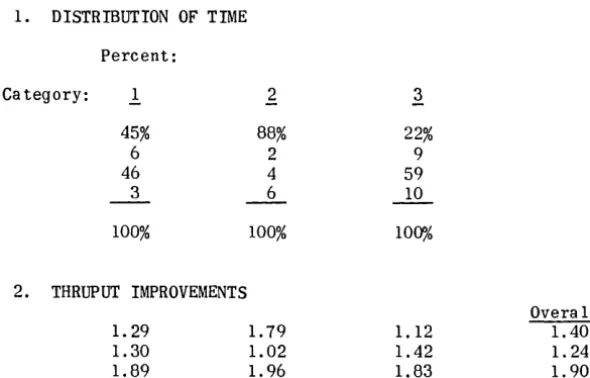
COMPUTER ANALYSIS AND THRUPUT EVALUATION
by R. A, Arbuckle
We now have the proper tools for making sound evaluations of thruput
improvements
16
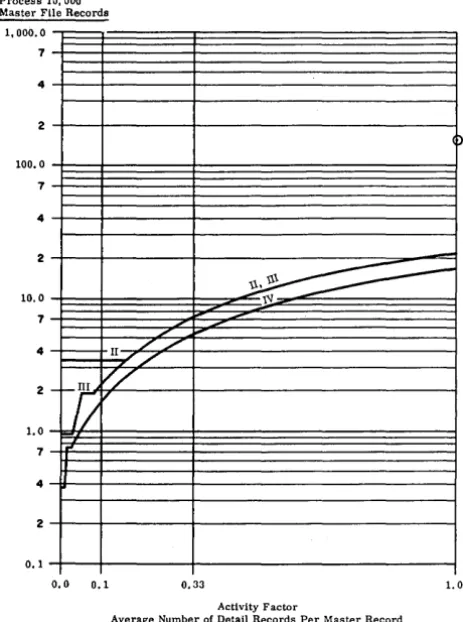
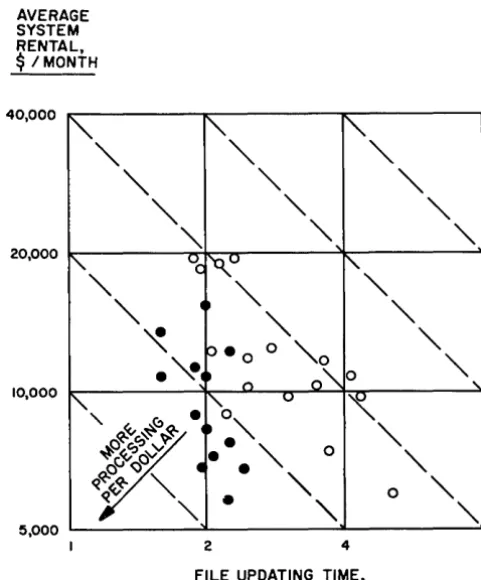
STANDARDIZED BENCHMARK PROBLEMS MEASURE COMPUTER PERFORMANCE
by John R. Hi "egass
What every computer user wants is more processing power per dollar; and
a properly conducted computer evaluation study can save thousands of
dollars a month
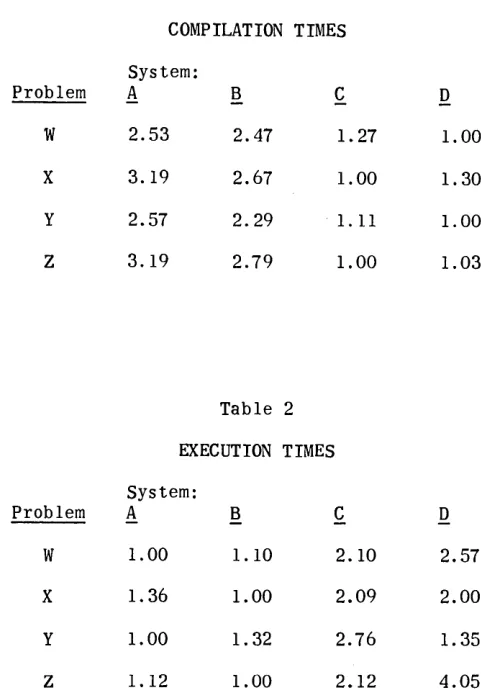
22
THE VALIDITY OF BASING COMPUTER SELECTIONS ON BENCHMARK RESULTS
by Edward O. Joslin and John 1. Ai ken
The need for understanding and selecting benchmark routines which ade·
quately reflect your workload
25
1965
ANNUAL INDEX
In Every Issue
39
7
9
37
10
10
10
11
11
57
54
58
58
58
across the editor's desk
COMPUTING AND DATA PROCESSING NEWSLETTER
editorial
Workable Solutions to the Technological Revolution
market report
Dedication of the Keydata Service May Mark Beginning of New Growth Industry ..• But When Wi" Growth Begin?
capital report
readers' and editor's forum
Non-Real-Time Computing
Savings Banks with Electronic Links from Bank Floor to Central Computer - Some History
1966 International Symposium on Mathematical and Computational Methods in the Social Sciences
The Computer and The Arts
National Science Foundation Grant to the Association for Computing Machinery Calendar of Coming Events
reference information
Computer Census
New Patents, by Raymond R. Skolnick
index of notices
Advertising Index Classified Advertisements
.~ ... COMPUTERS AND AUTOMATION IS PUBLISHED MONTHLY AT 815 WASHINGTON ST" NEWTONVILLE, MASS, 02160, BY BERKELEY ENTERPRISES, INC, PRINTED IN U,S.A. SUBSCRIPTION RATES. UNITED : :STATES, $15.00 FOR 1 YEAR, $29.00 FOR 2 YEARS, INCLUDING THE JUNE DIRECTORY ISSUE; CANADA, ADD SOc A YEAR FOR POSTAGE; FOREIGN, ADD $3.50 A YEAR FOR POSTAGE. ADDRESS ALL •• ... ··EDITORIAL AND SUBSCRIPTION MAIL TO BERKELEY ENTERPRISES, INC., 815 WASHINGTON ST., NEWTONVILLE, MASS., 02160. SECOND CLASS POSTAGE PAID AT BOSTON, MASS.
POSTMASTER. PLEASE SEND ALL FORMS 3579 TO BERKELEY ENTERPRISES, INC., 815 WASHINGTON ST., NEWTONVILLE, MASS. 02160. © COPYRIGHT, 1966, BY BERKELEY ENTERPRISES, INC. CHANGE OF ADDRESS: IF YOUR ADDRESS CHANGES, PLEASE SEND US BOTH YOUR NEW ADDRESS AND YOUR OLD ADDRESS (AS IT APPEARS ON THE MAGAZINE ADDRESS IMPRINT), AND ALLOW THREE WEEKS
IBM's new
Basic Operating System
is not really
basic.
IBM's new Basic Operating
Sys-tem is a unique programming
support package designed for the
small and intermediate size
SYSTEM/360.
It
contains a full range of
proc-essing programs and control
pro-grams that enable you to get big
system capabilities from your
moderate sized installation.
BOS is similar to other larger
IBM Operating Systems that have
been in use for some time.
Improved job throughput
BOS provides job stacking for
rapid job-to-job transition.
It
allows you to overlap input/
output operations with
process-ing tasks.
And you can perform
periph-eral operations or special data
6
communications concurrently
with a stacked job.
Reduced job turn around
BOS enables all language
com-pilers, service programs, control
programs, even your own
applica-tions programs, to reside on-line.
To achieve efficient
communi-cations between operator and
system, BOS provides implicit
in-structions regarding all input/
output devices, job continuation
and similar processing activities.
Five languages
By providing a powerful and
extensive group of high-level
lan-guages, PL/I, COBOL, FORTRAN,
RPG, and Assembler, BOS enables
you to use the language that best
suits your particular needs.
IBM~
Designate No. 4 on Readers Service Card
BOS affords you the ability to
segment your application
pro-grams in order that each segment
can be written in the most
appro-priate language. All segments can
then be combined by the BOS
link-age editor into a single
program-more flexible, program-more powerful.
And if you and your people are
less familiar with operating
sys-tems in general, IBM'S new BOS,
with its ease of implementation, is
the logical place to start getting
more productive work from your
computer installation.
Your IBM representative will be
glad to show you how BOS is a lot
of operating system - much more
than basic.
SYSTEM/360-The Computer
with a Future.
Workable Solutions to the
The October 1965 issue of "Change" published by the
Cen-ter for the Study of Democratic Institutions contains the
following information:
-A local union with 1300 members at a certain plant in
1959 had only 350 in 1963; shortly with the plant
auto-mated, there will be only 25 men, yet the plant will be
producing twice as much as before.
-In the tomato-picking industry a new machine does the
work of 70 to 80 men; the machine costs only $25,000.
There are now 20 such machines in California. It is
expected that 700 will be in use next season displacing
56,000 workers.
According to Michael Harrington in the "The Other
Amer-ica," published by Penguin Books in paperback, 1964, there
are 40 to 50 million people in the United States who are
in poverty. They may be subdivided into the aged, the
minorities, agricultural workers, unskilled workers, and
per-sons rejected by our industrial system. Over 11 million of
th('se persons are children under the age of 18.
At the same time that this. sort of thing is happening, we
find severe shortages of many kinds of trained skilled people.
"How do I get a good computer programmer?" "Why can't
the carpenter come before two months go by?" Recently a
standard index of demand for engineers maintained by
Deutsch and Shea, New York, N.Y., reached an
unprece-dented height. In "The Personnel Development Problem" by
Dick H. Brandon (in "Computers and Automation," August
1965) figures were given showing an unfulfilled need by
1970 of some hundred thousand persons qualified in
pro-gramming and analysis.
Thomas
J.
Watson, Chairman of the Board of International
Business Machines Corp., said in November, 1963:
Let's conclude the debate as to whether we have a
problem. We have. The time has come to find
work-able solutions.
If
we do this, it will solidify us as a
people and help insure our leadership in the world.
If
we fail, we may permanently alienate millions of
citi-zens and possibly destroy our system while trying to
defend some ideological details. . . .
There are a number of courses of action we can take; a
great variety of proposed solutions to the problems lie in
front of us. But we can group them roughly into three
great kinds:
1. Do nothing
2. Do something
Technological
3. Do the right thing
Let's consider each of these.
c&a
EDITORIAL
Revolution
The first kind of action is to do nothing about a problem.
There is an old joke: Bill says to Joe, "What do you do
when you feel like exercise?" and Joe replies, "I lie down
until the feeling goes away."
In spite of this joke, to do nothing, non-action, is often
sensible, practical, desirable, and even unavoidable. Suppose
during a whole week of my vacation at the seashore the
weather is rainy and cold instead of sunny and warm
-what can I do about it? Literally, nothing -
not until
human beings work out control over the weather.
Further-more, to do nothing is easy; it is usually safe and
comforta-ble; usually no one will find fault with you if you do
nothing; and it allows you to continue to be busy with the
things you were busy with before. Many of these reasons are
reflected in sayings such as: "I'll mind my business, and you
mind yours"; "One must cultivate one's own garden"; "Am
I my brother's keeper?" But over and over again the course
of nonaction lets some condition get worse and worse until
it becomes intolerable, and people won't put up with it any
more, and great violence and great waste occurs.
The next kind of action is to do something -
to make a
quick study of the problem, choose some action that can
clearly make it better for at least a little while, and pour
in effort to carry out that remedy. For example, suppose a
city is clogged with traffic: a solution is to "apply a computer"
so that traffic may be handled better and with less
conges-tion. Or in the case of technological unemployment, for
example, some people advocate retraining. They say,
"Re-train the displaced person so that he can work at a different
kind of a job.
If
an elevator operator has lost his job to an
automatic elevator, give him a course, say, in card
punch-ing, and let him find a job as a key punch operator in a
computer installation."
8
bqu
BRANDON
APPLIED SYSTEMS, INC.
and
carne!rla~!!J:!'
are pleased to announce the fourth series (Fall,
1965) of five
TECHNICAL COURSES
IN DATA PROCESSING
conducted by Brandon Applied Systems, Inc.
-
sponsored by Computers and Automation
"Management Standards for Data Processing"
a 2·day course for managers and senior personnel on manage· ment control and standards. This course is based in part on the book of the same name, by Dick H. Brandon. (D. Van Nostrand Campany, Inc., Princeton, N.J. 1963.)
New York, N.Y. -
November 3, 4
London -
December 6, 7
"Operations Control"
a 1.day course to provide operations managers and super· visors with a body of techniques and discipline for operations control.
New York, N.Y. -
November 9
"Computer Systems Analysis Techniques"
C1 2·day technical course on the techniques of systems analysis and computer feasibility study. This course is designed for ex-perienced analysts and supervisory personnel.
Washington, D.C. -
November 17, 18
New York, N.Y. -
December 1, 2
"Computer Selection"
a 1.day course for management and technical personnel con· templating acquisition or replacement of a computer system.
Washington, D.C. -
November 16
New York, N.Y. -
November 30
London -
December 10
. "Appreciation Cou rse in Data Processi ng"
a 2.day course for top executive and departmental manage· ment covering the basic principles of data processing.
London -
December 8, 9
New York -
January 13, 14, 1966
For the Fall, 1965 course catalog write or
phone or mail coupon:
BRANDON APPLIED SYSTEMS, INC.
30 East 42nd Street, New York, N.Y. 10017 212-YUkon 6·1518
TO:
Brandon Applied Systems
30 East 42 St.,
New York, N.Y. 10017
Please send me the Fall 1965 course catalog.
My name and address are attached.
Designate No. 9 on Readers Service Card
never yet heard of a way for greatly increasing the amount
of intelligence of a .given human being.
Solutions like these are stopgap solutions. They may help
for a while; then the problem returns in a worse form.
Over and over again, the temporary and partial reform allows
the underlying conditions to get worse and worse until they
are intolerable. The temporizing solutions have an added
disadvantage: they blunt the sharpness of the human energy
which would otherwise seek a better solution.
The third kind of action is to figure out and do the
right thing.
For example, let's take the disease smallpox, which has
practically vanished, due to the great Dr. Edward Jenner,
who lived in England 1749-1823. According to Collier's
Encyclopedia:
His investigations on the similarity between cowpox
and smallpox started in 1775. He observed that
dairy-maids who had cowpox did not contract smallpox.
After much research he inoculated an eight-year old boy
with cowpox and later with smallpox. The boy proved
immune to smallpox. Jenner had done likewise with
his own son . . . Jenner published his "Inquiry into the
Cause and Effects of the Variolae Vaccinae" in 1 798, and
announced his discovery of the smallpox vaccination.
At first it met violent opposition, but finally achieved
an almost universal recognition. . . . In 1802 the
government gave Jenner a grant of
£
10,000 and he was
vaccinating 300 poor persons a day without charge . . . .
In this way smallpox was eliminated after having scourged
human beings for centuries.
Other procedures might also have worked; in fact,
some-times there is more than one right course of action, right
thing to do; but the important point is that Dr. Jenner
worked out a scientifically correct course of action, for
dealing with the problem of smallpox.
In the case of a city afflicted with traffic congestion, we
can see clearly that the long-term balancing and managing
of traffic input, output, and circulation is necessary -
so
that the great asset of a viable city can be preserved year
after year for all posterity.
The same kind of right solution needs to be worked out
scientifically for the problems of the technological
revolu-tion:
1. All the goods and services that society needs year after
year should be scheduled for production using
ma-chines and persons as needed.
2. The persons needed for this production will be the
employed. They should be paid a comfortable
stan-dard of living and perhaps more. The capital needed
should also receive a reasonable return paid to its
owners .
3. All the other people in society (the young, the old,
the students, the housewives, the sick, the
under-privileged and the underdeveloped) should be given
a decent minimum standard of living and also
incen-tives for making a better life for themselves -
just
because they are human beings.
4. The way in which the arrangements can be most
reasonably worked out -
the long term balancing
and managing -
should be given as a problem (a
great Operation Match) to a computer. Any
ac-ceptable solution must not be rigid but also have
built-in reasonable flexibility.
As Thomas
J.
Watson said, "the time has come to find
workable solutions."
c.~
EDITOR
COMPUTERS and AUTOMATION for January, 1966
,.
DEDICATION OF THE KEYDATA SERVICE MAY MARK
BEGINNING OF NEW GROWTH INDUSTRY ••• BUT
WHEN WILL GROWTH BEGIN?
Keydata Corporation dedicated its Univac 491
based on-line commercial service bureau recently,
labeling it as the first time-shared computer for
busi-ness applications. The goal of the system is to provide
up to 256 individual business firms on-line proceSSing
of invoices, inventory records, and other business
transactions. Already 26 customers ranging from a
$50 million-a-year wholesale liquor distributor (who
is dumping its
mM
1440 and putting its data processing
work on the Keydata's computer) to a $1 million-a-year
clothing manufacturer have signed up for the system.
Customers are going on-line one by one during a
build-up of the system's. processing load ... with four to six
expected to be serviced by the end of the year.
Keydata is a subsidiary of Charles W. Adams
Associates, the highly regarded programming and
comsulting firm. Adams Associates have been
exten-sively engaged in development and implementation of
advanced techniques for on-line computing and
man-machine communications. The Keydata service was
first put into operation by the Adams Associates in
July, 1963, with eight stations connected on-line to a
Digital Equipment PDP-4 computer. This system was
used for the acquisition and processing of data related
to the settlement of some 40, 000 complex legal claims
in the Transitron stock snafu.
Design improvements and expansion of the
ex-ecutive routine (the master program that manages the
operation of the on-line computer) were made during
the last two years ••• evolving the software through two
generations. Regular commercial service was planned
for the Keydata by the Adams' people in early spring of
this year, but unexpected performance difficulties with
their computer at that time, a DEC PDP-6, caused
delays. In a surprise move they returned their PDP-6
and took delivery of a Univac 491 computer at the end
of July .•• the first 491 to be delivered since its formal
announcement in June. Working closely with Univac,
they had the service "on the air" in early October.
Who can benefit from an on-line data processing
service? Clearly any firm which puts a high premium
on immediate processing of inventory level requests,
order entry, re-order issuance, credit checking, etc.,
may find the Keydata service j;)eneficial. On such jobs
the Keydata service gives a response measured in
seconds versus a day or two for regular service
bureau-type performance on a batch processing computer. The
main consideration in assessing the value of the service
is whether the saving in time can justify the premium
charges involved in the on-line hookup.
Premium charges over and above regular
vice bureau transaction charges on the Keydata
ser-MARKET
REPORT
vice are due to on-line storage rental and data
communi-cations terminal and line charges. For example, in a
typical Keydata hook-up, on-line storage capacity rents
for $200 per month, the teletype terminal rents for $160
per month, and the private wire connection to get the
user hooked up to Keydata's computer costs between
$1. 33 and $2. 25 per month per mile. For a typical
user located 30 miles from Keydata's service bureau the
premium charge amounts to about $420 per month, or
say $20 each working day. For businesses where the
shortening of the delivery cycle by a day or two can
mean significant improvement in inventory cost or
cus::-tomer satisfaction, this premium charge may be easily
outweighed by the value of the benefits.
As Keydata1s service is currently set up,
manufacturing and distribution firms with $3-$5 million
in sales appear to be the most direct customer prospects.
Since there are approximately 15, 000 such firms in the
United States, the potential market for such on-line data
processing services should be conSiderably greater than
supplier capacity for many years to come.
At the current time line charges restrict the
distance from which a customer can economically use an
line computer service bureau. Therefore most
on-line service bureaus will service customers located
within 50-100 miles of the computer's location. Keydata
expects to open a second center in New York next year.
Other on-line service bureaus are springing up in
Atlanta, Dallas, San Francisco, and Washington.
The critical factor in achieving success for
the Keydata system will be the ability of the programmers
and systems analysts of the Adams Associates in
con-trolling the sophisticated real-time processor and its
executive routine in order to achieve satisfactory
cus-tomer service while preventing data errors, loss of
records, etc., when the number of users begins to
ap-proach peak loads. Since Keydata is renting their 491
configuration for $30, OOO/mo., it would seem that the
system needs at least 50-60 active customers before a
break-even point can be reached. However we feel it is
unlikely that satisfactory service for more than 30-50
subscribers can be rendered on the Keydata system
be-fore '67 ••• mostly due to programming complexities.
NON·REAL·TIME COMPUTING
J. J. Brett, President
Universal Time Punch, Inc. Cleveland, Ohio 44121
My congratulations on your special issue on real-time
com-puting and supervisory monitor programs. But now, how
about that vast market of applications where there is little
or no economic justification for real-time computing?
A vacuum of appropriate hardware has existed for such a
long time that computer users have all but given up on
modular source-data recording devices. However, this
vacu-um is in the process of being effectively shattered. Paul
Wagner Co. of California, Taller
&
Cooper Inc. of Brooklyn,
New York, and Universal Time Punch are all
manufactur-ing source-data gathermanufactur-ing equipment to provide variable data
in machine language.
As more of this type of equipment becomes available it
behooves us to look a little more carefully into the economics
of "Real-Time vs. Off-Line Data Collection." Some
infor-mation is not needed immediately. Often the desired use
is in a batch processing application, such as payroll, job
cost analysis, or the many areas of manufacturing control
(scheduling, machine loading and unloading, etc.) where
data is not required to be processed until the end of a day,
shift week or month. Then the overall costs of
communica-tion 'and transmission systems may not be justified and the
user may be better served by a source-data gathering
sys-tem based on a group of inexpensive modular units.
In the past, most of the modular or non-wired systems
depended heavily on ppunching, as the information
re-quired for batch processing applications is usually known in
advance. In most cases, this provided the bulk of the data
for the source document. However, pre-punching did not
provide the variable information needed to complete a source
document. In the past this variable information had to be
hand-written, then keypunched and verified.
Today, however, with equipment manufactured by the
companies aforementioned, it is possible to purchase
rela-tively inexpensive units to punch data directly into the source
document as the data originates.
They are particularly
feasible for the company which does not require data the
instant an operation is completed. Such a system obviously
does not require the investment or the costs of a wired or
cable system.
SAVINGS BANKS WITH ELECTRONIC LINKS
FROM BANK FLOOR TO CENTRAL COMPUTER
-
SOME HISTORY
I.
From James R. Terrell
Computer Development Department Pitney-Bowes Inc.
Stamford, Conn.
In the September, 1965, issue of
Computers and
Automa-tion, there is a short article on page 34 describing the
com-10
c&a
READERS'
&
EDITOR'S FORUM
puter operations of the Home Savings Bank of Boston. The
article states that that bank "is the first savings bank in
New England to begin operation of an electronic system
that establishes a direct link between teller windows on the
bank floor and customer records stored in an IBM computer
on another floor."
The Society for Savings in Hartford, Connecticut, has had
an on-line electronic system in operation since 1962. Not
only is there a direct link between teller windows on the
bank floor and the computer on another floor, there is a
direct link between all teller windows and the computer
includjng tellers at branches. This on-line system was
pio-neered by the Teleregister Corporation (now a division of
the Bunker-Ramo Corporation) and utilized the Telefile
computer for processing, magnetic drum storage for account
records, transaction records, and teller journals with magnetic
tape drives for back-up usage. At that time, I was at
Teleregister as the programming supervisor for the
develop-ment of the package of on-line routines for the banking
project.
The Society for Savings was one of three initial bank
installations which included the Howard Savings Bank in
Newark, New Jersey, whose system went into operation in
1961, and the Union Dime Savings Bank in New York City.
All three banks have branches with all tellers being fully
on-line.
Perhaps the article in
Computers and Automation intended
only to stress that the Home Savings Bank was the first IBM
on-line system in New England. However, it was not the
first on-line system for a New England Savings Bank.
II. From the Editor
We very much appreciate the correction.
1966 INTERNATIONAL SYMPOSIUM ON
MATHEMATICAL AND COMPUTATIONAL
METHODS IN THE SOCIAL SCIENCES
International Computation Centre
Rome, Italy
An International Symposium on Mathematical Methods in
the,Social Sciences will be held in Rome from July
4
to July
8, 1966 under the auspices of the International
Computa-tion Centre. Professor F. Braudel (College de France),
Profes-sor B. de Finetti (University of Rome), ProfesProfes-sor G. Th.
Guilbaud (E.P.H.E.), Professor P. F. Lazarsfeld (Columbia
University), Professor C. Levi-Strauss (College de France)
and Professor
J.
Piaget (University of Geneva) are Honorary
Members of the Symposium.
The Congress will be divided into four sections. Each
section will consist of an invited address (one hour), a
number of comments on submitted papers (fifteen to thirty
minutes), and general discussion (half hour).
The following is the list of the four sections with their
chairmen:
Anthropology: P. Maranda, chairman
Archaeology: ]. C. Gardin, chairman
Psychology: C. Flament, chairman
Sociology: R. Boudon, chairman
The Proceedings of the Congress will contain invited
lec-tures, the contributions to the symposia, and the program of
the Congress. They will be available by October 1966. Only
papers which have been submitted to the Organizing
Com-mittee in their final version by May 1966 will be included.
The official languages of the Symposium are French and
English, with simultaneous translation.
For more information, write to the International
Com-putation Centre, 23 Viale Civilta del Lavoro, Rome E.U.R.,
Italy.
THE COMPUTER AND THE ARTS
To the Editor:
I.
From l. Mezei
York University 2275 Bayview Ave. Toronto 12, ant., Canada
Much unpublished actiVIty is going on in the application
of computers to the arts. I am seeking to compile a list of
research projects using computers and involving visual
de-sign, architectural dede-sign, music, ballet, poetry, drama, film,
and the like.
If
any of your readers has done any \;York in
this area, I would greatly appreciate a brief description of
his work.
Also, how much interest might be there in a conference
on "The Computer and the Arts"?
II. From the Editor
In publishing this letter from Mr. Mezei, we would like to
ask any interested reader to write to him direct, and to send
us a carbon copy of the letter if convenient.
NATIONAL SCIENCE FOUNDATION GRANT TO
THE ASSOCIATION FOR COMPUTING MACHINERY
The National Science Foundation has awarded a grant of
$61,350 to the
Curriculum Committee on Computer Science
of the Association for Computing Machinery. Dr. William
F. Atchison, of the Georgia Inst. of Technology, is Chairman
of the Curriculum Committee. The primary purpose of the
grant, which is entitled
Computer Science Course -and
Cur-riculum Development, is to develop an undergraduate
pro-gram for the training of computer scientists.
Preliminary recommendations for an undergraduate
pro-gram have been developed and were published in the
Sep-tember 1965 issue of the
Communications of the ACM. The
Curriculum Committee has identified fifteen existing
under-graduate programs and discovered many more in
prepara-tion. It will direct its efforts toward a comprehensive
pro-gram which will point the way to a standard undergraduate
curriculum.
Members of the scientific and educational communities are
invited to communicate their views on this subject to Dr.
Atchison at the ACM National Headquarters, 211 East 43 St.,
New York, N.Y., 10017.
MARKET RESEARCH
ANALYST
The International Data Corporation, a
serv-ice firm specializing in market research studies
of technical industries, has a professional
po-sition available on its consulting staff for a
senior market research analyst.
• RESPONSIBILITIES •
The responsibilities of this position include
the planning and execution of statistical
stud-ies and consulting projects based upon the
market data files developed and maintained
on a continuing basis by the International
Data Corporation. These data flies include
de-tailed descriptions of most of the computer
and punched card equipment installations in
the United States and overseas, and a high
percentage of the orders for such equipment.
Participation is also expected in IDC's studies
of selective areas of advanced information
technology such as electro-optics, continuous
surface magnetic recording, etc.
• QUALIFICATIONS •
The ideal candidate should have five or
more years experience in market research
work in the computer industry or a related
field. He should be able to define and conduct
on an independent basis penetrating studies
of 'the technology and market for computers
and information technology. He should have
considerable skill in written and verbal
com-munications.
To such a person the International Data
Cor-poration offers a challenging position within a
growing company and an attractive
compen-sation arrangement. Advancement to a major
executive position is foreseen for the holder
of this position who is able to demonstrate a
high level of accomplishment.
If you feel qualified and able to undertake
these responsibilities, forward your resume in
confidence to Patrick
J. McGovern,
Interna-tional Data Corporation, Newton,
Massachu-setts, 021 60.
IIDIC
International Data Corporation 355 Walnut St.Newtonville, Massachusetts 02160