© 2019, IRJET | Impact Factor value: 7.211 | ISO 9001:2008 Certified Journal
| Page 1998
SMART VEHICLE SECURITY SYSTEM USING FINGER PRINT SENSOR
Jha Kshitiz Ranjeet
1, Sontake Aboli Ganesh
2, Shibe Arati Jayawant
3, Patil Sachin Sambhaji
41,2,3
BE (E&Tc) Students, ADCET, ASHTA, Maharashtra State, India
4
Assistant Professor, Department of E&Tc Engineering, ADCET, ASHTA, Maharashtra State, India
---***---Abstract - There have been a lot of vehicle thefts and recovering of these vehicles is a big headache both for the owner as well as the police authorities. Thieves use different techniques to change the vehicle’s appearance as well as using different parts of the vehicle and selling it and so on. So we aim to design a system that will give additional level of security to the owners thus preventing theft. This can be done by making sure that only the persons approved by the owner gets access to the vehicle and also the owner should be notified by the use of hidden techniques that the vehicle has been accessed by means of some physical damage.
Key Words: Smart Vehicle, Security system, Finger print sensor, Arduino, Relay.
1. INTRODUCTION
Vehicle security is an important issue these days due to the rising number of vehicle thefts. Once the vehicle is stolen recovering it is quite difficult. Parts go missing and moreover many vehicles are never found. Also the cost involving goes high and hence we can look for a system that will make it more secure and hence prevent the vehicle thefts.
Most vehicles today are manufactured with built-in car alarms however it is still a great idea to keep up to date with the latest developments and improvements. A lot of older security systems can be bypassed by experienced car thieves, this is why it is important to upgrade your vehicle alarm system. Being an expensive asset, it is important that we protect our cars from thieves. As the main purpose of Vehicle Security System installation is to protect our vehicles and its contents, by using biometrics to start the vehicles and thus now it has authorized access only.
1.1 objectives
The objective of this project is that, to change in the traditional starter system and make vehicles more secure. The objectives are as-
1. Prevention of Vehicle thefts 2. Increase in Vehicle Security
1.2 MOTIVATION
The high end vehicles have a very good level of security however; it is not the case with common vehicles as they have a very low level of security. We as electronics and
telecommunication engineers feel that we can add high security to these vehicles at a very low cost thus preventing the thefts. Just by use of fingerprint and proximity sensors, microcontrollers, and GSM technology this can be achieved in almost every vehicle. We can also use a wide variety of different sensors to increase the security of these vehicles.
2. LITERATURE SURVEY
The history of fingerprint started in China. That was when the first record of the technique was being used with thumb prints being imprinted in clay. In the 14th century, various Persian government papers had impression of fingers. Observation had it that no two fingerprints were exactly alike. In 1880, Henry Faulds proposed an article where friction ridges can be extensively used in crime scenes to identify criminals. He gave two examples which are; a sooty finger marks on a white wall exonerated an accused individual and a greasy print on a drinking glass that revealed who had been drinking some distilled spirits (Faulds, 1923) Fingerprint matching techniques are of two types: graph based and minutiae based. The template size of the biometric information based on minutiae is much smaller and the processing speed is higher than that of graph-based fingerprint matching. These characteristics are very important for saving memory and energy on the embedded devices (K and J., 1990). So much work as been done using the fingerprint for one kind of security system or the other, among whom are the works of Kumar, Mudholkar, Pandit, Kawale, to mention but a few (Kumar and Ryu, 2009, Kumar and Kumar, 2014, Mudholkar et al., 2012, Pandit et al., 2013, Kawale, 2013). Modern vehicles uses computer controlled battery ignition system; no matter the type of mechanism used, all ignition systems use battery, switch, coil, switching device and spark plug Delmar (2008). However, in this modern technology dispensation, biometrics has been employed for the ignition and security process (Omidiora et al., 2011, Sasi and Nair, 2013, Karthikeyan.a and Sowndharya.j, 2012, Pingat et al., 2013).
© 2019, IRJET | Impact Factor value: 7.211 | ISO 9001:2008 Certified Journal
| Page 1999
storing the information so that searching could be performed easily and efficiently. Sir Henry later established the first British fingerprint files in London. The Henry Classification System, as it came to be known, was the precursor to the classification system used for many years by the Federal Bureau of Investigation (FBI) and other criminal justice organizations that perform tenprint fingerprint searches.
In 1969, the Federal Bureau of Investigation (FBI) began its push to develop a system to automate its fingerprint identification process, which was quickly becoming overwhelming and required many man-hours. The FBI contracted the National Institute of Standards and Technology (NIST) to study the process of automating fingerprint identification. NIST identified two key challenges: (1) scanning fingerprint cards and identifying minutiae and (2) comparing and matching lists of minutiae.
[image:2.595.38.287.337.519.2]3. SYSTEM DEVELOPMENT
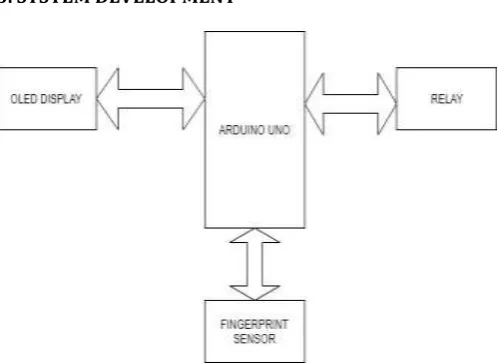
Fig 1.Block diagram ofVehicle security system
The main components of Vehicle security system consists of
Arduino UNO
Fingerprint Sensor
OLED display
Relay
The above Block diagram can be explained as follows The Fingerprint sensor will scan continuously for fingerprints. Once it receives a valid fingerprint it will display a welcome message for the user on the oled display. Then the Arduino will send the control signal to the relay turning on the vehicle. A message will be displayed on the screen to remove the finger.
3.1 HARDWARE DESIGN:
3. 1.1.Arduino
The Arduino UNO is an open-source microcontroller board based on the Microchip ATmega328P microcontroller and developed by Arduino.cc. The board is equipped with sets of digital and analog input/output (I/O) pins that may be interfaced to various expansion boards (shields) and other circuits. The board has 14 Digital pins, 6 Analog pins, and programmable with the Arduino IDE (Integrated Development Environment) via a type B USB cable.[4] It can be powered by a USB cable or by an external 9 volt battery, though it accepts voltages between 7 and 20 volts. It is also similar to the Arduino Nano and Leonardo. The hardware reference design is distributed under a Creative Commons Attribution Share-Alike 2.5 license and is available on the Arduino website. Layout and production files for some versions of the hardware are also available. "Uno" means one in Italian and was chosen to mark the release of Arduino Software (IDE) 1.0. The Uno board and version 1.0 of Arduino Software (IDE) were the reference versions of Arduino, now evolved to newer releases. The Uno board is the first in a series of USB Arduino boards, and the reference model for the Arduino platform. The ATmega328 on the Arduino Uno comes preprogrammed with a bootloader that allows uploading new code to it without the use of an external hardware programmer. It communicates using the original STK500 protocol. The Uno also differs from all preceding boards in that it does not use the FTDI USB-to-serial driver chip. Instead, it uses the Atmega16U2 (Atmega8U2 up to version R2) programmed as a USB-to-serial converter.
3.1.1.1 Pins
General Pin functions
LED: There is a built-in LED driven by digital pin 13. When the pin is HIGH value, the LED is on, when the pin is LOW, it's off.
VIN: The input voltage to the Arduino/Genuino board when it's using an external power source (as opposed to 5 volts from the USB connection or other regulated power source). You can supply voltage through this pin, or, if supplying voltage via the power jack, access it through this pin.
5V: This pin outputs a regulated 5V from the regulator on the board. The board can be supplied with power either from the DC power jack (7 - 20V), the USB connector (5V), or the VIN pin of the board (7-20V). Supplying voltage via the 5V or 3.3V pins bypasses the regulator, and can damage the board. 3V3: A 3.3 volt supply generated by the on-board
© 2019, IRJET | Impact Factor value: 7.211 | ISO 9001:2008 Certified Journal
| Page 2000
IOREF: This pin on the Arduino/Genuino board provides the voltage reference with which the microcontroller operates. A properly configured shield can read the IOREF pin voltage and select the appropriate power source or enable voltage translators on the outputs to work with the 5V or 3.3V.
Reset: Typically used to add a reset button to shields which block the one on the board.
Special Pin Functions
Each of the 14 digital pins and 6 Analog pins on the Uno can be used as an input or output, using pin Mode(),digital Write(), and digital Read() functions. They operate at 5 volts. Each pin can provide or receive 20 mA as recommended operating condition and has an internal pull-up resistor (disconnected by default) of 20-50k ohm. A maximum of 40mA is the value that must not be exceeded on any I/O pin to avoid permanent damage to the microcontroller. The Uno has 6 analog inputs, labeled A0 through A5, each of which provide 10 bits of resolution (i.e. 1024 different values). By default they measure from ground to 5 volts, though is it possible to change the upper end of their range using the AREF pin and the analog Reference() function.
In addition, some pins have specialized functions:
Serial / UART: pins 0 (RX) and 1 (TX). Used to receive (RX) and transmit (TX) TTL serial data. These pins are connected to the corresponding pins of the ATmega8U2 USB-to-TTL Serial chip.
External Interrupts: pins 2 and 3. These pins can be configured to trigger an interrupt on a low value, a rising or falling edge, or a change in value.
PWM (Pulse Width Modulation): 3, 5, 6, 9, 10, and 11 Can provide 8-bit PWM output with the analogWrite() function.
SPI (Serial Peripheral Interface): 10 (SS), 11 (MOSI), 12 (MISO), 13 (SCK). These pins support SPI communication using the SPI library.
TWI (Two Wire Interface) / I²C:A4 or SDA pin and A5 or SCL pin. Support TWI communication using the Wire library.
AREF (Analog REFerence):Reference voltage for the analog inputs.
3.2.2. Fingerprint Sensor(R305)
3.2.2.1 INTRODUCTION
Power DC 3.6V-6.0V Interface
UART(TT L logical level)/ USB 1.1
Working Typical: 100mA Matching 1:1 and
current Peak: 150mA Mode 1:N
Baud rate
(9600*N)bps, N=1~12 (default N=6)
Character file
size bytes256
Image acquirin
g time <0.5s Template size
512 bytes
Storage
capacity 256 Security level
5 (1, 2, 3, 4, 5(highest
))
FAR <0.001% FRR <0.1% Average
searchin
g time <1s (1:1000)
Window
dimension 18mm*22mm
Working environ ment Temp: -10℃- +40℃ RH: 40%-85% Storage environment Temp: -40℃- +85℃ RH: 40%-85% Outline Dimenti on Split type Module: 32*23*7mm Sensor:56*20* 21.5mm Integral type 54.5*20.6*23.8 mm Sensor:56*20* 21.5mm Integral type 54.5*20.6*23.8 mm 3.2.2.2Operation Principle
© 2019, IRJET | Impact Factor value: 7.211 | ISO 9001:2008 Certified Journal
| Page 2001
3.2.2.3Exterior Interface
Fig.2 Finger Print Sensor
Relay
A relay is an electrically operated switch. Many relays use an electromagnet to mechanically operate a switch, but other operating principles are also used, such as solid-state relays. Relays are used where it is necessary to control a circuit by a separate low-power signal, or where several circuits must be controlled by one signal. The first relays were used in long distance telegraph circuits as amplifiers: they repeated the signal coming in from one circuit and re-transmitted it on another circuit. Relays were used extensively in telephone exchanges and early computers to perform logical operations.
A type of relay that can handle the high power required to directly control an electric motor or other loads is called a contactor. Solid-state relays control power circuits with no moving parts, instead using a semiconductor device to perform switching. Relays with calibrated operating
characteristics and sometimes multiple operating coils are used to protect electrical circuits from overload or faults; in modern electric power systems these functions are performed by digital instruments still called "protective relays".
Magnetic latching relays require one pulse of coil power to move their contacts in one direction, and another, redirected pulse to move them back. Repeated pulses from the same input have no effect. Magnetic latching relays are useful in applications where interrupted power should not be able to transition the contacts.
Magnetic latching relays can have either single or dual coils. On a single coil device, the relay will operate in one direction when power is applied with one polarity, and will reset when the polarity is reversed. On a dual coil device, when polarized voltage is applied to the reset coil the contacts will transition. AC controlled magnetic latch relays have single coils that employ steering diodes to differentiate between operate and reset commands. It was used in long distance telegraph circuits, repeating the signal coming in from one circuit and re-transmitting it to another.
Basic design and Operations
Mercury-wetted relay
A mercury-wetted reed relay is a form of reed relay in which the contacts are wetted with mercury. Such relays are used to switch low-voltage signals (one volt or less) where the mercury reduces the contact resistance and associated voltage drop, for low-current signals where surface contamination may make for a poor contact, or for high-speed applications where the mercury eliminates contact bounce. Mercury wetted relays are position-sensitive and must be mounted according to the manufacturer's specifications to work properly. Because of the toxicity and expense of liquid mercury, these relays are now rarely used.
© 2019, IRJET | Impact Factor value: 7.211 | ISO 9001:2008 Certified Journal
| Page 2002
The same coalescence process causes another effect, which is a nuisance in some applications. The contact resistance is not stable immediately after contact closure, and drifts, mostly downwards, for several seconds after closure, the change perhaps being 0.5 ohm.
1) Solid-state relay
Solid-state relays have no moving parts.
25 A and 40 A solid state contactors
[image:5.595.308.561.71.273.2]A solid-state relay (SSR) is a solid state electronic component that provides a function similar to an electromechanical relay but does not have any moving components, increasing long-term reliability. A solid-state relay uses a thyristor, TRIAC or other solid-state switching device, activated by the control signal, to switch the controlled load, instead of a solenoid. An optocoupler (a light-emitting diode (LED) coupled with a photo transistor) can be used to isolate control and controlled circuits.
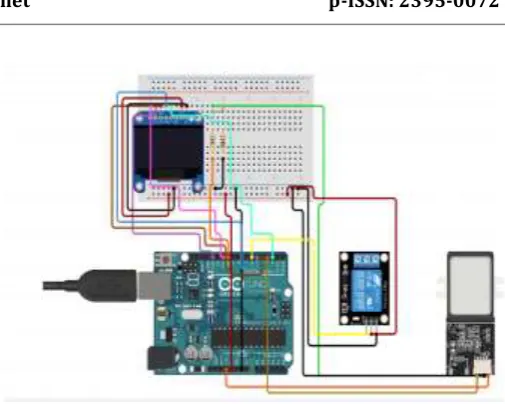
Fig 3. Overall Circuit Design
ALGORITHM AND FLOW CHART:
[image:5.595.314.558.355.657.2]Flowchart for fingerprint storing and identification.
© 2019, IRJET | Impact Factor value: 7.211 | ISO 9001:2008 Certified Journal
| Page 2003
PERFORMANCE ANALYSIS: 4.1. System Operation
The first step of operation is fingerprint identification.
The fingerprint identification process has two steps that is 1.Enrolling Fingerprint.
Having the fingerprint sensor module wired to the Arduino, follow the next steps to enroll a new fingerprint. Make sure you’ve installed the Adafruit Fingerprint Sensor library previously.
1. In the Arduino IDE, go
to File > Examples > AdafruitFingerprintSensorLibrar y > Enroll.
2. Upload the code, and open the serial monitor at a baud rate of 9600.
3. You should enter an ID for the fingerprint. As this is your first fingerprint, type 1 at the top left corner, and then, click the Send button.
4.Place your finger on the scanner and follow the instructions on the serial monitor.
2. Matching Fingerprint.
Once we have stored the fingerprints the fingerprint sensor will keep on continuously scanning for a fingerprint. Once it receives a valid fingerprint the Arduino will make relay output high, thus turning on the vehicle.
4.2 Expected Results at various stages
At first stage we expect the Arduino to be able to store the finger print and then verify it. Once the fingerprint verification process is complete then we expect some sort of output signal from the Arduino which we can use to produce the ignition. Thus the vehicle will only start when an authorized person is accessing it.
5. SUMMARY
5.1 Conclusive remarks
We have successfully able implemented this system and thus we can replace the traditional starter in Vehicles by more secure way and thus overcome the its drawbacks. This system helps in making vehicle more secure and thus it will help in prevention of thefts.
5.2 Applications
This project will be used in vehicles to make the vehicles more secure and prevent thefts.
It can be used for all types of vehicles with very little modifications and is at low costthus not increasing the price of the vehicle by very much.
6. REFERENCES
[1] 1.Automated Fingerprint Identification Systems (AFIS) Book by Peter Komarinski Originally published: 17 December 2004
[2] 7.FAULDS, H. 1923. A Manual of Practical Dactylography, “Police review" Publishing Company, Limited.
[3] fingerprint recognition using standardized fingerprint model Le Hoang Thai 1 and Ha Nhat Tam 2 1 Faculty of Information Technology, University of Science Ho Chi Minh City, 70000, Viet Nam 2 University of Science Ho Chi Minh City, 70000, Viet Nam, IJCSI International Journal of Computer Science Issues, Vol. 7, Issue 3, No 7, May 2010
[4] Arpit Agrawal and Ashish Patidar, “Smart Authentication for Smart Phones”, International Journal of Computer Science and Information Technologies, Vol. 5, No4 , pp.4839-4843,2014.
© 2019, IRJET | Impact Factor value: 7.211 | ISO 9001:2008 Certified Journal
| Page 2004
[6] S. S. Patil, K. N. Patil , S. P. Patil “Gesture based wheel chair for physically disabled person” International Journal of Engineering and sciences and research technology (IJESRT) (ISSN:2277-9655), pp-245-252,Publication Impact Factor:3.785,December 2015.
[7] S. S. Patil, K. M. Dange , S. P. Patil “PIC Microcontroller based Neural network and image processing controlled low cost autonomous vehicle” International Research Journal of Engineering and Technology (IRJET) Volume 2 Issue 9, (I20R),pp-504-507,Publication Impact Factor:4.45, December 2015.
BIOGRAPHIES
Mr. Kshitiz Ranjeet Jha , he is student of “B.E (E & Tc), Departments of Electronics & Telecommunication Engineering, Annasaheb Dange College of engineering and technology Ashta, Maharashtra, India”.
Ms. Arati Shibe Jaywant , she is student of “B.E (E & Tc), Departments of Electronics & Telecommunication Engineering, Annasaheb Dange College of engineering and technology Ashta, Maharashtra, India”.
Ms. Aboli Ganesh Sontakke , she is student of “B.E (E & Tc), Departments of Electronics & Telecommunication Engineering, Annasaheb Dange College of engineering and technology Ashta, Maharashtra, India”.
Mr. Sachin S. Patil is working as an assistant professor in department of E&Tc Engineering of Annasaheb Dange college of engineering and technology, Ashta. He stood 5th rank at the time of BE in SUK Exam. He has 10 years of teaching experience. He has attended 16 STTP, 11 Workshops, 5 national conferences, 15 international conferences. He has published 21 papers in international journals. He has also published 1 book. He got young instigator award at international conference at Nagpur.