D
·t
. !
~.
", ... ":="
um
1,:::::-i.;:<J;~I~,~,g1iW!lm· /!\.,~, IM!m(!wt~, (Y",~
jt;U;))~:Ytt,~,~' ')I~nl i¥§~B:( '~V~~!llil?)i~~~§j)\'j.:
m ~ tmrl IJJ.lm
~ ~ f.IID aJ::ll:iI c::Im !!!lJ
':? ~ 10. .... ,-,... :::'::. ~ . .:.J
i
J
(
/ ) '
.,. -I
~.j
~.
/ I
... ,-) Jr'
.,\1 (
I:.J
Ii
",
IJ
( "--,"
:J
... :.l 1I
i
I -) I\ I 1._) • \ i ' o J
i '""
'.
--~ .. ~-.. '-~__ .--.f
- -,_ ... __ . ---,---~--~ .. "-'---_.-../'
~\
\.> '-I ~
.--;
/~I
_J~ _ _ _ _ ,_~ _ _.:,
- - ] ' " ,."
..
''' ... ~..
-.~"!
~-lll\jkL
Iff~
I
r
I ~n\oj (O(~{ol i 1.'-{Qri1~'(~rr~.q(ofiil 1'liJi ~ ~'(ol ~ i; i (~frc:\,i~,n~I~, (\~ilrc(61i·fii
I
m,l,
}!.~,7Z!/F,.="", lL17~1,~,-,·,/-;;/7Nj
~Vld-/;!~L~~_!,!/t!!v
i{lHIT9MI
~~hl{~l"~? I'it..~~~~~: i~I!Ji!ljT!j;:~mG1\ c (;li~mwr!TiHI lij£\~~i~%1 c fu:.lrmHilliE·((;!iJ:i) l~~:r~-' r ~'I% (!~fiJl!~r;~':~~lin';::(:,!1rl{tt:1 '-:~:.l(:~,:!r:1:1~·i['i; ':~\1I,11\l:.
:9:':' -
it:fir:j ·~m:7~~IT j";l'~i(o!i: (\~r: i(~':1 ;~~7':~!I.1I1 ,C!i1\'1,tHo/*
I('~~~' ~l;::::i)~""'I'1;)}:lff*l i-~;:. d~:":1 'J;'!;~IV:;': ..:t;lj 1:'r:lil'l!:J.;":' ((:';J~:
*'i'!'l*:c'
1 I:). lui)II!;, It'/lo . 1(:'if:1 :;ji;'ii;yl; i'l1':i;lll~Ol:, I,':;: :f"':II;~,,:I~~;::·~i:I:1'\T/lfcli)I\(I!l;r;ri~r ::i,io, '::{;i:litl,t!' I::(c~~.;.~i I?'[!lf=firii ,''' i(i'V'!:t:!, I:r*f:!i~: ,- '1{,lIc{ol\'/: i~'fi'J~): lIir:Wli) 110.', 1~!~';I'lljIUI l:tit!lt:litil ((I[~;~;" :;~~...f:!~·i~
ClflCLE G on rlE,:.of::n ChHD
'~;H'·I"'I;i;
·~:';mi···I:'
·;I"'~:\:II. ., olr.II.Jiq:
:.' :jl~I;J!: 1~:I,;·~Ij·r;i1
~. : •.. !;1 % " .. 1 ~.'~ 1:1,,; : ~ n.~I,I;
DATAMATION
JANUARY 1, 1985/$3.00 U.S.A. VOLUME 31 NUMBER 1 This issue 184,390 copies
FEATURES
22
IN FOCUS
"Dp and the Disabled" may be a good match, report Nancy Burnett and Jill Neimark. New technology could have the potential to improve the lives of the handicapped and make the workplace more amenable.
68
FAST BREAK IN ·ARMONK
John W. Verity and Willie Schatz
Unfettered by the current admini-stration, IBM has wasted little time taking advantage of the relaxed atmosphere.
78
SHOPPING FOR MARKET
SHARE
Brian Jeffery
Most observers failed to anticipate that IBM would enter the telecom market by the third-party route.
87
THE USERS' STORY
Edith D. Myers
Big users talk about service,
. support, GUIDE, communications, and the waning of account contro/.
97
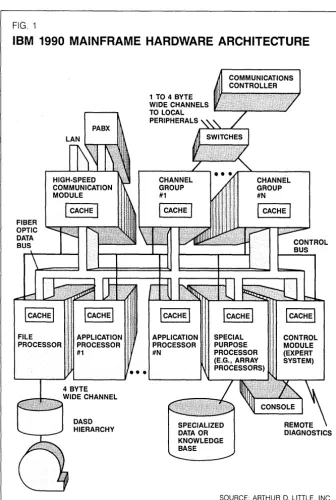
IBM: MAINFRAMES IN 1990
Norman Weizer and Frederic Withington
Customer needs, new technology, and IBM's self-interest will by 1990 bring about the evolution of an integrated architecture encompassing all IBM's multiple product lines.
108
A GENEROUS PORTION
Irene S. Nesbit
Once a mere snack, the pc software market is now a banquet. IBM has reserved a seat at the head of the table.
118
BANKING ON IBM
Hesh Wiener
While IBM £redit Corp.'s rapid growth has enabled users to reduce costs, the expansion may represent a threat to those users, to indepen-dent lessors, and even to IBM itself.
NEWS IN PERSPECTIVE
34
EXPERT SYSTEMS
Bringing home AI.
36
SOnwARE
Out of thin air.
38
LOCAL AREA NETWORKS
Can MS/Net succeed?
44
COMMUNICATIONS
Modem market madness.
52
MAINTENANCE
Micro service shakeout.
61
MICROCOMPUTERS
Battle of the boards.
64
BENCHMARKS
DEPARTMENTS
9
LOOK AHEAD
15
LETTERS
19
EDITORIAL
129
PEOPLE
133
HARDWARE
139
SOnwARE
145
SOURCE DATA
150
ON THE JOB
152
MARKETPLACE
153
READERS' FORUM
159
SUBJECT INDEX
164
ADVERTISERS' INDEX
INTERNATIONAL 64-1
- 2
THE JAPANESE
ALTERNATIVE
- 7
THE SIDE DOOR STRATEGY
-10
THE LINGUA FRANCA IN
FRANCE
-14
TEAMWORK WITH TOKYO
PHOTOGRAPH BY ARTHUR KLONSKY STYLIST: CAROL ROTHMAN
April 17-24, Hannover, West Germany
H
annover
CeBII .
Fair
J
5
For 8 Days
in
April, the World's
Com.puter
&
Office Equipm.ent
Experts
will
Convene at Hannover.
It's true. For 8 short days, the world's best thinkers and doers in the fields of
computers, office equipment and data technology will be gathered for CeBIT at
Hannover Fair '85. They'll come to Hannover to preview the state-of-the-world's
technologies, and in many cases, to showcase their own innovations.
For 8 days in April, Hannover will host 750,000 top executives and scientists-a
venue of experts in world technology. Collected, they represent an awesome and
elite purchasing power. It's really no surprise. The Hannover Fair has been the
world's preeminent trade fair since 1947. This year, the show is bigger and better
than ever, featuring 6,500 exhibitors from 50 countries and 10 major world
technologies.
If your company competes in the world market, you need to be counted among
these business-minded visitors. Our "full house" of CeBIT '85 exhibitors are all
ready to showcase their latest products and give you an up-to-date picture of the
current state of technology. Contact us for a complete information packet. We can
also assist you with low cost travel planning.
Delia Associates
(.£ij
HANNOVER FAIRS INFORMATION CENTER
___
l.
~
p.
0.
Box 338, Whitehouse, NJ 08888FOR FAST RESPONSE,
USE OUR TOLL FREE LINE: (800) 526-5978 IN N.J. AND CANADA: (201) 534-90444 U/\ lAMA IIUN CIRCLE 7 ON READER CARD
CRTRMRTION
Editor Rebecca S. Barna Managing Editor Parker Hodges Assistant Managing Editor Florence Lazar Assistant Managing Editor, News Larry Marion Features Editor Kenneth Klee
International Editor Linda Runyan Senior Writer John W. Verity Assistant News Editor Michael Tyler Assistant Features Editor Deborah Sojka New Products Editor Robert J. Crutchfield Copy Editor Theresa Barry
Assistant Copy Editor Eric Brand Assistant Editor Lauren D'Attilo
Editorial Assistants Donna O'Meara, Mary Ann Hariton
Bureau Managers
San Francisco Charles L. Howe Los Angeles Edith D. Myers Boston R. Emmett Carlyle Washington Willie Schatz European Managing Editor Paul Tate Technology Editor, Europe Fred Lamond Foreign Correspondents John Lamb, London;
James Etheridge, Paris; Peter Hidas, Oslo; Norman Kemp, Sydney.
Art Director Kenneth Surabian Assistant Art Director Susan M. Rasco Art/Production Coordinator Catherine
Kennedy
Art/Production Assistant Cheryl Storti Contributing Editors Pamela Archbold,
Laton McCartney, Hesh Wiener
Advisory Board Lowell Amdahl, Philip H. Dorn, Joseph Ferreira, Bruce W. Hasenyager, David Hebditch, John Imlay, Louis Nauges, Irene Nesbit, Angeline Pantages, Robert L. Patrick, Malcolm Peltu, Russell Pipe, Carl Reynolds, F.G. Withington. Publisher James M. Morris
Executive Editor John L. Kirkley Research Director Laurie Schnepf Operations Manager Patricia Adamo Production Manager Anne Earley
Circulation Vice President Joseph J. Zaccaria Circulation Manager Mary Agnes Glenister EDITORIAL OFFICES
Headquarters: 875 Third Ave., New York, NY 10022. Phone (212) 605-9400; telex 429073. New England: 1 Chaucer SI. RFD 2, Sandwich, MA 02563, (617) 888-6312. Washington, D.C.: 4451 Albemarle SI. NW, Washington, DC 20016, (202) 966-7100; Western: 1801 S. La Cienega Blvd., Los Angeles, CA 90035, (213) 559-5111; 2680 Bayshore Frontage Rd., Suite 401, Mountain View, CA 94043, (415) 965-8222. International: 130 Jermyn SI., Lon-don SW1Y 4UJ, England, (441) 839-1840, telex 914911; 13 Stanley Place, Budd Lake, NJ 07828, (201) 691-0592, telex 499-4308.
Technical pubhshlng
DB
~~W8~dstreelcorporatlOnW'BPA
MP
DATAMATION (ISSN 0011-6963) Magazine is issued twice monthly on the 1 st and 15th of every month by Technical Publishing, a company of The Dun and Bradstreet Corp., John K. Abely, presidenl. Executive, advertising, editorial of-fices, and subscription departments, 875 Third Ave., New York, NY 10022. Published at Lincoln, Nebr. Annual sub-scription rates: U.S. and possesions: $50; Canada: $75; Ja-pan, Australia, New Zealand: $140 air freight; Europe: $120 air freight, $225 air mail. All other countries: $120 surface, $225 air mail. Reduced rate for qualified U.S. students, pub-lic and school libraries: $38. Single copy: $3 in U.S. Sole agent for all subscriptions outside the U.S.A. and Canada is J.B. Tratsart, Ltd. 154 A Greenford Road, Harrow, Middle-sex HA13QT, England, (01)422-8295 or 422-2456. No sub-scription agency is authorized by us to solicit or take orders for subscriptions. Second-class postage paid at New York, NY 10001 and at additional mailing office. ©Copyright 1985 by Technical Publishing Co., a Division of Dun-Donnelley Publishing Corp., a company of The Dun and Bradstreet Corp. All rights reserved. "Datamation" registered trade-mark of Technical Publishing Company. Microfilm copies of Datamation may be obtained from University Microfilms, A Xerox Company, 300 No. Zeeb Road, Ann Arbor, M148106.
Printed by Foote & Davies/Mid-America. POSTMASTER:
i t \ .9
ooking for a report writer? The SAS System
; gives you software tools to write all your
reports. It's Easy. Powerful. Integrated.
DISTRICT Of COLu ... eIA FURNITURE lOll. "1~
IIUS .... ACfiINfS
SUPPLIES 1~3. 06~
PAPERPROOUCT 79.116
---OISTRICT 0' COLu ... eIA
FURNITURE
8US .... ACMINES 116.58"
SUPf't..IES 78.86"
PAPER PRODUCT 20.26!5
---FURNITURE
SUS .... ACHINES ue.!5"z
17;,12.
PAPERPROOUCT .52 . .557
---Take a quick look at sales by state.
Discover ...
The Easy SAS Solution
The SAS System is easy to use. It increases your
whole company's productivity since users write
their own reports. In fact, most reports take only a
few simple commands. Lists with totals and
sub-totals, charts, graphs, maps, tables, calendars,
forms, and more.
CENTRAL FlEGION
Now focus on sales by product.
Discover ...
SOUTH REGION
The Powerful SAS Solution
The SAS System is easy, and it's powerful too.
Pro-grammers enjoy no declarations and few overhead
specifications. With a few simple statements, you
can read files from your production systems and
DL/I
data bases. Ideal for adhoc reporting,
pro-blem solving, and prototyping.
SAS is a registered trademark of SAS Institute Inc., Cary, NC. USA. VMS is a trademark of Digital Equipment Corp., Marlboro. MA. Copyright 10 I 'Jll4 by SAS Institute Inc. Printed in the USA.
",," a,e i
Discover ...
The Integrated SAS Solution
Use the SAS System for all your reports and
Infor-mation Center applications, including data entry
and retrieval, data management, statistical analysis,
forecasting, project planning, and more. That's
part of the integrated SAS solution.
Plus the same SAS report runs under any of the
operating systems we support with no
modifica-tion - including IBM OS, TSO, CMS, DOS/VSE,
SSX, and ICCF. You can access any data set under
DOS/VSE,
including VSAM data sets. Or you can
generate your report under Digital Equipment
Corp.'s VMS™ or Data General Corp.'s AOS/VS
operating systems.
Then summarize and present.
(5
Mal{e the SAS System
your report writing solution.
It may be the best decision you
mal{e all year.
5) ))
SAS Institute Inc., Software Sales Department,
SAS Circle, Box 8000, Cary, NC 27511-8000, USA.
Telephone (919) 467-8000. Telex 802505.
International customers,
please ask about your
local distributors.
ADR.
WE lZEEP WRITING THE
"And about the time America put
the first man on the moon,
ADR
put
HISTORY OF SOFTWARE.
/978
1919
19801982.
'VThen an industry is as competitive as the software
W
business, it's difficult to tell the imitators from the
innovators. Fortunately, in our industry, history clearly
shows which is which.
ADR,
Applied Data Research, invented the
soft-ware business. In fact, we received the first patent ever
granted for a software product. And at a time when our
only competitor,
IBM,
was actually giving their
soft-ware away, people were willing to pay for ours. Ever
since then
ADR
has been setting the standards for the
systems software industry.
ADR
put the first programmer on-line with
ADRIROSCOE~
and established the way programmers have
worked ever since.
ADR
delivered the first commercially practical
system for managing all of a company's programs,
ADR/The
LIBRARIAN:
and put an end to those stacks
of punch cards.
ADR
pioneered the concept of advanced
program-ming languages with
ADR/MetaCOBOL~beginning the
use of high level languages to dramatically increase
programmer productivity.
/983
198fT1985
ADR
created the first high performance relational
data base management system,
ADR/DATACOM/DB:a single data base solution for both the production and
end-user environments, and established relational as the
data base of the future.
ADR
developed the first complete 4th generation
application development system,
ADR/IDEAL~a system
that increases productivity by automating the
program-ming process, the way all programmers will work in
the future.
And
ADR
invented migration software with the
ADR/VSAM
TRANSPARENCyT,M
the first software
sys-tem to automate data base conversion, and began a new
era - software that allows your system to evolve with
new technology.
ADR
is developing the concepts of the future and
delivering viable solutions today, to help you get the
most from your computer resources so you can get the
most" from your people resources.
For more information about innovative software
solutions, call
1-800-ADR-WARE
and talk to the people
who keep writing the book on software.
ADR.
ADR
APPLIED DfXrA RESEARCH. ORCHARD ROAD&RT. 206 CN-8, PRINCETON, NEW JERSEY 08540 1-201-874-9000.
In short,
System W isa
mature, well-rounded
prod-uct supported by years of
experience in the decision
support field and by a
com-pany whose reputation is
above reproach. Therefore,
without hesitation, we
would recommend that
anyone in the market for a
state-of-the-art decision
support system
not overlook
Sys.temW
in their
evaluation.
- Data Decisions, Cherry·HiIl,
New Jersey, SeptenJber, 1984.
r1984 Comshare
More than 100 top corporations chose
Comshare's System W decision support software
in the last 18 months. Teamed with IBM
mainframes, System W untangles the
information management challenges that face
business professionals. Especially the big payoff
ones I ike performance reconci liations, problem
analysis, forecasting and electronic
management reporting.
before your company makes a major investment
in decision support software.
Data Decisions, an independent research and
publishing firm, has evaluated System W, too.
And it says that companies seeking a
competitive edge in business planning and
analysis should put System W to the test.
You should read the Data Decisions evaluation
For your free copy of the full Data DeciSions
report, call Chris Kelly at Comshare toll free:
1-800-922-SYSW (in Michi"gan call:
313-994-4800). Or mail your business
card to: Comshare, P.O. Box 1588, Ann Arbor,
Michigan 48106.
SYSTEM W DECISION SUPPORT SOFTWARE
©
~
~O·
n
....
r~
...
~
n!f\\
~.::J
' = 1 .. _. 1\
\!
/Il'~
c;
11/2
\1
,=:-
~'I
10
.
~J~Ur:::::::/
LV
~
.
...J \ : __ =:J®For decision makers who need
to know their options now.
WANG ON
AT&T LIST?
••• AS WANG
JOINS UNIX
BANDWAGON
IBM MICRO SW
EFFORT SOARS
MICROVAX2 TO
APPEAR lATE
IN 1985
10,000 MACS
TO GEISCO
LOOK AHEAD
We hear that American Telephone & Telegraph
considered and recently rejected an acquisition of
one of the BUNCH companies -- Burroughs, Univac,
Cont-rol Data, Honeywell, NCR -- as a way of
finally getting an installed base and worldwide
computer marketing network. After a long internal
struggle over whether to buy or make its own
network, Ma Bell has decided to buy. The top name
on the lips of senior officials is Wang
,
Laboratories. Wall Street sources say that the bid
for a major dp player will come within two months,
and will buoy the rest of the industry because it
will raise the value of other computer companfes.
Given AT&T's interest, or maybe because of it,
look for a soup to nuts commitment to Unix from
Wang. The company is expected to announce a
'
complete series'of operating systems for its
entire product line, based on AT&T's Unix System
V. Expect a rollout in May, followed by the
'
software bridges to interconnect Wang's office
automation offerings with IBM's DIA/DCA formats a
month later. A new version of its database
management system will handle digitized voice and
images as well as data by
year~end, so~rcesclaim.
Silicon Valley is abuzz with stories of efforts by
IBM to recruit writers of micro applications
soft-ware. The company supposedly has openings for
~orethan 3,000 programmers, analysts, and other soft-"
ware mavens to rapidly expand its product
offer-ings. High on the list is a micro-to-mainframe
link, sources say.
DEC's new MicroVAX II, with the processing power
of up to 1 million instructions per second, will
begin shipping in volume by midyear, and the
company expects its oems and system integrator
customers to deliver end-user systems by December.
Oems that have already received a preview of the
new machine say its processing power will range
from .6MIPS to more than lMIPS, comparable to the
company's VAX 750 through VAX 780 line, in a
package similar in size to a rack-mounted
PDP-11/34. More than a dozen beta test site units are
scheduled for shipment in the next few we'eks.
There's more to the recently announced deal
between Apple Computer and General Electric
Information Services than was announced. Instead
of the 1,000-Mac purchase that GEISCO admitted, up
to 10,000 personal computers may be
CT IN AGONY
INSTEAD OF
ECSTASY
DOCUTEL DUMP
DUE
RUMORS AND RAW
RANDOM DATA
10 DATAMATION
LOOK AHEAD
involved. The procurement is part of a worldwide
network GEISCO is setting up for Apple's 100
offices. Apple will use the net for applications
including inventory control, shipping, receiving,
and electronic mail. To be called AppleLink, the
net will use Apple's proprietary error-free
protocol, a takeoff on AppleBus. Sources say that
the. net, scheduled to go into beta testing this
month and to be rolled out in March, will cost
Apple $250,000 per month -- cheaper, perhaps, than
what it was paying Tymnet for packet switched
service. Will AppleLink be setting a new industry
standard that big carriers like the Rockville,
Md.-based GEISCO will adopt? "Why do you think we
bought 10,000 Macs that retail for about $2,000
apiece, dummy?" replies a GEISCO savant.
The IBM PC AT 'and internal strife are leaving
Convergent Technologies a shambles: the order
books for the Santa Clara maker of intelligent
workstations and multi-user Megaframe and
Miniframe cpus are slender due to increased
competition, customer concern over the future of
the company, and massive staff defections. Indeed,
in recent weeks the company had to reassure
investors that it is not headed for bankruptcy.
The embarrassing situation among Olivetti, AT&T,
and Docutel is about to end. Look for Olivetti to
divest its 50% interest in the Texas maker of
automated teller machines any day now. For more
than a year, Olivetti executives have been
"embarrassed," in the words of one source, about
the obvious conflicts between the Docutel/Olivetti
marketers and AT&T. The folly of AT&T, Olivetti,
and Docutel/Olivetti each trying to sell the same
Olivetti PC clone has gone on long enough, and
Olivetti is desperately trying to find a buyer.
Meanwhile, the Milan-based company has just about
taken oyer day-to-day operations of the Texas
firm, replacing most of the American management.
Look for Floating Point Systems to introduce a new
low-end array processor next month. The pressure's
mounting from Star Technologies and other
new-comers, and FPS is expected to corne out of its
doldrums of the past few months •••• One Wall Street
analyst now predicts IBM will have 55% of the unit
shipments of microcomputers by 1987, double its
1984 level. Apple will have 20%, with AT&T,
Compaq, Tandy, and all the rest fight for the
The
legendary
P-Series printer
quietly
assumes
a
new role.
When it comes to noise in the work-place, less is better.
At Printronix, we listened. And we designed the P-Series XQ accordingly. At less than 55 DBA, it will be seen and not heard.
Though you'll be giving up noise, you won't give up the legendary quality and reliability that has made this printer a best seller worldwide. Like the Printronix patented print mechanism that routinely handles heavy duty printing requirements.
Nor will you give up P-Series speed. Choose a 300 line per minute or 600 line per minute model.
Nor will we ask you to give up options. For IBM 3270 compatibility, add the PI-3287 option. Or add the Intelligent Graphics Processor, an effective way to create, store, and print forms and labels in one pass.
The P-Series XQ'gives you even more. Select data processing, compressed printing, and high speed draft printing. Compressed printing puts a 132
char-CIRCLE 10 ON READER CARD
acter line report on ll-inch paper, at full rated speed. And high-speed draft printing increases throughput by more than 33%, up to 800 lines per minute with the P600XQ.
Now we realize noise has its appro-priate moments.
So speak up. Ask for the P-Series XQ printers loud and clear.
Call your Authorized Printronix Distributor. Or call 800-556-1234. In California, 800-441-2345. For OEM information, call 714-863-1900.
The first line in quiet printers
PRINTRONIX
THE
MOST
IMPOIlTAIIT fEATUIlE
YOU'LL flllD III DIGITAL'S
TELEPIlIIITEIlS IS THE
COMMITMEIIT BEHIIID THEM.
When Digital pioneered the
concept of interactive
comput-ing some 25 years ago, an
inter-esting side benefit occurred.
Out of necessity, we had to
develop our first teleprinter.
But ratherthan simply
approaching the task as a
sideline, we genuinely
commit-ted ourselves to the job of
developing a truly outstanding
product. The end result was
the LA36™ teleprinter. A system
that provided far more
fea-tures, capabilities and
durabil-ity than most people needed
just then. The fact that over
200,000 LA36 teleprinters
remain in active duty across
the country today is a true
tes-tament to the careful thought
and foresight that went into the
original design.
Each new model
intro-duced since the LA36
tele-printer has been yet another
demonstration of our
commit-ment to the needs of the
mar-ketpace.
And an equally
strong demonstration of the
market's commitment to us. For
the popularity of our products,
in several cases, has actually
helpeq drive the industry to
adopt new standards. With the
introduction of the LA36
tele-printer, for instance, came the
wide acceptance of the 300
baud communications rate.
And the LA 120 ™
teleprinter
helped popularize the faster
1200 baud rate.
Digital's commitment to the
teleprinter market remains
rock-solid. Our terminals
man-ufacturing plant in Arizona
currently produces more
teleprinters than ever before.
So as long as there's a need for
teleprinters, you can count on
Digital to fulfill that need. With a
product specifically designed
forthe job.
THE DECWRITER III.
THE IDEAL TERMINAL
FOR HIGH DUTY
CYCLES AND RUGGED
ENVIRONMENTS.
Even the briefest glance
explains why the DECwriter
I!I'M (the LA 120) teleprinter has
established Digital's
long-standing reputation in the
ter-minals market. This heavy duty
teleprinter is every bit as tough
as it looks.
It gives you exactly what
you want. Fast draft speed
printing at 180 characters per
second. Fanfold paper
capa-bilities in widths up to 15". A
choice of 8 character widths.
And extensive
communica-tions support, including
auto answerback and auto
disconnect.
Most importantly, the
DECwriter III teleprinter is a
true master of forms. Some 45
features, like horizontal pitch,
left/right and top/bottom
mar-gins, as well as horizontal and
vertical tabs, are all
summa-rized right on the keyboard,
allowing you to set up formats
in an unusually quick and
sim-pie manner. Then, once set, all
can be stored in non-volatile
memory. And the DECwriter III
teleprinter can provide crisp,
legible forms up to an
impres-sive 6 parts.
DIGITAL'S
LETTERWRITER 100.
THE BEST ENGINEERED
TELEPRINTER FOR
THE OFFICE.
by simply pressing a single
button, you can shift from a
high speed 240 characters per
second to a high quality 30
characters per second, with
printing that's difficult to
distin-guish from true letter quality.
There's even an optional 80
character per second memo
mode that's ideal for interoffice
correspondence.
For further versatility, the
letterwriter 1 00 teleprinter lets
you select from 8 different
character widths, multiple
character sets and a wide
vari-ety of typefaces. In fact, you
can store 5 different typefaces
resident within the teleprinter,
and the selection can include
Courier10,12,and Italics,
Gothic 10 and 12, Orator 10,
and APl, so you can select the
style that suits the job as easily
as pressing a key. And, in the
event you'd like to illustrate a
particular point, bit map
graphics help you do just
that.
The letterwriter 100
can handle the paperthat
best suits your needs.
Sheet, fanfold or roll, in
any width up to
15~'Finally, the letterwriter
100 product tackles all
your forms. Setup is simple,
and the high quality dot
matrix printhead provides crisp,
legible copies through 4 part
forms.
In short, the letterwriter 100
is the one teleprinter that finally
lives up to the requirements of
your whole office.
THE DECWRITER
CORRESPONDENT. THE
ONLY FULL-FEATURED
COMPAa YOU'LL FIND.
In many situations, the
applications themselves
sug-gest a clear solution.
But just as often, the
solu-tion isn't quite so clear.
That's when you need
Digital's Correspondent
™tele-printer.lt's the closest thing to
an ideal, all-around terminal.
Consider its wealth of
features. The Correspondent
teleprinter allows you to use
ordinary single sheet, roll, or
fanfold paper for high quality
output that won't fade over time
like thermal paper. It also gives
you the flexibility to print
multi-ple part forms and labels. And
you may customize the text
output to your own particular
style by selecting from a wide
variety of character sets, widths
and sizes alone or in
conjunc-tion with bit map graphics.
But what makes the
Corre-spondent teleprintertruly
impressive is that you get all
these features in a compact
little 20-pound package. A
package complete with three
communications interfaces.
Not just the usual RS232-C
port, but a 300 baud acoustic
coupler and a 300/1200 baud
modem as well. That means
the Correspondent teleprinter
© Digital Equipment Corporation 1984. Digital. the Digital logo. LA36. LA 120. DECwriter. DECwriter III. Letterwriter 100 and Correspondent are trademarks of Digital Equipment Corporation.
can function as a console or as'
a transportable terminal that
can move from desk to desk or
office to office, ready to
com-municate in whatever mode is
available.
No matter how you look at
it, the Correspondent
tele-printer gives you a lot of
capa-bility in a small package.
BEST ENGINEERED
MEANS ENGINEERED
TOA PLAN.
Digital's teleprinters, like all
Digital hardware and software
products, are engineered to
conform to an overall
comput-ing strategy. This means that
our products are engineered
to work together easily and
expand economically. Only
Digital provides you with a
single, integrated computing
strategy direct from desktop to
data center.
For more information and
the name of the Authorized
Terminals Distributor or Digital
Representative near you, call
1-800-DIGITAl, extension 700.
Or write Digital Equipment
Corporation,2 Mount Royal
Avenue, UP01-5, Marlboro,
MA01752.
THE BEST ENGINEERED
COMPUTERS
8aby/Laser~----foryour
8./36.
The good news
is
that
you
can
afford
it.
If
you have an IBM Baby/36 or
if you are "expecting: then the
GBT Baby/Laser is all the printer
you will need.
..
$5995.
A small price for a
small printer with big performance
for your IBM S/34, S/36, S/38,
3270 or Pc.
The GBT 6630XP Baby/
Laser prints reports and letters
both horizontally and vertically.
Print on standard letter or legal
size bond, letterhead, envelopes,
labels, cardstock and
transpar-encies. All at speeds of up to eight
pages per minute. That's more
than 500 lines per minute! Not
bad for a Baby.
Multiple print fonts and
raster graphics allow infinite
possibilities for document
crea-tion. Make impressive looking
reports using graphs, charts and
logos. With its resolution of
90,000 dots per square inch, the
result is a page that looks
pro-fessionally printed.
The GBT Baby/Laser is so
quiet that you won't mind putting
it on your desktop. All supplies
are contained in easy to handle
cartridges, making maintenance
quick and clean.
The Baby/Laser is cared for
nationwide by both
Hewlett-Baby/36 is the commonly accepted nickname for the new IBM 5362 or "small" System/36.
It is also a registered trademark of California Software Products, Inc.
CIRCLE 11 ON READER CARD
Packard and General Business
Thchnology, Inc.
To take immediate delivery
of your own bundle of joy, the
GBT 6630xp, or for further
details, call
(714) 261·1891.
Or write
General Business
Technology, Inc.,
1891 McGaw
Avenue, Irvine, CA 92714.
-
-- -- -- -- -- _ .
--
--
-
-
-- --
- -
-- --
- -
-- -- -- --
-
-
- -
-
--
-==-
- -
==-
- -
==®
Printers for
!ourIBM
HYPERCORRECT?
I would feel forced to argue with your headline "Utterly Correct" for the letter from Herbert F. Spirer (Sept. 1, p. 15) ex-cept that pedantry of this nature is always based on theoretical appreciations of lan-guage that do not really model English as she is spoke. On a theoretical level, Spirer may be absolutely correct, partially cor-rect, incorrect in the main, or, for empha-sis, very hot-damn correct, depending on the theory being espoused.
On a real level, he is not very cor-rect, and is at least partially incorrect in his assertions. For example, his assertion that a statement is either correct or rect is incomplete. Is it correct or incor-rect or very incorincor-rect? I think it should read, "A statement is correct or incorrect or neither or both." Or it is sometimes correct!
I think many great detective yarn-spinners feel their readers want to know the villain was very dead. And many heart transplant recipients prefer to know that the donors who saved them were not very dead!
To berate someone's writing style is pointless and unfair. That is either for sure or for unsure. Of that I'm very sure, but not so sure it isn't very correct!
DON C. WARREN AO-D NAMSA APO, New York
REPLY FROM THE STACKS
In response to my piece, "Librarians: The Untapped Resource" (Readers' Forum, Sept. 1983, p. 243), you kindly printed two very positive replies and one very negative one, "From the Padded Cell," from Mr. Robert M. Gordon (Letters, February, p. 23). At the time, I consid-ered writing a rejoinder to Mr. Gordon.
Recently, in preparing for a course I teach at the Columbia University Grad- . uate School of Business on the subject of MIS/DSS, I had the occasion to read in de-tail an article on the history of IMS that I had only skimmed before: "IMS: Past, Present, Future," by William Grafton, an article that had quite serendipitously ap-peared in the same issue as my piece (p.
LETTERS
158). Mr. Grafton provides a far better rejoinder to Mr. Gordon than I ever could have. He comments deservedly on the great success and impact of IMS, but he is also candid en ought to comment on opportunities missed. In thar context he says:
"Why were hierarchical databases chosen for DL/I? I can remember the de-bate at Rockwell. There were advocates of the network approach being used by Bachman at GE, and of the inverted file concept used by some of the library auto-mation projects.
"But disk files were small at the time, and the Apollo storage require-ments were large .... "
The implication is clear: if busi-ness data processing had taken its cue then from library data processing, the de-velopment of DBMS/MIS technology would have been greatly expedited.
Thank you Mr. Grafton for your neutral and elegant support of the thesis that business and library data processing have much to learn from each other.
MICHAEL E.D. KOENIG Columbia University New York, New York
VENDOR BENDER
Michael Tyler makes some interesting points in "Hard Facts on Hardware Reli-ability?" (Oct. 1, p.82). All attempts to compare different vendors' performances based on data recorded in Logrec (R
+,
EREP, etc.), however, are ultimately de-pendent on the vendors' hardware having accurately and responsibly returned diag-nostic information to the cpu.With such highly sensitive infor-mation, this is a little like the fox guard-ing the chicken coop. I'm aware of one vendor that has programmed its disk con-troller to report temporary equipment checks (which worry dp managers) as temporary data checks (which are easier to dismiss). If pressed, they will patch the controller to report accurately.
Unfortunately, there is very little as objective as a head crash.
JOSH SALE Trillium Manhattan Beach, California
PROLOG IS PAST
Our product IF/Prolog has been available for VAX with Berkeley-Unix since Sep-tember 1983, also beating DEC's Prolog implementation (Letters, Oct. 15, p. 23). During 1984 we have ported IF/Prolog to 14 different computers including IBM'S PC, VAX/VMS, and Eclipse/ AOS. We are currently working on a Prolog compiler to be released during the first quarter of 1985.
CLAUS M. MUELLER President Interface Computer GmbH Munich, Germany
MEAN LETTER
Your article, "Hard Facts on Hardware Reliability?," does not point out a signifi-cant statistical fact of life: in a normally distributed population, half the members are "below average" by definition. To overlook this truth is naive.
A manager must use his awareness of his resources and mission to set his own standards of reliability. Anything short of those standards is unacceptable. A manager whose standards are derived from product comparisons is no manager at all. He cedes the responsibility for set-ting goals and measuring performance to statistics drawn from a population over which he has no control.
RAY PASEUR Systems Support Representative Vion Corp. Washington, D.C.
THE RIGHT PRICE
Thank you for mentioning our latest re-port, "Making the Micro-Mainframe Connection," in your Oct. 1 issue (Source Data, p. 159).
The $12.95 price you quoted for this report, however, was in error. The correct price is $39.95. This second edi-tion has been expanded and includes can-did product reviews, tips on installation, plus three ways to install the link with or without the cooperation of the data pro-cessing department.
STEPHANIE WILLIAMS Information Research Mattawan, Michigan
18 Reasons We're Uniquel)
1
There's our position on the
bottom line. Simply put: No one
can match our emulations, editing
and ergonomics for $549.
Can anyone better this price?
~,' ._._.-..
_--7
As
well as the local editing
and block mode transfer
capaci-ties you need to speed work flow.
i'~~ ... '"'.' •.• ~~
BI~g~iIIij
'tm\
13
What's more, we'll add more.
In OEM quantities, we'll
customize our 210's appearance,
personality and programming so
it's perfectly suited to your needs.
2
'
Only at the expense of ' .
features. Often it's obvious
where they've cut corners:
With a pug-ugly box.
But as you can see, the Ampex
210 is sleekly ergonomic.
.
w _ _ _ _ _ _ _ _ _ _ _ _ _ _ - - - - -_ _ _ _ _ _ _ _ _ _ _ _ _
8
Plus 16 'resident emulations' you
can switch at the touch of a key.
Including the TeleVideo 910, 910+,
912, 920 or
925~..
,
'\
\
l
_'---1_- \
-- --..--- ~--... --
---14
And if you need
a
more
'
powerful terminal with even
more features, consider the next
step up in our family of terminals:
the Ampex 230.
3
We human-engineered the
Ampex 210 with a full 14"
screen that tilts and swivels to just
the angle yoU: need. So it's
com-fortable to use, no matter how
you're positioned.
- --~----"'~ ... ~
---."
-....---9
The Lear Siegler ADM 3,
ADM 31\ 3A+ or ADM 5: ..
15
We back every Ampex
, terminal with a six month
warranty and a worldwide service
network.
Positioned to Meet Your Needs.
4
We also equipped it with
a low-profile, Selectric-style,
adjustable-slope keyboard for
easy tyPing.
1\:·1·· » . > " » '
.~"-
... '.': .. -.-' - - - ' > ' > ' ' ' ' ' . ' ' . ','":~-.'''>
..
« • • . • - ' .. ' - ' . • : 1 " ':.1.' i... .;", f
,: ... '
j
t'~';'r~~,';;-
,to .':'"".JJ.,,,Iiiil ..
.1."" , ... \••.•
d
t i~f,~il"ij"~~~:;.~I.~*'~'''{\(\,;, .... ''f1~,~ 't
) ''C
j
"",'-:'
10
The Esprit (Hazeltine) 1400,
1410 or
1500~..
16
How can we pack all that into
the Ampex 210 for just $549?
We're
in
a position
tobe competitive.
We can take advantage of over 25
years of video, computer peripheral and
offshore manufacturing experience.
5
And With a soothing, flicker-free
amber screen for easy reading. (If
you prefer, you can have the option
of green at no extra cost.)
11
ADDS Regent 20, 25 and
Viewpoint.~
.
17
So if you need a well-designed,
full-featured terminal,
call
us
at 800 621-0292. Or 800 821-9473
in California. We'll show you how
you can be very comfortably
sit-uated for just $549.
tADDS, Regent and Viewpoint are trademarks of Applied Digital Data Systems Inc.
6
But ergonomics are just the
beginning. The Ampex 210 is
as beautifully engineered inside
as outside. With line graphics and
a bidirectional printer port as
standard features.
12
And Qume's QVT
102~AMPEX
18
The Ampex 210 is from the
Computer Products Division of
Ampex Corporation. One of The
Signal Companies
t
>)1" J
I / " , - '
.. ',....//
I
I
/
INQUIRE!1ext:
Helps
you
find what's buried
inyour
database.
You don't have to be an Einstein to realizethat numbers are only part of the data your organization needs in order to be effective. As often as not, the information you need consists of a few key phrases buried inside a mountain of written documentation.
Until recently, accessing this information was a nightmarish task, largely dependent on paper filing systems and relatively blliblc human memory.
Hut \\ith ]0:QUIRE/Text, it's easy. Power-luI "carch commands zip through every-thing lrom research reports to correspond-('IHe-cxtracting vital information faster
and more accurately than ever before. The result is a quantum leap in the quality and diversity of online information available for decision support. For the first time, textual information can be retrieved and manipulated as easily as numeric data-with an output of up-to-date, integrated management reports.
No wonder INQUIRE/Text users include some of the world's leading scientists and researchers-not to mention lawyers,
llNIFOIDATA\
CIRCLE 13 ON READER CARD
librarians, engineers, corporate records managers, and entrepreneurs.
And no wonder more and more people everywhere are seeing text manage-ment as an indispensable elemanage-ment of the Information Center.
INQUIRE/Text. The only system around that can turn a mass of text into a source of energy.
For more information call or write Infodata Systems Inc., 5205 Leesburg Pike, Falls Church, Virginia 22lH 1.
a:
w ('J
Z
:::J
S
(f)
a:
o o
>-co
z o
~ a:
I-(f)
::::>
---l
Rebecca S. Barna, Editor
EDITORIAL
Today's extravagance can be tomorrow's necessity. Likewise, today's extrav-agance can be tomorrow's ticket to the poorhouse. Nowhere is that more ap-parent than in information technology.
Take a look at keyboard devices. As we rang in the new year in 1983 there was an astonishing number of keyboards in use-one for every five white-collar workers in America. This year, the ratio should be one for three. By the end of the decade, we can expect at least one keyboard device for each white-collar employee. Already, many research scientists rely on multiple keyboards-one in the office, one in the lab, and one at home.
You can bet many of those keyboards were bought as an extrava-gance; most are now a necessity.
Just two short years ago, the installed processing power worldwide was half what it is today. The next two years will see the purchase of as much computing power as has ever previously been available. Processing power doesn't double every two years out of dire necessity; but that's what it quickly becomes.
Affordability is a big factor. Computing costs are coming down by better than 20% per year. In a competitive world, applications that might have required extravagant expenditures are now so reasonably priced that they can easily be rationalized as necessities.
Those changes come compliments of technological progress. There are major marketing changes as well. Already a $100 billion business, the worldwide market for information processing will break $200 billion by de-cade's end. The world's newest market will soon be its biggest.
Information processing plays a pivotal role in today's global economy (annual information processing revenues now exceed the sales of all but the automotive and oil sectors), and this places awesome responsibility on the in~ dustry and its players. That's why we pause at the onset of the new year to put the spotlight on IBM, this industry's leader, a company with such im-mense power that its simplest gesture would be the wildest extravagance on the part of any of its competitors.
As the feature articles in this issue indicate, IBM is now either the in-cumbent or a shoo-in for the top spot in almost every segment of the infor-mation processing business. And as President Reagan embarks on his second term in office, it's almost a given that IBM will have four years free from the federal antitrust attentions that have troubled it for decades.
While we certainly make no allegation of specific antitrust violations on the part of IBM, we nevertheless suggest continued scrutiny of the compa-ny's position, power, and prognostications. When a company the size of IBM can enter an already established market such as personal computers and within two years be that market's leader, what might that same company ac-complish in four years' time? .
The argument always surfaces that to constrain IBM's activities is to constrict this country's lead in computing, that to put boundaries around IBM is to hobble the United States in its technological race with Japan.
But four·years of unfettered growth for IBM at this high-growth stage of technology may be an extravagance that the country can't afford. Waiting another four years before reexamining IBM's market power may be too late. The bill that is rendered may well be tallied in terms of technologies not de-veloped because prudent businesspeople found the prospect of competing with IBM too daunting. Too much may have been irretrievably lost.
Winston Churchill once said, "If we open a quarrel between the past and the present, we shall find that we have lost the future." We suggest that if we do not open a quarrel between the present and the future, we may have
lost a rich and important past. @
~ ~---~---~
Peat~ar~cktechnology
has exploded the myths
about computer systems
development:
It doesn't have to take
forever or cost the earth.
Introducing Structured
Retrofit.
Even the best-managed computer system can develop spaghetti code over the years. Chang-ing demands and expanded requirements can make yesterday's state-of-the-art a state of confusion. And until now you haven't had a cost-effective way of replacing your system. But now Peat Marwick has the answer: a technological breakthrough that gives you the best of both worlds: the technical currency of a new software system at an affordable price. It's called Structured Retrofit. Its advantages are simple: You save the valuable existing in-formation from your present system by re-generating it in a structured format that is then used as a base to build your new target system. Even on a new computer.
Your immediate benefit is you can produce-your new system with savings in time and ex-pense as great as fifty percent of that needed to write an entirely new system. Only Peat Marwick's software engineering services, like Structured Retrofit, can do this. And you gain the advantage of a major reduction in mainte-nance programming costs.
Peat Marwick's software engineering tech-nology creates workable solutions for your business problems. Learn more about the advantages of systems development through the Structured Retrofit process. For a free brochure send in the coupon or call
800-344-3600
(in Illinois 800-328-4200).Mail to: Peat, Marwick, Mitchell & Co. 345 Park Ave., Box SR, New York, NY 10154
SR-D-1/1l85
Name Title Company
Address
City
State Zip
IiiiiI
PEAT
I~MARWICK
Accounting and Auditing/
Tax Services/Management Consulting/ Private Business Advisory Services
22 DATAMATION
DP
AND THE
DISABLED
The computers currently on
the market are essentially
hostile to the handicapped.
by Nancy Burnett and
Jill
NeimarkGuest: Can I have a room for the night? Host: Sure, if you don't mind making your own bed.
Guest: That's okay.
Host: Fine. The lumber's out back; here's a hammer and saw.
What we find funny about this old joke is the difference in expectations. The guest expects the same accommodation we would, i.e., that the room will be equipped with suitable furniture. Evident-ly, the host thinks otherwise.
Likewise, we expect to find suit-able accommodations in our homes and workplaces. How many new employees plan to bring their own desks, chairs, or telephones to work the first day?
Many disabled workers do, be-cause the items routinely supplied do not meet their limited physical abilities.
Fortunately, computer technology has the capacity to transform the lives of the disabled: enable the deaf to talk on the phone via computer bulletin boards; al-low the blind to work as stockbrokers, . lawyers, and writers using computer braillers; help paraplegics to draw and paint using sophisticated sensing pads. Technology that is even more friendly to the handicapped is on the way: opticon readers for the blind will prick out braille patterns on a person's thumb; devices will control computers via ultraviolet or infra-red rays, so the handicapped can operate them from a distance; and a program be-ing tested at North Texas State Universi-ty in Denton will interpret the guttural sounds of the speech-disabled. The com-puter hears "wa," becomes activated, and makes the sounds, "May I have a glass of water?"
Much of this .specialized hardware is currently being developed at great ex-pense and at a very slow pace in isolated pockets around the country-often by people who have had their own or a fam-ily member's life scarred by disability. The manufacturing expense is, of course, passed on to the buyer. Even when the major computer manufacturers produce hardware for the disabled, it is often pro-hibitively expensive. Digital Equipment Corp. manufactures a much acclaimed
$5,000 talking computer terminal for the blind. That price is staggering for an un-employed person-and most of the dis-abled are unemployed.
Until recently, programmers have been working within an industry largely indifferent to the needs of the disabled. The computers currently on the market are essentially handicapped-hostile. The hardware is not standardized, so a pro-gram adapted for the disabled on an Ap-ple does not necessarily run on an IBM or Wang. And though machines like Apple and IBM are open-ended-which means you can take the lid off and adapt and add to the hardware-many are closed. What you buy is what you get-forever.
Codes designed to protect soft-ware from being pirated can keep it from being adapted to the needs of the handi-capped as well. Sometimes, when special devices (such as speech synthesizers) are added, these programs can't send their in-formation through the device. This means that many valuable programs-Wordstar and Lotus 1-2-3 among them-can be translated only on some computers.
Disability experts estimate the present disabled population in the United States to be as large as 36 million people. One of every 11 Americans has arthritis, or impaired vision, or diabetes, or heart disease, or some other limiting physical condition. The last 10 years have seen a growing awareness of the right of the dis-abled to equal access. Architectural and transportation barriers are succumbing to the thoughtful application of technology and design. Now that the disabled can get to work, however, a new barrier awaits on the desktop.
For someone who can't see, a screen is a useless method of computer output. For someone with limited or no
Describe a particular job and
the disabled person who is to
perform it, and JAN will search
the database for examples of
other employers who have solved
the problem.
manual ability, much hardware and soft-ware is also virtually useless. Ask yourself this simple question: could you operate your computer/terminal if you were wearing mittens? Your answer will sug-gest why many have feared that informa-tion processing jobs could be inaccessible to the disabled.
But not if the federal government has anything to say about it. The latest civil rights legislation resulted in some new tasks for the General Services Ad-ministration. The Office of Information Resource Management (OIRM) has been given responsibility for ensuring a coordi-nated effort in the U.S. government to use
a: w 0.. o o u w
> W
IN FOCUS
computer technology for the benefit of disabled employees. In addition, an inter-agency committee is being formed to for-mulate policy and guidelines for the use of such equipment in the government, and a technical assistance office has been created to advise government agencies on implementation of individual systems.
Judge Leonard Suchanek," chief judge of the Board of Contract Appeals at the GSA, has been assigned chairmanship of the interagency committee. Represen-tation on the committee is at the assistant secretary level, with appointees from the Dep"artment of Defense, the Office of
Per-IBM hired its first disabled
worker in its secon" year of
busi-ness, SO years before civil rights
for the disabled became law.
sonnel . Management, the Department of Health and Human Services, and several other departments and agencies.
"We plan to' put the weight of the government and all its contracts behind the effort to develop accessible technol-ogy," says Judge Suchanek. "One policy that we might consider is requiring that all edpequipme'nt sold to the government be adaptable for disabled users, or that it be compatible with adapted equipment."
He explains that the GSA is not go-ing to require that all printers be braille printers, for instance, but that a braille printer be plug-compatible with other printers. "We want to encourage develop-ment of equipdevelop-ment that will serve more than one population. Voice recognition and speech synthesis are two technologies that would benefit both the disabled and the able-bodied."
To encourage the use of such equipment, OIRM has established a techni-cal assistance office with a software spe-cialist experienced in assembling systems for the disabled. "One of the problems in the government," notes Suchanek, "is that hardly anyone knows how'to put two or three pieces of equipment together and get it all to work." OIRM has also placed a special identification for adaptive equip-ment on its "excessed equipequip-ment" inven-tory. This will enable those searching for technology to locate adaptive equipment on the excess lists, and then to recycle it. The move by GSA is greeted with encouragement by Carolyn Emerson, handicap program coordinator for Hon-eywell. "After last year's White House Conference on Computers and the Handi-capped," she says, "Honeywell organized a study group to consider ways of making our products accessible. It was apparent to us, though, that we couldn't be the only vendor to bid on a contract if our product has extra features the other bid-ders have not included. But requiring all
24 OAT AMATION
vendors to meet the specification of acces-sibility will ensure not only fair bidding, but also some competition among ven-dors regarding an affordable, workable solution."
Among the possibilities being con-sidered by the Honeywell study group are a port on each terminal that would accept any keyboardemtilator, and software that would permit macro processing rather than individual keystrokes. A keyboard emulator is required by someone with limited manual ability. It may range from a modified keyboard with no autorepeat function to a single switch with which the user sends Morse code, converted to ASCII
by the emulator.
Emerson points out an important fact in adaptive computer equipment: "We noticed a lot of small efforts were being made by company employees for other company employees, but there is no organization of those devices into market-able products, no standardizatiori, and no awareness of the device beyond a small circle of employees." While several blind employees have been supplied with speak-ing terminals, braille printers, and the like, they may be unable to access more than one system with that equipment.
The big move by Honeywell to centralize awareness of disabled employ-ees and their equipment represents a com-mon trend in companies" grappling with reasonable accommodation laws. There is a tendency to apply top-down, structured methodology to the situation now, rather than the earlier style of local area initia-tive, in which a manager would hire a dis-abled worker from time to time, with no overall corporate policy for affirmative action. '
The same management commit-ment and style needed for affirmative ac-tion success could profitably be applied to the marketing of the numerous products developed in local applications. Emerson says, "Honeywell is not in the business of marketing all these adaptive devices, but we would be willing to help a separate en-trepreneur develop a marketing plan, for instance, or otherwise lend some business and management expertise to such an
effort." .
IBM takes a similar position, estab-lishing a value-added reseller relationship with companies such as Prentke Romich of Shreve, Ohio. These companies receive technical assistance in modifying key-boards, adding speech synthesizers, or other devices. The var then markets arid services the device or system, and can keep a closer relationship with the com-munity of users with special needs than could IBM. One program that is distribut-ed in this manner was creatdistribut-ed by blind musicologist Dick Gage at the Cambridge
IBM Scientific Center and distributed by
Solutions By Example in Boston. It is called PC Speak and reads aloud programs
like VisiCalc, which require viewing whole screens of information at once. With a single command the blind opera-tor puts the computer in a suspended state so it will not process information, and moves the cursor across the screen, listening to the speech synthesizer trans-late the information out loud.
IBM also was one of a select group of corporations invited to the White House Conference attended by Honeywell. Carl Brown, affirmative action program man-ager for IBM, confirms that iBM is consid-ering approaches to making its major products more accessible to the handi-capped. While announcing no specific plans, he says, "IBM has always had a tra-dition of respect for the individual. We are strongly committed to affirmative ac-tion and equal opportunity, both for our employees and for our customers." .
. Brown is right. IBM is cited in the 1982 Department of Labor study of rea-sonable accommodation among federal contractors as having an "exemplary rec-ord" in hiring the disabled. IBM hired its first disabled worker in its second year of business, more than 50 years before civil rights for the disabled became law.
Declares Brown, "Every line man-ager at IBM is encouraged to hire disabled workers when appropriate, and to retrain employees who become disabled." Adap-tive devices are paid for out of the local budget, or may be funded by rehabilita-tion agencies in the case of retraining.
A good example of IBM'S company philosophy is the case" of a Washington, D.C., area programmer who had worked in a technical capacity before being
para-Ask yourself this simple question:
could you operate your
computer/terminal if you
wer~wearing mittens?'
lyzed in an accident. After rehabilitation, the individual has become not only a suc-cessful programmer for IBM, but also an entrepreneur with three companies run via computer assistance from home.
IBM fulfills two conditions common in firms with outstanding affirmative ac-tion programs: it has over 200,000 em-ployees and is a high-tech company. This combination gives the company the finan-cial and technical resources neces'sary to provide reasonable accommodation to al-most any worker.