Journal of Chemical and Pharmaceutical Research, 2014, 6(6):2080-2085
Research Article
CODEN(USA) : JCPRC5
ISSN : 0975-7384
Optimization model of fuzzy location-routing problem of victim
search in flood disaster
Li Shouying and Zhou Huijuan
Department of Mathematics and Science, Luoyang Institute of Science and Technology, Luoyang, China
_____________________________________________________________________________________________
ABSTRACT
The boats routes arrangement and shelters choice of victim Search in flood were integrated to optimize. Considering the urgency of flood, the uncertainty of rescue time(travel time of boats and rescue time of workers ) and the possible repeated rescue of boats different kinds, the paper established a fuzzy rescue time Location-Allocation Problem(LRP) model with time windows. A matching hybrid genetic algorithm containing heuristic rule was introduced according the characteristics above. The algorithm used three-stage real-code. The chromosome represents the search order of boats among nodes. The heuristic rule determines the shelters choice and the moment to shelter when the boat rescue repeatedly. The simulated test analysis demonstrates the effect degree to objective function of load factor and the reasonable load factor, and it indicates that the model and the algorithm provides a method for the decision of search for victims in Flood.
Key words: Flood; victim search; location-routing problem; fuzzy model; genetic algorithm
_____________________________________________________________________________________________
INTRODUCTION
Flood is an overflowing of a large amount of water beyond its normal confines. Severe floods often make huge losses of life and property. Some sudden floods often result in a large area of land flooded, many people trapped. So the trapped people must be rescued and evacuated to shelters as quickly as possible under limited time, space and resource constraints. In the flood rescue process, the choice of rescue boats routes and which shelters the trapped transfer to must be selected by the rescue boats situation (number of boats, location, capacity, maximum transport distance and speed), the location and capacity of the shelter. The problem involves location-allocation problem of shelters’ choice and vehicle-routing problem of boats’ routes. So it is necessary from the nodes of view of the system to study both of them. A fuzzy location-routing problem of victim search in flood disaster will be study in the paper.
transform all backhaul problems into a given generic form and propose a unified heuristic based on Large Neighborhood Search method incorporating heuristics with different properties and probabilistic move acceptance scheme[7]. Yi W, Özdamar L. Extend the commodity logistics model to integrate the wounded evacuation and emergency medical center location problems and the logistics operations are illustrated by a concrete application on earthquake scenario[8].
However, these studies are targeted at the logistics field LRP, LRP of victim Search in flood has its particularity. For example, due to the variability the complexity and the destructive of the disaster, the travel time of rescue boats and the rescue time of the victim is high uncertain; at the beginning of disaster, the number of boats is often limited and may require repeated rescue; the time window of the rescue nodes should be strictly meet and make the maximum efficiency of the entire rescue process; some rescue nodes may require repeated rescue because of the victim number of some nodes may be greater than the capacity of the boats. For the above features, the paper established a fuzzy rescue time Location-Allocation Problem(LRP) model with time windows and designed a hybrid genetic algorithm.
PROBLEM DESCRIPTION
When flooding occurs, the rescue routes of boats need to be arranged quickly and the victim should be transferred to the appropriate shelter. The research work of this paper is based on the following assumptions: (1) Assuming there are several boats docking nodes, rescue nodes and shelter nodes, and each boats docking nodes have several different types of rescue boats; (2) The number of the people at some rescue nodes may be greater than the capacity of the boat, it may requires repeated visits. And the rescue should be completed within a certain time window; (3) Different shelter have different capacity limitation; (4) Different types boats have different capacities and transport distance limitations and different speed , the load of boats has no effect on transport distance and speed; (5) Assuming the boats may be in short supply, so boats set out from docking nodes at time zero, search and rescue people to a suitable shelter, according to the needs of the rescue the boats may repeatedly rescue (the fuel would be fill before set out), but does not consider the movement of persons between the shelters; (6) The time boats sail between nodes and the victim rescue are triangular fuzzy numbers; (7) The load factor to boat is
ω
(0< <ω
1). when the load factor is not less thanω
the boat will direct shipment to the appropriate shelter to avoid the pursuit of full load outweigh a longer path. The target is pursuit the minimal sum of rescue completed moment of all rescue nodes. The project should give the routes of every boats and the appropriate target shelter of the boats, and meet the requirements of boats capacity, transport distance limitations and shelter capacity.MATHEMATICAL MODEL
The symbols are described below.
H i i
{
=
1, 2,
L
, }
I
is the set of rescue nodes;N
i is the number of person atthe rescue node i i( ∈H);
S r r
{
=
1, 2,
L
, }
R
is the set of shelters;D q q
{
=
1, 2,
L
, }
Q
is the set of boatsdocking nodes;
Ω = ∪ ∪
H
S
D
is the set of all nodes;B k k
{
=
1, 2,
L
, }
K
is the set of the boat serialnumber;
CS
r is the capacity of the shelter r r( ∈S); d is the distance between the node i and ij j , ( ,i j∈Ω);C
k、k
L
、k
V
is the capacity constraints, transport distance and average speed limit of boat( )
k k∈B ; t%ijk is the travel time of boat k k( ∈B) from node (i i∈Ω) to node j j( ∈Ω), it is taken as
triangular fuzzy number (T1,ijk,T2,ijk,T3,ijk), T2,ijk is taken as dijk v , T1,ijk is taken as (dijk v)
δ
1, T3,ijk istaken as (dijk v)
δ
2,δ
1andδ
2 could be obtained based on travel environment, rescue experience and therunning condition of boats. t%i0 is time needed rescue a person at node (i i∈H), it is taken as triangular fuzzy number (T T1,′ ′i, 2,i,T3,′i);
ROUTE l
k{
=
1, 2,
L
,
R
l}
is the set of path belong to boat k k( ∈B). A path of boat( )
k k∈B is that boat set out from boat docking node to a shelter by way of a serial of rescue nodes. the path number is from small to large based on arrival time ;
RΩ
lk is the set of nodes on the pathl l
(
∈
ROUTE
k)
of the boat k k( ∈B);RH
lk is the set of rescue nodes on the pathl l
(
∈
ROUTE
k)
of the boat k k( ∈B);lki
LRΩ
is the set of the nodes until node (i i∈H) on the pathl l
(
∈
ROUTE
k)
(include node (i i∈H));lki
LRH
is the set of the rescue nodes until node (i i∈H) on the pathl l
(
∈
ROUTE
k)
; Τ%lk is the time boat k k( ∈B) need to complete the rescue task on pathl l
(
∈
ROUTE
k)
; T%lik is the moment boat( )
late moment of node (i i∈H) be rescued; Π% is the sum of finish time of all nodes;
x
lijk equal 1 if boat( )
k k∈B sailing from node
i
to nodej
on the pathl l
(
∈
ROUTE
k)
, else it equal 0;y
lik is the number of person boat k k( ∈B) rescued at nodei
on the pathl l
(
∈
ROUTE
k)
;z
kr is the number of person boat k k( ∈B) transported to shelterr r
(
∈
S
)
.As the travel time t%ijkand the rescue time t%i0are triangular fuzzy numbers, fuzzy knowledge shows that, Τ%lk、
lik T% 、
Π% are also triangular fuzzy number.
0
lk lk lk
lk lijk ijk j ljk i R j R i RH
x t t y
∈ Ω ∈ Ω ∈
Τ =%
∑ ∑
% +∑
% , ∀ ∈l ROUTEk,∀ ∈k B1
0
1 lk lk lk
l
lik jk ljpk ijk j ljk j j LR p LR j LRH
T x t t y
−
= ∈ Ω ∈ Ω ∈
=
∑
Τ +∑
∑
+∑
% % % % , ∀ ∈i RHlk,∀ ∈l ROUTEk,∀ ∈k B
k lk lik l ROUTE i RH k B
T
∈ ∈ ∈
Π =%
∑
∑ ∑
%The objective aims at minimizing the rescue completed time sum of all nodes.
( )
minf x = Π% (1) S.t.
, , ,
lik i k
T% ≤LT ∀ ∈ ∀ ∈i H l ROUTE ∀ ∈k B (2)
,
kr r k Bz
CS
r
S
∈
≤
∀ ∈
∑
(3),
,
lk
lik k k
i RH
y
C
l
ROUTE
k
B
∈
≤
∀ ∈
∀ ∈
∑
(4)lk lk
lijk ij k i R j R
x d
L
∈ Ω ∈ Ω
≤
∑ ∑
,∀ ∈
l
ROUTE
k,
∀ ∈
k
B
(5)0
lk lk
lipk lpjk i R j R
x
x
∈ Ω ∈ Ω
−
=
∑
∑
,∀ ∈
l
ROUTE
k,
∀ ∈ ∀ ∈
k
B
,
p
RH
lk (6)0,
k lk
liqk l ROUTE i R k B
x
q
D
∈ ∈ Ω ∈
= ∀ ∈
∑
∑ ∑
(7)0
k lk k lk
lirk lrjk
l ROUTE i R l ROUTE j R
x
x
∈ ∈ Ω ∈ ∈ Ω
−
≥
∑
∑
∑
∑
,∀ ∈ ∀ ∈
k
B
,
r
S
(8)Constraints (2) ensure that time windows will be met. (3) is for the shelter capacity constraints; (4) is for boats capacity constraints; (5) is for the transport distance constraints; constraints (6) ensure the continuity of boat traveling ; constraints (7) ensure that no boat sail into a boat docking; constraints (8) guarantee the boat sailed out from a shelter that this boat never sail into.
HYBRID GENETIC ALGORITHM
Taking into account the special nature of chromosome code, and the diversity, shortage of the boats(that may require repeated rescue), the victim number of some nodes are large, before generating chromosomes, higher number rescue nodes will be copied and become a number of nodes (called the original node, the nodes were copied and the node itself is named as virtual rescue node and call them homologous nodes), Only one rescue boat will be arranged to a virtual rescue node in order to reach multi-boat access to a rescue node.First copy some point: Note the minimum capacity of all boats as
C
min. When the number of rescue nodei
is greaterthan
C
min, ifN
i is integer multiple ofC
min, copy nodei
as Ni/Cmin virtual rescue nodes, else copyFor example, there are 10 virtual rescue nodes, 3 rescue boats, 3 shelters. For chromosome follows:
Sub-string 1st and sub-string 2nd correspond to the gene locus, which means the rescue order of all boats. The position appears figure 1 in sub-string 1st has 2,3,5,8,9, which means the rescue order of boat 1 is 9-6-4-7-8, Sub-string 3rd represents all the boats were arranged routes by the order of 4-1-2-3. At this point the rescue routes are not fully determined. The shelter will be arranged into the routes according the capacity of boat, the capacity of shelters and the order 9-6-4-7-8. There are several possibility: (1) If the number of node 9 is greater than the capacity of boat 1, the boat 1 will fully loaded sail towards the right shelter(the nearest and satisfy the constraint, the same below). At the same time if the node 9 is a virtual node, the number of all of its homologous rescue nodes should be updated to 'the number of node 9 - the capacity of boat 1'. The boat 1 will transport victim to shelter and rescue again to node 6 after filled fuel. (2) If the number of node 9 is not greater than the capacity of boat 1 and meet the load factor requirements of boat 1, all victims will be rescued to the boat and sail to a proper shelter. At the same time if the node 9 is a virtual node, the number of all of its homologous rescue nodes should be updated to 0. The boat 1 will transport victim to shelter and rescue again to node 6 after filled fuel. (3) If the number of node 9 does not meet the load factor requirements of boat 1, all victim will be rescued to the boat and sail to node 6. At the same time if the node 9 is a virtual node, the number of all of its homologous rescue nodes should be updated to 0. Perform the same operations to nodes 6-4-7-8 as described above, the route of boat 1 will be determined. If the update to the number of virtual rescue nodes make the number of a node to be 0, this node will not be operated. The next operation is arranged the routes of boat 3 and 2 according sub-string 3rd. All routes of every boat will be determined.
About the illegal chromosomes, the chromosome coding cannot guarantee that all people were rescued to shelters. For such illegal chromosomes, its fitness function value will be added up a large number of M as penalty to reduce the probability to participate in subsequent genetic operations. In fact, the rescue nodes were copied according the minimum capacity of all boats, so the illegal chromosomes will be very few. The simulated test analysis demonstrates that the illegal chromosomes won’t appear in the optimal solution.
About the population, its size is num .The initial population generated as follows: Generated a chromosome randomly, if it is illegal chromosome, generated a chromosome again. If it is not, credited it into the initial population until num chromosome was generated. The fitness function is fi =Zmin /Zi, fi is the value of
fitness function of chromosomes i . Zmin is the minimum objective function value of the same generation
chromosome. Zi is the objective function value of the chromosome i . The fitness function value ranges is
(0,1] .
To prevent the wrong chromosome code, it needs to select a different chromosome crossover and mutation operations to the two sub-strings according the characteristics. In this paper, Two-point crossover, shuffle crossover and uniform mutation will be performed to sub-string 1st. Order crossover, section-matching crossover and reversed mutation will be performed to sub-string 2nd and 3rd.
Constraints (2) are guaranteed to meet the requirements of search and rescue point of time windows, constraints (3) for the shelter capacity constraints; constraints (4) For a vessel capacity constraints; constraints (5) of the vessel haul constraints; constraints (6) ensure the continuity of vessels traveling in point is the search and rescue routes; constraints (7) ensure that no vessel into a vessel docked points; constraints condition (8) does not guarantee the vessel never sailed out into the sanctuary.
SIMULATED TEST
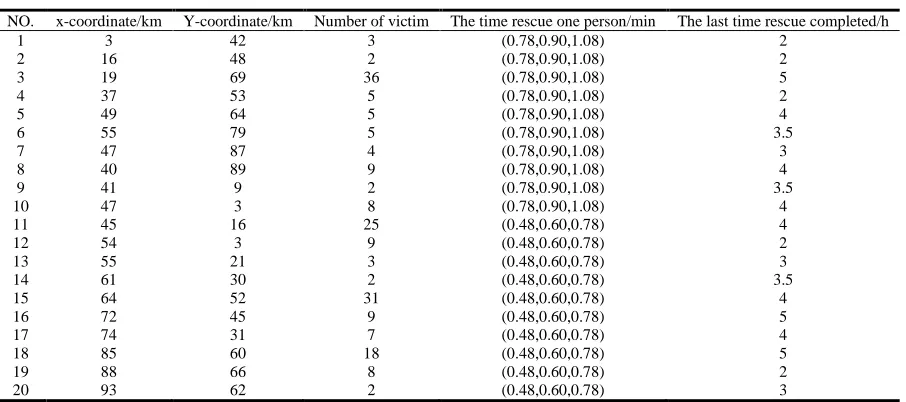
Table 1 Points of Rescues
NO. x-coordinate/km Y-coordinate/km Number of victim The time rescue one person/min The last time rescue completed/h
1 3 42 3 (0.78,0.90,1.08) 2
2 16 48 2 (0.78,0.90,1.08) 2
3 19 69 36 (0.78,0.90,1.08) 5
4 37 53 5 (0.78,0.90,1.08) 2
5 49 64 5 (0.78,0.90,1.08) 4
6 55 79 5 (0.78,0.90,1.08) 3.5
7 47 87 4 (0.78,0.90,1.08) 3
8 40 89 9 (0.78,0.90,1.08) 4
9 41 9 2 (0.78,0.90,1.08) 3.5
10 47 3 8 (0.78,0.90,1.08) 4
11 45 16 25 (0.48,0.60,0.78) 4
12 54 3 9 (0.48,0.60,0.78) 2
13 55 21 3 (0.48,0.60,0.78) 3
14 61 30 2 (0.48,0.60,0.78) 3.5
15 64 52 31 (0.48,0.60,0.78) 4
16 72 45 9 (0.48,0.60,0.78) 5
17 74 31 7 (0.48,0.60,0.78) 4
18 85 60 18 (0.48,0.60,0.78) 5
19 88 66 8 (0.48,0.60,0.78) 2
20 93 62 2 (0.48,0.60,0.78) 3
Table 2 Shelters
NO. x-coordinate/km Y-coordinate/km Capacity
1 30 28 50
2 75 80 50
3 12 60 100
4 38 77 100
5 62 13 100
6 68 33 50
7 87 49 50
[image:5.595.202.408.308.574.2]8 95 97 50
Table 3 Boat Docking
NO. coordinate/km The NO. Of boats
1 (30,62)
1、2
(
2 (50,35) 3、4
3 (71,69) 5
Table 4 Boats
NO. Transport distance/km Capacity Speed km/h
1、3 120 10 60
2、4 100 20 50
5 90 30 40
The algorithm parameters are as follows:
num=100;MAXGEN=300;
δ
1=0.9;δ
2=1.2;α
=0.9;β
=1;ω
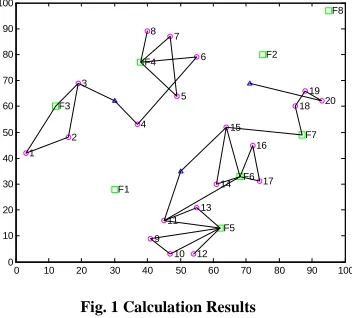
=0.8;q=20;Crossover rate is 0.9; mutation rate is 0.05.Fig. 1 Calculation Results
CONCLUSION
Because of the boats may be shortage that they will be required rescue repeatedly. The objective aims at minimizing the rescue completed time sum of all rescue nodes. The paper established a boats shortage, kind of boats, fuzzy boat travel time and fuzzy rescue time Location-Allocation Problem(LRP) model with time windows and designed a hybrid genetic algorithm contains heuristic rules. The simulated test analysis demonstrates the effect degree to objective function of load factor and the reasonable load factor, and it indicates that the model and the algorithm provides a method for the decision of search for victims in Flood. Further research could consider the impact of dynamic changes on the parameters of the rescue process, such as the number of boats, the number of rescue nodes and the number of person at the nodes. In a word, the dynamic optimization of flood rescue will be a new direction.
REFERENCES
[1]Tuzun, D., Burke, L.I., European Journal of Operational Research, v.116, n.4, pp. 87-99, April, 1999. [2]Albareda-Sambola, M., Diaz, A.J., Ferna′ndez, E., Computers&Operations Research, v.32, n.4, pp. 407-428,
April, 2005.
[3]Nagy,G.,Salhi,S. European Journal of Operational Research, v.162, n.11, pp. 126-141, November, 2005. [4]Zheng Bin, Ma Zujun, Fang Tao, Systems Engineering , v.27, n.8, pp. 21-25, August, 2009.
[5]Dai Ying, Ma Zujun, Zheng Bin, Management Review, v.22, n.1, pp. 121-128, January, 2010. [6]Bent, R., Henteryck, P.V. Computers and Operations Research, v.33, n.3, pp. 875-893, March, 2006.
[7]Ropke, S., Pisinger, D., European Journal of Operational Research, v.171, n.5, pp. 750-775, May, 2006. [8]Yi W, Özdamar L. European Journal of Operational Research,v.179, n.3, pp.1177-1193, March, 2007.
0 10 20 30 40 50 60 70 80 90 100 0
10 20 30 40 50 60 70 80 90 100
1 2
3
4 5
6 7 8
9 10 11
12 13
14 15
16
17 18
19 20
F1
F2
F3
F4
F5 F6