https://doi.org/10.5194/gmd-11-3027-2018 © Author(s) 2018. This work is distributed under the Creative Commons Attribution 3.0 License.
Parameter calibration in global soil carbon models using
surrogate-based optimization
Haoyu Xu1, Tao Zhang1,2, Yiqi Luo2,3, Xin Huang1,2, and Wei Xue1,2
1Department of Computer Science and Technology, Tsinghua University, Beijing 100084, China
2Department of Earth System Science, Ministry of Education Key Laboratory for Earth System Modelling,
Tsinghua University, Beijing 100084, China
3Center for Ecosystem Science and Society, Northern Arizona University, Flagstaff, AZ, USA
Correspondence:Wei Xue ([email protected]) Received: 28 February 2017 – Discussion started: 5 April 2017
Revised: 2 May 2018 – Accepted: 9 May 2018 – Published: 27 July 2018
Abstract.Soil organic carbon (SOC) has a significant effect on carbon emissions and climate change. However, the cur-rent SOC prediction accuracy of most models is very low. Most evaluation studies indicate that the prediction error mainly comes from parameter uncertainties, which can be improved by parameter calibration. Data assimilation tech-niques have been successfully employed for the parame-ter calibration of SOC models. However, data assimilation algorithms, such as the sampling-based Bayesian Markov chain Monte Carlo (MCMC), generally have high computa-tion costs and are not appropriate for complex global land models. This study proposes a new parameter calibration method based on surrogate optimization techniques to im-prove the prediction accuracy of SOC. Experiments on three types of soil carbon cycle models, including the Commu-nity Land Model with the Carnegie–Ames–Stanford Ap-proach biogeochemistry submodel (CLM-CASA’) and two microbial models show that the surrogate-based optimization method is effective and efficient in terms of both accuracy and cost. Compared to predictions using the tuned parame-ter values through Bayesian MCMC, the root mean squared errors (RMSEs) between the predictions using the calibrated parameter values with surrogate-base optimization and the observations could be reduced by up to 12 % for different SOC models. Meanwhile, the corresponding computational cost is lower than other global optimization algorithms.
1 Introduction
Soil organic carbon (SOC) is the largest pool of global land carbon (Todd-Brown et al., 2013; Luo et al., 2015). The emis-sion of CO2, the most important greenhouse gas, from land
ecosystems greatly depends on the amount of carbon stored in soils. Moreover, anthropogenic CO2emission leads to
cli-mate warming (Houghton et al., 2001), which further stim-ulates soil carbon release, forming a positive feedback be-tween the carbon cycle and climate warming (Melillo et al., 2002; Friedingstein et al., 2006; Luo, 2007). In the fifth phase of the Coupled Model Intercomparison Project (CMIP5), the outputs of 11 Earth system models (ESMs) show great uncer-tainty in the SOC predictions. Despite the similarity in model structures (Huang et al., 2017), simulated soil carbon con-tent varies six-fold, ranging from 510 to 3040 Pg of carbon, among the models (Todd-Brown et al., 2013). Only half of the 11 models have a predicted global total SOC which falls within the estimated range of the (HWSD). Modeled SOC is hardly agrees with the observation (Luo et al., 2015).
mechanisms (Luo et al., 2003, 2017; Huang et al., 2018). The matrix land carbon cycle model can be semi-analytically saved to obtain steady-state solutions and save more than 90 % computational time compared to original models (Xia et al., 2012). As a consequence, the matrix approach makes parameter estimation and calibration possible. The matrix approach has been successfully used for parameter calibra-tion to constrain SOC turnover and microbial process using the Bayesian Markov chain Monte Carlo (MCMC) algorithm (Harauk et al., 2014, 2015; Shi et al., 2018).
Bayesian MCMC is a sampling-based approach and usu-ally requires a large number of simulations for building an acceptable parameter chain. For instance, over 500 000 simulations are required during the parameter calibration of soil carbon models (Xu et al., 2006). Even using high-performance computers, complex land models, like the lat-est version of Community Land Model (CLM5.0), require a very long spin-up time for carbon cycle simulation, lead-ing to several hours or days for one simulation. Although the matrix approach has been developed to enable data assimila-tion of global land carbon cycle models (Harauk et al., 2014, 2015; Shi et al., 2018), Bayesian MCMC is still very compu-tationally expensive for calibrating global land models. More effective and efficient parameter calibration algorithms are urgently needed.
The parameter calibration of SOC models can be for-mulated as an optimization problem that aims to minimize the output of a cost function. This cost function evaluates the difference between the outputs of model simulation and the corresponding observations and returns a single value (e.g., RMSE) to represent the model error. Global optimiza-tion algorithms are introduced to find the minimum value of the nonlinear, non-convex, and black-box problems (Ha-puarachchi et al., 2001; Ma et al., 2006; Rocha, 2008). Unfor-tunately, the number of required simulations for most global optimizations is very large.
To reduce the number of simulations and decrease the computational cost, we, for the first time, present a surrogate-based optimization method (SBO) for calibrating soil carbon models. Surrogate models serve as computationally inexpen-sive approximations of expeninexpen-sive simulation models (Booker et al., 1999), such as complex geoscientific models. During the optimization process, the surrogate model can be used to determine a new promising point in the parameter space at which the expensive simulation model originally has to be evaluated. With the help of the surrogate model, many un-necessary simulations with bad parameter values, which lead to high prediction errors, are avoided. SBO has been shown to find the near-optimal parameter values within only a few hundred simulations for different problems (Aleman et al., 2009; Giunta et al., 1997; Regis, 2011; Simpson et al., 2001). Most studies on both global and surrogate optimiza-tions focus on the mathematical function benchmarks like “Comparing Continuous Optimizers”, abbreviated as COCO (Hansen et al., 2010; Wang et al., 2014). However, the
optimization of the mathematical functions may be ex-tremely different from the parameter calibration of com-plex real-world models. In this paper, we explore the state-of-the-art surrogate optimization method for parame-ter calibration of three SOC models: CLM coupled with Carnegie–Ames–Stanford Approach biogeochemistry sub-model (CLM-CASA’), and two microbial sub-models such as those used in studies by Hararuk et al. (2014, 2015). Al-though the three models are computationally attainable for parameter calibration, we compare the performance of surrogate-based optimization to advanced global optimiza-tion algorithms and the data assimilaoptimiza-tion method to examine the potential of SBO. The SBO method may be extended to other complex global land models.
In this paper, we present the structure and parameters of three SOC models in Sect. 2. Section 3 introduces the algo-rithm design of SBO. The parameter calibration results and the analysis of different parameter calibration algorithms are presented in Sect. 4. Section 5 discusses the calibrated results using SBO. Finally, we draw conclusions in Sect. 6.
2 Global land carbon models, data and cost function Earth system models (ESMs) are a fundamental tool for sim-ulating climate impacts on the carbon cycle at the global scale. There are many common properties among structures of different global land carbon modules of ESMs (Luo et al., 2016). Almost all models have multiple carbon pools and carbon is transferred among these pools (Weng and Luo, 2011). In this study, we selected three SOC models, which have previously been calibrated for their parameters with the Bayesian MCMC algorithm (Hararuk et al., 2015). The first model is the soil carbon component of CLM coupled with the Carnegie–Ames–Stanford Approach biogeochem-istry submodel (CLM-CASA’) (Oleson et al., 2004, 2008). The CLM is the land model for the Community Earth Sys-tem Model (CESM). The other two SOC models are micro-bial models, which consider the nonlinear regulation of SOC dynamics with microbial biomass.
2.1 CLM-CASA’ C-only version model
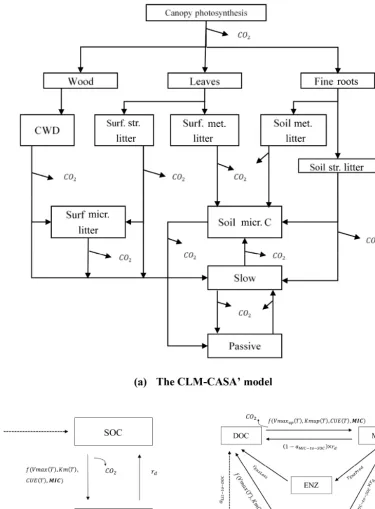
The CLM-CASA’ is embedded in CLM3.5. The latter includes biogeophysics and biogeochemistry submodels. CLM-CASA’ inputs carbon through net primary productiv-ity (NPP), which is partitioned to three live biomass pools (wood, leaves and fine roots) (Fig. 1a). Dead plant materi-als become litter and are transferred separately to four litter pools. Litter decomposition results in part of the carbon be-ing released to the atmosphere as heterotrophic respiration and part of the carbon being stabilized into soil carbon pools. Organic carbon in the soil pools is partially decomposed to be released as CO2via microbial respiration and partially
outputs to indicate SOC dynamics is the total soil organic carbon content, which is the sum of carbon in soil microbial (or active) pools, slow pools and passive pools (Fig. 1).
The CLM-CASA’ model simulates soil carbon decompo-sition as a first-order decay process (Oleson et al., 2004, 2008). Based on theoretical analysis, the carbon cycle of most ESMs can be summarized with one matrix equation (Luo et al., 2001; Luo and Weng, 2011; Xia et al., 2013) as follow:
dX(t )
dt =Aξ(t )KX(t )+BU (t ). (1)
In the abovementioned equationX(t )is the carbon content of different pools; dX(t )dt is the change of the carbon content;A is a matrix of transfer coefficients among different pools;ξ(t ) andKare both diagonal matrixes, representing environmen-tal scaling factors and baseline carbon decomposition rates, respectively;U (t )is NPP, the carbon influx into the whole system; andBrepresents the partitioning coefficients of the carbon influx among plant pools. The steady-state solution of equation is given by Xia et al. (2012) as follows:
Xss= −(AξK)−1BU , (2)
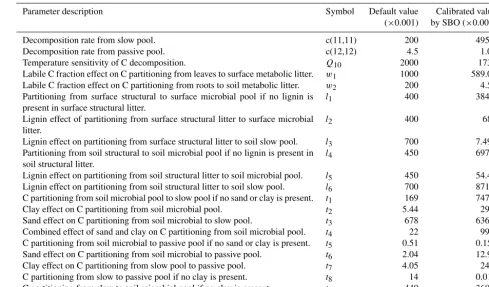
whereξB andU are the long-term averages of the environ-mental scalars, C partitioning among the three live pools, and NPP, respectively. The steady-state soil C generated by this C-only version is in agreement with that simulated by the original CLM-CASA’ model (Xia et al., 2012). The struc-tural diagram of the CLM-CASA’ C-only model is presented in Fig. 1a and the parameters are described in Table 1. 2.2 The microbial models
Microorganisms catalyze various processes of the land car-bon cycle, such as the decomposition and stabilization of SOC (Kuzyakov et al., 2000; Luo et al., 2001; Peng et al., 2009). However, most conventional SOC models, such as CLM-CASA’, do not explicitly represent microbial pro-cesses. Microbially explicit models usually represent SOC decomposition by considering extracellular enzyme activi-ties rather than simple decay constants as in the CLM-CASA’ and other traditional SOC models (Schimel and Weintraub, 2003). In this study, we focus on two enzyme-driven decom-position models; one has two pools (Fig. 1b) introduced by German et al. (2012) and the other has four pools (Fig. 1c) introduced by Allison et al. (2010). We call these two mod-els the two-pool microbial model and the four-pool microbial model, respectively. C inputs for the two models are NPP and the outputs are the carbon content of each pool at a steady state.
The two-pool microbial model is described using the fol-lowing equations: (Hararuk et al., 2015).
dMIC
dt =CUE×Vmax×MIC SOC Km+SOC
−rd×MIC (3)
dSOC
dt =Inputsoil+rd×MIC−Vmax
×MIC SOC
Km+SOC
. (4)
Where
CUE=CUEslope×Ts−CUE0 (5)
Vmax=Vmax0×exp
− Ea
R×(Ts+273)
×exp(−parclay×clay) (6)
Km=Kmslope×Ts+Km0×exp(parlig×lignin). (7)
In the abovementioned, MIC represents the microbial biomass; Vmax is the temperature adjusted rate of SOC
decomposition; Km is the half-saturation constant for the
substrate-limited SOC decomposition rate;rdis the
micro-bial death rate; CUE is the micromicro-bial carbon use efficiency; Inputsoilis the carbon influx to soil, a 30-year averages of soil C input produced by CLM-CASA’ (Hararuk et al., 2015);Ts
is soil temperature;Ris the gas constant (8.31 J K−1mol−1); CUE0 and CUEslope are the baseline microbial carbon use
efficiency and its dependency on temperature, respectively; Vmax0 is the maximum rate of microbial carbon uptake;Ea
is the activation energy of SOC decomposition; Km0 and
Kmslopeare the baseline half-saturation constant and its
de-pendency on temperature, respectively; lignin is lignin con-tent; and parligis a parameter to regulate the lignin-dependent
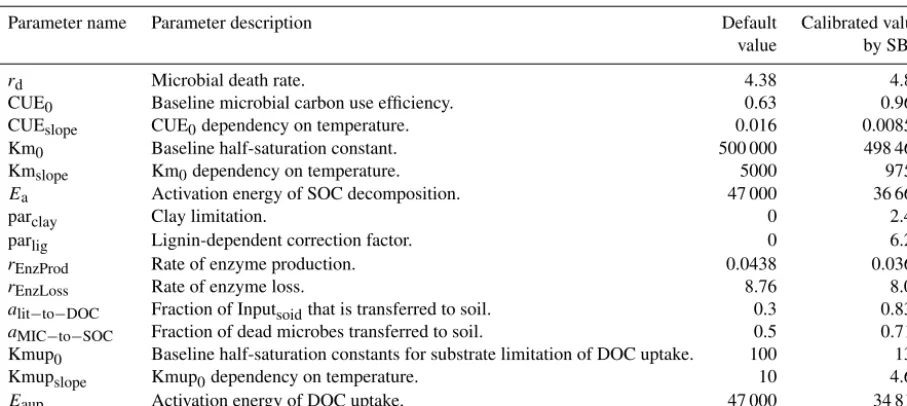
correction factor. See Table 2 for a more comprehensive de-scription of those parameters.
The four-pool microbial model from Allison et al. (2010) is described as follows:
dMIC
dt =Vmaxup×MIC
DOC Kmup+DOC
×CUE−rd×MIC−rEnzProd×MIC (8)
dDOC
dt =alit−to−DOC×Inputsoil+rd
×MIC×(1−aMIC−to−SOC)+Vmax
×ENZ SOC
Km+SOC+rEnzLoss ×ENZ−Vmaxup×MIC
DOC
Kmup+DOC (9)
dSOC
dt =alit−to−SOC×Inputsoil+rd ×MIC×aMIC−to−SOC−Vmax
× ×ENZ SOC
Km+SOC (10)
dENZ
dt =rEnzProd×MIC−rEnzLoss×ENZ, (11) where ENZ and DOC are enzyme and dissolved organic car-bon pools, respectively;Vmaxup is the temperature-adjusted
Figure 1.Schematic representations of(a)a CLM-CASA’ model,(b)a two-pool microbial model and(c)a four-pool microbial model. Surf.: surface; str.: structural; met.: metabolic; micr.: microbial.
constant limiting the microbial uptake of DOC; rEnzProd is
a rate of enzyme production; Inputsoil is C transferred from
litter to soil; alit−to−DOC is the fraction of Inputsoil that is
transferred to DOC;aMIC−to−SOCis the fraction of dead
Table 1.Parameter description of CLM-CASA’ C-only model.
Parameter description Symbol Default value Calibrated value (×0.001) by SBO (×0.001)
Decomposition rate from slow pool. c(11,11) 200 495.6 Decomposition rate from passive pool. c(12,12) 4.5 1.01 Temperature sensitivity of C decomposition. Q10 2000 1737
Labile C fraction effect on C partitioning from leaves to surface metabolic litter. w1 1000 589.04
Labile C fraction effect on C partitioning from roots to soil metabolic litter. w2 200 4.52
Partitioning from surface structural to surface microbial pool if no lignin is present in surface structural litter.
l1 400 384.5
Lignin effect of partitioning from surface structural litter to surface microbial litter.
l2 400 689
Lignin effect on partitioning from surface structural litter to soil slow pool. l3 700 7.499
Partitioning from soil structural to soil microbial pool if no lignin is present in soil structural litter.
l4 450 697.7
Lignin effect on partitioning from soil structural litter to soil microbial pool. l5 450 54.46 Lignin effect on partitioning from soil structural litter to soil slow pool. l6 700 871.5
C partitioning from soil microbial pool to slow pool if no sand or clay is present. t1 169 747.7
Clay effect on C partitioning from soil microbial pool. t2 5.44 29.6
Sand effect on C partitioning from soil microbial to slow pool. t3 678 636.8
Combined effect of sand and clay on C partitioning from soil microbial pool. t4 22 99.5
C partitioning from soil microbial to passive pool if no sand or clay is present. t5 0.51 0.152
Sand effect on C partitioning from soil microbial to passive pool. t6 2.04 12.99
Clay effect on C partitioning from slow pool to passive pool. t7 4.05 24.2
C partitioning from slow to passive pool if no clay is present. t8 14 0.012
C partitioning from slow to soil microbial pool if no clay is present. t9 449 368.8
loss. The temperature-dependent functions are follows:
CUE=CUEslope×Ts−CUE0 (12)
Vmaxup=Vmaxup0×exp(−
Eaup
R×(Ts+273)
) (13)
Kmup=Kmupslope×Ts+Kmup0 (14)
Vmax=Vmax0×exp(−
Ea
R×(Ts+273)
)
×exp(−parclay×clay) (15)
Km=Kmslope×Ts+Km0×exp(parlig×lignin), (16)
whereVmaxup0 is the maximum rate of microbial DOC
up-take; Eaup is the activation energy of DOC uptake; Kmup0
and Kmupslopeare baseline half-saturation constants for
sub-strate limitation of DOC uptake and its dependency on tem-perature, respectively.
Fifteen parameters of the four-pool microbial model are also described in Table 2.
2.3 Data and cost function
Microbial models and CLM-CASA’ C-only models divide the world into 64×128 grid cells and output SOC content for each grid (Fig. 2). The observed SOC data for parameter cal-ibration comes from the International Geosphere Biosphere Programme – Data and Information System (IGBP-DIS) dataset (Global Soil Data Task Group, 2000). The IGBP-DIS
Figure 2.IBGP-DIS soil carbon distribution. Soil carbon varies from 0 kg m−2in deserts to 60 kg m−2in boreal regions.
dataset includes a 1 km resolution global land carbon data set that has been widely used in many studies to evaluate and improve models (Zhou et al., 2009; Smith et al., 2013).
Table 2.Parameter and description of the four-pool microbial models.
Parameter name Parameter description Default Calibrated value value by SBO
rd Microbial death rate. 4.38 4.89
CUE0 Baseline microbial carbon use efficiency. 0.63 0.965
CUEslope CUE0dependency on temperature. 0.016 0.00853
Km0 Baseline half-saturation constant. 500 000 498 467
Kmslope Km0dependency on temperature. 5000 9751
Ea Activation energy of SOC decomposition. 47 000 36 669
parclay Clay limitation. 0 2.41 parlig Lignin-dependent correction factor. 0 6.23
rEnzProd Rate of enzyme production. 0.0438 0.0361
rEnzLoss Rate of enzyme loss. 8.76 8.08
alit−to−DOC Fraction of Inputsoidthat is transferred to soil. 0.3 0.832
aMIC−to−SOC Fraction of dead microbes transferred to soil. 0.5 0.716
Kmup0 Baseline half-saturation constants for substrate limitation of DOC uptake. 100 134
Kmupslope Kmup0dependency on temperature. 10 4.62
Eaup Activation energy of DOC uptake. 47 000 34 811
r= r
1 N
XN
i=1(Xi−Oi)
2, (17)
whereN denotes the total number of grid cells, andXi and
Oi are the SOC of the model prediction and the IGBP-DIS
observation, respectively. To avoid overfitting and evaluate the calibrated parameters more fairly, we separate all grid cells into a training set and a validation set. The training set is used to guide the parameter calibration process and the val-idation set is used to evaluate the calibrated results. Hararuk et al. (2014, 2015) also used this method when calibrating SOC parameters with the Bayesian MCMC approach. The experiment results in Sects. 3 and 4 refer to the results for the validation set.
3 Surrogate-based optimization algorithm design 3.1 Introduction to the surrogate-based optimization
algorithm
The parameters of most soil carbon models and land mod-els have traditionally been tuned manually (Luo et al., 2001, 2016). The manual tuning method might be effective for simple models but still highly depends on expert experi-ence. Complex models may consist of various components from different disciplines and have hundreds or thousands of parameters. In these cases manual tuning consequently be-comes impractical.
Different parameter calibration algorithms are available, which have been developed based on optimization theory. Gradient search algorithms like the quasi-Newton method are introduced to search for a set of parameters with better per-formance in the parameter domain. These algorithms are
usu-ally efficient and fast. However, gradient search algorithms are designed for finding the local optimum. They cannot be used to solve multimodal problems derived from complex Earth system models. In addition, they are based on the gradi-ent information which is unavailable for most soil carbon and land models, as these models are too complex to obtain such details. Thus, parameter calibration usually becomes a black-box optimization problem. Global optimization algorithms, such as genetic algorithms and particle swarm optimization algorithms, are based on parameter generation and selection strategies. They are basically still gradient independent but can be easily used for parameter calibration of complex Earth system models. Global optimization algorithms are designed to find the global minimum. However, the number of samples (model runs) might still be too large to be applicable to com-plex models with large numbers of parameters (Jones et al., 1998). Moreover, complex Earth system models, for exam-ple CLM, require several hours over hundreds of cores for just one sample run and pose a special challenge regarding the feasibility of automatic parameter calibration.
pa-rameter calibration of computationally expensive black-box problems (Vu et al., 2016).
3.2 Key components of the surrogate-based optimization algorithm
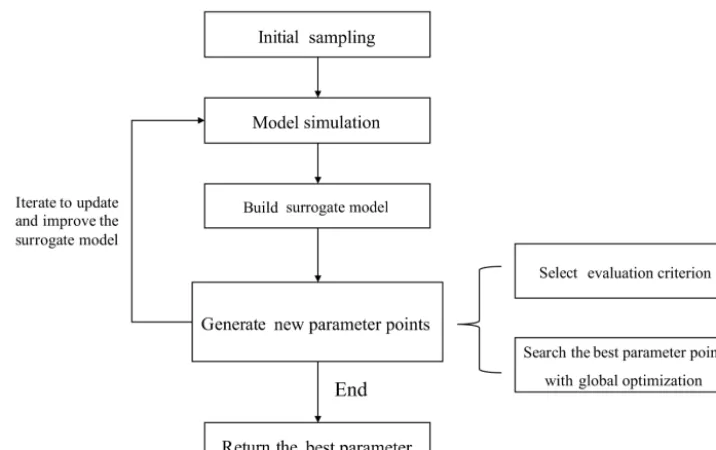
A flowchart describing the SBO is presented in Fig. 3. First, initial sets of parameter values are generated using a sampling method. These sets are then used as inputs to run the real simulation model. Second, a surrogate model is constructed by fitting the outputs of these sample runs. The surrogate model serves as a computationally inexpensive ap-proximation of the expensive simulation model (Booker et al., 1999). Then in each iteration, new sample points sim-ulated by the real model are generated according to a spe-cific strategy. This strategy can make use of the information gained from the surrogate model and only exploits the avoid-able real model runs to meet the accuracy requirement. The new sample points and their simulation outputs are used to update the surrogate model at the same time. Finally, when some stop criteria (typically the maximum number of simu-lations allowed) are met, the algorithm returns the optimized parameter values. During the SBO process, quite a few sam-ple runs are generated based on the evaluation of the surro-gate model and most meaningless simulations with bad pa-rameter values are avoided. As a result, the computationally expensive model is only simulated at a few selected promis-ing parameter points, and the surrogate model replaces the real model during the calibration process. Thus, the compu-tation cost is substantially reduced.
Different surrogate-based optimization algorithms may have different choices with respect to the following:
– The sampling method to generate the initial setS0.
– The surrogate model, which predicts the outputy using the given data point x. Before prediction, some(x, y) data pairs should be given to train the model (these data are called the training set).
– How to decide the new points at which to run the real model in each iteration.
For the initial sampling, Monte Carlo sampling and Latin hypercube sampling (LHS) are two main sampling meth-ods (McKay et al., 1979; Iman et al., 1981). In Monte Carlo sampling values are sampled from a probability distribution, which is generally a uniform distribution unless we have ad-ditional knowledge about the model and the parameters. Dur-ing the LHS procedure, the range of each parameter is di-vided into M equally probable intervals. M sample points are selected to cover all intervals of each parameter. Com-pared to random sampling, LHS ensures that the ensemble of random numbers is representative of the real variability of the parameters. As a result, we use LHS to generate the initial setS0(Iman et al., 1981).
There are various surrogate models, such as multivariate adaptive regression splines (MARS) (Friedman, 1991), poly-nomial regression models (Myers et al., 2016), radial basis functions (RBFs) (Gutmann, 2001; Müller and Shoemaker, 2014; Powell, 1992; Regis and Shoemaker, 2007, 2009; Wild and Shoemaker, 2013), and kriging (Davis and Lerapetritou, 2009; Forrester et al., 2008; Jones et al., 1998).
The MARS model is an extension of naïve linear models introduced by J. H. Friedman (Friedman, 1991). The form of MARS is presented as follows:
ˆ
f (x)=Xm
i=1ciBi(x), (18)
wheref (x)ˆ represents the prediction ofyat the pointx, and ci is a constant coefficient to be trained. Bi(x)is the basis
function which can take one of the following three forms: a constant, a hinge function like max(0, x−const)and a prod-uct of more than one hinge function.
The RBF model is a real-valued function. The prediction at a pointxusing the RBF model only depends on the distance betweenxand other points in the training set, whose outputs have already been given. The distancer= kx, ckis generally the Euclidean distance. The radial function is the function that satisfies the propertyφ (x, c)=φ (kx, ck)=φ (r). The prediction at pointx with the RBF model is formulated as follows:
ˆ
f (x)=XN
i=1wiφ (kx, xik), (19)
wherexi represents the point of the training set which has
N points in total. Many different radial functions have been introduced and some commonly used of these are Gaussian φ (r)=e−(εr)2, multiquadric φ (r)=p1+(εr)2 and
poly-harmonic spline: φ (r)=rkln(r). In our experiments, we choose the Gaussian radial function.
Both the kriging model and the Gaussian process regres-sion model predict the output using a Gaussian process gov-erned by prior covariance. Thex andy should be normal-ized to satisfy a normalization distribution where the means is zero and the covariance is 1 one before they are used to train the kriging model. The kriging predictor can be found as follows:
ˆ
f (x)= ˆµ+Xn
i=1ciri(x), (20)
whereµˆ is the estimated mean of the Gaussian process,ci is
a constant representing the weight andri(x)=Corr(x, x(i))
is the correlation between thexand theith pointx(i)in the training set.µˆ andci can be trained with the training set.
In addition, many machine learning regression models are also introduced, such as support vector regression (Zhang et al., 2009), artificial neural network (Behzadian et al., 2009) and random forest (Breiman, 2001).
Figure 3.A flowchart of the surrogate-based optimization.
guide new parameter point generation. Most strategies con-vert the parameter point generation to optimization problems using an evaluation criterion (Fig. 3). There are many differ-ent generation strategies, including “Minimizing an Interpo-lating Surface” (MIS) (Jones, 2001) and “Maximizing Ex-pected Improvement” (MEI) (Schonlau et al., 1997; Picheny et al., 2012). In MIS, the minimum of the surrogate model response surface is found and treated as the new parameter point to evaluate the real simulation model and then update the surrogate model. MEI introduces the “expected improve-ment” criterion. This criterion estimates the uncertainty of the surrogate model and balances the exploration and ex-ploitation. Exploration refers to searching in an unfamiliar area of the parameter space to learn about it and avoiding being trapped in the local optimum. Exploitation means fast convergence in an area. Balancing the exploration and ex-ploitation ensures SBO can find real global optimum and does not waste simulations on meaningless parameter sets and areas. Another parameter generation strategy is the can-didate point approach (CAND) (Regis and Shoemake, 2007). In the CAND strategy, the criterion for exploitation is MIS and the criterion for exploration is the distance of the candi-date point to the set of sampled parameter points from pre-vious iterations. The prepre-viously sampled points represent the explored region and we can estimate the uncertainty from the distance to the explored region. A weighted sum of these two criteria is used to determine the new parameter point during the SBO.
3.3 Design of the surrogate-based optimization algorithm for soil carbon models
Elaborating on the previous introduction of SBO, a detailed account of the SBO procedure follows.
Step 1: Generate an initial sampling setS0.
Step 2: Run the real model and calculate the output error of the parameter points ofS0.
Step 3: Build the surrogate model using the parameters and outputs generated in Step 2.
Step 4: Predict the output errors of those points that do not belong toS0 using the surrogate model and
deter-mine the points at which to run the real model.
Step 5: Run the real model again for the new parameter points from Step 4 and calculate the output errors of these selected points.
Step 6: Update the surrogate model with the new data from Step 5.
Step 7: Iterate through Steps 4 to 6 until the end condi-tion has been met.
number of samples. Therefore, we choose the LHS as the ini-tial sampling strategy.
As mentioned in the previous section, many kinds of surrogate-based models have been introduced and developed. The machine learning regression models do not perform as well as RBF and kriging models, according to an evaluation of similar cases (Wang et al., 2014). In this study, we use the RBF surrogate model (RBF-SBO) as our default choice because it has been shown to perform better than other sur-rogate models (Müller and Shoemaker, 2014) and is easily implemented. Our algorithm framework also includes other surrogate models, such as kriging and MARS, and can intro-duce others in the future.
The surrogate model is not accurate enough to represent complex and nonlinear models when the SBO starts. The MIS can be very efficient but is easy to trap into local op-tima, as the strategy does not consider the uncertainty of the surrogate model and only selects the optimum of the surro-gate model. The MEI eliminates the disadvantage of MIS but can only be used for the kriging surrogate model because the calculation of the expected improvement requires the stan-dard error at the parameter point and only the kriging (Gaus-sian Process) surrogate model can provide this (Jones et al., 1998). Finally, we use the CAND strategy as the parameter generation strategy in our algorithm to balance the exploita-tion and exploraexploita-tion of the uncertain region.
4 Parameter calibration experiments 4.1 Experiment configuration
In this study, we select the Bayesian MCMC approach and four advanced global optimization algorithms for compari-son with our proposed SBO method. Our SBO algorithm is implemented based on the “Surrogate Model Optimization Toolbox” toolkit (Müller, 2014). Three SOC models and their cost functions are introduced in Sect. 2. The target of param-eter calibration is to find the optimal values of paramparam-eters to achieve the minimum value of the cost function (average RMSE). Moreover, we repeat the parameter calibration pro-cess of each algorithm 50 times and use the average results for algorithm evaluation. We compare the performance of al-gorithms in terms of both effectiveness and efficiency. The effectiveness refers to the accuracy of the calibrated results and the efficiency can be evaluated by the required number of simulations of the original SOC models.
4.2 Various global optimization algorithms and the Bayesian MCMC approach
The Bayesian MCMC approach and the four following ad-vanced global optimization algorithms: differential evolu-tion (DE), particle swarm optimizaevolu-tion (PSO), shuffled com-plex evolution (SCE-UA) and the covariance matrix adaption
evolution strategy (CMA-ES), are compared with our RBF-SBO.
DE (Storn and Price, 1997) and PSO (Kennedy, 2011; Shi and Eberhart, 2009) are the representative algorithms of the evolution strategy and swarm intelligence, respectively. They both have the ability to converge quickly and outper-form many genetic algorithms and simulated annealing algo-rithms (Price et al., 2006; Shi and Eberhart, 2009). SCE-UA is designed for the parameter calibration of hydrologic mod-els and has been successfully applied to various hydrology models such as the TOPMODEL, the Xinanjiang watershed model and short-term load forecasting (Hapuarachchi et al., 2001; Ma et al., 2006; Li et al., 2007). SCE-UA tries to keep both effectiveness and efficiency by combining the local (the simplex method) and global optimization methods. Despite the difference in algorithm details, DE, PSO and SCE-UA all generate new parameter points according to some sim-ple mathematical formulas. Unlike these three algorithms, CMA-ES creates new parameter points based on a multi-variate normal distribution (Hansen and Ostermeier, 2001; Hansen and Kern, 2004). The dependencies between param-eters are represented by the covariance matrix of a normal distribution. CMA-ES has been shown to be the best global optimization algorithm in the BBOB-2009 comparison study (Hansen, 2009).
calibration results from the Bayesian MCMC approach are presented in Table 3.
4.3 Results and analysis
4.3.1 Effectiveness and efficiency
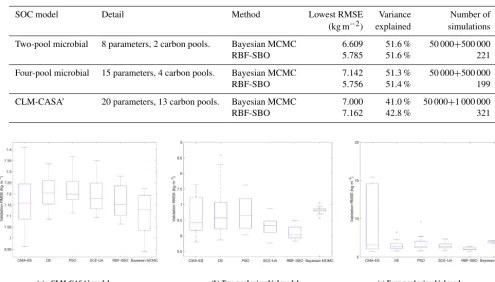
Figure 4 presents the calibrated results (RMSE) of the dif-ferent algorithms we applied. For each algorithm, we only perform 100 simulations to compare the effectiveness if the number of simulations is limited. As the Bayesian MCMC approach requires a large number of samples to reach a sta-ble distribution, over 500 000 simulations were conducted for the algorithm evaluation.
Clearly, the average RMSE of the RBF-SBO is the lowest (0.6 kg m−2better than the Bayesian MCMC algorithm) for the two microbial models among all the algorithms (Fig. 4b, c). For the CLM-CASA’ model, our RBF-SBO algorithm is still superior to the global optimization algorithms. The Bayesian MCMC approach performs slightly better (about 0.02 kg m−2) but requires many more simulations to achieve the results (Fig. 4a).
The results of RBF-SBO also indicate less variation among the 50 repeated experiments than the global optimiza-tion algorithms for the three models. For the same reason pre-viously mentioned, the Bayesian MCMC approach has less variation than our RBF-SBO algorithm for the two micro-bial models. For the CLM-CASA’ model, our RBF-SBO is still promising to get stable results. Among the global opti-mization algorithms, CMA-ES shows a very significant fluc-tuation (Fig. 4b, c), indicating that it is unreliable when the number of simulations is as small as 100. This is because the CMA-ES requires quite a few simulations on the exploration of the parameter domain and the construction of the param-eter covariance matrix. Therefore, RBF-SBO is the most ef-fective and stable algorithm when the number of simulations is limited.
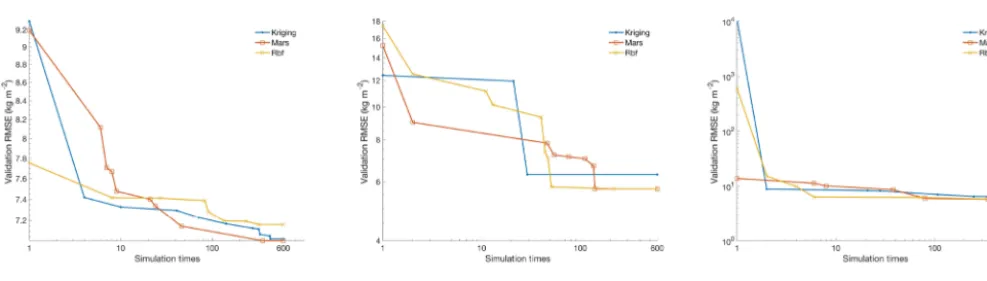
Figure 5 shows the results in terms of average validation RMSE. We don’t compare the efficiency of Bayesian MCMC since it is in nature a sampling algorithm, not an optimiza-tion algorithm. The average validaoptimiza-tion RMSE of RBF-SBO is lower than the four global optimization algorithms before the number of simulations increases to 600 for the two mi-crobial models and to 200 for the CLM-CASA’ model, re-spectively. Our RBF-SBO requires fewer simulations than the global optimization algorithms when they reach the same RMSE value and accuracy range. Thus, our RBF surrogate optimization is the most efficient algorithm, requires the min-imum number of simulations and has the lowest computa-tional cost. Compared to the global optimization algorithms, SBO has two main advantages. Firstly, SBO samples an ini-tial parameter set to build a surrogate model; this building process is a learning process which can better understand the parameter space and thus help conduct better optimization. Secondly, SBO can avoid some bad parameter points (“bad”
means high prediction error), which are not supposed to be evaluated with the help of the surrogate model.
Another important observation is that the difference be-tween the results of our RBF-SBO and the global optimiza-tion algorithms decreases as the number of simulaoptimiza-tion in-creases (Fig. 5). Moreover, the CMA-ES outperforms the RBF-SBO when the number of simulations exceeds 200 for the CLM-CASA’ model (Fig. 5a). Our SBO can quickly build the surrogate model with relatively good accuracy, which helps find a near-optimal solution with lower com-putation cost. However, the surrogate model is only an ap-proximation of the real model and accuracy might be lim-ited due to the strong nonlinearity and high complexity of the real model. After gaining sufficient knowledge of the original model through many simulations, the excellent global opti-mization algorithms, such as CMA-ES, may achieve similar performance to or even outperform our SBO, which suggests that our SBO is better fitted for use regarding the parameter calibration of cost-intensive models.
4.3.2 Impact of the model complexity
Compared to the two-pool and four-pool microbial models, the CLM-CASA’ model has 13 carbon pools and 20 param-eters. Despite the increased complexity of the CLM-CASA’ model, the SBO obtains better results before conducting 200 simulations of the real model (Fig. 5a). Moreover, the SBO is always the best parameter calibration method for the two-pool and four-two-pool microbial models before conducting 600 simulations (Fig. 5b, c). In addition, only one global opti-mization algorithm, CMA-ES, has better performance com-pared to the SBO on the CLM-CASA’ model after 200 sim-ulations. Considering the high variance of CMA-ES on the two microbial models (Fig. 4b, c), our SBO is more effective and more reliable on average.
4.3.3 Impact of different types of surrogate models
We select the RBF as the surrogate model in the experiments because the RBF is widely adopted in many SBO algorithms (Müller and Shoemaker, 2014). In this section, we also test two other typical surrogate models, kriging and MARS. The MARS model is simple and has almost no requirements for the sample quality. MARS is very quick to train and pre-dict. Kriging, also known as Gaussian process regression, is a method of interpolation for which the interpolated val-ues are modeled by a Gaussian process governed by prior covariance. Kriging provides the best linear unbiased predic-tion of the intermediate values under suitable assumppredic-tions on the priors.
Table 3.Calibration results of the Bayesian MCMC and our surrogate-based optimization.
SOC model Detail Method Lowest RMSE Variance Number of (kg m−2) explained simulations
Two-pool microbial 8 parameters, 2 carbon pools. Bayesian MCMC 6.609 51.6 % 50 000+500 000 RBF-SBO 5.785 51.6 % 221
Four-pool microbial 15 parameters, 4 carbon pools. Bayesian MCMC 7.142 51.3 % 50 000+500 000 RBF-SBO 5.756 51.4 % 199
CLM-CASA’ 20 parameters, 13 carbon pools. Bayesian MCMC 7.000 41.0 % 50 000+1 000 000 RBF-SBO 7.162 42.8 % 321
Figure 4.The RMSEs of the different optimization algorithms:(a)CLM-CASA’ model;(b)two-pool microbial model and(c)four-pool microbial model. The box plots show the means and the quartiles spreading over a total of 50 calibration runs. The central line indicates the median, the bottom and top of the box are the first and third quartiles, the black bottom and top lines out of the rectangles are the maximum and minimum and the red crosses represent the outliers. The number of simulations of the five algorithms is 100 and the number of simulations of the Bayesian MCMC is presented in Table 3.
global optimization algorithms, indicating that our SBO is robust.
5 Analysis of parameter calibration results 5.1 CLM-CASA’ model
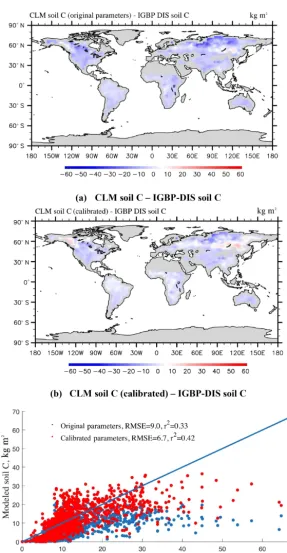
The steady-state global SOC simulations (Eq. 2) using CLM-CASA’ with the default and calibrated parameter values are presented in Fig. 7a and b, which are also compared to the observed SOC pools provided by the IGBP-DIS dataset. The SOC simulation results, using the calibrated parameter val-ues from the SBO, match the observation better than the sim-ulation results with the default parameter values (Fig. 7c) and display a relatively lower RMSE. By using the calibrated parameter values the SOC simulations are significantly im-proved in most parts of the world, except for some grid cells in the west of Canada and the east of Russia (Fig. 7a, b and c). As a result, the CLM-CASA’ simulation result with the default parameter values can only explain 33 % of variation in the observed soil C, whereas the simulation with the cali-brated parameter values can explain an improved ratio (42 %)
of variation in the observed soil C. The unexplained variation is partly due to uncertainty in observations. To further im-prove the model’s accuracy, we need to gain a more in-depth understanding of uncertainty sources from the data, model structure, parameters and forcing.
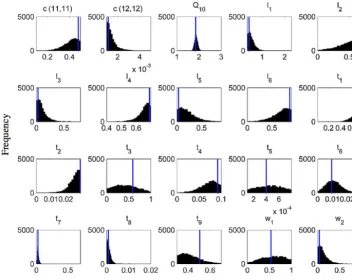
Figure 8 presents the frequency distributions of the 20 cal-ibrated parameters based on MCMC and the calcal-ibrated pa-rameter values using the proposed SBO (the blue lines in Fig. 8). Narrow posterior distributions indicate highly sensi-tive parameters, consistent with the conclusions of Hararuk et al. (2014). The calibrated parameter values of SBO are quite similar to the responding parameter values at the peaks of posterior distributions for most highly sensitive parameters, such as the temperature sensitivity of heterotrophic respira-tion (Q10) and the clay effect on C partitioning from slow
pools to passive pools (t7). The parameter calibration results
(RMSE) of the SBO and the Bayesian MCMC are similar, which means that both are consistent with the parameter cal-ibration results listed in Table 3.
Figure 5. The average RMSEs with the increase of number of simulations and different optimization algorithms:(a)the CLM-CASA’ model,(b)the two-pool microbial model and(c) the four-pool microbial model. Since RBF-SBO requires some initial simulations to start the optimization process, RBF-SBO starts when thexaxis value is 19.
Figure 6.The average RMSEs with the increase of number of simulations and different surrogate models.
explain this issue. In addition, the unreasonable setting of those bounds might be another possible reason. For instance, the calibrated c(12,12) value (1.01×10⁻³) reaches its lower bound, indicating that passive SOC residence time almost ap-proaches 1000 years.
As listed in Table 1, the calibrated temperature sensitivity (Q10) decreases from 2 to 1.74. The size of soil microbial
and passive pools increases due to the longer residence time of the passive pool and lower temperature sensitivity (Q10).
The size of the slow pool, on the contrary, decreases due to the increase in the decomposition rate from the slow pool or the decrease of its residence time. Comprehensively, the size of the SOC, which is the sum of carbon capacity in pas-sive pools, slow pools and soil microbial pools, increases and closely approximates the observation.
5.2 The microbial models
According to the calibrated RMSE and r2 the SOC simu-lation of the two-pool and four-pool microbial models are very similar. Without the loss of generality, we only analyze the parameter calibration results of the four-pool microbial
model in this section. After parameter calibration using the SBO, the global SOC produced by the four-pool microbial model is improved, especially in China, Russia, Europe and North America (as shown in Fig. 9). Overall, the microbial models explain a higher fraction of the global variability of the observed SOC data and have lower spatial RMSEs than the CLM-CASA’ model (as listed in Table 3).
The microbial models achieve better SOC predictions than the calibrated CLM-CASA’ model in terms of their predic-tion of the C capacity in the low-temperature regions (Russia, Europe, North America) and in the regions with small soil C inputs (Figs. 7b and 9). The SOC contents are determined by two main factors: the soil carbon inputs and the SOC resi-dence time (Luo et al., 2003). Considering the same soil car-bon inputs in the CLM-CASA’ and the microbial models, the improvement is mostly induced by the differences in SOC residence time. In all three models, the SOC residence time is essentially controlled by temperature (Xia et al., 2013). As a result, the temperature sensitivity (Q10)contributes to the
Figure 8.Frequency distributions of 20 calibrated parameters of the CLM-CASA’ model using the Bayesian MCMC approach (Harauk et al., 2014) and surrogate-based optimization (blue line in each graph).
Figure 9.Spatial correspondence of the four-pool microbial model produced SOC to the IGBP-DIS reported SOC.
of the microbial models calculate spatially variableQ10with
higher values in the low-temperature regions and lower val-ues in the high-temperature regions, which reflects the im-pact of temperature on the microbial activity. In addition, the SOC residence time can also be affected by the quality of SOC inputs and is related to the microbial decomposition processes. Fresh C input stimulates microbial growth dynam-ics, resulting in an increase in the old SOC decomposition rate (i.e., priming effect) (Kuzyakov et al., 2000; Fontaine et
al., 2004, 2007). Therefore, the microbial models simulate lower SOC residence times than the CLM-CASA’ in regions with high SOC input and a high SOC residence time and the regions with low SOC input. This is due to the nonlinearity of the substrate limitation in microbial models (Eqs. 8 and 10), as well as the dependency of the residence time on bial dynamics. Comprehensively, the introduction of micro-bial dynamics allows the micromicro-bial models to better predict SOC than the CLM-CASA’ model.
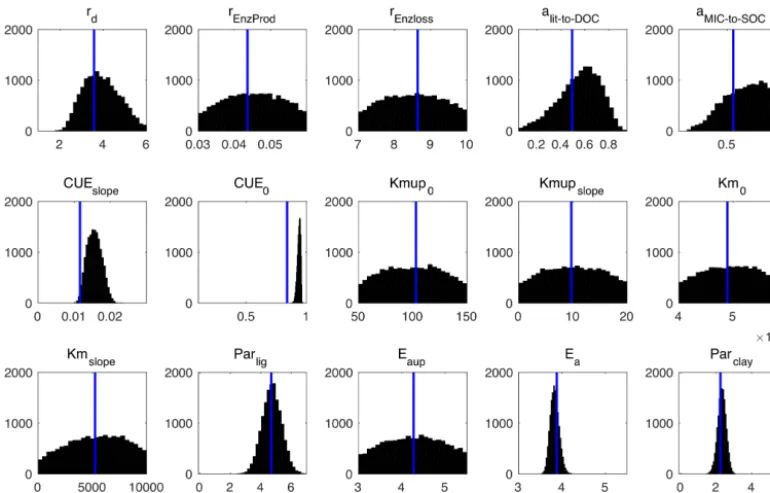
Figure 10 presents the posterior distributions of the param-eters calculated by Bayesian MCMC and the parameter val-ues calibrated using our SBO. According to the posterior dis-tribution,rd, CUEslope, CUE0,Ea, parlig and parclay are the
most constrained and sensitive parameters. The calibration results of the SBO are consistent with the posterior distri-butions of these highly sensitive parameters (Fig. 10) except CUEslopeand CUE0. CUEslopeand CUE0are highly sensitive
owing to their influence on temperature sensitivity. Due to the difference between CUEslopeand CUE0, the RMSE of SBO
is 1.4 and 0.8 kg m−2lower than those found with Bayesian MCMC for four-pool and two-pool microbial models respec-tively (as listed in Table 3). The mismatch of CUEslope and
CUE0may mainly be due to the different targets of the
Figure 10.Posterior probability density functions of the four-pool microbial model parameters (generated by Bayesian MCMC). The blue vertical lines are the final calibrated parameter values from our surrogate-based optimization.
6 Conclusions
Parameter calibration is becoming more and more challeng-ing for SOC model development, especially for the compu-tationally expensive global land models, owing to the large number of simulations. In this study, we introduce an SBO algorithm to the parameter calibration of three SOC models. The main findings are as follows:
1. Compared to advanced global optimization algorithms, SBO is more effective and more efficient on average. Our RBF-SBO outperforms other parameter calibration algorithms when the number of simulations does not ex-ceed 200.
2. The parameter optimization based on the RBF surrogate model gains more accurate calibration results than those of the Bayesian MCMC approach in the three soil car-bon models.
3. The SBO scheme is robust. Various types of surrogate models have similar performance in the parameter cali-bration tasks of SOC models.
4. Although SBO is only guided by a single cost function, it can still result in better parameter values than the de-fault algorithms. We carefully analyze the spatial SOC distributions produced by the models with the calibrated parameters using SBO, which indicate that SBO truly improves the model’s prediction and simulation capa-bility.
Although the three SOC models used in this analysis are not computationally unattainable for parameter calibration, what we have learned about SBO from this study can poten-tially be applied to more complex models. Currently, more and more complex simulation models present challenges to the SBO algorithm. To improve the accuracy of SBO, bet-ter surrogate models are expected. Current surrogate models including our implementation for soil carbon models mainly employ only one surrogate model, which may limit success-ful use for different kinds of models. In the future we will focus on the application of multiple surrogate models using ensemble learning.
Code and data availability. The code and data from the three mod-els and the related algorithm implementations can be found in the Supplement. If you have any problem using the code and repeating the experiments, please feel free to contact the corresponding author of this paper: Wei Xue ([email protected]).
Supplement. The supplement related to this article is available online at: https://doi.org/10.5194/gmd-11-3027-2018-supplement.
Acknowledgements. We would like to thank all the reviewers for their insightful comments and suggestions. This work is partially supported by the National Key R&D Program of China (grant no. 2016YFA0602100 and 2017YFA0604500) and National Natural Science Foundation of China (grant no. 91530323 and 41776010).
Edited by: Christoph Müller
Reviewed by: Maarten Braakhekke and one anonymous referee
References
Aleman, D. M., Romeijn, H. E., and Dempsey, J. F.: A response surface approach to beam orientation optimization in intensity-modulated radiation therapy treatment planning, INFORMS J. Comput., 21, 62–76, 2009.
Allison, S. D., Wallenstein, M. D., and Bradford, M. A.: Soil-carbon response to warming dependent on microbial physiology, Nat. Geosci., 3, 336–340, 2010.
Behzad, M., Asghari, K., Eazi, M., and Palhang, M.: Generalization performance of support vector machines and neural networks in runoff modeling, Expert Syst. Appl., 36, 7624–7629, 2009. Booker, A. J., Dennis Jr., J. E., Frank, P. D., Serafini, D. B., Torczon,
V., and Trosset, M. W.: A rigorous framework for optimization of expensive functions by surrogates, Struct. optimization, 17, 1–13, 1999.
Breiman, L.: Statistical modeling: The two cultures (with comments and a rejoinder by the author), Stat. Sci., 16, 199–231, 2001. Davis, E. and Ierapetritou, M.: A kriging based method for the
so-lution of mixed-integer nonlinear programs containing black-box functions, J. Global Optim., 43, 191–205, 2009.
Fontaine, S., Bardoux, G., Abbadie, L., and Mariotti, A.: Carbon in-put to soil may decrease soil carbon content, Ecol. Lett., 7, 314– 320, 2004.
Fontaine, S., Barot, S., Barré, P., Bdioui, N., Mary, B., and Rumpel, C.: Stability of organic carbon in deep soil layers controlled by fresh carbon supply, Nature, 450, 277–280, 2007.
Forrester A. I. J., Sóbester, A., and Keane, A. J.: Engineering Design via Surrogate Modelling: A Practical Guide, John Wiley & Sons, Chichester, 2008.
Friedlingstein, P., Cox, P., Betts, R., Bopp, L., von Bloh, W., Brovkin, V., and Bala, G.: Climate-carbon cycle feedback anal-ysis: Results from the C4MIP model intercomparison, Climate, 19, 3337–3353, 2006.
Friedman, J. H.: Multivariate adaptive regression splines, Ann. Stat., 19, 1–67, 1991.
German, D. P., Marcelo, K. R. B., Stone, M. M., and Allison, S. D.: The Michaelis–Menten kinetics of soil extracellular enzymes in response to temperature: a cross-latitudinal study, Glob. Change Biol., 18, 1468–1479, 2012.
Giunta, A. A.: Aircraft multidisciplinary design optimization us-ing design of experiments theory and response surface model-ing methods, Virginia polytechnic institute and state university, 1997.
Global Soil Data Task Group: Global Gridded Surfaces of Se-lected Soil Characteris- tics (IGBP-DIS), [Global Gridded Sur-faces of Selected Soil Characteristics (International Geosphere-Biosphere Programme – Data and Information System)], Data
set, Oak Ridge National Laboratory Distributed Active Archive Center, Oak Ridge, TN, 2000.
Gutmann, H. M.: A radial basis function method for global opti-mization, J. Global Optim., 19, 201–227, 2001.
Haario, H., Saksman, E., and Tamminen, J.: An adaptive Metropolis algorithm, Bernoulli, 7, 223–242, 2001.
Hansen, N.: Benchmarking the Nelder-Mead downhill simplex al-gorithm with many local restarts, Proceedings of the 11th Annual Conference Companion on Genetic and Evolutionary Computa-tion Conference: Late Breaking Papers, ACM, 2403–2408, 2009. Hansen, N. and Kern, S.: Evaluating the CMA evolution strategy on multimodal test functions, Proceedings of International Confer-ence on Parallel Problem Solving from Nature, Springer Berlin Heidelberg, 282–291, 2004.
Hansen, N. and Ostermeier, A.: Completely de-randomized self-adaptation in evolution strategies, Evol. Comput., 9, 159–195, 2001.
Hansen, N., Auger, A., Ros, R., Finck, S., and Pošík, P. Compar-ing results of 31 algorithms from the black-box optimization benchmarking BBOB-2009, Proceedings of the 12th annual con-ference companion on Genetic and evolutionary computation, ACM, 1689–1696, 2010.
Hapuarachchi, H. A. P., Li, Z., and Wang, S.: Application of SCE-UA method for calibrating the Xinanjiang watershed model, Journal of Lake Sciences, 13, 304–314, 2001.
Hararuk, O., Xia, J., and Luo, Y.: Evaluation and improvement of a global land model against soil carbon data using a Bayesian Markov chain Monte Carlo method, J. Geophys. Res.-Biogeo., 119, 403–417, 2014.
Hararuk, O., Smith, M. J., and Luo, Y.: Microbial models with data-driven parameters predict stronger soil carbon responses to cli-mate change, Glob. Change Biol., 21, 2439–2453, 2015. Houghton, J. T., Ding, Y., Griggs, D. J., Noguer, M., van der
Lin-den, P. J., Dai, X., Maskell, K., and Johnson, C.: Climate Change 2001: the scientific basis, Cambridge University Press, Cam-bridge, 2001.
Huang, Y. Y., Lu, X. J., Shi, Z., Lawrence, D., Koven, C., Xia, J. Y., Du, Z. G., Kluzek, E., and Luo, Y. Q.: Matrix approach to land carbon cycle modeling: A case study with Community Land Model, Glob. Change Biol., 24, 1394–1404, 2018.
Iman, R. L., Campbell, J., and Helton, J.: An approach to sensitiv-ity analysis of computer models, J. Qual. Technol., 13, 174–183, 1981.
Jones, D. R.: A taxonomy of global optimization methods based on response surfaces, J. Global Optim., 21, 345–383, 2001. Jones, D. R., Schonlau, M., and Welch, W. J.: Efficient global
opti-mization of expensive black-box functions, J. Global Optim., 13 455–492, 1998.
Kennedy, J.: Particle swarm optimization, Encyclopedia of Machine Learning, Springer US, 760–766, 2011.
Kuzyakov, Y., Friedel, J. K., and Stahr, K.: Review of mechanisms and quantification of priming effects, Soil Biol. Biochem., 32, 1485–1498, 2000.
Li, G., Cheng, C. T., Lin, J. Y., and Zeng, Y.: Short-term load fore-casting using support vector machine with SCE-UA algorithm, Third International Conference on Natural Computation (ICNC 2007), IEEE, 1, 290–294, 2007.
Luo, Y. and Weng, E.: Dynamic disequilibrium of the terrestrial car-bon cycle under global change, Trends Ecol. Evol., 26, 96–104, 2011.
Luo, Y., Wu, L., Andrews, J. A., White, L., Matamala, R., Schäfer, K. V. R., and Schlesinger, W. H.: Elevated CO2differentiates
ecosystem carbon processes: Deconvolution analysis of Duke Forest FACE data, Ecol. Monogr., 71, 357–376, 2001.
Luo, Y., White, L. W., Canadell, J. G., DeLucia, E. H., Ellsworth, D. S., Finzi, A., Lichter, J., and Schlesinger, W. H.: Sustainabil-ity of terrestrial carbon sequestration: A case study in Duke For-est with inversion approach, Global Biogeochem. Cy., 17, 1021, https://doi.org/10.1029/2002gb001923 , 2003.
Luo, Y., Ahlström, A., Allison, S. D., Batjes, N. H., Brovkin, V., Carvalhais, N., Chappell, A., Ciais, P., Davidson, E. A., Finzi, A., Georgiou, K., Guenet, B., Hararuk, O., Harden, J. W., He, Y. J., Hopkins, F., Jiang, L. F., Koven, C., Jackson, R. B., Jones, C. D., Lara, M. J., Liang, J. Y., McGuire, A. D., Parton, W., Peng, C. H., Randerson, J. T., Salazar, A., Sierra, C. A., Smith, M. J., Tian, H. Q., Todd-Brown, K. E. O., Torn, M., van Groenigen, K. J., Wang, Y. P., West, T. O., Wei, Y. X., Wieder, W. R., Xia, J. Y., Xu, X., Xu, X. F., and Zhou, T.: Towards More Realistic Projections of Soil Carbon Dynamics by Earth System Models, Global Biogeochem. Cy., 30, 40–56, 2016.
Luo, Y. Q., Keenan, T. F., and Smith, M.: Predictability of the ter-restrial carbon cycle, Glob. Change Biol., 21, 1737–1751, 2015. Ma, H., Dong, Z., Zhang, W. M., and Liang, Z. M.: Application of SCE-UA algorithm to optimization of TOPMODEL parameters, Journal of Hohai University 4, 2006.
Marshall, L., Nott, D., and Sharma, A.: A comparative study of Markov chain Monte Carlo methods for conceptual rainfall-runoff modeling, Water Resour. Res., 40, W02501, https://doi.org/10.1029/2003WR002378, 2004.
McKay, M. D., Beckman, R. J., and Conover, W. J.: Comparison of three methods for selecting values of input variables in the analy-sis of output from a computer code, Technometrics, 21, 239–245, 1979.
Melillo, J. M., Steudler, P. A., Aber, J. D., Newkirk, K., Lux, H., Bowles, F. P., Catricala, C., Magill, A., Ahrens, T., and Morris-seau, S.: Soil warming and carbon-cycle feedbacks to the climate system, Science, 298, 2173–2176, 2002.
Müller, J.: MATSuMoTo: The MATLAB Surrogate Model Toolbox For Computationally Expensive Black-Box Global Optimization Problems, arXiv:1404.4261, 2014.
Müller, J. and Shoemaker, C. A.: Influence of ensemble surrogate models and sampling strategy on the solution quality of algo-rithms for computationally expensive black-box global optimiza-tion problems, J. Global Optim., 60, 123–144, 2014.
Myers, R. H., Montgomery, D. C., and Anderson-Cook, C. M.: Re-sponse surface methodology: process and product optimization using designed experiments, John Wiley & Sons, 2016. Oleson, K. W., Dai, Y., Bonan, G., Bosilovich, M., Dickinson, R.,
Dirmeyer, P., Hoffman, F., Houser, P., Levis, S., and Niu, G.-Y.: Technical description of the community land model (CLM), NCAR Tech., 2004.
Oleson, K. W., Niu, G., Yang, Z., Lawrence, D., Thornton, P., Lawrence, P., Stockli, R., Dickinson, R., Bonan, G., and Levis, S.: Improvements to the Community Land Model and their impact on the hydrological cycle, J. Geophys. Res., 113, https://doi.org/10.1029/2007jg000563, 2008.
Peng, S., Piao, S., Wang, T., Sun, J., and Shen, Z.: Temperature sensitivity of soil respiration in different ecosystems in China, Soil Biol. Biochem., 41, 1008–1014, 2009.
Picheny, V., Ginsbourger, D., Richet, Y., and Caplin, G.: Quantile-Based Optimization of Noisy Computer Experiments With Tun-able Precision, Technometrics, 55, 2–9, 2012.
Powell, M. J. D.: The theory of radial basis function approximation in 1990, in: Advances in Numerical Analysis II: Wavelets, Sub-division Algorithms and Radial Functions, edited by: Light, W. A., Oxford University Press (Oxford), 105–210, 1992.
Price, K., Storn, R. M., and Lampinen, J. A.: Differential evolution: a practical approach to global optimization, Springer Science & Business Media, 2006.
Regis, R. G.: Stochastic radial basis function algorithms for large-scale optimization involving expensive black-box objective and constraint functions, Comput. Oper. Res., 38, 837–853, 2011. Regis, R. G. and Shoemaker, C. A.: A stochastic radial basis
func-tion method for the global optimizafunc-tion of expensive funcfunc-tions, INFORMS J. Comput., 19, 497–509, 2007.
Regis, R. G. and Shoemaker, C. A.: Parallel stochastic global opti-mization using radial basis functions, INFORMS J. Comput., 21, 411–426, 2009.
Rocha, H.: Model parameter tuning by cross validation and global optimization: application to the wing weight fitting problem, Structural and Multidisciplinary Optimization, 37, 197 pp., 2008. Schimel, J. P. and Weintraub, M. N.: The implications of exoen-zyme activity on microbial carbon and nitrogen limitation in soil: a theoretical model, Soil Biol. Biochem., 35, 549–563, 2003. Schonlau, M., Welch, W. J., and Jones, D. R.: Global
ver-sus local search in constrained optimization of com-puter models, Lecture Notes-Monograph Series, 11–25, https://doi.org/10.1214/lnms/1215456182, 1998.
Shi, Y. and Eberhart, R. C.: Empirical study of particle swarm opti-mization, Front. Comput. Sci. Chi., 3, 31–37, 2009.
Shi, Z., Crowell, S., Luo, Y. Q., and Moore III, B.: Un-certainty in soil carbon projection constrained by data but amplified by model structures, Nat. Commun., https://doi.org/10.1038/s41467-018-04526-9, 2018.
Simpson, T. W., Mauery, T. M., Korte, J. J., and Mistree, F.: Kriging models for global approximation in simulation-based multidisci-plinary design optimization, AIAA J., 39, 2233–2241, 2001. Smith, M. J., Purves, D. W., Vanderwel, M. C., Lyutsarev, V., and
Emmott, S.: The climate dependence of the terrestrial carbon cycle, including parameter and structural uncertainties, Biogeo-sciences, 10, 583–606, https://doi.org/10.5194/bg-10-583-2013, 2013.
Storn, R. and Price, K.: Differential evolution – a simple and effi-cient heuristic for global optimization over continuous spaces, J. Global Optim., 11, 341–359, 1997.
Todd-Brown, K. E. O., Randerson, J. T., Post, W. M., Hoffman, F. M., Tarnocai, C., Schuur, E. A. G., and Allison, S. D.: Causes of variation in soil carbon simulations from CMIP5 Earth system models and comparison with observations, Biogeosciences, 10, 1717–1736, https://doi.org/10.5194/bg-10-1717-2013, 2013. Vu, K. K., D’Ambrosio, C., Hamadi, Y., and Liberti, L.:
Surrogate-based methods for black-box optimization, International Trans-actions in Operational Research, 24, 393–424, 2016.
optimiza-tion with two benchmark problems, Environ. Modell. Softw., 60, 167–179, 2014.
Weng, E. and Luo, Y.: Relative information contributions of model vs. data to short- and long-term forecasts of forest carbon dynam-ics, Ecol. Appl., 21, 1490–1505, 2011.
Wild, S. M. and Shoemaker, C.: Global convergence of radial basis function trust-region algorithms for derivative-free optimization, SIAM Rev., 55, 349–371, 2013.
Xia, J., Luo, Y., Wang, Y. P., and Hararuk, O.: Traceable compo-nents of terrestrial carbon storage capacity in biogeochemical models, Glob. Change Biol., 19, 2104–2116, 2013.
Xia, J. Y., Luo, Y. Q., Wang, Y.-P., Weng, E. S., and Hararuk, O.: A semi-analytical solution to accelerate spin-up of a coupled car-bon and nitrogen land model to steady state, Geosci. Model Dev., 5, 1259–1271, https://doi.org/10.5194/gmd-5-1259-2012, 2012.
Xu, T., White, L., Hui, D., and Luo, Y.: Probabilistic inversion of a terrestrial ecosystem model: Analysis of uncertainty in parameter estimation and model prediction, Global Biogeochem. Cy., 20, GB2007, https://doi.org/10.1029/2005gb002468, 2006. Zhang, X., Srinivasan, R., and Van Liew, M.: Approximating SWAT
model using artificial neural network and support vector ma-chine, J. Am. Water Resour. As., 45, 460–474, 2009.