R E S E A R C H
Open Access
Modified home range kernel density
estimators that take environmental
interactions into account
Guillaume Péron
Abstract
Background:Kernel density estimation (KDE) is a major tool in the movement ecologist toolbox that is used to delineate where geo-tracked animals spend their time. Because KDE bandwidth optimizers are sensitive to temporal autocorrelation, statistically-robust alternatives have been advocated, first, data-thinning procedures, and more recently, autocorrelated kernel density estimation (AKDE). These yield asymptotically consistent, but very smoothed distributions, which may feature biologically unrealistic aspects such as spilling beyond impassable borders.
Method:I introduce a semi-parametric variant of AKDE designed to extrapolate more realistic home range
shapes by incorporating movement mechanisms into the bandwidth optimizer and into the base kernels. I implement a first approximative version based on the step selection framework. This method allows
accommodating land cover selection, permeability of linear features, and attraction for select landscape features when delineating home ranges.
Results:In a plains zebra (Equus quagga), the reluctance to cross a railway, the avoidance of dense woodland,
and the preference for grassland when foraging created significant differences between the estimated home range contours by the new and by previous methods.
Conclusion:There is a tradeoff to find between fully parametric density estimators, which can be very realistic but need to be provided with a good model and adequate environmental data, and non-parametric density estimators, which are more widely applicable and asymptotically consistent, but whose details are bandwidth-limited. The proposed semi-parametric approach attempts to strike this balance, but I outline a few areas of future improvement. I expect the approach to find its use in studies that compare extrapolated resource availability and interpolated resource use, in order to discover the movement mechanisms that we need to improve the extrapolations.
Keywords:Movement ecology, AKDE, Temporal autocorrelation, Step selection function, Resource selection,
Point process pattern, Semiparametric
Introduction
Many researchers use kernel density estimators (KDE) to extrapolate where a geo-tracked animal spends its time, often using the 95% extrapolated isopleth as the home range contour [1–3]. KDE work by approximating the stationary utilization distribution p(r) of the animal, i.e., its time budget with respect to locationr, with a sum of
“kernels”, i.e., unimodal distributionsκ centered around each recorded location {ri} [4,5].
^
p rð ;f gri ;σBÞ ¼ 1 N
XN
i¼1
κðr;ri;σBÞ ð1Þ
The parameterσB, termed the bandwidth, controls the spread of each kernel around each recorded location, and therefore ultimately the degree of smoothing of the resulting distribution [4,6,7]. A small bandwidth yields a distribution with numerous peaks around each cluster of recorded locations; a large bandwidth smooths out
© The Author(s). 2019Open AccessThis article is distributed under the terms of the Creative Commons Attribution 4.0 International License (http://creativecommons.org/licenses/by/4.0/), which permits unrestricted use, distribution, and reproduction in any medium, provided you give appropriate credit to the original author(s) and the source, provide a link to the Creative Commons license, and indicate if changes were made. The Creative Commons Public Domain Dedication waiver (http://creativecommons.org/publicdomain/zero/1.0/) applies to the data made available in this article, unless otherwise stated.
Correspondence:[email protected]
these peaks and yields a more spread-out distribution [2, 5]. The choice of an appropriate bandwidth is therefore critical, and indeed usually trumps the influence of the ac-tual shape of the kernels, i.e., the analytical form of func-tionκ[4]. At least three categories of optimal bandwidth selection routines have been developed to inform and automatize this decision [8], but, because of temporal autocorrelation in movement data [9–11], only one, the reference function approximation, is recommended for animal tracking applications [12]. In the reference func-tion approximafunc-tion approach, one optimizes the band-width by minimizing an approximated mean integrated square error criterion (MISE).
MISEð Þ ¼σB Z
ΩjpREFð Þr −^pðr;f gri ;σBÞj
2
dr
ð2Þ
pREF(r) is the reference function, usually chosen for its mathematical properties. In a non-approximate MISE, there should be ap(r) term instead ofpREF(r), but, since
p(r) is the unknown we want to estimate, we need to re-place it with the reference function. Ω represents the domain of possible locations, the∫ ∙dr notation denotes integration over one realization of the stochastic move-ment process in space, and the〈∙〉notation denotes inte-gration over all realizations of the movement process.
If Eq. 2 did not account for the temporal autocorrel-ation structure of the movement process, it would intro-duce a bias in the bandwidth estimate, that can severely impedes comparative inference [7, 9, 11–15]. For ex-ample, the optimizer would converge towards a zero bandwidth when the sampling resolution would increase or the amount of temporal autocorrelation in the animal movement would increase, yielding increasingly smaller home ranges [12]. The amount of bias depends on both
the sampling resolution and the movement rates of the animal. There are two known ways to deal with temporal autocorrelation in Eq. 2. First, one may subsample the data so that successive records are approximatively inde-pendent [9, 16]. The recommended best practice is to keep one record every 3τwhere τis the autocorrelation time (the rate at which the proximity between two re-cords declines with the time lag between them). I here-after refer to this as “robust KDE” (KDEr). The other way to deal with temporal autocorrelation is to keep all the data in, but specify a temporal autocorrelation model in the kernels that make up ^pand in the reference func-tion, yielding a different MISE that is minimized by a different value of the bandwidth [12]. This approach is termed “autocorrelated kernel density estimation” (AKDE). In both cases, the approximation of p(r) by
pREF(r) still leads to a“reference function approximation bias” [17]. This bias is usually positive. It can be
corrected a posteriori [17], in which case I use the rec-ommended notation“c”, e.g., AKDEc.
Both these robustizing protocols increase the band-width compared to standard or naive KDE. The KDEr option also requires the user to discard potentially massive amounts of data. As a consequence, the result-ing distribution, although statistically robust and asymp-totically consistent, may look oversmoothed and biologically irrelevant [16,18]. For example, the 95% iso-pleth might intersect impassable barriers such as coast-lines [19]. The issue of boundaries is indeed recurrent in KDE applications, including in other fields than animal tracking data analysis (review in [20, 21]). For home range estimation, the most common response is to clip the distributions at known barriers [19]. This intuitive practice is equivalent to introducing a dose of mechan-ism in the otherwise fully nonparametric KDE method-ology. By specifying where to clip and how to redistribute the weight, we in effect inform the model that the barrier was unpassable. However, instead of pro-viding that information in an ad hoc way at the very end of the process, we could uptake it from the start. The MISE would then become less sensitive to an increase in bandwidth that would otherwise have caused the kernel distributions to spill beyond the barrier, yielding a differ-ent optimal bandwidth. We would also incorporate the barrier into the reference function, making it more real-istic, and thereby suppressing the reference function ap-proximation bias. Lastly, we would apply the effect of the barrier to each kernel, yielding an estimated utilization distribution that is truncated at the barrier by construct. More generally, in addition to barriers, we can incorporate in this way any movement mechanism that can be formalized using a step selection function
[22, 23], e.g., land cover selection [22] and permeability
of linear features like roads [24].
Material and methods
Step 1: fitting a mechanistic movement model
At time t, the positionrt of the animal was assumed to be drawn from a step selection kernel gu made of the product of an availability functionga, conditioned on the movement path prior to t, Rt−1, and especially the last
known position,rt−1, and of a weight function W, both
defined over the movement domainΩ[22,23,25].
guðrtjRt−1Þ ¼Kt−1WðrtjRt−1;tÞgaðrtjRt−1Þ ð3Þ
Ktis a scaling constant so thatgusums to one.
weight function Wdescribed environmental interactions: selection of some land covers over others, attraction or re-pulsion towards fixed landscape features such as human settlements, and barrier permeability, i.e., the rate at which animals avoid crossing linear features such as roads and rivers [25]. Following established practice [22,27,28], the analytical form of the weight functionWwas:
logWðrtjRt−1;tÞ ¼xðrtÞTαþδðrtjrt−1ÞTλ ð4Þ
x(rt) describes the environment at locationrt. Thekth elements ofx(rt) (k= 1,…K1) contains a 0 or 1 coding for the presence of land cover typekat locationrt. The next
K2elements contain the distances fromrt to fixed land-scape features (or the value of continuous environmental covariates such as climate or vegetation density).δ(rt|rt−
1) is a vector containing a 1 in thelhcell if a barrier of type lis crossed when going straight fromrt−1tort. Note that this straight-line permeability model is valid only for small steps that make longer detours extremely unlikely.
The model parameters are included in vectorsα,the se-lection coefficients, and λ, the permeability coefficients. Thekth element ofα(1 <k≤K1) quantifies how much land cover type k is preferred over land cover type 1. Thelth element of λquantifies the reluctance to cross linear fea-tures of typel, zero meaning that the linear feature has no effect on movement. Both α and λwere considered con-stant through time and space in the present application.
For the sake of simplicity, and because my focus here was on the post-fitting treatment of α and λ estimates, rather than on the estimation itself, I used a relatively fast but approximate procedure to estimate the parame-ters in W. Following Johnson, Hooten & Kuhn [29], I reformulated the movement model as a space-time point process [30,31]. This meant that the availability function
ga was approximated by a Brownian availability window at each time step. However, in the post-fitting treatment, I used the Ornstein-Uhlenbeck model for ga as an-nounced above. This means that different contradictory models were in practice used to estimate the weight function and the availability function. The detail of the space-time point process implementation is provided in Additional file2.
Step 2: bandwidth optimization
To incorporate environmental interactions, I replaced the kernels of Eq. 1 by weighed multivariate Gaussian distributions [20,21].
^
pð Þ ¼r 1 N
XN
i¼1
KBi−1WðrjRiÞφðr;ri;σBÞ ð5Þ
φ(r,ri,σB) denotes the multivariate Gaussian
distribu-tion of meanri and variance-covariance matrix σB, and
KBi is a scaling constant so that each kernel sums to one (more details in Additional file1). Following Fleming et al. [12], I simplified Eq. 5 using σB=σB∙σ0, whereσ0is
the variance-covariance matrix of the availability func-tion. This means that the direction of the smoothing was driven by the anisotropy of the movement process.
Importantly, these kernels feature a simplistic perme-ation model that imply a straight-line move from rto ri (Eq.4). In the zebra case study below, the violation of that straight-line assumption was almost without consequence, because theσBvalue was moderate and the linear feature exhibited no convolution at all, meaning that even if the path fromrtoriwas not straight, the chance to cross the linear feature was similar to that of a straight move. How-ever in other applications, researchers may need to con-sider alternative jackknifing methods, e.g., diffusive permeation kernels [32]. In addition, with Eq. 5 we as-sume a regular redistribution of the discounted weight across the whole availability domain. In applications where the animals remain near the linear features when they en-counter them [19], alternative redistribution rules may be warranted, e.g., reflected kernels [20].
Next, for the reference function, I also used weighted multivariate Gaussian distributions, summed over re-corded locations to represent the expected equilibrium distribution of the movement process.
pREFð Þ ¼r 1 N
XN
i¼1
K0i−1WðrjRiÞφðr;μ0;σ0Þ ð6Þ
K0i is a scaling constant so that each element of the reference function sums to one.
Like Eq. 5, Eq. 6 features a simplistic permeation model that assumes a straight line move from μ0 to r.
When using Eq.5,6, there is an analytical form for the MISE, derived in Additional file 1. These details expand on the proof of Fleming et al. [12] demonstrating how temporal autocorrelation is incorporated into the KDE framework. The resulting MISE optimization algorithm is however prohibitively time-consuming. Thus, pending al-gorithmic improvement, the new approach remains mostly theoretical and exploratory. I however developed a faster-running simplified version in the following section.
Simplified version
Because the MISE optimization was so prohibitively time-consuming, I simplified the protocol by by-passing Step 2 entirely, or more precisely, replacing Step 2 with the corresponding step of the AKDE analytical protocol [33]. In other words, the bandwidth is optimized while taking temporal autocorrelation into account, but with-out taking environmental interactions into account. The weights from Step 1 are then only applied when eventu-ally computing the distribution (Step 3). I propose the notation E-AKDE for the full version where environ-mental interactions are incorporated in Step 2, and SE-AKDE for the simplified version where environmen-tal interactions are not incorporated at Step 2. Import-antly, because of the assumption from the straight-line permeability model, E-AKDE is not compulsorily always more reliable than SE-AKDE.
Step 3: computing the kernel density and correcting for the remaining reference function approximation bias
From the estimated σB, I computed isopleths of ^pðrÞ using Eq. 5. I then applied the reference function bias correction routine of Fleming and Calabrese [17] to the isopleths, but only when implementing SE-AKDE, hence the SE-AKDEc notation hereafter. When implementing E-AKDE, I considered that by changing the reference function (Eq. 6), I got rid of the reference function ap-proximation bias. This is certainly a strong assumption that was however supported by the empirical results.
Zebra case study and comparison with alternatives to KDE
I analyzed data collected from a plains zebra (Equus quagga) in and near Hwange national park, Zimbabwe (26.861E, −18.624 N). The study individual (individual local identifier: Ganda) was monitored between Jan 2011 and Sept 2012 with a collar-mounted GPS that recorded one location every hour [34]. I rescaled the recent Hwange vegetation map [35] at a 150 m resolution and pooled vegetation classes into 4 categories to reduce com-puting time for this illustration case. Other landscape fea-tures known to influence zebra space use included water holes, a railway with adjacent road that marks the
northern border of the park, and a town. These were all included in the step selection model (Eq.3).
I compared four variants of the KDE methodology: a naïve reference function-based bandwidth optimizer that did not account for temporal autocorrelation (KDE), the robustized approach where the data were subsampled before analysis (KDEr), the AKDE approach where the autocorrelation structure was incorporated in the reference function (AKDEc), and finally the new methods (E-AKDE and SE-AKDEc). For KDE and KDEr I used the kde2d function in R-package MASS. The position autocorrelation time τ required to sub-sample the data for KDEr was estimated from the ctmm.fit routine in R-package ctmm [33]. For AKDEc, I used the akde function in ctmm within the recommended analytical protocol [33]. For E-AKDE, the algorithm and mathematical justification are de-scribed (with words) in Additional file 1. For SE-AKDEc, I used the AKDE bandwidth but then ap-plied the environmental interaction weights when computing the distribution.
I also implemented three non-KDE methodologies. First, I used the asymptotic distribution of the fitted Ornstein-Uhlenbeck model to draw the ellipses that most closely approximated the home range and core area. Second, I implemented the movement-based kernel density estimator (MKDE), in which the kernels are re-placed by step selection functions, i.e., the gu(ri+ 1|Ri) estimated at Step 1 [19, 36]. MKDE, like the Brownian bridge, computes the probability that a location was used between records [36]. The method focuses on one
realization of the movement path and on the process un-certainty around the interpolated path between records [37]. By contrast, KDE extrapolators average the utilization distribution across realizations of the move-ment path. Lastly, I implemove-mented an individual-based simulation procedure (IBS) [38, 39] to generate 1000 1-month-long tracks with one record per hour, each track starting from a randomly selected recorded loca-tion, and moving stochastically according to the model described in Eq.1. This yielded a cloud of 720,000 simu-lated records, from which I computed the density of records per pixel, thereby obtaining a rasterized cumula-tive utilization distribution that quantified the time budget under the fitted mechanistic movement model.
distribution is proportional to the movement variance or home range scale.
Results and discussion
Comparison between KDE variants in the zebra case study
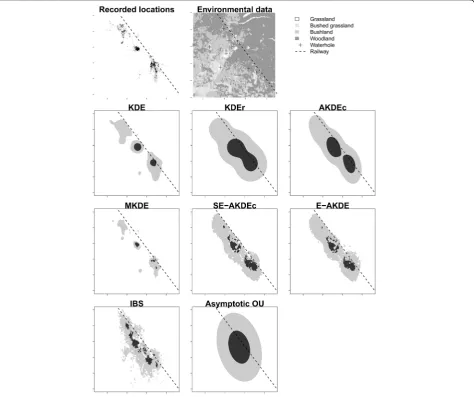
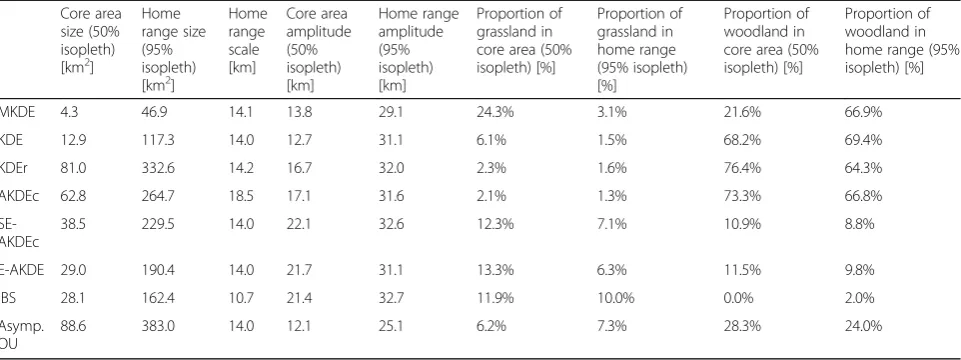
The standard KDE yielded the smallest home range area and amplitude among all KDE variants (Fig.1and Table1). As reviewed in the introduction, this small estimated home range size is partly caused by an unwanted property of the standard KDE in the presence of temporal autocor-relation [7,9,11–15]. The KDEr version indeed yielded a much larger estimated home range. AKDEc yielded a smaller home range estimate than KDEr, with a notably smaller core area leading to a large estimated home range
scale. Neither AKDEc nor KDEr provided any information about landcover selection or reluctance to cross the rail-way (Fig.1), as expected by construction. The most visu-ally compelling effect of using SE-AKDEc and E-AKDE was that the space to the east of the railway was weighted down compared to AKDEc and KDEr. In addition, the core area was markedly irregular in shape, reflecting the avoidance of the densest woodland cover type and the preference for pure grassland. The composition of the home range remained similar across all methodologies. In particular, while c.30% of the raw data was recorded in grassland, only 1–6% of the estimated home range was es-timated to be grassland. This result stems from the scar-city and patchiness of grassland in the area, meaning that
any extrapolation was bound to incorporate more non-grassland than grassland. In addition, bushland and woodland are sometimes actively selected by zebras, e.g., after a predation event [34], meaning that the fitted cover selection model did not strictly discount these land-cover types and that it might be interesting to fit a time-varying landcover selection model in this context. Lastly, the estimated E-AKDE bandwidth (0.20) was smaller than that of AKDE (0.31) yielding a smaller esti-mated home range from E-AKDE than SE-AKDEc. The decrease in bandwidth suggests that the methodology suc-cessfully took up the information that some of the move-ment variance was caused by resource selection, not stochastic diffusion. These empirical results overall sug-gest that the new reference function suppressed the refer-ence function approximation bias.
Extrapolation/interpolation, parametric/non-parametric
As outlined by several authors previously, MKDE does not measure the same thing as KDE [33,36]. MKDE im-plements aninterpolation. The potential for confusion has led some authors to recommend against using the termin-ology of“utilization distribution”for MKDE and other in-terpolative methods, and to restrict the use of that phrase to extrapolated distributions [33]. Accordingly, in the zebra case study, the“home range”area was much smaller when estimated with MKDE than with other methods (Table 1, Fig. 1). The isopleth of the MKDE distribution quantifies the process uncertainty around the interpolated path, and the interpolated time budget during the study. By contrast, KDEr and AKDEc are designed to delineate asymptotically consistent, statistically robust, conservative buffers around activity centers.
Like KDEr and AKDEc, SE-AKDEc, and E-AKDE ex-trapolate the utilization probability. But, contrary to KDEr and AKDEc, they include a dose of mechanism (Eq. 1) into the base kernels of the extrapolation (Eq. 5). This yields what can be termed a semi-parametric extrapola-tion. Compared to AKDEc, the dose of mechanism modi-fies what the method considers a plausible realization of the movement process. The objective is to combine the asymptotic consistence of AKDE with the biological real-ism of fully parametric methodologies. One of the main criticism of fully parametric extrapolations [40] is indeed their sensitivity to the goodness of fit of the underlying mechanistic movement model, which the semi-parametric approach partly relaxes. In terms of biological inference, SE-AKDEc, and E-AKDE extrapolate the potentially ac-cessible resources under a known set of movement rules and under the constraint that the movement paths must all pass through the recorded locations. Comparing ex-trapolations from different models can help infer new movement mechanisms or assess model parsimony. Fi-nally, compared to the IBS approach, SE-AKDEc and E-AKDE provide three key advantages: no tuning parame-ters, full conditioning on the recorded locations, and asymptotic consistency. As highlighted above, a way to better articulate the IBS approach with E-AKDE would be to use IBS to generate the pilot estimate upon which to base the reference function.
Conclusion
The key message is that it should soon be possible to make the statistically robust, asymptotically consistent al-ternatives to KDE less bandwidth-limited than they cur-rently are, and make them yield more realistic, less ovoid
Table 1Home range area, home range scale, and home range composition for the same zebra study individual, using the various home range estimation methods. The home range scale is the root mean squared distance to the distribution centroid. The amplitude is computed as the longest distance between two points on a contour. IBS stands for individual-based simulation, other notation like in the main text
Core area size (50% isopleth) [km2]
Home range size (95% isopleth) [km2]
Home range scale [km]
Core area amplitude (50% isopleth) [km]
Home range amplitude (95% isopleth) [km]
Proportion of grassland in core area (50% isopleth) [%]
Proportion of grassland in home range (95% isopleth) [%]
Proportion of woodland in core area (50% isopleth) [%]
Proportion of woodland in home range (95% isopleth) [%]
MKDE 4.3 46.9 14.1 13.8 29.1 24.3% 3.1% 21.6% 66.9%
KDE 12.9 117.3 14.0 12.7 31.1 6.1% 1.5% 68.2% 69.4%
KDEr 81.0 332.6 14.2 16.7 32.0 2.3% 1.6% 76.4% 64.3%
AKDEc 62.8 264.7 18.5 17.1 31.6 2.1% 1.3% 73.3% 66.8%
SE-AKDEc
38.5 229.5 14.0 22.1 32.6 12.3% 7.1% 10.9% 8.8%
E-AKDE 29.0 190.4 14.0 21.7 31.1 13.3% 6.3% 11.5% 9.8%
IBS 28.1 162.4 10.7 21.4 32.7 11.9% 10.0% 0.0% 2.0%
Asymp. OU
home range shapes. I introduced new semi-parametric methodologies, based on the step-selection framework [23]. I outlined several avenues for future improvement. I expect E-AKDE to function as part of an iterative process by which semi-mechanistic extrapolations are compared to realized resource use until no significant improvement can be made by adding new movement rules in the ex-trapolation process. The point would be to give less im-portance to the time spent at a given location, and more importance to the ratio between availability and use.
Additional files
Additional file 1:Appendix A: Description of the E-AKDE bandwidth optimizer. (PDF 271 kb)
Additional file 2:Appendix B: Additional method elements: The space-time point process likelihood and Approximate routine to determine whether a linear feature is crossed. (PDF 241 kb)
Abbreviation
AKDE:autocorrelated kernel density estimator; E-AKDE: autocorrelated kernel density estimator with environmental interactions.; KDE: kernel density estimator; MKDE: movement-based kernel density estimator
Acknowledgements
S. Chamaillé-Jammes provided the zebra data and constructive comments on a previous draft. I thank C. Fleming for a detailed and helpful review, J. Calabrese for insightful discussions of previous drafts, and an anonymous reviewer. V. Miele advised on the incorporation of C++ code.
Funding
The zebra project was funded by ANR-08-BLAN-0022 and ANR-16-CE02– 0001-01.
Availability of data and materials
The data have been uploaded to MoveBank (www.movebank.org) under the study name“Plains zebra Chamaillé-Jammes Hwange NP”.
Authors’contributions
The author read and approved the final manuscript.
Ethics approval and consent to participate
The zebra project operates under Zimbabwe Parks and Wildlife Management Authority permit # 23(1)(c)(ii)03/2009.
Consent for publication Not applicable.
Competing interests
The authors declare that they have no competing interests.
Publisher’s Note
Springer Nature remains neutral with regard to jurisdictional claims in published maps and institutional affiliations.
Received: 2 November 2018 Accepted: 25 April 2019
References
1. Fieberg J, Börger L. Could you please phrase“home range”as a question? J Mammal. 2012;93:890–902.
2. Kie JG, Matthiopoulos J, Fieberg J, Powell RA, Cagnacci F, Mitchell MS, et al. The home-range concept: are traditional estimators still relevant with modern telemetry technology? Philos Trans R Soc B Biol Sci. 2010;365:2221–31. 3. Powell RA, Mitchell MS. What is a home range? J Mammal. 2012;93:948–58.
4. Silverman BW. Density estimation for statistics and data analysis. London: Chapman and Hall; 1986.
5. Worton B. Kernel methods for estimating the utilization distribution in home-range studies. Ecology. 1989;70:164–8.
6. Kie JG. A rule-based ad hoc method for selecting a bandwidth in kernel home-range analyses. Anim Biotelemetry. 2013;1:13.
7. Börger L, Franconi N, De Michele G, Gantz A, Meschi F, Manica A, et al. Effects of sampling regime on the mean and variance of home range size estimates. J Anim Ecol. 2006;75:1393–405.
8. Silverman BW. Spline smoothing: the equivalent variable kernel method. Ann Stat Institute of Mathematical Statistics. 1984;12:898–916. 9. Hansteen TL, Andreassen HP, Ims RA. Effects of spatiotemporal scale on
autocorrelation and home range estimators. J Wildl Manag. 1997;61:280–90. 10. Dray S, Royer-Carenzi M, Calenge C. The exploratory analysis of
autocorrelation in animal-movement studies. Ecol Res. 2010;25:673–81. 11. Swihart RK, Slade NA. Testing for Independence of observations in animal
movements. Ecology. 1985;66:1176–84.
12. Fleming CH, Fagan WF, Mueller T, Olson KA, Leimgruber P, Calabrese JM. Rigorous home-range estimation with movement data: a new autocorrelated kernel-density estimator. Ecology. 2015;96:1182–8. 13. Girard I, Ouellet J-P, Courtois R, Dussault C, Breton L. Effects of sampling
effort based on GPS telemetry on home-range size estimations. J Wildl Manag. 2002;66:1290–300.
14. Laver PN, Kelly MJ. A critical review of home range studies. J Wildl Manag. 2008;72:290–8.
15. Seaman DE, Millspaugh JJ, Kernohan BJ, Brundige GC, Raedeke KJ, Gitzen RA. Effects of sample size on kernel home range estimates. J Wildl Manag. 1999;63:739.
16. De Solla SR, Bonduriansky R, Brooks RJ. Eliminating autocorrelation reduces biological relevance of home range estimates. J Anim Ecol. 1999;68:221–34. 17. Fleming CH, Calabrese JM. A new kernel density estimator for accurate
home-range and species-home-range area estimation. Methods Ecol Evol. 2017;8:571–9. 18. Slaght JC, Horne JS, Surmach SG, Gutiérrez RJ. Home range and resource
selection by animals constrained by linear habitat features: an example of Blakiston’s fish owl. J Appl Ecol. 2013;50:1350–7.
19. Benhamou S, Cornélis D. Incorporating movement behavior and barriers to improve kernel home range space use estimates. J Wildl Manag. 2010;74:1353–60.
20. Jones MC. Simple boundary correction for kernel density estimation. Stat Comput. 1993;3:135–46.
21. Tenreiro C. Boundary kernels for distribution function estimation. Revstat Stat J. 2013;11:169–90.
22. Forester JD, Im HK, Rathouz PJ. Accounting for animal movement in estimation of resource selection functions: sampling and data analysis. Ecology. 2009;90:3554–65.
23. Lele SR, Keim JL. Weighted distributions and estimation of resource selection probability functions. Ecology. 2006;87:3021–8.
24. Bischof R, Steyaert SMJG, Kindberg J. Caught in the mesh: roads and their network-scale impediment to animal movement. Ecography. 2017;40:1369–80. 25. Beyer HL, Gurarie E, Börger L, Panzacchi M, Basille M, Herfindal I, et al.“You
shall not pass!”: quantifying barrier permeability and proximity avoidance by animals. J Anim Ecol. 2016;85:43–53.
26. Dunn JE, Gipson PS. Analysis of radio telemetry data in studies of home range. Biometrics. 1977;33:85–101.
27. Johnson DS, Thomas DL, Ver Hoef JM, Christ A. A general framework for the analysis of animal resource selection from telemetry data. Biometrics. 2008;64:968–76.
28. Fieberg J, Matthiopoulos J, Hebblewhite M, Boyce MS, Frair JL. Correlation and studies of habitat selection: problem, red herring or opportunity? Philos Trans R Soc B Biol Sci. 2010;365:2233–44.
29. Johnson DS, Hooten MB, Kuhn CE. Estimating animal resource selection from telemetry data using point process models. J Anim Ecol. 2013;82:1155–64.
30. Cressie NAC. Statistics for spatial data. New York: Wiley; 1993.
31. Berman M, Turner TR. Approximating point process likelihoods with GLIM. J R Stat Soc C Appl Stat. 1992;41:31–8.
32. Robb WL. Thin silicone membranes. Their permeation properties and some applications. Ann N Y Acad Sci. 1968;146:119–37.
34. Courbin N, Loveridge AJ, Macdonald DW, Fritz H, Valeix M, Makuwe ET, et al. Reactive responses of zebras to lion encounters shape their predator-prey space game at large scale. Oikos. 2016;125:829–38.
35. Arraut EM, Loveridge AJ, Chamaillé-Jammes S, Fox HV, Macdonald DW. The 2013-2014 vegetation structure map of Hwange National Park, Zimbabwe, produced using free images and software. KOEDOE - African Prot Area Conserv Sci. 2018;60:a1497.
36. Benhamou S. Dynamic approach to space and habitat use based on biased random bridges. PLoS One. 2011;6:e14592.
37. Fleming CH, Fagan WF, Mueller T, Olson KA, Leimgruber P, Calabrese JM. Estimating where and how animals travel: an optimal framework for path reconstruction from autocorrelated tracking data. Ecology. 2016;97:576–82. 38. Signer J, Fieberg J, Avgar T. Estimating utilization distributions from fitted
step-selection functions. Ecosphere. 2017;8:e01771.
39. Wang M, Grimm V. Home range dynamics and population regulation: an individual-based model of the common shrew Sorex araneus. Ecol Model. 2007;205:397–409.