Available Online at www.ijpret.com
436
INTERNATIONAL JOURNAL OF PURE AND
APPLIED RESEARCH IN ENGINEERING AND
TECHNOLOGY
A PATH FOR HORIZING YOUR INNOVATIVE WORK
SURVEY ON MOTION ESTIMATION METHODS
PROF. PRASHANT A. BHALGE, AYUSHI V. RATHOD
1. Asst. Professor, Dept. Of Computer Science And Engg, Babasaheb Naik College Of Engg, Pusad (INDIA).
2. M.E. 2nd Sem. Student, Dept. of Computer Science And Engg, Babasaheb Naik College Of Engg, Pusad, INDIA.
Accepted Date: 15/02/2014 ; Published Date: 01/04/2014
\
Abstract: In this paper presents existing methods of motion estimation for. Video
compression under image processing. Motion Estimation (ME) algorithms vary with respect to the a priori information and constraints that employ, as well as the method of computation they use to obtain the estimate. This paper presents motion estimation technique to improve accuracy and coherence of motion vectors estimated by the standard block matching technique and a new optical flow estimation algorithm for color image to overcome the influence of shadows and improve the accuracy of optical flow estimation. Motion estimation is the process of determining motion vectors that presents the transformation from one 2D image to another; usually from adjacent frames in a video sequence. Motion estimation is key for the processing of digital video.
Keywords: Block-matching algorithm, Phase correlation and frequency domain methods, Pixel recursive algorithms, Optical flow.
Corresponding Author: PROF. PRASHANT A. BHALGE
Access Online On:
www.ijpret.com
How to Cite This Article:
Prashant Bhalge, IJPRET, 2014; Volume 2 (8): 436-442
Available Online at www.ijpret.com
437 INTRODUCTION
In video sequences Motion Estimation (ME) is the process of determining motion vectors (MVs) that describe the transformation from one 2D image to another. Image (global motion estimation) or specific parts, such as rectangular blocks, arbitrary shaped patches or even per pixel are whole related to the MVs.
Image data in an image sequence remains mostly the same between frames along motion trajectories. That is the same as saying that the scene content does not change much from frame to frame. For the purpose to exploit the image data redundancy in image sequences there is a need to estimate motion in the image sequence so one can process along motion trajectories. The main purpose of motion estimation techniques is to recover this information by analyzing the image content. Efficient and accurate motion estimation is an essential component in the domains of image sequence analysis, computer vision and video communication. It may worth mentioning that although motion estimation is also used in many other disciplines such as computer vision, target tracking, and industrial monitoring, the techniques developed particularly for image coding are different in some respects. The goal of image compression is to reduce the total transmission bit rate for reconstructing images at the receiver
I.BLOCK-MATCHING MOTION ESTIMATION:-
Block matching motion estimation (BMME) plays a very important role in video coding. The performance of BMME greatly affects the quality of the encoded bit stream.
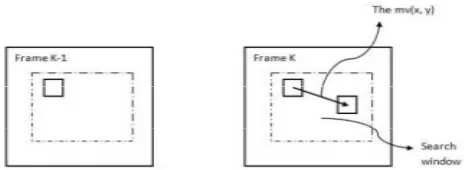
BMA(block matching algorithm):is a way of locating matching blocks in a sequence of digital video frames for the purposes of motion estimation y.Goal: it is to find a matching block from a frame ’i’ in some other frame ’j’, which may appear before or after ’i’. This can be used to discover temporal redundancy in the video sequence, increasing the effectiveness of inter frame video compression
Available Online at www.ijpret.com
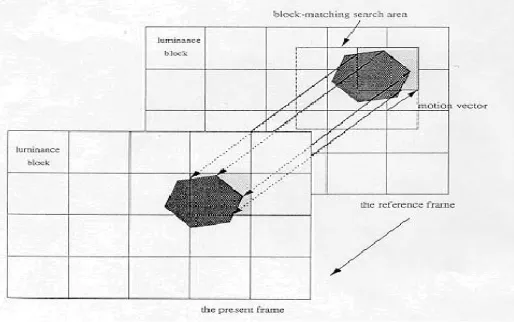
438 Figure 1.2 illustrates a process of block-matching algorithm. In a typical BMA, each frame is divided into blocks, each of which consists of luminance and chrominance blocks. Usually, for coding efficiency, motion estimation is performed only on the luminance block. Each luminance block in the present frame is matched against candidate blocks in a search area on the reference frame. These candidate blocks are just the displaced versions of original block. The best (lowest distortion, i.e., most matched) candidate block is found and its displacement (motion vector) is recorded.
Consequently the motion vector and the resulting error can be transmitted instead of the original luminance block; thus inter frame redundancy is removed and data compression is achieved. At receiver end, the decoder builds the frame difference signal from the received data and adds it to the reconstructed reference frames. The summation gives an exact of the current frame. The better the prediction the smaller the error signal and hence the transmission bit rate.
Figure 1.2 Process of block matching algorithm
Figure1.3 illustrates e.g. the block matching process. The Current ‘block’ (in this case, 3 x 3 pixels) is shown on the left and this block is compared with the same position in the reference frame (shown by the thick line in the centre) and the immediate neighboring positions (pixel in each direction). The mean squared error (MSE) between the current block and the same position in the reference frame
(Position (0, 0)) is given by
Available Online at www.ijpret.com
439 Figure 1.3 Current 3 x 3 blocks and 5 x 5 reference area
II.OPTICAL FLOW MOTION ESTIMATION:-
Optical flow is defined as the change of structured light in the image, e.g. on the retina or the camera’s sensor, due to a relative motion between the eyeball or camera and the scene. Further definitions from the literature highlight different properties of optic flow. Optical flow is the distribution of apparent velocities of movement of brightness patterns in an image not only does it contain rich 2D motion cues, but contain 3D scene structure information. Recently, optical flow estimation has been the foundation of many technologies for motion estimation, tracking, image segmentation and compression, which can acquire motion cues of targets under camera Moving and gain target’s zoom and rolling cues if deeper analysis is done
The concept of optical flow was introduced by the American psychologist James J. Gibson in the 1940s to describe the visual stimulus provided to animals moving through the world. James Gibson stressed the importance of optical flow for affordance perception, the ability to discern possibilities for action within the environment. Followers of Gibson; perception of the shape, distance and movement of objects in the world; and the control of locomotion. Recently the term optical flow has been co-opted by robotics to incorporate related techniques from image processing and control of navigation, such as motion detection, object segmentation, time-to-contact information, and focus of expansion calculations, luminance, and motion compensated encoding, and stereo disparity measurement.
Available Online at www.ijpret.com
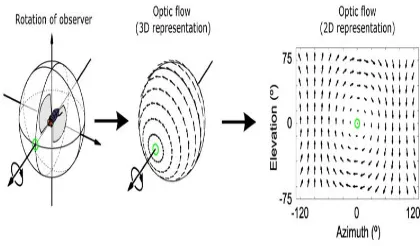
440 The optic flow experienced by a rotating observer (in this case a fly). The direction and magnitude of optical flow at each location is represented by the direction and length of each arrow. Optical flow estimation is used in computer vision to characterize and quantify the motion of objects in a video stream, often for motion-based object detection and tracking systems.
I. Fig 1.4 Moving objects detection in a series of frames using optical flow.
III.PHASE CORRELATION AND FREQUENCY DOMAIN METHOD:-
Recently there has been a lot of interest in motion estimation techniques operating in the frequency domain. These are commonly based upon the principle of cyclic correlation .Perhaps the best-known method in this class is phase correlation, which has become one of the motion estimation methods of choice for wide range of professional studio and broadcasting applications.
In addition to computational efficiency, phase correlation offers key advantages in terms of its strong response to edges and salient picture features, its immunity to illumination changes and moving shadows and its ability to measure large displacements. A key performance issue in motion estimation is sub pixel accuracy.
Available Online at www.ijpret.com
441
Phase-based methods utilize the shift property of the Fourier transform and phase correlation is the best-known motion estimation technique operating in the frequency domain. Phase correlation operates on a pair of co-sited rectangular image blocks ftandft+1 of identical dimensions belonging to consecutive frames or fields of moving sequence sampled at t, t+1 .The estimation
Of motion relies on the detection of the maximum of the cross-correlation function between ftandft+1
Is circular and for computational efficiency it can be carried out as a multiplication in the frequency domain using fast implementation because all
Functions involved are discrete, cross-correlation. The phase correlation surface is defined As:
ct ,t 1 k, l =F -1(Ft*Ft+1/ Ft*Ft+1)
where Ft and Ft +1 are respectively the two-dimensional discrete Fourier transforms of ft and ft+1, F -1 denotes the inverse Fourier transform and * denotes complex conjugate. The co-ordinates (km,lm) of the maximum of the real-valued array ct ,t+1 can be used as an estimate of the horizontal and vertical components of motion between ft and ft+1as follows:
(km,lm) =argmaxRe {ct ,t 1(k,l)}
(km,lm) = argmaxRect ,t+ 1(k,l) (3)
Where Re{} is the real part of the complex phase correlation surface array. The above baseline method
Can only yield integer-precision motion estimates. Sub-pixel accuracy can be achieved by fitting prototype functions in the vicinity of the maximum peak of the phase correlation surface.
CONCLUSION:-
Available Online at www.ijpret.com
442 REFERENCES:-
1. SerdarInce and JanuszKonrad, “Occlusion-Aware Optical Flow Estimation” Fellow, IEEE, IEEE TRANSACTIONS ON IMAGE PROCESSING, VOL. 17, NO. 8, AUGUST 2008
2. Bin Li and Kai-Kuang Ma” Unequal-arm Adaptive Rood Pattern Search with Early Terminations For Fast Block-matching Motion Estimation on H.264” 2006 IEEE
3. ZHOU Wei1 SHI Hao Shan, DUAN Zhe Min1 ZHOU Xin” An Efficient Block-matching Motion Estimation Algorithm for H.264 Video Coding Standard”,2006 IEEE
4. Bernard, C. Fast optic flow computation with discrete wavelets, Technical Report, CMAP, Ecole Polytechnique, 1997.
5. Toshiyuki YOSHIDA, Hidetoshi KATOH, and Yoshinori SAKAI” Block Matching Motion Estimation using Block Integration based on Reliability Metric” 1997 IEEE.
6. Barron, J.L.; Fleet, D.J.; Beauchemin, S. Performance of optical flow techniques. International Journal of Computer Vision (Springer), 1994.
7. A. Zaccarin and B. Liu. Fast algorithms for block motion estimation. In IEEE ICASSP, volume 3, pages 449{452, 1992.
8. D. M. Martinez. Model {based motion estimation and its application to restoration and interpolation of motion pictures. PhD thesis, Massachusetts Institute of Technology, 1986.