Available Online at www.ijpret.com 1608
INTERNATIONAL JOURNAL OF PURE AND
APPLIED RESEARCH IN ENGINEERING AND
TECHNOLOGY
A PATH FOR HORIZING YOUR INNOVATIVE WORK
CONTENT BASED VIDEO RETRIEVAL USING KEY FRAME EXTRACTION
ALGORITHM
ANURADHA B. RATHOD1, P. S. GAWANDE2
1.M.E. Student, Department of Computer Science and Engineering, RSCE, Maharashtra, India. 2.Department of Electronics and Telecommunication, RSCE, Maharashtra, India.
Accepted Date: 05/03/2015; Published Date: 01/05/2015
Abstract: Key frame extraction has been recognized as one of the important research issues in video information retrieval. Although progress has been made in key frame extraction, the existing approaches are either computationally expensive or ineffective in capturing most important visual content. Video summarization aimed at reducing the amount of data that must be examined in order to retrieve the information desired from information in a video, is an essential task in video analysis and indexing applications. We propose an innovative approach to the selection of representative (key) frames of a video sequence for video summarization In this paper, we discuss the importance of key frame selection; and then briefly review and evaluate the existing approaches. To overcome the shortcomings of the existing approaches, we introduce a new algorithm for key frame extraction.
Keywords: Video summarization, video skimming, lecture videos, key frames, Video Retrieval
Corresponding Author: MS. ANURADHA B. RATHOD
Access Online On:
www.ijpret.com
How to Cite This Article:
Anuradha B. Rathod, IJPRET, 2015; Volume 3 (9): 1608-1616
Available Online at www.ijpret.com 1609
INTRODUCTION
Digital video has become a popular storage and exchange medium due to the quick development in recording technology, recovered video compression techniques and high-speed networks in the last few years. Therefore audiovisual recordings are used more and more frequently in e-lecturing systems. A number of universities and research institutions are taking the opportunity to record their lectures and publish them online for students to access independent of time and location. As a result, there has been a huge increase in the amount of multimedia data on the Web. Therefore, for a user it is nearly impossible to find desired videos without a search function within a video files. Even when the user has found related video data, it is still difficult most of the time for him to judge whether a video is useful by only glancing at the title and other global metadata which are often brief and high level. The relevant metadata can be automatically gathered from videos by using appropriate analysis techniques. They can help a user to find and to understand lecture contents more efficiently, and the learning effectiveness can thus be recovered. Traditional video retrieval based on visual feature extraction cannot be simply applied to lecture recordings because of the homogeneous scene composition of lecture videos. Now people tend to produce lecture videos by using multi-scenes format by which the speaker and his presentation are displayed synchronously. Video summarization aimed at reducing the amount of data that must be examined in order to retrieve a particular piece of information in a video is consequently an essential task in applications of video analysis and indexing.
Available Online at www.ijpret.com 1610 Low level visual features can be used in indexing the key frames and thus the video sequences to which they belong. The use of low level features in the indexing process should not be considered as a less powerful strategy; high level features with different levels of semantic can be derived from them.
2. KEY FRAME EXTRACTION SYSTEM
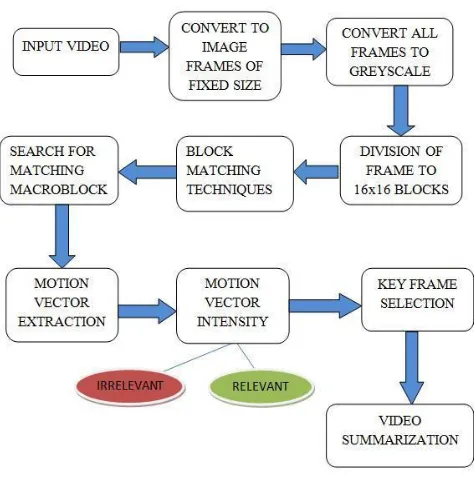
Fig 1: System Architecture diagram
The aim of the algorithm is to provide a summarized video which produces a gist of the original video without losing semantics of the video. Fig1 provides the blueprint for our process. The initial process involves converting the input video into frames [1][2][3]. After which the frames are grey scaled. Later, each frame is further divided into a fixed number of macro blocks (16x16 in this case) which facilitates the use of an individual macro block as comparison units. The first macro block of the first frame is then compared with the macro blocks in the second frame to search for the closest match to the original macro block. Comparing all macro blocks in the second frame is a tedious process and hence an astute method of selection of macro blocks is required which gives the correct match yet saves processing time [4].
Available Online at www.ijpret.com 1611 each block of the first frame, and sum of all such motion descriptors is considered to produce the cumulative motion descriptor between the two frames. Such a cumulative motion descriptor is obtained between each pair of consecutive frames. These motion descriptors are then compared to categorize them into irrelevant and relevant. The motion descriptors signify the amount of motion present between two consecutive frames. Absence of motion signifies no or minimum difference between two frames, whereas a high motion descriptor signifies a vast difference between two frames and thus leads to the conclusion of them being key frames. Summation of all such key frames lead to the formation of the summarized video[5].
2.1 New key frame extraction approach
Available Online at www.ijpret.com 1612
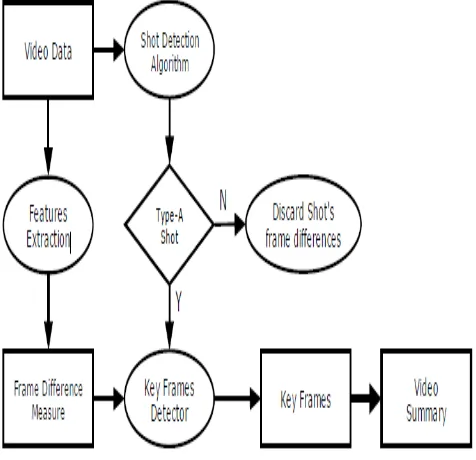
Fig 2: The Key Frame Extraction Algorithm
We distinguish two types of shots: “informative” shots (type A) and “uninformative” shots (type B). Type B shots are those limited by: a fade-out followed by a fade-in effect, a fade-out followed by a cut or a cut followed by a fade-in. If we were to extract key frames from these shots the resulting set of frames would contain uniformly colored images that are meaningless in terms of the information supplied. Key frames are extracted from type A shots of only.
2.2 Algorithms of key frame extraction
Available Online at www.ijpret.com 1613
Sampling algorithms Condition for sampling key frame
Spatial At every camera change
Temporal Once every T second
Spatio-temporal Sampling a key frame
At every camera change
If T second elapsed with no camera
Change after the previous key frame
Adaptive
spatio-temporal
Sample a key frame
At every camera change
If T second elapsed without camera
Change where:
t = T(1-n/20) if 1<= n<=10 t = T/2 if n>10
(n= No. of footsteps since last key frame)
Table1: Algorithm steps for key frame extraction
2.3 Key frame selection
Available Online at www.ijpret.com 1614
3. MATHEMATICAL MODEL
A video frame is a solo picture or motionless shot that is shown as fraction of a larger video. Key-frame is the frame that can represent the content of a section of a video. The key frames are the frames which has drastic change than the previous frame. In proposed system, the key-frame extraction is done with the help of color histogram.
The algorithm of color histogram is given below:
1. Set„ d as threshold and initialize the algorithm.
2. Select the first frame and set it as a key frame.
3. If no frame is captured go to 6.
4. Start the comparison of current captured frame with the selected key frame.
5. Calculate the difference between them
a. If the d > difference then select the current frame as next key frame.
b. If the d < difference then go to c.
c. Go to next frame.
6. End.
4. RESULTS
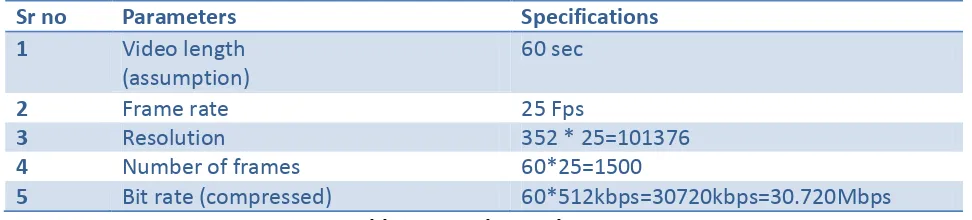
The different sequences of videos are scene from table-2. It summarizes some of the characteristic of the algorithms tested. Based on that for an amount of interval obtain key frame from above mention steps of algorithm.
Sr no Parameters Specifications
1 Video length
(assumption)
60 sec
2 Frame rate 25 Fps
3 Resolution 352 * 25=101376
4 Number of frames 60*25=1500
5 Bit rate (compressed) 60*512kbps=30720kbps=30.720Mbps
Available Online at www.ijpret.com 1615
Sr No Threshold (k) Actual key
frames
Detected key frames Transmission bandwidth (Mbps)
1 K=1 10 19 19*512kbps=9.7
2 K=1 10 15 15*512kbps=7.6
3 K=1 10 10 10*512kbps=5.1
4 K=1 10 7 7*512kbps=3.58
Table3: Result Analysis
Here the key frames are changing according to threshold value, for higher threshold we get less key frames and vice-versa, so based on application we can make a relevant threshold so that we can save the transmission bandwidth accordingly.
5. CONCLUSION
This paper discusses the proposed key frame extraction algorithm. However, the key frames of a particular event are often taken into account. The experimental result shows that the key information of live video are extracted efficiently resulting in saving transmission bandwidth The differences between pairs of consecutive frames of a video sequence, the algorithm determines the complexity of the sequence in terms of changes in visual content as expressed by different frame descriptors. Similarly measures are computed for each descriptor and combined to form a frame difference measure
REFERENCES
1. Haojin Yang and Christoph Meinel, Member, IEEE “Content Based Lecture Video Retrieval Using Speech and Video Text Information,” in Proc. IEEE Int. Conf. Acoust., Speech Signal Process., 2014, val.7 no.2
2. G. Ciocca1, R. Schettini “Key frame extraction for video summarization using motion activity descriptors”.
3. Gamhewage C. de Silva, Byoungjun Oh, Toshihiko Yamasaki, Kiyoharu Aizawa “Experience retrieval in a ubiquitous home” CARPE’05, November 11, 2005, Singapore.
Available Online at www.ijpret.com 1616 5. Yueting Zhuangy , Yong Rui Thomas S_ Huang and Sharad Mehrotra “An adaptive key frame extraction using unsupervied clustering,” in ARL Cooperative Agreement No. DAAL01-96-0003and in part by NSF/DARPA/NASA Digital Library Initiave Program under Cooperative agreement No94-11318
6. D. Lee and G. G. Lee, “A korean spoken document retrieval system for lecture search,” in Proc. ACM Special Interest Group Inf. Retrieval Searching Spontaneous Conversational Speech Workshop, 2008.
7. J. Glass, T. J. Hazen, L. Hetherington, and C. Wang, “Analysis and processing of lecture audio data: Preliminary investigations,” in Proc. HLT-NAACL Workshop Interdisciplinary Approaches Speech Indexing Retrieval, 2004, pp. 9–12.
8. Zhang H J,Wu J H, Zhong D et al, “An integrated system for content-based video retrieval and browsing”. Pattern Recognition, 1997, 30: 643-658.
9. Yeung M M, Liu B, “Efficient matching and clustering of video shots”. Proceedings of IEEE ICIP, 1995: 338-341.
10. Zhang Y J, Lu H B, “Hierarchical video organization based on compact representation of video units”. Proc. Workshop on Very Low Bitrates Video’99, 1999: 67-70.
11. Calic J, Izquierdo E, “Efficient key-frame extraction and video analysis”. Proceeding of the International Conference on Information Technology: Coding and Computing (ITCC’02),2002: 28-33.