Differentiating the Motivations and Justifi cations
Underlying Individual Differences in Pakeha Opposition
to Bicultural Policy: Replication and extension
of a predictive model
Chris G. Sibley
University of AucklandMarc S. Wilson and Andrew Robertson
Victoria University of WellingtonThis study elaborated upon Sibley, Robertson, and Kirkwood’s (2005) recently proposed model predicting individual differences in Pakeha (New Zealanders of European descent) support/opposition for the symbolic and resource-specifi c aspects of bicultural policy. The theory integrates research on the function of historical representations and collective guilt for historical injustices within the context of Duckitt’s (2001) model of the dual motivational and cognitive processes underlying prejudice, and argues that the refutation of responsibility for historical injustices functions as a legitimizing myth justifying social inequality between Maori and Pakeha. Consistent with Duckitt (2001), structural equation modeling indicated that social conformity predicted dangerous world beliefs, which in turn predicted Right-Wing Authoritarianism (RWA), whereas tough-mindedness predicted competitive world beliefs, which in turn predicted Social Dominance Orientation (SDO). SDO in turn predicted decreased levels of support for different aspects of bicultural policy, and as hypothesized, these effects were mediated by the refutation of responsibility for historical injustices. These fi ndings provide further insight into the ideological attitudes thought to motivate (in this case SDO), and the justifi cations thought to legitimize (in this case the refutation of historical responsibility) expressions of opposition toward different aspects of bicultural policy in the New Zealand socio-political environment. The utility of this theoretical framework for assessing both the processes underlying, and the content of, socially elaborated discourses legitimizing discriminatory attitudes in other domains and across other cultural contexts is discussed.
N
ew Zealand (NZ) is relatively unique on the world stage. This is due in part to a political system which formally recognizes Maori (the indigenous peoples of NZ) and non-Maori New Zealanders as distinct but equal partners. This idea of biculturalism is enshrined in the Treaty of Waitangi, signed in 1840, between representatives of Maori and the British colonial government. Once declared a legal “nullity”, the Treaty began its rehabilitation in the late 1960’s (Orange, 2004). It is now regarded as one of the legal foundations for NZ’s sovereignty,and is considered by both Maori and Pakeha1 (New Zealanders of European
descent) to be the most important event in NZ’s history (Liu, 2005; Liu, Wilson, McClure, & Higgins, 1999).
Over the last few years, research has begun to map out the different themes underlying Pakeha discourse and attitudes regarding Maori-Pakeha relations, concepts of biculturalism, and related social policy. Elaborating upon this qualitative work (e.g., Nairn & McCreanor, 1990, 1991, Barclay & Liu, 2003), Sibley and Liu (2004) developed
a scale assessing support/opposition for two different aspects of bicultural policy. The fi rst theme referred to the symbolic principles of biculturalism, defi ned as the degree to which people are supportive of the incorporation of Maori culture and values into mainstream (primarily Pakeha) NZ culture and national identity. The second theme referred to resource-specifi c aspects of bicultural policy, defi ned as the degree to which people are supportive of policies that aim to redistribute resources in favour of Maori on a categorical basis. Previous research using both student and general population samples indicated that although the majority of Pakeha supported the symbolic principles of bicultural policy (e.g., Maori language, Marae greetings, the Haka, wearing bone carvings, etc), support for its resource-specific aspects (e.g., land claims, resource-allocations favouring Maori, affirmative action programs) was dramatically lower (Sibley & Liu, 2004; Sibley, Robertson, & Kirkwood, 2005).
in press). Preliminary fi ndings supported our model of the associations between the ideological attitudes motivating, and justifi cations legitimizing, individual differences in Pakeha expressions of opposition/support for different aspects of bicultural policy (see Sibley et al., 2005, for a detailed description of the theory and reasoning underlying this model).
The present study elaborates upon our earlier research in this area in three ways. Firstly, our earlier research has focused solely on the predictive utility of Social Dominance Orientation (SDO; Pratto, Sidanius, Stallworth, & Malle, 1994) and Right-Wing Authoritarianism (RWA; see Altemeyer, 1996, 1998). The present study provides a more detailed assessment of the antecedents underlying individual differences in Pakeha opposition toward bicultural policy by including measures of personality and social worldview that Duckitt (2001) theorized underlie SDO and RWA.
Secondly, our earlier research in this area has assessed beliefs about Pakeha responsibility for historical injustices using a combination of items referring to beliefs about responsibility and reparation (e.g., ‘We should not have to pay for the mistakes of our ancestors’) and items derived from Doosje et al’s (1998) scale referring to the experience of guilt and regret for historical injustices (e.g., ‘I feel guilty about the negative things NZ Europeans/Pakeha have done to Maori’). Although exploratory factor analysis indicated that items referring to these two concepts loaded on a single underlying factor (Sibley et al., 2005), the present study uses items referring solely to beliefs about reparation in order to avoid the possible confl ation of these two constructs.
Finally, the present research tests a Structural Equation Model using latent variables. The estimation of latent variables in Structural Equation Modeling (SEM) has considerable advantages over the use of the observed means as it reduces the effects of measurement error, thus providing a more accurate appraisal of the associations between constructs included in the model. Before presenting these analyses, we fi rst offer a brief overview of previous theory and research relevant to this investigation.
A brief overview of the model
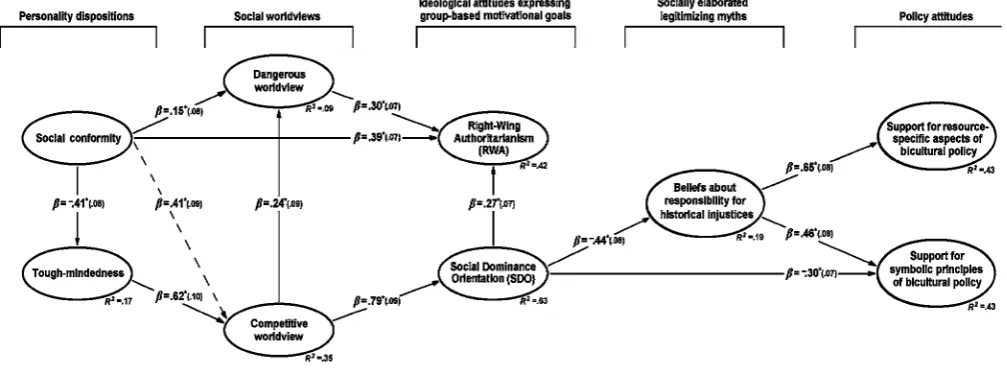
According to Duckitt (2001; Duckitt et al., 2002), individual differences in prejudice are born out of two complementary cognitive/motivational processes, which result in individual differences in two types of group-based motivational goals. Duckitt’s (2001) model is presented in the left half of Figure 1. On the one hand, the personality trait of social conformity predisposes the individual to perceive the social world as a dangerous and threatening place, leading to higher levels of RWA. The personality trait high in tough-mindedness, on the other hand, predisposes the individual to perceive the world as a competitive jungle, leading to the endorsement of SDO. High levels of SDO may therefore be seen as an expression of the motivational goal for group-based dominance and superiority, whereas low levels refl ect goals of egalitarianism and altruistic social concern. High levels of RWA, in contrast, are an expression of the motivational goal for social control and security, whereas low levels refl ect goals of independence and autonomy (Duckitt et al., 2002). Thus, the dual process model provides insight into the processes underlying individual differences in prejudice, and hence the conditions where one or the other, or the linear combination of these two ideological attitude dimensions (SDO, RWA) will predict discriminatory attitudes.
In NZ, it seems that general political ideology, and hence the issues surrounding Maori-Pakeha intergroup relations tend to be anchored in issues of equality-inequality and intergroup competition versus harmony, rather than issues of danger and threat (see for example, Liu, Wilson, McClure, & Higgins, 1999). Accordingly, we expect that opposition toward different aspects of bicultural policy will be predicted primarily by the motivational goal for intergroup dominance and superiority (indexed by SDO), rather than the motivational goal for social control and security (indexed by RWA).
We further posit that the refutation of responsibilityfor historical injustices may function as a hierarchy enhancing legitimizing myth allowing individuals motivated toward intergroup dominance
and superiority (i.e., those high in SDO) to justify expressions of opposition toward bicultural policy. According to Sidanius and Pratto (1999; Sidanius, Levin, Federico & Pratto, 2001; Whitley, 1999) beliefs about responsibility for historical injustices should thus mediate the relationship between primary ideologically-based motivations (in this case SDO) and discriminatory attitudes and outcomes, as indexed by measures of support/opposition for different aspects of bicultural policy. Recent research conducted in Australia also supports the possibility that perceptions of history may function as a legitimizing myth in contexts where minority group members have suffered from historical injustices. Consistent with our own research examining Pakeha beliefs in the NZ context, Reid, Gunter, and Smith (2005) reported that collective guilt for historical injustices experienced by Aboriginal-Australians on the part of past generations of European-Australians mediated the relationship between individual differences in European-Australians’ levels of universalism (a value measure conceptually related to low levels of SDO) and compensatory attitudes.
Overview and hypotheses
Method
Participants and Procedure
Participants were 213 undergraduate students who participated for partial course credit and who self-identifi ed as NZ European/Pakeha (the majority ethnic group in NZ). Participants (71 males and 142 females) ranged from 17-46 years of age (MMM = 19.77, = 19.77, SD = 4.04).
The measures used in this research were included in a larger series of randomly ordered survey packets unrelated to the current research that were administered early in 2005. One packet assessed (in order) personality (social conformity, tough-mindedness), and attitudes toward bicultural policy and beliefs about historical injustices, the other packet assessed (in order) RWA, SDO, and social worldviews (competitive and dangerous world). Data from the two packets were matched using confidential student identifi cation numbers. The entire set of survey packets took approximately 25 minutes to complete. Data from people who identifi ed with an ethnicity other than NZ European/Pakeha (19 Pacifi c Nations, 34 Asian, 27 Maori, 19 European, 7 Indian, 1 unidentifi ed; n = 107) were excluded from the sample as the current investigation focused solely on self-identifi ed Pakeha participants’ attitudes.
Materials
Personality dimensions of social conformity and tough-mindedness were each assessed using shortened 8-item versions of Duckitt et al’s (2002) measures2. The scale assessing social
conformity contained the following pro-trait adjectives: conventional, respectful, moralistic, and obedient; and the following con-trait adjectives: unorthodox, non-conforming, unconventional, and rebellious. The scale assessing tough-mindedness contained the following pro-trait adjectives: unsympathetic, unfeeling, ruthless, and harsh; and the following con-trait adjectives: compassionate, generous, kind, and sympathetic. Consistent with Duckitt et al. (2002), these items were administered with instructions to: “Please rate the extent to which you feel each of the following descriptive adjectives
is characteristic or uncharacteristic of YOUR PERSONALITY AND BEHAVIOR.” Adjectives were rated on a scale ranging from 1 (not at all characteristic of my personality and behavior) to 7 (very characteristic of my personality and behavior). Higher scores indicated higher mean levels of social conformity and tough-mindedness, respectively.
Belief that the social world is a dangerous and threatening place and belief that the social world is a competitive place were each assessed using 8 balanced Likert-type items from Duckitt et al’s (2002) scale3.
Belief that the world is a dangerous place was assessed using items: 3, 4, 5, 6, 7, 8, 9, and 10 of Duckitt et al’s (2002) scale. The scale included items such as “My knowledge and experience tells me that the social world we live in is basically a dangerous and unpredictable place, in which good, decent and moral people’s values and way of life are threatened and disrupted by bad people” (pro-trait), and “My knowledge and experience tells me that the social world we live in is basically a safe, stable and secure place in which most people are fundamentally good” (con-trait). Belief that the world is a competitive place was assessed using items: 1, 2, 4, 5, 8, 9, 10, and 11 of Duckitt et al’s (2002) scale. The scale included items such as “It’s a dog-eat-dog world where you have to be ruthless at times” (pro-trait), and “The best way to lead a group under one’s supervision is to show them kindness, consideration, and treat them as fellow workers, not as inferiors” (con-trait). Items were rated on a scale ranging from 1 (strongly disagree) to 7 (strongly agree). Con-trait items were reverse scored so that higher mean scores indicated higher levels of belief that the social world is a dangerous and threatening place, and belief that the world is a competitive place, respectively.
Social Dominance Orientation (SDO) was measured using the balanced 16-item SDO6 scale (Sidanius & Pratto, 1999), and included Likert-type items such as “Some groups of people are simply inferior to other groups” (pro-trait), and “No one group should dominate in society” (con-trait).
Right-Wing Authoritarianism (RWA) was measured using a shortened set of 16 balanced items from Altemeyer’s (1996) scale (items: 8, 10, 12, 13, 15, 22, 23, 24, 25, 26, 28, 29, 30, 31, 32, and 34). The scale included items such as “The only way our country can get through the crisis ahead is to get back to our traditional values, put some tough leaders in power, and silence the troublemakers spreading bad ideas” (pro-trait), and “Our country
needs free thinkers who will have the courage to defy traditional ways, even if this upsets many people” (con-trait). Items assessing SDO were rated on a scale ranging from 1 (strongly negative) to 7 (strongly positive). Items assessing RWA were rated on a scale ranging from 1 (strongly disagree) to 7 (strongly agree). Con-trait items were reverse scored so that higher mean scores indicated higher levels of SDO and RWA, respectively. The aforementioned scales have all been used extensively in the previous literature and have been shown to display acceptable internal reliability and construct validity (Altemeyer, 1998; Duckitt, 2001; Duckitt et al., 2002; Pratto et al., 1994).
Beliefs about responsibility for historical injustices were assessed using three Likert-type items: “If our ancestors have acted unjustly in the past, then it is our responsibility to see that those acts are corrected in the present” (pro-trait), “I believe that I should take part in the efforts to help repair the damage caused to Maori by NZ Europeans/Pakeha in the past” (pro-trait), and “We should not have to pay for the mistakes of our ancestors” (con-trait). The second of these items was adapted from an item originally included in Doosje et al’s (1998) measure of collective guilt. The other two items were developed by Sibley et al. (2005). These items were rated on a scale ranging from 1 (strongly disagree) to 7 (strongly agree). Con-trait items were reverse scored so that higher mean scores indicated higher levels of the belief that Pakeha of the present are responsible for historical injustices experienced by Maori that were brought about by European colonials.
Sibley et al’s (2005) Pakeha Attitudes toward Biculturalism Scale. Five items assessed support for symbolic principles of bicultural policy and fi ve items assessed support for resource-specifi c aspects of bicultural policy. The items included in this scale are presented in the Appendix. Items were rated on a scale ranging from 1 (strongly disagree) to 7 (strongly agree). Con-trait items were reverse scored so that higher mean scores indicated higher levels of support for these two aspects of bicultural policy.
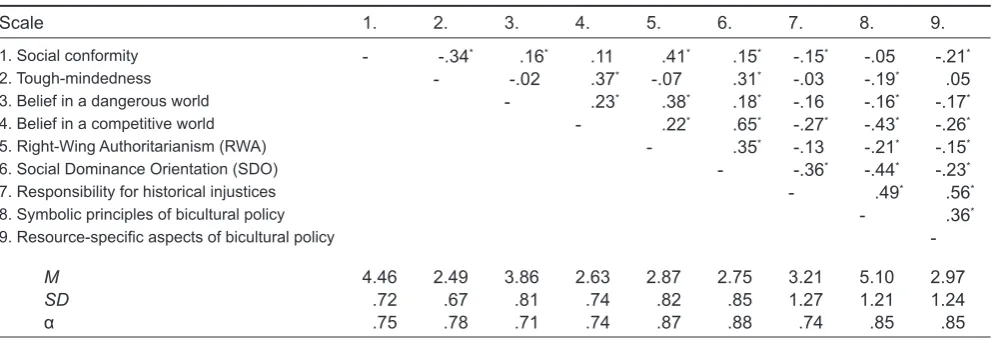
Descriptive statistics and internal reliabilities for all scales used in this research are presented in Table 1.
Results
Correlations between self-identifi ed Pakeha respondents’ personality, social worldviews, SDO, RWA, beliefs about historical injustices, and support for the symbolic principles and resource-specifi c aspects of bicultural policy are displayed in Table 1.
In order to conduct SEM analyses using latent variables, we adopted the partial disaggregation procedure outlined by Bagozzi and Heatherton (1994). Consistent with Duckitt et al. (2002), the items contained in each scale were parceled to form three manifest indicators. Item parcels were randomly selected, but where possible
contained a balanced number of pro-and con-trait items (see Bpro-andalos pro-and Finney, 2001, for further discussion of item parceling). As only three items assessed beliefs about historical injustice, these three items (rather than item parcels) were entered as manifest indicators of this construct. In all SEM analyses, the three manifest indicators created for a given scale were allowed to relate solely to the latent variable assessing that particular construct.
Hu and Bentler (1999) argued that it is important to consider both the standardized Root Mean square Residual (sRMR; a residual-based fi t index) and one or more index of comparative fit, such as the Root Mean Square Error of Approximation (RMSEA), Comparative Fit Index (CFI), Non-Normed Fit Index (NNFI), or Goodness of Fit Index (GFI), when considering the overall adequacy of a model. sRMR and RMSEA and values below .08 and .06, respectively, and CFI, NNFI, and GFI indices above .95 are considered indicative of good-fi tting models (Hu & Bentler, 1999). The Model Consistent Akaike Information Index (Model CAIC) is also reported for the purposes of comparison with alternative models.
The hypothesized and revised models
According to the criteria outlined by
Hu & Bentler (1999), the hypothesized model (shown by the solid lines presented in Figure 1) approached an acceptable level of fi t. Fit indices for the hypothesized model are presented in Table 2. However, post-hoc model modifi cation indices using the Lagrange multiplier identified an additional unpredicted positive path leading directly from social conformity to belief in a competitive world. The revised model including this additional path is presented in Figure 1. As summarized in Table 2, the revised model performed well and yielded improved fi t indices that fell well within the ranges recommended by Hu and Bentler (1999), with the sole exception that the GFI remained somewhat lower than recommended. The revised model also yielded a lower Model CAIC. A Chi-square difference test comparing the hypothesized and revised models indicated that the revised model provided a signifi cantly better fi t, χ2
d.ff (1) = 22.31, d.ff (1) = 22.31,
d.ff p < .001.
[image:4.595.57.555.556.727.2]All paths between latent variables reported in the revised model were statistically signifi cant, z’s > 1.96, with the sole exception of the hypothesized direct effect of social conformity on dangerous world beliefs, zzz = 1.84, = 1.84, p = .07. The paths from each latent variable to its manifest indicators were also all highly signifi cant, β’s > .51, z’s > 6.97.
Table 1. Descriptive statistics and correlations between indices of self-identifi ed Pakeha respondents’ personality (social conformity, tough-mindedness), social worldviews (dangerous world, competitive world), SDO, RWA, beliefs about responsibility for historical injustices, and support for the symbolic principles and resource-specifi c aspects of bicultural policy.
Scale 1. 2. 3. 4. 5. 6. 7. 8. 9.
1. Social conformity - -.34* .16* .11 .41* .15* -.15* -.05 -.21*
2. Tough-mindedness - -.02 .37* -.07 .31* -.03 -.19* .05
3. Belief in a dangerous world - .23* .38* .18* -.16 -.16* -.17*
4. Belief in a competitive world - .22* .65* -.27* -.43* -.26*
5. Right-Wing Authoritarianism (RWA) - .35* -.13 -.21* -.15*
6. Social Dominance Orientation (SDO) - -.36* -.44* -.23*
7. Responsibility for historical injustices - .49* .56*
8. Symbolic principles of bicultural policy - .36*
9. Resource-specifi c aspects of bicultural policy
M 4.46 2.49 3.86 2.63 2.87 2.75 3.21 5.10 2.97
SD .72 .67 .81 .74 .82 .85 1.27 1.21 1.24
α .75 .78 .71 .74 .87 .88 .74 .85 .85
The revised model (see Figure 1) performed well, and accounted for 43% of the variance in support/opposition for both the symbolic principles and resource-specifi c aspects of bicultural policy. The personality and social worldview dimensions of Duckitt’s (2001) dual process model predicted 63% and 42% of the variance in SDO and RWA, respectively. The proportions of predicted variance (R
proportions of predicted variance (R
proportions of predicted variance ( 2’s)
in all dependent measures included in the model are displayed in Figure 1.
As can be seen in Figure 1, the paths between personality, social worldview and ideological attitude predicted by Duckitt (2001) were all signifi cant and in the expected directions. As expected, social conformity was negatively related to tough mindedness. Social conformity was also directly, although relatively weakly, related to dangerous world beliefs, and dangerous world beliefs were in turn directly related to RWA. Thus, in line with Duckitt’s (2001) prediction, there was a trend suggesting that social conformity exerted a weak indirect effect on RWA that was mediated by dangerous world beliefs, β = .05, zzz = 1.65, = 1.65, p < .10, while being also directly related to RWA in its own right. Tough-mindedness was directly related to competitive world beliefs, which were in turn directly related to SDO. Thus, the effects of tough-mindedness on SDO were indirect, and entirely accounted for by intermediary beliefs that the social
world is a competitive place, β = .49,
z = 6.00, p < .01. Consistent with predictions, competitive world beliefs predicted dangerous world beliefs. Consistent with analyses of other NZ samples (Duckitt, 2001); SDO appeared to predict RWA rather than vice-versa. The revised model further suggested that social conformity had a direct, positive effect on competitive world beliefs in this data.
As also shown in Figure 1, and consistent with Sibley et al. (2005), SDO was directly negatively related to beliefs about the legitimacy of historical injustices and support for the symbolic principles of bicultural policy. Beliefs about historical injustices were, in turn, directly positively related to support for both the symbolic principles and resource-specifi c aspects of bicultural policy. Thus, the effect of SDO on support/opposition for the resource-specifi c aspects of bicultural policy was indirect, being entirely mediated by beliefs about historical injustices, β = -.29, zzz = -5.03, = -5.03, p < .01. Similarly, close to half (i.e., 40%) of the standardized total effect of SDO on support/opposition for the symbolic principles of bicultural policy was mediated by beliefs about historical injustices, βββ = -.20, = -.20, zzz = -4.20, = -4.20,
p < .01.
Testing alternative models
A series of plausible alternative models were also examined in order to evaluate if the hypothesized model provided the
most parsimonious explanation of the relationships between the variables of interest. This is a common step when testing structural equation models, and has been recommended by various authors (e.g., Lee & Hershberger, 1990). The alternative models considered here provided markedly worse fi t indices in all cases.
Consistent with Duckitt et al. (2002), we fi rst tested an alternative model in which the placements of SDO and RWA were swapped with competitive and dangerous worldviews (Alternative model 1). All other paths in the model remained identical to those presented in Figure 1. Thus, the model tested the possibility that social worldviews functioned as legitimizing myths akin to beliefs about historical injustices. As can be seen through comparison of the model fi t indices presented in Table 2, the revised model presented in Figure 1 outperformed this alternative model.
A second alternative model in which beliefs about historical injustices and attitudes toward bicultural policy were included as additional worldview dimensions predicting SDO also provided poorer fi t indices, as shown in Table 2 (Alternative model 2). These results were further supported by a chi-square difference test, χ2
d.ff(2) = 200.42, d.ff(2) = 200.42, d.ff
p < .001.
[image:5.595.43.547.606.796.2]Finally, a third alternative model in which attitudes toward different
Figure 1. Structural equation model predicting individual differences in Pakeha students’ attitudes toward the symbolic principles and resource-specifi c aspects of bicultural policy with standardized path coeffi cients. (Note. For simplicity, manifest indicators and paths from latent to manifest indicators are not shown; +p < .07; *p < .05; standard errors
aspects of bicultural policy functioned as legitimizing myths predicting beliefs about historical injustices also provided poorer fit indices than the model presented in Figure 1, as shown in Table 2 (Alternative model 3).4 All three
of these alternative models included the additional non-hypothesized path leading from social conformity to competitive world beliefs.5
Summary of results
In sum, the results indicated that a personality disposition high in social conformity predisposed one to perceive the social world as both a dangerous and competitive place. Dangerous world beliefs led in turn to heightened levels of RWA. A personality disposition high in tough-mindedness, in contrast, predisposed one to perceive the world as a competitive place, which in turn fostered heightened levels of SDO. Those high in SDO, in turn, tended to express lower levels of responsibility for historical injustices, which precipitated lower levels of support for both the symbolic principles and resource-specifi c aspects of bicultural policy (hence the negative associations between SDO and support for bicultural policy). However, when considered in a model also including SDO, the motivational goal for social control and ingroup security indexed by RWA did not directly predict opposition to bicultural policy in this sample.
Discussion
Examples of the discursive strategies or ‘standard stories’ used to legitimize or refute Pakeha responsibility for historical injustices are prevalent in both the NZ media and in everyday Pakeha discourse (e.g., Barclay & Liu, 2003; Kirkwood, Liu, & Weatherall, 2005; McCreanor, 2005; Nairn & McCreanor, 1990, 1991; Tuffi n, Praat, & Frewin, 2004; Wetherell & Potter, 1992). The
current study contributed to this growing literature by (a) operationalizing one aspect of the standard story (i.e., that aspect based on the positioning of responsibility for historical events), and (b) modeling its function as a legitimizing myth within the broader contexts of Duckitt’s (2001) model of the dual motivational and cognitive processes underlying prejudice and intergroup attitudes.
Our model replicated the causal pathways predicted by Duckitt (2001). The model further indicated that political ideology surrounding ethnic group relations in NZ, and particularly Maori-Pakeha intergroup relations, may be more heavily anchored in issues of equality-inequality and intergroup competition versus harmony (SDO), rather than issues of danger and threat to ingroup values (RWA). Consistent with this perspective, and in line with Duckitt’s (2001) earlier fi ndings, our SEM analyses indicated that SDO had a signifi cant effect on RWA, whereas RWA failed to exert a signifi cant reciprocal effect on SDO.6 Previous research in
South Africa, in contrast, has identifi ed the opposite pattern of results, in which RWA strongly predicts SDO (Duckitt et al., 2002). Given both these and other similar findings (e.g., Duckitt, 2001; Sibley et al., 2005), we argue that representations of ethnic group categorizations in NZ, and particularly Maori-Pakeha relations, are more likely to be characterized by discourses along the lines of “‘us,’ who are superior, strong, competent, and dominant (or should be) and ‘them,’ who are inferior, incompetent, and worthless”, than they are by ingroup threat- and conformity-oriented discourses along the lines of “‘them,’ who are bad, dangerous, immoral, and deviant and who threaten ‘us,’ who are normal, morally good,
decent people” (Duckitt et al., 2002, p. 88).
The dual process model and legitimizing myths
The content of legitimizing myths used in a given domain should depend upon the social representations used to build consensus and manage debate about intergroup relations in that context. Thus, the content of legitimizing myths used to justify discriminatory attitudes may also differ according to whether such attitudes are driven by motivations for intergroup competition and dominance (SDO) or ingroup threat and security (RWA).
[image:6.595.48.555.88.163.2]On the one hand, the content of legitimizing myths stemming from group-based motivations for dominance may be tailored toward justifying and maintaining hierarchical relations between groups. In the context of Maori-Pakeha relations, such myths may be anchored in (a) notions of equality, and (b) the positioning of ingroup responsibility (or lack thereof) for contemporary and historical disadvantages experienced by minority group members. Consistent with this possibility, recent qualitative work in this area indicates that Pakeha draw upon two different themes when expressing opposition toward bicultural policy. One of these themes appears to be anchored in the notion that equality should reflect individual merit. The construction of equality in this way allows one to oppose any entitlement, provision or allocation of resources to particular ethnic groups on the basis that such allocations are unfair to other individuals who do not belong to that group. The other theme appears to be based on (re-)positioning the relevance of key historical events (e.g., The Treaty of Waitangi) in order to refute claims based on historical grievances (Sibley, Liu, & Kirkwood, 2006). To
Table 2. Model fi t indices for the hypothesized model, revised model, and alternative models.
χ222 (df) (df) sRMR RMSEA NNFI CFI GFI Model CAIC
Hypothesized model 407.18 (312) .08 .04 ± .01 .98 .98 .88 827.03
Revised model (shown in Figure 1) 384.87 (311) .06 .03 ± .01 .98 .99 .88 811.08
Alternative model 1 411.66 (311) .08 .04 ± .01 .98 .98 .87 837.86
Alternative model 2 585.29 (309) .14 .07 ± .01 .95 .96 .83 1024.22
Alternative model 3 415.19 (311) .07 .04 ± .01 .98 .98 .88 841.40
date, our empirical research in this area has focused on the latter of these two possible legitimizing myths. Further research is necessary in order to more clearly operationalize history- and equality-based legitimizing myths and assess their function in models predicting attitudes toward bicultural policy in NZ. Research is also needed to further delineate the effects of beliefs about historical injustices and collective emotion for such injustices.
The content of legitimizing myths stemming from group-based motivations for ingroup security and conformity (i.e., RWA), in contrast, may be more explicitly tailored toward maintaining ingroup norms and values. Such myths may center around notions of (ingroup) morality and values, and the positioning of outgroup threats to ingroup values and way of life. For example, research may fi nd that those high in RWA tend to justify discriminatory attitudes toward homosexuals using legitimizing myths grounded in biblical interpretations of the immorality and sinfulness of homosexual practice.
The legitimizing myths used by those high in SDO or RWA may also differ somewhat in function at the individual level. For instance, the legitimizing myths used by people high in RWA may allow those individuals to endorse discriminatory beliefs without experiencing cognitive dissonance in instances where such beliefs may be otherwise perceived as non-normative. We suspect that people high in SDO, in contrast, may not fi nd it necessary to justify their discriminatory attitudes to
themselves in this same way, and may be less likely to experience dissonance in instances where their beliefs differ from perceived social norms (see Altemeyer, 1999; Wilson, 2003).
Caveats and Conclusions
An unpredicted direct effect leading from social conformity to belief in a competitive social world was also identifi ed. Unpredicted direct effects between social conformity and negative attitudes toward various outgroups have also been observed in previous research, and have typically been interpreted as refl ecting context dependent variation in social norms against antiminority prejudice (Duckitt, 2001; Duckitt et al., 2002). The unpredicted effect observed
in our research may have occurred for a similar reason, namely that, at the time this research was conducted in early 2005, variation in one or more unidentified external socio-political factor(s) may have led to increased normative perceptions of the social world as a competitive place amongst Pakeha students. For instance, at the time this data was collected Pakeha higher in social conformity may have been more likely to hold competitive world beliefs because of recent political discourse framing Maori-Pakeha relations as zero sum (e.g., the emphasis placed on Maori land claims and related Treaty settlement issues by the National party). However, given the number of unpredicted associations involving social conformity that have been observed both here and elsewhere, such findings should be interpreted cautiously and, as Duckitt et al. (2002) suggested, should be replicated using alternate measures of social conformity before more substantive conclusions may be formed.
In sum, the current study sought to integrate Duckitt’s (2001) research outlining the individual difference-based (personality) and contextual factors (perceptions of the environment and social world) underlying discriminatory attitudes, with research detailing how those individuals who endorse the resulting motivational goals of SDO and RWA draw upon socially elaborated legitimizing myths in order to justify expressions of opposition toward bicultural policy. This research may be thought of as presenting a ‘static snapshot’ outlining the structural relations between the ideological attitudes theorized to motivate (namely competitively-driven dominance and superiority indexed by SDO), and the socially elaborated justifications theorized to legitimize (in this case the refutation of responsibility for historical injustices) expressions of opposition toward different aspects of bicultural policy. Thus, our research traces an outline that integrates theory and research on the processes thought to underlie individual differences in prejudice, with research on the function and content
of more specific socially elaborated discourses used by those with a group-based motivational goal for intergroup dominance and superiority (SDO),
and/or social control and conformity (RWA) to justify discriminatory attitudes in a given domain. We hope that future research may benefi t from the theoretical framework outlined here, and we encourage researchers to further explore both the processes underlying, and the content of, legitimizing myths in other domains of intergroup relation and across other cultural contexts.
References
Altemeyer, B. (1996). The authoritarian spectre. London, England: Harvard University Press.
Altemeyer, B. (1998). The other “authoritarian personality”. In M. P. Zanna (Ed.) Advances in experimental social psychology (Vol. 30. pp. 47-92). San Diego: Academic Press.
Altemeyer, B. (1999). To thine own self be untrue: Self-awareness in authoritarians.
North American Journal of Psychology, 1, 157-164.
Bagozzi, R. P., & Heatherton, T. F. (1994). A general approach to representing multifaceted personality constructs: Application to state self-esteem. Structural Equation Modeling, 1, 35-67.
Bandalos, D. L., & Finney, S. J. (2001). Item parceling issues in structural equation modeling. In G. A. Marcoulides & R. E. Schumacker (Eds.), New developments and techniques in structural equation modeling (pp. 269-296). Mahwah, NJ:
modeling (pp. 269-296). Mahwah, NJ:
modeling
Lawrence Erlbaum Associates.
Barclay, K. & Liu, J. H. (2003). Who gets voice? (Re)presentation of bicultural relations in New Zealand print media.
New Zealand Journal of Psychology, 32, 3-12.
Doosje, B., Branscombe, N. R., Spears, R., & Manstead, A. S. R. (1998). Guilty by association: When one’s group has a negative history. Journal of Personality and Social Psychology, 75, 872-886. Duckitt, J. (2001). A dual-process
cognitive-motivational theory of ideology and prejudice. In M. P. Zanna, (Ed.), Advances in experimental social psychology (Vol. 33. pp. 41-113). New York: Academic Press.
Duckitt, J., Wagner, C., du Plessis, I., & Birum, I. (2002). The psychological bases of ideology and prejudice: Testing a dual process model. Journal of Personality and Social Psychology, 83, 75-93. Hu, L-T., & Bentler, P. M. (1999). Cutoff
Kirkwood, S., Liu, J. H., & Weatherall, A. (2005). Challenging the standard story of indigenous rights in Aotearoa/New Zealand. Journal of Community and Applied Social Psychology, 15, 1-13. Lee, S., & Hershberger, S. (1990). A simple
rule for generating equivalent models in covariance structure modeling. Multivariate Behavioral Research, 25, 313-334. Liu, J. H. (2005). History and identity:
A system of checks and balances for Aotearoa/New Zealand. In J. H. Liu, T. McCreanor, T. McIntosh, & T. Teaiwa, (Eds.), New Zealand identities: Departures and Destinations, pp. 69-87. Wellington, NZ: Victoria University Press.
Liu, J. H., & Hilton, D. (2005). How the past weighs on the present: Social representations of history and their role in identity politics. British Journal of Social Psychology, 44, 537-556.
Liu, J. H., Wilson, M. W., McClure, J., Higgins, T. R. (1999). Social identity and the perception of history: Cultural representations of Aotearoa/New Zealand.
European Journal of Social Psychology, 29, 1021-1047.
McCreanor, T. (2005). ‘Sticks and stones may break my bones…’: Talking Pakeha identities. In J. H. Liu, T. McCreanor, T. McIntosh, & T. Teaiwa, (Eds.), New Zealand identities: Departures and Destinations, pp. 52-68. Wellington, NZ: Victoria University Press.
Nairn, R. G., & McCreanor, T. N. (1990). Insensitivity and hypersensitivity: An imbalance in Pakeha accounts of racial confl ict. Journal of Language and Social Psychology, 9, 293-308.
Nairn, R. G., & McCreanor, T. N. (1991). Race talk and common sense: Patterns in Pakeha discourse on Maori/Pakeha relations in New Zealand. Journal of Language and Social Psychology, 10, 245-262.
Orange, C. (2004). An Illustrated history of the Treaty of Waitangi (2ndndnd ed). Wellington, ed). Wellington,
NZ: Allen & Unwin.
Pratto, F., Sidanius, J., Stallworth, L. M., & Malle, B. F. (1994). Social Dominance Orientation: A personality variable predicting social and political attitudes.
Journal of Personality and Social Psychology, 67, 741-763.
Reid, S. A., Gunter, H. N., & Smith, J. R. (2005). Aboriginal self-determination in Australia: The effects of minority-majority frames and target universalism on majority collective guilt and
compensation attitudes. Human
Communication Research, 31, 189-211. Sibley, C. G., & Liu, J. H. (2004). Attitudes
towards biculturalism in New Zealand: Social dominance and Pakeha attitudes
towards the general principles and resource-specifi c aspects of bicultural
policy. New Zealand Journal of
Psychology, 33, 88-99.
Sibley, C. G., Liu, J. H., & Kirkwood, S. (2006). Toward a social representations theory of attitude change: The effect of message framing on general versus specifi c attitudes toward equality and entitlement. New Zealand Journal of Psychology, 35, 3-13.
Sibley, C. G., Robertson, A., & Kirkwood, S. (2005). Pakeha attitudes toward the symbolic and resource-specifi c aspects of bicultural policy in New Zealand: The legitimizing role of collective guilt for historical injustices. New Zealand Journal of Psychology, 34, 171-180. Sidanius, J., Levin, S., Federico, C. M., &
Pratto, F. (2001). Legitimizing ideologies: The social dominance approach. In J. T. Jost & B. Major (Eds.), The psychology of legitimacy: Emerging perspectives on ideology, justice, and intergroup relations
(pp. 307-331). Cambridge: Cambridge University Press.
Sidanius, J., & Pratto, F. (1999). Social dominance: An intergroup theory of social hierarchy and oppression. Cambridge: Cambridge University Press.
Tuffi n, K., Praat, A., & Frewin, K. (2004). Analysing a silent discourse: Sovereignty and tino rangatiratanga in Aotearoa.
New Zealand Journal of Psychology, 33,
100-108.
Wetherell, M., & Potter, J. (1992). Mapping the language of racism: Discourse and the legitimization of exploitation. New York: Harvester Wheatsheaf.
Whitley, B. E. (1999). Right-Wing Authoritarianism, Social Dominance Orientation, and prejudice. Journal of Personality and Social Psychology, 77,
126-134.
Wilson, M. S. (2003). Social dominance and ethical ideology: The end justifi es the means? Journal of Social Psychology, 143, 549-558.
Notes
1 There is continued debate in New
Zealand regarding the most appropriate term describing New Zealanders of European descent. Although New Zealand European is the most popular term (Liu et al., 1999), Pakeha is the term that most strongly implies a relationship with Maori and hence seems most appropriate for this paper.
2 A validation sample of 40 undergraduate university students completed the full versions of Duckitt et al’s (2002) measures of social conformity and tough-mindedness. A composite of the 8 items used to assess social conformity in the current research was highly positively
correlated with the full 14-item measure,
r(38) = .88,
r(38) = .88,
r p < .001. The shortened 8-item measure of tough-mindedness displayed a similarly high correlation with the full 24-item measure, rrr(38) = (38) = .92, p < .001. These results indicate that the shortened measures of social conformity and tough-mindedness used in this research provided relatively reliable indicators that were consistent with Duckitt et al’s (2002) full measures of these two constructs.
3 A validation sample of 40 undergraduate university students completed the full versions of Duckitt et al’s (2002) measures of belief that the social world is a dangerous and threatening place, and belief that the social world is a competitive place. A composite of the 8 items used to assess dangerous worldview in the current research was highly positively correlated with the full 10-item measure,
r(38) = .96,
r(38) = .96,
r p < .001. The shortened 8-item measure of competitive worldview displayed a similarly high correlation with the full 20-item measure, rrr(38) = (38) = .89, p < .001. These results indicate that the shortened measures of dangerous and competitive worldviews used in this research provided relatively reliable indicators that were consistent with Duckitt et al’s (2002) full measures of these two constructs.
4 Additional analyses were also conducted examining latent indicators of only the two personality, two worldview, and two ideological attitude dimensions outlined in Duckitt’s (2001) dual process model (excluding collective guilt and attitudes toward bicultural policy). Some readers may be interested to know that this model provided an acceptable fi t when examined separately, χ222 (127, (127, n = 213) = 170.38; sRMR = .08; RMSEA = .04; 90% confi dence interval = .02 < RMSEA < .06; NNFI = .98; CFI = .98; GFI = .92; Model CAIC = 450.25. For the purposes of comparison with Duckitt (2001; Duckitt et al., 2002), this model did not include the additional unpredicted path from social conformity to competitive world beliefs. 5 Versions of these three alternative
models which did not include a direct path leading from social conformity to belief in a competitive world also provided comparably poorer fi t indices than those provided by the hypothesized model (which also did not include a direct path leading from social conformity to belief in a dangerous world).
6 When these reciprocal effects were included in the model, RWA non-signifi cantly predicted SDO, β = .09, z = 1.28, whereas SDO remained a signifi cant predictor of RWA, β = .21, zzz = 2.58. = 2.58.
Keywords:
Acknowledgement
The Authors would like to thank John Duckitt for helpful comments on an earlier version of this manuscript.
Address for correspondence:
Chris Sibley
Department of Psychology University of Auckland Private Bag 92019 Auckland, New Zealand
E-mail: [email protected] Appendix
Items and construct defi nitions for the Pakeha Attitudes toward Biculturalism Scale
Attitudes toward the symbolic principles of bicultural policy
Defi ned as the degree to which people are supportive of the incorporation of Maori values and culture into mainstream (primarily Pakeha) NZ culture and national identity.
1. The New Zealand national anthem should be sung in both Maori and English. 2. New Zealand should be proud of its cultural diversity and embrace
biculturalism.
3. Maori culture should stay where it belongs – with Maori – because it has nothing to do with the rest of New Zealand as a whole. (r)
4. Maori language should be taught in all New Zealand schools. 5. Maori culture should not be pushed on the rest of New Zealand. (r) Attitudes toward the resource-specifi c aspects of bicultural policy
Defi ned as the degree to which people are supportive of policies that aim to redistribute resources in favour of Maori on a categorical basis.
1. We are all New Zealanders, and Maori should not get special allowances. (r) 2. It is only fair to provide additional resources and opportunities for under
privileged minorities, such as Maori.
3. I feel that although Maori have had it rough in past years, they should still be treated the same as everyone else. (r)
4. It is racist to give one ethnic group special privileges, even if they are a minority. (r)
5. I fi nd the idea of giving priority or special privileges to one group appalling, minority or otherwise. (r)