Editorial
I am continually surprised by the sheer diversity of research interest among members of our profession. This issue exemplifies this, both geographically and historically.
Sarah McDonald, one of 2010’s excellent group of LIRG student prize-winners, writes about the currency of news sourced from London newspapers and re-printed in Dublin City newspapers in the last decade of the eighteenth century. Combining primary research within recently digitised London and Dublin newspapers with a sound understanding of the print trade and transport networks in those years, McDonald tells a fascinating story. That she laments the lack of data sources covering environmental and logistical factors during that period simply reinforces the thoroughness of her approach to her research.
Although similarly focused on a major city, Helen Byamugisha and colleagues deal with an entirely different information challenge, in this case one that really can change lives. The authors examine information needs and use among urban farmers in Kampala City in Uganda. Through a mix of face to face interviews and focus groups, the researchers established the types of information that were useful to crop and animal farmers and the occasions or situations in which that
information was most needed. Peppered with quotations from the farmers themselves, this study really emphasises the life-changing benefit of appropriate, accurate and timely information.
Given the excellence and value of LIS research, our third paper, from Gaby Haddow, is especially significant. It addresses the issue of how research is
communicated to practitioners, and in particular the important role of professional association publications. Among professional literature these publications are the most widely read by practitioners and therefore have the greatest potential to disseminate research to that group. Library and Information Research has always strived to present research in a way that makes it relevant and useful to readers, I am sure we can learn from Haddow’s work.
Our four book reviews as usual cover a range of interesting subjects: information strategy and policy; the design and planning of new library buildings; copyright and e-learning; and issues surrounding the support of international students in academic libraries. Most of us will be able to relate to at least one of these topics so I urge you to read the review and then perhaps dip into the books themselves. And of course, if you find another newly published book and would like to review that for Library and Information Research then please get in touch. This issue sees the end of an era in our book reviews section. After many years of sterling work, Colin Johnston is retiring from the post of Book Reviews Editor, to be replaced by Pauline Rafferty of Aberystwyth. We are extremely grateful to Colin for all his hard work over the years and we wish him well in his retirement. We greatly look forward to working with Pauline on the Editorial Team.
_______________________________________________________________________________
M.Pickton 2
Open access and copyright
Library and Information Research is an open access journal. A freely available copy of this paper may be downloaded from the journal’s website:
http://www.cilipjournals.org.uk/lir
_______________________________________________________________________
Sarah McDonald
Sarah McDonald graduated from University College Dublin in 2010 with a Master of Library and Information Studies. Previously, she was Head of Information Systems in the private sector.
Email: [email protected]
“Freshest advices”?: The currency of London news in Dublin City
newspapers, 1790
–1801
Sarah McDonald
Abstract
This paper summarises a MLIS dissertation which studied the currency of news, sourced from London newspapers and re-printed in Dublin City newspapers, during the final decade of the eighteenth century. London was a vital
communications network hub for the dissemination of information, consisting of British and Foreign Intelligence, to Irish port cities such as Dublin. Using the resources of recently digitised London and Dublin newspaper series, it was possible to build a model which accurately represents the transmission time for London „News‟ into Dublin editorial offices. The model provides a frequency distribution from which the minimum, maximum and average transmission times are established. It is argued that the same method can reliably be applied to determine the transmission time for news from the main European cities to London and Dublin.
1 Introduction
During the eighteenth-century, London and Paris were gateways to wider cultural and intellectual horizons for the Irish citizen. These European capitals, among others, acted as hubs in the transmission of mainstream current affairs and „News‟ reporting to Dublin and other Irish port towns. News which was printed in the London press was transported by British postal service and packet ships across the Irish Sea to Dublin. Relying heavily on the content of the London newspapers for copy, Dublin printers composed, printed and distributed their newspapers to street hawkers, booksellers, coffee-houses and circulating libraries. The idea of news currency and therefore the value of the news product changed in terms of people‟s expectations as the decades passed. The life-cycle of „News‟ as a product
_______________________________________________________________________________
S. McDonald 4
impeded even, by the country‟s physical geographic position; in effect an island beyond an island off the Continental mainland? Negotiating the often treacherous conditions in Dublin Bay, Waterford Harbour, or at the Port of Donaghadee was a continual physical barrier to the arrival of the latest newspapers mailed from London.
2 Dublin’s print trade and packet ships
The population of the city of Dublin rose to 182,000 by the end of the eighteenth-century yet “we do not know how many English speakers would read, nor indeed, how many Irish speakers could understand English, let alone read it” (Pollard, 1989, 211-2). At the time of the Union in 1800, Ireland probably held a population of two million Irish-speakers, one-and-a-half million Irish-English bilinguals, and one-and-a-half million English-speakers (Bew, 2007, 62-3). Certainly, Ireland‟s level of illiteracy, compounded by the need to cater for two languages and two major religions, created substantial challenges for the Irish print trade. It was an era of heavy taxation and threat of prosecution for seditious libel; survival, rather than profit, became the key issue for most print houses. The decision was easily made. “The Dublin book trade catered first and foremost for the English-speaking Protestant ascendancy. The needs of the Catholic majority were served slowly and sparingly” (Pollard, 1989, 225).
The print trade in Dublin reached its peak in membership in the early 1790s but by the end of the decade there was a noticeable decline, probably caused by the effects on trade of the war with France; traditional French sources were cut off by war, and supplies from England and Scotland attracted heavy import duties (Kinane, 2002, 20). In addition, the Press Act of 1798 meant that only
newspapers which were organs of Dublin Castle or had a well-established income from advertising could survive the increase in taxes, penalties and sureties (Inglis, 1954, 109-10). This was an era of unprecedented political and cultural change for Ireland yet the channels for influencing and communicating those changes were increasingly muzzled and potentially biased.
The heart of the old city of Dublin was also the heart of its print trade.
From 1750 to 1810, Dublin was dominated by a strong merchant and trading community … [centred on] the Temple Bar district [and] dominated by the Old Custom House on the quays and the Exchange House on Cork Hill.
(Cox, 2000, 31-2) The location of the print trade so close to the Custom House and quays was not unintentional. The time of going to press depended entirely upon the arrival, by packet ship, of the „Mail‟ containing the London news, and the schedule of postal service out of Dublin to other parts of Ireland. Gandon‟s new Custom House at Custom House Quay opened for business in November 1791 “with a wharf in front and a road to the packet station skirting the chief entrance” (Marmion, 1860, 230-1). It replaced the dilapidated old Custom House on Essex Quay which was built in 1707 and with this move the progressive development of the city
eastwards was hastened. The growth in trade and traffic necessitated the
Gandon, and later rebuilt as O‟Connell Bridge. As this was the east-most bridge on the Liffey it had the effect of cutting off a stretch of river previously used to berth sailing ships and discharge their cargoes with the result that only rowing boats could now pass upstream under Carlisle Bridge to the old heart of Dublin city (Gilligan, 1988, 97). The importance of the Dublin coffee-house in the dissemination of information is significant. In both Dublin and London most coffee-houses found it necessary to offer a selection of newspapers for their customers. This facility met the needs of “those who could not or would not pay the full price of the newspaper” but were instead able to read for free – or by subscription1 – in the coffee-house, “hire copies from a hawker … or club together to buy a copy”. Thus readership of newspapers was “more widespread than circulation figures alone suggest” (Boyce et al, 1978, 91).
Prior to the advent of railways and steam-ships, communications between Ireland, Great Britain and the Continent were entirely dependent on favourable weather, tides, working conditions, and roads. London newspapers travelled by scheduled British postal service mail-coach, or „By Express‟ horse and rider, to Holyhead. In England, Scotland and Ireland the development of the newspaper industry was “intimately linked to the improvement of roads [and] the growing efficiency of the General Post Office” (Boyce et al, 1978, 89). Despite the introduction of mail stage-coaches by Palmer in Britain in 1784, travelling speed remained at four to five miles per hour – the maximum speed at which a team of horses could be expected to pull a mail coach over common roads a set distance of up to twenty miles before a fresh team was required (Willson, 1903, 24).2 It regularly took eighty-two hours to travel 400 miles between London and Edinburgh – equating to a speed of less than five miles per hour.3 One hundred and eighty years earlier the situation was very similar. When Queen Elizabeth I died at 3am on Thursday, 24 March 1602, the Council met at Whitehall and by 10am had proclaimed James VI of Scotland as the new King of England. Sir Robert Cary rode at „express‟ speed to Edinburgh covering 400 miles in three days to bring the news to the new King:
Consequently, lowland Scotland, or at least Edinburgh, may have learned of the change of dynasty before some parts of England. It took considerably longer for the news to travel to rebellion-torn Ireland; the earl of Tyrone, his armies worn out and his supplies exhausted, surrendered to the late queen on 3 April, still in ignorance of her death.
1
At Hyde‟s coffee-house in Dublin, subscribers paid a guinea‟s subscription a year to retire to a specially reserved apartment to read the newspapers and debate their contents (Oram, 1983, 36).
2
In 1798 the Holyhead mail left London at eight at night and arrived in Shrewsbury between ten and eleven the following night, taking twenty-seven hours to run 162 miles [6mph] (Willson, 1903, 19, 25). In 1828, with the benefit of better roads, the coaches travelled from London to Holyhead, a distance of 261 miles, in twenty-nine hours [9mph] (Hemmeon, 1912, 105). 3
_______________________________________________________________________________
S. McDonald 6
(Woolf, 2001, 84-5). This clearly highlights how distant, in communication terms, various parts of the kingdom were from London, and how that remoteness created multiple, and sometimes conflicting, versions of reality for the people.
In the eighteenth century three routes, known as the „Domestic Packets‟ were used for mail crossing the Irish Sea: Donaghadee to Port Patrick (22 miles), Holyhead to [Dublin (60 miles)] and Milford Haven to Waterford or Dunmore (about 80 miles). Although the boats were not large, usually less than 100 tons and manned only by ten men, they kept the schedule as closely as tide and weather would allow. The final hour for posting letters changed daily according to the tides.
(Reynolds, 1983, 48) The principal route across the Irish Sea was Dublin to Holyhead.
Surveys [prior to 1829] proved that it took an average 20 hours to go from Holyhead to the Pigeon House [Dublin], 17 hours from the Pigeon House to Holyhead.
(Reynolds, 1983, 49) Adverse weather and unfavourable tides played havoc with the packet schedule. The prevailing westerly winds meant that delays on the Holyhead to Dublin route were more frequent than on the reverse route. The route was served by five packet boats on a daily service. The extensive sandbar (Dublin Bar) running north–south in Dublin Bay effectively formed a barrier to shipping at the entrance to the River Liffey except at high water. The packet boats had to lie off-shore until there was sufficient water to cross the Bar. When Sir George Shee wrote „A Memoir on the Construction of Ships‟ to be read at the Royal Irish Academy, 1 November 1794, he specifically highlighted the difficulties which the Dublin Bar created for packet ships:
The construction of vessels employed in carrying mails between Dublin and Holyhead … can float on the Dublin Bar only at a particular time of tide, by which fair winds are frequently missed, and passage from England unnecessarily prolonged. From their want of length and excessive depth they are such slow sailers, that the Favourite, a light long vessel … has made her passage to
Holyhead in nine hours, when two packets, which weighed anchor when she did, took twelve to perform theirs.
(Shee, 1797, 24) The Admiralty Hydrographic Service was established in 1795 but it was not until 1800 that the Board of Admiralty directed that a survey of Dublin Bay be taken by Captain William Bligh4 of the Royal Navy. Prior to this, mariners used
4
Bligh recommended that the North Bull Wall be constructed parallel to the South Bull Wall to prevent sand building up in the mouth of the harbour. It was not until the completion of the North Bull Wall in 1842 that Bligh‟s forecasted natural scouring action of the Liffey estuary began and sand was deposited outside the shipping channel to create Bull Island, thus enabling shipping to pass over the Bar at any time (Dublin Docklands, 2009, History and Heritage at
„unofficial‟ maps of Dublin Bay showing hydrographic information as the depth of the water in feet at low tide.
In 1796, the Post Office decided to maintain small vessels of about forty tons, known as wherries, at Holyhead and Dublin [in the event that] conditions were against packets trying to enter the Liffey [...] the mails could be transferred to wherries in Dublin Bay to be taken ashore.
(Gilligan, 1988, 104) Normally, passengers and mail disembarked at the Custom House. The
re-construction of the South Bull Wall in the 1750s provided alternative
disembarkation points at Ringsend and the Pigeon House when packets were unable to progress up the river.
It seems likely that reciprocal agreements were in place between certain Dublin and London newspaper printers whereby they exchanged copy. Content from the London Gazette appears regularly, word for word, in the Freeman‟s Journal and other Dublin newspapers. On arrival at the Dublin printer, the London papers had to be reviewed and content selected for inclusion in the issue of the Dublin paper undergoing composition, or even those already on the press. Late arrival of the London papers meant the press had to be stopped and the newest content added to the chase of set type for printing. The Freeman‟s Journal on 25 June 1796 stated “We stop the press to state that a mail has just arrived, which brings a London Gazette containing important intelligence … which we shall give in a Postscript Extraordinary”. Carr describes the Dublin street newspaper hawker thus:
Opposite to the grand front of the late parliament-house is the general post-office, where the ear is annoyed with newsmen, crying out, “Two packets, two packets” meaning that the news, which they hold in their hands, contain the intelligence brought by that number of packets last arrived from England.
(Carr, 1806, 52) Working conditions and time pressures for the Dublin newspaper printer were similar to those in London. “The later a newspaper could be sent to press, the better the chance of including late despatches or parliamentary reports” – this affected the composing department and the press room (Howe, 1947, 372). However, daily newspapers imposed extra demands: “The Full Hands on daily newspapers were compositors engaged to attend the office for … twelve [hours]” (Howe, 1947, 373). These working hours necessitated composition by candlelight for a large portion of the year. It is evident from the Freeman‟s Journal that late night composition was a regular activity: “At twelve o‟clock last night arrived four mails”5
_______________________________________________________________________________
S. McDonald 8
incurred at the London link of the chain. In London, “Postal clerks had a
monopoly in the translation of foreign-language papers and reports for which a fee was charged. This also held up delivery” (Williams, 1977, 39). The Times was particularly noted for its coverage of foreign news having established Foreign Correspondents at Brussels and Paris in 1792.6
3 The time value of the news
The history of the spread of information has repercussions on “our knowledge of the history of everyday life, the history of commodities and the history of
mentalities”. “Information helped form a modern conception of time” (Dooley and Baron, 2001, 8). But the concepts of „Time‟, „Currency‟ and „The Present‟ are hard to define. In terms of „News‟ in the pre-industrial revolution era these concepts are relative:
From the point of view of a person receiving news of a great event, and recording it or passing it on to an acquaintance, there was an unbridgeable temporal gap between the event itself and his or her perception of it … Our perception of news is very different from that of [eighteenth century people], because both our
technology and our relationship to that technology is radically different; theirs, in turn, differed from that of the pre-print era.
(Woolf, 2001, 83) News has a time value – it has to be „current‟ to be valuable (Komito, 2004, 25). Depending on logistical and geographical factors, „currency‟ had different
meanings for different demographic concentrations. Similarly, for some, „News‟ was a source of important intelligence, while for others it was merely a source of diversion. The more news ages, the more likely it is to be read for entertainment rather than intelligence. As long as news was current, it did not lose its value. As well as having a value, news also had a price. Apart from the cost of the
newspaper, acquiring literacy skills required an investment. “Many people were therefore not literate, because it was not seen as worth the investment”. Literacy was a powerful tool which “would be at the very least a waste, and at the worst dangerous, in the hands of peasants”. Restricting literacy made people dependent on others and resulted in “differential access to information” (Komito, 2004, 22). The second half of the eighteenth century was a period of great political
revolution in America and Europe, and this demanded an unprecedented attention to the creation and dissemination of information in the form of news and
comment. The same was true for Ireland and Great Britain in the lead-up to the Union. The Dublin press recognised that the communications network was centred in London and that “it was easier and cheaper to reprint accounts from the English press than to employ reporters” (Inglis, 1954, 229). “The format which began in the metropolitan centre of London was imitated by the principal print centres of the empire in an effort to recreate exactly the success of the original template” (Archbold, 2008, 270). To the same end, the Dublin newspaper printer also imitated the format of the London newspaper and copied its content.
6
The spread of newspapers from one country to another was itself a network phenomenon: much of the content of individual papers consisted of news items taken from other papers, thanks to the emerging international postal network. If we think of the newspapers themselves as forming a communications network, the more „nodes‟ transmitting information, the more any individual paper could offer at little extra cost to itself.
(Starr, 2005, 33) Expanding markets increased the appetite for information about the wider world. In the Freeman‟s Journal for this period the space devoted to British and Foreign Intelligence generally exceeded that given to domestic news. For the Dublin newspapers, there was an inherent delay by having to wait for the arrival of newspapers from London, yet without access to the news those papers contained, Dublin‟s awareness of international events would have been severely crippled. For researchers of eighteenth-century Ireland, the speed at which Dublin learned of remote events – via the communications hub which was London – can be a crucial piece of information.
4 Methodology
This historical research was based on a combination of instrumental and collective case studies of London news reporting in Dublin papers and primarily involved document analysis and experimental dataset construction. In the absence of meteorological records for the eighteenth-century7 it is not possible to model the weather conditions which prevailed at particular seasons and dates for the arrival of mail and packet ships trying to enter Dublin Bay. However, using the
resources of recently digitised London and Dublin newspaper series, it is possible to build a model which accurately represents the transmission time for London „News‟ into Dublin editorial offices. We will see that the same method can reliably be applied to determine the transmission time for news from the main European cities to London and Dublin.
For this study, all 1,638 available issues in the digitised surrogate8 of a Dublin newspaper, the Freeman‟sJournal, 1790 to 1801 inclusive, were examined to create a dataset and model containing the transmission time for all the London news reported in the Freeman‟s Journal. In addition, to verify the findings, a sample of twenty specific events were tracked in two London newspapers followed by five Dublin newspapers to determine the transmission time for the reporting of each of those events and compare the results with those of the Freeman‟s Journal model. The focus was on the particularly turbulent years of the 1790s, with the start of the French Revolutionary wars. Dublin (and London) newspapers of the time reported British and Foreign Intelligence in column
7
Richard Kirwan's 'Meteorological Observations' from 1790 to 1799 were examined but these did not contain sufficient level of detail for weather modelling. Meteorological observations were taken at the Royal Botanical Gardens in Glasnevin from 1800 and published yearly in the
_______________________________________________________________________________
S. McDonald 10
paragraphs headed with the city of origin and the date of the mail(s) from which their reports are taken (see Figure 1).
Figure 1: Examples of dated paragraph headers from the Freeman’s Journal.
These dated paragraph headers are key to the calculation of the transmission time; namely, the difference between the publication date9 of the Freeman‟s Journal and the date of the mail containing the London news. The dated paragraph headers were found to be an accurate and reliable indicator of the transmission time for the re-printing of London news. The London mails were always reported in sequence and there were few gaps in the sequence. To test the validity of the dates given in the Freeman‟s Journal, a selection was cross-checked against the corresponding dates in the London papers. With the validity verified, the dates were used to create a model of the transmission time for reporting London news in the Freeman‟s Journal. A summary of the model is given in Table 1 and
graphically in Figure 2.
T-Time in
Days 3 4 5 6 7 8 9 10 11 12 13 14 15
Frequency
1790-1801 17 558 1339 830 487 164 39 30 13 7 1 1 1
Mean T-Time
in days 5.621
Standard
Deviation 1.31
Table 1: Frequency distribution, mean and standard deviation of the
transmission time (T-Time) in days for reporting news from 3,487 London mails in 1,638 issues of the Freeman’s Journal, 1790-1801.
Table 1 shows that, over a twelve-year period, the shortest transmission time for re-printing a London newspaper article in a Dublin newspaper was three days. This happened only seventeen times in 3,487 London mails. The mean
transmission time for the period was 5.621 days. The longest transmission time was fifteen days10. For the Dublin reader, the London news was generally
9
From [at least] January 1790 until the end of May, 1793, the banner of the Freeman‟s Journal stated the issue date in the form “From Tuesday, May the 28th, to Thursday, May the 30th, 1793”. The publication date for these issues is the second of the two dates; in this case Thursday, 30 May 1793.
10
available four to seven days later than for its London reader, as indicated by the low standard deviation of just 1.31 days.
Figure 2: Frequency distribution of the transmission time for reporting news from 3,487 London mails in the Freeman’s Journal, 1790-1801.
Year Jan Feb Mar Apr May Jun Jul Aug Sep Oct Nov Dec
1790 5.96 6.20 5.95 5.89 5.48 6.00 5.74 5.93 6.29 5.85 5.77 7.56
1791 7.88 6.78 5.45 5.12 5.37 5.12 5.28 5.54 5.70 6.03 6.22 7.48
1792 5.59 5.57 6.14 5.81 5.37 5.17 5.07 5.59 5.88 6.11 5.69 7.48
1793 5.75 6.55 5.96 5.26 5.26 5.61 5.17 5.64 5.46 5.59 5.58 5.62
1794 5.65 7.07 6.06 5.00 5.19 5.19 5.03 4.74 5.72 6.48 5.13 6.41
1795 5.56 6.11 5.96 5.00 5.16 5.23 5.36 5.35 5.26 5.72 6.54 6.69
1796 7.10 6.37 5.71 5.08 5.50 5.57 5.06 5.26 5.09 5.91
1797 5.18 5.13 5.30 5.23 5.04 5.35 5.44 5.42 5.55 5.75
1798 5.75 5.75 5.38 5.10 5.29 5.30 5.48 5.24 5.57 5.44 5.58 5.63
1799 5.21 7.12 5.29 5.33 5.00 5.60 7.68 5.24 5.11 5.45 6.09 5.20
1800 5.42 4.50 4.88 5.26 5.14 5.27 5.32 5.13 5.18 5.70 5.70 5.23
1801 5.66 5.41 5.08 4.77 5.03 5.06 5.03 4.93 4.96 5.06 5.33 5.57
Avg. 5.96 6.13 5.59 5.23 5.26 5.36 5.44 5.33 5.47 5.73 5.74 6.24
Table 2: Average transmission time in days for London news printed in the
_______________________________________________________________________________
S. McDonald 12
Not surprisingly, the detailed data shows that the Winter months display a volatility that is not evident in the Summer months (see Table 2). The months April to September show the least volatility and therefore the optimum window of predictability regarding the expected transmission time for receiving London mails. There is also evidence of a weak, yet visible, downward trend over the twelve-year period (see Table 3). Improvements in the chain of transmission may have contributed to this modest (almost one day) reduction in the average
transmission time. There is no evidence that the construction of Carlisle Bridge (now O‟Connell bridge) or the relocation of the Custom House had a negative impact on the transmission time.
Year 1790 1791 1792 1793 1794 1795 1796 1797 1798 1799 1800 1801
Avg.
T-Time 6.06 6.06 5.79 5.60 5.67 5.69 5.75 5.35 5.46 5.44 5.28 5.16
Table 3: Average transmission time in days for London news printed in the
Freeman’s Journal, 1790-1801, per year.
The periodicity of the Freeman‟s Journal – a tri-weekly, printed on Tuesday, Thursday and Saturday – was just as significant, if not more so, as a factor affecting the currency of the news than the arrival of the packet ship. If a mail arrived after the publication of Saturday‟s paper then it would have an imposed time-lag of an extra three days – until the following Tuesday‟s issue – in addition to the „natural‟ lag incurred due to regular logistical and environmental factors. Proceedings of the British and Irish parliaments were regularly reported in the newspapers when the Houses were in session (Nov./Dec. to June/July). London papers reported the proceedings promptly – usually the following day or in the next issue – thus the typical transmission time for British parliamentary
proceedings being reported in the Dublin press was the standard transmission time plus one day.
Usage of mails from Donaghadee <> Port Patrick and Waterford <> Milford Haven routes was explicitly mentioned when bad weather closed the Holyhead route. Donaghadee mails were used for eleven issues and Waterford mails for four issues. This contingency would have added two or more days to the overall transmission time.
Newspapers were not published with „early‟ or „late‟ editions, but the content of the final copy of an issue was likely to be different from an earlier copy if a British mail arrived before printing was completed11. This newest content was often included as a „Postscript Extraordinary‟ on the final page printed; this was not necessarily the last page in the newspaper. In the case of the Freeman‟s Journal (a 4-page, two-sided sheet), late news and Postscript Extraordinary generally appeared on page four but also appeared on page one (usually in the rightmost column). There is also evidence that full copies were printed a little
11
earlier for distribution outside Dublin than the final copies intended for the Dublin consumer. In the Freeman‟s Journal, 17December, 1795, it is stated “The
following Gazette having but appeared in our country number of Tuesday, we repeat it, as our duty for our town readers”. A consequence of this practice is that the earlier „country edition‟ might contain different news from that of the „city edition‟, or might not contain the latest news from abroad. Any such missing news was not repeated in the next published issue so it is unclear how it was disseminated to the non-Dublin readership, if at all. Final composition was usually completed by noon on publishing day. A small number (51) of issues contained news items with the heading „By Express‟. The data shows that the news contained in these paragraphs was no more current than the regular London mails which travelled by the normal mail-coach service from London to
Holyhead, rather than by Express rider. This suggests that the sea-crossing / Dublin Bay was the critical bottleneck in the chain of transmission from London to Dublin.
5 Conclusion
Insufficient primary source data exists with which to build a robust model of the environmental and logistical factors on which the chain of transmission of news from London to Dublin depended during the period 1790-1801. In particular, the absence of a comprehensive set of meteorological records meant that the history of a critical factor, the weather, could not be modelled for this research.
Nevertheless, the Freeman‟s Journal provided a source of recurrent, consistent and reliable data with which to build a model of the transmission time for the reporting of London – and by extension, other foreign cities – news in Dublin. Results demonstrate clearly that the physical transmission time for news into Dublin editorial offices, was on average, just under a week; 5.3 - 5.7 days. Very rarely was news in transit for less than four days. What was „News‟ for a Dublin reader, therefore, were the European concerns of a week ago for the London reader. Ireland‟s harbour cities, as benchmarks for what was „current‟ and what was obsolete information, appear to have diverged markedly from their inland counterparts, with their readers sharing many more of the horizons and concerns of port communities elsewhere, rather than those of the inland counties.
Indicators from this research also demonstrate what would be required for the full modelling for the physical arrival of „ForeignIntelligence‟ from the Continent. 6 Implications for LIS practitioners
6.1 Transferability of findings
This study suggests that the transferability of the methodology or approach for other port cities/geographical area or other categories of imported news is
_______________________________________________________________________________
S. McDonald 14
report12. The transmission times reported in Table 2 apply to London news which, by its very nature, was prioritised for reprinting by the Dublin press. Re-printing of other works sourced from London would not follow this frequency distribution.
6.2 Virtual Research Environments
Digitised surrogates of primary sources offer advantages, such as search and browse facilities, over microfilm and the original but the researcher needs to show a critical detachment from the surrogate. Errors can be introduced during the digitisation process. During the Freeman‟s Journal case study, 461 (7%) pages with dated paragraph headers were found to be mis-filed in the digitised surrogate. It was possible to „logically‟ re-file these pages in their correct issues of the
newspaper during the data capture. As a result, the data from those pages was not omitted from the case-study. Many more pages which did not have dated
paragraphs were also identified as being mis-filed but were not of interest to this study. It was not possible to logically relocate some of these pages.
Up until the end of May, 1793, the banner of the Freeman‟s Journal stated the issue date in the form “From Tuesday, May the 28th
, to Thursday, May the 30th, 1793”. The publication date is the second of the two dates, yet in the surrogate the issue is „incorrectly‟ filed under the first date.
There were a number of instances where the first page of an issue of the
Freeman‟s Journal was missing from the surrogate so it appeared as if the whole issue was missing because issues are indexed for retrieval based on the existence of page one. As a consequence, the „orphaned‟ pages two, three and four were mis-filed as a continuation of the previous issue.
A balance needs to be found between the convenience of a digitised collection and the quality assurance provided by study of the originals. The importance of maintaining a critical detachment from a digital surrogate was proven beyond doubt; the convenience of desktop-based research and reliance on virtual research environments can lead researchers, unwittingly, into error. Wusteman (2008) proposes that librarians take a proactive role in the development, training and use of virtual research environments. A finding of this study suggests an additional role for librarians, namely, providing a valuable service to researchers by validating the digital surrogates in their collections.
6.3 Newspapers and society
Sommerville (1996, 4) stated how news created “a new kind of reading public, even a new society”. The newspapers encouraged this perception of their status and value to society; “… this undeniable truth – that the Freeman‟s Journal finds its way into the circles of rank and fashion, and is read by every family of
distinction in Ireland and Great Britain.” (Freeman‟s Journal, 19 October 1790,
12
In the Freeman‟s Journal, 7 February, 1799, J. Moore advertised his publication of a summary report of the Union debates in the Irish House of Commons from the 22 and 24 January. In the
4). Barnard (2006, 51) says “the expectation was that a man of [good] standing … might reasonably be assumed to read the papers”, indicating the necessity of being well-informed. The similarity of content and style, and the promotion of London intelligence among the five Dublin newspapers in this study supports Barnard‟s suggestion that “these features may have strengthened the sense in some readers of belonging to a Britannic or Anglophone community not confined to Ireland” (Barnard, 2006, 51). The passing of the Act of Union and many other mechanics of the Anglicisation of Ireland were well-oiled directly and indirectly by the Dublin press.
Not only was the content of the news of interest, but the timing of its arrival by packet ship in Dublin was a recurring event that caused (a) the urban dweller to consider if, and when, he should look for news, and (b) the newspaper printer to decide what news would be disseminated – and when. The deliberation on these decisions was more acute in the era of tri-weekly newspapers and an
unpredictable environment. People‟s seeking and information-processing behaviour may well have been influenced by the periodicity, currency and content of the news from London.
6.4 Recommendations for further research
(a) A model constructed using data from a daily published newspaper would provide a more finely-tuned representation of the transmission time. Such a model would have eliminated the enforced time-lag due to the tri-weekly periodicity of the Freeman‟s Journal. A comparison of the models would show the extent to which periodicity affected the frequency distribution shown above. (b) The methodology employed in this research could be applied to build models of the currency of news in other contexts:
- London news reported in Dublin newspapers at other periods in the seventeenth and eighteenth centuries;
- Foreign (American and Continental) intelligence reported in Dublin newspapers;
- The difference in currency for Dublin readers between information from newspapers and that of other printed materials (pamphlets, letters, etc) sourced from London;
- London news reported in other Irish port towns;
- The difference in news currency between pre- and post-industrial revolution times.
_______________________________________________________________________________
S. McDonald 16
References
Archbold, J. (2008) Irish Periodicals in their Atlantic Context, 1770-1830: The monthly and quarterly magazines of Dublin, with comparison to those of Edinburgh and Philadelphia. Ph.D. thesis, Trinity College, Dublin.
Barnard, T. (2006) Print Culture, 1700-1800. In: Gillespie, R. and Hadfield, A. (eds.) The Oxford History of the Irish Book Volume III: The Irish Book in English, 1550-1800. Oxford: Oxford University Press. 34-58.
Bew, P. (2007) Ireland: The Politics of Enmity 1789-2006. Oxford: Oxford University Press.
Boyce, G., Curran, J. and Wingate P. (eds.) (1978) Newspaper History: from the seventeenth century to the present day. London: Constable.
Carr, J. (1806) The Stranger in Ireland: or, a tour in the southern and western parts of that country in the year 1805. London.
Cox, C. (2000) Women and business in eighteenth-century Dublin: a case study. In: Whelan, B. (ed.) Women and paid work in Ireland, 1500-1930. Dublin: Four Courts Press. 30-43.
Dooley, B. and Baron, S.A. (eds.) (2001) The Politics of Information in Early Modern Europe. London: Routledge.
Dublin Docklands: History and Heritage. URL:
http://www.ddda.ie/index.jsp?p=629&n=113 [accessed 15.1.11]. Gilligan, H.A. (1988) A History of the Port of Dublin. Dublin: Gill and Macmillan.
Hemmeon, J. C. (1912) The History of the British Post Office. Cambridge: Harvard University.
Howe, E. (ed.) (1947) The London compositor: documents relating to wages, working conditions and customs of the London printing trade,1785-1900. London: Bibliographical Society.
Inglis, B. (1954) The Freedom of the Press in Ireland 1784-1841. London: Faber and Faber.
Irish Newspaper Archives. URL: http://www.irishnewsarchive.com/ [accessed 31.07.09].
Kinane, V. (2002) A Brief History of Printing and Publishing in Ireland. Dublin: National Print Museum.
Komito, L. (2004) The Information Revolution and Ireland: prospects and challenges. Dublin: University College Dublin Press.
Marmion, A. (1860) The Ancient and Modern History of the Maritime Ports of Ireland. London.
Oram, H. (1983) The Newspaper Book: a history of newspapers in Ireland, 1649-1983. Dublin:MO Books.
Pollard, M. P. (1989) Dublin‟s Trade in Books 1550-1800: Lyell Lectures, 1986-1987. Oxford: Clarendon Press.
Reynolds, M. (1983) A History of the Irish Post Office. Dublin: MacDonnell Whyte.
Shee, Sir G. (1797) A Memoir on the Construction of Ships. In: Royal Irish Academy (ed.) The transactions of the Royal Irish Academy, Vol. 6. Dublin, [1787]-1800, edited by Royal Irish Academy. Dublin. 15-25.
Sommerville, C. J. (1996) The News Revolution in England: cultural dynamics of daily information. Oxford: Oxford University Press.
Starr, P. (2005) The Creation of the Media: political origins of modern communications. New York: Basic Books.
Wiles, R. M. (1965) Freshest Advices: early provincial newspapers in England. Columbus: Ohio State University Press.
Williams, K. (1977) The English Newspaper: an illustrated history to 1900. London: Springwood Books.
Willson, B. (1903) The Story of Rapid Transit. New York: Appleton. Woolf, D. (2001) News, history and the construction of the present in early modern England. In: Dooley, B. and Baron, S.A. (eds.) The Politics of Information in Early Modern Europe. London: Routledge. 80-118.
Wusteman, J. (2008) Virtual Research Environments: What is the librarian's role? Journal of Librarianship and Information Science, 40(2), 67-70.
_______________________________ The Occasion
Sarah McDonald was awarded a special mention by the judges of the 2010 LIRG student prize competition for her MLIS dissertation: In one forme or another: the currency of London news in Dublin City newspapers, 1790-1801.
Acknowledgement
Grateful thanks to Dr. Barbara Traxler Brown of University College Dublin for her inspiration, supervision and enthusiastic support.
Open access and copyright
Library and Information Research is an open access journal. A freely available copy of this paper may be downloaded from the journal‟s website:
http://www.cilipjournals.org.uk/lir
_______________________________________________________________________
Authors
Helen Byamugisha is the Head of the Books Acquisition Section of Makerere University Library and is a Doctoral candidate; Robert Ikoja-Odongo is Professor of Library and Information Science and George Nasinyama is Associate Professor of Veterinary Medicine, both of Makerere University, Kampala, Uganda.
Email: [email protected]
Received 01 May 2010
Accepted 01 December 2010 18
Information needs and use among urban farmers in Kampala
City in Uganda
Helen M. Byamugisha, Robert Ikoja-Odongo, George William Nasinyama
Abstract
The paper presents results of a study on information needs and use among urban farmers in Kampala City in Uganda. An information need is recognition that one‟s knowledge is inadequate to satisfy a goal. Urban farming is characterized by low agricultural production leading to food insecurity. Although urban farming is viewed as an important survival strategy, the information needs of urban farmers in Kampala City are not known. The study used both qualitative and quantitative study design. Methods used were face-to face interview and focus group
discussion. Respondents included 380 urban farmers and 36 focus group
respondents. Results show that the information needs of the urban farmers were as varied as the heterogeneity of their agricultural enterprises and information was used for different purposes and depended on the type of farming enterprise(s) and activity undertaken. The paper recommends that the dissemination of agricultural information in Kampala City needs to be based on the urban farmers‟ enterprise groups and their information needs.
1 Introduction
Case (2002) suggests that an information need is the recognition that one‟s knowledge is inadequate to satisfy a goal, while Moore (2002) describes an information need as the lack of appropriate information on which to base choices that could lead to benefits or services that may improve people‟s well-being. Belkin, Oddy and Brooks (1982) describe an information need as an inadequate state, or an Anomalous State of Knowledge (ASK). Since the information needs of urban farmers in Kampala City are not known, there are no agricultural information services that specifically target these farmers.
Wilson (1981) noted that need is a subjective experience which occurs only in the mind of the person in need, and consequently, is not directly accessible to an observer. He further explained that the experience of need can only be discovered by deduction from behaviour or through the reports of the person in need. Dervin (1977) recognizes limitations in existing research, arguing that the majority of information needs studies have focused upon the library and its activities and has considered the user only in this context. Wilson (1981) hence advises that
information need research should focus upon uncovering the facts of everyday life of the people being investigated to understand the needs that exist which press the individual towards information seeking behaviour.
Based on Wilson‟s advice, Ozowa (1995) studied information needs of small scale farmers in Africa. He found that the information needs of farmers revolve around the resolution of problems such as hazards, weed control, moisture insufficiency, soil fertility, farm credit, labour shortage and soil erosion. He lamented that agricultural information is not integrated with other development programs to address the numerous related problems that face farmers. The author noted that the information provided was exclusively focused on policy makers, researchers, and those who manage policy decisions, with scant attention paid to the
information needs of the targeted beneficiaries of the policy decisions, particularly farmers. He warned that non-provision of agricultural information to farmers is a key factor that has greatly limited agricultural development particularly in developing countries. Ozowa (1995) recommended that if the approaches to agricultural development programs are to work, African governments need to take approaches to information dissemination that grow from a clear understanding of what farmers‟ information needs are.
_______________________________________________________________________________
H.M.Byamugisha, R.Ikoja-Odonga, G.W.Nasinyama 20
Wesseler (2002) intimated that farmers‟ information needs pertain to the production and initial processing of farm products, and to the market (prices, quantity, quality, mandatory norms, etc.), natural resources and their management. The author advised that many limitations such as illiteracy, poor communication networks (deficient or non-existent infrastructure), and inappropriate support from service providers must be lifted in order to begin to meet these information needs efficiently.
Information use, on the other hand, is a behaviour that consists of the physical and mental acts involved in incorporating the information found into the person‟s existing knowledge base (Marchionini, 2001). Wilson (1981) pointed out that one of the problems with information use is that information processing is as
subjective as information need, and like information need, is not observable since it takes place in the mind of the individual. Wilson and Walsh (1996) proposed eight general categories which describe how people use information. To them, information may be used to develop a context; understand a particular situation; know what and how to do something; get the facts about something; confirm another item of information; project future events; motivate or sustain personal involvement; develop relationships, enhance status, reputation or personal fulfillment.
Although Savolainen (1994) acknowledges that the use of information has not been successfully studied, results of research in information use in other
disciplines (e.g. artificial intelligence, cognitive research in learning, memory and thinking) indicate that the first characteristic to be noted about users is that the number of those who have need of information far exceeds those who actually use it. Therefore, it can be hypothesised that if the information needs of urban farmers in Kampala district were known and if the farmers had access to and used
agricultural information, they would make the best use of resources at their disposal thereby improving urban food security and reducing urban poverty. 2 Methodology
This research adopted a mixed method approach using a dominant quantitative and less-dominant qualitative design. The mixed methods approach aims to overcome the weaknesses that are often experienced in single method studies, allows the strengths and weaknesses of each technique to be addressed and arguably produces more convincing research findings (Creswell, 2009). Both purposive and simple random sampling methods were used to select the study areas and the respondents. The three study Divisions namely Kawempe, Nakawa and Rubaga were selected using a purposive method. A simple random sampling method (Lottery method) was used to select nine parishes (three from each
Division) while a systematic sampling method using random numbers was used to select 380 urban farming households from all the nine parishes. In addition, a purposive sampling strategy was employed to select 36 focus group respondents from nine parishes from the three study Divisions.
information needs and information use. A structured interview guide and a focus group interview schedule were the instruments used to collect data. Data analysis for the quantitative data was done using the Statistical Package for the Social Sciences (SPSS) software. For the qualitative data, analysis followed the guidelines laid out by Krueger and Casey (2000). The strategy involved content analysis that included examining transcripts, categorizing responses and analyzing themes that emerged in the data. Chunks or units of data, a process referred to as „unitizing‟ the data (Guba and Lincoln, 1985)were identified; categories were developed according to the themes of the study, namely information needs and use. Some qualitative interviews responses based on verbatim recordings (translated from vernacular to English) are quoted in italics and are given in the findings.
3 Findings
3.1 Urban Farmers’ Agricultural Information Needs
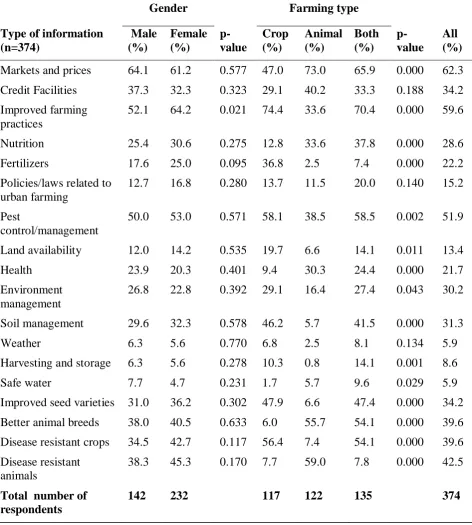
The study sought to establish the information needs of the urban farmers. The results in Table 1 show that of the 374 farmers interviewed, the greatest need for information was about markets and prices (62.3%). This was followed by
information needs on improving farming practices (59.6%), pest control and management (51.9%) as well as nutrition and fertilizers (50.8%). Just over one third of farmers wanted information on disease resistant animals (42.5%), disease resistant crops (39.6%) and better animal breeds (39.6%), while information about improved seed varieties (34.2%), soil management (31.3%), and weather and environment management (30.2%) received a number of mentions. The farmers showed less need for information about safe water and weather (5.9%) probably because there are many sources of safe water in Kampala City due to the presence of the National Water and Sewerage.
A Chi-square test for independency was used to test for the relationship between the types of information need and both gender and farming enterprise. While there was no significant relationship between information need and gender (with the exception of information needs concerning improved farming practices), the results show that there was a highly significant relationship between farmers‟ information needs and the type of urban farming enterprise undertaken. For example, the farmers engaged in animal production showed a higher need for information on markets and prices (73.0%) than those involved in crop production (47.0%). Conversely, the crop producing farmers showed a higher need for
information on improved farming practices (74.4%) than those who farmed animals (33.6%).
_______________________________________________________________________________
H.M.Byamugisha, R.Ikoja-Odonga, G.W.Nasinyama 22
land they occupied. Both male and female respondents argued that they spent a lot of money buying expensive animal drugs and feeds.
“We want to know the right animal drugs or vaccines to use because in some animal drug shops, people sell expired animal drugs while others sell drugs that are no longer recommended for use”.
Gender Farming type
Type of information (n=374)
Male (%)
Female (%)
p-value
Crop (%)
Animal (%)
Both (%)
p- value
All (%)
Markets and prices 64.1 61.2 0.577 47.0 73.0 65.9 0.000 62.3 Credit Facilities 37.3 32.3 0.323 29.1 40.2 33.3 0.188 34.2 Improved farming
practices
52.1 64.2 0.021 74.4 33.6 70.4 0.000 59.6
Nutrition 25.4 30.6 0.275 12.8 33.6 37.8 0.000 28.6
Fertilizers 17.6 25.0 0.095 36.8 2.5 7.4 0.000 22.2
Policies/laws related to urban farming
12.7 16.8 0.280 13.7 11.5 20.0 0.140 15.2
Pest
control/management
50.0 53.0 0.571 58.1 38.5 58.5 0.002 51.9
Land availability 12.0 14.2 0.535 19.7 6.6 14.1 0.011 13.4
Health 23.9 20.3 0.401 9.4 30.3 24.4 0.000 21.7
Environment management
26.8 22.8 0.392 29.1 16.4 27.4 0.043 30.2
Soil management 29.6 32.3 0.578 46.2 5.7 41.5 0.000 31.3
Weather 6.3 5.6 0.770 6.8 2.5 8.1 0.134 5.9
Harvesting and storage 6.3 5.6 0.278 10.3 0.8 14.1 0.001 8.6
Safe water 7.7 4.7 0.231 1.7 5.7 9.6 0.029 5.9
Improved seed varieties 31.0 36.2 0.302 47.9 6.6 47.4 0.000 34.2 Better animal breeds 38.0 40.5 0.633 6.0 55.7 54.1 0.000 39.6 Disease resistant crops 34.5 42.7 0.117 56.4 7.4 54.1 0.000 39.6 Disease resistant
animals
38.3 45.3 0.170 7.7 59.0 7.8 0.000 42.5
Total number of respondents
142 232 117 122 135 374
They unanimously expressed need for information on how to build animal shelters, and on how to make animal drugs and animal feeds from locally available materials. The farmers further said that they needed information on seasonal changes, the right crops and when to plant them.
The indication was that urban farmers‟ information needs were as varied as the heterogeneity of their farming enterprises, activities or tasks. The findings are in line with Ozowa (1995) who observed that the information needs of small scale farmers revolve around the resolution of problems related to pests hazards, weed control, soil fertility, farm credit and soil erosion. As Ozowa (1995) emphasizes, no one can categorically claim to know all the information needs of urban farmers especially in an information dependent sector like agriculture where there are new and rather complex problems facing farmers every day. However, the findings of this study indicate that it may be possible to identify significant groups of urban farmers who share common information needs. Therefore, the dissemination of agricultural information should be based on the different urban farmers‟ enterprise groups and those groups‟ information needs.
The farmers were next asked to narrate the situations in which they had
experienced a need for agricultural information. Varied responses were given. The results show that of the 364 farmers who responded, 54.4% needed information when animals were sick and 40.9% of farmers identified a need for information when yields were low (see Table 2). A Chi-square test for independency was again used to test for the relationship between the situations in which information needs arose and both gender and type of farming enterprise. While there was no significant correlation between gender and the situation in which information needs arose, there was a high significant relationship between the situations in which farmers‟ information needs arose and category of farming enterprise (represented by p=0.000 and 0.004). This is not unexpected since the situations described are mostly applicable to either crop farmers or to animal farmers but not both (e.g. „before planting and want to know about rains‟ or „when my animals are sick‟).
Members of the three focus groups had similar views but in addition mentioned that the farmers needed agricultural information during harvesting and marketing of the produce. However, the focus group respondents unanimously insisted that they needed the information all the time as long as farming activities were taking place. The indication was that rather than gender, urban farmers need for
information was specific to the problem situations they found themselves in and mainly depended on the type of farming enterprise.
_______________________________________________________________________________
H.M.Byamugisha, R.Ikoja-Odonga, G.W.Nasinyama 24
Gender Farming Type
Situations (n= 364) Male
(%)
Female %)
p-value
Crop (%)
Animal (%)
Both (%)
p-value
Total (%)
When I want land for farming
28.7 28.1 .901 42.9 10.2 32.1 .000 28.3
Before planting, and want to know about rains
26.5 36.80 .042 54.5 5.1 33.6 .000 33.0
When my animals are sick
54.4 54.4 .996 6.2 77.1 74.6 .000 54.4
When I get low yields 36.8 43.4 .212 59.8 14.4 48.5 .000 40.9 When I need fertilizers 22.8 21.5 .772 31.2 3.4 30.6 .000 22.0 When I want solution for
crop disease
33.8 40.8 .186 54.5 5.9 53.0 .000 38.2
When I want to start rearing chicken, pigs or cattle
29.4 23.7 .227 4.5 42.4 29.1 .000 25.8
When I want to sell some produce for money
31.6 30.7 .855 19.6 39.8 32.8 .004 31.0
Total number of respondents
136 228 118 121 134 364
Table 2: Situations in which urban farmers needed agricultural information
3.2 How Agricultural Information was used
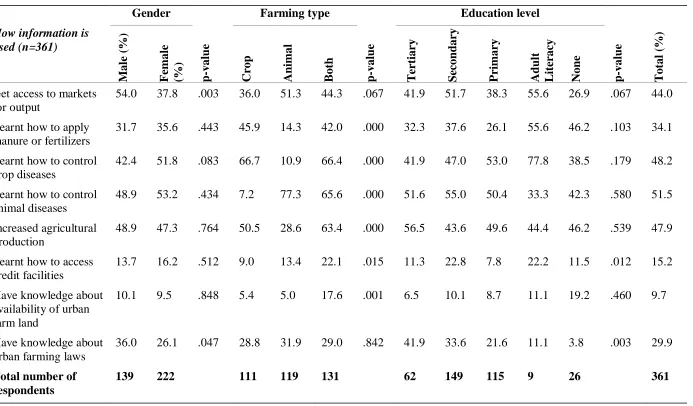
The farmers were asked to describe how they used the agricultural information they received. Table 3 shows that information was mainly used in controlling animal diseases (51.5%) followed by controlling crop diseases (48.2%). The findings show that except for getting access to markets (p=0.003), there was no significant difference in information use between female and male urban farmers. However, there was a strong correlation between information use and the type of farming enterprise as reflected by the p-value in table 3 below.
Although one would have expected higher use of information among farmers with higher levels of education, there was no significant difference in information use among the farmers with different education levels except for knowing how to get access to credit (p=.012) and having knowledge of urban farming laws (p=.003). The indication is that while agricultural information was used for different
purposes, the level of information use per activity varied. These responses were in line with Wilson and Walsh‟s (1996) information use categories described above. In this model the significance and role of agricultural information were
Gender Farming type Education level
How information is used (n=361) M ale (%) F em ale
(%) p-v
alu e Cr op Ani m al B ot h p -v alu e T er tiary S ec on d ar y P rim ar y Adu lt L it er ac y
None p-v
alu e T ot al (%)
Get access to markets for output
54.0 37.8 .003 36.0 51.3 44.3 .067 41.9 51.7 38.3 55.6 26.9 .067 44.0
Learnt how to apply manure or fertilizers
31.7 35.6 .443 45.9 14.3 42.0 .000 32.3 37.6 26.1 55.6 46.2 .103 34.1
Learnt how to control crop diseases
42.4 51.8 .083 66.7 10.9 66.4 .000 41.9 47.0 53.0 77.8 38.5 .179 48.2
Learnt how to control animal diseases
48.9 53.2 .434 7.2 77.3 65.6 .000 51.6 55.0 50.4 33.3 42.3 .580 51.5
Increased agricultural production
48.9 47.3 .764 50.5 28.6 63.4 .000 56.5 43.6 49.6 44.4 46.2 .539 47.9
Learnt how to access credit facilities
13.7 16.2 .512 9.0 13.4 22.1 .015 11.3 22.8 7.8 22.2 11.5 .012 15.2
Have knowledge about availability of urban farm land
10.1 9.5 .848 5.4 5.0 17.6 .001 6.5 10.1 8.7 11.1 19.2 .460 9.7
Have knowledge about urban farming laws
36.0 26.1 .047 28.8 31.9 29.0 .842 41.9 33.6 21.6 11.1 3.8 .003 29.9
Total number of respondents
_______________________________________________________________________________
H.M.Byamugisha, R.Ikoja-Odonga, G.W.Nasinyama 26
Gender Farming type Education level
The benefits accrued from utilizing the information (n=374)
M ale (%) F em ale
(%) p-v
alu e Cr op Ani m al B ot h p -v alu e T er tiary S ec on d ar y P rim ar y Adu lt L it er ac y
None p-v
alu e T ot al (%)
Have enough food for my family
54.9 60.3 .303 68.4 29.5 75.6 .000 60.9 62.9 53.3 36.4 57.1 .296 58.3
Sell excess for income 56.3 45.7 .046 29.1 61.5 57.0 .000 46.9 55.6 49.2 45.5 28.6 .115 49.7 Farming keeps me
busy since I do not have other job
19.0 30.2 .017 24.8 18.9 33.3 .029 15.6 27.8 28.3 18.2 32.1 .279 25.9
Total number of respondents
142 232 117 122 135 64 151 120 11 28 374
3.3 Benefits that accrued from using agricultural information
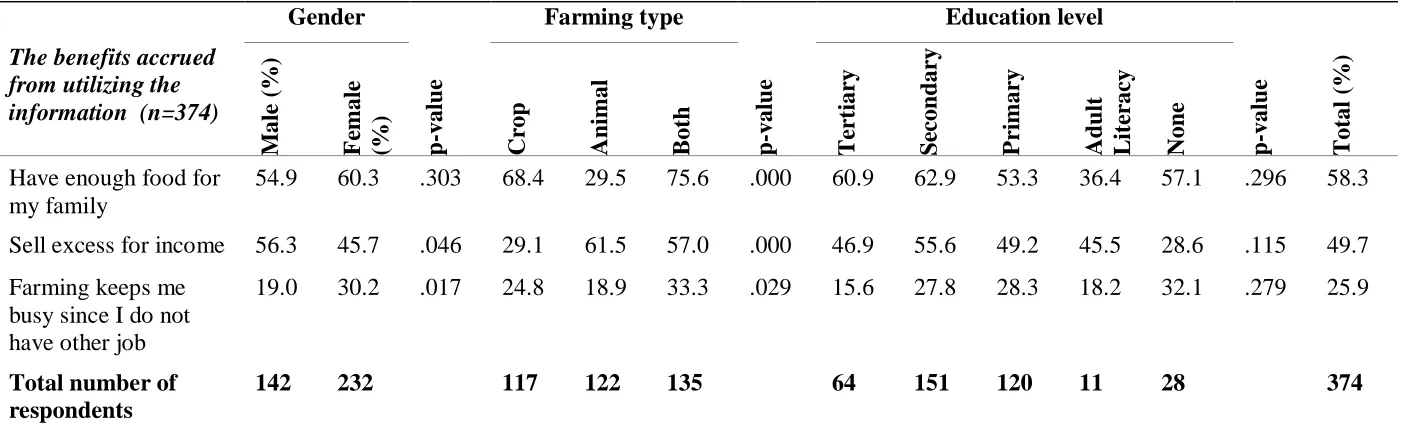
The impact of information usage was judged by the benefits that accrued. Table 4 shows that having enough food for the family (58.3%) was the most frequent benefit, followed by selling excess for income (49.7%). The views from the focus group discussions also emphasized that the major benefit from using agricultural information was improved agricultural production:
“I had one cow but when I got information from a fellow farmer about cross-bred cows, I used the information. As a result of this information, I multiplied my cows and I now have 8 cows” (male FGD participant, Nakawa Division).
A female participant from Kawempe Division said:
”I got and used information on how to keep eggs and then sell them at once. As a result, I now sell many trays and have improved my standards of living”.
The implication is that information use is as varied as the farmers‟ farming enterprises and needs. This finding tallies with Meho and Hass (2001) who believe that information use is an indicator of information needs and a behaviour that leads an individual to the use of information in order to meet his/her
information needs. But as Mwala (1997) pointed out, the use of information may also have varied as a result of the value urban farmers attached to information, the characteristics of the individual urban farmer seeking information, social and organizational factors as well as urban farming tasks‟ requirements.
The respondents were asked to describe the level of satisfaction they derived from using the agricultural information they obtained. The aim was to establish whether the information received satisfied the farmers‟ needs. Interestingly, slightly over half of the respondents derived partial satisfaction (50.6%) as compared to 49.4% of the respondents who reported full satisfaction. Moreover, the survey data indicates that in cases where the farmers were not satisfied with the information obtained, they started information search all over again. Rational choice theory provides a framework for understanding why individuals decide how much effort is needed to find information in order to accomplish their objectives. The theory posits that when faced with several courses of action, people usually do what they believe is likely to have the best overall outcome (Scott, 2006). Actors assess costs and benefits according to their own preferences, value and utilities and then choose an alternative that promises to maximize the benefits relative to the effort or cost required (Prabha at al., 2007). However, in real life situations, urban farmers may not have had at their disposal the full range of all possible choices with which to assess and compare the benefits of each choice in relation to the effort or cost. Therefore, the premise of rational choice theory has been
_______________________________________________________________________________
H.M.Byamugisha, R.Ikoja-Odonga, G.W.Nasinyama 28
individuals satisfice, they compare the benefits of obtaining more information against the additional cost and effort of continuing to search. Theoretically, decision makers consider all potential alternatives until the optimal solution emerges (Stroh et al., 2002). However, such an exhaustive analysis would require additional time and expenditure which information seekers, including urban farmers, must weigh against the likelihood that they will find additional information of sufficient value to offset the cost of continued searching. The consequences of putting time and effort into finding optimal solutions can be costly. Users may hence satisfice their need for information based on what they are able to find and thus stop looking for more information. Prabha (2007) noted that users may also stop looking for information prematurely if the information systems are difficult or unusable. Therefore, the very abundance of agricultural information makes it crucial for urban farmers in Kampala City to decide on what information would be enough to satisfy their needs although like Stroh et al., (2002) advised, the farmers must be willing to forgo the best solution in favour of one that is acceptable.
3.4 Information Transfer
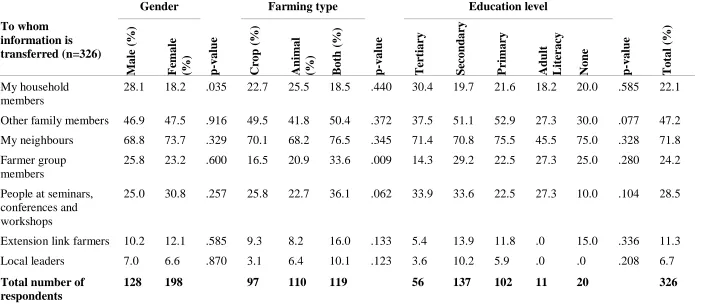
A final question aimed to find out whether the agricultural information obtained was shared with other people. Although the value of information is subjective, the results show that information obtained was transferred to other people. Table 5 shows that out of 326 farmers who responded to this question, the majority of them transferred information to neighbours (71.8%) and approximately half passed it on to family members not in the same household („other family members‟, 47.2%). The lowest proportion of farmers (6.7%) transferred information to local leaders, probably because the farmers instead expected to receive information from these people. The results also show that neither gender, farming enterprises nor education level influenced the way urban farmers shared information. Views from FGDs show that information obtained was mainly transferred to fellow farmers who were involved in similar farming activities:
“We exchange information with fellow farmers because they are the immediate people to help us before looking for the LC’s who are always out of their offices. One time I went to the animal drug shops and I was given expired drugs and when I used the drugs, my animal died. Because of that, fellow farmers are more helpful”.
Some of the people who had encountered problems in accessing agricultural information in one way were able to access and utilize it in another. The fact that urban farmers shared information with other people is recognition that
Table 5: Transfer of agricultural information to others
Gender Farming type Education level
To whom information is transferred (n=326) M ale (%) F em ale
(%) p-v
alu e Cr op ( %) Ani m al
(%) Bot
h ( %) p -v alu e T er tiary S ec on d ar y P rim ar y Adu lt L it er ac y
None p-v
alu e T ot al (%) My household members
28.1 18.2 .035 22.7 25.5 18.5 .440 30.4 19.7 21.6 18.2 20.0 .585 22.1
Other family members 46.9 47.5 .916 49.5 41.8 50.4 .372 37.5 51.1 52.9 27.3 30.0 .077 47.2 My neighbours 68.8 73.7 .329 70.1 68.2 76.5 .345 71.4 70.8 75.5 45.5 75.0 .328 71.8 Farmer group
members
25.8 23.2 .600 16.5 20.9 33.6 .009 14.3 29.2 22.5 27.3 25.0 .280 24.2
People at seminars, conferences and workshops
25.0 30.8 .257 25.8 22.7 36.1 .062 33.9 33.6 22.5 27.3 10.0 .104 28.5
Extension link farmers 10.2 12.1 .585 9.3 8.2 16.0 .133 5.4 13.9 11.8 .0 15.0 .336 11.3
Local leaders 7.0 6.6 .870 3.1 6.4 10.1 .123 3.6 10.2 5.9 .0 .0 .208 6.7
Total number of respondents