in the population sciences published by the Max Planck Institute for Demographic Research Konrad-Zuse Str. 1, D-18057 Rostock · GERMANY www.demographic-research.org
DEMOGRAPHIC RESEARCH
VOLUME 17 ARTICLE 12, PAGES 339-368
PUBLISHED 23 NOVEMBER 2007
http://www.demographic-research.org/Volumes/Vol17/12/ DOI: 10.4054/DemRes.2007.17.12
Research Material
Enumerating same-sex couples in censuses
and population registers
Patrick Festy
© 2007 Festy
This open-access work is published under the terms of the Creative Commons Attribution NonCommercial License 2.0 Germany, which permits use, reproduction & distribution in any medium for non-commercial purposes, provided the original author(s) and source are given credit.
1 Introduction 340 2 The 1990 and 2000 US censuses: issues at stake 340 3 The 2001 Canadian census: common-law partners (same-sex) 342 4 Back to the 1990 and 2000 US censuses:
unmarried and married partners
347
5 The French approach to census data: friends of the same sex 352 6 Same-sex couples in censuses: a tentative overview 357
6.1 Willingness to declare 357
6.2 Data reliability 358
6.3 Possible extensions to other countries 359 7 The Dutch population register: answers without questions 361
8 Conclusion 364
Enumerating same-sex couples in censuses and population registers
Patrick Festy1
Abstract
The recommendations recently issued by the Conference of European Statisticians (CES) for the next round of population and housing censuses underline for the first time that some countries might find it in their interest to enumerate same-sex couples. Many pitfalls can be expected when such a sensitive topic is newly included in a census. The experience of the few western countries that have already taken initiatives in this direction helps identify difficulties to be faced and suggest “good practices” to be adopted. Coverage is extended to countries which rely on permanent registers rather than periodic censuses to enumerate their population.
1. Introduction
Following the example of Denmark in 1989, a dozen western countries have introduced legal recognition for same-sex couples somewhat similar – and in a few cases equal – to marriage (Waaldijk, 2004). In parallel, there has been an increasing desire to know the numbers and characteristics of all same-sex couples. This has resulted in the use of traditional statistical sources to provide information on this relatively small group.
US demographers led the way with the 1990 census. Their experience was extended to more countries ten year later. For the 2010 round of population and housing censuses, the recommendations by the Conference of European Statisticians (CES) underline for the first time that some countries might find it in their interest to enumerate same-sex couples: “data needs can arise resulting from the increasing legal recognition of such unions, or on the importance of same-sex cohabiting partners who
are not married/registered.” (United Nations Economic Commission for Europe.
Conference of European Statisticians, 2006, p. 107) The Conference suggests response categories that could be added to the household composition and/or to the de jure and
de facto marital status questions to identify these couples. The CES has endorsed a plea
by Statistics Canada, which proposed that “good practices” also be recommended, after reviewing the concepts and methods used in several countries (Statistics Canada, 2004). There are no such guidelines in the final document, despite the many pitfalls that can be expected when such a sensitive topic is newly included in a census. To begin to fill the gap we analyse the few cases of current practice. We also extend the coverage to countries which rely on permanent registers rather than periodic censuses to enumerate their population.
2. The 1990 and 2000 US censuses: issues at stake
The pioneering experience of US demographers, with the 1990 then the 2000 data, offers a good opportunity to examine the different problems associated with such an operation. The census is a huge statistical procedure to gather information from the whole population. It has many constraints, but it is nevertheless essential for collecting information on small groups, such as same-sex couples. This is particularly so if a breakdown of the geography and characteristics (sex, age, location, education, occupation or income) is wanted. Attempts to use survey data have severe limits due to sample size, even if a compilation is made of multiple waves of data collection.
for increasing our knowledge of the population2. Hence, the organisers of the census cannot develop a long set of questions to deal with a specific topic, especially if it is to identify and characterise a very small part of the population.
In the US, no specific question is addressed to same-sex couples and no specific response item is labelled so that such couples can identify themselves, and only themselves, through it. In fact, some sort of a two-step procedure is used: couples are identified first, then same-sex couples are identified because both members of the couple have given the same sex (two men or two women).
The household form can be used on a 100% basis (the so called short form), with a question on the relationship between the householder (the person in whose name the house is owned or rented) and each household member. See http://www.census.gov/ dmd/www/pdf/d61a.pdf question 2 to person 2 or + in the household. Relatives are distinguished from non-relatives. Couple relationships are labelled ‘husband/wife’ at the top of a rather long list of relatives. ‘Unmarried partner’ is amid a list of non-relatives some distance away. Information on the sex of the householder and of each household member is also needed. It is available from the next question on the same form. No indication on the census form tells the same-sex couples which box they should check to describe their relationship. The US census organisers intend that, when the householder belongs to a cohabiting same-sex couple, he/she should identify the other one as his/her unmarried partner. Both should then check the same box on the sex question. No other recording can be accepted. In particular, since same-sex marriage is not legal in the US, the husband/wife answer is not legally correct, nor is any other answer in the list of relatives3.
2The importance of being fairly counted by the 2000 US census rapidly appeared as a challenge for the
representatives of the homosexual community, as a matter of principle, but also as a practical and political issue. "The Census will provide us with a gold mine of information. We will have a statistical picture of same-sex households by racial composition, where they live, and how many children they have," said Dr. Lee Badgett, Director of the Institute for Gay and Lesbian Strategic Studies (IGLSS). "The Census tracks changes in families in the U.S. Our families deserve to be counted so that the full diversity of the American family can be reflected and presented to policy makers." "All public policy flows from the U.S. Census," explained Paula Ettelbrick, Family Policy Director of the National Gay and Lesbian Task Force Policy Institute (NGLTF). "If we are not counted, we lose out on federal funding for research, funding for community services and passage and implementation of laws that benefit our community. We also sacrifice important opportunities for more equitable political representation of our community." Quotations from the NGLTF website, 'News and Views’ section - http://www.ngltf.org
3 In 1990, the Census Bureau systematically rejected same-sex couples who had declared to be other than
In practice, respondents filling in questionnaires sometimes make mistakes or choose not to follow the rules. Gay and lesbian couples may misidentify themselves, if they consider themselves as husbands or wives rather than not related persons or if they choose not to declare themselves as partners and prefer to check the housemate or any other non-relative box. But heterosexual partners may also happen to check the wrong box on the sex question (or the information may be wrongly entered during data processing). The couple will be misidentified. The evaluation of the census material relies on the detection, interpretation and measurement of these errors. It should result in an improved estimate of the number of same-sex couples, compared with the raw figures extracted from fieldwork before any editing, imputation and adjustment. But beyond the statistical data collection, another factor needs to be taken into account, that of census actors and of their efforts to make the best results available.
From census to census, but still more so from country to country, procedures differ. Questionnaires and data processing techniques vary and probably reflect an unequal concern with the enumeration of same-sex couples. These are sometimes clearly identified as a specific category, sometimes ignored as an intruder in a long-established list of family forms. A comparative analysis of practices applied in western countries to enumerate same-sex couples will be used to substantiate assumptions on differential approaches to homosexual issues in the world of statisticians. Three countries will be under scrutiny – Canada, France and the US – with a bird’s eye view on New Zealand, England and Germany. There will be an extension to the Netherlands as an example of the use of population registers as a substitute for censuses in countries which no longer have one.
3. The 2001 Canadian census: common-law partners (same-sex)
Up to 2001, the Canadian censuses followed a procedure that was not very different from that in the US. Persons in the household were listed, starting from ‘an adult’ (person 1), and relationships were then described between each subsequent individual and person 1. Like in the US, couple relationships could be either ‘Husband or wife of Person 1’ or ‘Common-law partner of Person 1’. See http://www12.statcan.ca/ english/census01/info/96-2a-en.pdf question to person 2 or +. Unlike the US, the list of possible answers was not organised around a distinction between relatives and non relatives and the two couple items were at the top of the list, one below the other. A further difference was the provision of a write-in box to allow any kind of relationship to be reported.
contained no explicit instructions for doing so. This information was only available through the Census telephone help line, and through a fact sheet that was distributed to gay and lesbian organisations. Comments received on questionnaires and during the 2001 Census consultation process indicated that many persons in same-sex relationships were not clear on how to respond, or objected to being included in the ‘Other’ category.
In both the 1991 and 1996 Censuses, assessment of data during processing showed that some persons in same-sex relationships attempted to report themselves as common-law partners. In 1996, approximately 11,000 couples did so and declared to be sex. However, analysis of the 1991 and 1996 data revealed that many apparent same-sex relationships were actually cases of opposite-same-sex common-law partners who mistakenly checked the same response on the gender question. Members of the gay and lesbian community expressed dissatisfaction with the failure of censuses to collect and publish data on same-sex couples (Turcotte et al, 2003).
Preparation of the 2001 census paid close attention to the best wording of questions to elicit unambiguous declarations from same-sex couples. Alternative solutions were envisaged (Turcotte et al, 2003):
- To keep the previous situation. Same-sex partners should declare to be so in the write-in box. But for more clarity, ‘same-sex partners’ would be among the examples of ‘Other’ relationships to Person 1 on the census form;
- To adopt the US solution. Same-sex partners should report themselves as ‘common-law partners’. For more clarity, an instruction would be given on the census form (which is not the case in the US);
- To insert a new explicit item in the list of possible answers to the question, i.e. ‘Same-sex partner of Person 1’ just after the first two items ‘Husband or wife of Partner 1’, ‘Common-law partner of Person 1’.
two people of the opposite sex or of the same sex who live together as a couple but who are not legally married to each other.”4
In brief, every effort was made in the 2001 Canadian census to give homosexual couples the possibility to identify themselves and to be enumerated5.
Despite clarification, risks of inconsistency always exist between information on relationship to person 1 and on sex of the two persons concerned. It may happen either because of respondent(s) who check(s) a wrong item, or because of operators who later process the data. Out of 41,880 couples who had declared to be common-law partners (same-sex), 11,864 were not between individuals of the same sex6. Reciprocally, out of 1,100,000 couples who had declared to be common-law partners (opposite-sex), 6,227 were not between individuals of opposite sex. A sample of inconsistent cases was selected to determine how many of the couples were in fact same-sex or opposite-sex. Questionnaires were examined for given names as well as comments and capture errors that might provide insight into the situation. The vast majority of cases were valid common-law couples. Of these, a substantial proportion could not be identified as clearly opposite-sex or same-sex due to unfamiliar or ambiguous names, and the overwhelming majority of the others turned out to be opposite-sex.
Among those identified as couples who had declared to be in a same-sex relationship but who also reported being male and female, 99% proved to be different-sex and 1% same-different-sex, i.e. some 11,000 versus 100 respectively. The former statistic is to be compared with the 1,100,000 heterosexual couples, 1% of whom checked the wrong relationship item. The couples who ticked the wrong sex represent 0.3% of cases among the 30,000 homosexual couples. Among those who had declared to be in a different-sex relationship but who had both given the same sex, 89% proved to be different-sex and 11% same-sex, i.e. more than 5,500 versus some 600 respectively. For opposite sex couples, 0.5% gave a wrong sex. For same-sex couples 2% gave the incorrect relationship. Rates of error differ little between the two groups (0.3 to 0.5% on sex; 1 or 2% on relationship), with two consequences. First, the impact is radically asymmetrical. Large numbers of different sex-couples were wrongly classified as
4
In 1996, the definition clearly pointed to heterosexual couples: “Common-law refers to two people who live together as husband and wife but who are not legally married to each other.”
5 As in the 2001 Census, the question on household relationships in the 2006 Census includes a response
category for the identification of same-sex common-law partners. But same-sex couples may happen now to be married. In this case, the relationship must be declared by a written response of ‘same-sex married spouse’ in the write-in field. This possibility is provided on the census forms among the examples illustrating cases of ‘Other’ responses.
Gay and lesbian associations have taken as discriminatory the fact that same-sex married couples are required to use the ‘Other’ response rather than to check the ‘Husband or wife’ box. According to Statistics Canada, either response will be captured correctly as a married same-sex couple. Nothing can be said now on the impact this confusion may have had on the quality of the 2006 data.
6 The study reported here only concerns persons numbered 1 and 2 on the household list. 41,880 is the total of
sex and likely to seriously inflate the count of such couples. Tiny numbers of same-sex couples were wrongly classified as different-sex, with a marginal influence on the total. Second, methods that reallocate inconsistent cases in proportion to consistent ones are efficient: huge numbers of dubious cases are reclassified as heterosexual couples and small numbers as homosexual couples.
Table 1: Estimates of person 1 and person 2 in the household having a
same-sex common law relationship
Common-law relationship to 1 Sex of person 1 and 2 Identified couples
among the cases2
Same-sex Opposite-sex MM or FF MF Blank or
invalid
Reported couples
Sampled cases1
Of which, same-sex
Estimated same-sex couples3
X X 30,016 30,016
X X 11,062 647 383 4 116
X X 802 405 320 127 318
X X 6,227 623 406 44 675
X X 533 325 171 18 56
Total 48,640 2,000 1280 193 31,181
1 Questionnaires examined for inconsistencies
2 Questionnaires where couples and the sex of the partners where identified without ambiguity
3
Inconsistent cases are allocated to same-sex common law relationships in proportion to same-sex couples among the identified cases. The results are only likely averages since the procedure is stochastic, but the confidence interval is small.
Source: 2001 Census of Canada, from Statistics Canada.- Families. 2001 Census Technical Report.
Before any editing, the number of couples who consistently declared to be same-sex and to be both males or both females was 30,016 and the number of couples with inconsistent answers amounted to 18,624. After allocation of the cases with inconsistencies between the type of common-law partnership and the sex of the partner, the estimated number of same-sex couples rose to 31,181 (+1,165). A majority of re-allocated cases result from errors on relationship to person 1, which was wrongly checked ‘opposite-sex’, a minority from errors on sex. The result remains well below the raw number of these couples, cited above (41,880), because a large proportion of inconsistencies are due to opposite-sex couples that misclassify themselves.
Other errors are cases of same-sex couples who did not check the right box in the Relationship to Person 1. They provided a write-in response (‘Other’) or they classified themselves as ‘room-mate’ or ‘husband/wife’7. When each case was examined and when all other variables pointed to it being a valid same-sex couple, the total estimated number of these couples rose once more, but less than previously, to 31,748 (+567).
7
The numbers are small. Few same-sex couples mistakenly or deliberately declared themselves as married.
To conclude, the Canadian procedure in 2001, with an explicit response item for same-sex couples in the list of relationships in the household, has been very efficient. Inconsistencies remain, due to errors in the declaration of sex by heterosexual couples, but such cases can be reallocated. In 2006, New Zealand has adopted the same overall method (Box A).
Box A: New Zealand:
from a US-type questionnaire to an improved Canada-style formulation
In 1996 and 2001, Statistics New Zealand issued statistics on same-sex couples relying on questions similar in spirit to the ones in the US censuses. Relationships to any person in the same household could be:
(i) ‘my legal husband or wife’,
(ii) ‘my partner or de facto, or boyfriend or girlfriend’, etc.
Same-sex partners were expected to mark the latter category, as instructed in the Help Notes (but not on the census form). They were identified by crosschecking both individuals’ answers to the sex question. As early as 1998, when preparing the 2001 census, Statistics New Zealand (1998, p. 24) acknowledged that “the question wording may need to be addressed to make it clearer that gay and lesbian relationships are a valid response.” Left unamended, the procedure was questioned again five years later “as leaving room for misunderstanding, incorrect reporting by respondents, and thus an undercount in the output data.” (Statistics New Zealand, 2003, p. 9)
By the same time these innovations had been accepted, the Civil union act 2004 was adopted and came into effect on 26 April 2005, some one year before the census and after the closure of the test and dress rehearsal period. The legislation allows two people to have their relationship solemnised as a civil union and officially registered, whether these two people are same-sex or opposite-sex. Despite the impossibility of pre-testing it, it was decided to take account of these new categories and to fully develop the list of response items in the living arrangements question on the individual form of the 2006 census. Relationships to any person in the household can be:
(i) ‘my legal husband or wife’,
(ii) ‘my opposite-sex civil union partner’,
(iii) ‘my same-sex civil union partner’,
(iv) ‘my opposite-sex partner or de facto, boy friend or girlfriend’, (v) ‘my same-sex partner or de facto, boyfriend or girl friend’, etc.
It is the first time, to our knowledge, that same-sex partners’ legalised and consensual unions are treated in parallel to those of opposite-sex partners. In consequence, two specific lines are devoted to them in the census questionnaire. From the first experiences, it is expected that “respondents would skim the answers to find their option” (Statistics New Zealand, no date, p. 18), but only a careful evaluation of the census results will assess the quality of the data.
4. Back to the 1990 and 2000 US censuses: unmarried and married
partners
sibling or a relative, for example, or, if the age differences were large enough (15 or more years), even a parent or child of the householder. Given the actual numbers of couples and non-couples among the households with two same-sex adults, the probability for declared husbands or wives of being reallocated to unmarried partners was extremely small. In brief, the 1990 procedure excluded almost systematically same-sex persons who had declared being husbands or wives from the count of same-same-sex couples (Yax, 2002). The decision was clearly condemned by some gay and lesbian associations.
In 2000, the atmosphere had changed. The Census bureau took into consideration the fact that couples in long term same-sex relationships may consider themselves as ‘married partners’ and thus respond as such on the Census form. Declarations of same-sex couples as husbands or wives were considered as invalid because of the law8, but not as erroneous. They were systematically turned into same-sex unmarried partnerships.
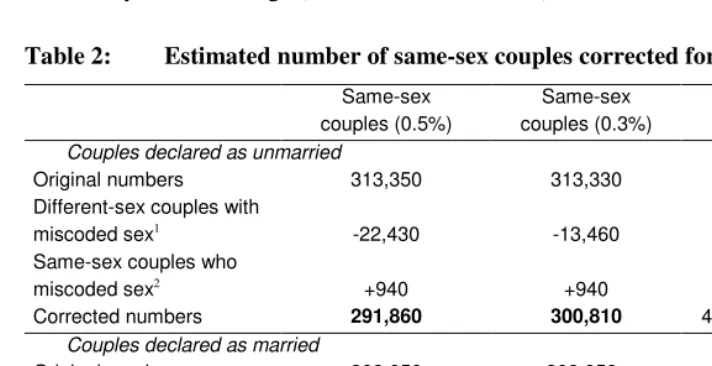
From 1990 to 2000, the number of same-sex couples estimated from censuses jumped from 145,130 to 594,391. The increase can be partly attributed to the change in the procedure adopted by the Census bureau. It is difficult to measure this number from the census itself, but it could be obtained from the Census 2000 Supplementary Survey, which collected data from 700,000 households, concurrently with the decennial census, through the use of long-form questionnaires comparable to the census ones (Black et al, 2002). The enumerated same-sex couples (Table 2) were, in approximately equal proportions, declared as unmarried and married partners (some 300,000 in each category). But they were at very different risks of being contaminated by different-sex couples who had checked a wrong box on sex, since married heterosexual couples are more than ten times more numerous than unmarried heterosexual ones (53 versus 4.5 million). If one assumes, like in Canada, that 0.5% of heterosexual couples wrongly declare their sex and appear as homosexual, there will be as many as 265,000 (= 53,000,000*0.005) among the married same-sex couples and as few as 22,000 (= 4,500,000*0.005) among the unmarried ones (Table 2, 1st column). Reciprocally, if one assumes, like in Canada, that 0.3% of homosexual couples wrongly declare their sex and appear as heterosexual, there will be 1,000 (= 300,000*0.003) missing from the married as well as from the unmarried same-sex couples. In total, the number of homosexual couples who declared being unmarried is slightly overestimated (7%) and those who declared being married are nine times too many.
8 An Act of the Congress in 1996 urged “the various administrative bureaus and agencies of the United States
However, the estimates are fragile, given the huge size of the group of married opposite-sex couples. If the miscoding rate on sex was 0.3 instead of 0.5% (Table 2, 2nd column), the number of same-sex couples declared as married would only be twice the actual level (308,000 versus 150,000). That of same-sex couples declared as unmarried would only be 4% too high (313,000 versus 301,000).
Table 2: Estimated number of same-sex couples corrected for miscoding of sex
Same-sex couples (0.5%)
Same-sex couples (0.3%)
Opposite-sex couples
Couples declared as unmarried
Original numbers 313,350 313,330 4,486,400
Different-sex couples with miscoded sex1
-22,430 -13,460 +22,430/13,460 Same-sex couples who
miscoded sex2
+940 +940 -940
Corrected numbers 291,860 300,810 4,507,890/4,498,920
Couples declared as married
Original numbers 308,050 308,050 53,100,000
Different-sex couples with
miscoded sex1 -265,500 -159,300 +265,500/159,300
Same-sex couples who miscoded sex2
+920 +920 -920
Corrected numbers 33,470 149,670 53,364,580/53,258,380
1
Estimated as 0.5% (first column) or 0.3% (second) of opposite-sex couples that appear as same sex.
2 Estimated as 0.3% of same-sex couples that appear as opposite-sex.
Source: Census 2000 Supplementary Survey, from Black et alii, 2002.
equations is the miscoding rate on sex, which results in heterosexual couples being wrongly classified as homosexual9. One can estimate simultaneously this rate and the “true” proportion of same-sex couples with children, from the basic data in the table above. The solutions are: 0.3% of couples that miscode sex and 20% of same-sex couples with children. They point to the 2nd column of Table 2 as the best estimate of same-sex couples: a total of 450,000.
In conclusion, the US method uses no specific item responses for same-sex couples. Its results may be heavily affected by the behaviour of same-sex couples and that of statistical offices. Do the former tick the right box and do the latter accept unexpected answers? Uncertainties interfere with those linked to miscoding on sex by couples, which ‘create’ same-sex couples from the huge group of different-sex couples. The numerical consequences may be important if married same-sex couples are accepted as a possible answer, since married different-sex couples outnumber them by far. England used the US method in 2001 (Box B).
Box B. The 2001 English census:
the relationship matrix and cohabiting same-sex couples
The procedure followed in England and Wales to number same-sex couples from the 2001 census does not differ essentially from the US procedure. Persons in households were asked to describe their relationship from a list of 11 items, the first two of which were ‘Husband or wife’ and ‘Partner’. Cohabiting couples were taken as two persons who had declared themselves as partners. The category included same-sex couples if the two persons had both answered male or female to the sex question. A total of 88,300 couples were identified this way and were subject to a thorough validation, which resulted in the rejection of 55 per cent of them (49,000) (Office for National Statistics, 2005, p. 29). Such a percentage is very high, compared to US results.
o A large fraction (25 out of 55, i.e. some 22,000 couples) resulted from
wrong imputation of the relationship information. It may be due to the use of a complex “relationship matrix” to picture household composition. People were asked to complete a series of grids that mapped the relationships of household members to one another, not only to the reference person. Complexity resulted in relatively high rates of non response and imputation (relationship to person 1 in the household list was not given in 3.5 per cent of cases and had to be imputed in 4.7 per cent, a total of 1,326,000 imputations).
o The second largest fraction (18 out of 55, i.e. some 17,000 couples) was
due to the wrong imputation of an additional person in the household. It must be linked to another peculiarity of the English census, the “one number census” procedure, which adjusted the census database for under-enumeration. It resulted in the imputation of 1.3 million additional households (5.9 per cent of the total household estimate), plus 0.6 million people imputed in counted households (1.2 percent of the total population estimate).
o The third fraction (12 out of 55, i.e. some 10,000 couples) was caused by
5. The French approach to census data: friends of the same sex
In France, the census has, for many years, adopted a different approach to the collection of information on relationships between the reference person and the other members in the household. Instead of an explicit list of response items that defines the possible answers, the question remains open-ended with a number of suggestions made to the respondent. From the dwelling bulletin, the first person on the household roster is “one of the members of a couple” and the second “the spouse or, if there is no spouse, one of the adults living in the dwelling”. Suggested relationships are “spouse, cohabitation partner, son, daughter, father, mother, grandson, daughter in law, nephew, friend, subtenant, etc.” No indication is given concerning same-sex partners but neither the
spouse nor the cohabitation partner is said to be opposite-sex. See
http://www.recensement.insee.fr/FR/RUB_MOT/logement.pdf ‘Liste A’ on the
household form of the 1999 census. The sex of each household member is given on his/her individual form. The apparent flexibility offered by the questionnaire is seriously counteracted by the coding rules. For instance the reference person of the household is not simply the first one on the list. A strong priority is given to men, activity status and age, beyond the already cited fact of belonging to a couple (“The reference person is chosen among all men in couples in the household; if there are none, among the adults of a single parent family, if there are none, among the persons who are not sub-tenants or accommodated employees. The criterion is to choose the oldest economically active person or, if there are none in the dwelling, the oldest person.”10) When the person on the first line does not comply with these rules and a new reference person has to be chosen, all the links with the other household members must be reinterpreted.
If the reference person is partnered – and he is likely to be so, given the priority attached to men in couples – the second person to be coded is his partner, whether married or not. However “the partner of the first person must be unique and of the opposite sex.”11 If the subsequent check on the sex of the individuals reveals him/her to be of the same sex as the reference person, their link is re-coded blank. Ultimately, the blank code is re-re-coded ‘other relative’.
In brief, same-sex couples who have declared themselves as such cannot be found in any partner category (married or unmarried), which is strictly limited to opposite-sex couples. They are to be found with other relatives, together with cousins, uncles/aunts
or nephews/nieces of the reference person, and they cannot be distinguished from them12.
From a large sample extracted from the census, where the respondents were asked again their relationship status, the number of estimated same-sex couples was as low as 10,500 (compared, for instance, with 34,200 in the half as populous Canada). But all the questionnaire wording definitely pointed to couples being heterosexual (Toulemon et al, 2005).We prefer to resortto Labour Force Surveys conducted in the second half of the 1990s along lines that did not differ much from the census. This time, same-sex couples that declared themselves as such were not rejected from data processing. In 1995-1999, they were 45,000 on average each year, i.e. 0.3% of all couples enumerated in the surveys.
One hypothesis is that a majority of same-sex couples have declared another type of relationship at census, the most likely one being ‘friends’ rather than ‘other relatives’, ‘owner-tenant’ or ‘employer-employee’. Reasons to believe that there are few hidden same-sex couples in the last three categories are the following:
‘Owner-subtenant’ and ‘employer-employee’ are numerically very small
and leave almost no room for hidden partners (there are only some 10,000 same-sex pairs of owners-subtenants in the total population and 2,000 same-sex pairs of employers-employees, compared with 76,000 same-sex pairs of friends).
In households of two ‘other relatives’, the proportion of same-sex pairs is 64%, which looks reasonable, if we consider that INSEE reclassified as such the same-sex couples who declared themselves in this way. They are added to genuine same-sex dyads of ‘other relatives’, which are likely to be well balanced between same-sex and different-sex: in French society, sister-sister or brother-brother are as acceptable types of cohabitation as sister-brother By contrast, the proportion of same-sex pairs of ‘friends’ looks very high (87%)13.
The characteristics of same-sex ‘other relatives’ are not in line with what we know on homosexual couples from other sources. This is contrary to same-sex ‘friends’, which will be shown to be over represented in the Paris region or at University level of education, compared to opposite-sex couples.
12 Sons/daughters of the reference person or his partner are one category (with sons-in-law/daughters-in-law,
stepdaughters/stepsons). Grandsons/grand-daughters of the reference person or his partner are another. So are the ascendants of the reference person or his partner (parents, grand-parents). So, same-sex other relatives may be same-sex cousin-cousin, uncle-nephew, aunt-niece, as well as same-sex partners.
13 Due to the small proportion of different-sex friends, the probability that same-sex friends include persons
One reason to believe that same-sex ‘friends’ could be homosexual couples is the typical way they differ from heterosexual couples on a number of key characteristics. Two examples are given based on comparisons between France and Canada (Tables 3 and 4). Same-sex friends are over-represented in large urban units (200,000 inhabitants and over) and under-represented in small urban units (below 50,000 inhabitants) and rural communes. And the same holds for same-sex couples in large census metropolitan areas in Canada (500,000 inhabitants and over) and out of census metropolitan areas. Same-sex friends are also over-represented at university level and under-represented at primary school level, as are same-sex couples in Canada14.
Table 3: Distribution of same-sex and opposite-sex pairs by size of
geographical units
France, 1999 Canada, 2001
Size
Same-sex friends
Opposite-sex couples Size
Same-sex couples
Opposite-sex couples
Urban units,
200,000+ 57.2 36.6
Census
metropolitan areas 500,000+
69.5 38.9
Urban units,
50,000<200,000 11.5 12.3
Census
metropolitan areas <500,000
12.1 14.0
Urban units <50,000 & rural communes
31.3 51.1 Out of census
metropolitan areas 18.4 47.1
Total 100.0 100.0 Total 100.0 100.0
Sources: 1999 Census for France and 2001 Census for Canada, from Digoix et al, 2004.
Turcotte et al, 2003
14 Students sharing the same household have been excluded from the French statistics. Despite this, it is
Table 4: Distribution of same-sex and opposite-sex pairs by educational attainment
France, 1999 Canada, 2001
Same-sex friends
Opposite-sex couples
Same-sex couples
Opposite-sex couples Educational
level
M F M F
Educational level
M F M F
University 36.2 38.4 21.1 20.6 University with
degree 33.4 34.8 18.7 16.5 Secondary
school 48.1 45.2 54.7 54.1
Intermediate
level 55.7 54.1 53.7 57.2
Primary school 15.7 15.4 24.2 25.4 Less than high
school 10.9 11.1 27.6 26.3 Total 100.0 100.0 100.0 100.0 Total 100.0 100.0 100.0 100.0
Sources: See Table 3.
Box C. Same-sex couples in German micro-censuses
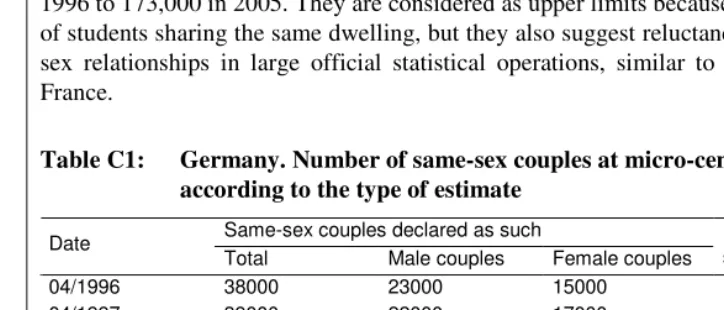
Since 1996, the annual German micro census (Mikrozensus) has given two estimates of the number of same-sex couples. The first comes from the processing of the relationship question in the household roster. From 1996 to 2004, the question concerned the relationship of any household member to the first person on the list. Only one couple could be identified this way. In 2005, a new question was introduced on the partnership of every household member to any other person in the household. Several couples can be identified. In both cases, the wording of the question is neutral regarding the sex of the partner (Lebenspartner, Lebenspartnerin). There is no interference either with the legal status of the couple, who can be legalised or not if same-sex (Lebenspartnerschaft), but not married. With this type of self-declaration, the number of same-sex couples has grown from 38,000 in 1996 to 60,000 in 2005 (Table C1). Compared to the total number of couples (same-sex or not, married or not), the proportion has risen from 0.2 to 0.3%.
The Statistisches Bundesamt (2006) contrasts this “restricted” definition to an “enlarged” one, which takes account of all pairs of same-sex unrelated persons aged 16 years or more in the households. The numbers are three times higher, from 124,000 in 1996 to 173,000 in 2005. They are considered as upper limits because they include pairs of students sharing the same dwelling, but they also suggest reluctance to declare same-sex relationships in large official statistical operations, similar to that perceptible in France.
Table C1: Germany. Number of same-sex couples at micro-censuses,
according to the type of estimate
Same-sex couples declared as such Date
Total Male couples Female couples
Households of same-sex adults
04/1996 38000 23000 15000 124000
04/1997 39000 22000 17000 114000
04/1998 44000 25000 19000 134000
04/1999 41000 25000 16000 128000
05/2000 47000 27000 20000 142000
04/2001 50000 29000 21000 147000
04/2002 53000 31000 22000 148000
05/2003 58000 32000 26000 159000
03/2004 56000 30000 26000 160000
2005 60000 36000 24000 173000
6. Same-sex couples in censuses: a tentative overview
Enumerating same-sex couples by censuses poses two major problems well illustrated by several recent experiences. The first lies in the willingness of same-sex (unmarried) couples to declare themselves as such. The second is the unreliability of answers, which may create confusion in the identification of same-sex couples.
6.1 Willingness to declare
In France, support has been given to the assumption that same-sex partners could have declared being ‘friends’. There were 76,000 such cases, compared with some 13,400,000 couples (opposite or same-sex, married or not), i.e. 0.6% (Table 5). Another assumption, also partly supported, is that same-sex couples who declared themselves as such were a minority (one third of all same-sex couples). The estimates we can extract from the German micro-census are consistent with the French results.
Table 5: Estimated numbers of same-sex couples, in proportion to all couples
England & Wales, 2001
France, 1999
Germany, 2005
US, 2000
Canada, 2001
Declared as unmarried couple
0.3% 0.5% 0.5%
Declared as married couple
0.3% 0.3%
0.25%
Declared as other 0.6% 0.5% 0.25%??
0.01%
Total 0.9% 0.8% 1.0%? 0.5%
Sources: see above and text
partners, even if signs exist that some did so (Badgett and Rodgers, 2003)15. From various national surveys in the 1990s, Black et al (2000) evidence that the total ratio could be about 1.0%.
In Canada, where the response items had been carefully designed, only a few hundred couples identified themselves as husbands/wives, or room-mates, or other. They represented 0.01% of the total of 7 million couples and 0.5% of all same-sex couples.
6.2 Data reliability
Only in Canada were errors in declaration or coding carefully analysed. There are errors on the sex of individuals and on their relationship. The former probably exist in any census and measurements taken in Canada can tentatively be extended to other countries. The latter may be more specific, due to the design of the question and of the response items.
In the large group of heterosexual couples, 0.5% wrongly appeared as same-sex because one of the two partners made an error on sex. In the small group of homosexual couples, the frequency of error was 0.3%. The orders of magnitude are in line with measurements taken in the US and England. In Canada, these errors were inconsequential because sex was double-checked: relationship was declared as same- or opposite-sex, and errors on sex revealed inconsistencies to be corrected. The situation is different when the relationship makes no distinction and the identification of same-sex couples relies on sex declaration, as is the case in the US. It is confirmed here that the consequences may be serious if the same- and opposite-sex groups are highly unbalanced, as is the case for married couples.
On relationship to the household reference person, the frequency of errors was higher than on sex (1% in the large group of opposite-sex couples and 2% in the small group of same-sex couples). This can probably be partly attributed to the format of the
15 From (non representative) samples with persons who had filled in the questionnaire, Badgett and Rogers
(2003) conclude that a large majority of same-sex couples had declared to be unmarried partners. Among those who had not, those who had declared to be roommates were more numerous than those who had chosen husbands/wives. The samples were taken from an online poll and among participants in the 2000 Millenium March. They probably over-represent persons informed by the information campaign during the census (respectively 42% and 60% had read or heard of the ‘unmarried partner’ option). This may explain the high percentages of those who checked the right box.
list of response items. ‘Common-law partner (opposite-sex) of Person 1’ and ‘Common-law partner (same-sex) of Person 1’ as two alternative answers were adjacent (one below the other) and had very similar wording (only one word different out of eight), in a relatively long list of 13 items. Confusion is unlikely in the US census between the ‘Husband/wife’ and ‘Unmarried partner’ items, as they are highly differentiated in location and wording in the questionnaire.
6.3 Possible extensions to other countries
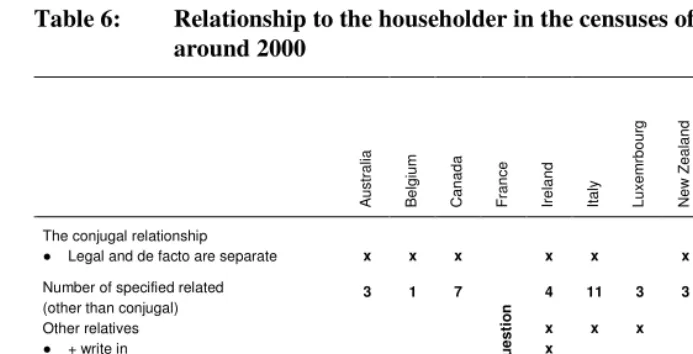
We will now look at censuses taken around 2000 in the western world to assess their capacity to enumerate same-sex couples (Table 6). Modern censuses collect information at household and individual levels. Most often, the household form contains the information on links between persons. The individual form goes into more details on each enumerated person16. Information on the sex of the partners is available there in most countries17.
Identifying same-sex couples by a specific response item in answer to the relationship question was replicated in no country other than Canada. The open-ended question to be coded later is unique to France. Everywhere, enumerating same-sex couples should go through a US-type procedure, where same-sex couples are identified by two questions: one on relationship, another one on sex. Given the risk of error on sex and the huge prevalence of married couples among partners of opposite-sex, it is essential to keep these distinct from unmarried couples. It is not done in Luxembourg and Spain. New Zealand is the most detailed in the content of the item: ‘partner or de facto, boyfriend or girlfriend’. Might it help to elicit answers from same-sex couples?
The US is unique in classifying unmarried partnership in the not related category, an option that may guide same-sex couples towards the husband/wife box. Elsewhere in non-European countries, the unrelated category is essentially opened to flatmates. Can its very existence attract answers from same-sex couples?
Some countries have very detailed response items for family relationships and almost nothing on unrelated household members (Italy and UK). Could these long lists be deterrent for same-sex couples, even if the partner (convivente in Italy) box is available for them? Finally, note that in no country does the census form give same-sex
16 In New Zealand the information on relationships in the household was collected twice in 2001, on the
household and individual forms.
Belgium in 2001 was an exception on another point. Relatives in the household were not listed by the respondent but by the National Register. Only non-relatives were asked about. We come back to registers later.
17 Again with the exception of Belgium, but also of France, where the household form only includes the name
couples any indications on how they should complete the form to identify themselves. Various other examples are given, most often attached to the write-in boxes.
Table 6: Relationship to the householder in the censuses of various countries
around 2000 A u s tr a lia B e lg iu m C a n a d a F ra n c e Ir e la n d It a ly L u x e m rb o u rg N e w Z e a la n d S p a in S w it z e rl a n d U K U S
The conjugal relationship
● Legal and de facto are separate x x x x x x x x x
Number of specified related
(other than conjugal) 3 1 7 4 11 3 3 3 3 7 8
Other relatives x x x x x x x
● + write in x x
Number of specified unrelated 1 2 1 2 4
Other unrelated x x x x
● + write in
Other (unspecified) x x x x x x x
● + write in x x
O p e n -e n d e d q u e s ti o n x
Australia. Unrelated: Unrelated flatmate or co-tenant is the specified category / Other: e.g. son-in-law, granddaughter, uncle,
boarder
Belgium. Legal links are documented by the National Register. The census only collects information on de facto relationships (partner, partner’s child, other non relative)
Canada. Common-law partners are opposite-sex / same-sex. Unrelated: Lodger or boarder; Room-mate are specified categories /
Other: e.g. grandparent, cousin, niece or nephew, lodger’s husbnd or wife, room-mate’s daughter or son, employee. France. The relationship is described by the respondent; examples are given: spouse, cohabiting partner, son daughter, father,
mother, grandson, daughter in law, nephew, friend, sub-tenant. Ireland. Unrelated (including foster children).
Luxembourg. “The spouse of the reference person can also be the partner in a common law union”.
New Zealand. The household form does not distinguish between legal and de facto partners, but the individual form does (partner or
de facto, boyfriend or girlfriend). Unrelated: Flatmate is the specified category. / Other (e.g. grandchild, visitor on the HH form;
grandmother, mother-in-law, partner’s father or boarder on the individual form).
Switzerland. In the case of a couple, both are household heads. Unrelated: Domestic employee; Lodger are specified categories
Other: e.g. foster child, boarder
7. The Dutch population register: answers without questions
In the Netherlands, like in most Northern European countries, population censuses no longer exist and the largest bulk of demographic statistics are extracted from registers. Information concerning local populations is continuously updated. This is essentially on vital events affecting individuals (birth, death, marriage18, registered partnership19, divorce, migration).
Although attached to the individuals, this type of information also reveals links between persons. Birth establishes a link between child and parents, marriage between spouses; divorce dissolves links between spouses and so does death of married people, etc. Persons in registers may be linked directly, like parents-children, spouses or registered partners, or indirectly, like brothers/sisters who share the same parent(s). One step further, indirect links may suggest the existence of unregistered relationships between individuals: if a child lives with his/her two unrelated parents, these form an unmarried couple. More subtly, the fact that two unrelated adults moved simultaneously to their present address suggests they are a couple.
On the basis of this information, persons living at the same address can be shown to be related and to form a family. Persons with no identifiable family ties (“unattached” persons) need an additional input to be classified as household members20. Their households can only be constituted after the links between the persons have been imputed. This is the case for some 11% of the Dutch households (about 700,000), which represent some 7% of the population (about 1.1 million persons). Unmarried couples without children are inevitably the group that needs the higher fraction of imputation: close to 50%. Rules of imputation were extracted from a regression analysis on a sample of addresses where household rosters were collected for the Labour Force Survey (in 2000-2001, 230,000 persons were interviewed). For the most numerous case (two unattached persons living at the same address), 4,000 addresses were included in the sample. These records were used to determine the probability for two persons living at an address of belonging to the same household and of being linked by a stable relationship (Steenhof & Harmsen, 2004).
18 Since April 2001, same-sex couples can register their marriage under the same conditions as opposite-sex
couples.
19 Since January 1998, same-sex and opposite-sex couples can legalise their union as a “registered
partnership” that gives them rights similar to marriage on most points except those of parental relationships to children.
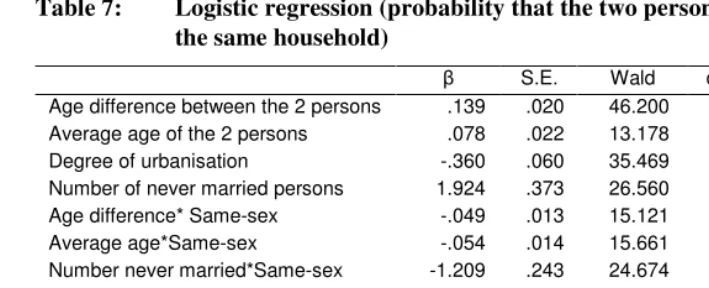
Table 7: Logistic regression (probability that the two persons do not belong to the same household)
β S.E. Wald df Sig. Exp(β) Age difference between the 2 persons .139 .020 46.200 1 .000 1.149 Average age of the 2 persons .078 .022 13.178 1 .000 1.081 Degree of urbanisation -.360 .060 35.469 1 .000 .697 Number of never married persons 1.924 .373 26.560 1 .000 6.849 Age difference* Same-sex -.049 .013 15.121 1 .000 .952 Average age*Same-sex -.054 .014 15.661 1 .000 .948 Number never married*Same-sex -1.209 .243 24.674 1 .000 .298
Sex of the two persons 102.409 2 .000
Same-sex (males) -7.390 .782 89.228 1 .000 .001 Same-sex (females) -6.533 .799 66.872 1 .000 .001
Constant 2.268 .563 16.252 1 .000 9.662
Source: Steenhof & Harmsen, 2004.
The variables in the regression are age, sex and marital status of the two persons and degree of urbanisation (Table 7). Combinations and interactions of variables are used, like age difference between the two persons, their average age, interaction of these variables by same-sex, etc.
Regression analysis shows the importance of being same-sex for the two persons to belong to the same household and to be linked by a stable relationship. The Dutch case confirms the intuition gained from the French data: that two cohabiting unrelated same-sex persons are very likely to form a couple.
Parameters calculated in the sample of addresses are then applied to all pairs of unattached persons in the municipal registers. They identify stochastically those who are linked (they form a unique household) and those who are not linked (they are two one-person households).
The use of this procedure results in a yearly estimate of the number of same-sex couples. The raw calculation reveals a high number of such couples among young ages. Hence a complementary assumption is made that same-sex students or workers below the age of 30 years who share the same household are not couples.
The procedure is radically different from that followed by censuses. Information on links between cohabiting individuals is not obtained though questionnaires filled in by the persons themselves, but is documented externally. Documentation includes administrative information recorded in certificates of vital events, but also assumptions based on heterogeneous elements: simultaneous migration to present address or characteristics of sex, age, marital status and location. It is a mix of hard data, common sense and statistical assessment that define a population partly identified for sure, partly measured on the basis of probability21.
Questions about the reliability of the results are not the same as those posed about census data. The method starts from the undisputable observation that people live at the same address. It then eliminates the case of related persons, who are known for sure (including cases of registered same-sex partners since 1998 and same-sex spouses since 2001). It finally postulates links. Two of these postulates can probably be questioned as being too extensive. If two persons move to the same address on the same date, they are included in the category 'unmarried couples'; if two persons are living together in the same household, it is assumed that they have a stable relationship. These excessive extensions oblige the statistical institute to correct the data for students and young workers. That brings the total number of same-sex couples down by 12,000, but one may wonder whether it is enough and if other cases exist of two men or two women living together in the same household without forming a couple. It is unfortunately difficult to go further than suspicion.
Population registers exist in countries other than the Netherlands and could be used to estimate the number of cohabiting same-sex couples. Belgium and the Nordic countries are examples of countries where population registers have been substituted for censuses to make periodic estimates of population numbers and demographic characteristics. All these registers share with the Dutch one the capacity to link individuals, when formal relationships are evidenced by vital events that concern them directly or indirectly (child-parents, spouses or registered partners, brothers/sisters, etc.).
However, another basic condition for using the register in the enumeration of households is that individuals also be characterised by their precise address, i.e. by their location in a clearly identified housing unit. This is the case in the Netherlands, but also in Belgium, Denmark and Finland; the list is being extended to Norway, through the insertion of information from the 2001 population and housing census in the register. Iceland and Sweden are making the necessary efforts to join the group. None of these countries has so far produced estimates of the number of same-sex couples.
21 Censuses also include a dose of allocation where statisticians postulate what may have been the intention of
Population registers contain no information on the links between the persons in the household, contrary to censuses. These links may be known from administrative information, they may be postulated from individual behaviour or they may be postulated on the basis of probability. This may result in statistics of same-sex couples that are not based on declarations.
8. Conclusion
When small populations (minorities) are to be counted, surveys are not adequate tools because sampling fractions do not include enough cases for a reliable observation. Censuses or administrative records are much more pertinent sources.
Such sources have constraints because of their very property of covering all individuals in the population. They cannot be as detailed and flexible on any topic as a survey. Questions must be few for the forms to be short enough. They must be termed in such a simple manner that people can understand them without external help.
Examples have been given of these technicalities from a few cases. In the 2000 round of censuses, Canada was the only country that decided to use one line of its questionnaire for a response item specifically dedicated to same-sex couples. France saved a lot of space by leaving the question of relationship between household members “open”, so that everybody could decide their own formulation. The US and all other countries relied on a combination of non-specific items that identified the couple relationship on one hand and the sex of the partners on the other. In no case was any additional space “wasted” on census forms to explain to respondents what they should do.
In population registers, it is not even possible to put a question to the persons. One must rely on information already collected by the administration to exclude people who cannot form a same-sex couple (because they are related by other links) and one must rely on various assumptions to estimate whether the others are same-sex couples.
In no case does data collection result in a straightforward processing of the number of same-sex couples. Risks of erroneous answers are sometimes considerable, given the small size of the population to measure. Even in the most favourable situation (Canada 2001), the number of couples who wrongly declared being same-sex was well over the margin of acceptable uncertainty. Decisions on data editing, imputation, etc. must be taken to come closer to reality. But most of them look like black boxes for the vast majority of users and they cast some doubts on the validity of the results. Maximum transparency is needed.
After the Canadian and the US censuses in the 1990s, gay and lesbian associations challenged the data issued by the national offices of statistics and demonstrated their willingness to help achieve a fair picture of the group of homosexual couples. Their involvement in the preparation and the conduct of the next wave of censuses clearly contributed to an improvement in the results. It also seems to have been the case of the 2006 New Zealand census, although it is much too early for a clear assessment of the new procedure.
In France, the homosexual community is much less enthusiastic to enter a battle for improved knowledge of the number of same-sex couples. When legal recognition was opened to same-sex couples through the PACS (Pacte civil de solidarité), there were voices opposed to counting these acts, in the name of confidentiality and privacy regarding sexual orientation. The initial law in 1999 forbade the enumeration, and it took eight years for an amended law to be brought into force. Under these conditions, it is no surprise that the 1999 census procedures making it impossible to issue statistics on same-sex couples remained unchallenged by the homosexual community.
Statistical results in France, Germany and probably England suggest that, in the absence of explicit response items dedicated to same-sex couples, these couples are very reluctant to declare themselves as such in categories that were initially labelled for opposite-sex partners. In Canada, by contrast, the explicit same-sex answers lengthily discussed beforehand seem to have attracted nearly all the concerned people.
is by far preferable for statistics to rely on the free declaration of the individuals themselves rather than on assumptions made without their knowledge. From the recent experience of a few Western countries, these conditions are best fulfilled when explicit response items are proposed to enumerated people.
References
Badgett, M. V. Lee and Rogers, Marc A.- Left out of the count: Missing same-sex couples in census 2000.- IGLSS by the numbers, The Institute for Gay and Lesbian Strategic Studies, 2003, 14 p.
Black, Dan ; Gates, Gary ; Sanders, Seth and Taylor, Lowell.- Demographics of the Gay and Lesbian population in the United States: Evidence from available systematic data sources.- Demography, volume 37, n° 2, May 2000, p. 139-154.
Black, Dan; Gates, Gary; Sanders, Seth; Taylor, Lowell.- Same-sex unmarried partner couples in census 2000: How many are gay and lesbian.- Working paper, 2002, 21 p.
Digoix, Marie; Festy, Patrick & Garnier, Bénédicte.- What if same-sex couples exist in France after all? In: Digoix, Marie & Festy, Patrick (eds).- Same-sex couples, same-sex partnerships & homosexual marriages. A focus on cross-national differentials.- Documents de travail 124, INED, 2004, p. 193-210.
Fields, Jason M. and Clark, Charles L.- Unbinding the ties: Edit effects of marital status on same gender couples.- Population Division Working Paper n° 34, US Census Bureau, April 1999, 11 p.)
Institut national de la statistique et des études économiques (France).- Guide d'utilisation du recensement de la population de 1999. Tome 6, Description des
traitements de l'exploitation lourde.- Paris : INSEE, 234p.
Office for national Statistics.- Census 2001. Quality report for England and Wales. HMSO, Palgrave Macmillan, New York, 2005, 108 p.
Saxton, Peter and Hughes, Tony.- Submission to Statistics New Zealand on 2006 census of population and dwellings: Preliminary views on content.- New Zealand Aids foundation, Auckland, 2003, 31 p.
Statistics Canada.- Families. 2001 Census Technical Report.- Catalogue N° 92-381-XIE, Electronic publication available at www.statcan.ca , 60 p.
Statistics Canada.- Towards possible changes to the census recommendations on families and households.- Joint UNECE-Eurostat work session on population censuses (Geneva, 23-25 November 2004), 7 p.
Statistics New Zealand.- Census 2001: Final report on content.- Wellington, 1998, 93 p.
Statistics New Zealand.- 2006 census. Final questionnaire design.- Electronic publication available at
www.stats.govt.nz
, no date, 93 p.Statistisches Bundesamt.- Leben in Deutschland. Haushalte, Familien und Gesundheit - Ergebnisse des Mikrozensus.- Wiesbaden, 2006, 100 p.
Steenhof, Liesbeth & Harmsen, Carel.- Same-sex couples in the Netherlands, In: Digoix, Marie & Festy, Patrick (eds).- Same-sex couples, same-sex partnerships & homosexual marriages. A focus on cross-national differentials.- Documents de travail 124, INED, 2004, p. 233-243.
Toulemon, Laurent; Vitrac, Julie, Cassan, Francine.- Le difficile comptage des couples homosexuels d’après l’enquête EHF, In: Lefèvre, Cécile et Fillon, Alexandra (sous la direction de).- Histoires de familles, histoires familiales. Les résultats de l’enquête Famille de 1999, Les Cahiers de l’Ined n° 156, INED, 2005, p. 589-602.
Turcotte, Pierre; Renaud, Viviane and Cunningham, Ron.- Same-sex relationships and sexual orientation in Canada: Data, concepts, and methodological issues.- Paper presented at the 2003 PAA Meeting, Minneapolis, May 2003, 32 p.
United Nations economic commission for Europe. Conference of European statisticians.- Conference of European statisticians recommendations for the 2010 censuses of population and housing.- United Nations, Geneva, 2006, 200 p. (p. 107)
Waaldijk, Kees (ed).- More or less together: Levels of legal consequences of marriage, cohabitation and registered partnership for different-sex and same-sex partners. A comparative study of nine European countries.- Paris : Institut national d'études démographiques, 2004. 192 p. (Documents de travail / INED ; 125).