RESEARCH PAPER
To Depict Oil Extraction Efficiency from Gas Invaded
Zone: Simulation Study
Ahmed Zoeir*, Mahshid Reyhani, Mohammad Simjoo
Faculty of Petroleum and Natural Gas Engineering, Sahand University of Technology, Tabriz, Iran
Received: 31 August 2018, Revised: 29 December 2018, Accepted: 11 June 2019 © University of Tehran 2019
Abstract
Future exploitation scheme of an oil reservoir in each cycle within its production life depends on the profitability of the current extraction scenario compared with predicted recoveries that acquire with applying other available methods. In fractured reservoirs appropriate time to pass from the gas injection process into chemical enhanced oil recovery (EOR) firmly depends on the oil extraction efficiency within the gas invaded zone. Several variables including fluid characteristic, fracture network and matrix units properties, etc., impact gas-oil gravity drainage (GOGD) performance within the gas invaded zone. In this work, CMG GEM and ECLIPSE 300 were used to simulate GOGD mechanism in several 2D cross-sectional models to investigate effects of the matrix height, matrix rock type, fracture network transmissibility, and miscibility conditions on the oil extraction rate, change of average pressure and producing gas-oil ratio (GOR). Results showed that in small heights of the matrix units especially at compacted rock types, GOGD was weak that caused a rapid decrease in oil production rates and early increase in producing GOR. Results also showed that wherever the matrix porosity and permeability values were high, recovery was accelerated and GOR remained constant for longer exploitation times. Furthermore, using high-pressure lean gas injection for miscible GOGD gives higher extraction efficiencies rather than applying rich or enriched gas.
Keywords:
Fractured Reservoir, Gas Invaded Zone, Miscible GOGD, CMG GEM, ECLIPSE 300
Introduction
Fractured media simulations are some challenging tasks from two main aspects, firstly the full description of the reservoir itself, and secondly the presence of issues within the numerical solution methods. Two separate media distinguish in fractured reservoirs are matrix units in which most of the oil is stored and the fracture network in which most of the transmissibility appears. The flow of fluids in such reservoirs is primarily through the fracture network that has high permeability and relatively low porosity surrounding matrix units. Matrix units contain the majority of the reservoir pore volume and act as a source or sink term to fracture network. Specific mechanisms that control oil extraction from the fractured reservoirs are known as water
oil imbibition in water invaded zone, gas oil drainage in the gas invaded zone and rock, and fluid expansion. Oil Extraction rates and oil recoveries in fractured reservoirs are functions of several variables including fracture network characteristics, matrix properties, fluid’s °API, etc. In addition to that, miscibility condition of injected fluid can reduce gas/oil interfacial tension (IFT) that leads to lowering residual oil saturation which in turn increases ultimate recovery from such reservoirs. Several attempts were made in the literature in order to simulate oil production from fractured reservoirs and to investigate parameters which affect oil extraction efficiency from the invaded zones.
Warren et al. [1] presented an analytical solution for single-phase unsteady-state flow in a naturally fractured reservoir rock and introduced the concept of the dual porosity. It was assumed that the matrix porosity was uniform and fracture system was parallel to principal permeability axes.
Firoozabadi et al. [2] simulated single matrix unit and some cross-sectional models with several dual porosity simulators and compared the resultant oil rates, recovery curves, and gas-oil ratio (GORs). Results showed that immiscible gas-gas-oil gravity drainage (GOGD) process in single matrix unit gives 40% to 44% recoveries while in the case of cross-sectional models capillary force has a great influence on reservoir pressure and producing GOR, therefore severely impacts the ultimate recovery.
Penuela et al. [3] introduced an improved flow equation that represents interporosity flow rates in terms of pressure gradients in matrixes, fracture surface areas, matrix permeabilities, and time-dependent shape factors. It was illustrated that the corrected equation can explain the matrix-fracture interaction during immiscible GOGD more accurately and upgrade flow calculations within the fractured media.
Sarma et al. [4] combined differential form of the single- and two-phase matrix/fracture interaction functions with classic analytical solutions of the pressure diffusion equation. This technique accounted for transient and pseudo-steady state pressure conditions and verified against single porosity models.
Rossen et al. [5] used pseudo-capillary pressure functions that applied to consider fluid distribution within the matrix units without using the gravity terms. In this way, they reported that more accuracy is achieved in determining the interaction between gravity and capillary forces which led to more accurate simulation results.
Dean et al. [6] developed a computer program to perform single and dual porosity calculations in three-dimensional three-phase conditions. It was shown that dual porosity approaches give relatively lower ultimate recoveries rather than single porosity models. It was also illustrated that the dual porosity and dual permeability methods give relatively similar results.
Wit et al. [7] simulated immiscible GOGD in matrix stacks then showed that using routine approaches for a limited number of the units causes a systematic error in estimations. To eliminate such error, they presented pseudo-relative permeability functions for matrix units with attention to their position within the stack.
Ladron et al. [8] expressed formulations which describe immiscible GOGD in a stack of matrix units thereafter developed an in-house program that was founded on their formulas. Their code was validated with results from two commercial software namely Eclipse 100 and CMG IMEX.
Okon et al. [10] used Eclipse 100 simulator to investigate the impacts of density difference and capillary contrast on oil extraction efficiency in immiscible GOGD processes. It was shown that a single matrix exhibits higher oil recovery than stacks consisted of two, three and four matrixes. Results also showed that in cases with high capillary contrast, higher recoveries are expected compared with those that represent capillary continuity.
Udoh et al. [11] used Eclipse 100 simulator to perform sensitivity analyses on fracture width and matrix properties to investigate their effects on matrix/fracture interaction. Results showed that fracture porosity and matrix storativity capacity influence ultimate oil recoveries from naturally fractured reservoirs while fracture width has no effect.
Uleberg et al. [12] used compositional simulator to study the effects of average reservoir pressure, injection gas type, and component diffusion among phases, on miscible GOGD performance. It was shown that using enriched rather than lean gas increase ultimate recoveries while increasing pressure accelerates extraction from matrix units.
Verlaan et al. [13] performed a modeling study to investigate the impacts of gas recycling rate and matrix width over height ratio on first contact miscible GOGD in fractured media. It was shown that increasing gas injection rate accelerates hydrocarbon extraction from matrix units while leaving ultimate recovery unchanged. It was also concluded that injecting separator gas at miscible condition results in significant incremental oil extraction in fractured media with large capillary holdups.
Saidian et al. [14] used fractured glass micromodel to investigate the impacts of oil type, viscosity ratio, and injection rate on oil extraction from the matrix to fracture during miscible GOGD. It was illustrated that wherever viscosity ratio is near unity increasing injection rate accelerates oil extraction from matrix while also increasing ultimate recovery. Conversely, in cases with high viscosity contrast increasing injection rate only increases oil production at early times while decreasing recovery at late times.
Mohammadi et al. [15] simulated immiscible gas recycling process into a fractured reservoir in field scale using Eclipse 100 software thereafter performed sensitivity analyses over injection pressure, well patterns, also completion interval. It was found that gas recycling can increase extraction efficiency to 68% while natural depletion gives only 39% recovery. It was also concluded that completing injection wells in the fracture network and production wells in the matrix always give higher ultimate oil recovery values.
Bazargan et al. [16] simulated immiscible inert gas injection into a fractured media model describing outcrop of a real oil field using COMSOL software. It was shown that the oil production rate has the most significant effect on sweep efficiency from fractured media. It was also concluded that fracture connectivity plays a second important role in oil extraction efficiency when using inert gas injection process in fractured reservoirs.
Badakhshan et al. [17] compared field data with predicted data of natural depletion in a real fractured reservoir which was under gas injection into a cap for 15 years. It was reported that the pressure maintenance process gave about 16% incremental oil over primary recovery which was lower than what was predicted from simulations performed 15 years ago. Their study showed that the gas injection into fractured media in field scale is an economical process which can increase ultimate recovery significantly.
Zobeidi et al. [18] performed a series of experiments to investigate neighbor matrix interaction influences on miscible GOGD process in fractured media. It was shown that infiltration into matrix units is more effective whenever unit heights are large. It was also illustrated that reimbibition effect is less destructive at miscible condition rather than the immiscible condition.
units is about 4% lower than a single matrix due to the fact that oil reflows from the fracture network into matrixes.
Zobeidi et al [20] performed a set of laboratory experiments to simulate GOGD mechanism using three various models, transparent rectangle filled with glasses, and two cylindrical models with single and stacked matrix units. It was shown that injecting rich or enriched gas into a low-pressure oil reservoir, also injecting high-low-pressure lean gas into an undersaturated rich oil reservoir cause an increase in ultimate oil recoveries. It was also illustrated that using enriched gas at miscible condition leads to lower extraction efficiency rather than high-pressure lean gas due to the fact that GOGD driving force weakens under such circumstances.
In this investigation, we performed several sensitivity analyses over the fluid type and geological parameters describing fractured media during immiscible and miscible GOGD using ECLIPSE 300 and CMG GEM software. Simulation results on various gas injection scenarios including immiscible, first and multiple contacts miscible GOGD processes were then compared to find out how far one can go through secondary recovery using gas injection in various type fractured media and to know wherever it is preferred to change into chemical enhanced oil recovery (EOR) processes or not. The novelty of this study in comparison to previously mentioned works in the literature is that we simultaneously studied immiscible, first and multiple contact miscible GOGD in various type fractured media models. Two miscibility states namely high-pressure lean gas injection process and low-pressure rich gas injection scenario were studied under various media characteristics to examine GOGD efficiency in fractured media. Another difference to other works in literature is that we applied compositional simulators to magnify first & multiple contact miscibility influences on GOGD process performance.
Methodology
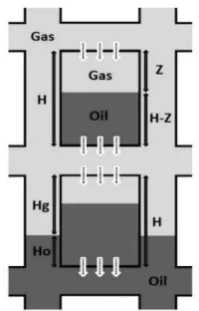
Two various matrix types recognize in the gas invaded zone, oil containing matrix units which are totally surrounded with gas, and matrix units which are partially immersed in gas. Since gas oil gravity drainage is the most important oil extraction mechanism in the gas invaded zone, the only difference between these two types is the magnitude of the driving force. Under immiscible condition hydrostatic relationship calculates the pressure in the fracture network while Darcy’s equation with certain Rel Perm curve for each phase describes flow in the matrix unit. Conversely at miscible condition injected gas dissolves in matrix oil leading to variable Rel Perm functions which are dependent on position rather than time. To quantitatively explain GOGD in the gas invaded zone, consider two matrix units which were under oil extraction via GOGD mechanism for some time as shown in Fig. 1.
Darcy’s equation which is written for gas displacement describes flow in a gas column within a matrix which is totally surrounded with gas in fracture.
∅TopGas − ∅ZGas=
µGasUInterface
kkRel Gas
Z (1)
Similarly, Darcy’s equation which uses oil Rel Perm explains flow in the oil column within such matrix units.
∅ZOil− ∅BottomOil =
µOilUInterface
kkRel Oil
(H − Z) (2)
The difference among various phase potentials at interface comes from capillary pressure plus the difference in hydrostatic pressure.
∅ZGas− ∅ZOil =Pc− g(H − Z) (3)
Rearranging fluid flow equations and then multiplying velocity with matrix area gives an equation which calculates oil extraction volumetric flow rate for matrixes which are totally surrounded with gas.
QOil|Totally Immersed =
(g(H − Z)∆ρ − Pc)A
µGas
kkRel Gas(
µOilkRel Gas
µGaskRel OilH + (1 −
µOilkRel Gas
µGaskRel Oil)Z)
(4)
In cases in which matrix unit is partially immersed in gas, almost the same equations appear. The only difference is that now hydrostatic pressure difference, as GOGD driving force, is smaller.
QOil|Partially Immersed =
(g(Hg− Z)∆ρ − Pc)A
µGas
kkRel Gas(
µOilkRel Gas
µGaskRel OilH + (1 −
µOilkRel Gas
µGaskRel Oil)Z)
(5)
In cases with more than one matrix unit, two common models namely dual porosity and dual permeability describe fluid flow in fractured media. Dual porosity approach considers that all media storage capacities exist in matrixes, conversely, all media transmissibility for fracture network, while only fractures are in contact with injection or production wells. This is while Dual permeability approach supposes uniform porosity distribution in media whereas matrixes can also directly contact all the drilled wells. Both approaches were used in this paper thereafter their results were compared to illustrate the impact of solution method on miscible and immiscible GOGD performance in the gas invaded zone. During immiscible GOGD obvious contact surface recognize among injection phase and reservoir oil while at miscible GOGD such surfaces are not present. In addition to that, since it was mentioned earlier in this paper, relative permeability curves relevant to the immiscible condition are constant all over the media at all times while conversely in miscible condition relative permeability curves depend on how much gas is dissolved in oil in each situation at certain time. In order to validate simulations performed in this article firstly, we repeated Okon’s work on simulating immiscible GOGD via ECLIPSE 100 software. Oil extraction from 2, 3 and 5 vertically placed matrix units was simulated for 500 days under two various conditions, capillary continuity thereafter capillary discontinuity among matrix units. Simulation conditions such as fluid specifics, matrix & fracture properties for this verification step are shown in Table 1.
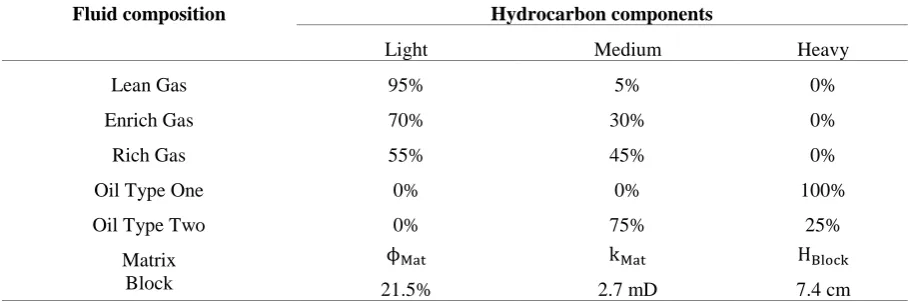
and rich via changing the composition of the reference components. Different nonequilibrium gas injection scenarios reported in Zobeidi’s experiments were then simulated using all fluid types mentioned in Table 2.
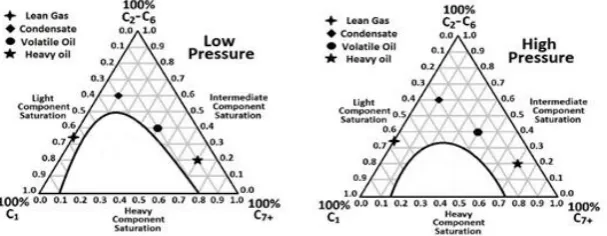
In this investigation we used commercial compositional simulators, namely Eclipse 300 and CMG GEM, to study effects of geological parameters on immiscible and miscible GOGD performance in naturally fractured reservoirs. In this way first, we defined three various oil samples in PVTi rather than WINPROP representing gas condensate, volatile & heavy oil. In the following three gaseous samples namely pure methane, lean & rich separator gas were also defined. All these fluid samples are shown as separate points on ternary diagrams extracted from WINPROP (same as PVTi) software (Figs. 2 and Fig. 3).
At low-pressure condition, a straight line which is not going through the two-phase region connects lean gas point to the condensate sample. This shows that the condensate sample can fully dissolve any amount of injected lean gas at once exhibiting first contact miscibility. Conversely, straight lines that connect lean gas point to volatile and heavy oil points passes through the two-phase region. Since lean gas mixes with volatile oil sample, an equilibrium state reaches in which some fractions of lean gas dissolve in the volatile oil. More contacts with fresh volatile oil dissolve all lean gas components in volatile oil exhibiting multiple contact miscibility. In case of lean gas mixing into heavy oil, one cannot achieve total dissolution even after several contacts. Such circumstance shows immiscible gas injection condition with very few components transfer among phases.
Since pressure increases, the mixing of lean gas with volatile oil exits from multiple contact miscibility entering first contact miscibility condition while also mixing of lean gas with heavy oil is not more immiscible.
Table 1. Media characteristics and fluid properties for immiscible GOGD Verification Process
Media Rock and fluid properties
Reservoir fluid µOil ρOil BOil
0.190 cP 850 kg/m3 1.50
Injected fluid µGas ρGas BGas
0.023 cP 0.83 kg/m3 0.0042
Matrix block ϕMat kMat HBlock
30% 1.0 mD 0.05 m
Fracture network ϕFrac kFrac WFrac
100% 30.0 mD 0.01 m
Table 2. Media characteristics and fluid properties for miscible GOGD verification process
Fluid composition Hydrocarbon components
Light Medium Heavy
Lean Gas 95% 5% 0%
Enrich Gas 70% 30% 0%
Rich Gas 55% 45% 0%
Oil Type One 0% 0% 100%
Oil Type Two 0% 75% 25%
Matrix Block
ϕMat kMat HBlock
21.5% 2.7 mD 7.4 cm
In situations in which injecting gas is more enriched in heavy components, it is easier to achieve miscibility condition. As gas type changes from pure methane to lean gas and consequently to rich gas, condition varies from immiscible to multiple contacts, then to first contact miscible. Although increasing pressure again aids the mixing process, it cannot guarantee the miscible mixing of pure methane with heavy oil. Table 3 reports details on compositions of fluids used in simulating GOGD process.
Fig. 2. Oil samples on ternary diagrams extracted from WINPROP (also PVTi)
Fig. 3. Gas samples on ternary diagrams extracted from WINPROP (also PVTi) Table 3. Compositions of various type oil & gas used in GOGD simulations
Fluid 𝐂𝟏 𝐂𝟐-𝐂𝟔 𝐂𝟕+
Pure CH4 100% 0% 0%
Lean Gas 65% 35% 0%
Rich Gas 35% 65% 0%
Condensate 30% 60% 10%
Volatile Oil 20% 40% 40%
Heavy Oil 10% 20% 70%
In order to investigate the impact of geological parameters which describe fractured media on the efficiency of the GOGD process, we supposed an imaginary layered fractured media case study which was consisted of five different type pay zones. All layers had the same matrix properties while matrix unit heights and fracture permeabilities were different. Fracture porosities were supposed one hundred times smaller than those of matrixes while fracture permeabilities were assumed ten to a hundred times larger. The geometry used in this study is a 2D model consisted of 10*10 grid nodes in which each node represented an individual matrix or fracture locus within the vertical cross section. Table 4 exhibits properties relevant to all layers within the supposed vertical cross section.
drawn in CMG GEM and Eclipse 300 software, then gas injection process was simulated and the resultant graphs of the oil rate, recovery percent, average pressure, and GORs were drawn against time to give some reference values for next comparison studies. Then several modified 2D models with various properties were specified and simulated via ECLIPSE 300 and CMG GEM software to predict future oil exploitation from the fractured reservoir.
In order to study the effects of the matrix unit sizes and heights on the GOGD process efficiency, we assumed several modified models with different matrix unit sizes and heights as shown in Table 5. Values range from one-fifth of the original size up to triple size while ratios among matrix heights in various layers remain constant. Again, the modified models were nourished to CMG GEM and Eclipse 300 software and resultant graphs of oil rate, recovery percent, average pressures, and GORs were drawn.
Table 4. Multiple layers porosity and permeability in the basic model Layer
No.
Matrix porosity
Matrix permeability (mD)
Fracture porosity
Fracture permeability (mD)
Block size (ft)
One 0.29 1.00 0.01 10.0 25
Two 0.29 1.00 0.01 10.0 25
Three 0.29 1.00 0.01 90.0 5
Four 0.29 1.00 0.01 20.0 10
Five 0.29 1.00 0.01 20.0 10
Table 5. Modified block heights in several overlaying layers
Layer No.
Block heights (% Basic heights)
20 % 100 % 200 % 300 %
1st 5 ft 25 ft 50 ft 75 ft
2nd 5 ft 25 ft 50 ft 75 ft
3rd 1 ft 5 ft 10 ft 15 ft
4th 2 ft 10 ft 20 ft 30 ft
5th 2 ft 10 ft 20 ft 30 ft
After that, we varied the matrix properties to investigate the impact of the rock type on GOGD process. Both permeability and porosity values were varied simultaneously according to one classic approach. Matrix porosities ranged from 30% to one-third of the original value, 10% while matrix permeabilities shrink to twentieth. Fracture porosities were also changed while its relevant permeabilities were calculated from duct transmissibility relationship. Fracture properties in two upper layers and also two neighbor bottom layers were changed together and always had the same values. Modified properties are shown in Tables 6 and 7.
Table 6. Modified matrix properties in various simulations
Modification No. Matrix Property
Porosity Permeability (mD)
1st 0.30 1.00
2nd 0.25 0.50
3rd 0.20 0.20
4th 0.15 0.10
Table 7. Modified fracture properties in various simulations
Modification No.
Fracture properties
Porosity Layer permeability (mD) 1st and 2nd 3rd 4th and 5th
1st 0.020 80 720 160
2nd 0.015 35 300 70
3rd 0.010 10 90 20
Results and Discussions
We start this section by repeating two previously carried out investigations on examining GOGD performance in fractured media. To verify our determinations on miscible GOGD, experimental data on rich gas injection into single matrix and stack consisted of four units extracted from Zobeidi’s investigation was simulated via CMG GEM software. Two experiment sets including rich gas injection into the fracture network surrounding four overlying cylindrical matrix units, and lean gas injection followed with rich gas, were selected for this goal. Then all media specifics like matrix & fracture properties, fluid characteristics, etc., were set in CMG GEM simulator thereafter GOGD process was simulated for 30 hr. Our results are in agreement with Zobeidi’s core flooding data from two viewpoints, namely ultimate recovery and extraction acceleration as shown in Table 8. Since one uses miscible rich gas injection earlier in the production life of an oil reservoir, higher cumulative oil extraction efficiency will achieve. Although from an economic point of view, injecting low volumes of expensive rich gas after a long time immiscible GOGD gives acceptable oil recovery values.
Table 8. Oil recoveries from simulated miscible GOGD via CNG IMEX
Rich Gas
Injection Time
100 Min 200 Min 500 Min 1000 Min 1500 Min 1700 Min
Literature Start Time 39% 73% 90% 91% 92% 93%
After A Day 11% 19% 25% 28% 40% 73%
Verification Start Time 37% 70% 88% 90% 91% 92%
After A Day 10% 17% 23% 26% 38% 68%
To validate our calculations on immiscible GOGD, reported oil recoveries from matrix stack consisted of two, three, and five units after Okun’s work were used. Two main conditions for matrix units interaction, capillary continuity and discontinuity were supposed in separate series of simulations. Okon reported higher oil extraction efficiency at conditions in which matrix units show least capillary continuity degree. One can explain such a result in a way that wherever matrix units contact each other with higher surface area, a larger fraction of oil extracted from each matrix have enough chance to enter the neighbor one. Decreasing oil extraction efficiency with an increase in the number of neighbor units in a stack is another evidence to such a claim. Our simulations via ECLIPSE 100 show very nice agreement with Okon’s reported results as is indicated in Table 9.
Table 9. Oil recoveries from simulated immiscible GOGD via Eclipse 100
Matrixes In Stack
Capillary Continuity Capillary Discontinuity
20 Days 30 Days 50 Days 300 Days 20 Days 30 Days 50 Days 300 Days
L
iter
atu
re Two 41% 44% 46% 55% 43% 46% 48% 56%
Three 39% 42% 45% 53% 41% 44% 46% 54%
Five 36% 39% 42% 51% 38% 42% 44% 52%
Valid
atio
n Two 38% 43% 45% 53% 42% 45% 47% 55%
Three 37% 40% 43% 52% 40% 43% 45% 53%
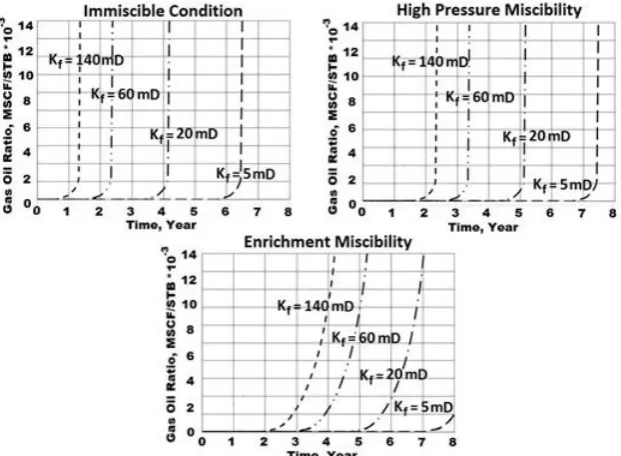
After the verification process with some other works in the literature, we start to simulate GOGD process in previously explained five-layer fractured media model. This cross-sectional geometry represents one vertical plane within an idealized fractured media which is consisted of 10*10 grid nodes placed in XZ two-dimensional space. Grid nodes exhibit matrix units exist in five different overlaid layers and relevant fractures next to them. Production starts with an oil rate of about 400 STB/Day to 500 STB/Day and continues to exploit with GOGD mechanism for eight years. Our calculations started with the simulation of this reference geometry via ECLIPSE 300 and CMG GEM reservoir simulators at various miscibility conditions. Simulation of the reference 2D vertical cross-section model with Dual Poro and Dual Perm approaches in two commercial softwares (not shown here) illustrated almost similar results except that the Dual Perm method predicts slightly higher recoveries, small postpone in GORs increscent and some little higher oil rates at late times within the production times. In the following sensitivity analysis over the matrix, unit height was carried out while the volume of each unit was kept constant. In this way, one increases GOGD driving force leaving the capillary force, that is a function of only matrix oil saturation, unchanged. Since capillary forces always impede oil extraction from matrix units, this negative effect is higher at later times due to oil saturation reduction within the matrixes. At immiscible GOGD condition, no gas component enters the oil phase leaving relative permeability curves constant while conversely under miscible condition, oil and gas Rel Perm curves deviate from original values. Since GOGD simulations in this paper undergo transient conditions for all calculational parameters, unsteady state equations for phase equilibrium, mass and momentum conservation were taken into account in the applied simulators. Hence multi-contact miscibility concept differs from the first contact only wherever process times are comparable to phase equilibrium times. No such deviation was seen in our simulation results (also not shown here). Instead, the way to achieve miscibility is of high importance in this article. The simplest way to carry out a miscible GOGD process is to increase injection pressure to values higher than minimum miscibility pressure (MMP). In such condition, matrix oil starts to dissolve gas flowing through the fractured network getting more and more volatile. Its °API increases while its viscosity decreases leading to an easier flow through matrix unit according to Darcy’s equation. In such condition, matrix fracture interaction invigorates, therefore, higher oil extraction efficiency is expected. Another way to achieve miscibility during GOGD process is the enrichment of the injected gas with heavy hydrocarbon components.
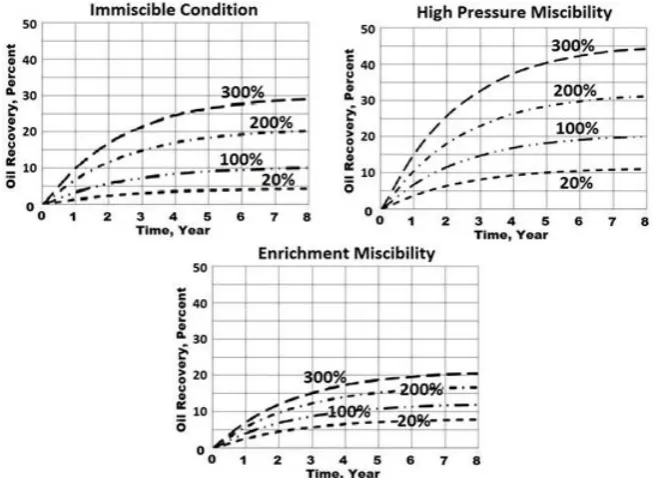
Using rich gas instead of lean for injection into gas invaded zone increases component transfer into the oil phase leading to stronger matrix fracture interaction. But one must notice that using higher density gas in GOGD potentially weakens most important oil extraction driving force. Simulation results on sensitivity analysis over matrix height at immiscible condition, enrichment, and high-pressure miscible conditions were shown in Fig. 4.
equivalent height leads to a decrease in oil extraction efficiency. This reduction can grow up to 10% to 15%.
In the next step, we investigated the effects of matrix rock type on GOGD performance in the gas invaded zone via changing matrix porosity and permeability values simultaneously according to one classic approach. When matrix properties are strong, which means situations with large flow properties, interaction among matrix units and fractured network reinforces that leads to lower fall in oil production rates.
It seems that rock type has an important impact on GOGD efficiency. As the matrix porosity improves from 10% to 30% recovery accelerates about 5%. Matrix properties also affect average pressure and consequently producing GORs. In cases with strong transmissible rock types, reservoir pressure remains high for longer times so a progressive increase in GORs is postponed to later times.
Fig. 4. Impacts of matrix block height & miscibility condition on GOGD performance
transmissible fissures probably due to the fact that at such condition fluid can travel from very long distances toward the wellbore. Reservoir pressures in porous media with strong fracture network, highly permeable and nicely distributed, fall very slowly with time which causes the reservoir to reach saturation state at later times. Conversely, when fractured network properties are weak, one can expect rapid increscent in GORs. Increasing pressure to more than MMP during lean gas injection into gas invaded zone forces some gas fractions to dissolve in oil, postponing an accelerational increase in producing GORs. This is while the enrichment process gives almost the same outcomes except that GORs increase a little slower after gas infiltration.
Fig. 5. Impacts of matrix properties & miscibility condition on GOGD performance
Conclusions
Several key finding of the present paper can be summarized as follows:
• Achieving miscibility with increasing pressure to values higher than MMP increases matrix oil volatility while leaving the GOGD mechanism unchanged which leads to higher oil extraction efficiency especially in fractured media with short matrix units. Using rich gas for injection into gas invaded zone reduces density difference needed for GOGD to proceed which has a negative effect on oil extraction performance.
• Taller matrix units reinforce GOGD mechanism at immiscible, also high-pressure lean gas injection miscible condition which leads to production acceleration, later decrease in oil production rates, also postponement of a progressive increase in GORs. In situations with twice or triple matrix unit heights, ultimate recoveries were approximately increased by about 10% to 20% for the immiscible case and 13% to 25% for high-pressure miscibility condition.
• Wherever matrix properties are strong we mean higher transmissibility and porosity values, one can expect a slower decrease in oil production rates which in turn accelerates the oil recovery and smaller average pressure drops which helps us to produce oil longer times at undersaturated condition.
• Finlly, spread some high permeable fractured network seems to have little impact on oil extraction from the gas invaded zone. Hence, high permeable fractures prevent a rapid decrease in oil production rates. By applying the miscible condition, regardless of the way is used, one can expect little postpone in gas infiltration in production well.
• Since equilibrium times are much less than field scale injection process times, multiple contact miscibility concept is not significantly effective on GOGD process performance. One can expect this to affect core flooding experiments more significantly.
Nomenclatures
EOR Enhanced oil recovery IFT Interfacial tension GOGD Gas-oil gravity drainage GOR Gas-oil ratio
MMP Minimum Miscibility pressure
Reference
[1] Warren JE, Root PJ. The behavior of naturally fractured reservoirs. Society of Petroleum Engineers Journal. 1963 Sep 1;3(03):245-55.
[2] Firoozabadi A, Thomas LK. Sixth SPE comparative solution project: Dual-porosity simulators. Journal of Petroleum Technology. 1990 Jun 1;42(06):710-63.
[3] Penuela G, Civan F, Hughes RG, Wiggins ML. Time-dependent shape factors for interporosity flow in naturally fractured gas-condensate reservoirs. InSPE Gas Technology Symposium 2002 Jan 1. Society of Petroleum Engineers.
[4] Sarma P, Aziz K. New transfer functions for simulation of naturally fractured reservoirs with dual porosity models. InSPE Annual Technical Conference and Exhibition 2004 Jan 1. Society of Petroleum Engineers.
[5] Rossen RH, Shen EI. Simulation of gas/oil drainage and water/oil imbibition in naturally fractured reservoirs. SPE Reservoir Engineering. 1989 Nov 1;4(04):464-70.
[7] Wit K, Clemens T, Rijkels L. Simulation of gas/oil gravity drainage in a stack of interacting blocks: pseudo relations for a limited number of gridblocks. InSPE Annual Technical Conference and Exhibition 2002 Jan 1. Society of Petroleum Engineers.
[8] Ladron de Guevara-Torres JE, Rodriguez-de la Garza F, Galindo-Nava A. Gravity-Drainage and Oil-Reinfiltration Modeling in Naturally Fractured Reservoir Simulation. SPE Reservoir Evaluation & Engineering. 2009 Jun 1;12(03):380-9.
[9] Jadhawar PS, Sarma HK. Numerical simulation and sensitivity analysis of gas-oil gravity drainage process of enhanced oil recovery. Journal of Canadian Petroleum Technology. 2010 Feb 1;49(02):64-70.
[10] Okon AN, Udoh FD. Gas-oil gravity drainage in fractured porous media. Indian Journal of Engineering. 2013;3(8):70-5.
[11] Udoh FD, Igbafe AI, Okon AN. Gas-Oil Gravity Drainage and Reinfiltration in Naturally Fractured Reservoirs. InSPE Nigeria Annual International Conference and Exhibition 2015 Aug 4. Society of Petroleum Engineers.
[12] Verlaan M, Boerrigter PM. Miscible gas-oil gravity drainage. InInternational Oil Conference and Exhibition in Mexico 2006 Jan 1. Society of Petroleum Engineers.
[13] Uleberg K, Høier L. Miscible gas injection in fractured reservoirs. InSPE/DOE Improved Oil Recovery Symposium 2002 Jan 1. Society of Petroleum Engineers.
[14] Saidian M, Masihi M, Ghazanfari MH, Kharrat R, Mohammadi S. An Experimental Study of the Matrix-fracture Interaction During Miscible Displacement in Fractured Porous Media: A Micromodel Study. Energy Sources, Part A: Recovery, Utilization, and Environmental Effects. 2014 Feb 1;36(3):259-66.
[15] Mohammadi S, Khalili M, Mehranfar M. The Optimal Conditions for the Immiscible Gas Injection Process: A Simulation Study. Petroleum Science and Technology. 2014 Jan 17;32(2):225-39. [16] Bazargan M, Broumand P, Gudmundsson A. Modelling Nitrogen Gas-Assisted Gravity Drainage
for Enhanced Oil Recovery in a Fractured Media. In80th EAGE Conference and Exhibition 2018 2018 Jun 11.
[17] Badakhshan A, Golshan H, Musavi-Nezhad HR, Sobbi FA. The impact of gas injection on the oil recovery of a giant naturally fractured carbonate reservoir. Journal of Canadian Petroleum Technology. 1998 Dec 1;37(12).
[18] Zobeidi K, Fassihi MR. Block to block interactions and their effects on miscibility gravity drainage in fractured carbonate reservoirs, experimental and analytical results. Journal of Petroleum Science and Engineering. 2018 May 1;164:696-708.
[19] Rahmati N, Rasaei MR. Quantifying the reimbibition effect on the performance of gas‐oil gravity drainage in fractured reservoirs: Mathematical modelling. The Canadian Journal of Chemical Engineering. 2019 Jun;97:1718-28.