An Impact of Globalization on Gender Wage Inequality: A case Study of Selected Developing Countries
Saeed Rasekhi∗ Haniyeh Hosseinmardi∗∗
Abstract
Globalization may have different impacts on the gender wage gap depending on the specialization and trade pattern as well as the socio-economic situation.
The main purpose of this paper is to examine an impact of globalization on gender wage inequality. Specifically, the hypothesis is that globalization reduces gender wage gap. For this, we have employed a panel technique for 21 selected developing countries during 2000-2007. Based on the obtained results, the hypothesis is verified.
Keywords: Globalization; Gender Wage Inequality; Competitive Pressure; Developing Countries.
JEL Classification: F16, J16, J31.
1- Introduction
Nowadays, more women than before have access to higher education, greater equality in legislative rights and more rewarding opportunities in the labour market. Also, a greater proportion of women than ever before hold high positions in politics, trade unions, business and academia (Glenn, 2009). But the gender inequalities are still alive and women are still under the pressure in many parts of the world.
The discrimination is partly justifiable regarding to human capital is different between men and women. But these differences cannot explain the whole of gender wage gap and in many cases women and men are the same but a man earns more than women (Levine, 2003).
Beside some social affecting factors on the gender wage gap(Schimmel and Pech, 2004), globalization has a narrowing effect on the gap. Based on Becker’s theory (1971), costly discrimination could not persist in the face of long-run competition. Hence rising competition from international trade is expected to eliminate any discriminatory pay differentials between men
∗
Corresponding Author: Associate Professore in Economics, Department of Economics, Economics and Adminstrative Sciences Faculty, University of Mazandaran, Air Force Avenue, Babolsar, Mazandaran Province, Iran, Email: [email protected].
∗∗
and women in the long run. Also, increasing trade will expand job opportunities with an increasing number of women being absorbed in export-oriented industries (Wood, 1991). However, the female share of labour may peak with increasing exports if the demand for the generally lower-skilled female labour first rises and subsequently falls again over time (Joekes, 1995). However, globalization may also worsen the gender wage gap. If firms try to use lower wage workforce with a weaker bargaining power such as female workers, trade competition will create a widen wage gap among groups of workers (Darity, 1989).
The purpose of this paper is to answer to the following questions:
Is there any link between globalization and gender wage inequality? and what are the effects of social conditions especially female participation in labor force and parliament on the gender wage discrimination?
To answer these questions, we’ve employ and estimated a Panel regression with a sample of 21 developing countries during time period 2000-2007. The rest of paper is organized as follows: Section 2 reviwes the empirical studies on the topic. Section 3 introduces methodology. In Section 4, empirical results are presented. Finally, Section 5 is devoted to conclusions. References are given at the last part.
2.Empirical Studies
There are some studies on the gender wage inequality as follows:
Seguino (2000) has empirically investigated the determinants of economics growth for some of semi-industrialized countries during time 1975-1995. Based on this study, GDP growth is positively related to the gender wage inequality.
Oostendorp (2004) has studied some selected countries during timeperiod 1983-1999 and concluded that the occupational gender gap decreases with economic development, trade and foreign investment. Fontana (2004) has applied Social Accounting Matrix (SAM) and Computable General Equilibrium (CGE) model for Bangladesh and Zambia to highlight how differences in resource endowments, labour market characteristics and socio-cultural norms shape the way in which trade expansion affects gender inequalities.
Berik (2004) has explored the effect of international trade on the gender wage discrimination for Taiwan and Korea. This study has indicated that competition from foreign trade is positively associated with wage discrimination against women.
Meyer (2007) has examined the effects of economic globalization on gender wage inequality by employing a panel regression of 55 countries during time period 1975–1998. Based on the results, trade openness has a possitive effect on the female share of earned income.
Menon (2008) has examined the impact of trade liberalization on relative wages and employment of women in India. By using OLS and fixed effects methods during time period 1983-2004 at the industry level, the study has shown that trade openness is possitively related to larger wage gaps. Ferrant (2009) has developed a new aggregate index of gender inequalities and then indicated a negative relationship between gender inequalities and development.
Neumayer (2010) has analayzed women’s rights over the time period 1981-2007 for selected countries at different stages of economic development. Based on the results, the globalization may increase the bargaining power of women through getting in contact with high-standards countries. Yahmed (2012) has examined the effect of trade openness on the gender wage gap. Based on the results, a reduction in trade costs increases wage inequality within-groups and has non-monotonic effects on between-group inequality. Furthermore, trade openness reduces the gender wage gap among unskilled workers but increases the gender wage gap among high-skill workers. Ying Ge et al. (2013) have used an enterprise-population-level dataset to investigate the link between globalization and gender inequality in the Chinese labor market. They have found that foreign and exporting firms employ more female workers than domestic nonexporters. The results highlight the importance of globalization in encouraging female employment and reducing gender discrimination.
3. Methodology
The theoretical underpinning of the impact of globalization on the gender wage gap is based on two mainstream theories, Heckscher-Ohlin-Samuelson (HOS) theory and Becker’s theory of discrimination. Both predict a beneficial impact of globalization on gender wage gap.
Demand for lower-skilled labour will therefore rise. The wages of unskilled labour will thus increase relative to skilled labour. This effect also points to a narrowing of the gender wage gap in developing countries opening to trade since women are often employed in wage, lower-skilled jobs than men.
shared with workers through bargaining; in the case of interest to us, rents can be shared disproportionately with men, with both women and men willing to work in the sector because wages for both groups are at or above the competitive wage (Black, 2001). An exogenous increase in trade reduces rents in the industry and hence reduces wages; if male workers were enjoying more rents than female workers, the gap between the two will shrink with the increased competition. In the competitive sector, since wages were already at the competitive level, the gender wage gap will be less affected by the increase in trade. It is clear that any form of product market competition -whether through increased imports or increased domestic competition-plays an important role in this model, suggesting a link between market structure and the ability of an employer to practice discrimination: discriminating employers with market power, presumably earning positive economic profits, will be able to survive longer in the market than those operating in a competitive market with zero economic profits. Therefore, the gender wage gap should be smaller in competitive markets than in concentrated markets, all else equal (Black, 2004). Becker’s theory seems to add more weight to the discussion of trade liberalization leading to equitable gains from trade than the H-O-S model (Odongo, 2009).
According to the literature, there are some factors affecting on gender wage gap as follow:
Globalization: we expect a negative relationship between globalization and the occupational gender wage gap(Oostendorp, 2004). First, trade will lead to more competition and therefore less discrimination. Second, increases in trade will drive up the relative demand for female labour at least in developing countries. We’ve used the percentage of import and export in GDP to measure the trade liberalization. The basic data are obtained from Word Development Indicators (WDI, 2008).
increasing FDI makes the discrimination less costly. The FDI inflow data are extracted from WDI (2008).
Human development: Depending on the level of education and experience, human capital has different impacts on the relative demand for skilled or unskilled workers. Increasing skill’s demand makes some competition pressures and consquently may decrease the cost of the discrimination (Munshi, 2008). To measure the capital, we’ve used the Human Development Index which is estimated by United Nations (HDR, 2010). Female participation in labour market: to keep their competition power, the firms need to innovation and to improve quality of production through employing the skilled labour including female workers without any discrimination. So, in all stages of opening trade, it’s expected that female participation in labour market to increase (Reilly, 2005).1 The data of this variable are obtained from ILO statistics.
Proportion of female in parliament: The social institutions such as parliaments have an important role on the women employment in any country. It seems that there is a negative relationship between the percentage of female legislators and the gender wage gap. Also, if there are more female legislators, this will probably allude to more educated females and lower gender wage gap (Odongo, 2009). Proportion of female in parliament is measured by the percentage of women in each national parliament which is obtained from United Nations.
Civil liberties: This means certain rights given to the people based on the constitution which includes freedom of speech, expression, press, assemble, worship, right to vote, right to equality in public places without any interference or restriction from the government. They are given to treat all the people equally under the law and make them enjoy rights of speech, protection, enjoyment and liberty. These liberties may increase the women's political opportunities and reduce the gender wage gap. Civil Liberties index is published by Freedom House Institute and varies between 1 to 7; 1 and 7 mean most and least freedom respectively.
According to the above mentioned theories, we can use the following model:
log( e
1 2 ) 3 4lo (g ) 5 6
w witm itf
op n FDI HDI LABOR PARL
it it it it it it
GDP GDP− = +β β +β +β +β +β +ε (1)
Where, i and t indicate country and year respectively,witmand witf show respectively the wage of man and woman and the GDP is GDP per capita.
1
We’ve used the logarithm of openness index(op ne it) and the percentage of FDI inflow in GDP (FDIit) to measure the liberalization. The level of education as a proxy of human capital is measured by Human Development Index (HDIit). We’ve employed two variables to measure the gender inequality including the percentage of women in labor force (LABORit) and the percentage of women in parliament (PARLit). To
examine the impact of the gender inequality in societies rights on the gender wage gap, we’ve added the Civil Liberties Index to the equation. Now we can rewrite the equation (1) with adding a new variable:
) l
log( e
1 2 3 4og( ) 5 6
w witm itf
op n FDI HDI LABOR PARL cL
it it it it it it it
GDP GDP− = +β β +β +β +β +β + +ε (2)
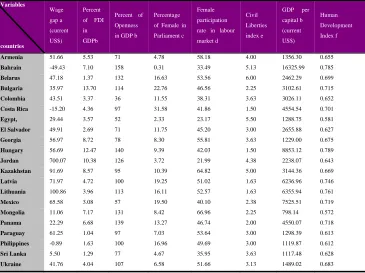
Table 1 shows the average of variables in selected developing countries.
Table 1: Average of variables in selected developing countries Variables countries Wage gap a (current US$) Percent of FDI in GDPb Percent of Openness
in GDP b
Percentage
of Female in
Parliament c Female
participation
rate in labour
market d Civil Liberties index e GDP per capital b (current US$) Human Development Index f
Armenia 51.66 5.53 71 4.78 58.18 4.00 1356.30 0.655
Bahrain -49.43 7.10 158 0.31 33.49 5.13 16325.99 0.785
Belarus 47.18 1.37 132 16.63 53.56 6.00 2462.29 0.699
Bulgaria 35.97 13.70 114 22.76 46.56 2.25 3102.61 0.715
Colombia 43.51 3.37 36 11.55 38.31 3.63 3026.11 0.652
Costa Rica -15.20 4.36 97 31.58 41.86 1.50 4554.54 0.701
Egypt, 29.44 3.57 52 2.33 23.17 5.50 1288.75 0.581
El Salvador 49.91 2.69 71 11.75 45.20 3.00 2655.88 0.627
Georgia 56.97 8.72 78 8.30 55.81 3.63 1229.00 0.675
Hungary 56.69 12.47 140 9.39 42.03 1.50 8853.12 0.789
Jordan 700.07 10.38 126 3.72 21.99 4.38 2238.07 0.643
Kazakhstan 91.69 8.57 95 10.39 64.82 5.00 3144.36 0.669
Latvia 71.97 4.72 100 19.25 51.02 1.63 6236.96 0.746
Lithuania 100.86 3.96 113 16.11 52.57 1.63 6355.94 0.761
Mexico 65.58 3.08 57 19.50 40.10 2.38 7525.51 0.719
Mongolia 11.06 7.17 131 8.42 66.96 2.25 798.14 0.572
Panama 22.29 6.68 139 13.27 46.74 2.00 4550.07 0.718
Paraguay 61.25 1.04 97 7.03 53.64 3.00 1298.39 0.613
Philippines -0.89 1.63 100 16.96 49.69 3.00 1119.87 0.612
Sri Lanka 5.50 1.29 77 4.67 35.95 3.63 1117.48 0.628
Ukraine 41.76 4.04 107 6.58 51.66 3.13 1489.02 0.683
4. Empirical Results
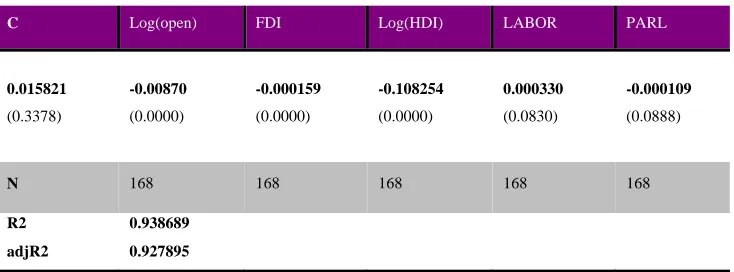
Tables 2 and 3 show the estimation results from the first and second regression respectively. The coefficient of the LOG (OPEN) is negative and significant in both regressions. Also, the same result is obtained for
FDI. Thus we can conclude that the trade and financial openness have a negative and significant effect on the gender wage gap.
The coefficient of HDI as a good proxy for education level and human capital is negative and significant in both tables. This means by increasing HDI, the gender wage discrimination decreases. Coefficient of the LABOR
is positive and significant in table 1 and negative but insignificant in table 2. Based on the result in table 1, it seems that an increase in women labour may decrease the women wage as expected from labor market and it may consequently weaken the bargaining power of the workers and finally increase the wage gap. This is right especially when women are disproportionally employed in sectors increasingly competing on the basis of “cheap” labor (ostendrop, 2004).
Women’s share of legislators (PARL), which is the indicator of the presence of women in decision-making, is consistently negatively associated with the gender wage gap in both of the regressions and they are significant.
Table 2: The estimation results from the regression of
log( e
1 2 ) 3 4lo (g ) 5 6
w witm itf
op nit FDIit HDIit LABORit PARLit it GDP GDP− = +β β +β +β +β +β +ε
C Log(open) FDI Log(HDI) LABOR PARL
0.015821
(0.3378)
-0.00870
(0.0000)
-0.000159
(0.0000)
-0.108254
(0.0000)
0.000330
(0.0830)
-0.000109
(0.0888)
N 168 168 168 168 168
R2 0.938689
adjR2 0.927895
Source: Calculations of present study by using Eviews 7
Table 3: The estimation results from the regression of
) l
log( e
1 2 3 4og( ) 5 6
w witm itf
op nit FDIit HDIit LABORit PARLit cLit it GDP GDP− = +β β +β +β +β +β + +ε
C Log(open) FDI Log(HDI) LABOR PARL CL
0.039152
(0.0260)
-0.007783
(0.0395)
-0.000173
(0.0246)
-0.121257
(0.0000)
-5.2300
(0.8298)
-0.000221
(0.0106)
-0.004161
(0.0000)
N 168 168 168 168 168 168
R2 0.919431
adjR2 0.904574
2. Conclusions
References:
1- Artecona, R. and W. Cunningham (2002). Effects of Trade Liberalization on the Gender Wage Gap in Mexico, World Bank.
2- Australian Government (2008). Understanding the gender pay gap: key factors that contribute to the gap in women’s and men’s earnings, Equal Opportunity for Women in the Workplace Agency, chapter 6.
3- Becker, G. (1971). The Economics of Discrimination. 2nd ed. Chicago: University of Chicago Press.
4- Berik, G.; Y. van der Meulen Rodgers and J. Zveglich (2004). International Trade and Gender Wage Discrimination: Evidence from East Asia. Review of Development Economics, 8(2): 237–254.
5- Black, S.E. and E. Brainerd (2004). Importing Equality? The Impact of Globalization on Gender Discrimination. Industrial and Labour Relations Review, 57(4): 540-559.
6- Blau, F.D. and L.M. Kahn (2003). Understanding International Differences in the Gender Pay Gap. Journal of Labour Economics, 21(1): 106-144.
7- Braunstein, E. and M. Brenner (2007). Foreign Direct Investment and Gendered Wages in Urban China. Feminist Economics, 13(3-4): 213-237. 8- Caselli, M. (2010). Trade liberalisation, skill-biased technical change and wages in developing countries: a model with heterogeneous firms. Department of Economics, University of Oxford, UK, Working Paper, No, S/2010-27.
9- Darity, W. (1989). What’s Left of the Economic Theory of Discrimination?. in Steve Shulman and William Darity (eds.), The Question of Discrimination, Middletown: Wesleyan University Press, 335-74.
10- Ferrant, G. (2010). The Gender Inequalities Index (GII) as a New Way to Understand Gender Inequality Issues in Developing Countries.
11- Fontana, M. (2004). Modelling the Effects of Trade on Women at Work and at Home: Comparative Perspectives. Économie international, 99: 49-80.
12- Fontana, M. and A. Wood (2000). Modelling the Effects of Trade on Women, at Work and at Home. World Development, 28(7): 1173-90. 13- Freedom House (2011). Civil Liberties. www.freedomhouse.org. 14- Glenn, S.; S. Melis and L. Withers (2009). Gender (in) equality in the labour market: an overview of global trends and developments. International Trade Union Confederation.
15- Joekes, S. (1995). Trade-Related Employment for Women in Industry and Services in Developing Countries. UNRISD, Occasional paper, No.5. 16- Levine, L. (2003). The Gender Wage Gap and Pay Equity: Is Comparable Worth the Next Step?. Report for Congress, Congressional Research Service.
17- Menon, N. and Y. van der Meulen Rodgers (2009). International Trade and the Gender Wage Gap: New Evidence from India’s Manufacturing Sector. World Development, 37(5): 965-981.
18- Meyer, L.B. (2007). International Trade Liberalization and Gender Wage Inequality: A Cross-National Analysis 1975–1998. Women and International Development Centre for Gender in Global Context, Working Paper, 289.
19- Munshi, F. (2008). Does openness reduce wage inequality in developing countries? A Panel data Analysis. University of Gothenburg, Sweden.
20- Neumayer, E. and I. de Soysa (2011). Globalization and the Empowerment of Women: An Analysis of Spatial Dependence via Trade and Foreign Direct Investment. World Development, 39(7): 1065–1075. 21- Odongo, M.I.A. (2009). Trade and Gender: The Effects of the Determinants of the Gender Wage Gap. MA Dissertation, International Institute of Social Studies.
22- Oostendorp, R.H. (2009). Globalization and the Gender Wage Gap.
23- Osterreich, S. (2007). Gender, trade and development: Labour market discrimination and North-South terms of trade. The Feminist Economics of Trade, New York: Routledge.
24- Reilly, B. and P.V. Dutta (2005). The Gender Pay Gap and Trade Liberalisation: Evidence for India. PRUS Working Paper, No. 32.
25- Schimmel, B. and B. Pech, (2004). Gender and Corruption, Approches and Recommendation for TA. Deutsche Gesellschaft für, Technische Zusammenarbeit (GTZ).
26- Seguino, S. (2000). Gender Inequality and Economic Growth: A Cross-Country Analysis. World Development, 28(7): 1211-1230.
27- Siegmann, K.A. (2006). Globalisation, Gender, and Equity Effects of Foreign Direct Investment on Labour Markets in Rural Indonesia. Journal of Economics, 3(1): 113 – 130.
28- Sitja, N.M.; S. Maubrigades; M. Camou and E. Camps (2006). Globalization and Wage Inequality in South and East Asia, and Latin America: a Gender Approach. Working Paper, Cambridge University. 29- Torin, M. (2001). The Gender Dimension of Globalisation: A Review of the Literature with a Focus on Latin America and the Caribbean. United Nations.
30- United Nations (2008). Seats Held by Women in National Parliament, Percentage. data.un.org.
31- United Nations (2010). International Labour Organization, Key Indicators of the Labour Market (KILM), sixth edition, www.ilo.org. 32- United Nations (2010). International Labour Organization, Labour Statistics Database, www.ilo.org.
33- United Nations (2010). World Development Indicators, www.databank.wold bank.org.
36- Wood, A. (1991). North-South trade and female labour in manufacturing: An asymmetry. Journal of Development Studies, 27(2): 168-89
.37- Yahmed, S. B. (2012). Gender Wage Gaps across Skills and Trade Openness. Aix-Marseille University, CNRS & EHESS.