DEMOGRAPHIC RESEARCH
VOLUME 30, ARTICLE 18, PAGES 535
546
PUBLISHED 26 FEBRUARY 2014
http://www.demographic-research.org/Volumes/Vol30/18/ DOI: 10.4054/DemRes.2014.30.18
Descriptive Finding
When one spouse has an affair, who is more
likely to leave?
Paula England
Paul D. Allison
Liana C. Sayer
© 2014 Paula England, Paul D. Allison & Liana C. Sayer.
This open-access work is published under the terms of the Creative Commons Attribution NonCommercial License 2.0 Germany, which permits use, reproduction & distribution in any medium for non-commercial purposes, provided the original author(s) and source are given credit.
1 Background 536
2 Data and methods 536
3 Results 538
4 Discussion 544
Demographic Research: Volume 30, Article 18 Descriptive Finding
When one spouse has an affair, who is more likely to leave?
1Paula England2
Paul D. Allison3
Liana C. Sayer4
Abstract
OBJECTIVE
We examine whether having an affair around the time a marriage broke up is associated with being the person who wanted the divorce more or the person who was left. We also examine predictors of having an affair around the end of the marriage.
METHODS
We use the National Survey of Families and Households, using each ex-spouse’s reports of which spouse wanted the divorce more and whether either was having an affair around the end of the marriage. We combine latent class models with logistic regression, treating either spouse’s report as a fallible indicator of the reality of whether each had an affair and who wanted the divorce more.
RESULTS
We find that a spouse having an affair is more likely to be the one who wanted the divorce more. We find little gender difference in who has affairs preceding divorce.
CONCLUSIONS
Results suggest that it is more common to leave because one is having an affair, or to have an affair because one has decided to leave, than it is to discover one’s spouse having an affair and initiate a divorce.
1 We acknowledge funding from National Institute for Child Development of the U.S. National Institutes of
Health and the U.S. National Science Foundation.
2 Corresponding author. New York University, U.S.A. E-Mail: [email protected]. 3
University of Pennsylvania, U.S.A.
1. Background
Despite trends toward permissiveness in premarital sex, most Americans disapprove of extramarital sex. In a 1992 American survey, 77% declared it ―always wrong,‖ and only 25% of married men and 15% of married women claimed to have ever engaged in it (Laumann et al. 1994). Extramarital sex has been found to be more common among those who married young, divorced previously, had parents who divorced, attend church less frequently, or are black or male (Treas and Giesen 2000; Amato and Rogers 1997). Extramarital sexual affairs often foreshadow divorces, and longitudinal analysis suggests that they can be both cause and consequence of other marital problems that predict divorce (Previti and Amato 2004). While we know that affairs precede some divorces, past research has not examined which is the more common scenario—that the person having the affair leaves to form a union with their new-found partner, or that one spouse discovers the other’s affair and leaves as a result. Our analysis speaks to this question, using data on a sample of U.S. couples who divorced to assess whether one spouse having an affair around the end of the marriage predicts which spouse wanted the divorce more. We also examine the distinct predictors of husbands and wives having affairs toward the end of marriages that ended in divorce.
2. Data and methods
We use waves 1, 2, and 3 of the National Survey of Families and Households. The NSFH started from a probability sample of U.S. households, with interviews in 1987–88, 1992–24, and 2001–02. In households containing a married couple at Wave 1, if spouses separated or divorced, each ex-spouse was interviewed separately at the next wave and asked about the divorce. We started with a sample of all Wave 1 married couples in which neither spouse was over 55 and use all 747 cases of separation and/or divorce that occurred between Waves 1 and 3; we consider marriages to be dissolved at the point of separation.
Demographic Research: Volume 30, Article 18
Whether each partner was having an affair was measured by two questions asked in the separate interviews of each ex-spouse: ―Was your husband/wife involved with someone else just before your marriage ended?‖ and ―Were you involved with someone else just before your marriage ended?‖ In addition to using these measures, along with other covariates, to predict who wanted the divorce more, two additional analyses assess the net association of the other covariates with whether the husband and whether the wife had an affair before the end of the marriage. (We cannot include marriages that did not dissolve in our analysis of predictors of affairs because the questions about affairs were asked only of those who divorced.) These additional two models are also latent class analyses; they treat his and her report of whether the husband was having an affair as alternative indicators of whether he actually was, which is the dependent variable, and analogously for the model predicting whether the wife was having an affair.
Covariates in our models include spouses’ relative age (wife greater than three years younger, wife greater than three years older, or within three years), wife’s age at marriage, the duration of the marriage in years at the point of separation, whether either spouse was black, whether his/her parents divorced while s/he was growing up, whether s/he ever cohabited, whether s/he was previously divorced, whether the first birth to the couple was conceived before marriage, their number of children under 18 at the most recent wave before the divorce, whether there were children present that are the wife’s but not the husband’s (and vice versa) at Wave 1, his and her education at Wave 1 in years, his and her annual earnings at the most recent wave before the divorce, and the number of months that he and she had been employed (part- or full-time) out of the two year period ending 12 months before the separation. We also include reports of each partner’s religious attendance, whether each believes marriage is for life, whether each reports disagreements about household tasks, and whether each thinks their finances are unfair to the other spouse at the most recent wave.
covariates. In this regression, reports of affairs by self and other are treated as separate observed independent variables, not as fallible indicators of latent variables.
Next we seek to predict whether husbands and whether wives had affairs, among divorcing couples. For this we use two logistic regression models predicting whether he had and whether she had an affair, respectively, each embedded in a latent class analysis that treats each spouses’ report of whether he (she) was having an affair as a fallible indicator of whether he (she) was involved in an affair.
For each regression, we estimated the latent class and logistic regression models simultaneously by maximum likelihood (with robust standard errors) using methods described by Yamaguchi (2000) and implemented in Mplus software. Missing data on the dependent variables were handled by full information maximum likelihood. Missing data on predictors were multiply imputed under a multivariate normal model, under the missing-at-random assumption, using PROC MI in SAS. The units of analysis for all regressions are the 747 divorcing couples. (No imputation is used for the descriptive proportions in Tables 1 or 2.) All analyses are unweighted.
3. Results
Demographic Research: Volume 30, Article 18
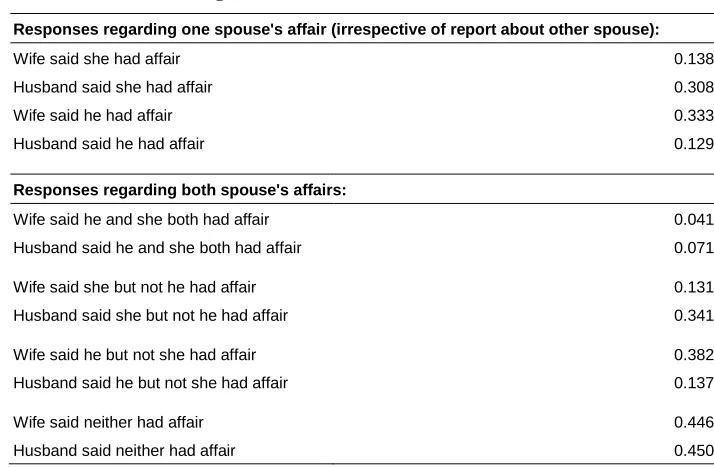
Table 1: Proportion of divorces after which husbands and wives made various claims about whether self or spouse had an affair around the end of the marriage
Responses regarding one spouse's affair (irrespective of report about other spouse):
Wife said she had affair 0.138
Husband said she had affair 0.308
Wife said he had affair 0.333
Husband said he had affair 0.129
Responses regarding both spouse's affairs:
Wife said he and she both had affair 0.041
Husband said he and she both had affair 0.071
Wife said she but not he had affair 0.131
Husband said she but not he had affair 0.341
Wife said he but not she had affair 0.382
Husband said he but not she had affair 0.137
Wife said neither had affair 0.446
Husband said neither had affair 0.450
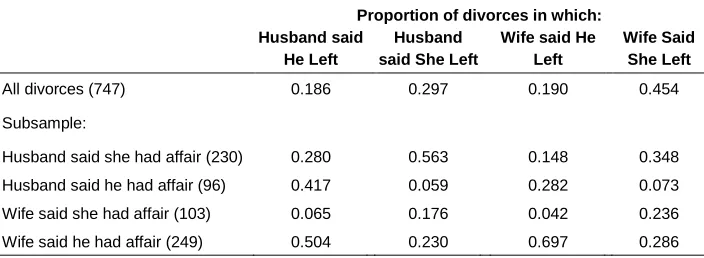
Table 2: Proportion of divorces after which husband said he left, husband said she left, wife said he left, wife said she left; for all divorces and subsamples defined by ex-spouses' reports of affairs
Proportion of divorces in which: Husband said
He Left
Husband said She Left
Wife said He Left
Wife Said She Left
All divorces (747) 0.186 0.297 0.190 0.454
Subsample:
Husband said she had affair (230) 0.280 0.563 0.148 0.348
Husband said he had affair (96) 0.417 0.059 0.282 0.073
Wife said she had affair (103) 0.065 0.176 0.042 0.236
Wife said he had affair (249) 0.504 0.230 0.697 0.286
Note: Statistics not shown for cases where either spouse said both wanted the divorce equally, or did not answer the question. Thus, the proportion of divorces in a given row for husband said he left plus husband said she left do not add to 1; and the analogous statement for wives’ reports is true.
Demographic Research: Volume 30, Article 18
affairs or that those who have affairs often decide to leave to be able to form a union with the new partner. Initiating a divorce because you discover a partner having an affair appears much less common.
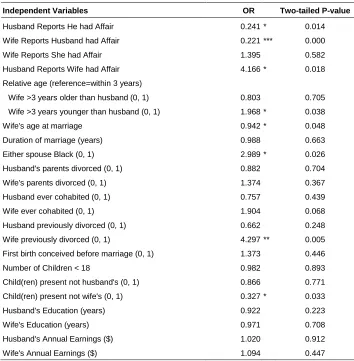
Table 3: Odds ratios from latent class logistic regression model predicting that wife (versus husband) wanted divorce more among couples who divorced
Independent Variables OR Two-tailed P-value
Husband Reports He had Affair 0.241 * 0.014
Wife Reports Husband had Affair 0.221 *** 0.000
Wife Reports She had Affair 1.395 0.582
Husband Reports Wife had Affair 4.166 * 0.018
Relative age (reference=within 3 years)
Wife >3 years older than husband (0, 1) 0.803 0.705
Wife >3 years younger than husband (0, 1) 1.968 * 0.038
Wife's age at marriage 0.942 * 0.048
Duration of marriage (years) 0.988 0.663
Either spouse Black (0, 1) 2.989 * 0.026
Husband's parents divorced (0, 1) 0.882 0.704
Wife's parents divorced (0, 1) 1.374 0.367
Husband ever cohabited (0, 1) 0.757 0.439
Wife ever cohabited (0, 1) 1.904 0.068
Husband previously divorced (0, 1) 0.662 0.248
Wife previously divorced (0, 1) 4.297 ** 0.005
First birth conceived before marriage (0, 1) 1.373 0.446
Number of Children < 18 0.982 0.893
Child(ren) present not husband's (0, 1) 0.866 0.771
Child(ren) present not wife's (0, 1) 0.327 * 0.033
Husband's Education (years) 0.922 0.223
Wife's Education (years) 0.971 0.708
Husband's Annual Earnings ($) 1.020 0.912
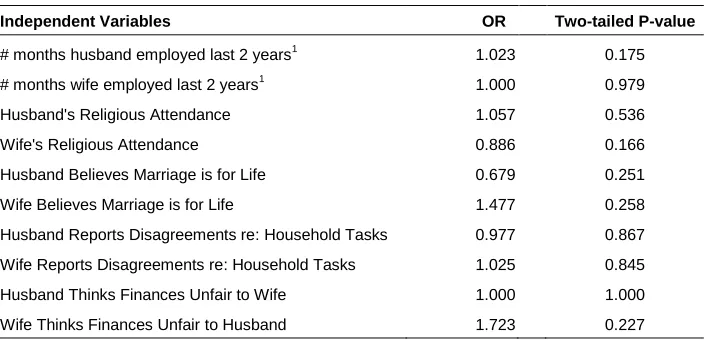
Table 3: (Continued)
Independent Variables OR Two-tailed P-value
# months husband employed last 2 years1 1.023 0.175
# months wife employed last 2 years1 1.000 0.979
Husband's Religious Attendance 1.057 0.536
Wife's Religious Attendance 0.886 0.166
Husband Believes Marriage is for Life 0.679 0.251
Wife Believes Marriage is for Life 1.477 0.258
Husband Reports Disagreements re: Household Tasks 0.977 0.867
Wife Reports Disagreements re: Household Tasks 1.025 0.845
Husband Thinks Finances Unfair to Wife 1.000 1.000
Wife Thinks Finances Unfair to Husband 1.723 0.227
***=p<.001, **=p<.01, *= p<.05, +=p<.10, two-tailed tests.
1
The two year period ends 12 months before the month of the separation.
The models also show other predictors of who wanted the divorce more (net of whether either spouse was having an affair). The wife is approximately twice as likely to be the one wanting the divorce more when she is younger than the husband (OR=1.968); put another way, the husband is much less likely to leave a wife who is younger than himself. In marriages where either spouse is black, the woman is approximately three times as likely to be the one who is leaving than is true for spouses of other races (OR=2.989). (Results not shown reveal that in most of these couples where at least one partner is black, both partners are black, and in cases where only one is black, it is generally the husband.) Women who were married and divorced from a previous husband are approximately four times more likely to be the one wanting the divorce more in the more recent marriage (OR=4.297); but whether men were divorced before does not affect whether they were the one wanting the current divorce. This may be because women initiate a much higher proportion of divorces than men; consequently, the fact that a woman is previously divorced may be a stronger indicator of general willingness to leave a marriage. If the wife was older (than other wives) when she entered this marriage, she is less likely to be the one who wanted the divorce more (OR=.942). She is over 65% less likely to be the one wanting the divorce (OR=.327) when the household contains one or more of his children that are not also hers.
Demographic Research: Volume 30, Article 18
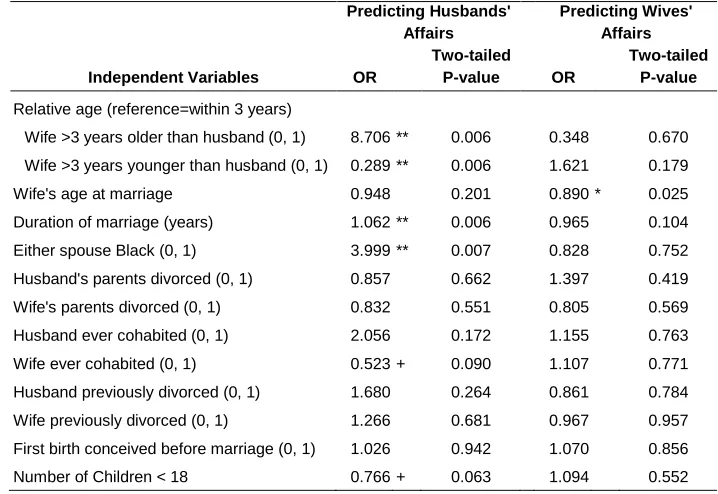
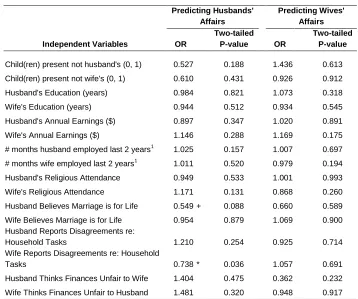
significant net predictor of whether the wife has an affair; women who married at older ages are less likely to have affairs. The model predicting whether men have affairs contains more significant predictors: Men are almost nine times as likely to have an affair if their wife is more than three years older than themselves (OR=8.706), and about 70% less likely to do so if their wife is more than three years younger than themselves (OR=.289). For each year the marriage has lasted, men are 6.2% more likely to have had an affair (OR=1.062). Men are nearly four times more likely to have affairs in couples where one or both partners are black (OR=3.999); given that husbands are black in most of these couples, this suggests that black men are more likely than other men to have affairs. Men are nearly 25% less likely to have an affair if the couple has children under 18 (OR=.766). The remaining significant coefficients have no obvious interpretation; men are less likely to have affairs if the wife reports that they have had disagreements about household tasks and less likely if the wife cohabited with anyone before the marriage.
Table 4: Odds ratios from latent class logistic regression models predicting husband having affair and wife having affair, among couples who divorced
Predicting Husbands' Affairs
Predicting Wives' Affairs
Independent Variables OR
Two-tailed
P-value OR
Two-tailed P-value
Relative age (reference=within 3 years)
Wife >3 years older than husband (0, 1) 8.706 ** 0.006 0.348 0.670
Wife >3 years younger than husband (0, 1) 0.289 ** 0.006 1.621 0.179
Wife's age at marriage 0.948 0.201 0.890 * 0.025
Duration of marriage (years) 1.062 ** 0.006 0.965 0.104
Either spouse Black (0, 1) 3.999 ** 0.007 0.828 0.752
Husband's parents divorced (0, 1) 0.857 0.662 1.397 0.419
Wife's parents divorced (0, 1) 0.832 0.551 0.805 0.569
Husband ever cohabited (0, 1) 2.056 0.172 1.155 0.763
Wife ever cohabited (0, 1) 0.523 + 0.090 1.107 0.771
Husband previously divorced (0, 1) 1.680 0.264 0.861 0.784
Wife previously divorced (0, 1) 1.266 0.681 0.967 0.957
First birth conceived before marriage (0, 1) 1.026 0.942 1.070 0.856
Table 4: (Continued)
Predicting Husbands' Affairs
Predicting Wives' Affairs
Independent Variables OR
Two-tailed
P-value OR
Two-tailed P-value
Child(ren) present not husband's (0, 1) 0.527 0.188 1.436 0.613
Child(ren) present not wife's (0, 1) 0.610 0.431 0.926 0.912
Husband's Education (years) 0.984 0.821 1.073 0.318
Wife's Education (years) 0.944 0.512 0.934 0.545
Husband's Annual Earnings ($) 0.897 0.347 1.020 0.891
Wife's Annual Earnings ($) 1.146 0.288 1.169 0.175
# months husband employed last 2 years1 1.025 0.157 1.007 0.697
# months wife employed last 2 years1 1.011 0.520 0.979 0.194
Husband's Religious Attendance 0.949 0.533 1.001 0.993
Wife's Religious Attendance 1.171 0.131 0.868 0.260
Husband Believes Marriage is for Life 0.549 + 0.088 0.660 0.589
Wife Believes Marriage is for Life 0.954 0.879 1.069 0.900
Husband Reports Disagreements re:
Household Tasks 1.210 0.254 0.925 0.714
Wife Reports Disagreements re: Household
Tasks 0.738 * 0.036 1.057 0.691
Husband Thinks Finances Unfair to Wife 1.404 0.475 0.362 0.232
Wife Thinks Finances Unfair to Husband 1.481 0.320 0.948 0.917
***=p<.001, **=p<.01, *= p<.05, +=p<.10, two-tailed tests.
1
The two year period ends 12 months before the month of the separation.
4. Discussion
Demographic Research: Volume 30, Article 18
findings not limited to divorcing couples suggest that men have more affairs than women. Our finding of no aggregate gender difference between men or women having affairs around the end of a marriage suggests that women who do have affairs may be more likely to leave than men; future research should study this directly.
Among spouses who divorced, when the woman is younger than the man, he is less likely to have had an affair, and he is less likely to be the one who wanted the divorce; by contrast, men have affairs more and are disproportionately the ones wanting the divorce more when the wife is older than the husband. Men’s preference for younger wives has been found in studies of mate selection (England and McClintock 2009); our results suggest that this preference affects decisions to have affairs and divorce as well.
References
Amato, P.R. and Rogers, S.J. (1997). A longitudinal study of marital problems and subsequent divorce. Journal of Marriage and the Family 59(3): 612–624. doi:10.2307/353949.
England, P. and McClintock, E.A. (2009). The gendered double standard of aging in U.S. marriage markets. Population and Development Review 35(4): 797–816. doi:10.1111/j.1728-4457.2009.00309.x.
Laumann, E.O., Gagnon, J.H., Michael, R.T., and Michaels, S. (1994). The social organization of sexuality: Sexual practices in the United States. Chicago: University of Chicago Press.
Previti, D. and Amato, P.R. (2004). Is infidelity a cause or a consequence of poor marital quality? Journal of Social and Personal Relationships 21(2): 217–30. doi:10.1177/0265407504041384.
Sayer, L., England, P., Allison, P.D., and Kangas, N. (2011). She left, he left: How employment and satisfaction affect women’s and men’s decisions to leave marriages. American Journal of Sociology 116(6): 1982–2018. doi:10.1086/ 658173.
Treas, J. and Giesen, D. (2000). Sexual infidelity among married and cohabiting Americans. Journal of Marriage and the Family 62(1): 48–60. doi:10.1111/ j.1741-3737.2000.00048.x.
Yamaguchi, K. (2000). Multinomial logit latent-class regression models: An analysis of the predictors of gender-role attitudes among Japanese women. American