Interrelationship between action control variables and L2
learners’ dynamic changes of WTC
Hashemian, Mahmood
Department of English Language, Shahrekord University, Iran ([email protected])
Mirzaei, Azizullah
Department of English Language, Shahrekord University, Iran ([email protected])
Alian, Azadeh
Department of English Language, Shahrekord University, Iran ([email protected])
Received: 14 May 2015 Revised: 14 July 2015 Accepted: 10 September 2015
Available Online: 2 November 2015 DOI: 10.5861/ijrsll.2015.1223
ISSN: 2243-7754 Online ISSN: 2243-7762
OPEN ACCESS
Abstract
This study aimed to examine whether action control system, defined in terms of stable
individual differences, predicts key reactions to the dynamic and situated nature of
willingness to communicate (WTC) in both whole-class and group work. By adopting
methods of classroom observation and questionnaires, we measured the consistency between
self-report and actual WTC among 30 EFL participants. Whereas trait-like WTC—as
measured by a self-report questionnaire - could predict a tendency to communicate, classroom
observation of situational WTC showed the evidence to be contrary. Preoccupation, as one
component of action control system, influenced the decision to engage in interaction with
both the teacher and fellow students. Looking at the issue from a very personal perspective,
we propose that although high trait-like WTC predicts a tendency to communicate,
preoccupation of action control system causes a lack of actual WTC inside the classroom with
the context as a key element in determining this WTC. Implications for trait and dynamic
conceptions of WTC are discussed.
Interrelationship between action control variables and L2 learners’ dynamic changes of
WTC
1. Introduction
Willingness to communicate (WTC) is such an important feature in our daily life communications that it is almost impossible to expect a communication to be highly effective without being willing to initiate and continue a conversation. In fact, communication is competent and of high quality when it is appropriate for a particular situation (Morreale, Spitzberg, & Barge, 2006). All the same, studies in L2 have identified individual differences in language learning achievement (e.g., Bailey, Daley, & Onwuebuzie, 2000; Gardner, 1985; MacIntyre, 1994; & Schuman, 1986). These studies have hypothesized that variables such as anxiety, self-confidence, motivation, and personality influence a second language within the individual learners. In this regard, Morreale et al. (2006) also compared positive and negative sides of motivation to communicate and named the positive side WTC and the negative side communication apprehension. According to Morreale et al. (2006), WTC is the individual’s tendency to initiate communication. Indicators of this willingness may be approaching a stranger at a party and introducing yourself, making the first suggestion in a group meeting, or raising one’s hand with a question in a public lecture (Morreale, 2006, p. 7). As Kuhl (1994a) posits, the links to basic brain functions are central to describing one's action tendencies. If it would be the case, we need to investigate different things going on at the same time within a typical human head. The ability of each individual in controlling, ignoring, and adjusting certain brain functions such as inhibition and excitement is also an important skill which should be developed by everyone willing to communicate in L1 in general and in L2 classroom in particular.
This research was carried out to answer the following questions:
Is there any possible relationship between L2 learners' self-report and actual WTC inside and outside the classroom?
Is there any possible relationship between action control variables and L2 learners actual WTC in the classroom?
Does L2 learners' WTC behavior in class differ in each of the teacher-presence and teacher-absence contexts?
To examine the above research questions, the following null hypotheses were formulated:
H01: There is no significant relationship between L2 learners' self-report and actual WTC inside and outside the classroom.
H02: There is no significant relationship between action control variables and L2 learners' actual WTC inside the classroom.
H03: L2 learners' WTC behavior does not differ in each of the teacher-presence or teacher-absence contexts.
of WTC in an L1, due to the absence of vocabulary items, would be too reluctant to speak up in an L2 classroom. An individual, who is talkative in the family circle, would be quite reticent when located in bonds of friendship. Therefore, due to these subtle differences within the individuals, contexts, and languages, one would notice that there is much more involved in one’s behavior at any particular point of time. Thus, to enter such a complex area of ever-changing behaviors, L2 teachers need to be aware of action control system inside each individual learner’s brain. Thus, because the basis of action control lies in the activity of the brain, action control system does L2 learners a great favor to overcome all their communication difficulties. This is also the brain that controls all our actions that shows the source of all our emotions, contains a life-time of memories, and is who we are or who we will be.
2. Review of Literature
2.1 Willingness to communicate
In the early 1990s, L2 field took many insights from L1 communication field. L1 WTC was a personality-based predisposition (McCroskey & Richmond, 1991). Burgoon (1976) discussed the term
unwillingness to communicate, which we describe as an individual’s inclination to avoid speaking with others,
owing to a great variety of reasons such as anxiety, introversion, and alienation. The late 1970s and early 1980s saw more developments on the L1 side of WTC. McCroskey and Baer (1985) broadly define WTC as the probability of starting communication when such an opportunity presents itself. MacIntyre and Doucette (2010) defined L2 WTC as a person’s “readiness to enter into discourse at a particular time with a specific person or persons” (p. 547). As they put it, being willing to communicate is one of the ways in which L2 learners become fluent in an L2 and, sometimes, it becomes the ultimate goal of L2 learning. Given great variation within all the individuals, the languages, and cultures coupled with a variety of contextual factors, finding a sole factor as a predictor of WTC remains a too difficult task.
Since the late 1990s, many scholars (e.g., Cao & Philp, 2006; Hashimoto, 2002; MacIntyre et al., 1998; Yashima, 2002) have pursued WTC as a situational construct, not as a trait-like individual difference. MacIntyre et al. (1998) was the first leading figure who proposed that it is not necessary to limit WTC to a trait-like variable. Developing a heuristic model consisting of all the situational, social, cognitive, affective, and individual factors involved in WTC in which each variable affected a number of other variables in the preceding layers, he exerted a strong influence on the other scholars of the field, and consequently, on a number of upcoming studies. The focus of recent work on WTC, however, has shifted from a systematic developmental framework to investigations of the relationship between different situational factors and actual WTC inside the classroom.
WTC as a trait-like predisposition - Based on this theoretical perspective, WTC is viewed as “a personality-based, trait-like predisposition which is relatively consistent across a variety of communication contexts” (McCroskey & Richmond, 1991, p. 23). Extending literature review on the issue, Mortensen, Arnston, and Lustig (1977) as well as McCroskey and Richmond (1982, 1987, 1990) proposed WTC to be the individuals’ tendency to initiate communication when they are free to do so. Because of the consistency of the personality traits across different communication contexts, L2 learners’ WTC in classroom context is predictable on the basis of their WTC in other contexts.
2.2 Action control system
In the mid-1990s and in an attempt to investigate WTC, Kuhl (1994a) proposed the theory of action control, which accounts for the initiation of action. This theory consists of three key concepts (i.e., preoccupation, hesitation, and volatility) which form the base of any sort of action (Kuhl, 1994b). Kuhl (1994a) found that hesitation, the inability to put decisions into action, is the moment in which people usually vacillate between continuing their current behavior and following through on the decision to initiate a new action. Preoccupation measures the extent to which enduring thoughts cause a person to fail to begin or change a behavior. Volatility measures the ability to stay within self-initiated and pleasant activities without shifting to alternative ones; it represents an inability to stay focused on a specific topic.
Furthermore, Kuhl (1982, 1984) pointed out that motivation and ability are sufficient but not enough conditions for the performance of an action unless the action consists of mere routine behavior or is controlled by external forces. He also mentioned that when a particular person intends to perform an action, he is subject to different external or internal forces, which arouse alternative action tendencies. In order for the intended action to be done against the other alternative tendencies, it has to be selectively strengthened and protected against interference until it is performed. He assumed a process of action control for this function. This theory suggests that the efficiency of the process of action control is affected by two different states of the organism that is action versus state orientation. According to him, state orientation occurs when an individual excessively focuses on his or her past, present, or future state without attending to any action plan, which may bring about a change in the future or present situation. An individual, who is action-oriented, seeks to implement an action plan and focuses simultaneously on his or her present state, an intended future state, and alternatives, which may transform the present state into the desired future state. According to him, the two states of action versus state orientations are conceived to be determined by an interaction of situational and personal factors. Kuhl (1981), in another study, indicated that a very powerful situational determinant of state-orientation is the prolonged exposure to uncontrollable aversive events. Focusing on past failures may be the most frequent instance of state orientation.
3. Methodology
3.1 Design
The WTC profiles were based on the self-report questionnaires’ data as well as the classroom observations. For the first research question, the data collected were subjected to inferential statistics. The two scales were linear and quantitative. Each participant’s self-report WTC was calculated according to the responses given to each question for four skills of speaking, reading, writing, and comprehension. Tokens of WTC behavior were calculated by counting the number of times each participant had shown the behaviors described in each category of observation. A parametric Pearson product-moment correlation coefficient was used to identify the correlation between actual and self-report WTC both inside and outside the classroom.
As for the second question, the responses to each situation based on either action or state orientation of ACS for the three variables of preoccupation, hesitation, and volatility were calculated, and a parametric Pearson product-moment correlation coefficient was used to see if the participants’ silence in the actual classroom was attributed to a disruption in action control variables.
3.2 Participants
Thirty EFL learners (9 males and 21 females) in their upper-intermediate level of study participated in the study, all of whom were studying English in Nasle-e-Farda Institute in Najafabad, Isfahan, Iran, in two classes taught by two different teachers. Their ages ranged from 15 to 37 years, and the average age was 19.5. All the participants had Persian as their L1 and studied Upper-Intermediate World Pass and Passages 1 as their textbooks.
3.3 Materials
In order to gauge the participants’ proficiency level and to ensure their homogeneous entry behavior, Oxford Placement Test (OPT; Allen, 1992), with reasonable measures of validity and reliability, was used to screen the participants. The participants who scored lower than 50% of the total possible score were excluded from the study.
The next materials were modified versions of Willingness to Communicate Inside the Classroom and Willingness to Communicate Outside the Classroom. By adopting a trait-like approach, these Likert-type questionnaires developed by MacIntyre et al. (2001) assessed the participants’ self-report WTC in four areas of speaking, reading, writing, and comprehension. The scale comprised of 27 items ranging on a 5-point Likert scale from one (almost never willing) to five (almost always willing) in order to determine their level of agreement with each item statement. The items were in a way that involved the participants’ WTC inside and outside the classroom in four areas of speaking, reading, writing, and comprehension. Using Cronbach’s alpha, the scale was a valid and reliable one (MacIntyre et al., 2001). The alpha reliability estimates for WTC inside the classroom, in the current study, are as the following: Speaking (8 items, α = .78), comprehension (5 items, α = .79), reading (6 items, α =. 85), and writing (8 items, α = .85). These estimates for WTC outside the classroom are also as the following: Speaking (8 items, α = .89), comprehension (5 items, α = .90), reading (6 items, α = .93), and writing (8 items, α = .82).
The participants were also given the Action Control Scale (ACS) developed by Kuhl (1994a). This scale consists of three subscales. Each scale consists of 12 dichotomous forced-choice items, which describes a particular situation. The subscales were as the following:
Preoccupation (failure-related action orientation; α = .70) - These 12 items describe situations in which thoughts concerning unpleasant experiences interfere with one’s behavior-changing ability. The sum of the answers ranged from 0 to 12. For example, “when I’m in a competition and have lost every time: (a) I can soon put losing out of my mind, (b) The thought that I lost keeps running through my mind.”
Hesitation (decision-related action orientation; α = .74) - These 12 items describe difficulties associated with initiating an intended activity without referring to ruminating thoughts due to state orientation. The sum of the answers ranged from 0 to 12. For example, “When I know I must finish something soon: (a) I have to push myself to get started, (b) I find it easy to get it done and over with.”
Volatility (performance-related action orientation; α = .60) - The 12 items in this subscale describe one’s ability to continue pleasant activities without a sudden shift to alternative activities. The sum of answers ranged from 0 to 12. For example, “When I have learned a new and interesting game: (a) I quickly get tired of it and do something else, (b) I can really get into it for a long time.”
unknown word) were based on the descriptions of learners with high WTC and motivation. These descriptions include a desire to “take moderate but intelligent risks such as guessing word meanings based on background knowledge, speak up despite the possibility of making occasional mistakes” (Oxford, 1997), trying out a difficult sentence in class, or making requests without any concern for grammatical mistakes (Ely, 1986). The scheme was originally developed based on observations made by a number of researchers (Ely, 1986; MacIntyre et al., 1998; Oxford, 1997; & Wajnryb, 1992). These observations concerned a number of classroom behaviors possessed by those learners regarded as having high motivation and high WTC inside the classroom.
3.4 Procedure
After applying the OPT and screening the participants with the same level of proficiency, the questionnaires were given, and all the observations were made. The data collection consisted of (a) two self-report WTC questionnaires, administered on one day, (b) an ACS, administered on another, (c) eight classroom observations, carried out three times weekly in two-hourly sessions, and (d) six audio-recordings of group and pair work, carried out over two weeks. The eight classroom observations were conducted three times weekly in two-hourly sessions over three weeks and six audio-recordings of group and pair work were carried out in three sessions weekly over two weeks. This is presented in Table 1:
Table 1
Three Stages of Data Collection
Stage 1 Week 1
Stage 2 Week 2
Stage 3 Week 2-4 Self-report
questionnaires
Action control scale Classroom observation (8×2h/three weeks) Pair/group work (six sessions/three weeks)
During the observations, the participants recorded themselves in classrooms’ interactions during pair and group work by their mobile phones. The scheme comprised of two sections: One representing the teacher’s presence in whole-class situations and the other indicating the teacher’s absence in pair or group work.
4. Results
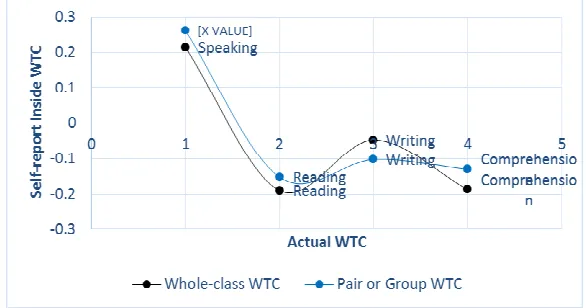
The objective of the current research for the first question was to gain a better insight into the participants’ views about their own WTC to find its discrepancy with actual classroom WTC. As for this question and the first null hypothesis, no relationship was observed between either inside self-report WTC and actual classroom WTC (df = 58, α = 0.05, Sig. = 0.730 > 0/05) or outside self-report WTC and actual classroom WTC (df = 58, α = 0.05, Sig. = 0.307 > 0/05). So, as things stand, the first null hypothesis of the study was safely accepted. Figure 1 and 2 show this in further details:
Figure 2. Correlation between actual WTC and self-report WTC outside the classroom
In classroom reality, the L2 participants display different levels of WTC and their teachers and peers perceive their behaviors both positively and negatively. From a context-sensitive perspective, one can conclude that WTC in actual class does not exist as a single entity in itself, but is rather the result of numerous surrounding conditions and underlying cognitive predictors. However, looking at the issue from a very personal perspective, the discrepancy between self-report and actual WTC seems to be due to a disruption in action control system - a system each individual learner goes through before taking any particular sort of action (Kuhl, 1994a). In this regard, the answers to the second question are pursued.
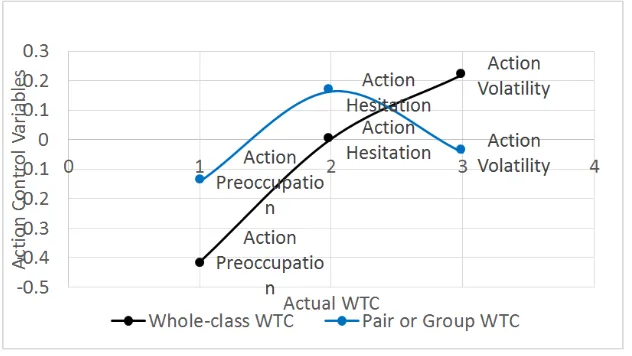
The objective of the research for the second question was to see if there is any link between action control and actual classroom WTC. According to the results, preoccupation demonstrated a relation to WTC (df = 58, α = 0.05, Sig. = 0/023 < 0/05). Figure 3 shows this relationship. Hence, the second null hypothesis was partially rejected, and the following directional hypothesis comes forward:
H04: There is a relationship between preoccupation in L2 learners and their actual WTC inside the classroom.
Figure 3. Correlation between actual WTC and action control variables
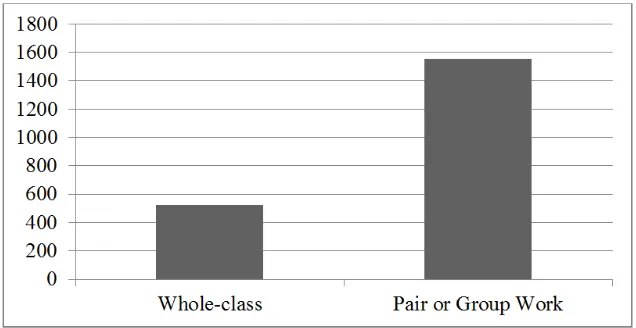
H05: WTC behavior differs significantly in each of the teacher-presence or teacher-absence contexts.
Figure 4. The behavioral representation of actual WTC
Overall, WTC, which is the necessary part of becoming fluent in an L2, is the ultimate goal of many L2 learners. By making use of intentions, participants might be better able to identify the opportunities in an L2 and, thus, would recognize their sources of hesitation. In this regard, the source of hesitation will vary from one situation to the next. Bearing this in mind, the learners may promote security, an antecedent to higher WTC. Volatility was not directly linked to WTC in the classroom. However, it seems that in the end, the tendency to abandon tasks, caused by volatility, would lead to lower WTC. This highlights the dynamic nature of WTC, having both transient and enduring characteristics and is in line with the more recent studies in which WTC has been recognized as being dynamic, having both enduring and transient characteristics (Cao & Philp, 2006; Kang, 2005). As Cao and Philp (2006) note, one can strengthen or weaken his or her WTC according to the factors associated with a specific situation, topic, and interlocutor.
5. Discussion and Conclusion
One focus of this study was the relationship between L2 self-report WTC both inside and outside the classroom and actual WTC in classroom contexts. The mismatch between self-report WTC and actual classroom behavior suggests that WTC behavior in the actual classroom contexts was influenced by both trait-level and state-level WTC. Logically enough, the self-report questionnaire was not limited to instructional settings, but also concerned general willingness to interact with others in other aspects of daily life. Issues such as talking about their favorite hobbies, things they must do, things they want to buy, and their favorite habits, are among a variety of WTC settings involved in the questionnaires.
The findings related to the first and second questions are in broad agreement with those of MacIntyre (1999). As he put it, an individual, based on his or her trait WTC, may be in a situation in which communication is likely, but for the same individual in a particular situation, situated WTC would influence whether or not communication actually takes place. Thus, one should observe situated WTC to see if the individual perceives a particular context as a suitable one to communicate. When in classroom context, due to the fact that a variety of factors such as interlocutor familiarity, interlocutor participation, group size, and gender come in, the distinction between trait-like WTC and situational WTC could be quite difficult. From another point of view, the discrepancy between self-report and actual WTC behavior supports the acknowledgement by MacIntyre et al. (2001) suggesting the weakness of self-report questionnaire as a reliable method for measuring situational WTC because “thinking about communication in the L2 is different from actually doing it” (p. 377). The study draws L2 teachers’ attention to the ever-changing behavior in participants’ WTC and makes them aware of a variety of factors intertwined closely due to the specific behaviors at any particular point of time in the classroom.
Since WTC is a grey area, its lack or existence can be attributed to a variety of reasons. However, due to any reason, an implication of these findings is the potential of the interactional context in both whole-class and pair or group work to encourage or discourage WTC among learners. As other researchers have noted, teachers can encourage participation by both addressing factors such as self-confidence and anxiety (Cheng, 2000; Tsui, 1996; Young, 1991) and choosing topics and materials which are likely to appeal to learners and match their needs and interests. The results also demonstrate that learners change widely in different contexts and their preferences are not the same as each other. This also supports Kang's (2005) study suggesting that in order to support WTC in the classrooms, teachers need to be cautious about the interactions between factors when planning language activities, rather than focusing on only one factor. This study also provides empirical evidence for conceptualizing WTC as a situational variable, not simply a trait disposition in the classroom interactional contexts. WTC was found to entail fluctuation and dynamism due to the variations based on the environmental, individual, and linguistic dimensions. These dimensions varied in the extent of their inhibitive or facilitative effects on WTC behavior. This study also provides an example of taking a contextualized, process-oriented approach to the study of WTC in L2 classroom contexts. In doing so, it investigates the influence of learning environments and sociocultural contexts on WTC dynamism. According to Ushioda and Dornyei (2012), in the process of reconceptualizing and retheorizing L2 motivation, the potential for L2 motivation and WTC lies in an adoption of a person-in-context approach to investigate motivation as a dynamic and situated concept.
In this regard, it is important to concede that the effects of hesitation, preoccupation, and volatility are under the influence of situational variables. Truly, amazingly we find that the trait-like and state-dependent tendencies are the two sides of the same coin. This serves as a reminder of Funder's (2006) study suggesting that choosing to study stability versus change in behavior or attributing outcomes to the person versus the situation are indeed false dichotomies. The main finding during these four weeks of classroom observation is that the WTC behavior inside the classroom was in a state of flux from lesson to lesson and from task to task in a single lesson. Furthermore, this variability in actual WTC behavior on the part of the participants was shaped due to the joint influences of factors within and between the environmental, linguistic, and individual dimensions. Because all the factors and interactions between those factors varied, their influence on WTC also varied, and this variability resulted in dynamic changeability in the participants' WTC level. Finally, these factors exerted either a positive or a negative influence on classroom WTC. Overall, this study is another voice to be added to the current call in individual differences research. It also acknowledges the complex interrelationship between the social and cognitive factors underlying dynamic situational WTC in L2 classrooms. As Wen and Clement (2003) claim, class size appears to be one of the contextual factors embedded in classroom cohesiveness.
6. References
Bailey, P., Daley, C., & Onwuegbuzie, A. J. (2000). Correlates of anxiety at three stages of the foreign language learning process. Language and Social Psychology, 19(4), 474-490.
Burgoon, J. K. (1976). The unwillingness to communicate scale: Development and validation. Communication
Monograph, 43, 60-69. http://dx.doi.org/10.1080/03637757609375916
Cao, Y. Q., & Philp, J. (2006). Interactional context and willingness to communicate: A comparison of behavior in whole-class, group, and dyadic interaction. System, 34(4), 480-493.
http://dx.doi.org/10.1016/j.system.2006.05.002
Cheng, X. (2000). Asian students' reticence revisited. System 28, 435-446. http://dx.doi.org/10.1016/S0346-251X(00)00015-4
Ely, C. M. (1986). An analysis of discomfort, risk-taking, sociability, and motivation in the L2 classroom,
Language Learning, 36, 1-25. http://dx.doi.org/10.1111/j.1467-1770.1986.tb00366.x
Funder, D. C. (2006). Towards a resolution of the personality trait: Persons, situations, and behaviors. Journal of
Research in Personality, 40, 21-34. http://dx.doi.org/10.1016/j.jrp.2005.08.003
Gardner, R. C. (1985). Social psychology and second language learning: The role of attitudes and motivation. London: Edward Arnold.
Hashimoto, Y. (2002). Motivation and willingness to communicate as predictors of reported L2 use: The Japanese ESL context. Second Language Studies, 20(2), 29-70.
Kang, S. J. (2005). Dynamic emergence of situational willingness to communicate in a second language. System, 33, 277-292. http://dx.doi.org/10.1016/j.system.2004.10.004
Kuhl, J. (1981). Motivational and functional helplessness: The moderating effect of state versus action orientation. Journal of Personality and Social Psychology, 40, 155-170.
http://dx.doi.org/10.1037/0022-3514.40.1.155
Kuhl, J. (1982). Action- vs. state-orientation as a mediator between motivation and action. In W. Hacker, W. Volpert, & M. von Cranach (Eds.), Cognitive and motivational aspects of action (pp. 130-168). Amsterdam: North-Holland.
Kuhl, J. (1984). Volitional aspects of achievement motivation and learned helplessness: Toward a comprehensive theory of action-control. In B. A. Maher (Ed.), Progress in experimental personality research (pp. 114-139). New York: Academic Press.
Kuhl, J. (1994a). A theory of action and state orientations. In J. Kuhl & J. Beckmann (Eds.), Volition and
personality (pp. 9-46). Gottingen: Hogrefe and Huber.
Kuhl, J. (1994b). Action vs. state orientation: Psychometric properties of the action control system. In J. Kuhl & J. Beckmann (Eds.), Volition and personality (pp. 47-59). Gottingen: Hogrefe and Huber.
MacIntyre, P. (1994). Variables underlying willingness to communicate: a casual analysis. Communication
Research Reports, 11, 135-142. http://dx.doi.org/10.1080/08824099409359951
MacIntyre, P. D., & Doucette, J. (2010). Willingness to communicate and action control. System, 38,161-171. http://dx.doi.org/10.1016/j.system.2009.12.013
MacIntyre, P. D., Babin, P. A., & Clement, R. (1999). Willingness to communicate: Antecedents and
consequences. Communication Quarterly, 47, 215-229. http://dx.doi.org/10.1080/01463379909370135 Macintyre, P. D., MacMaster, K., & Baker, S. C. (2001). The convergence of multiple models of motivation for
second language learning. In Z. Dörnyei & R. Schmidt (Eds.), Motivation and second language
acquisition (pp. 461-492). Honolulu: university of Hawaii, Second Language Teaching and Curriculum
Center.
MacIntyre, P., Clement, R., Dornyei, Z., & Noels, K. (1998). Conceptualizing willingness to communicate in an L2: A situational model of L2 confidence and affiliation. The Modern Language Journal, 82, 545-562. http://dx.doi.org/10.1111/j.1540-4781.1998.tb05543.x
McCroskey, J. C., & Baer, J. E. (1985). Willingness to communicate: The construct and its measurement. Paper presented at the Speech Communication Association Convention, Chicago, IL.
McCroskey, J. C., & Richmond, V. P. (1991). Willingness to communicate: a cognitive view. In M.
Both-But-terfield (Ed.), Communication, cognition, and anxiety (pp. 19-44). Sage, CA: Newbury Park. Morreale, S. P., Spitzberg, B. H., & Barge, J. K. (2006). Human communication: Motivation, knowledge, and
skills. Belmont, CA: Thomson Learning.
development and application. Human Communication Research, 3, 146-158. http://dx.doi.org/10.1111/j.1468-2958.1977.tb00513.x
Oxford, R. (1997). Cooperative learning, collaborative learning, and interaction: Three communicative strands in the language classroom. The Modern Language Journal, 81(4),443-456.
http://dx.doi.org/10.1111/j.1540-4781.1997.tb05510.x
Schuman, J. H. (1986). Research on the acculturation model for second language acquisition. Journal of
Multilingual and Multicultural Development, 7(5), 379-392.
http://dx.doi.org/10.1080/01434632.1986.9994254
Tsui, A. (1996). Reticence and anxiety in second language learning. In K. Bailey & D. Nunan (Eds.), Voices from
the language classroom (pp. 145-167). Cambridge: Cambridge University Press.
Ushioda, E., & Dornyei, Z. (2012). Teaching and researching motivation, Modern Language Journal, 96(2), 21-323.
Wajnryb, R. (1992). Classroom observation tasks: A resource book for language teachers and trainers. Cambridge: Cambridge University Press.
Wen, W. P., & Clement, R. (2003). A Chinese conceptualization of willingness to communicate in ESL.
Language, Culture, and Curriculum, 16(1), 18-38. http://dx.doi.org/10.1080/07908310308666654
Yashima, T. (2002). Willingness to communicate in a second language: The Japanese EFL context. Modern
Language Journal, 86, 54-66. http://dx.doi.org/10.1111/1540-4781.00136
Young, D. J. (1991). Creating a low-anxiety classroom environment: What does language anxiety research suggest? Modern Language Journal, 75(4), 426-439.