AB INITIO STUDY OF THE POSSIBLE SINGLE-CENTER UNITS FOR
BINUCLEAR IRON COMPLEX [Fe
2(bpym)
3Cl
4]
Tihonovschi Andrei
Institute of Chemistry, Academy of Sciences of Moldova
Abstract: In present work we study two possible single-center units for binuclear iron complex Fe2(bpym)3Cl4 – [Fe(bpym)3]2+ and Fe(bpym)
2Cl2. The obtained ground states for both studied systems are singlet states. In the case
of Fe(bpym)2Cl2 the lowest excited states were calculated to be 240cm-1 (triplet) and 660cm-1 (quintet) above the
ground state and so are placed according to Lande rule. These states could be populated at room temperatures. For [Fe(bpym)3]2+fi rst excited state was found to be about 6000cm-1 above the ground state and so cannot be populated
at normal temperatures.
Keywords: iron complexes, bipyrimidine complexes, magnetic properties, ab initio study. Introduction
The binuclear and polynuclear transition metal complexes are widely used as models of natural enzymatic systems as well as models for molecular magnets. These complexes could be paramagnetic or diamagnetic in dependence of the bridging ligand(s) and ligand environment, manifesting the ferromagnetic or antiferromagnetic interactions between localized metal spins, respectively.
In order to explain magnetic properties of such complexes the Heisenberg-Dirac-Van Vleck model is widely used (see, for instance [1, 2]). This model takes into account so-called localized spin values. These are nothing else than values supposed according to the electronic confi gurations of the metal centers and ligand fi eld. These assumptions make sense when they give good fi t to experimental data and there are no possibilities to measure experimentally or calculate theoretically the exact spin values on centers. At the same time these presumptions can give only very general understanding of the way interactions take place by. The exact on-center spin values (measured or calculated) can give a much better comprehension about mechanism of these processes.
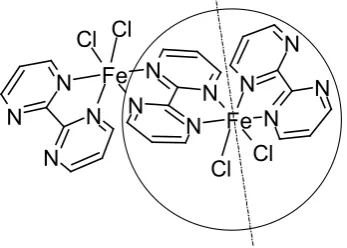
Considering the binuclear system mentioned above ([Fe2(bpym)3Cl4], see Fig. 1) we can choose one center and nearest ligands to form a single-center monomeric unit (marked with circle in Fig.1)
N
N N N
N N
N N
Cl Fe N
N N
N Fe Cl
Cl Cl
Fig. 1. Fe2(bpym)3Cl4 binuclear complex. Monomeric unit Fe(bpym)2Cl2 is marked with a circle around, dotted line shows the C2 axis.
This unit seems to be symmetrical. The highest symmetry group possible in this case is C2. The main symmetry axis is also shown in Fig.1.
N N1'
N N2' Cl1
Fe N1 N
N2 N
Cl1'
N
N2' N
N1'
N2" Fe N1 N N2
N
N1"
N N
(1) (2)
Fig. 2. Fe(bpym)2Cl2 (1) and [Fe(bpym)3]2+ (2) systems with atom numbering.
Methods of calculations
Geometry confi gurations of the systems under consideration were optimized using ab initio (ROHF) gradient methods realized in PC GAMESS [5] quantum chemistry package. Geometry optimizations were performed for states with total spin value (S) equal to 0 and 1.
Electronic structure calculations were performed using ROHF method with and without taking in consideration confi guration interactions (CI). CI basis is discussed below.
In all calculations STO-6G (Slater-Type Orbital approximated by 6 Gauss-type orbitals) orbital basis set was used.
Results and discussion
The fi rst studied compound is Fe(bpym)2Cl2 neutral complex with C2 symmetry as it was mentioned before. The second compound is the [Fe(bpym)3]2+ complex. The highest possible point group for this case is D
3 (see Fig.2). Three
axes C2 can be selected to go through each one of three bipyrimidine molecules centers and iron atom and C3 axis could be selected to go through iron atom and to be perpendicular to the plane in which three C2 axes lay (in Fig.2 C3 axis is perpendicular to the image plane).
The geometry data on these complexes are given in Table.1. and Table.2. There are presented calculated geometry data for both complexes and experimental data for [Fe(bpym)3]2+ reported by de Munno et al in [3] and van Albada G.A.
et al in [4].
Table 1
Bond distances and angles in Fe(bpym)2 Cl2 (1)
R (Fe – A), Å ∠ (N1 – Fe – A), deg ∠ (Cl1 – Fe – A), deg
A N1 N2 Cl1 N2 N1’ N2’ Cl1’ N1 N2 N2’
Calculated 1.892 1.876 2.196 83.72 174,96 92.64 93.61 89.96 89.21 176.04
Table 2
Bond distances and angles in [Fe(bpym)3]2+ (2)
R (Fe-N1), Å ∠ (N1–Fe–N2), deg ∠ (N1–Fe–N1’), deg ∠ (N1–Fe–N2’), deg Exp [3], [4] 1.970, 1.968-1.975 81.0, 81.04-81.66 88.31-95.76 173.90-175.41
From tables data it is seen that calculated geometry (at least for complex 2) is in good accordance with experimental data.
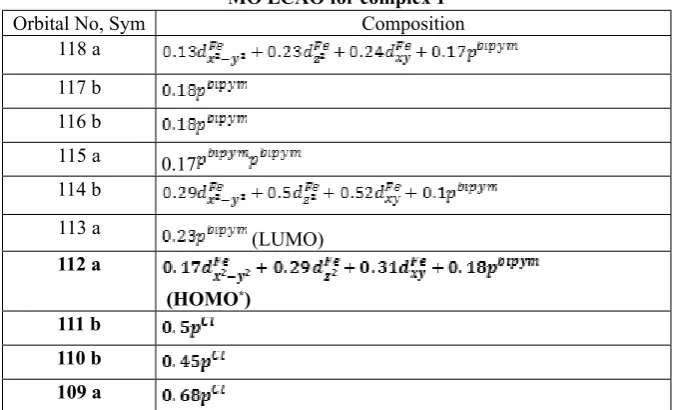
Calculated one-electron states which were used for CI calculations are presented on Fig.2. Their analytical forms are given in Table 3 and Table 4. It is seen that in both cases many active orbitals include large contributions from iron d-orbitals.
(1) (2)
Fig.3.One-electron states of monomers Fe(bpym)2Cl2 (1) and Fe(bpym)32+ (2). Electrons are placed according to the
ground states obtained.
Table 3
MO LCAO for complex 1
Orbital No, Sym Composition
118 a 117 b 116 b
115 a 0.17
114 b
113 a (LUMO)
112 a
Table 4
MO LCAO for complex 2 Orbital No.,
Sym
Composition 138 e
137 e
136 a2 (LUMO)
135 e
(HOMO*)
134 e 133 a1
*HOMO levels are shown according to ROHF calculations results.
The main criteria for choosing the MOs for CI basis were their composition (main contributing AOs) and the energy gap between them and HOMO (LUMO) level. The size of the CI basis was also chosen so that the possible number of confi gurations to be big enough.
For complex 1 it is seen that HOMO levels are two degenerated states with main contribution of dFe orbitals as
well as HOMO-1 level. LUMO is composed from p-orbitals of the three bipyrimidine ligands. HOMO and LUMO levels are very well separated (ΔE ≈ 6.8eV (0,25a.u.))
In the case of the complex 2 the main contributors to the most active levels are d-orbitals of the iron atom, p-orbitals of the chlorine atoms and p-orbitals of the nitrogen atoms of the bipyrimidine ligand.
The CI calculations for Fe(bpym)2Cl2 were performed using 108 core orbitals and 10 active with 8 electrons which give 22100 determinants with Sz=0. In case of the Fe(bpym)32+ we have used 132 core orbitals and 6 active with 6
electrons which give 400 determinants with Sz=0 (175 with S=0; 189 with S=1; 35 with S=2 and 1 with S=3).
The active orbitals in both cases were selected to include highest occupied levels that contain contributions from metal d-orbitals and so these orbitals can be considered “magnetic orbitals” (see [1]).
(1) (2)
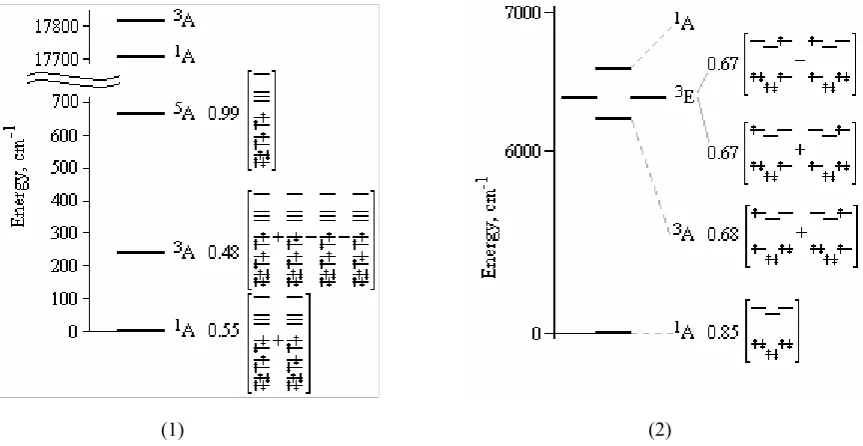
Fig.4.Lowest multielectronic states of the (1) Fe(bpym)2Cl2 and (2) [Fe(bpym)3]2+. Only the most contributing
electronic confi gurations are presented with corresponding coeffi cients. Orbitals populations are shown by arrows.
The multielectronic states of the complexes 1 and 2 are presented on Fig.4. In case of the complex 1 we have very interesting picture. The levels are placed according to Lande rule. In this case the ground state is singlet. The fi rst excited state which is triplet-one is only 240 cm-1 above the ground state and the second excited state is a quintet at 660cm-1
above the ground state. In this case the lowest excited states could be populated at normal temperatures.
In case of complex 2 ground state is singlet too. This result is in accordance with experimental data given both in [3] and [4]. The gap between the ground and the fi rst excited state is about 6100cm-1 and so the excited states are not
populated at normal temperatures. Conclusions
The results obtained show that values of the localized spins on centers in Fe2(bpym)3Cl4 complex cannot be presupposed to be equal to 2. The both studied single-center units were shown to have singlet ground states in accordance with experimental data and cannot be used in Heisenberg model. This means, that the only way to successfully develop any suitable model that will describe not only the behavior of the complete system, but the internal interactions that take place there, is to proceed with the magnetic properties of polynuclear complexes quantitatively by both the experimental or theoretical ab initio mean.
References Kahn O.
[1] Molecular magnetism. N.Y. : VCH Publishers Inc., 1993. Tsukerblat B.S.
[2] Group Theory in Chemistry and Spectroscopy. A Simple Guide to advanced Usage. London : Academic Press, 1994.
De Munno G., Julve M., Real J.A.
[3] Inorg. Chim. Acta. 1997, Vol. 255, 1, pp. 185-188. van Albada G.A., Smeets W.J.J., Spek A.L. and Jan Reedijk.
[4] J. Chem. Cryst. 2000, Vol. 30, 7, pp. 441-444.
![Fig. 2. Fe(bpym)2Cl2 (1) and [Fe(bpym)3]2+ (2) systems with atom numbering.](https://thumb-us.123doks.com/thumbv2/123dok_us/8796595.1769559/2.595.103.483.81.212/fig-fe-bpym-cl-bpym-systems-atom-numbering.webp)