INTRODUCTION
Nowadays, aluminum alloys are widely used in the industry owing to their properties and the availability of many forming techniques, includ-ing castinclud-ing, metal forminclud-ing and machininclud-ing [1, 16, 18]. Aluminum alloys have low density and high corrosion resistance. In addition, their mechani-cal properties can be shaped to a great extent due to the possibility of using a numerous group of alloying elements and the thermal workability of many of these alloys [8].
The 7075 is an Al-Zn-Mg-Cu aluminum alloy characterized by excellent mechanical properties such as high strength, and stress corrosion crack-ing resistance. The aforementioned alloy is used for manufacturing the parts used in the aviation and automotive industry [7, 15].
However, the high strength properties go hand in hand with limited formability, which is significantly lower than in the 5xxx and 6xxx al-loys [3]. The limited cold-forming options [11], temperature sensitivity during hardening [13] as well as susceptibility to cracking at high strain rate [2] are the main obstacles in using the 7075 alloy more widely in the automotive industry.
As far as the 7075 alloy is concerned, the major hardening operation is solution heat treatment and ageing, which leads to the creation of fine precipi-tates [12], whereas the strain-caused fragmentation of grain and hardening work are of lesser signifi-cance, since dislocations are the preferred areas of distribution of supersaturated solutions [14].
Traditionally, extruded rods, sheets and plates [1] are subjected to plastic forming. Typical tech-nological process for the 7075 alloy consists of: Volume 13, Issue 4, December 2019, pages 15–21
https://doi.org/10.12913/22998624/112361
Creating the Structure and Properties of 7075 Alloy Casts
by Thermal and Forming Processes
Krzysztof Majerski
1, Anna Dziubińska
1*, Grzegorz Winiarski
1, Michał Szucki
2,
Krzysztof Drozdowski
31 Lublin University of Technology, Faculty of Mechanical Engineering, ul. Nadbystrzycka 36, 20-618 Lublin,
Poland
2 AGH University of Science and Technology in Cracow, Faculty of Foundry Engineering, ul. Reymonta 23,
Building # D8, 30-059 Cracow, Poland
3 ZOP Co. Ltd Forging Plant, ul. Kuźnicza 13, 21-045 Świdnik, Poland
* Corresponding author’s e-mail: [email protected]
ABSTRACT
In this paper, the hot formability of 7075 aluminum alloy sand and permanent casting ingots were verified. The experiment was carried out by using casting, heat treatment (homogenization) of ingots and conducting isothermal compression tests at temperatures of 420-500°C. The effect of the forming temperature on the microstructure, the tendency for crack formation and hardness were determined. The results show that ingots in the as-cast state have a dendritic network structure rich in the second phase precipitation on the grain boundaries. After the homogeniza-tion process, the microstructure is significantly more balanced. The forming process at 420-480°C of sand casts leads to significant grain elongation and crack formation, mainly at the grain boundaries. Raising the forming temperature to 480-500°C leads to a reduction in the occurrence of cracks. On the other hand, permanent mold castings do not reveal cracks during deformation in the temperature range 420-480°C.
Keywords: Aluminum alloys, Heat treatment, Metal Forming, Microstructure
Research Journal
Accepted: 2019.11.15ingot homogenization and extruding of the semi-finished product, annealing, forming and, later on, heat treatment, which causes the process to be complicated and expensive [11].
Therefore, numerous studies are conducted to increase the technological effectiveness of the 7075 alloy forming. Paper [12] presents the results of the research on lowering the forming temperature of deep-drawn sheets. It was stated that using thin sheets and limiting the tempera-ture to 220°C causes no significant decrease in the mechanical parameters. As a result, additional heat treatment can be omitted. The authors of the article [11] present the results of the process of forming car brackets, made of T6 state 7075 al-loy. It was stated that blank and tool temperature is equal to 240°C and enough to obtain the proper geometry of the end product. Due to the insignifi-cant decrease of the mechanical properties caused by temperature growth conducting other heat treatment processes is economically unjustifiable.
The article [20] presents the results of the re-search on formability and mechanical properties of aluminium alloy 7075 sheets in the hot stamp-ing process. The best results were observed for 400°C and forming velocity equal to 50 mm/s.
Forming of thin, heat treated aluminium sheets is a well-known process for the discussed alloy. The majority of the occurring problems are connected to volume forming.
The article [14] presents the possibility of ap-plying hot thermo-mechanical processing HMTP, which allows for achieving a synergistic effect of precipitate hardening and grain refinement, which leads to obtaining better combinations of ductility and strength in comparison to the T6 treatment.
Furthermore, the methods for improving the properties of the product are introduced, e.g. by decreasing the grain volume as a result of mul-tiple deformations. However, they are, dedicated mostly to the processes in which the billet is in the form of extruded semi-finished product [9] and are not focused on increasing the technologi-cal effectiveness of the process, but on obtaining the best possible properties.
Currently, an increased interest in the meth-ods incorporating the casting and plastic treat-ment processes can be observed [10]. It is pos-sible to manufacture ingots close in shape to the final product, the shape and dimensions of which are defined in forging. The plastic treatment of the ingot results in better mechanical properties as well as structure. Moreover, the research on
in-tegrated casting-forming processes is conducted for the use of automotive industry [21].
The authors of the work [6] suggest applying continuous casting in order to obtain semi-finished products for plastic working.
In the article [17] a comparison of the form-ing possibilities of the 7075 aluminium alloy, at-tained using the direct chill casting method with and without homogenization, is presented. It was observed that despite the occurrence of second-ary phases (MgZn2), the non-homogenized in-gots had smaller areas of unsteady flow on pro-cess maps, whereas in the case of temperatures above 300°C even applying the strain rate equal to 10 1/s did not cause the material to crack dur-ing compression.
According to the authors of the article [4], us-ing the cast billets made of the 7075 aluminum alloy in the forging process allows for reducing the time of the technological process. The den-dritic structure significantly decreases the ideality factor, mostly due to temperature sensitivity and susceptibility to cracking. It was suggested that the temperature within the range 425-465°C and strain between 0.01-1 1/s is suitable. Moreover, the possibility of applying different criteria for anticipating cracking was verified.
According to the authors of the article [4] the possibility of using the batch in the form of cast-ings for the metal and sand molds would allow for a significant reduction in the technological costs in the case of the 7075 aluminum alloy. The pos-sibility of applying the aforementioned technol-ogy to other alloys is currently researched [5, 20]. Sand moulds are more suitable for small lot pro-duction, whereas the ingots for metal moulds can be used in manufacturing more products.
The objective of this study is to investigate the hot workability of the EN AW7075 alloy in the form of the sand mould and metal mould casts in terms of obtaining an advantageous microstructure.
MATERIALS AND METHODS
The aluminum alloys were cast into metal and sand mould (Fig 1a-b). The sand molds made of green sand with about 5% of water content (Fig. 1a) as well as steel permanent mold heated up to 300°C. The castings had the shape of a cylinder with the dimensions of ϕ32x80 mm. A K-type thermocouple was placed in the geometric center of the casting (Fig 1b), which enabled the temperature measure-ment during solidification and cooling process.
After pouring the metal into moulds, it was left there for ca. 30-45 min and then extracted. The casting was then subjected to machining in or-der to obtain the samples for the hot compression test, whereas from the central parts of the rolls, the samples for microstructural testing were attained. The samples for hot compression were subjected to homogenization at 475°C for 24h in order to obtain a homogenous chemical composition. The temper-ature of billet was set to 420, 440, 460, 480 and 500°C in order to determine the range of workabil-ity of the 7075 alloy. The forging tests were per-formed in accordance with the PN-H-04411:1983 standard by means of an open-die hot forging on a hydraulic press, Nargesa MX-700 (Fig 2a).
The roll samples with the dimensions d0 x ho
(20x30 mm) in accordance with the dependency (2.1) were deformed in line with the scheme in Fig.
2b to the final height h1 described by the depen-dency (2.2). The tools remaining in the direct con-tact with the material were heated to 250˚C, strain rate was equal 8 mm/s. The analysis involved in-vestigation of alloy workability, its susceptibility to crack occurrence, the hardness and changes of alloy microstructure during the forming process.
In order to create the metallographic samples, the material fragments were cut using a cutter with water cooling system and abrasive blades for cutting non-ferrous metals. The obtained frag-ments were mounted in resin and subjected to grinding and polishing processes.
The initial grinding was conducted on grind-ing discs with granularity 220, 500 and 1200. Fur-ther on the samples were polished using diamond slurry with granularity equal to 3 µm and alumina powder in colloidal silica suspension with granu-larity 0.05µm. After such treatment, the sections were etched by Keller’s reagent: 95 ml distilled water, 2.5 ml HNO3, 1.5 ml HCl, 1.0 ml HF.
The tests were conducted using the tions of the roll samples as well as the cross-sec-tions of the forgings. The observacross-sec-tions were carried out in central and surface parts of the roll samples, whereas in the case of the forgings the central, the surface and side parts of the samples were observed. Table 1. The 7075 alloy – chemical composition according to [EN 1706:2010 (E)]
Symbol Cu Cr Fe Mg Mn Si Ti Zn Al Other
7075 1.2 - 2 0.18 - 0.28 Max 0.5 2.1 - 2.9 Max 0.3 Max 0.4 Max 0.2 5.1 - 6.1 Rest 0.15
Fig. 1. Process of casting a) in a sand mould b) in a permanent mould
The Nikon MA200 optical microscope and Phenom proX scanning electron microscope were used in the microstructure analysis. The hardness tests were conducted using the Vickers method. The measurements were taken using the FM800 Future-tech hardness tester. The measurements were taken in HV1 scale, in compliance with PN-EN ISO 6507-1:2006.
RESULTS
Figure 3 presents the castings as well as the cooling curves obtained for the sand and metal
mould. Upon analysing the cooling curves, a sig-nificant difference between the cooling rate of the alloy in sand and metal moulds was observed. Cooling in a metal mould is much faster. On the basis of the obtained cooling curves, the approxi-mate setting times in sand moulds and dies (Table 2) were established (based on DTA analysis). Fig. 2. a) Hot compression stand, b) Hot compression sample scheme
Fig. 3. Cooling curves for the 7075 alloy: a) sand mould, b) metal mould
Table 2. Estimated setting time in sand moulds and dies
Mold type Time [s]
Sand 437
Permament 29
a) b)
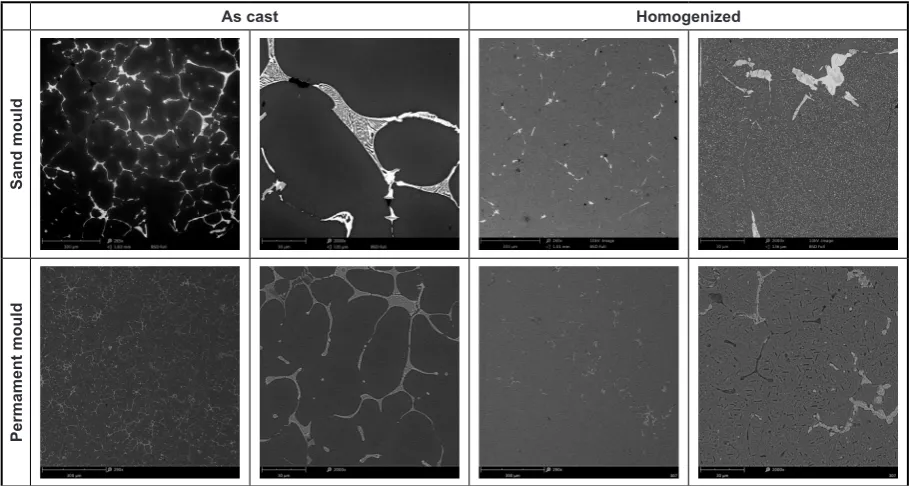
The setting time of the casting in a sand mould is significantly longer than for the metal mould. This phenomenon is caused by a signifi-cant difference in thermal conductivity of the ma-terial of the mould and can influence the structure of the casting. A microstructural analysis of the materials after casting and homogenization was conducted on non-etched sections, using a scan-ning microscope. Table 3 presents a comparison of the microstructure obtained using SEM during the observation of the non-etched sections.
After casting, the microstructures are den-dritic. Along the boundaries of grains, numerous eutectic precipitations, consisting of intermetal-lic phases are to be observed. As far as a casting from a sand mould is concerned, both grains and precipitations are larger. As a result of the
homog-enization process, dissolution of eutectics and a significant number of intermetallic precipitations can be observed. The homogeneity of alloys was considerably increased, which indicates that the strain possibility is higher. The remainders of the undissolved precipitations are more significant in the case of the sand mould.
An assessment aluminum alloy susceptibil-ity to plastic deformation was conducted by the means of visual evaluation of castings, carried out with the unaided eye after upsetting and a micro-structural analysis.
Table 4 presents the photographs of the sam-ples after hot compression tests. An analysis of the side surface of the samples showed that for each upsetting temperature the samples from the sand moulds show cracks or crack centres. How-Table 3. Microstructures of the material after casting and homogenization (SEM)
As cast Homogenized
Sand mould
Permament mould
Table 4. Test surface of the samples after hot compression test
420°C 440°C 460°C 480°C 500°C
Sand mould
ever, in the case of the samples upset at 500˚C, the loss of structural integrity is the least sig-nificant. Therefore, it can be assumed that this temperature is the most suitable for deforming the 7075 aluminium alloy in a sand mould. The evaluation of the side surface of the samples from metal moulds, acquired in the temperature range between 420-480°C showed no signs of cracking. The only cracks detected occurred on the side sur-face of the sample deformed at 500°C.
Table 5 shows the microstructures of selected areas of the upset forging’s the cross sections.
In the top of the upset forgings, both from the sand and metal moulds, a majority of original equiaxed grains of a varied size can be noticed. In the boundaries of the grains one can observe undis-solved intermetallic phases. In the case of the sand mould castings, those phases are significantly larg-er. The range of strain and deformation of grains is insignificant in this area. The size of grains did not change after the homogenization process.
In the central area of the upset forging, a sig-nificant deformation of the grains occurs. Howev-er, the grains show signs of dynamic recovery. As far as a casting from a sand mould is concerned,
a significant number of precipitations from inter-metallic phases can be observed in the boundaries of grains, which show no signs of deformation.
The side areas of the upset forgings show an average deformation ratio as far as the castings from sand mould are concerned. In this type of casting, one can notice that the areas of incon-sistency are located in the boundaries of grains, showing the characteristics of the cracks, occur-ring inside and advancing towards the surface.
In the central areas of the samples, the hardness tests were conducted. Table 6 presents the results of the measurements. Upon analysis of the results of the hardness test it was stated that the castings from sand moulds are harder than the ones obtained from permanent moulds. Moreover, immediately after casting, the samples showed the highest values of standard deviation, which indicates its inconsistent structure. After the homogenization process, the hardness of the product decreased significantly, for the sand and permanent moulds by 38% and 22%, respectively. As a result of hot deformation and rap-id cooling, the hardness of the products increases again, reaching the values of 132.8 HV for the sand form and 135.7 HV for metal form.
Table 5. Microstructures of the cross-sections after upsetting
Top Core Side
Sand mould 500°C
Permament mould
480°C
Table 6. Results of the hardness tests
Description As cast Homogenized Hot compressed
Sand mould Permament mould Sand mould Permament mould Sand mould Permament mould Average Hardness
HV1 138 111.1 94,1 86.6 132.8 135.7
CONCLUSIONS
The article presents the results of research on using the castings from sand and metal moulds with the 7075 aluminium alloy as charge material for forging in the temperature ranging from 420-500°C.
On the basis of the research it was stated that:
• The differences in microstructure of the castings from different moulds occur, mainly a larger size of grains as well as precipitations of the intermetallic phases in sand moulds that do not dissolve entirely in the homogenization process.
• The results of hot compression test indicate that the castings from sand moulds are more prone to cracking in of the side surface of upset forg-ings in the researched range of temperature.
• In the case of upset forgings from sand moulds, the cracks occur in the boundaries of grains, in the areas of significant precipitation of the intermetallic phases.
• The castings from sand moulds ought to be subjected to a longer homogenization process or the deformation reduced.
• The non-homogeneous microstructure between the different areas of upset forgings indicates that it is necessary to form the casting in such a way that allows for obtaining the possibly most similar level of deformation in the entire billet.
ACKNOWLEDGMENTS
Project “The Design and Implementation of an Innovative Low-Waste Metal Forming Technol-ogy for High-Strength Light Metal Alloys Used in the Aircraft and Automotive Industry”; No. LIDER/10/0058/L-8/16/NCBR/2017. Total cost of the Project: 1,200,000 PLN. The project is financed by the National Centre for Research and Develop-ment under the 8th edition of the LIDER Programme.
REFERENCES
1. Davis, J.R.: ASM Specialty Handbook: Aluminum and Aluminum Alloys. (1993).
2. G.W. Kuhlman: Forging of aluminum alloys. ASM Handbook, Vol. 14A Metalwork. Bulk Form. (2005). https://doi.org/10.1361/asmhba0003996. 3. George, E.T., MacKenzie, D.S.: Handbook of Alu
-minum: Volume 2: Alloy Production and Materials Manufacturing, (2003).
4. Guo, L. et al.: Processing map of as-cast 7075 alu-minum alloy for hot working. Chinese J. Aeronaut. (2015). https://doi.org/10.1016/j.cja.2015.08.002.
5. Kim, H.. et al.: A study of the manufacturing of tie-rod ends with casting/forging process. J. Ma-ter. Process. Technol. 125–126, 471–476 (2002). https://doi.org/10.1016/S0924-0136(02)00323-0. 6. Kwak, Z. et al.: Microstructure of selected 7xxx se
-ries aluminum alloys obtained by semi-continuous casting. Pr. Inst. Odlew. 56, (2016).
7. Moćko, W., Kowalewski, Z.L.: Dynamic proper -ties of aluminium alloys used in automotive indus-try. J. KONES. 19, 345–351 (2012).
8. Mondolfo, L.F.: Aluminum alloys: structure and properties. Elsevier (2013).
9. Naser, T.S. Ben, Krallics, G.: Mechanical behavior of multiple-forged Al 7075 aluminum alloy. Acta Polytech. Hungarica. 11, 7, 103–117 (2014). 10. Płonka, B. et al.: Application of Al alloys, in the form
of cast billet, as stock material for the die forging in automotive industry. Arch. Civ. Mech. Eng. (2008). https://doi.org/10.1016/S1644-9665(12)60201-5. 11. Polak, S. et al.: Warm forming of 7075 aluminum
alloys. Procedia Eng. 207, 2399–2404 (2017). 12. Porter, D.A. et al.: Phase Transformations in Metals
and Alloys, (Revised Reprint). CRC press (2009). 13. Robinson, J.S. et al.: The influence of quench sen
-sitivity on residual stresses in the aluminium alloys 7010 and 7075. Mater. Charact. (2012). https://doi. org/10.1016/j.matchar.2012.01.005.
14. Segal, V.M.: New hot thermo-mechanical process-ing of heat treatable aluminum alloys. J. Mater. Process. Technol. 231, 50–57 (2016). https://doi. org/10.1016/J.JMATPROTEC.2015.12.009. 15. Starke, E.A., Staley, J.T.: Application of
mod-ern aluminum alloys to aircraft. Prog. Aero-sp. Sci. 32, 2–3, 131–172 (1996). https://doi. org/10.1016/0376-0421(95)00004-6.
16. Totten, G.E., MacKenzie, D.S.: Handbook of Alu -minum: Vol. 1: Physical Metallurgy and Processes. CRC press (2003).
17. Wang, H. et al.: Warm forming behavior of high strength aluminum alloy AA7075. Trans. Nonfer-rous Met. Soc. China (English Ed. (2012). https:// doi.org/10.1016/S1003-6326(11)61131-X.
18. Winiarski, G. et al.: The influence of tool geometry on the course of flanges radial extrusion in hollow parts. Arch. Civ. Mech. Eng.17, 4, 986-996 (2017). https://doi.org/10.1016/j.acme.2017.04.002.
19. Xiao, W.-C. et al.: Deep drawing of aluminum alloy
7075 using hot stamping. Rare Met. 36, 6, 485–493 (2017). https://doi.org/10.1007/s12598-017-0919-4. 20. Zhou, H.T. et al.: A study of automobile brake
bracket formed by casting-forging integrated form-ing technology. Mater. Des. (2015). https://doi. org/10.1016/j.matdes.2014.11.046.
![Table 1. The 7075 alloy – chemical composition according to [EN 1706:2010 (E)]](https://thumb-us.123doks.com/thumbv2/123dok_us/8804765.1773959/3.595.75.521.512.746/table-alloy-chemical-composition-according-en-e.webp)