The Development of the Future European Knowledge Workers.
An Academic Perspective
Ramona – Diana LEON Faculty of Management
National University of Political Studies and Public Administration 30A Expoziției Blvd., Sector 1, 012104, Bucharest, Romania
Abstract. The research purpose was to determine whether the economics and business administration higher education institutions from the European Union members states are facilitating the development of the future knowledge workers or not. In order to achieve this goal, we employed an exploratory research and we combined a qualitative approach with a quantitative one. We focused on the common courses that are taught in the best European Union higher education institutions, according to the QS World University Rankings. We applied a content analysis to 267 syllabuses that belonged to 21 economics and business administration faculties. Then we employed a logistic regression in order to determine if the teaching methods, used during the bachelor studies, can predict the development of the future knowledge workers. The results have showed that the economics and business administration higher education institutions from the European Union member states tend to respond positively to companies’ necessity by developing almost 50% of the “ideal” knowledge worker profile. These findings have implications on both educational and managerial level. At the educational level, it reflects the vulnerable area of the educational process namely, skills development. It seems to be forgotten that education is more than just sharing explicit knowledge; it is about developing the current and the future citizens, building characters and stimulating the need for lifelong learning. At the managerial level, it brings forefront the deficiencies of the future human resources and it indicates the need for adapting the organizational culture and practices. What had been overlooked by the educational system may be complemented by an open organizational culture, an inspirational leadership and an effective coaching process.
Keywords: knowledge workers, university, teaching methods, Europe 2020 Strategy.
General assumption regarding the concept of knowledge worker
The Development of the Future European Knowledge Workers. An Academic Perspective
development; social inclusions and poverty reduction; and climate/energy), its achievement depends mainly on the quality of higher education or, more exactly, on the manner in which this manages to adapt to the demand of the economic agents.
Besides, in the current knowledge economy, most scholars concentrate either on highlighting that the knowledge workers are the key strategic resource of the modern organizations (Adelstein, 2007; McFarlane, 2008; Murray & Greenes, 2007; Schiuma, Carlucci, & Lerro, 2012; Sveiby & Simons, 2002) or on evaluating the knowledge workers value (Blickenstaff, 2012; Farrell & LaMotta, 2008; Ghezel Arsalan, Dahooei & Shojai, 2014; North & Gueldenberg, 2011; Patalas-Maliszewska, 2013). Both approaches tend to have a limited perspective on the subject; they concentrate on the outputs and neglect the inputs. They focus on who the knowledge workers is and what he/she can do to increase company’s success on the market but they neglect the processes through which the knowledge worker is developed. As Drucker (1959) states knowledge workers are people who apply knowledge to work. Therefore, they should not be taken for granted; their creation is ensured in a specific environment which facilitates the acquisition and development of skills, abilities and competences. This kind of environments is usually provided by the educational institutions; these are the ones that support the development of the main cognitive capabilities emphasized by Bennet and Bennet (2010, p.246):
- “Noticing: the ability to observe the world around us and identify those things relevant to our area of interest.
- Scanning: the ability to review and survey a large amount of data and information and selectively identify those areas that may be significant. - Patterning: the ability to review, study, and interpret large amounts of data/events/information and identify causal or correlative connections that are relatively stable over time or space and may represent patterns driven by underlying phenomena.
- Sensing: the ability to take inputs from the external world through our five senses and ensure the translation of those inputs into the mind so that it represents as accurate a transduction process as possible.
- Integrating: the capability to take large amounts of data and information and pull them together to create meaning, frequently called sense-making”.
individuals’ chances of getting employed. If their curriculum is out of line and their offer is not valued by the public and private economic agents then they will contribute to the growth of unemployment. Second of all, they contribute to the research and development activities and facilitate the development of innovations. The last ones may generate an increase in productivity, sales, benefits which support company’s development (new job openings, new investments, new and cleaner technologies etc.). Last but not least, education may increase people awareness to economic, social and environmental issues and it may also facilitate the development of a responsible citizen.
Therefore, in order to satisfy the complex requirements of the Europe 2020 Strategy, the European Union faculties should concentrate on developing future knowledge workers. In other words, the main skills and abilities that they should develop among their graduates are the ones that characterize the knowledge worker (Table 1). Practically, they should invest in developing students’:
- specialized knowledge – will guarantee the volume and quality of explicit knowledge that the graduate owns. It will represent the informational baggage with which each graduate will enter on the labor market.
- learning skills – will ensure individual’s capacity of developing himself/herself continuously. He/She will improve his/hers ability of keeping in touch with what is happening in the environment and will learn how to adapt to the future challenges.
- analysis and synthesis capacity – will emphasize individual’s ability of understanding a complex situation and also his/hers capacity of extracting the most important information.
- problem-solving skills – will improve graduate’s critical and creative thinking. He/She will be able to find answers to current problems and also to offer innovative and creative solutions to complex situations.
- time-management skills – will guarantee individual’s capacity of working with deadlines. He/She will be capable of working under pressure, in stressful conditions and will be able to organize his/hers activities efficiently.
- written and oral communication skills – will highlight graduate’s ability of expressing himself/herself in writing and also orally. The individual will know how to transmit the information that he/she has or needs in both written and oral form.
- teamwork skills – will facilitate individual’s capacity of accessing the knowledge that his/hers colleagues own and also will allow him/her to disseminate his/her knowledge.
The Development of the Future European Knowledge Workers. An Academic Perspective - using ICT skills – will highlight the fact that the individual is capable of using the information and communication technologies (ICTs) in order to gather, process and disseminate data and information.
Table 1. Skills and abilities of the knowledge worker (Leon, 2011, pp.212-213)
Author/-s, year Skills and abilities
Dunne, Bennett, and Carré
(1997) comunication skills; study skills;
problem-solving skills;
political and economical literacy;
using ICTs;
networking;
coping with uncertainty.
Hargreaves (1999) flexibility;
networking;
creativity;
learning skills.
Jenks (2004) critical thinking;
creativity;
sensitivity;
respect;
appreciation of other points of view;
interacting and working cooperatively and productively with others.
Johnson (2006) technology skills (using ICTs in order to
collaborate, learn, solve problems, make decisions, construct models, produce creative works and interact with peers, experts and other audience);
information problem-solving skills and
higher-order thinking skills (seeking information, using information creatively, demonstrate, interpret, analyze, compare, estimate);
conceptual skills (seeing the large piture, synthesizing information, being emphatic).
Lindberg (2008) risk-taking skills;
teamwork skills;
flexibility;
strategic analysis. Uluorta and Quill (2009) flexibility;
using ICTs;
innovation;
learning skills.
Sahlberg and Boce (2010) broad cognitive learning;
communication and collaborative skills;
risk-taking skills;
creativity;
innovation.
Leon (2011) learning skills;
technology skills;
problem-solving skills;
teamwork skills;
communication skills;
risk-taking skills;
critical thinking.
But are the economics and business administration higher education institutions from the European Union member states managing to develop this profile of graduate? Did they adapt their curriculum to the dynamic and uncertain economy in which their students are going to work or they remained faithful to the traditional school paradigm? Will they bring their contribution to the achievement of the Europe 2020 Strategy or they will be a source of vulnerability? We will offer an answer to these questions in the following sections. First, we will present some methodological aspects; we will highlight the main objectives and also the methods and techniques that we have used. In the third part, we will emphasize the skills and abilities on which the courses taught at the undergraduate level, in the economics and business administration higher education institutions from the European Union member states, are focusing on. We will also emphasize the impact of the teaching methods on the development of the future knowledge workers. In the end, we will summarize the main implications of our research and we will bring forward some directions for future research.
Research methodology
Goal and objectives
The Development of the Future European Knowledge Workers. An Academic Perspective
have the necessary skills and abilities in order to be described as “knowledge workers” and to facilitate companies’ success in a dynamic and unpredictable knowledge economy.
Our main research objectives were:
- to identify the most important economics and business administration higher education institutions from the European Union member states; - to analyze the syllabuses of the common courses that are taught to the undergraduate students from the economics and business administration higher education institutions;
- to identify the skills and abilities that the graduates may possess, according to the academic curriculum developed in the economics and business administration higher education institutions from the European Union member states;
- to identify the teaching methods used during the bachelor studies in the faculties of economics and business administration from the European Union member states;
- to determine the influence that the teaching methods used at the undergraduate level may have on the development of the future knowledge workers.
Data collection
In order to achieve our research goal, we developed an exploratory research in which we combined the advantages of a qualitative approach with the ones of a quantitative approach.
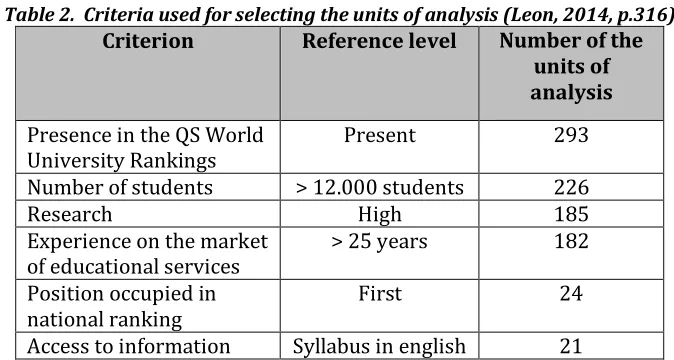
Table 2. Criteria used for selecting the units of analysis (Leon, 2014, p.316)
Criterion Reference level Number of the units of analysis
Presence in the QS World
University Rankings Present 293
Number of students > 12.000 students 226
Research High 185
Experience on the market
of educational services > 25 years 182
Position occupied in national ranking
First 24
Access to information Syllabus in english 21
Besides, we noticed that only 21 universities from the European Union member states met all the selection criteria. From these, 17 have a faculty dedicated to economics and business administration studies while 4 included these studies with the social ones and established a faculty of social studies. Despite these differences, we analyzed the whole 21 faculties because, as long as their students graduate an economic specialization, they are going to compete on the same dynamic market.
In the next stage, we analyzed the web pages of the selected economics and business administration higher education institutions and we identified the common courses that are taught during the undergraduate studies, no matter the area of specialization that students will choose. In this way we identify 267 syllabuses. To each of them we applied a content analysis in which the units of analysis were represented by educational goals, practical assignments, teaching and evaluating methods. We analyzed both educational goals and practical assignments in order to determine if courses’ objectives are transposed into reality or they remain on a declarative stage. Techniques like systematization and tabling had been used.
Data processing
In order to give a meaning to the collected data, we used a frequency analysis and a logistic regression analysis using Microsoft Excel application and SPSS Program.
The Development of the Future European Knowledge Workers. An Academic Perspective
reflects the intensity with which a specific skill or ability is promoted in the economics and business administration higher education institutions from the European Union member states.
The logistic regression analysis was chosen because of its robust character (Hair, Black, Babin, Anderson, & Tatham, 2006) and its ability to explain the relationship between a dependent (nominal or non-metric) variable and more independent (nominal, categorical, continuous) variables (Hair et al., 2006; Hosmer & Lemeshow, 2000). We used it in order to determine if the teaching methods (independent variables), used during the bachelor studies, influence the development of the future knowledge workers (dependent variable).
Both types of variables – the dependent and independent ones – were dummy variables. In the case of all five independent variables (namely, lectures, solving problems activities, case study activities, discussions and teamwork activities), “1” – represented “the use of the teaching method during the courses” whereas “0” represented “the absence of the teaching method during the courses”.
In the case of the dependent variable, data was codified. We assumed that a student may become the future knowledge worker if the course to which he/she attends develops at least half of the necessary skills and abilities (Table 3). Therefore, “1” highlighted the fact that “through that course, the future knowledge worker is developed” while “0” emphasized that “through that course, the future knowledge worker is not developed”.
Table 3. Necessary skills and abilities in order to be a future knowledge worker
Knowledge worker’s
characteristics Sources
Specialized knowledge Dunne et al. (1997), Guo, Xiao, and Yang (2012), Leon (2011)
Learning skills Dunne et al. (1997), Hargreaves (1999),
Leon (2011), Mladkova (2015), Sahlberg and Boce (2010), Uluorta and Quill (2009)
Analysis and synthesis capacity
Jenks (2004), Johnson (2006), Leon (2011)
Problem-solving skills Dunne et al. (1997), Hendarman and
Tjakraatmadja
Mladkova (2015)
Time-management skills Leon (2011), Sahlberg and Boce (2010), Uluorta and Quill (2009)
Written communication
skills Dunne et al. (1997), Leon (2011), Sahlberg and Boce (2010)
Oral communication skills Dunne et al. (1997), Leon (2011), Sahlberg and Boce (2010)
Teamwork skills Jenks (2004), Leon (2011), Lindberg
(2008), Sahlberg and Boce (2010)
Risk-taking skills Dunne et al. (1997), Johnson (2006), Leon
(2011), Lindberg (2008), Mladkova (2015), Sahlberg and Boce (2010), Uluorta and Quill (2009)
Using ICT skills Dunne et al. (1997), Fan Ng (2016),
Johnson (2006), Leon (2011), Mansi and Levy (2013), Rozewski, Jankowski, Brodka, and Michalski (2015), Uluorta and Quill (2009)
The result of these analysis and their implications are presented in the following section of this article.
The profile of the future knowledge workers developed in the European universities
The Development of the Future European Knowledge Workers. An Academic Perspective
inquisitive nature, that will know what to do at their job (they will have the explicit knowledge necessary for performing their tasks), will keep in touch with what is happening in the micro- and macro-environment and will be capable of understanding and extracting the essential from a complex situation.
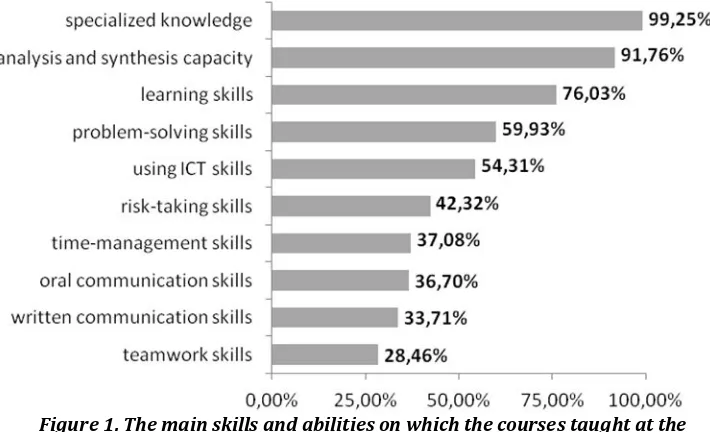
Figure 1. The main skills and abilities on which the courses taught at the undergraduate level focus on
Although on a first look it seems that the future graduates are going to become a valuable asset for any organization, we must notice that the development of two critical types of skills is rather neglected than encouraged. It is the case of the communication and teamwork skills, two aspects that are vital in an interconnected and fast changing world. Because of the lack of these skills, the future graduates will have difficulties in sharing their knowledge with others, writing a business project, report or letter, presenting their point of view, making a proposal to a colleague, manager or client or even in being part of a team. In other words, they will have all the knowledge that they need in order to do their job but they will not know how to use it efficiently.
The development of these skills is supported by the teaching methods that are used during the courses. As we can notice from Figure 2, most courses focus on lectures (98.88%), case studies (60.67%) and problem-solving activities (57.68%).
Figure 2. The main teaching methods used during the courses that are taught at the undergraduate level, in the economics and business administration higher education institutions from the European Union member
states
Most disciplines (98.88%) focus on using lectures because they have an important role in communicating conceptual and systematic knowledge. They are offering a general image on a specific topic and usually act as a starting point for further study. Since the activity is based on oral communication, it facilitates the processes of knowledge dissemination and acquisition between teachers and students. But, by attending to lectures, students are not only acquiring specialized knowledge regarding economic phenomena, they are also having access to teachers’ know-how and develop their listening skills. They learn how to maintain their concentration for a specific time and how to synthesize a big amount of information
Using case studies as teaching methods facilitates, first of all, the development of critical thinking. Students become capable of analyzing complex situations from different perspectives. They can identify a specific problem and they also develop their capacity of finding potential solutions. Besides, they have the opportunity to look beyond theory, to see how things are applied in the economic reality and to understand the connections between wide varieties of variables.
The Development of the Future European Knowledge Workers. An Academic Perspective
their assertiveness, confidence, actively listening, persuasion and compromise.
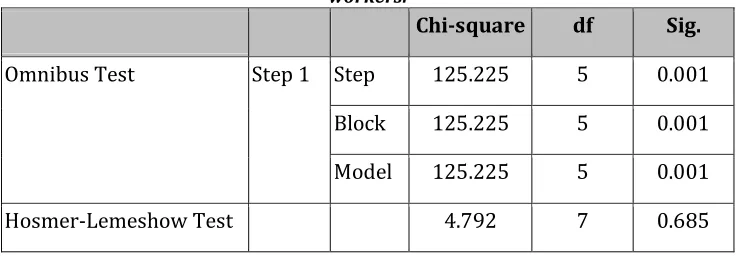
Based on the fact that the teaching methods determine the skills that students develop during the courses, we assumed that they may influence the development of the future knowledge worker. In order to properly determine this influence, we used the logistic regression analysis. The model was tested (Table 4) and since it passed the Omnibus test (the Chi-Square value for 5 degrees of freedom and a probability of 0.001 is 125.225 – greater than Chi-Square theoretical which equals 20.515) and the Hosmer-Lemeshow test (the level o significance is greater than 0.05), we rejected the null hypothesis. As a result, adding the teaching methods as variables to the model increases our ability to predict the development of the future knowledge workers in the economics and business administration higher education institutions from the European Union member states.
Table 4. Testing the model according to which the teaching methods used by the academic members influence the development of the future knowledge
workers.
Chi-square df Sig.
Omnibus Test Step 1 Step 125.225 5 0.001
Block 125.225 5 0.001
Model 125.225 5 0.001
Hosmer-Lemeshow Test 4.792 7 0.685
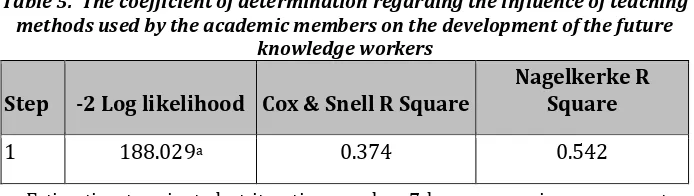
Table 5. The coefficient of determination regarding the influence of teaching methods used by the academic members on the development of the future
knowledge workers
Step -2 Log likelihood Cox & Snell R Square
Nagelkerke R Square
1 188.029a 0.374 0.542
a. Estimation terminated at iteration number 7 because maximum parameter estimates changed by less than 0,001.
The influence that each method has it on the development of the future knowledge worker was determined using the Wald Chi-Square statistic test (Table 6). This reflects the unique contribution of each predictor in the context of the other predictors being constant.
Employing a 0,05 criterion of statistical significance, we have noticed that problem-solving activities, discussions and teamwork activities have significant partial effects on the development of the future knowledge workers in the economics and business administration higher education institutions from the European Union member states. Taking these into account, we claim that by using:
- problem-solving activities as the main teaching method, there will be an increase in odds of developing the future knowledge worker by 34.917 times.
- discussions as the main teaching method, there will be an increase in odds of developing the future knowledge worker by 12.406 times.
- teamwork activities as the main teaching method, there will be an increase in odds of developing the future knowledge worker by 38.246 times.
Table 6. The influence of each teaching method on the development of the future knowledge workers in the economics and business administration
faculties from the European Union member states
B S.E. Wald df Sig. Exp(B)
Step 1a
Lectures 0.718 1.438 0.249 1 0.618 2.050
Problem-solving activities
3.553 0.581 37.356 1 0.001 34.917
Discussions 2.518 0.551 20.883 1 0.001 12.406
Case study 0.037 0.411 0.008 1 0.929 1.037
Teamwork activities 3.644 1.077 11.440 1 0.001 38.246
Constant -2.955 1.511 3.828 1 0.050 0.052
The Development of the Future European Knowledge Workers. An Academic Perspective
Synthesizing, we sustain that in order to develop the future knowledge workers – that economy needs – the academic programs should focus on using more activities based on interaction like, problem-solving, discussions and teamwork. These will develop students’ capacity of coping with the uncertainty, gaining access to their colleagues’ knowledge and adapting to the turbulences that characterize the knowledge economy.
Discussions, conclusions and further research
The current economic environment and the changes that occur on international level bring to forefront the importance of the higher education institutions in the society. As we have noticed, the economics and business administration higher education institutions from the European Union member states will contribute to the achievement of the Europe 2020 Strategy by developing the future knowledge workers, which will be capable of supporting the development of a smart, sustainable and innovative economy.
On the one hand, the economics and business administration higher education institutions from the European Union member states are trying to adapt to companies’ demand. Although the adaption process is not complete (there are still some leaks that focus on graduates’ lack of risk-taking, time-management, communication and teamwork skills), they tend to provide qualified human resources to the labor market. Most courses that are taught at the undergraduate level focus on developing students’ knowledge regarding economic phenomena (99.25%), their analysis and synthesis capacity (91.76%) and their learning skills (76.03%). Based on these, their graduate will be what is generically called “a specialist”. He/She will know how to do his/her job efficiently and will keep in touch with what is happening in the environment. Unfortunately, he/she will not be able to share his/her knowledge with others because of a lack of communication and teamwork skills. These are considered to be important by less than 40% of the analyzed courses.
economy; it has to be completed with a range of skills and abilities that help graduates to cope with the uncertainty and to adapt in a timely manner to the challenges that appear in the environment.
On the other hand, if we compare the ideal profile of the knowledge worker with the one that is developed in the economics and business administration higher education institutions from the European Union member states (Table 7), we observe that the future European graduates will have only half of the knowledge worker’s characteristics. The aspects that the two of them will have in common will be: specialized knowledge, learning skills, analysis and synthesis capacity, problem-solving skills and using ICT skills. These results are in line with the recent studies (Fan Ng, 2016; Hislop & Axtell, 2009) which prove that the job of a knowledge worker usually involves some level of knowledge intensity and communication with others, and it is based on the use of ICT.
Table 7. Comparative analysis between the “ideal” and “real” profile of the future knowledge worker, developed in the economics and business administration higher education institutions from the European Union member
states
Characteristic Ideal profile Real profile
Specialized knowledge + +
Learning skills + +
Analysis and synthesis capacity + +
Problem-solving skills + +
Time-management skills + -
Written communication skills + -
Oral communication skills + -
Teamwork skills + -
Risk-taking skills + -
Using ICT skills + +
Last but not least, the development of this profile is influenced by the teaching methods used during the classes. The problem-solving activities, discussions and teamwork activities have the most powerful impact but some of them tend to be neglected. For example, only 26.22% of the analyzed disciplines use teamwork activities although these increase students’ assertiveness, confidence, actively listening, communication skills, persuasion and compromise.
The Development of the Future European Knowledge Workers. An Academic Perspective
economics and business administration faculties that, from one reason or another, had not been included in the world ranking developed by Quacquarelli Symonds. Besides, we have only focused on the faculties of economics and business administration although any faculty may develop knowledge workers.
Despite this limit, the research findings have implications on both educational and managerial level. At the educational level, it reflects a vulnerable area of the educational process namely, skills development. It seems to be forgotten that education is more than just sharing explicit knowledge; it is about developing the current and the future citizens (in terms of what they know and, most important, what do they do with it), building characters and stimulating the need for lifelong learning. At the managerial level, it brings forefront the deficiencies of the future human resources and it indicates the need for adapting the organizational culture and practices. What had been overlooked by the educational system has to be complemented by an open organizational culture, an inspirational leadership and an effective coaching process.
All these elements create the conceptual framework for some future researches in which we aim to find an answer to the following questions: 1. What are the real skills and abilities that students obtain during their bachelor studies? Are there any differences between the skills on which the teacher focuses on and the ones that students develop during the course? 2. What are the reasons that make the academics chose a teaching method instead of another one?
Acknowledgments: A version of this article was
previously presented at INTCESS14: International Conference on Education and Social Sciences, 3-5 February 2014.
References
Adelstein, J. (2007). Disconnecting knowledge from the knower: the knowledge worker as Icarus. Equal Opportunities International, 26(8), 853-871.
Bennet, A., and Bennet, D. (2010). Multidimensionality: building the mind/brain infrastructure for the next generation knowledge worker.
On the Horizon, 18(3), 240-254.
Blickenstaff, G. (2012). How much are your employees worth?. Retrieved
from
Bosetti, L., and Walker, K. (2010). Perspectives of UK Vice-Chancellors on Leading Universities in a Knowledge-based Economy. Higher Education Quarterly, 64(1), 4-21.
Drucker, P.F. (1959). The Landmark of Tomorrow. New York, NY: Harper and Row.
Dunne, E., Bennett, N., and Carré, C. (1997). Higher education: core skills in a learning society. Journal of Education Policy, 12(6), 511-525.
European Commission (2010). Europe 2020: A strategy for smart, sustainable and inclusive growth. Retrieved from http://eur-lex.europa.eu/LexUriServ/LexUriServ.do?uri=COM:2010:2020:FI N:EN:PDF.
Fan Ng, C. (2016). Public spaces as workplace for mobile knowledge workers.
Journal of Corporate Real Estate, 18(3), 209-223.
Farrell, M., and LaMotta, L. (2008). How much are key employees worth?.
Retrieved from
www.forbes.com/2008/12/03/small-business-compensation-ent-hr-cx_mf_1203keyguyworth
Ghezel Arsalan, M.R., Dahooei, J.H., and Shojai, A.Z. (2014). A value-based framework for the assessment of knowledge workers. VINE: The journal of information and knowledge management systems, 44(2), 295-318.
Guo, W., Xiao, H., and Yang, X. (2012). An empirical research on the correlation between human capital and career success of knowledge workers in enterprise. Physics Procedia, 25(1), 715-725.
Hair, J.F., Black, W.C., Babin, B.J.. Anderson, R.E., and Tatham, R.L. (2006).
Multivariate Data Analysis. New Jersey: Prentice-Hall.
Hargreaves, D.H. (1999). The Knowledge-Creating School. British Journal of Educational Studies, 47(2), 122-144.
Hendarman, A.F., and Tjakraatmadja, J.H. (2012). Relationships among soft skills, hard skills, and innovativeness of knowledge workers in the knowledge economy era. Procedia – Social and Behavioral Sciences, 52(1), 35-44.
Hislop, D., and Axtell, C. (2009). To infinity and beyond? Workspace and the multi-location worker. New Technology, Work, and Employment, 24(1), 60-75.
Hosmer, D., and Lemeshow, S. (2000). Applied Logistic Regression. New York: John Wiley.
Jenks, C.L. (2004). Missing links in the public school curriculum: four dimensions for change. World Futures, 60(3), 195-216.
Johnson, D. (2006). Skills for the knowledge worker. Teacher Librarian, 34(1), 8-13.
The Development of the Future European Knowledge Workers. An Academic Perspective
Leon, R.D. (2014). University’s contribution to the development of the future knowledge workers. In F. Uslu (Ed.), Proceedings of INTCESS14-International Conference on Education and Social Sciences (pp.313-322). Istanbul: OCERINT.
Lindberg, M.E. (2008). Higher Education-to-work Transitions in the Knowledge Society: The Initial Transition and Positional Competition Point of View. Higher Education in Europe, 33(4), 375-385.
Mansi, G., and Levy, Y. (2013). Do instant messaging interruptions help or hinder knowledge worker’s task performance?. International Journal of Information Management, 33(3), 591-596.
McFarlane, D.A. (2008). Effectively managing the 21st century knowledge worker. Journal of Knowledge Management Practice, 9(1), 3-7.
Mladkova, L. (2015). Knowledge workers and the principles of 3S (Selfmanagement, Self-organization, Self-control). Procedia – Social and Behavioral Sciences, 181(1), 178-184.
Murray, A.J., and Greenes, K.A (2007). From the knowledge worker to the knowledge economy. The Journal of Information and Knowledge Management Systems, 37(1), 7-13.
North, K., and Gueldenberg, S. (2011). Effective Knowledge Work: Answers to the Management Challenges of the 21st. Bingley: Emerald Group
Publishing Limited.
Patalas-Maliszewska, J. (2013). Managing Knowledge Workers: Value Assessment, Methods, and Application Tools. London: Springer.
Rozewski, P., Jankowski, J., Brodka, P., and Michalski, R. (2015). Knowledge workers’ collaborative learning behaviour modelling in an organization social network. Computers in Human Behavior, 51(2), 1248-1260.
Sahlberg, P., and Boce, E. (2010). Are teachers teaching for a knowledge society?. Teachers and Teaching, 16(1), 31-48.
Schiuma, G., Carlucci, D., and Lerro, A. (2012). Managing knowledge processes for value creation. The Journal of Information and Knowledge Management Systems, 42(1), 4-14.
Sveiby, K.E., and Simons, R. (2002). Collaborative climate and effectiveness of knowledge work: an empirical study. Journal of Knowledge Management, 6(5), 420-433.
Uluorta, H., and Quill, L. (2009). In pursuit of the knowledge worker: educating for world risk society. International Studies in Sociology of Education, 19(1), 37-51.