Open Access
Research article
Average and extreme multi-atom Van der Waals interactions:
Strong coupling of multi-atom Van der Waals interactions with
covalent bonding
Alexei V Finkelstein
Address: Institute of Protein Research, Russian Academy of Sciences,142290, Pushchino, Moscow Region, Russia
Email: Alexei V Finkelstein - [email protected]
Abstract
Background: The prediction of ligand binding or protein structure requires very accurate force field potentials – even small errors in force field potentials can make a 'wrong' structure (from the billions possible) more stable than the single, 'correct' one. However, despite huge efforts to optimize them, currently-used all-atom force fields are still not able, in a vast majority of cases, even to keep a protein molecule in its native conformation in the course of molecular dynamics simulations or to bring an approximate, homology-based model of protein structure closer to its native conformation.
Results: A strict analysis shows that a specific coupling of multi-atom Van der Waals interactions with covalent bonding can, in extreme cases, increase (or decrease) the interaction energy by about 20–40% at certain angles between the direction of interaction and the covalent bond. It is also shown that on average multi-body effects decrease the total Van der Waals energy in proportion to the square root of the electronic component of dielectric permittivity corresponding to dipole-dipole interactions at small distances, where Van der Waals interactions take place.
Conclusion: The study shows that currently-ignored multi-atom Van der Waals interactions can, in certain instances, lead to significant energy effects, comparable to those caused by the replacement of atoms (for instance, C by N) in conventional pairwise Van der Waals interactions.
Background
Van der Waals (VdW) forces, which are very important for the structure and interactions of biological molecules, are usually treated as a simple sum of pairwise inter-atomic interactions even in dense systems like proteins [1-5]. However, multi-atom VdW interactions are usually ignored. This seems to follow the Axilrod-Teller theory [6] which predicts a drastic (stronger than for pairwise inter-actions) decrease of three-atom interactions with distance; and indeed, detailed computations of single-atom liquids [7] and solids [8,9] show that MB (multi-body) effects
amount to only ~5% of the total energy. However, this work shows that multi-atom VdW interactions can become quite large in the presence of covalent bonds. This finding, which equally concerns atomic interactions in biological molecules and solvents, implies a necessity to revise the all-atom force fields currently used.
Results and Discussion
TheoryFollowing earlier studies [6,7,10-12], each atom i(i = 1, 2, ..., n) is considered as a three-dimensional (3D) harmonic Published: 30 July 2007
Chemistry Central Journal 2007, 1:21 doi:10.1186/1752-153X-1-21
Received: 30 March 2007 Accepted: 30 July 2007
This article is available from: http://journal.chemistrycentral.com/content/1/1/21 © 2007 Finkelstein et al
quantum oscillator, where an electron with mass mi oscil-lates harmonically with a frequency ωi, if unaffected by other atoms. Atom i is fixed in the 3D point ri; it has an instantaneous dipole moment exi, where e is the elemen-tary charge and xi the 3D vector of instantaneous displace-ment (whose equilibrium value is zero). Thus, a classic Hamiltonian for the system of coupled oscillators is
here θij/|rij|3 = (δ - 3n
ij 丢 nij)/|rij|3 is the usual dipole-dipole interaction tensor (where δis the 3D unit matrix, nij 丢 nij the tensor product of vectors nij = rij/|rij|, and rij = ri - rj; i ≠ j). As is usually done (see Refs. [6,10-12]), rela-tively week quadruple-dipole and so on interactions of oscillators are ignored in addition to possible inharmoni-ousness of the oscillators.
Energy of multi-body VdW interactions
Using the substitution [12], a conventional
quantum mechanical Hamiltonian operator for coupled oscillators is obtained from [1]:
here is the reduced Planck constant. By the introduc-tion of a 3n-dimensional vector Y = [y1, ..., yn] composed of n 3D vectors yi, and a 3n × 3n matrix B = ||bij||
com-posed of n × n 3D blocks
, we obtain a simple Hamiltonian
for oscillation in a 3n dimensional potential well deter-mined by the 3n × 3n matrix B. The 3n eigenvalues (Ω1)2,
..., (Ω3n)2 of matrix B are squared frequencies of 3n inde-pendent one-dimensional oscillations along its eigenvec-tors. If dipole-dipole interactions are absent (i.e., all θij ≡
0, where 0 is the zero 3D matrix), Ω1 = Ω2 = Ω3 = ω1, ...,
Ω3n-2 = Ω3n-1 = Ω3n = Ωn. If dipole-dipole interactions are small, Ω1 > 0, ..., Ω3n > 0 are eigenvalues of the positively
determined matrix B1/2 (while in the case of too large
dipole-dipole interactions the system becomes unstable, and at least one Ω2 becomes negative). The frequencies Ω
> 0 of the stable system of oscillators determine the ground state energy of this system [12]: the system's
energy is in the presence of
dipole-dipole interactions, while the energy of the same
but non-interacting oscillators is . Thus,
the energy of VdW dispersion forces is
In general, one can compute all 3n eigenvalues (Ωi)2 of 3n
× 3n matrix B(and thus eigenvalues Ωi of B1/2 and their
sum Sp [B1/2]) in a time proportional to (3n)3.
Computa-tionally, this solves a problem of exact calculation of VdW dispersion forces for any system of polarizable dipoles.
However, to get a physical understanding of the main terms contributing to these forces, one has to consider the main terms of Sp[B1/2].
Matrix B can be presented as
where matrix B0 corresponds to uncoupled oscillators and
ΔB to weak coupling of the oscillators. Now let us con-sider an auxiliary matrix Bλ= B0 + λΔB (where λis a small multiplier), and present its square root, , as a series
, where is a diagonal
matrix with 3D blocks ( )ij = ωiδif i = j, and ( )ij = 0 if i≠j, and matrices Z1, Z2,... have to be calculated.
Since
and ,
H m d
dt m e i i i i i i i ij ij i j j i i = ⎛ ⎝⎜ ⎞ ⎠⎟ + +
∑
∑
∑
∑
> 2 2 2 2 2 3 x x r x x 2 ω θθ | | ; (1)yi =xi mi
ˆ | | ; H e m m i i i i
i i j
ij ij i j j i i = − ∂ ∂ + +
∑
∑
∑
∑
> =2 2 2 2 3 2 2 2 2y y r y y
ω θθ
(2)
=
b bij[ ij =ωi2δδ if i= j,bij =(e2 m mi j)(θθij/ |rij| )3 if i≠ j]
ˆ
H d
d
= −=2 +
2
1 2
2
2
Y Y YB
(3) W s s n = = ⎡⎣ ⎤⎦ =
∑
2= =21 3
1 2
' Sp B /
W i i n 0= =
∑
=2 13ω
ΔW W W i
i n
= − = ⎛ ⎡⎣ ⎤⎦ − ⎝
⎜⎜
∑
= ⎞⎠⎟⎟0 1 2
1
2 3
=
Sp B / ω . (4)
B B B
0 0 0 0 0 0 = + = ⎡ ⎣ ⎢ ⎢ ⎢ ⎢ ⎢ ⎤ ⎦ ⎥ ⎥ 0 1 2 Δ ω ω ω 2 2 2 δδ δδ δδ ... ... ... ... ... ... ... n ⎥⎥ ⎥ ⎥ + ⎡ ⎣ ⎢ ⎢ ⎢ ⎢ ⎤ ⎦ ⎥ ⎥ ⎥ 0 0 0 b b b b b b 12 1 21 2 1 2 ... ... ... ... ... ... ... n n
n n ⎥⎥
,
(5)
B1 2λ/
B1 2λ/ =B1 20/ +λZ1+λ2Z2+... B1 20/
B1 20/ B1 20/
B1 2 1 2λ Bλ B0 λB0 Z Z B λ B Z Z Z Z B 1 2
1 1 01 2 2 0 1 2
2 1 1 0
1 2
/ / / / / /
[ ] [ ]
= + + + + + 2 +....
This system can be solved recursively: equation MZ + ZM = Y (where matrices consist of equal-size blocks (M)ij, (Z)ij, (Y)ij, i, j = 1, ..., n) unambiguously determines Z for any Y when M = ||ωiδijδ|| is a positively determined diag-onal matrix:
, and from [ωi + ωj](Z)ij = (Y)ij = (Y)ij we have (Z)ij = (Y)ij/ (ωi + ωj).
Denoting 1/(ωi + ωj) as μij and
as hij, we have
Matrices Z1, Z2, Z3,... do not depend on λ. Series converges at λ= 1, if the terms bij of the matrix ΔB (and consequently hij) are sufficiently small. Thus, the energy of dispersion forces
can be presented as a sum of pairwise, triple, quadruple,
etc. interactions (the term is equal to
0, since all diagonal blocks hii ≡0).
The term
is a sum of conventional London's energies ΔWik [10-13] of pairwise interactions: since Sp[θik θki] = 6,
where
is a convenient dimensionless parameter for the
interac-tion of oscillators i and k, and αi = e2/(m
i ) is the elec-tronic polarizability of atom i.
The term
is the sum of the energies of triple interactions, ΔWikp, which depends on the geometry of the triangles (Fig 1a) formed by the atoms involved [6,8,11,13]. Because Sp[θikθkpθpi] = 3+9cosφk·cosφp·cosφi,
Thus, a triple interaction can be both repulsive and attrac-tive: attractive, when atoms i, k, p stay nearly along a line; repulsive, when these atoms form an acute or right-angled triangle [6].
The quadruple interactions (contributing to the energy
term Sp[Z4] can consist of not only four different
atoms, but also three or two. Four-, three- and two-atom interactions contain terms like Sp[hikhkphpqhqi], Sp[hikhki -hiphpi], Sp[hikhkihikhki], respectively (where different indi-ces denote different particles). After simple but voluminous calculations it can be shown that
B Z Z B B
B Z Z B Z Z
B Z Z B
0 1 2
1 1 01 2
0 1 2 2 0 1 2 1 1 0 1 2 0 1 2 / / / / / / ( + = + = − + = − Δ 2 "
m m ZZ Z1 m−1+ +... Zm−1 1Z ); and so on. (6)
(MZ+ZM)ij=
∑
⎡⎣ i ip ⋅( )Zpj+( )Zip⋅ p pj ⎤⎦ = + ]( )Z pi j ij
ω δ δδ ω δ δδ [ω ω
b
ij /(ωi +ωj)={
e2 [ m mi j(ωi +ωj)]}
⋅(
θθ
ij / |rij |3)
( ) ( ) / ;
( ) ( ) /( )
Z B
Z Z Z
1 2 1 1
ij ij i j ij
ij ij i j ik kj
=
(
+)
== − + = −
Δ ω ω
ω ω
h
h h ⋅⋅
= − + + = + ⋅ +
∑ ∑ μ
ω ω μ μ
ij k
ij ij i j ik kp pj
p
ip k
;
(Z3) (Z Z1 2 Z Z2 1) /( ) h h h ( jj k
ij
ij ik kp pq qj q
p k
ip iq iq kq ip pj
) ; ( ) ( ∑ ∑ ∑ ∑ = − ⋅ + + + μ
μ μ μ μ μ μ
Z4 h h h h μμ μkj kq+μ μ μkj pj)ij; and so on.
(7)
λZ1+λ2Z2+λ3Z3+...
ΔW==
(
⎡⎣ ⎤⎦ − ⎡⎣ ⎤⎦)
== [ ]+=[ ]
+= [ ]+2 2 2 2
1 2 0 1 2
2 3 4
Sp B/ Sp B/ Sp Z Sp Z Sp Z ....,
(8)
Sp[Z1]=
∑
Sp[hii]i
= = =
2Sp
[ ]
Z2 =2 Sp[− ]= − ⋅2 2 Sp[ ]+ ⎧ ⎨ ⎩ ⎫
∑
∑
μ ω ωω ω
ii ik ki k i
i k
i k
ik ki
h h h h ⎬⎬
⎭ <
∑
∑
k i (9)ΔWik = −3=(ω ωi+ k)⋅
( )
γik 2,2 (10)
γ ω ω
ω ω
α α
ik i k
i k i k ik = + ⋅ ⎛ ⎝
⎜⎜ |r |3 ⎞⎠⎟⎟ (11)
ωi2
= =
2Sp
[ ]
Z3 = 2⋅ Sp[ ]+ + ⋅ ⎧ ⎨ ⎪ ⎩⎪ ⎫ ⎬ ⎪ ⎭⎪ < <
∑
∑
ω ω ω
ω ω ω
i k p
i k p
ik kp pi p
k
h h h ii
∑
(12)
ΔWikp= i k p ik kp pi i k p
+ +
⋅ ⋅ +
3
2 1 3
=( )
( cos cos cos ), ω ω ω
γ γ γ ϕ ϕ ϕwhereii≠ ≠ ≠k p i.
(13)
=
2
=
where
.
In two-atom quadruple terms Γikik, -Sp[θikθkiθikθki] = -18. In three-atom quadruple terms like Γikip,
-Sp[θik θki θik θpi] = 9 - 9cos2φi (15) is always negative (Fig. 1b), i.e., neighbor k of atom i increases attraction of i to p, and neighbor p of i increases attraction of i to k. In four-atom quadruple terms Γikpq, the value of -Sp[θikθkpθkpθqi] varies from -18 to +9 depending on the mutual arrangement all four atoms.
Microscopic dielectric permittivity in a system of oscillators
Consider the system of oscillators described above, where dipole moments exa, exb of atoms a, b are now fixed. The potential energy of this system is
Here gab = e2θ
ab/|rab|3, X(ab) is a 3·(n-2)-dimensional vector composed of n-2 3D vectors xi (i ≠a, b), , are
3 × 3·(n-2) matrices composed of n-2 3D matrices gia or gib, respectively (i ≠a, b), and the 3·(n-2) × 3·(n-2) matrix A(ab) = ||a
ij|| is composed of (n-2) × (n-2) 3D blocks aij [i ≠ a, b, j ≠a, b, aij = mi δif i = j, aij = gij if i ≠ j]. The system's energy minimum is determined by equations
, so that
, and the
energy at minimum is
The terms in {} are not interesting to us at this stage, they correspond to the interaction of separate fixed dipoles a and b with a polarizable environment. The term
corresponds to the interaction
of dipoles a and b via a polarizable environment; and the last term corresponds to the direct interaction of dipoles a
Γikpq i k p q k q
i p i p
k q ik kp pq
= + + + +
+ + +
⎛ ⎝
⎜⎜ ⎞⎠⎟⎟⋅
=
16 ω ω ω ω
ω ω ω ω
ω ω
ω ω γ γ γ γγqi⋅
(
-Sp[θθ θθ θθ θθik kp pq qi])
U =xa ab bx X( )ab aab xa X( )ab b x X( ) ( ) ( )X
ab
b ab ab ab
g + G( ) + G( ) +1 A .
2
(16)
G( )aab G( )bab
ωi2
d
dX(ab)U=0
X( )ab = −[A( ) -1ab ] G( )aab xa−[A( ) -1ab ] G( )babxb
U a aab ab aab a b bab ab b ab
min= −12x ( )[ ] ( )x −12x ( )[ ] ( ( ) -1 ( ) -1
G A G G A G ))xb xa ( )aab[ ( ) -1ab] ( )b x x x.
ab b a ab b
{
}
− G A G + g(17)
−xaG( )aab[A( ) -1ab] Gb( )ab xb
Geometrical factors that determine (a) triple and (b) one out of three quadruple interactions of three atoms: i, k, p
Figure 1
Geometrical factors that determine (a) triple and (b) one out of three quadruple interactions of three atoms: i, k, p. C is the center of the shortest (i-p) side of triangle; γ= γpi; ;
.
ωΔ =
(
ω ωi+ k+ωp)
/ 3and b. Thus, the polarizable medium-modified energy of electrostatic interaction of fixed dipoles a and b is
when the "medium" consists of oscillators described at a microscopic level.
On the other hand, we have a classic "macroscopic" equa-tion for the medium-modified energy of interacequa-tion of the same two dipoles. The modification is described by per-mittivity, ε:
The value is a scalar in a uniform macroscopic
medium; but is a 3 × 3
tensor that depends on the 3D positions of dipoles a and b when in a non-uniform "microscopic" medium. This can be seen from comparison of Equations [18] and [19], which describe the same energy U(1)
a-medium-b = U(ε)ab in "micro-" and "macroscopic" terms. However, the effective value of medium-induced modification of dipole-dipole interaction strength can still be defined by the equation
Defined thus, the scalar εab coincides with the conven-tional permittivity in a uniform macroscopic medium. When the "medium" consists of oscillators described at a microscopic level, εab corresponds to the dielectric permit-tivity for the interaction of dipoles a and b via the polariz-able environment.
From equations [18] – [20],
. To estimate this value with accuracy up to triple interac-tions (i.e. up to the third powers of small g matrices), it remains only to find the main (g-independent) term of [A(ab)]-1, since products like already contain
second powers of g. From expansion similar to that pre-sented in equation [5], one obtains
If the sum is taken over the oscillating electrons only (while the nuclei positions are fixed), εab is an electronic component of dielectric permittivity.
Multi-atom VdW interactions are important in the presence of covalent bonds
Equations [10] – [14] show that energies of pairwise, tri-ple and quadrutri-ple interactions are proportional to ~ ω·γikγki, ~ ω·γikγkpγpi and ~ ω·γikγkpγpqγqi, respec-tively, where ωis an oscillator excitation energy. The γ values are small for non-bonded contacts. Indeed,
is normally close to
1/2, because ωi and ωk are of equal order of magnitude [13], and the αvalues are about 1 Å3 for atoms typical in
proteins (0.40 Å3 for H atoms, 0.69 – 0.85 Å3 for O atoms,
0.90–0.97 Å3 for N atoms, 1.03 – 1.32 Å3 for C atoms
[13]). Thus, the dimension less value γ is about 0.02 for the closest non-bonded contact of atoms (|r| ≈ 2.2–3.4 Å for atoms H, O, N, C [13]).
The very small value of γ at "non-bonded" distances means that triple, quadruple, etc., non-bonded atom-atom contacts are very weak compared to those that are pairwise.
However, the situation changes when the γfactor involves two atoms connected by a covalent bond. The atom-atom distance in this case is at least two times smaller than that for the closest non-bonded contact. Thus, the γfactor for covalently bonded atoms is about tenfold (see Eq. [11]) larger than the γfactor for the closest non-bonded contact of atoms. In this case, the energy of high-order interac-tions can approach that of a pairwise interaction.
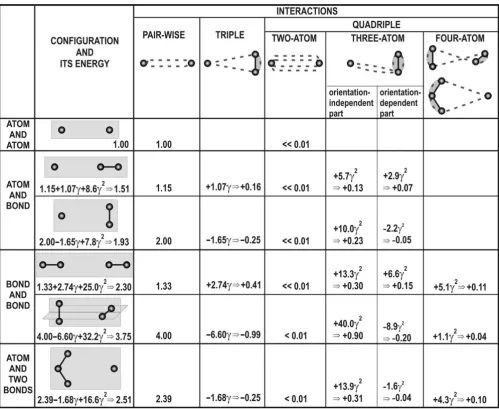
Taking an average estimate of γ= 0.15 for bonded atoms (that corresponds to a typical covalent bond length of 1.5 Å between chemically equal atoms with polarizability of 1 Å3), we see (Fig. 2) a significant change in the VdW
inter-action energy for the cost of triple and quadruple interac-tions of three atoms (when a pair of these atoms is covalently bonded) and, to a lesser extent, for the cost of four-atom interactions (when two pairs of atoms are cov-alently bonded). It is useful to mention here that one study cited herein [14] has already discussed the general idea that ''bond-bond'' interactions are more appropriate
U
a(1)-medium-b=
x
( ) -1x
a ab aab ab b ab
b
g
−
(
G
( )[
A
]
G
( ))
(18)
U
ab( )ε a ab bε
=
x
⎡
1
x
⎣⎢
⎤
⎦⎥
g
.
(19)1
ε
1 1
ε ⎡ ⎣⎢
⎤ ⎦⎥ = −
−
ab
aab ab b
ab ab
δδ G( )[A( ) -1] G( )g
1 1 1
2
εab ε ab ε
ab ba
ba ab ba
= ⎡
⎣⎢ ⎤ ⎦⎥
⎡ ⎣⎢
⎤ ⎦⎥ ⎡
⎣
⎢ ⎤
⎦
⎥
[
]
Sp g g Sp g g .
(20)
εab ab aab ab b ab
ba b ab ab
a
−2=
(
−)
−Sp⎣⎢⎡ g G( )[A( ) -1] G( )
(
g G( )[A( ) -1] G(aba))
⎤⎦⎥ Sp[g gab ba]G( ) ( )aabGbab
1
1 2 1 2
2 2
ε ω
α
ab p p
ab bp pa
ab b p a b
p ab
m
g g g g g
≈ − ⋅ = −
≠
∑
Sp[Sp[ a]] |r |r |3, aap pb
ab bp pa
ab b p a b | |r |
Sp[ ]
Sp[ ]
3 3
a
⋅
≠
∑
θθ θθ θθθθ θθ,
.
(21)
= = =
=
ω ω
ω ω γ
ω ω ω ω
α α
i k
i k
ik i k
i k
i k
ik
+ = + ⋅
⎛ ⎝
⎜⎜ r ⎞⎠⎟⎟
in
for conformational analysis than ''atom-atom'' interac-tions.
In the case of the collinear arrangement of atoms and bonds the attraction can grow by 70% (compare values in columns "configuration and its energy" and "pairwise" in Fig. 2), while in the case of the orthogonal arrangement of atoms and bonds, the attraction can decrease by 6%. The decrease is less than the increase because, as mentioned above, the quadruple interaction is mainly attractive. The main part of this attraction is due to the three-atom quad-ruple interaction. This can be divided in two parts:
Equa-tion [15] can be presented as Sp[θikθkiθipθpi] = 12 + (9cos2φi - 3), where the first (larger) term is an orientation-inde-pendent constant (actually, it simply increases the VdW attraction of any atom involved in covalent bonding to all other atoms, see Fig. 1b; in available force fields [1-5] this term is implicitly taken into account by ascribing and fit-ting different pairwise attraction forces to atoms in differ-ent covaldiffer-ent states). The second, the oridiffer-entation- orientation-dependent part equals zero if averaged in 3D space over all possible atom-to-bond orientations (see examples in Fig. 2); this part is rather similar to that for the interaction Energy of VdW interactions at various configurations of participating non-bonded and bonded atoms
Figure 2
of a separate atom with a remote covalent bond (cf. Fig.1b to Fig. 1a).
The orientation-dependent terms, which mainly arise from triple interactions, can increase or decrease VdW energy by ~±20–40% at extremes. This energy effect is sig-nificant, being comparable to that caused by the replace-ment of an N atom (αN ≈ 0.95 Å3) by a C (α
C ≈ 1.2 Å3) or O (αO ≈ 0.75 Å3) atom in a pairwise VdW interaction (see
equations [10,11] at ωN≈ωC≈ωO). Moreover, the orienta-tion effect is much stronger than the effect of replacing the pairwise energies of two C-N non-bonded contacts with the sum of pairwise energies of C-C and N-N contacts (αCαC + αNαN - 2αCαN ≈ 5% × αCαN). Note that the contact replacements are the main VdW effects currently used to distinguish ''correct'' protein folds from those that are ''wrong''.
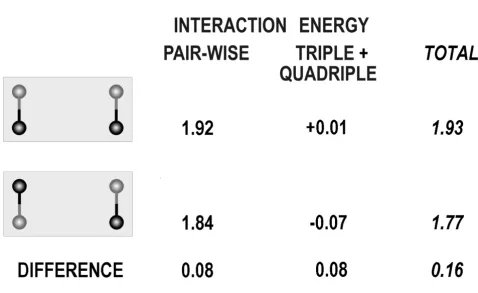
Thus, we indeed see that any conformational analysis should by no means ignore the cumulative effect of the coupling of multi-atom VdW interactions with covalent bonds. Figure 3 shows that the energy difference between two structures of equal compactness may change twice due to this effect.
It is necessary to note that at short distances, which are the most important for VdW interactions, one can expect effects of inharmonicity, higher multipole interactions, etc. [11,12]. These effects are avoided in the "harmonic oscillator" model used in this work. Nevertheless, they exist in reality, and their existence makes the expressions obtained for many-body interactions approximate to the same extent as the conventional London's expression is for pairwise interactions. In particular, the value of γ for each covalent bond may be treated as a parameter, the value of which should be obtained from a fit of the exper-imental data in the same way as the London's pairwise interaction energy [11,13,14]. The necessity of fitting the experimental data is underlined by a relatively slow con-vergence of both the orientation-dependent and orienta-tion-independent series in Figure 2.
"VdW permittivity"
VdW forces and the electronic part of dielectric permittiv-ity are evidently connected: both originate from dipole-dipole interactions. The relationship between VdW forces and the macroscopic dielectric permittivity of the medium is well studied in the continuum approximation [11,14,16]. However, this approach is useful and
rela-Energy difference between two competing structures of equal compactness strongly depends on the energy terms taken into account
Figure 3
tively simple when applied to large uniform bodies, like drops or layers. This work concerns interactions of small fragments composed of various atoms, and the frequency-dependent dielectric permeability, taken as a macroscopic characteristic, seems not to be an appropriate tool to investigate this case. Here we will consider an electronic part of the microscopic dielectric permittivity created by and acting at interacting harmonic oscillators, with the goal of demonstrating that multi-atom interaction creates a kind of "VdW permittivity" for pairwise VdW forces in addition to elucidating a connection between VdW forces and the electronic part of microscopic dielectric permittiv-ity.
The role of dielectric permittivity in VdW forces is ambig-uous. On the one hand, the VdW interaction of two atoms is proportional to the square of the electrostatic interac-tion between their fluctuating electronic polarizainterac-tions. Thus, one might expect the pairwise VdW interaction to be inversely proportional to the square of the electronic part of the dielectric permittivity. On the other hand, the medium's electrons (which create the electronic compo-nent of dielectric permittivity) are involved in VdW inter-actions of "their own" atoms, and it is not clear if they are "free" enough to influence the VdW interactions of the other atoms in such a strong manner.
Following equations [8] – [10], [12], [13], one can present the total VdW energy ΔW as
and see that
plays the role of "microscopic permittivity" for the pair-wise VdW interactions of atoms i, k. This "permittivity" depends on the distance between atoms i and k, and the space distribution of the other atoms with oscillating elec-trons around them. The value Φik looks similar to, but does not coincide with the square of the electronic part of
dielectric permittivity given by equation [21]. Thus the naive idea that VdW interaction may be inversely pro-portional to the square of the electronic part of the dielec-tric permittivity turned out to be wrong. However, the values Φik and εik are related if all atoms have equal elec-tron oscillation frequencies ω. Since the value εik of the
electronic component of the dielectric permittivity is not far from unity [13], we see in this case that
Thus, on average, MB effects decrease the pairwise VdW energy roughly in proportion to the square root of the electronic part of the microscopic dielectric permittivity for the dipole-dipole interaction via a polarizable atomic environment.
The main effect is caused by the electronic permittivity, which is pertinent to small, atomic distances, where the main VdW interaction takes place. One can expect that the electronic component of the microscopic dielectric per-mittivity for interacting dipoles at these distances is signif-icantly smaller than the electronic dielectric permittivity at macroscopic distances: the decrease in VdW energy caused by three-atom interaction in liquid argon [7] is approxi-mately five-fold less than that expected the from its mac-roscopic permittivity.
Conclusion
Ligand binding and protein structure prediction require especially accurate force field potentials, because one "correct" structure struggles against billions of "wrong" ones [17]. Despite huge efforts to optimize them, the force fields currently used are still not able, in a vast majority of cases, to bring an approximate, homology-based model of protein structure (whose atoms usually deviate by only 1.5 – 3 Å from their native positions) closer to its native conformation [18-22]. At present, even the most success-ful methods (one or two of the five dozen methods used) show some improvement of homology models by a force field-based refinement in only a half of cases [21-23]. This shows that a "significant difficulty still exists in both sam-pling and force field accuracy" [23]. One of the force field problems is that which concerns the "not well captured" balance between intramolecular and solvent dispersion (i.e., VdW) interactions [23]. On the other hand, a partial success of modern molecular mechanics methods in the prediction of detailed protein structure shows that (i) modern, improved methods of sampling of protein chain conformations seem to work (possibly, at the cost of aver-aging that decreases the effect of energy errors [17]) in some, but not all, cases (especially when a near-native conformation basin is reached from homology mode-ling), and (ii) current force field quality is sufficient in some, but not all, cases, so that an increase in the accuracy of the force field seems to be crucial for the final success of protein structure prediction methods.
This study shows that currently-ignored multi-atom VdW interactions can be important for the further development of force fields. The coupling of covalent bonding with
Δ Δ
Δ
W W
W
ik ikp
p k i k i
ik
p
i p p k
+ + =
−
+ + ⋅
< <
<
∑
∑
∑
∑
∑
...
( )
( )( )
1 2
2 ω
ω ω ω ω
αpp ik
ip pk
ik kp pi
ik ki p i j
|r |
|r | |r |
Sp[ ]
Sp[ ]
3
3 3⋅ +
⎧ ⎨ ⎪ ⎩
∑
≠θθ θθ θθ θθ θθ
,
... ⎪⎪
⎫ ⎬ ⎪ ⎭⎪
<
∑
∑
k i
,
(22)
Φ ω
ω ω ω ω
α
ik p
i p p k
p ik
ip pk
ik kp
≈ −
+ + ⋅ ⋅
1 2
2
( )
( )( )
|r | |r | |r |
Sp[
3
3 3
θθ θθ θθppi
ik ki p i j
] Sp[θθ θθ ]
≠
−
∑
+⎧ ⎨ ⎪ ⎩⎪
⎫ ⎬ ⎪ ⎭⎪
,
...
1
εab2
Open access provides opportunities to our colleagues in other parts of the globe, by allowing
anyone to view the content free of charge.
Publish with
Chemistry
Central and every
scientist can read your work free of charge
W. Jeffery Hurst, The Hershey Company.
available free of charge to the entire scientific community peer reviewed and published immediately upon acceptance cited in PubMed and archived on PubMed Central yours you keep the copyright
Submit your manuscript here:
http://www.chemistrycentral.com/manuscript/
multi-atom VdW interactions is not the only important MB effect. Some of those, like MB electrostatic interac-tions, are taken into account by the existing force fields (see [24,25]). Here the effect is caused by the interaction of the permanent charges or permanent molecular multipoles with particles of polarizable media. The other interactions, which include interaction of permanent multipoles with induced ones [26], are not yet taken into account by existing force fields.
The discovered specific coupling of covalent bonding with multi-atom VdW interactions does not need permanent charges or multipoles, and therefore involves the multi-tude of covalent bonds in molecules. Multi-atom interac-tion with any of the bonds can lead to a significant energy effect, which is comparable to that caused by the replace-ment of atoms in conventional pairwise VdW interac-tions. As a result, the effect described can be rather significant in choosing the molecular shape.
Abbreviations
3D – three-dimensional; VdW – Van der Waals; MB – multi-body; CASP – Critical Assessment of Techniques for Protein Structure Prediction meeting
Acknowledgements
I am grateful to D. Reifsnyder for assistance in the preparation of this paper, to A.G. Donchev for assistance in computations and to A.M. Dykhne, A.A. Vedenov, R.V. Polozov, M. Levitt and G. Vriend for seminal discussions. This work was supported in part by the Russian Foundation for Basic Research and Russian programs "Molecular and Chemical Biology" and "Leading Scientific Schools", INTAS, IHES and an International Research Scholar's Award from the Howard Hughes Medical Institute.
References
1. Levitt M, Hirshberg M, Sharon R, Dagget V: Potential energy func-tion and parameters for simulafunc-tions of the molecular dynamics of proteins and nucleic acids in solution. Comp Phys Commun 1995, 91:215-231.
2. MacKerell A Jr, Wiorkiewicz-Kuczera J, Karplus M: An all-atom empirical energy function for the simulation of nucleic acids.
J Am Chem Soc 1995, 117:11946-11975.
3. Jorgensen WL, Maxwell DS, Tirado-Rives J: Development and testing of the opls all-atom force field on conformational energetics and properties of organic liquids. J Am Chem Soc 1996, 118:11225-11236.
4. Halgren TA: Merck molecular force field. I. Basis, form, scope, parameterization and performance of MMFF94. J Comp Chem 1995, 17:490-519.
5. Wang J, Wolf RM, Caldwell JW, Kollman PA, Case DA: Develop-ment and testing of a general amber force field. J Comp Chem 2004, 25:1157-1174.
6. Axilrod BM, Teller E: Interaction of the van der Waals' type between three atoms. J Chem Phys 1943, 11:299-300.
7. Sadus RJ: Exact calculation of the effect of three-body Axilrod-Teller interactions on vapour-liquid phase coexistence. Fluid Phase Equilibria 1998, 144:351-360.
8. MacRury TB, Linder B: Many-body aspects of physical adsorp-tion. J Chem Phys 1971, 54:2056-2966.
9. Donchev AG: Many-body effects of dispersion interaction. J Chem Phys 2006, 125:074713.
10. London F: The general theory of molecular forces. Trans Fara-day Soc 1937, 33:8-26.
11. Barash YS: Van der Waals ForcesVolume chapters 2, 5. Moscow: Nauka; 1988.
12. Landau LD, Lifshitz EM: Quantum MechanicsVolume §23. New York: Pergamon; 1987.
13. Pauling L: General chemistry Volume chapters 6, 11. New York: W.H.Freeman & Co; 1970.
14. Parsegian AV: VdW Forces Cambridge: Cambridge Univ. Press; 2005. pp.4-29, 214-227, 241-260
15. Basharov MA, Vol'kenshtein MV, Golovanov IB, Ermakov GL, Nauch-itel' VV, Sobolev VM: Bond-bond interactions. I. Simple rela-tionship for estimating the energy of a bond-bond interaction. J Struct Chem (Moscow) 1984, 25:26-35.
16. Dzyaloshinskii IE, Lifshitz EM, Pitaevskii LP: General theory of Van der Waals' forces. Sov Phys Uspekhi 1961, 4:153-176.
17. Finkelstein AV, Gutin AM, Badretdinov AY: Perfect temperature for protein structure prediction and folding. Proteins 1995, 23:151-162.
18. Krieger E, Darden T, Nabuurs SB, Finkelstein A, Vriend G: Making optimal use of empirical energy functions: force field param-eterization in crystal space. Proteins 2004, 57:678-683. 19. Vincent JJ, Tai C-H, Sathyanarayana BK, Lee B: Assessment of
CASP6 predictions for new and nearly new fold targets. Pro-teins 2005:67-83.
20. Clarke N: Free modeling assessment. 2006 [http://prediction center.gc.ucdavis.edu/casp7/meeting/
presentationPresentations_assessors/CASP7_FM_Clarke.pdf]. 21. Read RJ: Assessing high accuracy models. 2006 [http://predic
tioncenter.gc.ucdavis.edu/casp7/meeting/
presentationPresentations_assessors/CASP7_HA_RJRead.pdf]. 22. Schwede T: Assessment of template based modeling (TMB).
2006 [http://predictioncenter.gc.ucdavis.edu/casp7/meeting/presenta tions/Presentations_assessors/CASP7_TBM_Schwede.pdf]. 23. Chen J, Brooks CL III: Can molecular dynamics simulations
pro-vide high-resolution refinement of protein structure? Proteins 2007, 67:922-930.
24. Honig B, Nicholls A: Classical electrostatics in biology and chemistry. Science 1995, 268:1144-1149.
25. Simonson T, Archontis G, Karplus M: Free energy simulations come of age: protein-ligand recognition. Acc Chem Res 2002, 35:430-437.