The Thirty-Third AAAI Conference on Artificial Intelligence (AAAI-19)
Multi-Task Learning with Multi-View Attention for
Answer Selection and Knowledge Base Question Answering
Yang Deng,
1Yuexiang Xie,
1Yaliang Li,
2Min Yang,
3Nan Du,
2Wei Fan,
2Kai Lei,
1*Ying Shen
1* *Corresponding Author1Shenzhen Key Lab for Information Centric Networking & Blockchain Technology (ICNLAB), School of Electronics and Computer Engineering, Peking University Shenzhen Graduate School, 2Tencent Medical AI Lab3Shenzhen Institutes of Advanced Technology, Chinese Academy of Sciences,
{ydeng,xieyx}@pku.edu.cn, [email protected], [email protected],
{ndu,davidwfan}@tencent.com,{leik,shenying}@pkusz.edu.cn
Abstract
Answer selection and knowledge base question answering (KBQA) are two important tasks of question answering (QA) systems. Existing methods solve these two tasks separately, which requires large number of repetitive work and neglects the rich correlation information between tasks. In this paper, we tackle answer selection and KBQA tasks simultaneously via multi-task learning (MTL), motivated by the following motivations. First, both answer selection and KBQA can be regarded as a ranking problem, with one at text-level while the other at knowledge-level. Second, these two tasks can benefit each other: answer selection can incorporate the ex-ternal knowledge from knowledge base (KB), while KBQA can be improved by learning contextual information from an-swer selection. To fulfill the goal of jointly learning these two tasks, we propose a novel multi-task learning scheme that uti-lizes multi-view attention learned from various perspectives to enable these tasks to interact with each other as well as learn more comprehensive sentence representations. The ex-periments conducted on several real-world datasets demon-strate the effectiveness of the proposed method, and the per-formance of answer selection and KBQA is improved. Also, the multi-view attention scheme is proved to be effective in assembling attentive information from different representa-tional perspectives.
Introduction
Question answering (QA) is an important but challeng-ing NLP application. Nowadays, there are many possible sources of data for the QA systems, such as web docu-ments, QA communities, knowledge bases and so on. Ac-cording to these data sources, question answering can be di-vided into several different tasks, including machine read-ing comprehension (Rajpurkar et al. 2016), answer selec-tion (Wang, Smith, and Mitamura 2007), knowledge base question answering (Bordes et al. 2015) and more. Recent years have witnessed many successes in applying deep neu-ral networks on these QA tasks (dos Santos et al. 2016; Wenpeng et al. 2016; Hao et al. 2017).
Despite the advancement of these models, different QA tasks are still solved separately. Designing and training var-ious models for specific tasks are time-consuming and ex-pensive. Recently, as seen in many other NLP tasks,
multi-Copyright c2019, Association for the Advancement of Artificial Intelligence (www.aaai.org). All rights reserved.
task learning has been extensively studied to learn multiple related tasks simultaneously. The applications of MTL are extensive in NLP domain, such as text classification (Zheng, Chen, and Qiu 2018), sequence labeling (Chen et al. 2018) and text summarization (Guo, Pasunuru, and Bansal 2018), etc. However, applying MTL on QA has received little at-tention.
In this work, we explore multi-task learning approaches to tackle answer selection and knowledge base question an-swering at the same time, with the intuition that these tasks both can be regarded as a ranking problem, but one in text-level and the other in knowledge-text-level. Specifically, the task of answer selection aims to pick out the correct answers for the given question from a set of candidate answer sen-tences, while the task of KBQA focuses on extracting the corresponding facts from KB, such as Freebase (Bollacker et al. 2008), to answer the given question. Besides, previ-ous works prove that answer selection task can be benefited from external knowledge (Savenkov and Agichtein 2017; Deng et al. 2018; Ying et al. 2018), while incorporating text information also enhances the performance of KBQA task (Yu et al. 2017; Sorokin and Gurevych 2018).
Most existing multi-task learning schemes divide the lay-ers of a model into task-specific and shared laylay-ers (Abhishek and Hal 2012; Guo, Pasunuru, and Bansal 2018). The shared layers are shared across all tasks, while the task-specific lay-ers are separate for each task. However, these methods ne-glect the interrelation between the task-specific layers and the shared layers, and the interaction among different tasks. Thus, we present a novel multi-task learning scheme to learn multi-view attentions from different aspects, which enables different tasks to interact with each other. Concretely, we as-semble the attentive information from the task-specific lay-ers to learn more comprehensive sentence representations in the shared layers. In addition, the multi-view attention mechanism enhances the sentence representational learning by combining word-level and knowledge-level information. That is to say, the attentive information in both word-level and knowledge-level are shared and transferred among dif-ferent tasks by using the multi-view attention scheme.
perfor-Answer Selection KBQA
word Q what was johnny appleseed ’s real name ? what is the name of a track created by katy perry ? A john chapman , aka american folk hero johnny appleseed . katy perry music artist track witness
knowledge Q johnny appleseed katy perry
A john chapman, johnny appleseed katy perry, music.artist.track, witness
Table 1: Examples of Answer Selection and KBQA Data
mance of each task compared to learning them indepen-dently. The experimental results also indicate the effective-ness of the multi-view attention scheme and each view‘s at-tention contributes.
In summary, our main contributions are as follows:
• We explore multi-task learning approaches for answer selection and knowledge base question answering. An-swer selection task can be improved by KBQA task in knowledge-level, while KBQA task can be enhanced by answer selection task in word-level.
• We propose a novel multi-task learning scheme that lever-ages multi-view attention mechanism to bridge differ-ent tasks, which integrates the important information of the task-specific layers into the shared layers as well as enables the model to interactively learn word-level and knowledge-level representations.
• Experimental results show that multi-task learning of an-swer selection and KBQA outperforms state-of-the-art single-task learning methods. Besides, the multi-view at-tention based MTL scheme further enhance the perfor-mance.
Multi-Task Learning for Question Answering
In this section, we introduce the multi-task learning of an-swer selection and knowledge base question anan-swering.
Problem Definition
The tasks of answer selection and KBQA can be typically regarded as a ranking problem. Given a questionqi ∈ Q,
the task is to rank a set of candidate answer sentences or factsai ∈A. Specifically, a functionf(q, a)that computes
a relevancy scoref(q, a)∈ [0,1]for each question-answer pair.
The multi-task learning of answer selection and KBQA starts with the entity linking results. As the example shown in Table 1, a word sequenceW = {w1, w2, ..., wL}and a
knowledge sequenceK ={k1, k2, ..., kL}are prepared for
each question and each candidate answer. For the question and answer in answer selection and the question in KBQA, we derive the knowledge of the sentence by entity link-ing (Savenkov and Agichtein 2017). For the answer fact in KBQA, we obtain the word sequence from the tokenized en-tity name and relation name (Yu et al. 2017).
In the multi-task scenario, we aim to rank the candidate answers for each question fromTrelated tasks. We referDt
as thet-th preprocessed task dataset withNsamples:
Dt={(Wq(it), K
(t)
qi , W
(t)
ai , K
(t)
ai, Y
(t)
i )} Nt
i=1, (1) whereYi(t)denotes the label ofi-th QA pair int-th task.
KBQA Encoder
KBQA Encoder AS
Encoder
AS Encoder
𝑥
KBQA Softmax
AS Softmax
T
a
sk
-S
p
ec
if
ic
E
n
co
d
er
L
a
ye
r
S
h
ar
ed
R
ep
re
se
n
ta
ti
o
n
L
e
arn
in
g
L
a
ye
r
S
h
ar
ed
Jo
in
t
L
ay
er
T
a
sk
-S
p
ec
if
ic
S
o
ft
m
ax
L
a
ye
r
Figure 1: Basic Multi-Task QA Network
Multi-Task Question Answering Network
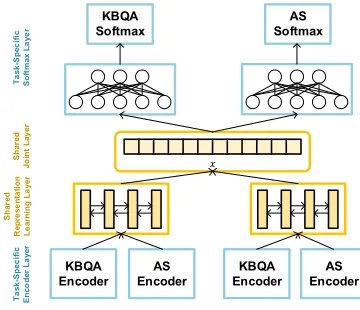
The basic multi-task learning model is a deep neural net-work that adopts layer-specific sharing mechanism (Guo, Pasunuru, and Bansal 2018) which shares some high-level information across different tasks and the remained layers are parallel and independent to learn task-specific low-level information. Figure 1 illustrates the overall architecture of multi-task QA network (MTQA-net) for answer selection (AS) and knowledge base question answering (KBQA).
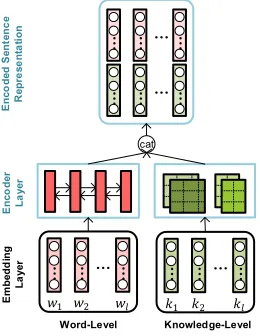
Task-specific Encoder Layer The preprocessed sen-tences are first encoded into distributed vector representa-tions. Different QA tasks are supposed to be diverse in data distributions and low-level representations. Therefore, each task is equipped with a task-specific siamese encoder for both questions and answers, and each task-specific encoder contains a word encoder and a knowledge encoder to learn the integral sentence representations, as shown in Figure 2.
Word Encoder.The input of the word encoder module is a sequence of word embeddingsEW ={ew1, ew2, ..., ewL}.
We employ Bi-LSTM (Bidirectional Long Short-Term Memory Networks) to capture the context information from both the head-to-tail and the tail-to-head context. The output atl-th word is represented byhl = [
− →
hl :
←−
hl], in which
− → hl
is the output of the forward network and←h−l is that of the
backward network. Given a pair of word sequences of the questionq and the answer a, we generate the word-based sentence representationHW ∈RL×dhfor both the question
and the answer, whereLanddhare the length of sentences
and the size of hidden units:
cat
E
m
be
dd
ing
L
a
ye
r
E
nc
o
de
r
L
a
ye
r
Word-Level Knowledge-Level
E
n
co
d
ed
S
en
te
n
c
e
R
epr
e
se
nt
a
ti
on
𝑤1 𝑤2 𝑤𝑙 𝑘1 𝑘2 𝑘𝑙
Figure 2: Task-specific Encoder Layer
Knowledge Encoder.Different from word encoder, a se-quence of knowledge embeddingsEK ={ek1, ek2, ..., ekL}
is input into knowledge encoder. As the knowledge sequence is composed by a series of tokenized entity or relation name, the high-level knowledge-based representations are desired for the latter learning procedure. We deal with this problem by applying CNN on the knowledge sequences, in which fil-ters of sizen slide over the knowledge embedding matrix to capture the local n-gram features. Each move computes a hidden layer vector as
xl=[ekl−n−1
2
, . . . , ekl, . . . , ekl+n−1 2
], (3)
hl= tanh (Wcxl+bc), (4)
whereWc and bc are the convolution kernel and the bias
vector to be learned.
Due to the uncertainty of the length of entities, a couple of filters of various sizes are employed to obtain different output vectors
H(1), H(2), . . . , H(n) , whereH(i)denotes
the output vector obtained by thei-th filter. We pass these output vectors through a fully-connected layer to get the knowledge-based sentence representation HK ∈ RL×df,
whereL is the length of the sentence and df is the total
filter sizes of CNN. Given the questionqand the answera, the knowledge-based sentence representations are:
HKq = [H
(1)
Kq :H
(2)
Kq :. . .:H
(n)
Kq], (5)
HKa= [H
(1)
Ka :H
(2)
Ka:. . .:H
(n)
Ka]. (6)
After obtaining the word-based and the knowledge-based sentence representations,HKq andHKa are still vectors in
the order of words in the sentence, since the fully-connected layer concatenates the outputs from all the filters in the di-mension of the feature instead of the sequence. Thus, the order ofHKq andHKa is consistent withHWq andHWa.
Then we concatenate them into the encoded sentence repre-sentations,Hq= [HWq :HKq]andHa= [HWa:HKa].
Shared Representation Learning Layer After encoding sentence into vector representations with task-specific en-coder, we share high-level information across different tasks
via a shared representation learning layer. Compared with the input of task-specific encoder layer, the integral sentence representation contains richer semantic meaning and share more similar distributions with other tasks. Therefore, we integrate the encoded vectors from all the tasks and pass through a high-level shared Siamese Bi-LSTM to generate the final QA representations:
Sq =Bi-LSTM(Hq); Sa =Bi-LSTM(Ha). (7)
We apply average pooling over the Bi-LSTM output,
sq = Average(Sq),sa = Average(Sa). Inspired by
pre-vious works (Severyn and Moschitti 2015) and (Tay et al. 2017), we incorporate some word and knowledge overlap features xol ∈ R6 to form the final feature space for
bi-nary classification, including word overlap score, non-stop word overlap score, weighted word overlap score, non-stop weighted word overlap score, knowledge overlap score and weighted knowledge overlap score. Thus, the final feature space will bex= [sq, sa, xol].
Task-specific Softmax Layer For a question-answer pair,
q(it)andai(t), and its labelyi(t)ink-th task, the final feature representations is fed into the task-specific softmax layer for binary classification:
p(t)=softmaxWs(t)x+b(st), (8)
wherep(t)is the predicted probability,W(t)
s ∈ Rdx×2and b(st)∈R2are the task-specific weight matrix and bias vector
in the hidden layer.
Multi-Task Learning
The overall multi-task learning model is trained to minimize the cross-entropy loss function:
L=−
T
X
t=1
λt
Nt
X
i=1
h
y(it)logp
(t)
i +
1−yi(t)
log
1−p(it)
i ,
(9) whereλt is a parameter that determines the weight oft-th
task, andy(it) is the ground-truth label of question-answer
pair(q(it), a(it)). In practice, the same weight is assigned to all tasks.
Multi-Task Model with Multi-View Attention
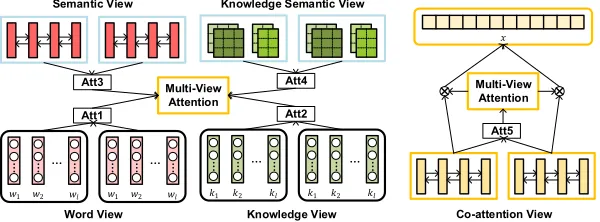
In order to enhance the interaction between different QA tasks in latent representation space, we propose a multi-view attention mechanism to fetch the important information from task-specific layers as well as the shared layers.
Multi-View Attention Scheme
𝑘1 𝑘2 𝑘𝑙
𝑤1 𝑤2 𝑤𝑙 𝑤1 𝑤2 𝑤𝑙 𝑘1 𝑘2 𝑘𝑙
Att4
Att2 Att3
Att1
Multi-View Attention
Att5
𝑥
Multi-View Attention
Word View Knowledge View Semantic View Knowledge Semantic View
Co-attention View
Figure 3: Multi-View Attention
Word View & Knowledge View We first adopt a two-way attention mechanism (dos Santos et al. 2016) to interactively modeling a pair of QA sentences, by attending correspond-ingly important information in two sentences. We collect the attention weights from both the word and the knowledge em-beddings:
MW =tanh
ETWqUWEWa
;MK =tanh
EKTqUKEKa
,
(10) whereUW ∈Rdew×dewandUK ∈Rdek×dek are parameter
matrices to be learned;dew anddek are the dimensions of
word embeddings and knowledge embeddings.
Then we apply max-pooling overMW andMK row-wise
and column-wise to obtain the word view and the knowledge view attention weights for the question and the answer:
α(1)q =softmax(Max(MW));α(1)a =softmax(Max(MWT)),
(11)
α(2)q =softmax(Max(MK));α(2)a =softmax(Max(MKT)),
(12)
whereα(1)q andα(1)a are the attention weights for the
ques-tion and the answer from word view;α(2)q andα(2)a are the
attention weights from knowledge view.
Semantic View & Knowledge Semantic View As the context semantic information is of great importance in sen-tence representational learning, we exploit the overall con-text semantic information as the attention source over all the elements in the sentence. Thus, we apply max/mean pooling over the output of the task-specific encoder layer to obtain the overall semantic information of a sentence. We experi-mented on using either max or mean pooling to generate the semantic information. The result shows that the following pooling methods achieve the best performance:
owq =Average HWq
; owa =Average(HWa), (13)
okq=Max HKq
; oka=Max(HKa), (14)
Conceptually, the attention mechanism takes into consid-eration the semantic information, which is expected to cap-ture the correlations between question words and answer words:
α(3)q =softmax(w T
wqtanh(Wwaowa+WwqHWq)), (15)
α(3)a =softmax(wwTatanh(Wwqowq+WwaHWa)), (16)
α(4)q =softmax(w T
kqtanh(Wkaoka+WkqHKq)), (17)
α(4)a =softmax(w T
katanh(Wkqokq+WkaHKa)), (18)
where Wwq, Wwa ∈ R
dh×dh, w
wq, wwa ∈ R
dh,
Wkq, Wka∈R
df×df,w
kq, wka∈R
df are attention
param-eters to be learned;α(3)q andα
(3)
a are the attention weights
for the question and the answer from semantic view;α(4)q
andα(4)a are the attention weights from knowledge semantic
view.
Co-attention View Similar to word view and knowledge view attention, we employ a two-way attention mechanism to generate the co-attention between final question and an-swer representations:
Mco=tanh
SqTUSSa
, (19)
α(5)q =softmax(Max(Mco)), (20)
α(5)a =softmax(Max(McoT)), (21)
whereUW ∈ Rds×ds is the attention parameter matrix to
be learned;dsis the dimension of final QA representations;
α(5)q andα(5)a are the co-attention weights for the question
and the answer.
Multi-View Attentive Representation We define the multi-view attention fusion from word, knowledge, seman-tic, knowledge semantic and co-attention views as:
αq=softmax 5
X
i=1
λ(qi)α
(i)
q ;αa=softmax 5
X
i=1
λ(ai)α
(i)
a , (22)
whereλ(qi)andλ(ai)are hyper-parameters that determines the
weights of the five kinds of attentions. In order to observe the contribution of each view of attention, we assign the same weight to all views of attention in the experiment. Finally, the attentive QA representations will be:
sq =Sqαq; sa=Saαa. (23)
Multi-View Attention Sharing
Experiment
Datasets & Preprocessing
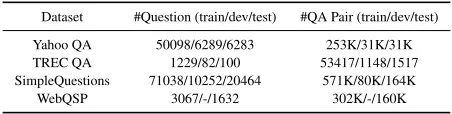
We use YahooQA (Tay et al. 2017) and TREC QA (Wang, Smith, and Mitamura 2007) for answer selection task, and SimpleQuestions (Bordes et al. 2015) and WebQSP (Yih et al. 2016) for knowledge base question answering task. The statistics of these datasets are described in Table 2.
Dataset #Question (train/dev/test) #QA Pair (train/dev/test)
Yahoo QA 50098/6289/6283 253K/31K/31K TREC QA 1229/82/100 53417/1148/1517 SimpleQuestions 71038/10252/20464 571K/80K/164K WebQSP 3067/-/1632 302K/-/160K
Table 2: Summary statistics of datasets.
YahooQA1 An open-domain community-based dataset collected from Yahoo Answers. Tay et al. (2017) filters out questions and answers whose length is out of 5-50, and gen-erates 4 negative samples for each question. The same met-rics as (Tay, Tuan, and Hui 2018a; Deng et al. 2018) are adopted for evaluation, including Precision@1 and MRR.
TREC QA A widely-adopted factoid question answer-ing dataset. Followanswer-ing previous works (Tay, Tuan, and Hui 2018a; Deng et al. 2018), we experiment on the raw TREC QA dataset and use Mean Average Precision (MAP) and Mean Reciprocal Rank (MRR) as evaluation metrics.
SimpleQuestions A single-relation KBQA dataset. This dataset consists of questions annotated with a corresponding fact from Freebase that provides the answer. We report Ac-curacy as previous studies (Yih et al. 2016; Yu et al. 2017). A question is considered answered correctly only when the predicted positive answers match one of the ground-truths.
WebQSPA multi-relation KBQA dataset. Yih et al. (2016) created this dataset by extracting the questions that are an-swerable using Freebase from WebQuestions (Berant et al. 2014). We adopt Accuracy as the evaluation metric as the SimpleQuestions dataset.
In our setting, we assume that the data are preprocessed by entity linking, which means entities in sentences have al-ready been extracted and linked to certain entities in the KB.
Entity Linking We use FB5M2 as the knowledge base, which contains 4,904,397 entities, 7,523 relations, and 22,441,880 facts. For YahooQA and TREC QA3, we label all the sentences with the entity mentioned in themselves. We apply the TagMe4 entity linker to extract entity men-tions from sentences, and only keep the entity menmen-tions with the confidence score above the 0.2 threshold. For each en-tity mention, we retrieve one certain enen-tity from FB5M. For SimpleQuestions and WebQSP, we start with the entity link-ing results5as Yu et al. (2017).
1
https://github.com/vanzytay/YahooQA Splits
2
https://research.facebook.com/researchers/15439345391893 48
3https://github.com/dengyang17/MTQA 4
https://github.com/marcocor/tagme-python
5
https://github.com/Gorov/KBQA RE data
Experiment Settings
The word embeddings for all the models are initialized by pre-trained GloVE embeddings6 of 300 dimensions. TransE (Bordes et al. 2013) is adopted as the knowledge em-bedding method to generate the knowledge emem-beddings for all the models. OpenKE7is employed to implement TransE with the default settings.
For all the implemented models, we apply the same pa-rameter settings. The LSTM hidden layer size and the final hidden layer size are both set to 200. The width of the convo-lution filters is set to be 2 and 3, and the number of convolu-tional feature maps is set to be 100. The learning rate and the dropout rate are set to 0.0005 and 0.5 respectively. We train our models in batches with size of 128. All other param-eters are randomly initialized from [-0.1, 0.1]. The model parameters are regularized with a L2 regularization strength of 0.0001. The maximum length of sentence is set to be 40.
Multi-Task Learning Results
Table 3 summarizes the experimental results of different methods on answer selection and knowledge base question answering. For answer selection task, four methods listed in Table 3 achieve the state-of-the-art results in Yahoo QA and TREC QA datasets. The first three methods (Tay et al. 2017; Tay, Tuan, and Hui 2018a; 2018b) are traditional single-task learning methods, while Deng et al. (2018) employs transfer learning method to pre-train the model with a large-scale dataset and leverages external knowledge from KB to improve the sentence representational learning. For KBQA task, we compare the proposed method to four single-task learning state-of-the-art methods. Note that we start with the same entity linking results as Yu et al. (2017).
In general, the proposed multi-view attention based MTL method, MVA-MTQA-net (MTL), outperforms the state-of-the-art results by a noticeable margin on all the datasets. For instance, on the YahooQA and SimpleQuestions dataset, the proposed method improves about 8% and 2% on the metrics over these baselines.
In both MVA-MTQA-net and its basic model (MTQA-net), multi-task learning (MTL) methods can significantly improve the performance of all four datasets compared with single-task learning (STL), which demonstrates the effec-tiveness of combining answer selection and knowledge base question answering to conduct multi-task learning.
Ablation Analysis of Multi-View Attention
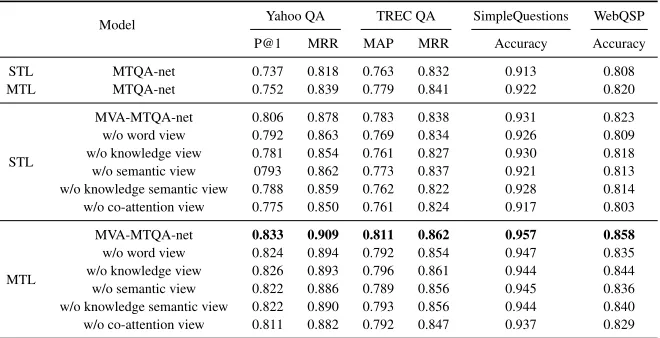
In this section, we conduct ablation experiments to illustrate the effect of multi-view attention scheme in the proposed method. We exclude the five kinds of views from MVA-MTQA-Net one by one and report the results in Table 4, in-cluding single-task learning and multi-task learning results.
From the results, we can observe that all kinds of view contribute more or less performance boost to the model. Ap-parently, co-attention view attention makes the most contri-bution to the improvement, which brings about 2-3% incre-ment on both STL and MTL of four tasks.
6
http://nlp.stanford.edu/data/glove.6B.zip
7
Model Yahoo QA TREC QA SimpleQuestions WebQSP P@1 MRR MAP MRR Accuracy Accuracy
HD-LSTM (Tay et al. 2017) 0.557 0.735 0.750 0.815 - -CTRN (Tay, Tuan, and Hui 2018a) 0.601 0.755 0.771 0.838 - -HyperQA (Tay, Tuan, and Hui 2018b) 0.683 0.801 0.770 0.825 - -KAN(AP-LSTM) (Deng et al. 2018) 0.744 0.840 0.797 0.850 - -BiCNN (Yih et al. 2015) - - - - 0.900 0.777 AMPCNN (Wenpeng et al. 2016) - - - - 0.913
-HR-BiLSTM (Yu et al. 2017) - - - - 0.933 0.825 Multiple View Matching (Yu et al., 2018) - - - - 0.937 0.854
MTQA-net (STL) 0.737 0.818 0.763 0.832 0.913 0.808 MTQA-net (MTL) 0.752 0.839 0.779 0.841 0.922 0.820 MVA-MTQA-net (STL) 0.806 0.878 0.783 0.838 0.931 0.823 MVA-MTQA-net (MTL) 0.833 0.909 0.811 0.862 0.957 0.858
Table 3: Multi-Task Learning Results
Model Yahoo QA TREC QA SimpleQuestions WebQSP P@1 MRR MAP MRR Accuracy Accuracy
STL MTQA-net 0.737 0.818 0.763 0.832 0.913 0.808 MTL MTQA-net 0.752 0.839 0.779 0.841 0.922 0.820
STL
MVA-MTQA-net 0.806 0.878 0.783 0.838 0.931 0.823 w/o word view 0.792 0.863 0.769 0.834 0.926 0.809 w/o knowledge view 0.781 0.854 0.761 0.827 0.930 0.818 w/o semantic view 0793 0.862 0.773 0.837 0.921 0.813 w/o knowledge semantic view 0.788 0.859 0.762 0.822 0.928 0.814 w/o co-attention view 0.775 0.850 0.761 0.824 0.917 0.803
MTL
MVA-MTQA-net 0.833 0.909 0.811 0.862 0.957 0.858 w/o word view 0.824 0.894 0.792 0.854 0.947 0.835 w/o knowledge view 0.826 0.893 0.796 0.861 0.944 0.844 w/o semantic view 0.822 0.886 0.789 0.856 0.945 0.836 w/o knowledge semantic view 0.822 0.890 0.793 0.856 0.944 0.840 w/o co-attention view 0.811 0.882 0.792 0.847 0.937 0.829
Table 4: Ablation Analysis of Multi-View Attention
For STL, knowledge and knowledge semantic view at-tentions are more distinguishable than word view and se-mantic view in two answer selection tasks, Yahoo QA and TREC QA, which indicates that attending more informa-tive knowledge in the sentence is important to measure the correlation between question and answer sentence. Simi-larly, slight difference exists between two word-level view and two knowledge-level view attentions in SimpleQues-tions and WebQSP tasks. However, the word view and se-mantic attentions contribute more.
For MTL, we observe that each view of attention makes a similar contribution to the improvement in four tasks, which demonstrates that the multi-view attention scheme enables each task to interact with each other in multi-task learning.
Case Study of Multi-View Attention
Multi-view attention scheme provides an intuitive way to in-spect the importance of each word in the question and the answer by visualizing the attention weight from each kind of view. Due to the limited space, we randomly choose one question-answer pair from TREC QA dataset and one from SimpleQuestions, and visualize the attention weights pre-dicted by MVA-MTQA-net. To be more differentiated, each view of the attention weights is normalized to [0, 1].
effec-what was johnny applesee
d ’s real name
(a) Question - An Example from Answer Selection 0.0
0.2 0.4 0.6 0.8 1.0
A
tt
en
ti
on
W
ei
gh
t
sept 26 : the
birth day of john
chap
man , aka
ameri canfolk hero
johnn y
apple seed
(c) Answer - An Example from Answer Selection 0.0
0.2 0.4 0.6 0.8 1.0
A
tt
en
ti
on
W
ei
gh
t
burdur province travel travel destinati
on guidebooks travel
to turkey (d) Answer - An Example from KBQA
0.0 0.2 0.4 0.6 0.8 1.0
A
tt
en
ti
on
W
ei
gh
t
what guideboo
k is for the burdur province (b) Question - An Example from KBQA 0.0
0.2 0.4 0.6 0.8 1.0
A
tt
en
ti
on
W
ei
gh
t
word view knowledge view semantic view knowledge semantic view co-attention view
Figure 4: Case Study of Multi-View Attention
tiveness of combining word-level and knowledge-level in-formation in KBQA task.
Related Work
Answer SelectionNeural networks based models has been proven effective in answer selection task, e.g., convolu-tional neural network (CNN) (Severyn and Moschitti 2015) and recurrent models like the long short-term memory (LSTM) (Wang and Nyberg 2015). Instead of learning the representations of the question and the answer separately, most recent studies utilize attention mechanisms to learn the interaction information between questions and answers, which can better focus on relevant parts of the input (Tan et al. 2016; dos Santos et al. 2016; Lei et al. 2018). With the emergence of large-scale knowledge bases, several ef-forts have been made on incorporating external knowledge from KBs to improve answer selection models. Savenkov and Agichtein (2017) scores candidate answers by com-bining the supporting evidence from structured KBs and unstructured text documents. Ying et al. (2018) proposed a knowledge-aware attentive neural network to attend the knowledge information in QA sentences, based on the enti-ties in sentences. Deng et al. (2018) leverage external knowl-edge from KB as a bridge to transfer more valuable informa-tion between cross-domain answer selecinforma-tion tasks.
Knowledge Base Question AnsweringMost approaches of KBQA are based on semantic parsing, which transform nat-ural language questions into structured query to extract the answer from the knowledge base (Yao and Durme 2014; Yih et al. 2015). Besides, most of state-of-the-art results are achieved by deep learning models. The core idea is to learn semantic representations of both the question and the knowledge. Based on the relevancy score between the rep-resentations of the question and the knowledge, the model
ultimately re-rank a list of candidate facts from KB (Bordes et al. 2015; Wenpeng et al. 2016; Hao et al. 2017). Contrary to answer selection, some recent studies integrate word or context information to aid in knowledge base question an-swering (Yu et al. 2017; Sorokin and Gurevych 2018). Multi-Task Learning Recent years have witnessed great successes of applying multi-task learning with neural net-works on many NLP problems (Liu, Qiu, and Huang 2017; Guo, Pasunuru, and Bansal 2018). Improved from the hard parameter sharing (Caruana 1997), most of these models consist of some task-specific private layers separated from the shared layer (Abhishek and Hal 2012). In addition, the key innovation in most recent studies in multi-task learning is the technique used to connect the private and shared parts. Chen et al. (2018) employs a meta-network to capture the meta-knowledge from the shared representational learning and generate the parameters of the task-specific representa-tional learning. Zheng, Chen, and Qiu (2018) exploits atten-tion mechanisms to select the task-specific informaatten-tion from the shared representation layer. Different from this multi-task learning scheme, we propose a multi-view attention scheme to gather the valuable information from both task-specific and shared perspective, which enhance the interac-tion between different tasks.
Conclusion
view, knowledge semantic view and co-attention view. The experiments conducted on several widely-used benchmark QA datasets demonstrate that joint learning of answer selec-tion and knowledge base quesselec-tion answering significantly outperforms single-task learning methods. Also, the multi-view attention scheme is effective in assembling attentive information from different representational perspectives to improve overall representational learning.
Acknowledgments
This work was financially supported by the National Natu-ral Science Foundation of China (No.61602013), the NatuNatu-ral Science Foundation of Guangdong (No.2018A030313017), the Shenzhen Fundamental Research Project (Grant No. JCYJ20170818091546869), and the project ”PCL Future Regional Network Facilities for Large-scale Experiments and Applications”. Min Yang was sponsored by CCF-Tencent Open Research Fund.
References
Abhishek, K., and Hal, D. I. 2012. Learning task grouping and overlap in multi-task learning. InICML.
Berant, J.; Chou, A.; Frostig, R.; and Liang, P. 2014. Se-mantic parsing on freebase from question-answer pairs. In
EMNLP.
Bollacker, K.; Evans, C.; Paritosh, P.; Sturge, T.; and Taylor, J. 2008. Freebase: a collaboratively created graph database for structuring human knowledge. InSIGMOD, 1247–1250. Bordes, A.; Usunier, N.; Weston, J.; and Yakhnenko, O. 2013. Translating embeddings for modeling multi-relational data. InNIPS, 2787–2795.
Bordes, A.; Usunier, N.; Chopra, S.; and Weston, J. 2015. Large-scale simple question answering with memory net-works.Computer Science.
Caruana, R. 1997. Multitask learning. Machine Learning
28(1):41–75.
Chen, J.; Qiu, X.; Liu, P.; and Huang, X. 2018. Meta multi-task learning for sequence modeling. InAAAI.
Deng, Y.; Shen, Y.; Yang, M.; Li, Y.; Du, N.; Fan, W.; and Lei, K. 2018. Knowledge as A bridge: Improving cross-domain answer selection with external knowledge. In COL-ING, 3295–3305.
dos Santos, C. N.; Tan, M.; Xiang, B.; and Zhou, B. 2016. Attentive pooling networks.CoRR, abs/1602.03609. Guo, H.; Pasunuru, R.; and Bansal, M. 2018. Soft layer-specific multi-task summarization with entailment and ques-tion generaques-tion. InACL.
Hao, Y.; Zhang, Y.; Liu, K.; He, S.; Liu, Z.; Wu, H.; Zhao, J.; Hao, Y.; Zhang, Y.; and Liu, K. 2017. An end-to-end model for question answering over knowledge base with cross-attention combining global knowledge. InACL. Lei, S.; Xiaodong, Z.; Feng, Q.; Baobao, C.; and Zhifang, S. 2018. A multi-view fusion neural network for answer selection. InAAAI.
Liu, P.; Qiu, X.; and Huang, X. 2017. Adversarial multi-task learning for text classification. InACL, 1–10.
Rajpurkar, P.; Zhang, J.; Lopyrev, K.; and Liang, P. 2016. Squad: 100, 000+ questions for machine comprehension of text. InEMNLP, 2383–2392.
Savenkov, D., and Agichtein, E. 2017. Evinets: Neural net-works for combining evidence signals for factoid question answering. InACL, 299–304.
Severyn, A., and Moschitti, A. 2015. Learning to rank short text pairs with convolutional deep neural networks. In SI-GIR, 373–382.
Sorokin, D., and Gurevych, I. 2018. Modeling semantics with gated graph neural networks for knowledge base ques-tion answering. InCOLING, 3306–3317.
Tan, M.; Santos, C. D.; Xiang, B.; and Zhou, B. 2016. Im-proved representation learning for question answer match-ing. InACL, 464–473.
Tay, Y.; Phan, M. C.; Tuan, L. A.; and Hui, S. C. 2017. Learning to rank question answer pairs with holographic dual lstm architecture. InSIGIR.
Tay, Y.; Tuan, L. A.; and Hui, S. C. 2018a. Cross temporal recurrent networks for ranking question answer pairs. In
AAAI.
Tay, Y.; Tuan, L. A.; and Hui, S. C. 2018b. Hyperbolic representation learning for fast and efficient neural question answering. InWSDM.
Wang, D., and Nyberg, E. 2015. A long short-term memory model for answer sentence selection in question answering. InACL, 707–712.
Wang, M.; Smith, N. A.; and Mitamura, T. 2007. What is the jeopardy model? a quasi-synchronous grammar for qa. InEMNLP, 22–32.
Wenpeng, Y.; Mo, Y.; Bing, X.; Bowen, Z.; and Hinrich, S. 2016. Simple question answering by attentive convolutional neural network. InCOLING, 1746–1756.
Yao, X., and Durme, B. V. 2014. Information extraction over structured data: Question answering with freebase. In
ACL, 956–966.
Yih, W. T.; Chang, M. W.; He, X.; and Gao, J. 2015. Se-mantic parsing via staged query graph generation: Question answering with knowledge base. InACL, 1321–1331. Yih, W. T.; Richardson, M.; Meek, C.; Chang, M. W.; and Suh, J. 2016. The value of semantic parse labeling for knowledge base question answering. InACL, 201–206. Ying, S.; Yang, D.; Min, Y.; Yaliang, L.; Nan, D.; Wei, F.; and Kai, L. 2018. Knowledge-aware attentive neural net-works for ranking question answer pairs. InSIGIR.