Dhanapal et al. World Journal of Pharmaceutical and Life Sciences
EVALUATION OF ANALGESIC ACTIVITY OF ETHANOLIC AND AQUEOUS
EXTRACTS OF ABUTILON INDICUM IN ALBINO MICE
Dhanapal Venkatachalam*1, Sampath Kumar K. P.2 and Anil Middha3
1
Department of Pharmacognosy, Sanjo College of Pharmaceutical Studies, Velappara, Palakkad, Kerala – 678 702.
2Department of Pharmaceutics, Coimbatore Medical College, Coimbatore, Tamilnadu.
3Department of pharmacy OPJS University, Rajasthan.
Article Received on 16/11/2017 Article Revised on 07/12/2017 Article Accepted on 28/12/2017
INTRODUCTION
Pain has been officially defined as an unpleasant sensory and emotional experience associated with actual or potential tissue damage. It is always a warning signal and primarily protective in nature but often causes a lot of discomfort and lead to many adverse effects.[1] Pain is a disabling accompaniment of many medical conditions and pain control is one of the most important therapeutic priorities[2] Analgesics are drugs used to treat or reduce pain and the classical analgesic drugs notably opiates and non-steroidal anti-inflammatory drugs have their origin in natural products but many synthetic compounds that act by the same mechanism have been developed and are associated with serious adverse effects such as ulceration, gastrointestinal bleeding, additive potential, respiratory distress, drowsiness, nausea etc.[3,4] Peripheral nerves transmit pain stimulus to the spinal cord which then links to the brain. Two types of nerve fibers are involved in this process; slow pain fibers and Fast pain fibers. Transmission of fast pain is through the Aδ fibers to the spinal cord while slow pain fibers is through the C-fibers. Fast pain nerve endings secrete neurotransmitter
called glutamate, which transmits fast pain impulses to the brain in the cortex. Therefore localization of pain in certain part of the body becomes relatively precise.[5] Although pain is beneficial to the immune system however it causes a lot of suffering and discomfort to the victims, lowering the quality of life and therefore need to be managed. To suppress pain, NSAIDs are prescribed all over the world.[6,7] For severe or chronic malignant pain opioids analgesics are drugs of choice[8] However, prolonged use of these NSAIDs only provides asymptomatic relief and the greatest drawback lies in their toxicity to liver, kidney and gastrointestinal linings.[9] In this regard, herbal medicines from medicinal plants have been employed in complementary and alternative medicine (CAM) for treatment of pain as well as diseases related to these conditions.[10] Traditional medicinal herbs for over centuries have served as potential source for alternative medicine and the knowledge of herbal medicine has been passed on from generation to generation.[11] Considering that most of analgesic, anti-malarial and anti-pyretic synthetic drugs such as aspirin, morphine, artemisinin, atrophine and
World Journal of Pharmaceutical and Life Sciences
WJPLS
www.wjpls.org
SJIF Impact Factor: 4.223*Corresponding Author: Dhanapal Venkatachalam
Department of Pharmacognosy, Sanjo College of Pharmaceutical Studies, Velappara, Palakkad, Kerala – 678 702.
ABSTRACT
Pain as a sensory modality; represent a symptom for diagnosing various diseases and its associated conditions. Conventional synthetic drugs that are used to manage pain are not readily available and are associated with adverse effects. Thus, the use of herbal medicine from medicinal plants is an age old practice used by many communities to cure diseases. These medicinal plants are known to contain phytochemical compounds capable of relieving pain and healing diseases. The present study aims to investigate the analgesic activity of the Ethanolic and Aqueous extracts of Abutilon indicum in albino mice using, Acetic acid-induced abdominal writhing and hot plate analgesic models in albino Wistar mice were used for the study. The extracts were administered intraperitoneally at a dose of 50 mg/kg and 100mg/kg while Diclofenac sodium 10mg/kg and pentazocine 5mg/ served as standard in Acetate induced abdominal writhing and hot plate, method respectively.. The results are analysed by one way ANOVA followed by Dunnet’s test The Ethanolic extract of 100mg /kg having significant analgesic activity in Acetic acid induced abdominal writhing response and percentage of inhibition (PI) (p<0.01 )when compared to control.. The Ethanolic extract of 50mg/kg and 100mg/kg exhibited significant analgesic activity in the hot plate method (p<0.001) by increasing the pain reaction time(PAT) of the rats to sec 7.25±0.38 at 45 min after treatment in comparison to control (4.08±13)
chloroquine were derived from the plant products.[12] Many of these medicinal plants with analgesic activity had been used without any adverse effects. One of such medicinal plants is Abutilon indicum. The present study to investigate the Analgesic activity of Ethanolic and
Aqueous extracts of stem of Abutilon indicum.
MATERIALS AND METHODS
Plant material
Abutilon indicum stem were collected from palakkad,
Kerala, India and authenticated by Dr. P. Jayraman, Director of plant Anatomy Research Centre Chennai the
Abutilon indicum was identified and deposited at the
plant research centre, Chennai with the voucher number PRC/AI/2017. The fresh stem were separated and kept for shade drying. Dried stem material was powdered using mechanical grinder and passed through 60 mesh sieve to get the powder of desired coarseness. Powdered material was preserved in an air tight container.
Extraction of Plant material
For preliminary phytochemical analysis, extract was prepared by weighing 600grams of the dried powdered stem were subjected to hot successive continuous extraction with different solvents as per the polarity, petroleum ether, benzene, chloroform, ethanol and finally with aqueous. The extracts were filtered in each step using Whatman filters paper. The filtrate was concentrated using a rotary evaporator at low
temperature (40-45oC) and pressure. The presence or absence of the primary and secondary phytoconstituents was detected by usual prescribed method.[13]
Chemicals and Drugs
Diclofenac sodium and Pentazocine, Tween 80 were
purchased from Sigma Co. (Sigma St. Louis, MO).
Absolute ethanol was of analytical grade and was purchased from Merck (German).The other reagents were of analytical grade.
Animals
Swiss albino mice 90-170gms maintained in the Animal house Facility of the Department of Pharmacology, Sanjo College of pharmaceutical studies, were used in these experiments. The animals were maintained on standard small animal feeds (Excel feed, Ilorin) and water ad libitum. This research was carried out in accordance with the rules governing the use of laboratory animals as accepted internationally. The experiment was conducted between the hours of 900 h and 1600 h. The experimental groups consisted of six animals. They were maintained at constant room temperature (22° ± 1 °C) and submitted to12 h light/dark cycle with free access to food and water.
Experimental procedure Acute oral toxicity study
Acute oral toxicity was conducted as per OECD guidelines (Organisation of Economic Cooperation and
Development) 423 (Acute toxic class method). The acute toxic class method is a step wise procedure of three animal of a single sex per step. Depending on the mortality and / or moribund status of animals, on the average 2-4 steps may be necessary to allow judgment on the acute toxicity of the test substance. This procedure results in the use of a minimal number of animals while allowing for acceptable data based scientific conclusion. The method uses defined doses, (5, 50, 300, 2000 mg/kg body weight) and the results allow a substance to be ranked and classified according to the globally harmonized system (GHS) for the classification of chemicals which causes acute toxicity. The method previously described by Lorke was adopted.[14]
Evaluation of analgesic effect[15-18]
Pain is not easily or satisfactorily defined and therefore is often interpreted as a suffering that results from the perception of painful stimuli. It’s a common symptom and it indicates that something is wrong in the body and may give a clue to the nature of disease. Hence, “pain is a specific sensation with its own peripheral and central mechanisms independent of other five senses.” Pain itself is not a disease; it is by far the most common medical complaint. It is usually perceived as an indication of ill health and most diseases have a component of pain. The control of pain is one of the most important uses to which drugs are put. Pain can be defined as the effect produced in consciousness by the arrival of nerve impulses generated by noxious stimuli in the brain. Drugs, which alter the pain sensitivity or remove pain, are called as painkiller or analgesics.
Acetic acid induced writhing response Method[19-20]
Acetic acid induced writhing method was adopted for evaluation of analgesic activity. Writhing is defined as a stretch, tension to one side, extension of hind legs, contraction of the abdomen so that the abdomen of mice touches the floor, turning of trunk (twist). Any writhing is considered as a positive response. Analgesic activity of Ethanolic and Aqueous extract extracts of Abutilon
indicum was determined through acetic acid-induced
pain in experimental animals.A total of thirty six Swiss albino mice were grouped into 6 groups of five animals each. Prior to pain induction and administration of the experimental doses, all the experimental animals were fasted for 12 hours but were allowed access to water ad
libitium. Pain was induced by injecting 0.6% acetic acid
solution at a dose of 10 mL/kg body weight into the left side of the abdomen intraperitoneally. Immediately, after injection with acetic acid abdominal muscle constriction in the abdomen and turning of body trunk of the laboratory animal was seen as an indication of pain. The different groups were treated as follows;
Group I (normal control) was administered with Co
solvent (Propylene glycol: Tween 80: Water-12:3:12).
Group II (positive control) were induced with pain
and administered with the standard drug.
Group III were induced with pain and administered with the 5omg/kg of AEAI.
Group IV were induced with pain and administered with 100mg/kg of AEAI.
Group V were induced with pain and administered with 50mg/kg of EEAI.
Group VI were induced with pain and administered with 100mg/kg of EEAI.
Each mouse was then placed in a transparent observation box and the number of abdominal constrictions (writhes) for each mouse was counted for 15 minutes commencing 5 minutes after intraperitoneal injection of acetic acid. The percentage writhing inhibition was then calculated and tabulated. (Table 1)
Percentage of writhing response = C-T × 100 C
Where, C- The vehicle-treated control group; T - Treated group value
Hot Plate Test[22]
The paws of mice and rats are very sensitive to heat at temperatures which are not damaging the skin. The responses are jumping, withdrawal of the paws and licking of the paws.The hot plate, which is commercially available, consists of a electrically heated surface. The temperature is controlled for 55° to 56 °C. This can be a copper plate or a heated glass surface. The animals are placed on the hot plate and the time until either licking or jumping occurs is recorded by a stop-watch. Evaluation of analgesic activity of the Ethanolic and aqueous extract
of Abutilon indicum was also carried out using hot plate
method. A total of thirty six Swiss albino mice were grouped into 6 groups of five animals each.
Group I (normal control) was administered with Co
solvent (Propylene glycol: Tween 80: Water-12:3:12)
Group II (positive control) were induced with pain
and administered with the standard drug
(Pentazocine 5mg/kg body eight)
Group III were induced with pain and administered with the 5omg/kg of AEAI.
Group IV were induced with pain and administered with 100mg/kg of AEAI
Group V were induced with pain and administered with 50mg/kg of EEAI
Group VI were induced with pain and administered with 100mg/kg of EEAI
The rats were placed on a hot plate maintained at 55°C within the restrainer. The reaction time (in seconds) or latency period was determined as the time taken for the rats to react to the thermal pain by licking their paws or jumping. The reaction time was recorded before (0 min) and at 15, 30, 45, 60 and 75 min after the administration of the treatments. The maximum reaction time was fixed at 60 sec to prevent any injury to the tissues of the paws. If the reading exceeds 15 sec, it would be considered as maximum analgesia Mean reaction time in seconds are recorded in (Table: 2).
Statistical analysis
The results are analysed by one way ANOVA followed by Dunnet’s test and p value <0.01 was considered significant.
RESULTS
Acute toxicity
The results showed no clinical signs and mortality of the animal therefore an LD50 > 2000 mg/kg body weight
may be assume
Acetic acid-induced writhing response
The effect of Ethanolic and Aqueous extracts of Abutilon
indicum on the acetic acid- induced abdominal
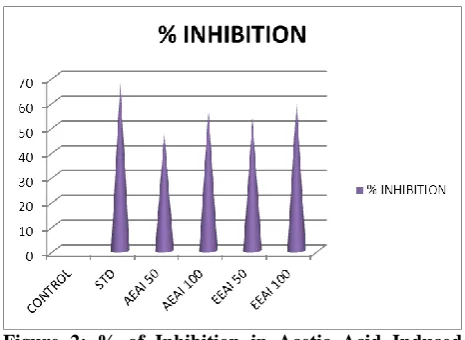
constrictions in mice is presented in the Table 1. The result shows that Ethanolic and Aqueous extracts (100 mg/kg), and the reference drug Diclofenac sodium (10 mg/kg) more significantly (P < 0.01) reduced abdominal writhing in mice when compared to the control group reducing the mean number of writhing from 12.5±2.7 in the control group to 5±0.37** at a dose of 100mg/kg of Ethanolic extract of Abutilon indicum. The reduction was in a dose dependent manner. Also the extract caused a dose dependent increase in inhibition of abdominal writhing, increasing it from 0% in control group to 60% at the dose 100 mg/kg of Ethanolic extract. Both the extracts at a dose of 50mg/kg are also significant (p<0.05) when compared to control group.100mg/kg of Ethanolic extracts was found more potent than all other extracts. The reference drug diclofenac sodium was found more potent than both the plant extracts at all of the dose level.
Table 1: Acetic acid induced writhing response of Abutilon indicum extracts.
Group no Drug treatment Dose mg/kg Mean writhing response Percentage inhibition
1 Control 27ml/kg 12.5±2.7 0
2 Diclofenac sodium 10 4±0.58** 68
3 AEAI 50 6.5±0.51* 48
4 AEAI 100 5.5±0.77** 56
5 EEAI 50 5.8±0.6* 53.60
6 EEAI 100 5±0.37** 60
when compared to control. AEAI –Aqueous extract of
Abutilon indicum, EEAI-Ethanolic extracts of Abutilon
indicum.
Figure 1: Mean Writhing response in Acetic Acid Induced Writhing in Mice, Standard – Diclofenac
(10mg/kg), AEAI-Aqueous extract of Abutilon
indicum, EEAI- Ethanolic extract of Abutilon indicum.
Figure 2: % of Inhibition in Acetic Acid Induced Writhing in Mice Standard – Diclofenac (10mg/kg), AEAI-Aqueous extract of Abutilon indicum, EEAI- Ethanolic extract of Abutilon indicum.
Hot Plate Method
The result of the effect of Ethanolic and Aqueous extracts of Abutilon indicum on the hot plate method is presented in Table 2. The result shows that Ethanolic extract 100mg/kg having more significant in mean reaction time when compared to control ( p<0.001)
.50mg/kg,100mg/kg of Aqueous extract of Abutilon
indicum and 50 mg/kg of Ethanolic extracts shows
significant in mean reaction time when compared to control .(p<0.01).
Table 2: Analgesic activity of Abutilon indicum in hot plate method.
Group No,
Treatment Dose
(mg/kg) Mean reaction time in seconds
0 Min 15 min 30 min 45 min 60 min 75 min
1 Control Co-solvent 1.95±0.16 2.50±0.15 2.9±0.13 3.46±0.11 4.08±13*** 4.60±0.1%
2 Pentazocine 5mg/kg 3.63±0.30 4.18±0.31 6.70±0.29** 7.5±0.29*** 8.4±0.19*** 9.3±0.12***
3 AEAI 50mg/kg 2.85±0.30 3.48±0.6 4.2±0.13** 4.18±0.18** 5.45±0.16** 5.98±0.22**
4 AEAI 100mg/kg 2.25±0.15 2.83±0.22 3.11±0.12** 4.18±0.06* 5.25±0.07** 6.25±0.11**
5 EEAI 50mg/kg 3.48±2.68 3.42±0.33 4.95±0.17** 5.43±0.11** 5.27±0.48** 7.36±0.11***
6 EEAI 100mg/kg 2.68±0.21 3.35±0.29 3.9±0.29* 5.28±0.19** 7.25±0.38*** 8.28±0.3***
One way ANOVA followed by dunnet’s test. Values are mean ± SEM. n=6, in each group *p<0.05, **p<0.01,***p <0.001 when compared to control.
DISCUSSION
The present study was designed to evaluate the analgesic potential of Ethanolic and Aqueous extracts of stem of
Abutilon indicum in Swiss albino mice. To evaluate the
characteristics are observed as indicators of pain; contraction of abdominal muscle, elongation of body part and extension of the hind limbs Therefore, such presentation is thought to be mediated by peritoneal receptors.[26] It has been proposed that acetic acid acts
indirectly by releasing endogenous substances
responsible for exciting the nerve endings and causing pain, but also excites neurons that are sensitive
to drugs.[27] To suppress pain conventionally,
nonsteroidal anti-inflammatory drugs are prescribed.[28] These drugs are used for treating various diseases such as arthritis, headache, pain and orthopaedic conditions. Analgesic drugs such as diclofenac relieve pain peripherally/centrally by inhibiting cyclooxygenase
enzyme (COX-1 and COX-2). Inhibition of
cyclooxygenase enzyme reduces the production of pain mediators such as prostaglandins, substance P, histamine, serotonin, and Bradykinin. Pain sensation is eventually reduced in the nociceptors.[29] These findings strongly suggest that Ethanolic and Aqueous extracts of stem of
Abutilon indicum possess peripherally or centrally
analgesic property Perhaps acting in a similar manner as conventionally used therapeutic drugs that reduce the pain perception in nociceptors by inhibiting production of prostaglandins. These results concur with other research studies on the evaluation analgesic activity of herbal plants extract using laboratory animals. Reduction in the number of abdominal writhing’s in this study is in agreement with a study carried out by[30] on analgesic properties of acetone leaf extracts of Carissa spinarum in mice. The findings are also in line with studies by[31] on antinociceptive activity of Toddalia asiatica (L) Lam in models of central and peripheral pain.Studies conducted on herbal plants by many researchers have linked presence of secondary active metabolites such as flavonoids, saponins and alkaloids to analgesic activities among other properties.[32-33] Flavonoids have the ability to disrupt synthesis of eicosanoids.[34] Flavonoids also have the ability to reduce production of arachidonic acid through inhibition of neutrophils degranulation.[35] Besides flavonoids, alkaloids also have been associated with the ability to inhibit pain perception.[36]
CONCLUSION
The Ethanolic and Aqueous extracts of stem of Abutilon
indicum in Swiss albino mice clearly demonstrated
analgesic activities on acetic acid-induced pain in Swiss albino mice. The extract reduced the number of abdominal writhing’s significantly when compared to the reference drug (diclofenac). This study therefore concludes that the medicinal plant posses analgesic properties. Suppression of pain in this study could be attributed to phytochemical constituents present in the extract. Therefore, it is possible to obtain analgesic agent from the plant and serve as an alternative bio-resource in managing pain. However, further research on the mechanism action of the extract should be carried out. The study thus, scientifically confirms the traditional use of the medicinal plant in management of pain.
ACKNOWLEDGEMENT
The authors are very thankful to the Director and Principal of Sanjo College of Pharmaceutical studies, Vellapara, Palakkad for providing facilities to carry out the present research work.
REFERENCES
1. Raquibul SM, Hossain MM, Aktar R, Jamila M,
Mazumder MEH, Alam MA, et al. Analgesic Activity of the Different Fractions of the Aerial
Parts of Commenila Benghalensis Linn.
International Journal of Pharmacology, 2010; 6(1): 63–67.
2. Rang HP, Dale MM, Ritter JM, Moore
PK. Pharmacology. 5th edn. New Delhi India: Elsevier Science ltd, 2003.
3. Laurence DR, Benneth PN, Brown MJ. Clinical
Pharmacology. 8th edn. Edinburgh: ChurchHill Livingstone, 1997.
4. Mate GS, Naikwade NS, Chowki CSA, Patil SB.
Evaluation of Anti-nociceptive Activity of Cissus
quadrangularis on Albino Mice. Int J Green
Pharm, 2008; 2: 118–121.
5. Rang HP, Dale MM, Ritter JM, Flower MC
Pharmacology. 7th edn, Churchill Livingstone, 2006; 202-210.
6. Boursinos LA, Karachalios T, Poultisides L,
Malizos M Do steroids, conventional non-steroidal anti-inflammatory drugs and selective Cox-2 inhibitors adversely affect fracture healing. Journal of Musculoskelet Neuronal Interact, 2009; 9: 44-52.
7. Sparkes A, Heiene R, Lascelles BD, Malik R,
Sampietro LR, et al. NSAIDs and cats- its been a long journey. Journal of Feline Medicine and Surgery, 2010; 12: 519-538.
8. Richard F, Michelle AC, Luigi XC Lippincott's
Illustrated Reviews. Pharmacology. Lippincott Williams & Wilkins, Philadelphia, 4th edn, 2008; 564.
9. Shah BS, Nayak BS, Seth AK, Jalalpure SS, Patel KN, et al. Search for medicinal plants as a source of
anti-inflammatory and anti-arthritic agents.
Pharmacognosy Magazine, 2006; 2: 77-86.
10. Singh A, Malhotra S, Subban R Anti-inflammatory
and analgesic agents from Indian medicinal plants. International Journal of Integrative Biology, 2008; 1: 57-72.
11. 1Komboj VP Herbal medicine. Current Science,
2000; 78: 35-39.
12. Gupta M, Mazumder UK, Gomathi P, Selvan VT
Anti-inflammatory activity of extract of Vernonia
amygdalina. Complementary and Alternative
Medicine, 2006; 6: 36-43.
13. Khandelwal KR. Practical Pharmacognosy‐
Techniques and Experiments. Pune: Nirali
Prakashan, 2002.
15. Kulkarni SK. Handbook of experimental Pharmacology. 3rded Vallabh Prakashan, New Delhi, 2005; 127.
16. Kenji O. Pain signalling pathways: from cytokines to ion channels. Int. J. B. C. B, 2007; 39: 490. 17. Tripathi KD, Essentials of Medical Pharmacology.
5th ed., Jaypee Brothers Medical Publishers (P) LTD, New Delhi, 2003; 167.
18. Satoskar RS, Bhandarkar SD, Ainapure SS.
Pharmacology and Pharmacotherapeutics. 16thed, Popular Prakashan, Mumbai, 1998; 151.
19. Singh SD, Majumbar K Analysis of activity
of Ocimum sanctum and its possible mechanism of
action. International Journal of Pharmacology, 1995; 3: 188-192.
20. Akuodor GC, Anyalewechi NA, Udoh FV, Ikoro
NC, Akpan JL, et al. Pharmacological evaluation
of Verbena hastate leaf extract in the relief of pain
and fever. Advances in Pharmacology and Toxicology, 2011; 3: 1-8.
21. Ezeja MI, Ezeigbo II, Madubuike KG Analgesic
activity of the methanolic seed extract of Buchholzia coriacea. Research Journal of Pharmaceutical, Biological and Chemical Sciences, 2011; 2: 182-187.
22. N. B. Eddy and D. Leimback, “Synthetic analgesic
II. Diethlenyl butenyl and dithienyl
butylamines,” Journal of Pharmacology and
Experimental Therapeutics, 1953; 107:
385–393. View at Google Scholar
23. Fujiyoshi T, Hayashi I, Ohishi S, Kuwashima M, Iida H, et al. Kaolin-induced writhing in mice, a new model of possible bradykinin-induced pain for assessment of analgesic agents. Agent and Actions, 1989; 27: 332-334.
24. Collier HJ, Dinneen LC, Johnson CA, Schneider C The abdominal constriction response and its suppression by analgesics drugs in the mouse. British Journal of Pharmacology, 1968; 32: 295-310.
25. Berkenkopf JW, Weichman BM Production of
protacyclin in mice following intraperitoneal injection of acetic acid, phenylbenzoquinone and zymosan. Prostaglandins, 1988; 36: 693-709.
26. Bentley G, Newton S, Starr J Studies on the
antinociceptive action of a-agonist drugs and their interactions with opioid mechanisms. British Journal of Pharmacology, 1983; 79: 125-34.
27. Inotai A, Hanko B, Meszaro A Trends in the non-steroidal anti-inflammatory drug market in six central-eastern European countries based on retail information. Pharmacoepidemiology and Drug Safety, 2010; 19: 183-190.
28. Davies P, Bailey PJ, Goldenberg MM,
Ford-Hutchinson AW The role of arachidonic acid oxygenation products in pain and inflammation. Annual Review of Immunology, 1984; 2: 35-54.
29. Mworia JK, Gitahi SM, Juma KK, Njagi JM,
Mwangi BM, et al. Antinociceptive Activities of Acetone Leaves Extracts of Carissa Spinarum in
Mice. Medicinal and Aromatic Plants, 2015; 10: 1- 4.
30. Mworia JK, Gitahi SM, Juma KK, Njagi JM,
Mwangi BM, et al. Antinociceptive Activities of Acetone Leaves Extracts of Carissa Spinarum in Mice. Medicinal and Aromatic Plants, 2015; 10: 1- 4.
31. Kariuki HN, Kanui TI, Yenesew A, Patel NB,
Mbugua MP Antinociceptive activity of Toddalia asiatica (L) Lam in models of central and pheripheral pain. Phytopharmacology, 2012; 3: 122-12.
32. Afsar T, Khan M, Razak S, Ullah S, Mirza B
Antipyretic, anti-inflammatory and analgesic
activity of Acacia hydaspica R. Parker and its phytochemical analysis. BMC Complementary and Alternative Medicine, 2015; 15: 136-145.
33. Kumar A, Agarwal K, Maurya KA, Shanker K,
Bushra U, et al. Pharmacological and phytochemical evaluation of Ocimum sanctum root extracts for its
anti-inflammatory, analgesic and antipyretic
activities. Pharmacognosy Magazine, 2015; 11: 17-24.
34. Robak J, Gryglewski RJ Bioactivity of flavonoids. Polish Journal of Pharmacology, 1996; 48: 555-564. 35. Tordera M Ferrandiz ML, Alcaraz MJ Influence of
anti-inflammatory flavonoids on degranulation and arachidonic acid release in rat neutrophils. Journal of Biosciences, 1994; 49: 235-240.
36. Uche FI, Aprioku JS the phytochemical constituents,