The Thirty-Third AAAI Conference on Artificial Intelligence (AAAI-19)
P
ARA
B
ANK
: Monolingual Bitext Generation and Sentential
Paraphrasing via Lexically-Constrained Neural Machine Translation
J. Edward Hu, Rachel Rudinger, Matt Post, Benjamin Van Durme
3400 North Charles StreetJohns Hopkins University Baltimore, MD, USA
Abstract
We present PARABANK, a large-scale English paraphrase dataset that surpasses prior work in both quantity and quality. Following the approach of PARANMT (Wieting and Gimpel, 2018), we train a Czech-English neural machine translation (NMT) system to generate novel paraphrases of English ref-erence sentences. By adding lexical constraints to the NMT decoding procedure, however, we are able to produce mul-tiplehigh-quality sentential paraphrases per source sentence, yielding an English paraphrase resource with more than 4 bil-lion generated tokens and exhibiting greater lexical diversity. Using human judgments, we also demonstrate that PARA -BANK’s paraphrases improve over PARANMT on both se-mantic similarity and fluency. Finally, we use PARABANKto train a monolingual NMT model with the same support for lexically-constrained decoding for sentence rewriting tasks.
1
Introduction
In natural languages, mappings between meaning and utter-ance may be many-to-many. Just as ambiguity allows for multiple semantic interpretations of a single sentence, a sin-gle meaning can be realized by different sentences. The abil-ity to identify and generateparaphrases has been pursued in the context of many natural language processing (NLP) tasks, e.g., semantic similarity, plagiarism detection, trans-lation evaluation, monolingual transduction tasks such as text simplification and style transfer, textual entailment, and short-answer grading.
Paraphrastic resources exist at many levels of granularity, e.g., WordNet (Miller, 1995) for word-level and the Para-phrase Database (PPDB) (Ganitkevitch, Van Durme, and Callison-Burch, 2013) for phrase-level. We are interested in building a large resource forsentence-level paraphrases in English. In this work, we introduce PARABANK, the largest publicly-available collection of English paraphrases we are aware of to date. We follow and extend the approach of Wi-eting and Gimpel (2018), who generate a set of 50 million English paraphrases, under the name PARANMT-50M, via neural machine translation (NMT).
A part of PARABANK is trained and decoded on the same Czech-English parallel corpus (Bojar et al., 2016) as PARANMT. However, PARABANKnot only contains more
Copyright c2019, Association for the Advancement of Artificial Intelligence (www.aaai.org). All rights reserved.
Figure 1: Contrasting prior work (e.g., PARANMT) on building sentential paraphrase collections via translation, PARABANK conditions on both the source andtarget side of a translation pair, employing positive and negative lexical constraints derived from the reference to result inmultiple,
diverseparaphrases.
reference sentences but also more paraphrases per reference than PARANMT with overall improvements in lexical di-versity, semantic similarity, and fluency. We are able to ob-tain a larger number of paraphrases per sentence by apply-ing explicit lexical constraints to the NMT decoder, requir-ing specific words to appear (positive constraint) or not to appear (negative constraint) in the decoded sentence. Using PARABANK, we train, and release to the public, a monolin-gual sentence re-writing system, which may be used to para-phrase unseen English sentences with lexical constraints.
The main contributions of this work are:
• A novel approach to translation-based generation of monolingual bitext;
• The largest and highest quality English-to-English bitext resource to date with 79.5 million references and pre-dicted human-judgment scores;
• Manual assessment of candidate paraphrases on semantic similarity, across a variety of generation strategies;
• A trained and freely released model for English-to-English rewriting, supporting positive and negative lexical constraints.
2
Background
The following summarizes key background in approaches to monolingual paraphrasing with regard to PARABANK, along with the essential prior efforts that enable PARA -BANK to improve on related work. We first discuss work on sub-sentential resources that may be: hand-curated, au-tomatically expanded from hand-curated, or fully automati-cally created. We then describe efforts at gathering or creat-ing monolcreat-ingual sentential bitexts, or otherwise sentence-to-sentence paraphrastic rewriting. For additional background, we refer readers to Madnani and Dorr (2010).
2.1
Paraphrasing Resources
Lexical Resources WordNet (Miller, 1995) includes manually-curated sub-sentential paraphrases. It groups sin-gle words or short-phrases with similar meanings into syn-onym sets (synsets). Each synset is related to other synsets through semantic relations (e.g., hypernym, entailment) to allow the construction of hierarchies and entailment rela-tions.
VerbNet (Schuler, 2006) is a manually-constructed lex-icon of English verbs. It is augmented with syntactic and semantic usage of its verb sense members. As a paraphrase resource, VerbNet groups verb senses into classes like “say-37.7-1” or “run-51.3.2”. Members under the same class share a general meaning as noted by the class name.
FrameNet (Baker, Fillmore, and Lowe, 1998) con-tains manually annotated sentences classified into seman-tic frames. Though designed as a readable reference and as training data for semantic role labeling, FrameNet can be used to construct sub-sentential paraphrases, owing to rich semantic contents like semantic types and frame-to-frame relations.
Many efforts have aimed to automatically expand gold resources, for example: Snow, Jurafsky, and Ng (2006) augmented WordNet by combining existing semantic tax-onomies in WordNet with hypernym predictions and coordi-nate term classifications; and Pavlick et al. (2015b) tripled the lexical coverage of FrameNet by substituting words through PPDB, with verification of quality via crowdsourc-ing.
Larger Paraphrases There is a rich body of work in auto-matically inducing phrasal, syntactic or otherwise structural paraphrastic resources. Some examples include: DIRT (Lin and Pantel, 2001), which extracts paraphrastic expressions over paths in dependency trees, based on an extension of the distributional hypothesis, which states that words that occur in the same contexts tend to have similar meanings (Harris, 1954); Weisman et al. (2012) explored learning inference re-lations between verbs through broader scopes (document or corpus level), resulting in a richer set of cues for verb en-tailment detections; and PPDB (Ganitkevitch, Van Durme, and Callison-Burch, 2013), a multi-lingual effort to con-struct paraphrase pairs by linking words or phrases that share the same translation in another language. Related to the hu-man scoring pursued here for ParaBank evaluation, in PPDB 2.0 (Pavlick et al., 2015a), the authors collected annotations
via Mechanical Turk to measure the quality of the induced paraphrases, in order to train a model for scoring all the en-tries in PPDB for semantic adequacy.
2.2
Monolingual Bitexts
Manually Created Some monolingual bitexts are created for research in text generation (Pang, Knight, and Marcu, 2003; Robin, 1995) where models benefit from exposure to multiple elicitations of the same concept. The utility of these resources is largely limited by their scale, as the cost of creation is high. Other sources include different transla-tions of the same foreign text, which exist for many classic readings. Work has been done on identifying and collecting sub-sentential paraphrases from such sources (Barzilay and McKeown, 2001). However, the artistic nature of literature could result in various interpretations, often rendering this type of resource unreliable.
PARANMT Wieting and Gimpel (2018) leverage the rel-ative abundance of bilingual bitext to generate sentence-level paraphrases through machine translation. This ap-proach trains a neural machine translation (NMT) model from a non-English source language to English over the en-tire bitext (Czech-English) (Bojar et al., 2016), and decodes the source to obtain outputs that are semantically close to the training target. Decoding in PARANMT solely depends on the trained model and the source text with no inputs de-rived from the target English sentences. The approach in PARANMT exhibits little control over the diversity and ad-equacy of its paraphrastic sentence pairs: the application of lexical constraints during decoding is a key distinction be-tween PARANMT and the approach described herein.
2.3
Lexically Constrained Decoding
Lexically constrained decoding (Hokamp and Liu, 2017) is a modification to beam search for neural machine translation that allows the user to specify tokens and token sequences that must (or must not) appear in the decoder output. A lex-ical constraint can be either positive or negative. A posi-tive constraint requires the model toincludethe constrained token or tokens in the output. Negative constraints, on the other hand, require the model toavoid certain token or to-kens in the output. The effect of constraints is to cause the system to generate the best decoding (translation or para-phrase) under those constraints.
Recently, Post and Vilar (2018) proposed a variant of lex-ically constrained decoding that reduced complexity from linear to constant-time (in the number of constraints). This allows us to decode hundreds of millions of sentences with constraints in a reasonable amount of time, and forms a key enabling technology for PARABANK. An implementation of it is included in Sockeye (Hieber et al., 2017), which we use for this work.
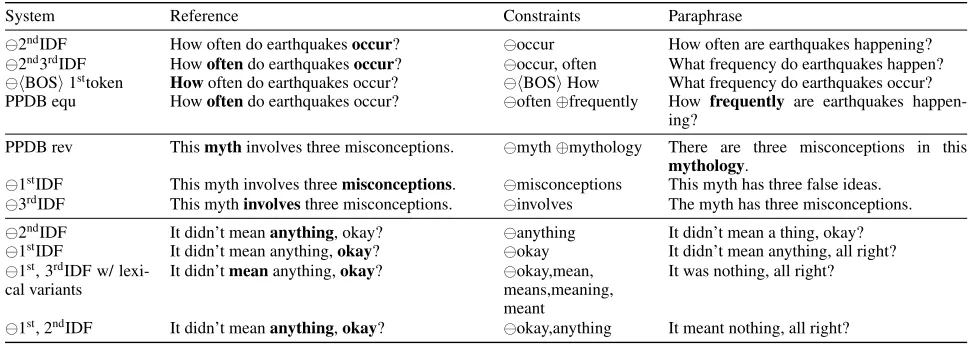
rank-System Reference Constraints Paraphrase
2ndIDF How often do earthquakesoccur? occur How often are earthquakes happening? 2nd3rdIDF Howoftendo earthquakesoccur? occur, often What frequency do earthquakes happen?
hBOSi1sttoken Howoften do earthquakes occur? hBOSiHow What frequency do earthquakes occur? PPDB equ Howoftendo earthquakes occur? often⊕frequently How frequently are earthquakes
happen-ing?
PPDB rev Thismythinvolves three misconceptions. myth⊕mythology There are three misconceptions in this mythology.
1stIDF This myth involves threemisconceptions. misconceptions This myth has three false ideas. 3rdIDF This mythinvolvesthree misconceptions. involves The myth has three misconceptions.
2ndIDF It didn’t meananything, okay? anything It didn’t mean a thing, okay? 1stIDF It didn’t mean anything,okay? okay It didn’t mean anything, all right? 1st, 3rdIDF w/
lexi-cal variants
It didn’tmeananything,okay? okay,mean, means,meaning, meant
It was nothing, all right?
1st, 2ndIDF It didn’t meananything,okay? okay,anything It meant nothing, all right?
Table 1: Examples of different constraint selection methods in PARABANKleading to multiple different paraphrases per refer-ence. System names are defined in Tab. 3 with full descriptions in§3.2. Constraints are labeled in bold.
ing aggregation and direct assessment. In manually evalu-ating the quality of our system’s paraphrases, we adopt an annotator interface based on EASL. Human annotators are asked to assess paraphrases’ semantic similarity to the refer-ence sentrefer-ence through a combination of direct numerical as-sessment and pairwise comparison. This mode of evaluation is akin to the method employed by the Workshop on Sta-tistical Machine Translation (WMT) evaluation through an adaptation of TrueSkillTM(Sakaguchi, Post, and Van Durme,
2014).
3
Approaches
3.1
Training the model
We use Sockeye (Hieber et al., 2017) to train the machine translation model, with which we generate paraphrases un-der different constraint systems. The training data, CzEng 1.7 (Bojar et al., 2016), is tokenized1and processed through
Byte Pair Encoding (BPE) (Sennrich, Haddow, and Birch, 2016). To reduce the vocabulary size, we tokenized all num-bers to digit-level.
The model’s encoder and decoder are both 6-layer LSTMs with a hidden size of 1024 and an embedding size of 512. Additionally, the model has one dot-attention layer. We trained the model on 2 Nvidia GTX 1080Ti for two weeks.
3.2
Selection of Lexical Constraints
Lexical constraints (§2.3) can directly influence the diversity and sufficiency of the NMT decoder output (i.e., the trans-lation). We generate paraphrases of English translations of Czech sentences using different sets of constraints obtained from the English side of the bitext. These constraints may be positive or negative, and multiple constraints of either type may be combined simultaneously (provided they are consis-tent).
1
We used spaCy (Honnibal and Montani, 2017) to tokenize En-glish text, and MorphoDiTa (Strakov´a, Straka, and Hajiˇc, 2014) to tokenize Czech text.
The tokens on which we base these constraints are the tokens that appear in the reference sentence (or are morpho-logical variants thereof), though in principle any token could be used as a constraint. To select the constraints from this pool, we experiment with different ways of selecting these constraints from the reference, resulting in 37 experimental system configurations (Tab. 3): one baseline system with no constraints, three with tokens selected positionally, 30 with positive and negative constraints selected via inverse docu-ment frequency (IDF), and three additional systems based on PPDB lookups. Here we describe these selection criteria in detail.
IDF Criteria We compute each token’s inverse document frequency (IDF) from the training data. To avoid constraints with misspelled or overly-specialized words, we exclude to-kens with an IDF above 17.0 from consideration as lexical constraints. We also avoid constraints based on the most fre-quent English words by setting a minimum IDF threshold of 7.0. These thresholds are heuristics and we leave optimiza-tions to future works. Among the remaining candidates, the constraint token may be selected by the highest IDF, lowest IDF, or randomly.
Prepositions We make one exception to the minimum IDF threshold in the case of prepositions, which we found fruitful as diversity-promoting constraints (see Fig. 1). The allowed prepositions are:about,as,at,by,for,from,in,into,of,on,
onto,over,to, andwith.
Morphological Variants To discourage trivial para-phrases, some negative constraint systems include morpho-logical variants of the word, and all negative constraint systems exclude capitalization. For positive constraints, we only consider morphological variants for verbs2, and only
2
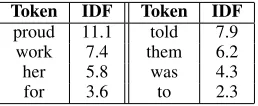
Token IDF Token IDF
proud 11.1 told 7.9
work 7.4 them 6.2
her 5.8 was 4.3
for 3.6 to 2.3
Table 2: Tokens assessed, along with their IDFs, of the sen-tence“I told her I was proud to work for them.”
one variant of the selected token is used. For all constraints, only lowercased alphabetical tokens are considered.
Positional Constraints It has been observed that RNN de-coders in dialogue systems can be nudged toward produc-ing more diverse outputs by modifyproduc-ing decodproduc-ing for only the first few tokens (Li et al., 2016). Motivated by this ob-servation, we includepositional constraints, which require that a given constraint apply only at the beginning of the sentence (denoted as hBOSiin Table 3). In particular, we require the first one, two, or three tokensnotto match the reference translation (i.e., anegativeconstraint).
PPDB Constraints We also use PPDB 2.0 (Pavlick et al., 2015a) as a source for introducingpositivelexical con-straints. For each token in the original English sentence that passes the IDF filter (above), we look up its para-phrases in PPDB3. We randomly select up to three
lex-ical paraphrases, one each of the type Equivalence, ForwardEntailment, and ReverseEntailment, if present. We further require the selected lexical paraphrases to coarsely match the original token’s POS tag (e.g., any form of verb, etc.) A negative constraint is then added for the original token, and a positive constraint is added for the lexical paraphrase from PPDB. These negative-positive con-straint pairs are applied one at a time (i.e., one pair per de-coding).
Example of constraint selection Here we work through the process of selecting lexical constraints to produce a new paraphrase of the sentence“I told her I was proud to work for them.”. We follow the rules of system number 18 (as des-ignated in Tab. 3).
First, tokens with only lower-cased alphabetical letters are assessed; they are listed in Tab. 2 along with their IDF val-ues. After applying the IDF thresholds and exception for prepositions, the following tokens are in the candidate pool, from which we choose tokens to constrain on (listed in de-scending order of IDF values): proud,told,work,for, and
to.
Under the configuration of PARABANK System 18 (Tab. 3), which avoids tokens with the lowest and the sec-ond lowest IDF, a negative constraint is generated for the tokensfor,For,to, and To. With these constraints applied, the resulting decoded paraphrase is:“I told her I was really proud of working with them.”.
3
We use the ppdb-2.0-lexical-xl packet downloaded from paraphrase.org.
No. ⊕/ Token(s) Selected Lex.
1,2,3 1st, 2nd, 3rd highest IDF4 None 4,5,6 (1st, 2nd), (2nd, 3rd), (1st, 3rd) IDF None 7 (1st, 2nd, 3rd) highest IDF None 8,9,10 1st, 2nd, 3rd highest IDF All 11,12,13 (1st, 2nd), (2nd, 3rd), (1st, 3rd) IDF All 14 (1st, 2nd, 3rd) highest IDF All 15,16,17 1st, 2nd,3rd lowest IDF None 18,19,20 (1st, 2nd), (2nd, 3rd), (1st, 3rd) low None 21 (1st, 2nd, 3rd) lowest IDF None
22,23,24 1, 2, 3 random tokens None
25,26,27 1, 2, 3 random tokens All
28 no constraints
29,30,31 ⊕ 1st, 2nd,3rd highest IDF Verb5 32,33,34 positionalhBOSi: 1, 2,3 tokens None 35,36,37 ⊕ PPDB equ, fwd, rev entailment None
Table 3: Different system configurations to generate para-phrases.⊕/ designates the type of constraint we impose on the model:negativeconstraints ( ) are sets of tokens or ngrams which the decoder must not include in its output, whilepositive constraints (⊕) are sets of tokens or ngrams
required in the output. Additional constraints may be cluded for lexical variations of the selected token(s), as in-dicated by the Lex. column. Systems in bold fonts are pre-sented here for evaluation. Evaluations of all systems will be made available with the resource.
More examples are shown in Tab. 1.
4
Extension to other bilingual corpora
Our methods are independent of the source bilingual cor-pora. We apply the same pipeline to the 109 word French-English parallel corpus (Giga) (Callison-Burch et al., 2009), which has different domain coverage than CzEng. This adds an additional 22.4 million English references, resulting in a total of 79.5 million reference sentences for PARABANK. We conducted manual evaluation on paraphrases generated from both CzEng and Giga, and included the additional PPDB constraint systems for Giga.5
Evaluation
We evaluate the quality of paraphrases by both semantic similarity and lexical diversity. A good paraphrase should strive to preserve as much meaning as possible while using lexically diverse expression. Otherwise, the result is either a trivial re-write or fails to convey the original meaning. We understand these two metrics as interdependent and some-times conflicting – a high lexical diversity likely sacrifices semantic similarity. The goal of PARABANKis to offer not only a balance between the two, but also options across the spectrum for different applications. Of course, good para-phrases should also be fluent in their expression, so we
4
Highest within the token pool. Same for lowest. 5
# System Czech-English French-English
len=5 len=10 len=20 len=40 Avg. len=5 len=10 len=20 len=40 Avg.
Semantic
Similarity
- PARANMT 73.47 73.49 75.49 71.09 73.39 - - - -
-17 3rdlow IDF 71.59 75.71 79.67 77.31 76.07 73.64 72.69 83.60 80.15 77.52
21 3 low IDF 59.86 66.56 70.76 69.77 66.74 62.84 69.56 81.73 77.08 72.80
28 no con. 76.63 78.35* 83.19* 80.35 79.63* 79.09 74.28 84.86 83.02* 80.31*
31 ⊕3rdtop IDF 77.12* 75.22 82.98 79.91 78.81 80.22* 73.78 85.01 80.02 79.76
34 first 3 tks 74.03 77.74 81.88 81.04* 78.67 78.12 74.37* 84.14 82.74 79.84
35 PPDB Equ - - - 79.22 67.30 82.09 79.98 77.15
36 PPDB Fwd - - - 65.40 69.39 85.10* 82.75 75.66
37 PPDB Rev - - - 64.25 66.28 76.35 72.49 69.84
Le
xical
Di
v
ersity
35 PARANMT 18.32 25.49 32.25 33.84 27.48 - - - -
-17 3rd low IDF 9.25 20.62 35.76 41.88 26.88 6.59 15.57 26.78 34.54 20.87
21 3 low IDF 0.00* 7.84* 22.04* 28.90* 14.70* 1.21* 6.90* 18.28 22.02 12.10
28 no con. 19.32 28.41 42.02 46.63 34.10 14.07 21.12 30.57 38.66 26.11
31 ⊕3rd top IDF 19.09 29.16 41.42 46.96 34.16 15.28 21.69 31.49 37.56 26.51
34 first 3 tks 13.22 24.90 39.11 44.67 30.47 10.87 18.15 27.70 36.87 23.40
35 PPDB equ - - - 4.46 13.33 25.88 29.54 18.30
36 PPDB fwd - - - 1.51 8.87 14.14* 19.03* 10.89*
37 PPDB bkw - - - 3.94 9.69 18.94 26.24 14.70
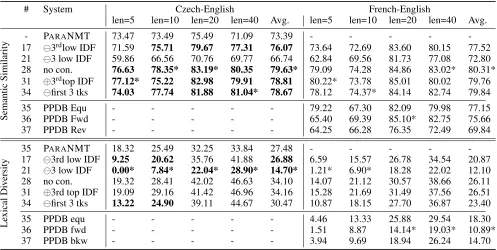
Table 4:Top: Semantic similarity between paraphrases and reference sentences, as scored by human annotators on a 0-100 scale (least to most similar). Results are grouped by length of reference sentences{5, 10, 20, 40}. System names and numbers correspond to Tab. 3. Improvements over PARANMT (Czech-English only) in bold. Asterisk (*) indicates best in column. Bottom: Lexical diversity between generated paraphrases and reference sentences, as computed by a modified BLEU score with no length penalty. Results are grouped by length of reference sentences, and BLEU is computed over concatenated references and concatenated paraphrases. Lower BLEU scores indicate greater lexical divergence; the lowest per column (bottom half) is indicated by (*).
also evaluate paraphrases for grammaticality and meaning-fulness, independent of their reference.
For brevity, we picked 5 PARABANK systems (bold in Tab. 3) to cover negative, positive, positional, and no con-straint. We also include system 21 (3 lowest IDF tokens) to show that too many constraints might significantly hurt se-mantic similarity. Full evaluations on all proposed systems will be included with the release of the resource.
5.1
Scoring P
ARAB
ANKparaphrases
Following the approach of PPDB 2.0 (Pavlick et al., 2015a), we trained a supervised model on the human annotations we collected. We extracted several features from reference-paraphrase pairs to predict human judgments of semantic similarity on all paraphrases, with the exception of those whose reference contains more than 100 tokens post-BPE. The regression model achieves reasonable correlation with human judgment on the test data with a Spearman’s ρof 0.53 on CzEng and 0.63 on Giga.
5.2
Baseline comparison
Our baseline system with no lexical constraints applied shows substantial improvement compared to PARANMT. This could be a combination of improved training data and NMT framework. PARANMT is trained on a 51.4M subset of CzEng1.6, while PARABANK used CzEng1.7, a 57.0M
subset of CzEng1.6. We also switched to SOCKEYEas our training framework. This baseline improvement gives us more flexibility to pursue explicit lexical diversity with rea-sonable compromise in semantic similarity.
5.3
Semantic similarity
Human judgment remains the gold standard of semantic similarity. We randomly sampled 100 Czech-English sen-tence pairs from each of the four English token lengths: 5, 10, 20, and 40. We translate 400 sentences from CzEng under 34 PARABANK systems (without PPDB constraints) and 400 sentences from Giga under 37 PARABANKsystems. Then, we merge identical outputs and add in the correspond-ing PARANMT entries to the CzEng evaluation.
independent judgments from at least 3 different workers. We then calculate the average score for each sentence pair, before averaging over all pairs from each PARABANK sys-tem (or PARANMT). The final score for each system is a number between 0 and 100.
The top half of Tab. 4 shows the average human judgment over 100 sentences per reference length for PARABANK sys-tems and PARANMT, grouped by sentence length.
Best performing PARABANK systems from each refer-ence length outperform PARANMT relatively by 5.0%, 6.6%, 10.2%, and 14.0% in terms of semantic similarity (corresponding to 5, 10, 20, 40 tokens per reference sen-tence).
5.4
Lexical diversity
We used a modified BLEU score to evaluate lexical diver-sity anda lower score suggests a higher lexical diversity. Specifically, we concatenate6multiple paraphrastic sentence pairs into one reference paragraph and one paraphrase para-graph, and calculate the associated BLEU score without brevity penalty. This modification ensures that we don’t reward shorter paraphrases. We compared the result with a naive unigram precision metric and they show a strong cor-relation with a Spearman’sρof 0.98.
The bottom half of Tab. 4 shows this modified BLEU score for each PARABANKsystem and PARANMT, grouped by reference length. For every length, there is at least one PARABANK system that exhibits higher lexical diversity than PARANMT; unsurprisingly, the PARABANK systems that apply the greatest number of lexical constraints tend to yield the greatest lexical diversity (e.g., system 21).
5.5
Meaningfulness and grammaticality
We ask annotators to comment on each paraphrase’s fluency by flagging sentences that are completely nonsensical or in-disputably ungrammatical. We consider a sentence nonsen-sical or ungrammatical when at least one independent anno-tator flags it as so.
We then calculate the percentage of sentences that are deemed both meaningful and grammatical for each PARA -BANKsystem and PARANMT.
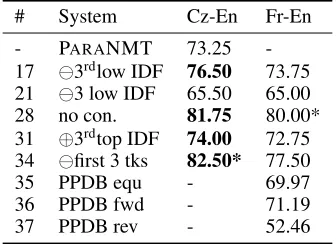
The result is shown in Tab. 5. System 34 (avoid first 3 to-kens) shows a 12.6% improvement over PARANMT. In all, 21 out of 34 proposed PARABANKsystems contain a smaller proportion of nonsensical or ungrammatical sentences than PARANMT. The full set of annotations are available with the resource.
6
Constrained monolingual rewriting
Napoles, Callison-Burch, and Post (2016) explored senten-tial rewriting with machine translation models. Inspired by their work, we use a subset of PARABANK, with more than 50 million English paraphrastic sentence pairs (English text from CzEng as source, PARABANK outputs as target), to train a monolingual NMT model, and decode with the same types of constraint systems. We present the following result6
After switching all tokens to lowercase and stripping punctua-tion to avoid rewarding trivial re-writes.
# System Cz-En Fr-En
- PARANMT 73.25
-17 3rdlow IDF 76.50 73.75
21 3 low IDF 65.50 65.00
28 no con. 81.75 80.00*
31 ⊕3rdtop IDF 74.00 72.75 34 first 3 tks 82.50* 77.50
35 PPDB equ - 69.97
36 PPDB fwd - 71.19
37 PPDB rev - 52.46
Table 5: Percentage of paraphrases for each system that are rated by human annotators as both grammatical and
meaningful, independent of similarity to the reference sen-tence. Improvements over PARANMT (Czech-English only) in bold. Asterisk (*) indicates best in column.
as a proof of concept that highlights the potential for and problems with the most straightforward instantiation of the model. A thorough investigation of building such a mono-lingual model is outside the scope of this work.
We decide to use the same LSTM model instead of more advanced self-attention models to contrast between the bilin-gual and monolinbilin-gual models. After training for one epoch, we decode the model with the same 5 constraint systems (no. 17, 21, 28, 31, 34) evaluated for the bilingual model, and ask human annotators7to compare their semantic
simi-larity to the reference sentence in the same way. We sampled 100 sentences across the same 4 lengths (25 sentences per length); each sentence receives at least 3 independent judg-ments. The semantic similarity scores for this monolingual system are reported in Tab. 6 (“Monolingual”) alongside lex-ical diversity scores (modified BLEU).
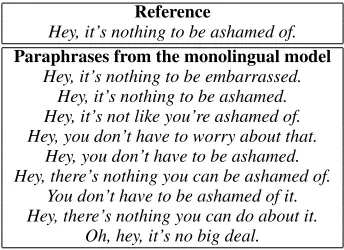
Outputs from the monolingual model show a significant boost in semantic similarity compared to bilingual counter-parts, system 28 (no constraint) shows an improvement of 16.7%. This is accompanied by an increase in BLEU score, a sign of less lexical diversity. Example outputs from the monolingual model can be found in Tab. 7.
As evidenced in our examples, some monolingual systems may generate slightly more nonsensical or ungrammatical sentences than their bilingual counterparts: future work will pursue more extensive model training and data filtering for the monolingual model. Our intent here is to foremost illus-trate the quality of PARABANKas a resource, while illustrat-ing the feasibility of trainillustrat-ing and employillustrat-ing a monolillustrat-ingual sentence rewriting model built atop the PARABANKartifact.
7
Conclusions and Future Work
We created PARABANKby decoding a neural machine trans-lation (NMT) model with lexical constraints. We applied our methods to CzEng 1.7 and Giga, leading to a large collection of paraphrases with 79.5 million references and on average 4 paraphrases per reference, which we make7
# System Semantic Similarity Lexical Diversity Bilingual (Cz-En) Monolingual Bilingual (Cz-En) Monolingual
- PARANMT 73.89 (std. 4.60) - 27.36 (4.89)
-17 3rd low IDF 76.79 (std. 3.77) 74.56 (std. 9.17) 27.20 (std. 14.67) 33.04 (std. 18.58) 21 3 low IDF 66.48 (std. 8.25) 63.35 (std. 19.59) 14.28 (std. 13.35) 24.82 (std. 20.52) 28 no con. 81.91 (std. 3.11) 86.25 (std. 3.94) 33.90 (std. 11.58) 44.36 (std. 13.69) 31 ⊕3rd top IDF 80.64 (std. 3.60) 83.09 (std. 4.23) 33.48 (std. 12.66) 43.80 (std. 13.39) 34 first 3 tks 80.04 (std. 1.95) 84.47 (std. 4.10) 30.20 (std. 13.50) 39.81 (std. 10.52)
- Reference 99.81 (std. 0.16) - 100.00 (std. 0.00)
-Table 6: Comparison of bilingual (Czech-English) and monolingual (English-English) paraphrasing systems in terms of (1) semantic similarityas rated by human annotators on a scale of 0-100, and (2) lexical diversityas measured by a modified BLEU score without length penalty, where lower BLEU scores are taken as evidence of greater lexical diversity. We observe that similarity and diversity scores for the monolingual rewriting systems exhibit higher variance than bilingual systems (sample standard deviations given in parentheses); however, the monolingual rewriter is able to generate English paraphrases in the absence of a Czech reference sentence.
Reference
Hey, it’s nothing to be ashamed of. Paraphrases from the monolingual model
Hey, it’s nothing to be embarrassed. Hey, it’s nothing to be ashamed. Hey, it’s not like you’re ashamed of. Hey, you don’t have to worry about that.
Hey, you don’t have to be ashamed. Hey, there’s nothing you can be ashamed of.
You don’t have to be ashamed of it. Hey, there’s nothing you can do about it.
Oh, hey, it’s no big deal.
Table 7: Example paraphrases generated from the monolin-gual rewriting model, after applying the same set of lexical constraints described in Tab. 3 and merging duplicates.
available for download at http://nlp.jhu.edu/parabank. Via large-scale crowdsourced annotations, we found the overall best performing PARABANKsystem exhibits an 8.5% rela-tive improvement in terms of semantic similarity over prior work. Analysis on lexical diversity showed the potential of PARABANK as a more diverse and less noisy paraphras-tic resource. In addition to releasing hundreds of millions of English sentential paraphrases, we also release a free, pre-trained, model for monolingual sentential rewriting, as trained on PARABANK.
With the existence of PARABANKand an initial monolin-gual rewriting model, future work can investigate how more advanced NMT models, such as those with self-attention structures, can lead to better rewriting. One may also inves-tigate the automatic expansion of resources for a variety of NLP tasks. For example, in Machine Translation one might create sentential paraphrases from the English side of bitexts for low-resource languages: cases where only small num-bers of gold translations exist in English, and are expensive or otherwise problematic to expand by hand. In Informa-tion ExtracInforma-tion, one may rewrite sentences with structured annotations such as for Named Entity Recognition (NER), with positive constraints that phrases representing known
NER spans be preserved while some tokens of the remain-der be negatively constrained, thereby providing additional novel sentential contexts for IE system training. In educa-tional NLP technology, one might wish to rewrite a sentence that includes or excludes target vocabulary words a language learner does not understand or is trying to acquire. There are many other such examples in NLP where the ability to rewrite existing datasets with lexical constraints could lead to significantly larger and more diverse training sets, with no additional human labor. To pursue such work may require a large, high quality monolingual bitext to train a rewriting model, and an NMT decoder supporting both positive and negative constraints, such as we have introduced here.
Acknowledgments
We thank Chu-Cheng Lin and three anonymous reviewers for their thoughtful feedback. This research was supported in part by DARPA AIDA. The views and conclusions con-tained in this publication are those of the authors and should not be interpreted as representing official policies or en-dorsements of DARPA or the U.S. Government.
References
Baker, C. F.; Fillmore, C. J.; and Lowe, J. B. 1998. The berkeley framenet project. In Proceedings of ACL/ICCL, ACL ’98, 86–90.
Barzilay, R., and McKeown, K. R. 2001. Extracting para-phrases from a parallel corpus. InProceedings of ACL.
Bojar, O.; Duˇsek, O.; Kocmi, T.; Libovick´y, J.; Nov´ak, M.; Popel, M.; Sudarikov, R.; and Variˇs, D. 2016. CzEng 1.6: Enlarged Czech-English Parallel Corpus with Process-ing Tools Dockered. In Sojka, P.; Hor´ak, A.; Kopeˇcek, I.; and Pala, K., eds.,Text, Speech, and Dialogue: 19th Inter-national Conference, TSD 2016, number 9924 in Lecture Notes in Computer Science, 231–238. Cham / Heidelberg / New York / Dordrecht / London: Masaryk University.
on Statistical Machine Translation, 1–28. Athens, Greece: Association for Computational Linguistics.
Ganitkevitch, J.; Van Durme, B.; and Callison-Burch, C. 2013. Ppdb: The paraphrase database. In Proceedings NAACL-HLT 2013, 758–764.
Ganitkevitch, J. 2018. Large-Scale Paraphrasing for Text-to-Text Generation. Ph.D. Dissertation, Johns Hopkins Uni-versity.
Harris, Z. S. 1954. Distributional structure. WORD 10(2-3):146–162.
Hieber, F.; Domhan, T.; Denkowski, M.; Vilar, D.; Sokolov, A.; Clifton, A.; and Post, M. 2017. Sockeye: A toolkit for neural machine translation. CoRRabs/1712.05690.
Hokamp, C., and Liu, Q. 2017. Lexically constrained de-coding for sequence generation using grid beam search. In
Proceedings of ACL, 1535–1546.
Honnibal, M., and Montani, I. 2017. spacy 2: Natural lan-guage understanding with bloom embeddings, convolutional neural networks and incremental parsing.To appear.
Li, J.; Galley, M.; Brockett, C.; Gao, J.; and Dolan, B. 2016. A diversity-promoting objective function for neural conver-sation models. In Proceedings of NAACL-HLT, 110–119. San Diego, California: ACL.
Lin, D., and Pantel, P. 2001. Dirt @sbt@discovery of in-ference rules from text. InProceedings of the Seventh ACM SIGKDD International Conference on Knowledge Discov-ery and Data Mining, KDD ’01, 323–328. New York, NY, USA: ACM.
Madnani, N., and Dorr, B. J. 2010. Generating phrasal and sentential paraphrases: A survey of data-driven meth-ods. Computational Linguistics36(3):341–387.
Miller, G. A. 1995. Wordnet: a lexical database for english.
Communications of the ACM38(11):39–41.
Napoles, C.; Callison-Burch, C.; and Post, M. 2016. Senten-tial paraphrasing as black-box machine translation. In Pro-ceedings of the NAACL 2016, 62–66. San Diego, California: Association for Computational Linguistics.
Pang, B.; Knight, K.; and Marcu, D. 2003. Syntax-based alignment of multiple translations: Extracting para-phrases and generating new sentences. In Proceedings of HLT/NAACL.
Pavlick, E.; Rastogi, P.; Ganitkevitch, J.; Van Durme, B.; and Callison-Burch, C. 2015a. Ppdb 2.0: Better paraphrase rank-ing, fine-grained entailment relations, word embeddings, and style classification. In Proceedings of ACL/IJCNLP, volume 2.
Pavlick, E.; Wolfe, T.; Rastogi, P.; Callison-Burch, C.; Dredze, M.; and Van Durme, B. 2015b. Framenet+: Fast paraphrastic tripling of framenet. In Proceedings of the ACL/IJCNLP, volume 2.
Post, M., and Vilar, D. 2018. Fast lexically constrained decoding with dynamic beam allocation for neural machine translation. InProceedings of NAACL.
Robin, J. P. 1995. Revision-based Generation of Natu-ral Language Summaries Providing Historical Background: Corpus-based Analysis, Design, Implementation and Evalu-ation. Ph.D. Dissertation, New York, NY, USA. UMI Order No. GAX95-33653.
Sakaguchi, K., and Van Durme, B. 2018. Efficient online scalar annotation with bounded support. InProceedings of ACL, 208–218. Melbourne, Australia: ACL.
Sakaguchi, K.; Post, M.; and Van Durme, B. 2014. Efficient elicitation of annotations for human evaluation of machine translation. InProceedings of WMT.
Schuler, K. K. 2006. VerbNet: A Broad-Coverage, Com-prehensive Verb Lexicon. Ph.D. Dissertation, University of Pennsylvania.
Sennrich, R.; Haddow, B.; and Birch, A. 2016. Neural ma-chine translation of rare words with subword units. In Pro-ceedings of ACL, 1715–1725. Berlin, Germany: ACL.
Snow, R.; Jurafsky, D.; and Ng, A. Y. 2006. Semantic taxon-omy induction from heterogenous evidence. InProceedings of ICCL/ACL.
Strakov´a, J.; Straka, M.; and Hajiˇc, J. 2014. Open-Source Tools for Morphology, Lemmatization, POS Tagging and Named Entity Recognition. InProceedings of ACL: System Demonstrations.
Weisman, H.; Berant, J.; Szpektor, I.; and Dagan, I. 2012. Learning verb inference rules from linguistically-motivated evidence. In Proceedings of EMNLP/CNLL, EMNLP-CoNLL ’12.