The Thirty-Third AAAI Conference on Artificial Intelligence (AAAI-19)
Switch-Based Active Deep Dyna-Q: Efficient Adaptive
Planning for Task-Completion Dialogue Policy Learning
Yuexin Wu,
?Xiujun Li,
†‡Jingjing Liu,
†Jianfeng Gao,
†Yiming Yang
? ?Carnegie Mellon University,†Microsoft Research‡Paul G. Allen School of Computer Science & Engineering, University of Washington ?{yuexinw,yiming}@cs.cmu.edu,†{xiul,jingjl,jfgao}@microsoft.com
Abstract
Training task-completion dialogue agents with reinforcement learning usually requires a large number of real user experi-ences. The Dyna-Q algorithm extends Q-learning by integrat-ing a world model, and thus can effectively boost trainintegrat-ing ef-ficiency using simulated experiences generated by the world model. The effectiveness of Dyna-Q, however, depends on the quality of the world model - or implicitly, the pre-specified ratio of real vs. simulated experiences used for Q-learning. To this end, we extend the recently proposed Deep Dyna-Q (DDQ) framework by integrating aswitcher that automati-cally determines whether to use a real or simulated experience for Q-learning. Furthermore, we explore the use of active learning for improving sample efficiency, by encouraging the world model to generate simulated experiences in the state-action space where the agent has not (fully) explored. Our re-sults show that by combining switcher and active learning, the new framework named as Switch-based Active Deep Dyna-Q (Switch-DDQ), leads to significant improvement over DDQ and Q-learning baselines in both simulation and human eval-uations.1
Introduction
Thanks to the increasing popularity of virtual assistants such as Apple’s Siri and Microsoft’s Cortana, there has been a growing interest in both industry and research community in developing task-completion dialogue systems (Gao, Gal-ley, and Li 2018). Dialogue policies in task-completion dia-logue agents, which control how agents respond to user in-put, are typically trained in a reinforcement learning (RL) setting (Young et al. 2013; Levin, Pieraccini, and Eckert 1997). RL, however, usually requires collecting experiences via direct interaction with real users, which is a costly data acquisition procedure, as real user experiences are much more expensive to obtain in the dialogue setting than that in simulation-based game settings (such as Go or Atari games) (Mnih et al. 2015; Silver et al. 2016).
One common strategy is to train policies with user simu-lators that are developed from pre-collected human-human conversational data (Schatzmann et al. 2007; Li et al. 2016). Dialogue agents interacting with such user simulators do not
Copyright c2019, Association for the Advancement of Artificial Intelligence (www.aaai.org). All rights reserved.
1
Source code is at https://github.com/CrickWu/Switch-DDQ.
incur any real-world cost, and can in theory generate un-limited amount of simulated experiences for policy train-ing. The learned policy can then be further fine-tuned using small amount of real user experiences (Dhingra et al. 2016; Su et al. 2016; Lipton et al. 2016; Li et al. 2017).
Although simulated users provide an affordable alterna-tive, they may not be a sufficiently truthful approximation to human users. The discrepancy between simulated and real experiences inevitably leads to strong bias. In addition, it is very challenging to develop a high-quality user simula-tor, because there is no widely accepted metric to assess the quality of user simulators (Pietquin and Hastie 2013). It re-mains a controversial research topic whether training agents through user simulators is an effective solution to building dialogue systems.
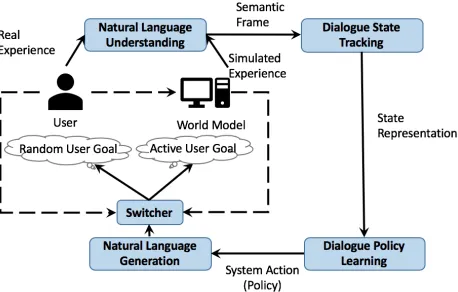
Recently, Peng et al. (2018) proposed Deep Dyna-Q (DDQ), an extension of the Dyna-Q framework (Sut-ton 1990), which integrates planning into RL for task-completion dialogue policy learning. As illustrated in Fig-ure 1a, DDQ incorporates a trainable user simulator, referred to as the world model, which can mimic real user behav-iors and generate simulated experience. The policy of the dialogue agent can be improved through either (1) real user experiences viadirect RL; or (2) simulated experiences via
indirect RLorplanning.
(a) DDQ framework (b) Proposed Switch-DDQ framework
Figure 1: Designs of RL agents for dialogue policy learning in task-completion dialogue systems
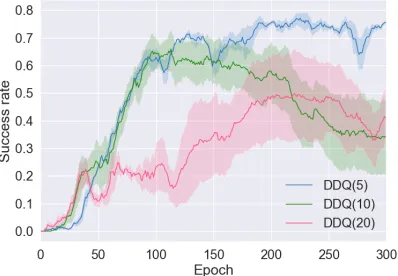
Figure 2: The learning curves of DDQ(K) without heuristics where(K−1)denotes the number of planning steps. The curves are sensitive toKvalues and may deteriorate in the later phase due to the low-quality simulated experiences.
Another limitation of DDQ is that the world model gen-erates simulated experiences by uniformly sampling user goals. However, training samples in the state-action space unexplored or less explored by the dialogue agent are usu-ally more desirable in order to avoid bias. This is the prob-lem that many active learning methods try to address. In this paper, we present a new variant of DDQ that addresses these two issues.
Our method is inspired by the recent study of Su et al. (2018), which tries to balance the use of simulated and real experience by measuring the quality of simulated ex-periences using a machine-learneddiscriminator. The more simulated experiences are used if their quality is higher. Their approach demonstrates some limited success, and suf-fers from two shortcomings. First, it does not take into ac-count the fact that the agent in different training stages might require simulated experiences of different qualities. Second, it still uniformly samples user goals and is not as sample-efficient as it should be (e.g., by using active learning).
In this paper, we propose a new framework, called
Switch-based Active Deep Dyna-Q (Switch-DDQ), to significantly improve DDQ’s sample efficiency. As illustrated in Fig-ure 1b, we incorporate aswitcherto automatically determine whether to use real or simulated experiences at different stages of dialogue training, eliminating the dependency on heuristics. The switcher is implemented based on an LSTM model, and is jointly trained with the dialogue policy and the world model. Moreover, instead of randomly sampling sim-ulated experiences, the world model adopts anactive sam-pling strategy that generates simulated experiences from the state-action space that has not been (fully) explored by the dialogue agent. Experiments show that this active sampling strategy can achieve a performance that is comparable to the original DDQ method but by using a much smaller amount of real experiences.
The work present in this paper contributes to the growing family of model-based RL methods, and can potentially be applied to other RL problems. To the best of our knowledge, Switch-DDQ is the first learning framework that conducts active learning in a task-completion dialogue setting. The contributions of this work are two-fold:
• We propose a Switch-based Active Deep Dyna-Q frame-work to incorporate active learning into the Dyna-Q framework for dialogue policy learning, providing a mechanism of automatically balancing the use of simu-lated and real user experiences.
• We validate the superior performance of Switch-DDQ by building dialogue agents for the movie-ticket booking task. The effectiveness of active learning and switcher is verified by simulation and human evaluations.
Model Architecture
Figure 3: Switch-DDQ for dialogue policy learning.
generation (NLG) module which outputs natural language responses (Wen et al. 2015); (5) a world model for generat-ing simulated user actions and simulated rewards based on active user goal selection; and (6) an RNN-based switcher for selecting the source of data (simulated or real experi-ences) for dialogue policy training. The solid lines in the figure illustrate the iterative dialogue policy training loop, while the dashed lines show the flow of data in training the world model and switcher.
The optimization of Switch-DDQ comprises four steps: (1)direct reinforcement learning: the agent conducts direct interactions with a real user, where the generated real ex-periences are directly used to improve the dialogue policy; (2) active planning: the agent interacts with the simulator and improves the policy using the simulated experiences; (3)world model learning: the world model receives real ex-periences and updates itself; and (4)switcher training: the switcher is learned and refined using both real and simulated experiences. Each step is detailed in the subsections below. The iterative Switch-DDQ algorithm, described in pseudo-code, is shown in Algorithm 1.
Direct Reinforcement Learning and Planning
Typically, dialogue policy learning can be formulated as a Markov Decision Process in the RL setting, a task-completion dialogue could be viewed as a sequence of (state, action, reward) tuples. We employ the Deep Q-network (DQN) (Mnih et al. 2015) for training the dialogue pol-icy (line 12 in Algorithm 1). Both the direct reinforcement learning and planning are accomplished using the same Q-learning algorithm using the simulated and real experiences, respectively.
Specifically, at each step, the agent receives the state s
and selects an actionato carry into the next dialogue turn. The action ais chosen using the exploration policy based on -greedy, where there is probability a random action being executed or otherwise the action that maximizes the
Q(s, a;θQ) function. The function Q(·) is parameterized by a Multi-Layer Perceptron (MLP) parameterized byθQ. Afterwards, the agent observes a reward r from the envi-ronment, and a corresponding response au from either a real user or the simulator, updating the dialogue state to
s0 until reaching the end of a dialogue. The experience
(s, a, r, au, s0)is then stored into the user experience buffer
Bu or simulator experience buffer Bs respectively. Func-tion Q(·)can be improved using experiences stored in the buffers.
In the implementation, we optimize the parameter θQ w.r.t. the mean-squared loss:
L(θQ) =E(s,a,r,s0)∼Bs∪Bu[(y−Q(s, a;θQ))] (1)
y=r+γmax a0 Q
0(s0, a0;θ
Q0) (2)
whereQ0(·)is a copy of the previous version ofQ(·)and is only updated periodically andγ∈[0,1]is the discount fac-tor.Q(·)is updated using back-propagation and mini-batch gradient descent.
Algorithm 1Switch-based Active Deep Dyna-Q
1: procedureSWITCH-DDQ TRAININGPIPELINE
2: fori←1 :max epochdo
3: userrandomly picks a user goalgu
4: Generate real experienceeufromuserbased on
guintoBu 5: repeat
6: Actively select a user goalgs based on the validation results# see Algorithm 2
7: Generate simulated experienceesfrom
sim-ulatorbased ongsintoBs
8: Evaluatequalityofesthroughswitcher
9: until quality<threshold
10: TrainsimulatoronBu
11: TrainswitcheronBu, Bs 12: TrainagentonBu, Bs
13: Evaluatesimulatoron validation set
Active Planning based on World Model
In a typical task-completion dialogue (Schatzmann et al. 2007), a user begins a conversation with a particular goal in mind Gwhich consists of multiple constraints. For ex-ample, in the movie-ticket-booking scenario, the constraints can be the place of the theater, the number of tickets to buy, and the name of the movie. An example of a user goal is request(theater;numberofpeople=2, moviename=mission impossible), which is presented in its natural language form as “in which theater can I buy two tickets for mission impossible”. Although there is no explicit restriction for the range of user goals in real experiences, in the stage of planning, the world model can selectively
generate the simulated experiences in the state-action space that are not (fully) explored by the dialogue agent, based on a specific set of user goals, to improve sample efficiency. We call our planningactive planningbecause it is a form of active learning.
gen-erate for each dialogue turn the user action, reward and the user’s decision whether to terminate the dialogue.
• Active user goal sampling module. Assume that we have collected large amounts of user goals from human-human conversational data. These user goals can be grouped into different categories, each with different constraints, amounting to different scales of difficulties. The key ob-servation is that, during the training process, while mon-itoring the performance of the agent policy on valida-tion set, we can gather detailed informavalida-tion about the impact of each category of user goals on the perfor-mance improvement of the dialogue agent e.g., in terms of the success rate (line 13 in Algorithm 1). The de-tailed information can be used to measure the cost (or gain) in the active learning setting (Russo et al. 2018; Auer, Cesa-Bianchi, and Fischer 2002) and guide the world model how to sample user goals.
Suppose there arekdifferent categories of user goals. At each epoch, the failure rate of each category estimated on the validation set is denoted asfiand the number of sam-ples for the estimation is ni. For simplicity, denote the summation ofni as N = Pini. Then, the active sam-pling routine (line 6 in Algorithm 1) can be expanded as
Algorithm 2Active Sampling Routine
1: procedureACTIVEUSERGOALSAMPLING
2: Draw a numberpifor each category followingpi∼
Nfi,
q
klnN ni
3: Select the user goaliwith the maximumpivalue
Here, N is the Gaussian distribution for introducing randomness. The Thompson-Sampling-like (Russo et al. 2018) sub-routine of Algorithm 2 is motivated by two ob-servations: (1) on average, categories with larger failure rate fi are more preferable as they inject more difficult cases (containing more useful information to be learned) based on the current performance of the agent policy. The generated data (simulated experiences) are generally associated with the steepest learning direction and can prospectively boost the training speed; (2) categories that are estimated less reliably (due to a smaller value ofni value) may have a large de facto failure rate, thus worth being allocated with more training instances to reduce
the uncertainty.qklnnN
i is the measurement of the
uncer-tainty offi, serving the role of variance in the Gaussian. Thus, the categories with high uncertainty are still likely to be selected even if the failure rate is small.
• Response generation module. We utilize the same design of the world model in Peng et al. (2018). Specifically, we parameterize it using a multi-task deep neural network (Liu et al. 2015). Each time the world model observes the dialogue state sand the last action from the agenta, it passes the input pair(s, a)through an MLPM(s, a;θM) generating a user actionau, a regressed rewardrand a bi-nary terminating indicator signalt. The MLP has a
com-mon sharing representation in the first layer (referred to as layerh). The computation for each term can be shown as below:
h= tanh(Wh(s, a) +bh) (3)
au=softmax(Wah+ba) (4)
r= tanh(Wrh+br) (5)
t=sigmoid(Wth+bt) (6)
Switcher
At every step of training, the switcher needs to decide whether the dialogue agent should be trained using simu-lated or real experience (lines 8-9 in Algorithm 1).
The switcher is based on a binary classifier implemented using a Long Short-Term Memory (LSTM) model (Hochre-iter and Schmidhuber 1997). Assume that a dialogue is represented as a sequence of dialogue turns, denoted by {(si, ai, ri)},i = 1, ..., N, whereN is the number of di-alogue turns of the didi-alogue. Q-learning takes a tuple in the form of(s, a, r, s0)as a training sample, which can be ex-tracted from two consecutive dialogue turns in a dialogue. Now, the design choice of switcher is whether the classi-fier is turn-based or dialogue-based. We choose the former, though a bit anti-intuitive, for data efficiency. There is an order of magnitude larger number of turns than that of dia-logues. As a result, a turn-based classifier can be more re-liably trained than a dialogue-based one. Then, given a dia-logue, we score the quality of each of its dialogue turns, and then averages these scores to measure the quality of the di-alogue (line 6 in Algorithm 1). If the didi-alogue-level score is below a certain threshold, the agent switches to interact with real users.
Note that each dialogue turn is scored by tak-ing into account its previous turns in the same dia-logue. Given a dialogue turn (st, at, rt) and its history
h = ((s1, a1, r1),(s2, a2, r2), ...,(st−1, at−1, rt−1)) We
use LSTM to encode husing the hidden state vector, and output a turn-level quality score via a sigmoid layer:
Score((s, a, r), h;θ) =sigmoid(LSTM((s, a, r), h;θ))
(7)
Since we store user experiences and simulated experi-ences in the buffersBu andBs, respectively (lines 4, 7 in Algorithm 1), the training of Score(.) follows a similar pro-cess of minimizing the cross-entropy loss as in the common domain adversarial training setting (Ganin et al. 2016) using mini-batches:
min θS
E(s,a,r),h∼Bulog (Score((s, a, r), h;θ))
+E(s,a,r),h∼Bslog (1−Score((s, a, r), h;θ)) (8)
Experiments
We evaluate the proposed Switch-DDQ framework in the movie-ticket booking domain, in two settings: simulation and human evaluation.
Dataset
For experiments, we use a movie-ticket booking dataset which contains raw conversational data collected via Ama-zon Mechanical Turk. The dataset is manually labeled based on a schema defined by domain experts. As shown in Table 1, the annotation schema consists of 11 intents and 16 slots. In total, the dataset contains 280 labeled dialogues, the aver-age length of which is 11 turns.
Annotations
Intent
request, inform, deny, confirm question, confirm answer, greeting, closing, not sure, multiple choice, thanks, welcome
Slot
city, closing, date, distanceconstraints, greeting, moviename, numberofpeople, price, starttime, state, taskcomplete, theater, theater chain, ticket, video format, zip
Table 1: The data annotation schema
Baselines
We compare the effectiveness of the Switch-DDQ agent with several baselines:
• DQN agent is implemented with only direct reinforce-ment learning in each training epoch (without lines 5-9 in Algorithm 1).
• TheDQN(K)has(K−1)times more real experiences than the DQN agent (repeat lines 3-4 in Algorithm 1K
times). The performance of DQN(K) can be viewed as the upper bound of DDQ (K), with the same number of planning steps(K−1)(they have the same training set-ting and the same amount of training samples during the entire learning process).
• The DDQ(K)agents are learned using a jointly-trained world model initiated from human conversational data, with(K−1)planning steps (replace lines 5-9 in Algo-rithm 1 with a(K−1)-round loop).
• The proposed Switch-DDQ agents are updated as de-scribed in Algorithm 1. Note that there is no parameter
K in the agent, as real/simulated ratio is automatically controlled by the switcher module.
Implementation Details
Agent and Hyper-parameter Settings We use an MLP to parameterize functionQ(·)in all the agent variants (DQN, DDQ and Switch-DDQ). The MLP has one hidden layer of
80 neurons with ReLU (Nair and Hinton 2010) activation function. The-greedy policy is adopted to explore the ac-tion space. The discount factorγfor future rewards is set to
0.9. For DDQ(K), as the number of real and simulated ex-periences is different at each epoch, the buffer sizes ofBu andBsare generally set to2000and2000×K, respectively. For Switch-DDQ, we observed that the results are not sensi-tive to the buffer size ofBs, so we set it to2000×5for all settings.
We randomly initialize the parameters in all neural net-works and empty both experience buffersBuandBsin the beginning. The RMSProp (Hinton, Srivastava, and Swersky 2012) algorithm is used to perform optimization over all the parameters where the learning rate is set to0.001. We also apply the gradient clipping trick to all parameters with a maximum norm of 1to prevent possible gradient explo-sion issues. At the beginning of each epoch (line 2 in Algo-rithm 1), the reference copyQ0(·)is updated. Each simulated dialogue contains less than 40 turns. Conversations exceed-ing the maximum number of turns are counted as failed. In order to train the agents more efficiently, we utilized the im-itation learning method called Reply Buffer Spiking (RBS) (Lipton et al. 2016) at the initial stage to build a simple rule-based agent trained from human conversational data. The trained agent is then used to pfill the real experience re-play bufferBuwith a total of50complete dialogues before training all the variants of the agent.
World Model We employ an MLP world model for DDQ and Switch-DDQ. The shared hidden layer is set to have size
160with hyperbolic tangent activation. The state and action input are encoded through a linear layer of size80. We pre-fill each ni as 5 to prevent division by0 error, during the calculation of the Gaussian variance (line 2 in Algorithm 2).
Switcher The LSTM switcher has a hidden layer with126
cells. Similar to the world model, states and actions are passed through a linear layer of size80as inputs at each time step. The switcher adopts an annealing threshold w.r.t. the epoch number to decide the quality of each dialogue turn. If the average dialogue episode score passes a certain thresh-old, all the high-quality predictions are pushed into buffer
Bs.2
Simulation Evaluation
We train the dialogue agents by simulating interactions be-tween the agents and well-programmed user simulators, in-stead of real users. That is, we train the world model to imi-tate the behaviors of the user simulator.
User Simulator We used an open-sourced task-oriented user simulator (Li et al. 2016) in our simulated evaluation. At each dialogue turn, the simulator will emit a simulated user response to the agent. When the dialogue ends, a reward signal will be provided. The dialogue is considered success-ful, if and only if a movie ticket is booked successfully and the information provided by the agent conform to all the con-straint slots in the sampled user goal. Each completed dia-logue shows either a positive reward2∗Lfor success, or a negative reward−Lfor failure, whereLis the maximum
2
Agent Epoch = 100 Epoch = 200 Epoch = 300 Success Reward Turns Success Reward Turns Success Reward Turns
DQN 0.2867 -17.35 25.51 0.6733 32.48 18.64 0.7667 46.87 12.27 DQN(5) 0.7667 46.74 12.52 0.7867 49.46 11.88 0.8000 50.81 12.37
DDQ(5) 0.6200 25.42 19.96 0.7733 45.45 16.69 0.7467 43.22 14.76 DDQ(10) 0.6800 34.42 16.36 0.6000 24.20 17.60 0.3733 -2.11 15.81 DDQ(20) 0.3333 -13.88 29.76 0.4467 5.39 18.41 0.3800 -1.75 16.69 Switch-DDQ 0.5200 15.48 15.84 0.8533 56.63 13.53 0.7800 48.49 12.21
Table 2: Results of different agents at training epoch={100,200,300}. Each number is averaged over3runs, and each run is tested on50dialogues. (Success: success rate) Switch-DDQ outperforms DQN and DDQ variants after Epoch 100, where DQN(5) is shown as the upper bound as it uses more real experiences. Best scores are labeled in bold faces.
Figure 4: The learning curves of DQN, DQN(5), Switch-DDQ, and DDQ(5) of each epoch.
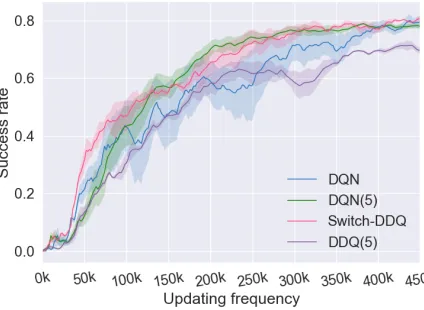
Figure 5: The learning curves of DQN, DQN(5), Switch-DDQ, and DDQ(5) on the scale of updating frequency.
number of turns in each dialogue and is set to40in our ex-periments. Furthermore, in each turn, a negative reward−1
is provided to encourage shorter dialogue.
Main Results We summarize the main results in Table 2 and plot the learning curves in Figure 4. As illustrated in Figure 2, DDQ(K) is highly susceptible to parameter K. Therefore, we only keep the best performing DDQ(5) as the baseline in the following figures. DQN(5), which uses
4times more real user experiences to this end, is the upper bound for the corresponding DDQ(5) method. In Table 2, we report success rate, average reward and average number of turns over3different runs for each agent. As is shown, the agent of Switch-DDQ after the first 100 epochs, consistently achieves higher success rates with a smaller number of inter-action turns. Again, DDQ(10) and DDQ(20) quickly deteri-orate through the training process. In Figure 4, we can ob-serve that in the first130epochs, DDQ(5) performs slightly better than Switch-DDQ. However, after that, Switch-DDQ surpasses DDQ(5) and achieves better performance. It only takes Switch-DDQ 180 epochs to achieve comparable re-sults to DQN(5), which utilizes 4 times more real experi-ences, and DDQ(5) fails to reach similar performance within
300 epochs. This is expected, as the aggressive simulator
sampling policy adopted by DDQ(5), though helping up-date the policy network more rapidly in the early stage of training, hurts the performance due to the use of low-quality training instances in the later stage. Note that except for DQN(5), all the agents are trained using the same number of real experiences in each epoch, differing only the amounts of simulated experiences used (for planning) and how these simulated experiences are generated (via active learning or not). The result show that Switch-DDQ can utilize simula-tors in a more effective and robust way than DDQ.
di-Figure 6: Learning curves of Switch-DDQ versus SU-DDQ where SU-DDQ uses a uniform sampling strategy.
Figure 7: Success rate on 128 user goal categories for Switch-DDQ and SU-DDQ, ranking in ascending order.
alogues and discreetly controlling the amount of simulated experiences via the switcher.
Ablation Test To further examine the effectiveness of the active learning module, we conduct an ablation test by re-placing the user goal selection routine (Algorithm 2) with the one based on uniform sampling, referred to as SU-DDQ. The results in Figure 6 demonstrate that Switch-DDQ can consistently outperform SU-DDQ, especially in the early phase (before epoch 100). This is due to the fact that the agent is more sensitive to the diversity of user goals in the earlier stage since in the limited data setting, many repeated cases introduce biases more easily. In Figure 7, we report the success rate for different categories of user goals and rank them in the increasing order. It is observed that for the cor-responding rank of user goal category, especially the ones with low success rate, the active version of Switch-DDQ al-ways give a better score. These results demonstrate that the use of the active module improves training efficiency.
Human Evaluation
Real users were recruited to interact with different agents, while the identity of the agent system is hidden from the users. At the beginning of the dialogue session, the user was provided with a randomly sampled user goal, and one of the agents was randomly picked to converse with the user. The dialogue session can be terminated at any time, if the user finds that the dialogue takes so many turns that it is unlikely to reach a promising outcome. Such dialogues are consid-ered as failed in our experiments.
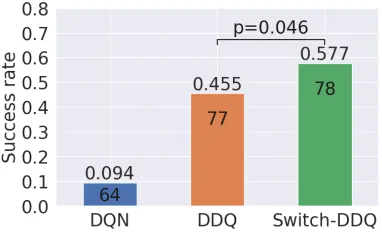
Three agents (DQN, DDQ(5), and Switch-DDQ) trained as previously described (Figure 4) at epoch 150 are selected as for human evaluation.3As illustrated in Figure 8, the
re-sults of human evaluation are consistent with those in the simulation evaluation. We find that DQN is abandoned more often by users as it takes so many dialogue turns (Table 2)
re-3
Epoch 150 is picked since we are testing the effectiveness of methods using a small number of real experiences.
Figure 8: Human evaluation results of DQN, DDQ(5), and Switch-DDQ. The number of test dialogues is shown on each bar, and the one-sided p-value is from a two-sample permutation test over the success/fail lists.
sulting in a much hefty performance drop, and the proposed Switch-DDQ outperforms all the other agents.
Conclusion
Acknowledgement
We thank the reviewers for their helpful comments, and we would like to acknowledge the volunteers for helping us with the human experiments. This work was done in part when Yuexin Wu was visiting Microsoft Research as an intern, and is supported in part by the National Science Foundation (NSF) under grant IIS-1546329.
References
Auer, P.; Cesa-Bianchi, N.; and Fischer, P. 2002. Finite-time analysis of the multiarmed bandit problem. Machine learning47(2-3):235–256.
Dhingra, B.; Li, L.; Li, X.; Gao, J.; Chen, Y.-N.; Ahmed, F.; and Deng, L. 2016. Towards end-to-end reinforcement learning of dialogue agents for information access. arXiv preprint arXiv:1609.00777.
Ganin, Y.; Ustinova, E.; Ajakan, H.; Germain, P.; Larochelle, H.; Laviolette, F.; Marchand, M.; and Lempitsky, V. 2016. Domain-adversarial training of neural networks. The Jour-nal of Machine Learning Research17(1):2096–2030. Gao, J.; Galley, M.; and Li, L. 2018. Neural approaches to conversational ai.arXiv preprint arXiv:1809.08267. Hakkani-T¨ur, D.; T¨ur, G.; Celikyilmaz, A.; Chen, Y.-N.; Gao, J.; Deng, L.; and Wang, Y.-Y. 2016. Multi-domain joint semantic frame parsing using bi-directional rnn-lstm. InInterspeech, 715–719.
Hinton, G.; Srivastava, N.; and Swersky, K. 2012. Rm-sprop: Divide the gradient by a running average of its recent magnitude. Neural networks for machine learning, Cours-era lecture 6e.
Hochreiter, S., and Schmidhuber, J. 1997. Long short-term memory.Neural computation9(8):1735–1780.
Levin, E.; Pieraccini, R.; and Eckert, W. 1997. Learning di-alogue strategies within the markov decision process frame-work. InAutomatic Speech Recognition and Understanding, 1997. Proceedings., 1997 IEEE Workshop on, 72–79. IEEE. Li, X.; Lipton, Z. C.; Dhingra, B.; Li, L.; Gao, J.; and Chen, Y.-N. 2016. A user simulator for task-completion dialogues.
arXiv preprint arXiv:1612.05688.
Li, X.; Chen, Y.-N.; Li, L.; Gao, J.; and Celikyilmaz, A. 2017. End-to-end task-completion neural dialogue systems.
arXiv preprint arXiv:1703.01008.
Lipton, Z. C.; Gao, J.; Li, L.; Li, X.; Ahmed, F.; and Deng, L. 2016. Efficient exploration for dialogue policy learning with bbq networks & replay buffer spiking. arXiv preprint arXiv:1608.05081.
Liu, X.; Gao, J.; He, X.; Deng, L.; Duh, K.; and Wang, Y.-Y. 2015. Representation learning using multi-task deep neu-ral networks for semantic classification and information re-trieval.
Mnih, V.; Kavukcuoglu, K.; Silver, D.; Rusu, A. A.; Veness, J.; Bellemare, M. G.; Graves, A.; Riedmiller, M. A.; Fidje-land, A.; Ostrovski, G.; Petersen, S.; Beattie, C.; Sadik, A.; Antonoglou, I.; King, H.; Kumaran, D.; Wierstra, D.; Legg, S.; and Hassabis, D. 2015. Human-level control through deep reinforcement learning. Nature518(7540):529–533.
Mrkˇsi´c, N.; S´eaghdha, D. O.; Wen, T.-H.; Thomson, B.; and Young, S. 2016. Neural belief tracker: Data-driven dialogue state tracking.arXiv preprint arXiv:1606.03777.
Nair, V., and Hinton, G. E. 2010. Rectified linear units im-prove restricted boltzmann machines. InProceedings of the 27th international conference on machine learning (ICML-10), 807–814.
Peng, B.; Li, X.; Gao, J.; Liu, J.; Wong, K.-F.; and Su, S.-Y. 2018. Deep Dyna-Q: Integrating planning for task-completion dialogue policy learning. InACL.
Pietquin, O., and Hastie, H. 2013. A survey on metrics for the evaluation of user simulations.The knowledge engineer-ing review28(1):59–73.
Russo, D. J.; Van Roy, B.; Kazerouni, A.; Osband, I.; Wen, Z.; et al. 2018. A tutorial on thompson sampling. Founda-tions and TrendsR in Machine Learning11(1):1–96.
Schatzmann, J.; Thomson, B.; Weilhammer, K.; Ye, H.; and Young, S. 2007. Agenda-based user simulation for boot-strapping a pomdp dialogue system. InHuman Language Technologies 2007: The Conference of the North American Chapter of the Association for Computational Linguistics; Companion Volume, Short Papers, 149–152. Association for Computational Linguistics.
Silver, D.; Huang, A.; Maddison, C. J.; Guez, A.; Sifre, L.; van den Driessche, G.; Schrittwieser, J.; Antonoglou, I.; Panneershelvam, V.; Lanctot, M.; Dieleman, S.; Grewe, D.; Nham, J.; Kalchbrenner, N.; Sutskever, I.; Lillicrap, T. P.; Leach, M.; Kavukcuoglu, K.; Graepel, T.; and Hassabis, D. 2016. Mastering the game of go with deep neural networks and tree search. Nature529(7587):484–489.
Su, P.-H.; Gasic, M.; Mrksic, N.; Rojas-Barahona, L.; Ultes, S.; Vandyke, D.; Wen, T.-H.; and Young, S. 2016. Continu-ously learning neural dialogue management. arXiv preprint arXiv:1606.02689.
Su, S.-Y.; Li, X.; Gao, J.; Liu, J.; and Chen, Y.-N. 2018. Discriminative deep dyna-q: Robust planning for dialogue policy learning.arXiv preprint arXiv:1808.09442.
Sutton, R. S. 1990. Integrated architectures for learn-ing, plannlearn-ing, and reacting based on approximating dynamic programming. InMachine Learning Proceedings 1990. El-sevier. 216–224.
Wen, T.-H.; Gasic, M.; Mrksic, N.; Su, P.-H.; Vandyke, D.; and Young, S. 2015. Semantically conditioned lstm-based natural language generation for spoken dialogue systems.
arXiv preprint arXiv:1508.01745.