36
Copyright © 2018. IJEMR. All Rights Reserved.
Volume-8, Issue-2, April 2018
International Journal of Engineering and Management Research
Page Number: 36-45
DOI: doi.org/10.31033/ijemr.v8i02.11786
Optimization of EDM Machining Parameters to Machine INCONEL – 825
Sanket Sahu1, Dr. Ramesh Chandra Mohanty2, Prof. R.R. Panda3, Dr. A.M. Mohanty4, Prof. Girija Nandan Arka5 1
M.Tech Scholar, Design and Manufacturing, Department of Mechanical Engineering, Centurion University, Bhubaneswar, INDIA
2,4Professor, Department of Mechanical Engineering, Centurion University, Bhubaneswar, INDIA 3,5Assistant Professor, Department of Mechanical Engineering, Centurion University, Bhubaneswar, INDIA
1Corresponding Author: [email protected]
ABSTRACT
It is observed that in recent trend INCONEL material has tremendous application in aeronautical, aerospace industry and automobile engineering because of its favorable properties. Therefore “Inconel 825” material has been chosen to machine by EDM. But EDM has a disadvantage of lower MRR. So an experimental investigation has been carried out to study machining parameters of EDM to improve MRR and reducing TWR, surface roughness and kerf width. Here heat treatment process has been studied and applied to improve tool life by reducing tool wear rate. In this experiment Copper tool has modified by changing its grain growth structure by step hardening process and results in both heat treated and without heat treated tools are compared.
Keywords-- EDM (Electro Discharge Machine), Without Heat treated tool, With Heat Treated Tool, MRR (Material Removal Rate), TWR (Tool Wear Rate), SR (Surface Roughness)
I.
INTRODUCTION
Electro discharge machining is an electro thermal non-traditional machining process based on removing of material from a part by means of a series of recurring electrical discharges created by electric pulse generators at short intervals between tool (electrode) and work piece in presence of a dielectric fluid[2]. It is the electrical energy which is used to generate electrical spark and material removal occurs due to thermal energy of spark.
EDM is mainly used to machine difficult-to-machine materials and high temperature resistance alloys. EDM can be used to machine difficult geometries in small batches or even on job shop basis. Any type of electrically
conductive hard materials can be machined by EDM machining process[3].
II.
WORKING PRINCIPLE
EDM machining is carried out by means of electric sparks that jumps between two electrodes subjected to a voltage and submerged in a dielectric fluid. Both the tool and work material are conductor of electricity. It is a controlled metal removal process that is used to remove metal by means of electric spark erosion. In this process electric spark is used as the cutting tool to cut (erode) the workpiece to produce the finished part to the desired shape. The tool is connected with negative terminal and workpiece with positive terminal submerged with dielectric fluid. As electric field is established the free electron is emitted from the tool called as “Cold Emission”[4]. The electrode gets high velocity and energy
accelerated towards job by dielectric medium and positive ion.
The gap is maintained in between tool and workpiece is called as “Spark Gap”. When the electrons
get accelerated a large number of electron flows from the tool to the work piece is called as “Avalanche Motion” of
electron [4]. This movement of electron can be seen as spark and thus electrical energy is dissipated as thermal energy of spark and heat flux is generated. Metal removal occurs due to instant vaporization of the metal as well as due to melting.
III.
TYPES OF EDM
Basically, there are two different types of EDM.
37
Copyright © 2018. IJEMR. All Rights Reserved.
Each of them is used to produce very small and accurate parts as well as large items like automotive stamping dies and aircraft body components. The largest single use of EDM is in die making.
i. Die Sinking EDM
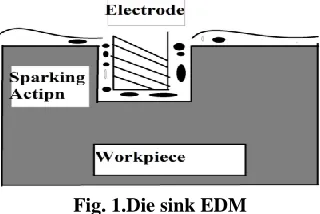
In the Die Sinker EDM Machining process, two metal parts submerged in an insulating liquid are connected to a source of current which is switched on and off automatically depending on the parameters set on the controller. When the current is switched on, an electric tension is created between the two metal parts. If the two parts are brought together to within a fraction of an inch, the electrical tension is discharged and a spark jumps across. Where it strikes, the metal is heated up so much that it melts. Sinker EDM, also called cavity type EDM or volume EDM consists of an electrode and workpiece submerged in an insulating liquid such as, more typically, oil or, less frequently, other dielectric fluids. The electrode and workpiece are connected to a suitable power supply. The power supply generates an electrical potential between the two parts. As the electrode approaches the workpiece, dielectric breakdown occurs in the fluid, forming a plasma channel, and a small spark jumps.
Fig. 1.Die sink EDM
ii. Wire cut EDM
Wire EDM Machining (also known as Spark EDM) is an electro thermal production process in which a thin single-strand metal wire (usually brass) in conjunction with de-ionized water (used to conduct electricity) allows the wire to cut through metal by the use of heat from electrical sparks. a thin single-strand metal wire, usually brass, is fed through the workpiece, submerged in a tank of dielectric fluid, typically de-ionized water. Wire-cut EDM is typically used to cut plates as thick as 300mm and to make punches, tools, and dies from hard metals that are difficult to machine with other methods.
Fig. 1.4 Wire Cut EDM
Important Parameters of EDM
In EDM machining process there are two machining parameters.
i.Input Parameters ii. Output Parameters
3.1. Input Parameters
a) Spark on time (pulse time or Ton): It is the duration of time in µs that current is allowed to flow per cycle. Material removal is directly proportional to the amount of energy applied during this on time. This energy is really controlled by the peak current and the length of the on time.
b) Spark off time (pulse time or Toff): It is the duration of time in µs between the spark. This time allows the molten material to solidify and to be cleaned the arc gap. This parameter is to affect the speed and the stability of the cut. Thus, if the off time is too short, it will makes sparks to be unstable.
c) Arc gap: The arc gap is the distance between the electrode and work piece during the machining time. It may be called as spark gap. It can be maintained by servo system.
d) Discharge current (Pulse current Ip): It is the most important machining parameter in EDM, because it is related to power consumption during machining. Until reaches the preset level, the current is increased which is known as discharge current. The setting of discharge current on static pulse generators generally determines the number of power units connected parallel to the gap. The larger discharge current means the higher power intensity during electrical discharge.
e) Lift time: It is the time in which tool lifts up and fresh dielectric field entered into the inter electrode gap by flushing.
f) Duty cycle ( ): It is the percentage of the pulse on time relative to the total cycle time. This parameter is calculated by dividing the on time by the total cycle time (pulse on time plus pulse off time).
g) Voltage (V): It is a potential that can be measure by volt. It is also effect to the material removal rate and allowed to per cycle.
h) Polarity: It specifies to the potential of work piece with respect to the tool, depending on the application, the polarity can be changed. Carbide, Titanium and copper are generally cut with negative polarity.
i) Diameter of the electrode (D): It is the Cu electrode of diameter 10mm in this experiment.
j) Over cut: It is a clearance per side between the electrode and the workpiece after the machining operation.
38
Copyright © 2018. IJEMR. All Rights Reserved.
The tool servo mechanism is responsible for inter electrode gap.
l) Dielectric Fluid: The dielectric fluid acts as an electrical insulator to carry out the spark. It cools down the electrode and also provides the high pressure to remove the eroded metal. Most commonly used dielectric fluids are paraffin, de-ionized water, kerosene, and EDM oil etc.
m) Flushing pressure: Flushing is an important factor in EDM process for supplying and cleaning the Dielectric fluids into the machining zone. Flushing is difficult if the cavity is deeper. The usual range of flushing is in between 0.1 to 1.2 Kgf/ .
3.2Output Parameters
a) Material Removal Rate (MRR): The material removal rate (MRR) is expressed as the ratio of the difference of weight of workpiece before and after machining to machining time and density of the material. Higher the material removal rate in EDM process, the better is the machining performance. However, the smaller is the electrode wear ratio. MRR determines both machining rate and tool electrode wear rate.
b) Tool Wear Rate (TWR): It is defined as the volumetric ration of the material removal on tool electrode. The smaller the tool wear rate in EDM process, the better is the machining performance.
c) Surface Roughness (SR): The smaller the surface roughness in the EDM process, the better the machining performance. A profilometer is used to measure the machined surface roughness.
IV. DIELECTRIC FLUID
In EDM, as has been discussed earlier, material removal mainly occurs due to thermal evaporation and melting. As thermal processing is required to be carried out in absence of oxygen so that the process can be controlled and oxidation avoided. Oxidation often leads to poor surface conductivity (electrical) of the work piece hindering further machining. Hence, dielectric fluid should provide an oxygen free machining environment. Further it should have enough strong dielectric resistance so that it does not breakdown electrically too easily but at the same time ionize when electrons collide with its molecule. Moreover, during sparking it should be thermally resistant as well[5].
The dielectric fluid has the following functions:
a) It helps in initiating discharge by serving as a conducting medium when ionized, and conveys the spark. It concentrates the energy to a very narrow region.
b) It helps in quenching the spark, cooling the work, tool electrode and enables arcing to be prevented.
c) It carries away the eroded metal along with it.
d) It acts as a coolant in quenching the sparks.
The electrode wear rate, metal removal rate and other operation characteristics are also influenced by the dielectric fluid. The dielectric generally fluid used are
transformer on silicon oil, EDM oil, kerosene (paraffin oil) and de-ionized water are used as dielectric fluid in EDM. Tap water cannot be used as it ionizes too early and thus breakdown due to presence of salts as impurities occur. Dielectric medium is generally flushed around the spark zone. It is also applied through the tool to achieve efficient removal of molten material.
In this experiment using the Commercial grade EDM oil (specific gravity= 0.763, freezing point= 94°C) was used as dielectric fluid are used it is using as coolant and medium of workpiece and tool during the process of erosion.
There are certain properties of dielectric fluids that need to be considered while selecting them for machining operation:
a) Dielectric Strength: It is the ability of a fluid to maintain high resistivity before spark discharge and in turn the ability to recover rapidly with minimal amount at the off time. Anoil has high dielectric strength with fine degree of control throughout the range and frequencies used.
b) Viscosity: The lower the viscosity of the fluid, the better is the accuracy and finished can be obtained.
c) Specific Gravity: The lighter the oil or lower its specific gravity, faster the heavier particles can settle down. This reduces the gap contamination and possibility of secondary discharge of spark.
Specification of Dielectric fluid
(EDM Oil Gradation)
V.
CHARACTERISTICS OF EDM
EDM specification by mechanism of process, metal removal rate and other function that shown in this table no 1.1
Table1.1- Specification of EDM Model ZNC25
Operating platform(mm) 28×450
Operating groove(mm) 820×500×280
X axle range Y axle range Z axle range
250mm 250mm 250mm
Electric pole carrying capacity 30 Kg
Maximum capacity of the operating platform
200 Kg
Maximum dimension(mm) 1920×1480×2010
Weight of the machine tool 1000Kg
39
Copyright © 2018. IJEMR. All Rights Reserved.
VI.
HEAT TREATMENT
In this experiment we have used two Copper tools out of which one is heat treated and other is without heat treated. One tool is heat treated in an electric arc furnace for 1 hour and temperature range was 500-700 0C
VII.
DESIGN VARIABLE
Design parameters-Material removal rate(MRR), Tool wear rate (TWR), Surface roughness(SR)Machining parameter- Pulse current (IP), pulse on time, pulse (TON), flushing Pressure (P).
VIII. TAGUCHI METHOD
Taguchi method developed by Dr. Genichi Taguchi, is a set of methodologies for optimization of a process or product.. This method involves three stages: system design, parameter design, and tolerance design. Out of these three stages, the second stage – the parameter design – is the most important stage as the first stage – system design – is an initial functional design and may be far from quality and cost. However, the third stage – tolerance design – is dependent of cost. Therefore, the parameter design is the key step in the Taguchi method to achieving high quality without increasing cost. L9 (33) orthogonal array was used for conducting the experiments. The level and factor are given in table-1. L9 orthogonal array has 9 no. of experiments and 8 degrees of freedom in the basis of input parameters. The input parameters foe this experiment are Pulse current (IP), pulse on time, pulse (TON), flushing Pressure (P). The S/N ratio for each levelof process parameters iscomputed based on the S/N analysis. Regardless of the category of the performance characteristic, the larger S/N ratio corresponds to the better performance characteristic. Therefore, the optimal level ofthe process parameters is the level having highest S/N ratio. Furthermore, statistical analysis of variance (ANOVA)is performed to see which process parameters are statistically significant. The optimal combination of the process parameters can be predicted by S/N and ANOVA analysis. Finally, a confirmation experiment is conducted to verify the optimal process parameters obtained from the parameter design. Hardening
The use of this treatment results in an improvement of mechanical properties. The metals are heated above the critical temperature and then cooled rapidly enough to be much harder, stronger. Alloys may be air cooled, or cooled by quenching in oil, water or some liquids depending upon the alloying medium. The hardening process consists of heating the component above normalization temperature
for some hour and then cooled at enough faster rates to allow the material to be much harder [28].
IX.
TEMPERING
To increase the hardness, strength and toughness tempering is applied on the metal. Generally it is applied on steel parts because steel never be used in quenched condition. It is generally considered in relieving stresses and to lower hardness within a specified range. It is a process of reheating the parts at relatively low temperature leading to precipitation of carbide present in the micro structure [28].
X.
QUENCHING
In this process the materials are heated up to a suitable temperature and then quenched in the water to get full hardness. This involves the heating of the material at required temperature and cooled rapidly by immersing in water, liquids, or oils to transform the material to a fully hardened structure. The quenching medium is chosen as per the alloying element present in the material and final mechanical properties are achieved [28].
Experimental Set Up
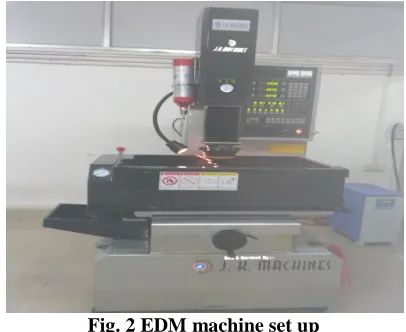
The experiments were conducted using Electric Discharge Machine, Model EDM-ZNC25 of Die sinking type. The polarity of the electrode was set as positive while workpiece was set as negative. EDM oil with specific gravity 0.763 was used as Di-electric fluid. It has a servo head which controls the whole experiment.
Fig. 2 EDM machine set up
The EDM consists of the following parts:
I. Dielectric pump, Reservoir and circulation pump. II. Power generator and control unit.
III. Working area with clamping device and X-Y-Z working table.
40
Copyright © 2018. IJEMR. All Rights Reserved.
In this chapter we are going to discuss about the experimental work which is consist of 2 sets of the L-9 orthogonal array based on Taguchi design. In this experiment total 18 run, 9run with without heat treated CU tool and other 9 run with heat treated CU tool. Experimental set up, selection of workpiece, tool design, and taking all the value and calculation of MRR, TWR, and SR have been discussed here.
Selection of Workpiece
EDM is capable of machining of hard material component such as heat treated tool steels, composites, super alloys, ceramics, carbides, heat resistant steels etc. In this experiment we have used INCONEL - 825 as Super alloy workpiece. It is an unalloyed medium carbon steels with tensile stress 85 Mpa and Yield Point 30 - 35.
Inconel is a family of austenitic nickel -
chromium-based superalloys.
Inconel alloys are oxidation-corrosion-resistant materials well suited for service in extreme environments subjected to pressure and heat. When heated, Inconel forms a thick, stable, passivating oxide layer protecting the surface from further attack. Inconel retains strength over a wide temperature range, attractive for high temperature applications where aluminum and steel would succumb to creep as a result of thermally induced crystal vacancies. Inconel’s high temperature strength is developed by solid solution strengthening or precipitation hardening, depending on the alloy.
Inconel alloys are typically used in high temperature applications. Common trade names for Inconel Alloy 625 include: Inconel 625, Chronin 625, Altemp 625, Haynes 625, Nickelvac 625 and Nicrofer 6020.[4]
It is widely used in Aerospace and Aerospace Engineering. It is also good corrosion resistance.
It has following chemical composition.
Table 1-specification of INCONEL - 825 material
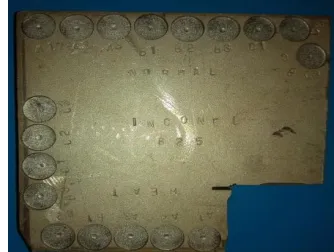
Fig. 3 INCONEL – 825 Workpiece (Before machining)
Fig.4 INCONEL-825 (after machining without heat treated and with heat treated)
Selection of electrode
In this experiment we have used 2 sets of copper electrode. One set is consists of 5 nos. of without heat treated CU electrode while the other sets is having similar 5 nos. of heat treated CU electrode.
Fig. 5 Without heat treated Cu electrode and Heat treated CU electrode
Heat treatment process of electrode
The hardness of the without heat treated CU tool was 35.3 HRC and it is tested using hardness testing machine. The composition of the electrode is examined by using XRF machine. The heat treatment process is carried out using Ashing Furnace for 2and ½ hour with temperature 330°c with water quenching for 30 minutes.
Table No. 4.2- Specification of CU electrode
Compound Si P C
l K C a Cu
G e T b T m A u H
g S
Conc. Percentage .5 3 0 . 1 4 8 . 6 3 2 .1 0 4 . 1 0 5 97.9 84 . 0 1 5 .1 3 8 . 1 3 4 . 0 5 5 .0 3 3 .1 2 1
41
Copyright © 2018. IJEMR. All Rights Reserved.
(Composition Test of Inconel – 825)
(Composition Test of Copper)
Fig. 6 Hardness testing machine
Fig. 7 XRF machining for composition
Fig. 8 Ashing Furnace
Fig. 9 Quenching ProcessMaterial Removal Rate (MRR)
The MRR is defined as the ratio of the difference in weight of the workpiece before and after machining to the machining time.
Where, Wi= Weight of the workpiece before machining Wf= weight of the workpiece after machining T= Machining Time
42
Copyright © 2018. IJEMR. All Rights Reserved.
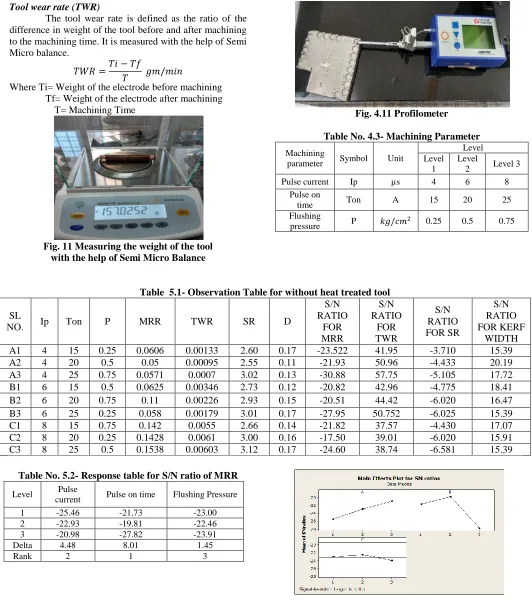
Tool wear rate (TWR)The tool wear rate is defined as the ratio of the difference in weight of the tool before and after machining to the machining time. It is measured with the help of Semi Micro balance.
Where Ti= Weight of the electrode before machining Tf= Weight of the electrode after machining
T= Machining Time
Fig. 11 Measuring the weight of the tool with the help of Semi Micro Balance
Fig. 4.11 Profilometer
Table No. 4.3- Machining Parameter
Machining
parameter Symbol Unit
Level Level
1
Level
2 Level 3
Pulse current Ip µs 4 6 8
Pulse on
time Ton A 15 20 25
Flushing
pressure P 0.25 0.5 0.75
Table 5.1- Observation Table for without heat treated tool
SL
NO. Ip Ton P MRR TWR SR D
S/N RATIO
FOR MRR
S/N RATIO
FOR TWR
S/N RATIO FOR SR
S/N RATIO FOR KERF
WIDTH A1 4 15 0.25 0.0606 0.00133 2.60 0.17 -23.522 41.95 -3.710 15.39 A2 4 20 0.5 0.05 0.00095 2.55 0.11 -21.93 50.96 -4.433 20.19 A3 4 25 0.75 0.0571 0.0007 3.02 0.13 -30.88 57.75 -5.105 17.72 B1 6 15 0.5 0.0625 0.00346 2.73 0.12 -20.82 42.96 -4.775 18.41 B2 6 20 0.75 0.11 0.00226 2.93 0.15 -20.51 44.42 -6.020 16.47 B3 6 25 0.25 0.058 0.00179 3.01 0.17 -27.95 50.752 -6.025 15.39 C1 8 15 0.75 0.142 0.0055 2.66 0.14 -21.82 37.57 -4.430 17.07 C2 8 20 0.25 0.1428 0.0061 3.00 0.16 -17.50 39.01 -6.020 15.91 C3 8 25 0.5 0.1538 0.00603 3.12 0.17 -24.60 38.74 -6.581 15.39
Table No. 5.2- Response table for S/N ratio of MRR
Level Pulse
current Pulse on time Flushing Pressure
1 -25.46 -21.73 -23.00
2 -22.93 -19.81 -22.46
3 -20.98 -27.82 -23.91
Delta 4.48 8.01 1.45
43
Copyright © 2018. IJEMR. All Rights Reserved.
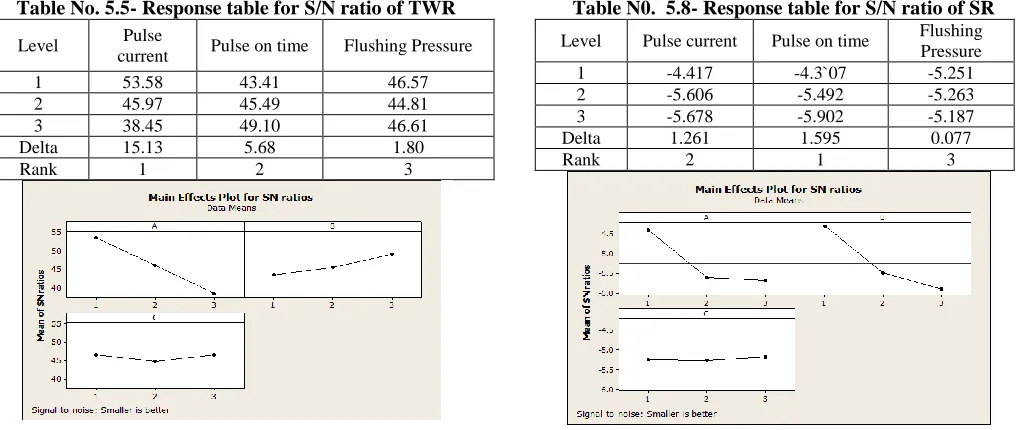
Table No. 5.5- Response table for S/N ratio of TWR
Level Pulse
current Pulse on time Flushing Pressure
1 53.58 43.41 46.57
2 45.97 45.49 44.81
3 38.45 49.10 46.61
Delta 15.13 5.68 1.80
Rank 1 2 3
Table N0. 5.8- Response table for S/N ratio of SR
Level Pulse current Pulse on time Flushing
Pressure
1 -4.417 -4.3`07 -5.251
2 -5.606 -5.492 -5.263
3 -5.678 -5.902 -5.187
Delta 1.261 1.595 0.077
Rank 2 1 3
Table No. 5.14- Observation Table for heat treated tool
SL
NO. Ip Ton P MRR TWR SR D
S/N RATIO
FOR MRR
S/N RATIO FOR TWR
S/N RATIO FOR SR
S/N RATIO FOR KERF WIDTH
A1 4 15 0.25 0.0571 0.00096 2.15 0.16 -23.53 50.182 -4.08 15.91
A2 4 20 0.5 0.0277 0.00084 2.42 0.14 -22.28 51.128 -4.433 17.07
A3 4 25 0.75 0.05 0.00063 2.93 0.12 -27.95 51.528 -5.421 18.41
B1 6 15 0.5 0.1176 0.00331 2.66 0.16 -26.44 40.706 -5.418 15.91
B2 6 20 0.75 0.0526 0.00249 2.85 0.15 -19.55 44.560 -6.0205 16.47
B3 6 25 0.25 0.1052 0.00249 3.00 0.10 -21.58 49.037 -6.0205 20
C1 8 15 0.75 0.1666 0.00755 2.35 0.21 -24.60 35.713 -5.418 13.55
C2 8 20 0.25 0.0769 0.00576 2.44 0.17 -16.26 39.954 -6.0205 15.39
C3 8 25 0.5 0.11 0.00235 3.78 0.06 -19.55 42.74 -6.579 24.43
Table No. 5.15- Response table for S/N ratio of MRR
Level Pulse current Pulse on time Flushing Pressure
1 -24.59 -24.86 -20.46
2 -22.53 -19.37 -22.76
3 -20.14 -23.04 -24.04
Delta 4.45 5.50 3.58
Rank 2 1 3
Table No. 5.18- Response table for S/N ratio of TWR
Level Pulse
current Pulse on time
Flushing Pressure
1 50.96 42.21 46.40
2 44.78 45.23 44.87
3 39.47 47.78 43.94
Delta 11.49 5.57 2.46
Rank 1 2 3
Table No. 5.21- Response table for S/N ratio of SR
Level Pulse current Pulse on
time
Flushing Pressure
1 -4.645 -4.973 -5.375
2 -5.820 -5.492 -5.477
3 -6.006 -6.006 -5.619
Delta 1.362 1.033 0.244
44
Copyright © 2018. IJEMR. All Rights Reserved.
XI.
CONCLUSION & DISCUSSION
For without heat treated tool, the response table for S/N ratios for MRR, TWR and SR are shown in tables 5,6 and 7 respectively graphical representation of the three control factors i.e TON, IP, and P on MRR, TWR and SR are shown in figure 4,5, and 6 respectively.
Referring to the table5, it was observed that pulse current is the main parameter for increasing the MRR, whereas the effect of Pulse on time and flushing pressure are equal. The MRR gives highest value in case of run no 9 and lowest value in case of run no 7.
Referring to the table 6, it was observed that pulse on time is the main parameter for reducing the TWR and pulse current and flushing pressure are also playing as main effective parameters for TWR. The TWR gives highest value in case of run no 3 and lowest value in case of run no 7.
Referring to the table 7, it was observed that pulse current is the main parameter for reducing the SR and whereas the effect of Pulse on time and flushing pressure are equal. The SR gives highest value in case of run no. 6 and lowest value in case of run no 7,
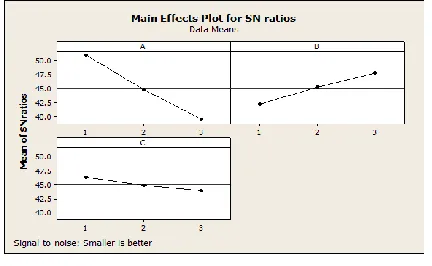
For Heat treated tool, the response table for S/N ratios for MRR, TWR and SR are shown in tables 8, 9 and 10 respectively graphical representation of the three control factors i.e. TON, IP, and P on MRR, TWR and SR are shown in figure 7,8 and 9 respectively.
Referring to the table8, it was observed that pulse current is the main parameter for increasing the MRR, Pulse on time also gives average effect whereas flushing pressure gives least effect. The MRR gives highest value in case of run no 9 and lowest value in case of run no 7.
Referring to the table 9, it was observed that pulse on time is the main parameter for reducing the TWR and pulse current and flushing pressure are also playing as main effective parameters for TWR. The TWR gives highest value in case of run no 3 and lowest value in case of run no 7.
Referring to the table 10, it was observed that pulse current is the main parameter for reducing the SR and whereas the effect of Pulse on time and
flushing pressure give equal effects. The SR gives highest value in case of run no 6 and lowest value in case of run no 7.
1. From the comparison of MRR, TWR,SR, kerf width of heat and non heat treated tool it is found that the heat treated tool is most significant compared to non heat treated copper tool.
2. For MRR the most significant factor is found to be the Pulse on time followed by Pulse current and flushing pressure.
3. For TWR the pulse on time and pulse current contributes more as compared to other parameter.
4. For SR the pulse current shows significant result and for kerf width the pulse on time is the best result.
5. In most of the cases the surface roughness is same for both heat treated and non heat treated electrode.
6. While considering pulse current (Ip) 4amp, pulse on time (Ton) 15µs and flushing pressure (p) as 0.25 the material removal rate is high. So it is the best combination for increasing the material removal rate.
7. The TWR is significantly reduced when pulse current (Ip) 8amp, pulse on time (Ton) 25µs and flushing pressure (p) as 0.50 .
8. The SR and kerf width is significantly reduced when pulse current (Ip) 8amp, pulse on time (Ton) 15µs and flushing pressure (p) as 0.75 .
9. Due to presence of some unwanted signal (Noise factors) the result is being deviated and the machining accuracy is changed.
REFERENCES
[1] Ch. Maheswara Rao & K.Venkatasubbaiah. 2016). Effect and optimization of EDM process parameters on surface roughness for En41 steel. International Journal of Hybrid Information Technology, 9(5), 343-358.
[2] Vasudevamurthy G. & Knight T. J. (2007). Effect of system parameters on size distribution of 304 stainless steel particles produced by electrical discharge mechanism.
Materials Letters, 61(27), 4872-4874.
[3] S. Abdurrahman Celik. (2007). Surface roughness investigation in the electrical discharge machining of powder metal material. Journal of Applied Sciences, 7(12), 1608- 1613.
45
Copyright © 2018. IJEMR. All Rights Reserved.
[5] S.R.Nipanikar. (2012). Parameter optimization of electro discharge machining of AISI D3 steel material by using taguchi method. Journal of Engineering Research and Studies, 3(3), 7-10.
[6] Harpreet Singh & Amandeep Singh. (2012). Effect of pulse on/pulse off time on machining of AISI D3 die steel using copper and brass electrode in E.D.M. International Journal of Engineering and Science, 1(9), 19-22.
[7] Samar Singh & Mukesh Verma. (2012). A parametric optimization of electric discharge drill machine using taguchi approach. Journal of Engineering, Computers & Applied Sciences, 1(3), 39- 44.
[8] Raghuraman S, Thiruppati K, & Pannerselvam T. Santosh. (2013). Optimization of E.D.M parameters using taguchi method and grey relational analysis for mild steel IS 2026. International Journal of Innovative Research in Science, Engineering and Technology, 2(7), 3095-3104. [9] D.C. Chen, J.J. Jhang, & M.W. Guo. (2013). Application of taguchi design method to optimize the electrical discharge machining. Journal of Achievements in Materials and Manufacturing Engineering, 57(2), 76-82. [10] Abhishek Gaikwad, Amit Tiwari, Amit Kumar, & Dhanajay Singh. (2014). Effect of EDM parameters in obtaining maximum MRR and minimum EWR by machining SS316 using copper electrode. International
Journal of Mechanical Engineering and Technology, 5(6),