The Thirty-Third AAAI Conference on Artificial Intelligence (AAAI-19)
Improving Image Captioning with Conditional Generative Adversarial Nets
Chen Chen, Shuai Mu, Wanpeng Xiao, Zexiong Ye, Liesi Wu, Qi Ju
Tencent AI Lab, Shenzhen, China 518000{beckhamchen, harrymou, wanpengxiao, joeyye, henrylwu, damonju}@tencent.com
Abstract
In this paper, we propose a novel conditional-generative-adversarial-nets-based image captioning framework as an extension of traditional reinforcement-learning (RL)-based encoder-decoder architecture. To deal with the inconsistent evaluation problem among different objective language met-rics, we are motivated to design some “discriminator” net-works to automatically and progressively determine whether generated caption is human described or machine generated. Two kinds of discriminator architectures (CNN and RNN-based structures) are introduced since each has its own ad-vantages. The proposed algorithm is generic so that it can enhance any existing RL-based image captioning framework and we show that the conventional RL training method is just a special case of our approach. Empirically, we show consis-tent improvements over all language evaluation metrics for different state-of-the-art image captioning models. In addi-tion, the well-trained discriminators can also be viewed as objective image captioning evaluators.
1
Introduction
Generating natural language descriptions of given images, known as image captioning, has attracted great academic and industrial interest since it can be widely used in image-text cross-searching, early childhood education and eye-handicapped people assistance. Compared with other com-puter vision tasks,e.g.image classification, object detection and semantic segmentation, image captioning is a more chal-lenging and comprehensive task — as it requires a fine-grain understanding of image objects as well as their attributes and relationships. Therefore, image captioning can be viewed as an interdisciplinary research domain of computer vision and natural language processing (NLP).
Inspired by the successful application of the encoder-decoder paradigm in neural machine translation (NTM) with RNNs, some pioneer works (Mao et al. 2014; Vinyals et al. 2015) creatively proposed to replace an RNN with a CNN to encode image features. Since then, the CNN-RNN structure has become a standard configuration of image captioning al-gorithms. Most prior works used maximum likelihood esti-mation (MLE) for training. However, as pointed out in (Ran-zato et al. 2015), this approach suffers from error
accumula-Copyright c2019, Association for the Advancement of Artificial Intelligence (www.aaai.org). All rights reserved.
tion, namely a bias exposure problem (Bengio et al. 2015), which creates a mismatch between training and testing — since at test-time, the model uses the previously generated words from the model distribution to predict the next word while directly uses ground-truth during training.
In order to address the exposure bias issue, many works incorporated reinforcement learning (RL) into the training stage to directly optimize language metrics such as BLEU (Papineni et al. 2002), METEOR (Banerjee and Lavie 2005), ROUGE (Lin 2004), CIDEr (Vedantam, Lawrence Zitnick, and Parikh 2015) and SPICE (Anderson et al. 2016). A policy-gradient (Sutton et al. 2000)-based RL method was first employed in image captioning, such as REINFORCE with a baseline (Rennie et al. 2017) and Monte-Carlo rollouts (Liu et al. 2017). Then, the so-called actor-critic RL algorithm was applied in (Ren et al. 2017; Zhang et al. 2017), which trains a second “critic” network to estimate the expected future reward during the intermediate state when generating each word given the policy of an actor network.
Recently, the most popular generative model–generative adversarial nets (GANs) (Goodfellow et al. 2014)–has achieved great success in computer vision tasks. But un-like the deterministic continuous mapping from random vec-tors to the image domain, many NLP tasks are discrete do-main generation issues. Inspired by the idea of reinforce-ment learning, a SeqGAN algorithm (Yu et al. 2017) was proposed to bypass the generator differentiation problem by directly performing the gradient policy update and suc-cessfully applied the result to text and music generation. In (Dai et al. 2017) and (Shetty et al. 2017), the authors con-ducted the first study that explores the use of conditional GANs (Mirza and Osindero 2014) or adversarial training in combination with an approximate Gumbel sampler in gener-ating image descriptions. However, what these papers con-cern about most is naturalness and diversity of descriptions while sacrificing the fidelity, which results in much lower language metrics scores compared with other image caption-ing algorithms.
or-der to simultaneously improve all language evaluation met-rics and generate more human-like descriptions, we are mo-tivated to design a “discriminator” network to judge whether the input sentence is human described or machine generated based on the idea of conditional GANs (Mirza and Osin-dero 2014). In this paper, we propose to employ an adver-sarial training method to alternatively improve the genera-tor (caption generation network) and the discriminagenera-tor (sen-tence evaluation network).
The main contributions of our proposed image captioning framework are listed as follows:
• Our proposed algorithm is generic so that it can enhance any existing RL-based image captioning framework and we show consistent improvements over all evaluation metrics by experiments.
• The well-trained discriminators can also be viewed as evaluators for image captioning learned by neural network instead of the traditional handcrafted evaluation metrics.
• Based on the up-down (Anderson et al. 2018) image ctioning model, the improved results trained by our ap-proach are uploaded to MSCOCO online test server and achieve the state-of-the-art performance.
2
Image Captioning Via Reinforcement
Learning
As described in the introduction, the traditional RNN model training method is MLE. That is, the model parametersθof the caption generator are trained to maximize
JG(θ) = 1 N
N
X
j=1
logGθ(xj|Ij)
= 1 N N X j=1 Tj X t=1
logGθ(x
j t|x
j 1:t−1,I
j), (1)
whereIj is thej-th image,xj =(xj 1,x
j 2,· · ·,x
j
Tj) is the
ground truth caption of the j-th image, Tj is the caption length of thej-th image,N is the total number of training examples, andGθ(·)is the probability of generated words
given an image or previous words, parameterized byθ (or we can directly callGθthe generator).
By using the RL terminologies as described in (Sutton and Barto 1998), in an encoder-decoder image captioning paradigm, the decoder can be viewed as an “agent” that in-teracts with an external “environment” (input words and im-age features extracted by the encoder). The “policy” is the caption generatorGθ, that results in an “action” that is the
prediction of the next word. After taking each “action”, the “agent” updates its internal “state” (weights of decoder, at-tention models,etc.). Upon generating the end-of-sequence (EOS) token, the “agent” returns a “reward”, denoted by
r, that is, for instance, a language evaluation metric score (CIDEr, BLEU, SPICE,etc.) calculated by comparing gen-erated sentences and the corresponding ground truth. So, the goal of RL training is to maximize the final expected reward of the generator:
LG(θ) =Exs∼G
θ[r(x
s)], (2)
wherexs = (xs1,xs2,· · · ,xsT)is a sample sequence from generator Gθ. In practice, the expected value is
approxi-mated by a Monte-Carlo sample (Sutton and Barto 1998):
LG(θ)≈r(xs), xs∼Gθ. (3)
Typically, the gradient ∇θLG(θ) can be calculated by a policy gradient approach such as REINFORCE (Williams 1992) algorithm with a baseline functionbto effectively re-duce the variance of the gradient estimate:
∇θLG(θ)≈ Ts
X
t=1
(r(xs1:t)−b)∇θlogGθ(xst|x s
1:t−1). (4)
The baselinebcan be an arbitrary function, as long as it does not depend on the “action”xs. A self-critical sequence training (SCST) (Rennie et al. 2017) method employs the re-wardr(xg)obtained by the current model under the greedy decoding algorithm used at test time as the baseline function. Then, the gradient function can be written as
∇θLG(θ) = Ts
X
t=1
(r(xs)−r(xg))∇θlogGθ(xst|x s 1:t−1).
(5) Since the reward of the sample sequence xs
1:Ts and the
greedy-decoded sequence xg1:T are the same during each time stept, we omit the subscripts ofxsandxgin Eq. (5).
3
Proposed Conditional Generative
Adversarial Training Method
3.1
Overall Framework
As described in the introduction, the most commonly used image captioning model is the so-called encoder-decoder framework. Typically, a CNN is employed as the encoder and an RNN is utilized as the decoder. Together with the attention mechanism and reinforcement learning method, a general caption generation framework is shown in the left part of Fig. 1, denoted as the generator. Inspired by the well-known generative adversarial nets (Goodfellow et al. 2014), a discriminator can be embedded into the image captioning framework to further improve the performance of the gener-ator, which is the initial design spirit of our proposed adver-sarial training method. Notice that our proposed framework is generic and can enhance any existing RL-based encoder-decoder model so the attention mechanism may be unnec-essary. In addition, the CNN encoder can be pre-trained on other datasets so that its weights can be fixed during decoder training (see the dashed lines and squares in Fig. 1).
As shown in Fig. 1, after generating a sentencex˜1:T, two modules will compute two scores based on different crite-rions: a discriminatorDφ with parameters φwill produce
a probability p ∈ [0,1]that indicates a given sentence is human generated rather than machine generated, and a lan-guage evaluator module will calculate an objective score
Figure 1: The overall framework of our proposed generative adversarial training method. The generator contains a CNN encoder, a RNN decoder and an unnecessary attention mechanism. The discriminator cooperated with the language evaluator provides feedback reward to update generator parameters by the reinforcement learning method (notice that CNN weights can be pre-trained and fixed).
Table 1: Kernel sizes and number of CNN discriminators
(window size, kernel numbers)
(1,100), (2,200), (3,200), (4,200), (5,200), (6,100), (7,100), (8,100), (9,100), (10,100), (15,160), (16,160)
function and is strictly fixed during training. Therefore, the two modules are cooperated together to obtain a criterion that balances the fidelity (achieves a high score under objec-tive evaluation metrics) and naturalness (a human-like lan-guage style).
Finally, the obtained reward for reinforcement learning af-ter generating a full sentencex˜ given imageI and ground-truth sentencexis calculated as
r( ˜x|I,x) =λ·p+(1−λ)·s=λ·Dφ( ˜x|I)+(1−λ)·Q( ˜x|x),
(6) whereλis a hyper-parameter between 0 and 1.
In the following subsections, we will introduce two kinds of discriminators–CNN-based and RNN-based structures–in detail.
3.2
CNN-based Discriminator Model
Recently, many CNN-based algorithms have shown great ef-fectiveness in complicated NLP tasks such as sentence clas-sification (Kim 2014) and text clasclas-sification (Zhang and Le-Cun 2015). Therefore, in this subsection, we first present the conditional CNN as our discriminator for real or fake sentence classification.
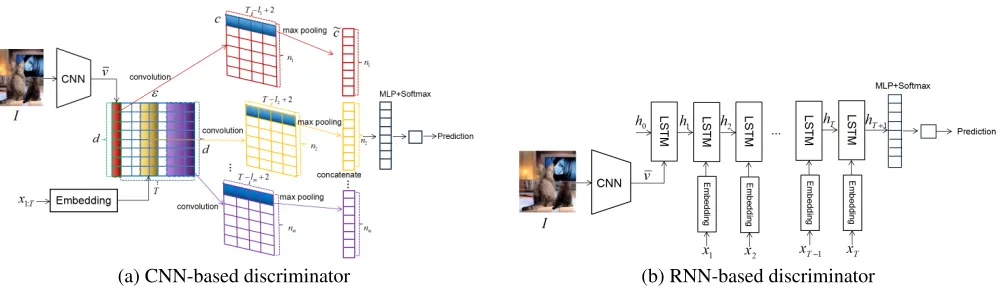
Following the discriminator design of SeqGAN (Yu et al. 2017), as illustrated in Fig. 2(a), first, we should build a ture map that consists of image features and sentence fea-tures, such as
ε=v¯⊕E·x1⊕E·x2⊕ · · · ⊕E·xT, (7)
where¯v= CNN(I)is thed-dimensional image feature pre-processed by a CNN for input imageI,E ∈ Rd×U is the
embedding matrix to map a U-dimensional one-hot word vector xi (i = {1,2,· · ·, T})into a d-dimensional token embedding, and ⊕ is the horizontal concatenation opera-tion to build the matrix ε ∈ Rd×(T+1). In order to extract
Algorithm 1Image Captioning Via Generative Adversarial Training Method
Require: caption generator Gθ; discriminator Dφ;
lan-guage evaluator Q, e.g. CIDEr-D; training set Sr =
{(I,x1:T)}andSw={(I,xˆ1:T)}.
Ensure: optimal parametersθ,φ. 1: InitialGθandDφrandomly. 2: Pre-trainGθonSrby MLE.
3: Generate some fake samples based onGθto formSf =
{(I,x˜1:T)}.
4: Pre-trainDφonSr∪Sf∪Swby Eq. (12).
5: repeat
6: forg-steps=1 :gdo
7: Generate a mini-batch of image-sentence pairs
{(I,x˜1:T)}byGθ.
8: Calculatepbased on Eqs. (7)-(9) or Eqs. (10)-(11). 9: Calculatesbased onQ.
10: Calculate rewardraccording to Eq. (6).
11: Update generator parametersθ by SCST method via Eq. (5).
12: end for
13: ford-steps=1 :ddo
14: Generate negative image-sentence pairs
{(I,x˜1:T)} by Gθ, together with negative
samples{(I,xˆ1:T)} ⊆ Sw and positive samples
{(I,x1:T)} ⊆Sr.
15: Update discriminator parametersφvia Eq. (12).
16: end for
17: untilgenerator and discriminator converge
ker-(a) CNN-based discriminator (b) RNN-based discriminator
Figure 2: CNN and RNN-based discriminator architectures. Best viewed in colour.
Table 2:λselection
fixed parameters:g=1;d=1; Metric=CIDEr-D
λ BLEU-4 METEOR ROUGE-L CIDEr SPICE
0 0.363 0.277 0.569 1.201 0.214
0.3 0.383 0.286 0.586 1.232 0.221
0.5 0.368 0.285 0.581 1.215 0.220
0.7 0.353 0.280 0.565 1.169 0.215
1 0.341 0.268 0.555 1.116 0.205
nels. The detailed design of kernel window sizes and num-ber is presented in Table 1 (slightly different from (Yu et al. 2017)). Without loss of generality, a kernelw ∈ Rd×l
with window sized×lapplied to the concatenated feature map of the input image and sentence will produce a feature mapc = [c1, c2,· · ·, cT−l+2]. Concretely, a specific fea-ture is calculated asci = ReLU(w∗εi:i+l−1+b), where i={1,2,· · · , T −l+ 2},∗is the convolution operation,b
is a bias term, andReLU(·)is the Rectified Linear Unit. Then we apply a max-over-time pooling operation over the feature map˜c= max{c}and concatenate all the pooled features from different kernels to form a feature vector˜c∈ Rn (n =Pmi=1ni). Following the instruction of (Yu et al. 2017), to enhance the performance, we also add the high-way architecture (Srivastava, Greff, and Schmidhuber 2015) before the final fully connected layer:
τ =σ(WT ·c˜+bT)
H= ReLU(WH·c˜+bH) ˜
C=τH+ (1−τ)˜c,
(8)
whereWT,WH ∈ Rn×n andbT,bH ∈ Rn are high way
layer weights and bias, respectively,σis the sigmoid func-tion andis the piece-wise multiplication operation.
Finally, a fully connected layer and sigmoid transforma-tion are applied toC˜ to get the probability that a given sen-tence is real under a given image:
p=σ(Wo·C˜+bo), (9)
whereWo ∈ R2×n andbo ∈ R2 are output layer weights
and bias, respectively.
3.3
RNN-based Discriminator Model
Since the most commonly used sequence modeling net-work is an RNN, in this subsection, we present the RNN-based discriminator architecture that consists of the standard LSTM structure, a fully connected linear layer and a softmax output layer.
For the first time step, the image feature vector ¯v is fed into the LSTM as an input with the randomly initial-ized hidden state h0 ∈ Rd. Then, for the following time
steps, the input vectors will be changed to token embeddings
E·xt(t = {1,2,· · ·, T}). The mathematical expressions are shown as follows:
ht+1=
LSTM(¯v,ht) t= 0
LSTM(E·xt,ht) t= 1,2,· · ·, T
. (10)
Then, after a fully connected layer and softmax layer, the probability that a given sentence is real under a given image can be calculated as:
p=σ(WR·hT+1+bR), (11)
whereWR ∈ R2×n andbR ∈R2are linear layer weights
and bias, respectively.
3.4
Algorithm
In order to incorporate the conditional GAN idea into the reinforcement learning method, the necessary back-propagated signal is the final rewardr, as depicted in Fig. 1. Since the language evaluation scoresis calculated by stan-dard metric criterions (CIDEr, SPICE, etc.), the most im-portant issue is the computation of discriminator probabil-ity outputp. One straightforward way to train a conditional GAN is to train the discriminator to judge pairs (image, sen-tence) as real or fake. This type of conditioning is naive in the sense that the discriminator has no explicit notion of whether real training sentences match the extracted image features.
Table 3: Metric selection
fixed parameters:g=1;d=1;λ=0.3
Metric BLEU-4 METEOR ROUGE-L CIDEr SPICE
CIDEr 0.381 0.280 0.580 1.248 0.213
CIDEr-D 0.383 0.286 0.586 1.232 0.221
BLEU-4 0.383 0.279 0.574 1.182 0.209
ROUGE-L 0.368 0.283 0.585 1.195 0.217
METEOR 0.377 0.287 0.576 1.180 0.214
Table 4: Step size combination selection
fixed parameters:λ=0.3; Metric=CIDEr-D
Step Sizes BLEU-4 METEOR ROUGE-L CIDEr SPICE
g=1;d=5 0.378 0.284 0.582 1.209 0.220
g=1;d=1 0.383 0.286 0.586 1.232 0.221
g=5;d=1 0.383 0.285 0.585 1.231 0.220
g=10;d=1 0.381 0.284 0.583 1.228 0.220
mismatched images (wrong pairs(I,xˆ1:T)). For the conve-nience of mathematical expression, we denote three sets as
Sr,Sf,Sw, which respectively consist of the three kinds of samples mentioned above.
Therefore, we slightly modify the traditional GAN train-ing loss function (Goodfellow et al. 2014) to separate the two error sources. The model parametersφof caption dis-criminator are trained to maximize
LD(φ) =E(I,x1:T)∈Sr[logDφ(I,x1:T)]
+ 0.5·E(I,˜x1:T)∈Sf[log(1−Dφ(I,x˜1:T))]
+ 0.5·E(I,ˆx1:T)∈Sw[log(1−Dφ(I,xˆ1:T))].
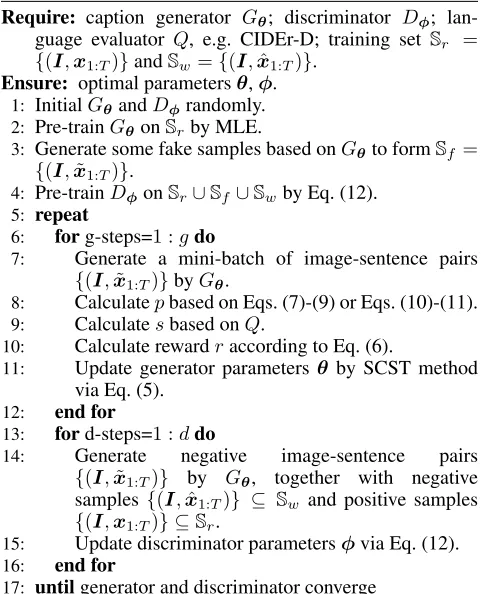
(12) Algorithm 1 describes the image captioning algorithm via the generative adversarial training method in detail. Notice that our proposed algorithm needs pre-training for both the generator and discriminator first. Then, we fine-tune the gen-erator and discriminator alternatively based on the standard GAN training process.
4
Experiments
4.1
Dataset
The most widely used image captioning training and evalua-tion dataset is the MSCOCO dataset (Lin et al. 2014) which contains 82,783, 40,504, and 40,775 images with 5 captions each for training, validation, and test, respectively. For of-fline evaluation, following the Karpathy splits from (Karpa-thy and Fei-Fei 2015), we use a set of 5K images for val-idation, 5K images for test and 113,287 images for train-ing. We adopt five widely used automatic evaluation met-rics: BLEU, ROUGE-L, METEOR, CIDEr and SPICE, to objectively evaluate the performance of different algorithms. For online evaluation on the MSCOCO evaluation server, we add the 5K validation set and 5K testing set into the training set to form a larger training set.
All the sentences in the training set are truncated to ensure the longest length of any sentence is 16 characters. We fol-low standard practice and perform some text pre-processing, converting all sentences to lower case, tokenizing on white space, and filtering words that do not occur at least 5 times, resulting in a model vocabulary of 9,487 words.
4.2
Implementation Details
The LSTM hidden dimension for the RNN-based discrim-inator is 512. The dimension of image CNN feature and word embedding for both CNN-based and RNN-based dis-criminators is fixed to 2048. We initialize the discriminator via pre-training the model for 10 epochs by minimizing the cross entropy loss in Eq. (12) using the ADAM (Kingma and Ba 2014) optimizer with a batch size of 16, an ini-tial learning rate of 1×10⁻³ and momentum of 0.9 and 0.999. Similarly, the generator is also pre-trained by MLE for 25 epochs. We use a beam search with a beam size of 5 when validating and tesing. Notice that our proposed generative-adversarial-nets-based image captioning frame-work is generic so that any existing encoder-decoder model can be employed as the generator. In our experiments, the Resnet101 (He et al. 2016) and bottom-up mechanism (An-derson et al. 2018) based on fastar R-CNN are chosen as en-coders, the top-down attention model (Anderson et al. 2018), att2in and att2all model (Rennie et al. 2017) are chosen as decoders to conduct controlled experiments. In addition, the SCST (Rennie et al. 2017) reinforcement learning method is adopted by all experiments. Therefore, all the generator and reinforcement learning hyper-parameters are identical with those of original referenced papers.
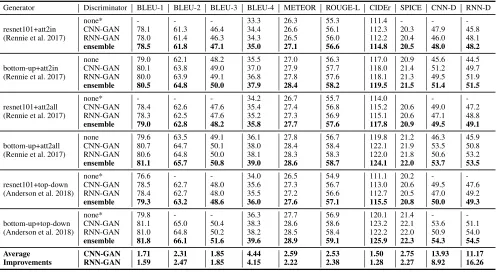
Table 5: Performance comparisons on MSCOCO Karpathy test set. The baseline algorithms are using resnet101 or bottom-up mechanism as the image feature extractor and SCST as the training method. Results of algorithms denoted by * are provided by original papers and the remaining experimental results are implemented by us for comparison. “None” means RL training method without discriminator. “CNN-GAN” and “RNN-GAN” mean training with our proposed approach by CNN-based and RNN-based discriminator, respectively. “Ensemble” indicates an ensemble of 4 CNN-GAN and 4 RNN-GAN models with different initializations. All values are reported in percentage (%).
Generator Discriminator BLEU-1 BLEU-2 BLEU-3 BLEU-4 METEOR ROUGE-L CIDEr SPICE CNN-D RNN-D
none* - - - 33.3 26.3 55.3 111.4 - - -resnet101+att2in CNN-GAN 78.1 61.3 46.4 34.4 26.6 56.1 112.3 20.3 47.9 45.8 (Rennie et al. 2017) RNN-GAN 78.0 61.4 46.3 34.3 26.5 56.0 112.2 20.4 46.0 48.1 ensemble 78.5 61.8 47.1 35.0 27.1 56.6 114.8 20.5 48.0 48.2
none 79.0 62.1 48.2 35.5 27.0 56.3 117.0 20.9 45.6 44.5 bottom-up+att2in CNN-GAN 80.1 63.8 49.0 37.0 27.9 57.7 118.0 21.4 51.2 49.7 (Rennie et al. 2017) RNN-GAN 80.0 63.9 49.1 36.8 27.8 57.6 118.1 21.3 49.5 51.9 ensemble 80.5 64.8 50.0 37.9 28.4 58.2 119.5 21.5 51.4 51.5
none* - - - 34.2 26.7 55.7 114.0 - -resnet101+att2all CNN-GAN 78.4 62.6 47.6 35.4 27.4 56.8 115.2 20.6 49.0 47.2 (Rennie et al. 2017) RNN-GAN 78.3 62.5 47.6 35.2 27.3 56.9 115.1 20.6 47.1 48.8 ensemble 79.0 62.8 48.2 35.8 27.7 57.6 117.8 20.9 49.5 49.1
none 79.6 63.5 49.1 36.1 27.8 56.7 119.8 21.2 46.3 45.9 bottom-up+att2all CNN-GAN 80.7 64.7 50.1 38.0 28.4 58.4 122.1 21.9 53.5 50.8 (Rennie et al. 2017) RNN-GAN 80.6 64.8 50.0 38.1 28.3 58.3 122.0 21.8 50.6 53.2 ensemble 81.1 65.7 50.8 39.0 28.6 58.7 124.1 22.0 53.7 53.5
none* 76.6 - - 34.0 26.5 54.9 111.1 20.2 - -resnet101+top-down CNN-GAN 78.5 62.7 48.0 35.6 27.3 56.7 113.0 20.6 49.5 47.6 (Anderson et al. 2018) RNN-GAN 78.4 62.7 48.0 35.5 27.2 56.6 112.7 20.5 47.0 49.2 ensemble 79.3 63.2 48.6 36.0 27.6 57.1 115.5 20.8 50.0 49.3
none* 79.8 - - 36.3 27.7 56.9 120.1 21.4 - -bottom-up+top-down CNN-GAN 81.1 65.0 50.4 38.3 28.6 58.6 123.2 22.1 53.6 51.1 (Anderson et al. 2018) RNN-GAN 81.0 64.8 50.2 38.2 28.5 58.4 122.2 22.0 50.9 54.0 ensemble 81.8 66.1 51.6 39.6 28.9 59.1 125.9 22.3 54.3 54.5
Average CNN-GAN 1.71 2.31 1.85 4.44 2.59 2.53 1.50 2.75 13.93 11.17 Improvements RNN-GAN 1.59 2.47 1.85 4.15 2.22 2.38 1.28 2.27 8.92 16.26
hyper-parameters are empirical values and will be clarified in the following subsection.
4.3
Parameters Determination
In order to determine a group of optimal hyper-parameters as mentioned in the above subsection, we design a series of experiments with a variable-controlling approach. We adopt the bottom-up image feature extractor together with top-down attention model as our fixed generator, SCST as our RL optimization method and the CNN structure as our dis-criminator.
First, we fix the g-stepsg = 1, d-stepsd = 1and lan-guage metricQas CIDEr-D (a smooth modification version of CIDEr). The objective results on the test split with differ-entλvalues are shown in Table 2. Notice that whenλ= 0, our algorithm exactly degenerates into the conventional RL method. Statistics reveal that all the metrics evaluation re-sults achieve their optimal scores whenλ= 0.3.
Second, we fix the g-steps g = 1, d-steps d = 1 and
λ= 0.3. The test results while RL optimizing by different language evaluatorQare shown in Table 3. Notice that here we do not choose SPICE as evaluator since the computa-tion of SPICE is extremely slow and is too time-consuming. When the evaluator is chosen as CIDEr-D, even though some scores (CIDEr and METEOR) are not the highest, the
comprehensive performance still outperforms other evalua-tors.
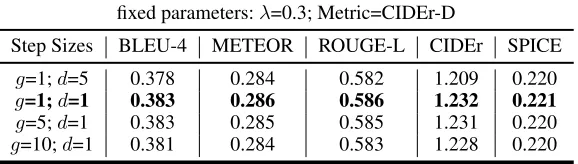
Third, we fixλ= 0.3and language evaluatorQas CIDEr-D. We try different step-size combinations and list the test results in Table 4. Experimental results demonstrate that the best step-size combination isg= 1andd= 1.
Overall, based on the experimental results explained above, the final optimal hyper-parameters of our proposed algorithm areλ= 0.3,g= 1,d= 1andQ=CIDEr-D.
4.4
Comparisons
CNN-Table 6: Performance of different models on the MSCOCO evaluation server. All values are reported in percentage (%), with the highest value of each entry highlighted in boldface. It is worth pointing out that almost all the metrics of our method (ensemble of 4 CNN-GAN and 4 RNN-GAN models in the last row) ranked in top two at the time of submission (5 Sep., 2018).
Algorithms BLEU-1 BLEU-2 BLEU-3 BLEU-4 METEOR ROUGE-L CIDEr SPICE c5 c40 c5 c40 c5 c40 c5 c40 c5 c40 c5 c40 c5 c40 c5 c40
NIC (Vinyals et al. 2015) 71.3 89.5 54.2 80.2 40.7 69.4 30.9 58.7 25.4 34.6 53.0 68.2 94.3 94.6 18.2 63.6 PG-BCMR (Liu et al. 2017) 75.4 91.8 59.1 84.1 44.5 73.8 33.2 62.4 25.7 34.0 55.0 69.5 101.3 103.2 18.7 62.2 Adaptive (Lu et al. 2017) 74.8 92.0 58.4 84.5 44.4 74.4 33.6 63.7 26.4 35.9 55.0 70.5 104.2 105.9 19.7 67.3 Actor-Critic (Zhang et al. 2017) 77.8 92.9 61.2 85.5 45.9 74.5 33.7 62.5 26.4 34.4 55.4 69.1 110.2 112.1 20.3 68.0 Att2all (Rennie et al. 2017) 78.1 93.7 61.9 86.0 47.0 75.9 35.2 64.5 27.0 35.5 56.3 70.7 114.7 116.7 20.7 68.9 Stack-Cap (Gu et al. 2017) 77.8 93.2 61.6 86.1 46.8 76.0 34.9 64.6 27.0 35.6 56.2 70.6 114.8 118.3 - -LSTM-A3(Yao et al. 2017) 78.7 93.7 62.7 86.7 47.6 76.5 35.6 65.2 27.0 35.4 56.4 70.5 116.0 118.0 -
-Up-down (Anderson et al. 2018) 80.2 95.2 64.1 88.8 49.1 79.4 36.9 68.5 27.6 36.7 57.1 72.4 117.9 120.5 21.5 71.5 CAVP (Liu et al. 2018) 80.1 94.9 64.7 88.8 50.0 79.7 37.9 69.0 28.1 37.0 58.2 73.1 121.6 123.8 - -RFNet (Jiang et al. 2018) 80.4 95.0 64.9 89.3 50.1 80.1 38.0 69.2 28.2 37.2 58.2 73.1 122.9 125.1 -
-Ours 81.9 95.6 66.3 90.1 51.7 81.7 39.6 71.5 28.7 38.2 59.0 74.4 123.1 124.3 -
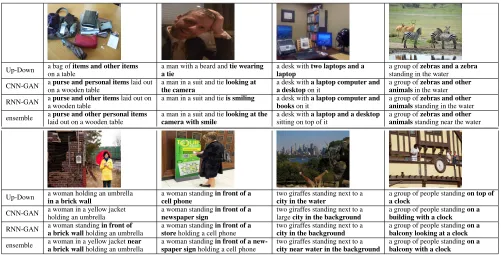
-Table 7: This table shows some caption examples by different algorithms. The first line is generated by the Up-Down model with SCST. The second and third lines are caption results by adding CNN-GAN and RNN-GAN traing, respectively. The last line is the results of ensemble of CNN-GAN and RNN-GAN.
Up-Down a bag ofitems and other items a man with a beard andtie wearing a desk withtwo laptops and a a group ofzebras and a zebra
on a table a tie laptop standing in the water
CNN-GAN apurse and personal itemslaid out a man in a suit and tielooking at a desk witha laptop computer and a group ofzebras and other on a wooden table the camera a desktopon it animalsin the water
RNN-GAN apurse and other itemslaid out on a man in a suit and tieis smiling a desk witha laptop computer and a group ofzebras and other
a wooden table bookson it animalsstanding in the water
ensemble apurse and other personal items a man in a suit and tielooking at the a desk witha laptop and a desktop a group ofzebras and other laid out on a wooden table camera with smile sitting on top of it animalsstanding near the water
Up-Down a woman holding an umbrella a woman standingin front of a two giraffes standing next to a a group of people standingon top of
in a brick wall cell phone city in the water a clock
CNN-GAN a woman in a yellow jacket a woman standingin front of a two giraffes standing next to a a group of people standingon a holding an umbrella newspaper sign largecity in the background building with a clock
RNN-GAN a woman standingin front of a woman standingin front of a two giraffes standing next to a a group of people standingon a a brick wallholding an umbrella storeholding a cell phone city in the background balcony looking at a clock
ensemble a woman in a yellow jacketnear a woman standingin front of a new- two giraffes standing next to a a group of people standingon a a brick wallholding an umbrella spaper signholding a cell phone city near water in the background balcony with a clock
based and based discriminators (CNN-D and RNN-D in the last two columns of Fig. 5) can also be viewed as two learned evaluators. The experimental results demon-strate that our proposed adversarial training approach can significantly boost the scores compared with traditional RL training method (improvements range from 8.9% to 16.3%).
In terms of CNN-based and RNN-based generative ad-versarial training framework (called CNN-GAN and RNN-GAN in Table 5), each has its own advantages. Experi-mental results show that CNN-GAN can improve the per-formance of image captioning frameworks slightly more as compared with RNN-GAN. However, during training stage, using RNN-GAN can save 30% training time according to
our experimental experience. The most important issue is that the ensemble results of 4 CNN-GAN and 4 RNN-GAN models can largely enhance the performance of a single model as shown in Table 5.
Specifically, when compared with the results of Up-Down model, by using our proposed generative adversarial train-ing method, it can obtain significant improvements.
4.5
Examples
To better understand the CNN-GAN and RNN-GAN frame-work, Table 7 provides some representative examples for comparisons. The baseline algorithm is the Up-Down model with SCST, whose results are shown in the first line. Our generated captions by CNN-GAN and RNN-GAN training approach with the same generator are listed in the second and third line, respectively. The last row is the results of en-semble of 4 CNN-GAN and 4 RNN-GAN models.
The four cases appearing above in Table 7 indicate that the original model will generate some duplicate words or phrase. Even without any grammar or description errors, these sentences seem rigid and machine generated. After generative adversarial training, the generated sentences are much more like a human style. The four cases appearing be-low in Table 7 present some logical errors which are incon-sistent with given images when using traditional RL train-ing method,e.g.“in a brick wall”, “in front of a cell phone”, “city in the water”, “on top of a clock”, while such error will be avoided when employing our proposed method.
5
Conclusion
This paper proposes a novel architecture combining gen-erative adversarial nets and reinforcement learning to im-prove existing image captioning frameworks. Current RL-based image captioning algorithms directly optimize lan-guage evaluation metrics such as CIDEr, BELU and SPICE; however, simply optimizing one metric or combination of these metrics will not consistently improve all evaluation metrics and will also result in some logical errors or un-natural styles when generating descriptions. Therefore, we are motivated to design a discriminator network to judge whether the input sentence is human described or ma-chine generated. Alternatively, the caption generator and the evaluation discriminator are improved by adversarial train-ing. We experimentally show consistent improvements over all language evaluation metrics for different state-of-the-art encoder-decoder based image captioning models optimized by conventional RL training, demonstrating the effective-ness of our proposed generative adversarial training method. In addition, the well-trained CNN and RNN-based discrim-inators can also be utilized as image captioning evaluators leaned by neural networks.
References
Anderson, P.; Fernando, B.; Johnson, M.; and Gould, S. 2016. Spice: Semantic propositional image caption evaluation. In Eu-ropean Conference on Computer Vision, 382–398. Springer. Anderson, P.; He, X.; Buehler, C.; Teney, D.; Johnson, M.; Gould, S.; and Zhang, L. 2018. Bottom-up and top-down attention for im-age captioning and visual question answering. InCVPR, volume 3, 6.
Banerjee, S., and Lavie, A. 2005. METEOR: An automatic met-ric for MT evaluation with improved correlation with human judg-ments. InProceedings of the acl workshop on intrinsic and
ex-trinsic evaluation measures for machine translation and/or sum-marization, 65–72.
Bengio, S.; Vinyals, O.; Jaitly, N.; and Shazeer, N. 2015. Sched-uled sampling for sequence prediction with recurrent neural net-works. InAdvances in Neural Information Processing Systems, 1171–1179.
Dai, B.; Fidler, S.; Urtasun, R.; and Lin, D. 2017. Towards diverse and natural image descriptions via a conditional GAN. In Pro-ceedings of the IEEE Conference on Computer Vision and Pattern Recognition, 2970–2979.
Goodfellow, I.; Pouget-Abadie, J.; Mirza, M.; Xu, B.; Warde-Farley, D.; Ozair, S.; Courville, A.; and Bengio, Y. 2014. Genera-tive adversarial nets. InAdvances in neural information processing systems, 2672–2680.
Gu, J.; Cai, J.; Wang, G.; and Chen, T. 2017. Stack-captioning: Coarse-to-fine learning for image captioning. arXiv preprint arXiv:1709.03376.
He, K.; Zhang, X.; Ren, S.; and Sun, J. 2016. Deep residual learn-ing for image recognition. InProceedings of the IEEE conference on computer vision and pattern recognition, 770–778.
Jiang, W.; Ma, L.; Jiang, Y.-G.; Liu, W.; and Zhang, T. 2018. Re-current fusion network for image captioning. InProceedings of the European Conference on Computer Vision (ECCV), 499–515. Karpathy, A., and Fei-Fei, L. 2015. Deep visual-semantic align-ments for generating image descriptions. InProceedings of the IEEE conference on computer vision and pattern recognition, 3128–3137.
Kim, Y. 2014. Convolutional neural networks for sentence clas-sification. InProceedings of the 2014 Conference on Empirical Methods in Natural Language Processing (EMNLP), 1746–1751. Kingma, D. P., and Ba, J. 2014. Adam: A method for stochastic optimization.arXiv preprint arXiv:1412.6980.
Lin, T.-Y.; Maire, M.; Belongie, S.; Hays, J.; Perona, P.; Ramanan, D.; Doll´ar, P.; and Zitnick, C. L. 2014. Microsoft coco: Common objects in context. In European conference on computer vision, 740–755. Springer.
Lin, C.-Y. 2004. Rouge: A package for automatic evaluation of summaries.Text Summarization Branches Out.
Liu, S.; Zhu, Z.; Ye, N.; Guadarrama, S.; and Murphy, K. 2017. Im-proved image captioning via policy gradient optimization of SPI-DEr. InProceedings of the IEEE Conference on Computer Vision and Pattern Recognition, 873–881.
Liu, D.; Zha, Z.-J.; Zhang, H.; Zhang, Y.; and Wu, F. 2018. Context-aware visual policy network for sequence-level image cap-tioning. arXiv preprint arXiv:1808.05864.
Lu, J.; Xiong, C.; Parikh, D.; and Socher, R. 2017. Knowing when to look: Adaptive attention via a visual sentinel for image caption-ing. InProceedings of the IEEE Conference on Computer Vision and Pattern Recognition, 375–383.
Mao, J.; Xu, W.; Yang, Y.; Wang, J.; and Yuille, A. L. 2014. Explain images with multimodal recurrent neural networks.arXiv preprint arXiv:1410.1090.
Mirza, M., and Osindero, S. 2014. Conditional generative adver-sarial nets.arXiv preprint arXiv:1411.1784.
Ranzato, M.; Chopra, S.; Auli, M.; and Zaremba, W. 2015. Sequence level training with recurrent neural networks. arXiv preprint arXiv:1511.06732.
Ren, Z.; Wang, X.; Zhang, N.; Lv, X.; and Li, L.-J. 2017. Deep inforcement learning-based image captioning with embedding re-ward. InProceedings of the IEEE Conference on Computer Vision and Pattern Recognition, 290–298.
Rennie, S. J.; Marcheret, E.; Mroueh, Y.; Ross, J.; and Goel, V. 2017. Self-critical sequence training for image captioning. In Pro-ceedings of the IEEE Conference on Computer Vision and Pattern Recognition, 7008–7024.
Shetty, R.; Rohrbach, M.; Hendricks, L. A.; Fritz, M.; and Schiele, B. 2017. Speaking the same language: Matching machine to hu-man captions by adversarial training. InProceedings of the IEEE International Conference on Computer Vision (ICCV).
Srivastava, R. K.; Greff, K.; and Schmidhuber, J. 2015. Highway networks.arXiv preprint arXiv:1505.00387.
Sutton, R. S., and Barto, A. G. 1998. Reinforcement learning: An introduction. MIT press Cambridge.
Sutton, R. S.; McAllester, D. A.; Singh, S. P.; and Mansour, Y. 2000. Policy gradient methods for reinforcement learning with function approximation. InAdvances in neural information pro-cessing systems, 1057–1063.
Vedantam, R.; Lawrence Zitnick, C.; and Parikh, D. 2015. Cider: Consensus-based image description evaluation. InProceedings of the IEEE conference on computer vision and pattern recognition, 4566–4575.
Vinyals, O.; Toshev, A.; Bengio, S.; and Erhan, D. 2015. Show and tell: A neural image caption generator. In Proceedings of the IEEE conference on computer vision and pattern recognition, 3156–3164.
Williams, R. J. 1992. Simple statistical gradient-following algo-rithms for connectionist reinforcement learning. InReinforcement Learning. Springer. 5–32.
Yao, T.; Pan, Y.; Li, Y.; Qiu, Z.; and Mei, T. 2017. Boosting image captioning with attributes. InProceedings of the IEEE Interna-tional Conference on Computer Vision, 4894–4902.
Yu, L.; Zhang, W.; Wang, J.; and Yu, Y. 2017. SeqGAN: Sequence generative adversarial nets with policy gradient. InAAAI, 2852– 2858.
Zhang, X., and LeCun, Y. 2015. Text understanding from scratch. arXiv preprint arXiv:1502.01710.