Reviewing the Effects of Population Growth
on Basic Education Development
Leodinito Y. Cañete Cebu Normal University Date Submitted:September 29, 2010
Date Revised: March 31, 2011
ABSTRACT
The influence of population on the economy is seemingly straightforward. It is about having enough resources to meet the needs of the growing number of people. This study explored access to resources between urban and non/less-urban populations and its impact on basic education development using evidence from Cebu Province because the population and development policy of the Philippine government has not been consistent. With Cebu Province registering a 2.44 exponential annual population growth rate between 1990 and 2000, the number of school entrants is not likely to abate. The results of the study showed a disturbing gender-related phenomenon because there are significantly more girls than boys attending and graduating from high school in both settings. Furthermore, girls tended to have higher access to basic education compared to boys as shown in their levels of educational attainment. Thus, it is imperative for both the public and private sector to adequately respond to the continued growth of the school age population as it impacts on the quality of basic education through a clear and consistent popdev policy.
Keywords: Population growth, education development, school-age children, basic education
INTRODUCTION
The influence of population on the economy is seemingly straightforward. It is about having enough resources to meet the needs of the growing number of people. Since the same resource base is shared by all members of the society, everybody is affected by development and many are deprived of their access to the same resources. Here, the current views on population and development are presented to substantiate their relationships.
In the field of population studies, it has long been recognized that education is strongly related to a broad range of demographic behaviors. The spread of education throughout a population has been shown to be of central importance for the long-term demographic transition from a high to a low level of fertility. As early as 1980, Caldwell (cited by UN 2003) asserted that once a society has achieved “mass education”, a high level of fertility would no longer persist.
A substantial body of research has generally accepted that education both influences and, over time, is influenced by demographic factors. However, while linkages among population, education and development have been recognized in academic and policy settings, the priority accorded to these relationships has varied.
A report by the United Nations in 2003 which intensively studied the interrelationships between education and population and their resulting effects on development documents the following conclusions:
•Increased education makes an important contribution to societies' economic growth and to the economic fortunes of individuals.
•Illiteracy is a powerful predictor of poverty.
•Among both women and men, an early age at first marriage is more common among those with no education than among their educated peers. •Women's age at the onset of their sexual activity is higher among those with
higher levels of education.
•Education of women is a major factor influencing the start of child-bearing. •Women with higher levels of education want fewer children.
•Of the socioeconomic variables that have been found to be associated with differentials in health and mortality, education is among the strongest and the most consistent.
•In developing countries, studies have shown that those with less education have higher maternal mortality, higher mortality for children under-five, less knowledge of key health interventions, lower levels of immunization coverage, and lower nutritional status.
•Access to proper care during pregnancy and delivery is also sharply differentiated by the level of a woman's education.
In sum, the report made it abundantly clear that education plays a key role in national development. In addition, it is also a major determinant of an individual's well-being because education empowers him or her to choose and decide on issues in such areas as work, place of residence, family size, health, lifestyle, and personal development. When aggregated, all these individual choices and decisions have dramatic consequences for the country's population.
No Cohesive Population Policy in the Philippines
The Philippines is stymied by a “lack of stable consensus” of its policy on population growth and fertility reduction that continues to this day (Herrin 2003). Its national family planning program has been characterized by shifting objectives of fertility reduction, upholding of reproductive rights, and promotion of maternal health. Herrin also points out that this lack of policy consensus has slowed down Philippine fertility transition as evidenced by the
Cañete: Reviewing the Effects of Population Growth
A substantial body of research has generally accepted that education both influences and, over time, is influenced by demographic factors. However, while linkages among population, education and development have been recognized in academic and policy settings, the priority accorded to these relationships has varied.
A report by the United Nations in 2003 which intensively studied the interrelationships between education and population and their resulting effects on development documents the following conclusions:
• Increased education makes an important contribution to societies' economic growth and to the economic fortunes of individuals.
• Illiteracy is a powerful predictor of poverty.
• Among both women and men, an early age at first marriage is more common among those with no education than among their educated peers. • Women's age at the onset of their sexual activity is higher among those with
higher levels of education.
• Education of women is a major factor influencing the start of child-bearing. • Women with higher levels of education want fewer children.
• Of the socioeconomic variables that have been found to be associated with differentials in health and mortality, education is among the strongest and the most consistent.
• In developing countries, studies have shown that those with less education have higher maternal mortality, higher mortality for children under-five, less knowledge of key health interventions, lower levels of immunization coverage, and lower nutritional status.
• Access to proper care during pregnancy and delivery is also sharply differentiated by the level of a woman's education.
In sum, the report made it abundantly clear that education plays a key role in national development. In addition, it is also a major determinant of an individual's well-being because education empowers him or her to choose and decide on issues in such areas as work, place of residence, family size, health, lifestyle, and personal development. When aggregated, all these individual choices and decisions have dramatic consequences for the country's population.
No Cohesive Population Policy in the Philippines
fact that the country’s fertility decline has been the slowest compared to neighboring countries such as South Korea and Thailand. As a result, the Philippines did not have the advantage of a more favorable age distribution (the so-called demographic bonus) that these countries had which contributed to their sustained economic growth and higher standards of living.
In his paper, Pernia (2003) raised the issue of why and how population matters remain crucial for the Philippines. Characterized as having a “soft state
and hard church”, the Philippines has neglected the “population problematique”, practically just sweeping it under the rug. Consequently, it now finds itself virtually alone among middle-income developing countries as not having made any significant demographic transition. And it finds itself having to debate an issue that is passé for most Asian developing countries including such less developed countries as Bangladesh and India.
In the same paper, Pernia argues further that although the population question is an old one, it deserves fresh discussion to elicit good answers. Why? It has been observed that the average per capita income and labor productivity (average output per worker) at the start of the 21st century were at the same
levels two decades earlier. Population certainly matters if the Philippines chooses to remain in a low-level equilibrium trap with low economic growth, high unemployment rates, low productivity levels, persistent poverty, declining human capital, and high fertility feeding back into low economic growth, high unemployment, and low productivity, going back and forth in a vicious cycle or to get out of it. A clear and consistent population policy, matched by an adequately funded action program, is needed to break this chain.
In addition to being clear and consistent, the proposed policy must be relevant and effective to optimize its impact on basic education development. Manasan (2007), in her analysis of the risks and opportunities in securing additional resources to ensure that the Philippines attains its Millennium Development Goals, shows that the inadequate government (per capita) expenditure for education is strongly correlated with the basic education's performance indicators. When expenditure for education rises, for instance, net enrolment also rises. Furthermore, Manasan, Cuenca and Villanueva-Ruiz (2007) present evidence that government education spending improves the well-being of an individual and enhances his or her capability to earn income in the future. In this sense, they reveal that directing education expenditure to the poor holds a promise for breaking the intergenerational transmission of poverty.
LITERATURE REVIEW
Since the population and development policy of the Philippine government has not been consistent, the merits and drawbacks of curbing population growth are best understood in the context of the very tangible reality of basic education development. High population growth rate means rapid growth of the school-age population that spreads out even more thinly the already very scarce resources for basic education development. Here, evidence from research on the relationship between poverty and access to basic education is reviewed.
While education may be a mechanism for the poor to be freed from the shackles of poverty, the results of the Annual Poverty Indicator Survey (APIS) conducted by the National Statistics Office in 2002 and 2004 imply that the poor are less likely to obtain basic education. Maligalig and Albert (2008), in their analysis of the 2002 and 2004 APIS found out that children, especially from poor families, are forced to stay out of school not only because they cannot afford the costs, but also because given the poor quality of education, it becomes more rational for them to work rather than to stay in school. Tabunda and Albert (2002 cited in Maligalig and Albert 2008) found out that both cost and quality factors are inherently tied to poverty because poor families have to sacrifice sending their children to school especially during periods of crisis. This condition limits the means by which poor families send their children to schools that provide quality education.
The same study summarized the reasons for nonattendance in school of school-age children as follows: (a) Cannot cope with school work; (b) High cost of education; (c) Illness and/or disability; (d) Lack of personal interest; (e) Schools are far or there is no school within the barangay; (f) Finished schooling; (g) Housekeeping chores; (h) No regular transportation from house to school; and others. A relationship between nonattendance in school and household income was also established, to wit: the percentage of children who are not attending school decreases as income (of the household to which the children belong) increases.
The poverty issues stemming from basic education are complicated by emerging gender issues. The logistic regression model that both authors ran using the best explanatory variables for not attending school shows that those who belong to the bottom 30 percent of the income deciles are 2.8 times more likely to be out of school than those in the upper 70 percent income group. In addition, the results also indicate that it is the boys, more than the girls, who are more likely not to attend school, all things being equal. More specifically, boys are 1.4 times more likely not to attend school than girls.
Their analysis of the expenditure pattern of families by income deciles also suggests that food and utilities are given more priority over education and health by families. With the current and continuing increase in food prices, the expenditure share in education will probably decrease further. This puts the increased targets in net enrolment ratio and dropout rate on a balance.
There is growing evidence pointing out that as poverty increases, the dropout rate also increases, but the net enrolment rate and cohort survival rate decreases. Recent data show that the ARMM is the most adversely affected region in the Philippines with the highest poverty incidence, the highest dropout rate and the lowest cohort survival rate among all the regions. In an era that calls for teaching to be scientifically-based, educators should have accurate, evidence-based pictures of what their students' lives are like, what competencies and understandings they might bring to school if schools were ready to receive them, and what social and cultural contexts have a bearing upon the interactions that occur in the classrooms. Otherwise, teachers may be accused of deficit thinking. Bomer and his colleagues warn educators about an in-service teacher education program in the United States which offers true claims that do not have supporting evidence and, worse, which are contradicted by anthropological, sociological and other research on poverty. In its comprehensive analysis of the truth claims of the said framework, Bormer's group concluded that the framework's characterization of people living in poverty leaves more teachers misinformed, consequently making poor students more likely to be in the lower tracks or lower ability groups.
The Philippines, too, needs a framework for understanding the lives of the poor that will guide its teacher education program. The framework can benefit from research and reviews of social psychological approaches to community empowerment programs such as that in Negros Occidental or even from Efren Peñaflorida's pushcart classrooms for urban street children in Metro Manila. The proposed framework has to acknowledge the person’s sense of individual mastery of his or her life that preserves his or her dignity and self-respect.
Problem
This study explored access to basic education between urban and non/less-urban populations of Cebu Province to highlight the straightforward relationship between population growth and basic education. Data were culled from Cebu: A Demographic and Socioeconomic Profile Based on the 2000 Census (2004) by Zosa, Zosa, Gultiano and Cusi. Data from all 53 cities and municipalities of Cebu showed percentages of people aged 7 to 20 who had not completed any grade at all; those who had pre-school, elementary school, and high school education were used as proxy indicators of access to basic education in lieu of discrepant participation rates.
The urban areas are collectively called Metro Cebu, an arbitrary geo-political division with a combined population of 1,661,899 in 2000. Metro Cebu refers to the urban areas of Cebu that fall within the economic radius of Cebu City as the urban center with Mandaue City, Consolacion, Liloan and Compostela on the northern portion; and Talisay City, Minglanilla and Naga on the southern part; and Lapulapu City and Cordova on the east. These LGUs are the urban areas of this study and the rest are categorized as non/less-urban areas.
RESULT
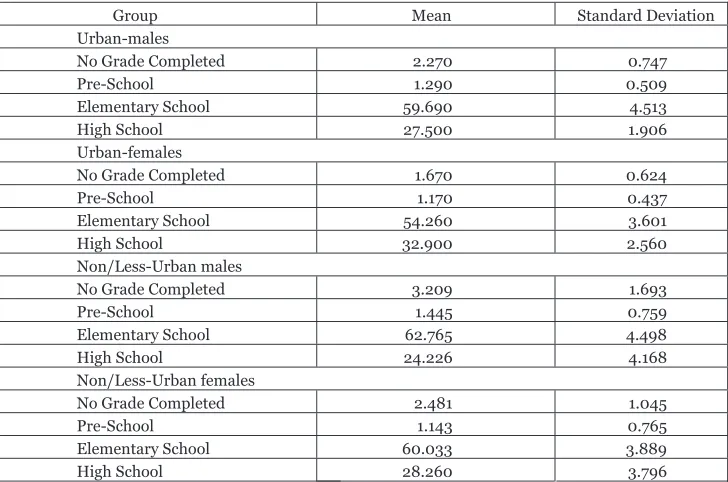
Table 1 reflects the comparative educational attainment profiles of the individuals of urban and non/less-urban areas of Cebu that were generated by simple descriptive statistics.
Table 1 Mean and Standard Deviation of Various Groups
Group Mean Standard Deviation
Urban-males
No Grade Completed 2.270 0.747
0 9 2 . 1 l o o h c S -e r P 0.509
Elementary School 59.690 4.513
High School 27.500 1.906
Urban-females
No Grade Completed 1.670 0.624
0 7 1 . 1 l o o h c S -e r P 0.437
Elementary School 54.260 3.601
High School 32.900 2.560
Non/Less-Urban males
No Grade Completed 3.209 1.693
5 4 4 . 1 l o o h c S -e r P 0.759
Elementary School 62.765 4.498
High School 24.226 4.168
Non/Less-Urban females
No Grade Completed 2.481 1.045
3 4 1 . 1 l o o h c S -e r P 0.765
Elementary School 60.033 3.889
High School 28.260 3.796
Table 2 shows the results of the confirmatory data analysis to decide whether the data contain enough information to cast doubt on conventional wisdom.
Table 2 Results of Two-Sample T-Test
Pairs of Mean and Standard Deviation No Grade Completed (Urban: M-F) No Grade Completed (Non/Less-Urban: M-F) Pre-school (Urban: M-F)
Pre-school (Non/Less-Urban: M-F) Elementary school (Urban: M-F) Elementary school (Non/Less-Urban: M-F) High school (Urban: M-F)
High school (Non/Less-Urban:M-F) No Grade Completed (Males: U-NU) No Grade Completed (Females: U-NU) Pre-school (Males: U-NU)
Pre-school (Females: U-NU) Elementary school (Males: U-NU) Elementary school (Females: U-NU) High school (Males: U-NU) High school (Females: U-NU)
This study reveals interesting results that do not fully support the findings of Maligalig and Albert (2008) indicating that with all things being equal it is the boys, more than the girls who are more likely not to attend school. The figures for Cebu in 2000 show that there is no significant difference between males and females regardless of whether they are in urban or non/less-urban areas in terms of participation in pre-school sessions and for those who have not completed any grade from urban areas. For both levels of the compulsory basic education program, it is only in the elementary level where there is a significant number of boys attending schools in all the cities and municipalities of Metro Cebu and the rest of the province. At the secondary school level, there is a complete reversal of the picture because it is the girls who are attending and completing high school instead of the boys.
The figures reveal further that there are more girls from non/less-urban areas than from urban areas who have completed the basic education program and the elementary level. In the urban areas, more boys attend high school than elementary school but compared to the urban girls, boys tend to go and finish elementary school.
The 2000 census data for Cebu showed single digit percentages of those who have not completed any grade and those who attended pre-school sessions and two-digit figures for those who graduated, enrolled and dropped out of elementary and high school. With Cebu Province registering a 2.44 exponential annual population growth rate between 1990 and 2000, the number of school entrants is not like to abate, which poses a challenge to the state to provide more basic education facilities and resources, simultaneously in urban and non/less-urban areas. In addition to straining the already limited resources of
the state, this increasing population will also increase the number of families burdened by the rising cost of living. The current and continuing increase in food prices decreases the expenditure share of education among families which will have an impact on increasing enrolment ratio and decreasing dropout rates.
Added to the poverty issues stemming from basic education are the emerging gender issues. The results of this study show a disturbing gender-related phenomenon because there are significantly more girls than boys attending and graduating from high school in both settings. This means that the improvements brought about by completing the two levels of basic education may not be felt by the boys. This situation lessens their chances at getting high-paying jobs that require high competencies. Unfortunately, the data do not include the reasons why there are more boys than girls who skip high school.
The profile for Cebu Province shows that girls tend to have higher access to basic education compared to boys as shown in their levels of educational attainment. This situation may lead to positive effects on the demographic transition of the country from high to low fertility levels. This demographic transition may be helped by having more girls entering and finishing basic education because previous studies revealed that more years in school have an impact on girls' decisions on when to have children and how many they want. Furthermore, access to proper care during pregnancy and delivery is also sharply differentiated by the level of a woman's education which could lead to lower maternal mortality, lower mortality for children under-five, more knowledge of key health interventions, higher levels of immunization coverage, and higher nutritional status.
CONCLUSION
Given the conditions revealed by this study, it is imperative for both the public and private sector to adequately respond to the continued growth of school age population as it impacts on the quality of basic education through a
clear and consistent popdev policy . A clear and consistent population policy,
matched by an adequately funded action program, is needed to optimize its
positive impact on basic education development. Government, for its part, must intensify its efforts in improving basic education by having evidence-based
policies and actions. Since education is a strategic investment to perform better
as a business, the private sector has to provide mechanisms to share the burden
of improving basic education such as strategic philanthropy to provide discretionary funds for teaching aids or provision of educational and administrative expertise.
LITERATURE REVIEW
Bomer, R, JE Dworin, M Laura & P Semingson. (2008). Miseducating Teachers about the Poor: A Critical Analysis of Ruby Payne's Claims About
Poverty. Teacher College Record, 110(12):2497-2531. Retrieved from
http://www.tcrecord.org ID number 14590.
Gultiano, S & P Xenos. (2004). Age-structure and Urban Migration of Youth
in the Philippines. A paper presented at the CICRED Seminar on
Age-structural Transitions: Demographic Bonus, But Emerging Challenges for Population and Sustainable Development funded by UNFPA, Paris, 23-26 2004.
Herrin, AN. (2003). Lack of Consensus Characterizes Philippine Population
Policy.PIDS Policy Notes No. 2003-03 (June 2003).
Maligalig, DS & JRG Albert. (2008). Ensuring a More Evidence-based Policy
for Basic Education. PIDS Policy Notes No. 2008-03 (April 2008).
Manasan, R. (2007). Risks and opportunities in securing increased resources for MDGs at the national level. PIDS Policy Notes No. 2007-08 (December 2007).
Manasan, RG, JS Cuenca & EC Villanueva-Ruiz. (2007). Benefit Incidence of
Public Spending on Education in the Philippines. Philippine Journal of
Development,XXXIV(2).
Ortigas, CD. ( 2000). Poverty Revisited: A Social Psychological Approach to
Community Empowerment. Ateneo de Manila University Press,
Philippines, 2000.
Pernia, E. (2003). Population: Does It Matter? Revisiting an Old Issue. PIDS Policy Notes No. 2003-02 (April 2003).
PIDS Research Information Staff. (2009). Making Reforms Truly Transform:
the Case of Philippine Basic Education.PIDS Policy Notes No. 2009-12
(December 2009).
United Nations. (2003). Population, Education and Development. UN
Department of Economic and Social Affairs, Population Division, New York, 2003.
World Economic Forum. Development-Driven Public-Private Partnerships in Basic Education: Emerging Priorities from Roundtable Discussions. Retrieved from http://www.weforum.org/pdf/ppp_education_sum
mary.pdf.
Zosa, AR & VH Zosa, S Gultiano & D Cusi. (2004). Cebu: A Demographic and
Socioeconomic Profile Based on the 2000 Census (2004). Cebu
Socio-Economic Empowerment and Development (SEED) Project and the Office of Population Studies (OPS) of the University of San Carlos, Cebu City 2004.